Kano Model Analysis
Contents: Introduction Concept Kano Graph Working  Benefits Drawbacks
Introducing the Concept Invented by Dr. Noriaki Kano Is a quality measurement tool used to prioritize customer needs based on how they impact customer satisfaction Affect future purchasing decisions Strategically guides design decisions
Defining the Concept Breaks down components of a product or service in categories based on its impact on customer satisfaction. To determine consumer priorities we develop a questionnaire to gauge willingness to pay & customer satisfaction vis a vis product attributes.
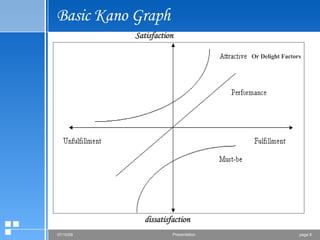
Defining the Concept Cont. 1. Surprise and delight factors Also called excitement factors and attractive attributes Satisfies latent needs,  Their presence increases satisfaction, their absence does not decrease it Source of differentiation
Defining the Concept Cont. 2. Performance attributes Also called ‘more is better’ attributes and one-dimensional  attributes Directly linked to voiced demands of customer relative to quality and their willingness to pay Presence enhances satisfaction while absence reduces it Linear relation to customer satisfaction    the better you do the more they like it!
Defining the Concept Cont. 3. Must-be attributes Also called threshold attributes  Represent basic musts or functions expected of a product/service When present are neutral, when absent dissatisfy consumers
Basic Kano Graph Satisfaction dissatisfaction Or Delight Factors
Refining the Model Earlier we said that we can break down a product’s attributes  In addition to surprise and delight factors, performance attributes and must be’s we have:
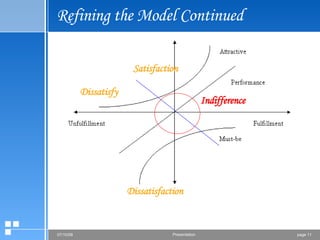
Refining the Model Continued 4. Indifferent attributes Attributes of a product or service whose presence or absence doesn’t affect customer satisfaction 5. Dissatisfiers Also called reverse quality attributes Presence causes dissatisfaction, absence causes satisfaction Now, we have a new graph
Refining the Model Continued Satisfaction Dissatisfaction Indifference Dissatisfy
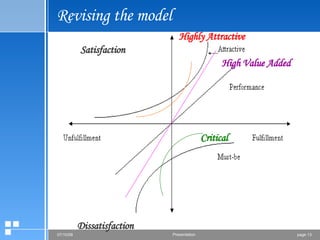
Refining the Model Cont. We can introduce sub-categories to further quantify We can prioritize by targeting the steeper attribute curves Useful when financial and technical constraints raise the need for trade-offs
Revising the model Critical Highly Attractive High Value Added Dissatisfaction Satisfaction
How Kano Analysis works? Develop a questionnaire Test the questionnaire Administer the questionnaire to customers Process the results Analyze the results
Evaluating the Model Benefits Guides decisions in quality strategies by prioritizing customer needs Is a useful tool for analyzing demand Is customer focused Quantifies satisfaction, making effective trade-offs easier
Evaluating the Model Drawbacks Guides strategy but has no forced compliance Is based on more effective competition over quality Is too often applied after the fact
Thank You

Kano Analysis

  • 1.
  • 2.
    Contents: Introduction ConceptKano Graph Working Benefits Drawbacks
  • 3.
    Introducing the ConceptInvented by Dr. Noriaki Kano Is a quality measurement tool used to prioritize customer needs based on how they impact customer satisfaction Affect future purchasing decisions Strategically guides design decisions
  • 4.
    Defining the ConceptBreaks down components of a product or service in categories based on its impact on customer satisfaction. To determine consumer priorities we develop a questionnaire to gauge willingness to pay & customer satisfaction vis a vis product attributes.
  • 5.
    Defining the ConceptCont. 1. Surprise and delight factors Also called excitement factors and attractive attributes Satisfies latent needs, Their presence increases satisfaction, their absence does not decrease it Source of differentiation
  • 6.
    Defining the ConceptCont. 2. Performance attributes Also called ‘more is better’ attributes and one-dimensional attributes Directly linked to voiced demands of customer relative to quality and their willingness to pay Presence enhances satisfaction while absence reduces it Linear relation to customer satisfaction  the better you do the more they like it!
  • 7.
    Defining the ConceptCont. 3. Must-be attributes Also called threshold attributes Represent basic musts or functions expected of a product/service When present are neutral, when absent dissatisfy consumers
  • 8.
    Basic Kano GraphSatisfaction dissatisfaction Or Delight Factors
  • 9.
    Refining the ModelEarlier we said that we can break down a product’s attributes In addition to surprise and delight factors, performance attributes and must be’s we have:
  • 10.
    Refining the ModelContinued 4. Indifferent attributes Attributes of a product or service whose presence or absence doesn’t affect customer satisfaction 5. Dissatisfiers Also called reverse quality attributes Presence causes dissatisfaction, absence causes satisfaction Now, we have a new graph
  • 11.
    Refining the ModelContinued Satisfaction Dissatisfaction Indifference Dissatisfy
  • 12.
    Refining the ModelCont. We can introduce sub-categories to further quantify We can prioritize by targeting the steeper attribute curves Useful when financial and technical constraints raise the need for trade-offs
  • 13.
    Revising the modelCritical Highly Attractive High Value Added Dissatisfaction Satisfaction
  • 14.
    How Kano Analysisworks? Develop a questionnaire Test the questionnaire Administer the questionnaire to customers Process the results Analyze the results
  • 15.
    Evaluating the ModelBenefits Guides decisions in quality strategies by prioritizing customer needs Is a useful tool for analyzing demand Is customer focused Quantifies satisfaction, making effective trade-offs easier
  • 16.
    Evaluating the ModelDrawbacks Guides strategy but has no forced compliance Is based on more effective competition over quality Is too often applied after the fact
  • 17.