Kano Analysis A talk on requirements prioritisation To ACS requirements SIG 25 th  June 2009 By Craig Brown
Whois: Craig Brown Craig Brown is a project consultant, project manager and business analyst.  I have worked with several leading corporate brands in Australia as well as started two small businesses.  I am currently lecturing in project management at Melbourne Institute of Technology's Sydney campus and contracting about town.  Blog:  www.betterprojects.net   Sponsor:  Ingena Group Limited Web:  www.ingena.com.au
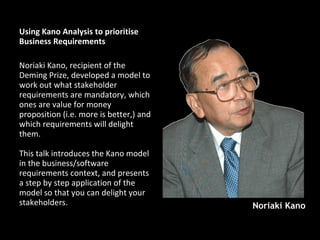
Using Kano Analysis to prioritise Business Requirements Noriaki Kano, recipient of the Deming Prize, developed a model to work out what stakeholder requirements are mandatory, which ones are value for money proposition (i.e. more is better,) and which requirements will delight them.  This talk introduces the Kano model in the business/software requirements context, and presents a step by step application of the model so that you can delight your stakeholders. Noriaki Kano
What is the role of the business analyst? The business analyst  as  product manager
The premise of this discussion, and most of what I say on the topic, is that the BA is responsible for…
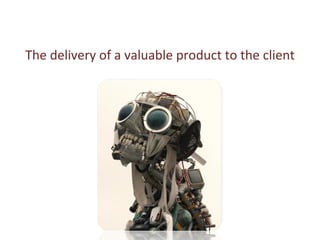
The delivery of a valuable product to the client
SOME PROBLEMS WITH REQUIREMENTS ELICITATION
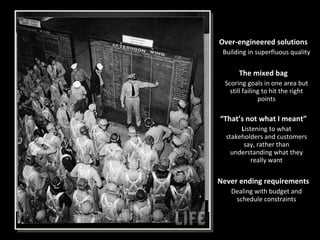
Over-engineered solutions Building in superfluous quality The mixed bag Scoring goals in one area but still failing to hit the right points “ That’s not what I meant” L istening to what stakeholders and customers say, rather than understanding what they really want Never ending requirements Dealing with budget and schedule constraints
REQUIREMENTS MANAGEMENT IN AN ITERATIVE AGE
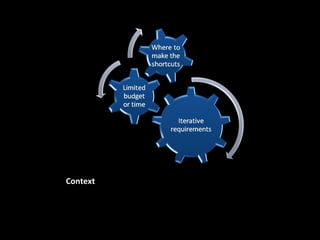
Multiple releases Product roadmaps Solution Layers What comes first?
ALTERNATIVE MODELS
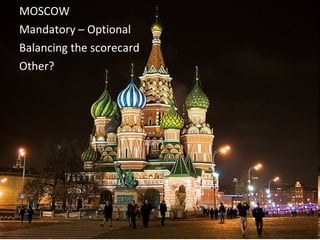
MOSCOW Mandatory – Optional Balancing the scorecard Other?
PLUGGING KANO  INTO BABOK 2
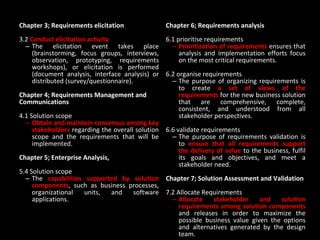
Chapter 3; Requirements elicitation 3.2 Conduct elicitation activity The elicitation event takes place (brainstorming, focus groups, interviews, observation, prototyping, requirements workshops), or elicitation is performed (document analysis, interface analysis) or distributed (survey/questionnaire).  Chapter 4; Requirements Management and Communications 4.1 Solution scope Obtain and maintain consensus among key stakeholders regarding the overall solution scope and the requirements that will be implemented. Chapter 5; Enterprise Analysis,  5.4 Solution scope The capabilities supported by solution components, such as business processes, organizational units, and software applications.  Chapter 6; Requirements analysis 6.1 prioritise requirements Prioritization of requirements ensures that analysis and implementation efforts focus on the most critical requirements. 6.2 organise requirements The purpose of organizing requirements is to create a set of views of the requirements for the new business solution that are comprehensive, complete, consistent, and understood from all stakeholder perspectives.  6.6 validate requirements The purpose of requirements validation is to ensure that all requirements support the delivery of value to the business, fulfil its goals and objectives, and meet a stakeholder need.  Chapter 7; Solution Assessment and Validation 7.2 Allocate Requirements Allocate stakeholder and solution requirements among solution components and releases in order to maximize the possible business value given the options and alternatives generated by the design team.
Chapter 3; Requirements elicitation 3.2  Conduct elicitation activity The elicitation event takes place (brainstorming, focus groups, interviews, observation, prototyping, requirements workshops), or elicitation is performed (document analysis, interface analysis) or distributed (survey/questionnaire).  Chapter 4; Requirements Management and Communications 4.1 Solution scope Obtain and maintain consensus among key stakeholders  regarding the overall solution scope and the requirements that will be implemented. Chapter 5; Enterprise Analysis,  5.4 Solution scope The  capabilities supported by solution components , such as business processes, organizational units, and software applications.  Chapter 6; Requirements analysis 6.1 prioritise requirements Prioritization of requirements  ensures that analysis and implementation efforts focus on the most critical requirements. 6.2 organise requirements The purpose of organizing requirements is to create  a set of views of the requirements  for the new business solution that are comprehensive, complete, consistent, and understood from all stakeholder perspectives.  6.6 validate requirements The purpose of requirements validation is to  ensure that all requirements support the delivery of value  to the business, fulfil its goals and objectives, and meet a stakeholder need.  Chapter 7; Solution Assessment and Validation 7.2 Allocate Requirements Allocate stakeholder and solution requirements among solution components  and releases in order to maximize the possible business value given the options and alternatives generated by the design team.
Chapter 3; Requirements elicitation 3.2   Conduct elicitation activity The elicitation event takes place (brainstorming, focus groups, interviews, observation, prototyping, requirements workshops), or elicitation is performed (document analysis, interface analysis) or distributed (survey/questionnaire).  Chapter 4; Requirements Management and Communications 4.1 Solution scope Obtain and maintain consensus among key stakeholders   regarding the overall solution scope and the requirements that will be implemented. Chapter 5; Enterprise Analysis,  5.4 Solution scope The   capabilities supported by solution components , such as business processes, organizational units, and software applications.  Chapter 6; Requirements analysis 6.1 prioritise requirements Prioritization of requirements   ensures that analysis and implementation efforts focus on the most critical requirements. 6.2 organise requirements The purpose of organizing requirements is to create   a set of views of the requirements   for the new business solution that are comprehensive, complete, consistent, and understood from all stakeholder perspectives.  6.6 validate requirements The purpose of requirements validation is to   ensure that all requirements support the delivery of value   to the business, fulfil its goals and objectives, and meet a stakeholder need.  Chapter 7; Solution Assessment and Validation 7.2 Allocate Requirements Allocate stakeholder and solution requirements among solution components  and releases in order to maximize the possible business value given the options and alternatives generated by the design team.
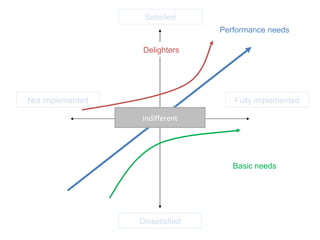
Kano analysis tells you What is mandatory What is delightful What is a value for money proposition, and What doesn’t matter
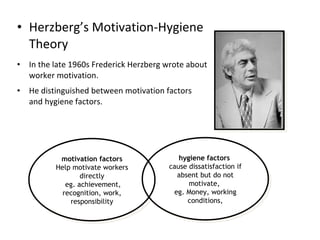
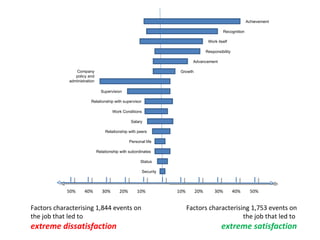
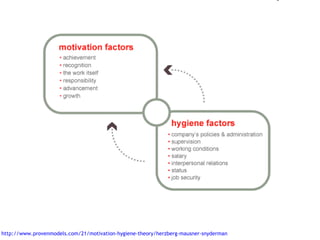
Herzberg’s Motivation-Hygiene Theory In the late 1960s Frederick Herzberg wrote about worker motivation. He distinguished between  motivation factors and hygiene factors. motivation factors Help motivate workers directly eg. achievement, recognition, work, responsibility hygiene factors   cause dissatisfaction if absent but do not motivate,  eg. Money, working conditions,
Achievement Recognition Work itself Responsibility Advancement Growth Company policy and administration Supervision Relationship with supervisor Work Conditions Salary Relationship with peers Personal life Relationship with subordinates Status Security Factors characterising 1,844 events on the job that led to  extreme dissatisfaction Factors characterising 1,753 events on the job that led to  extreme satisfaction 50% 40% 30% 20% 10% 10% 20% 30% 40% 50%
http://www.provenmodels.com/21/motivation-hygiene-theory/herzberg-mausner-snyderman
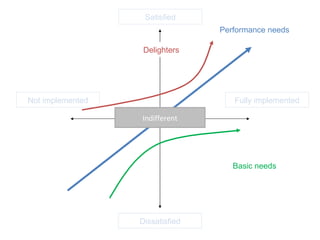
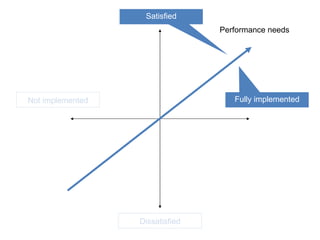
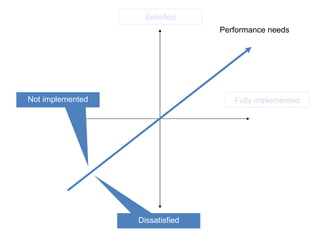
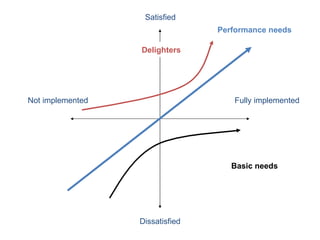
Satisfied Dissatisfied Fully implemented Not implemented Performance needs Basic needs Delighters Indifferent
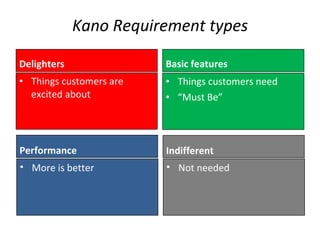
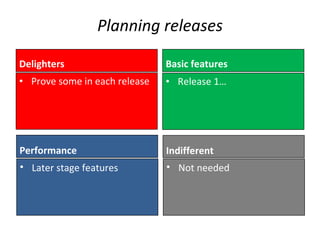
Kano Requirement types Delighters Things customers are excited about Basic features Things customers need “ Must Be” Performance Indifferent More is better Not needed
Secondary Key Plus Basic Llosa (1997 [8] , 1999 [9] ) Low impact One-dimensional Attractive Basic Brandt and Scharioth (1998) [7] Low Key Value-added Flat Venkitaraman and Jaworski (1993) [6] Unimportant as determinant Hybrid Value enhancing Minimum requirement Brandt (1988) [5] Neutral Critical Satisfier Dissatisfier Cadotte and Turgeon (1988) [4] Indifferent One-dimensional Attractive Must-be Kano (1984) [3] Motivator Hygiene Herzberg et al. (1959) [2] Driver type 4 Driver type 3 Driver type 2 Driver type 1 Author(s)
Satisfied Dissatisfied Fully implemented Not implemented Performance needs Basic needs Delighters Indifferent
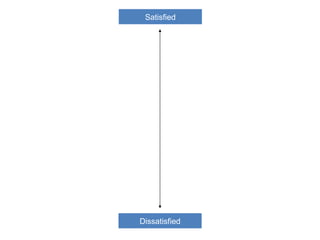
Satisfied Dissatisfied
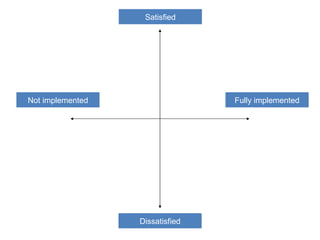
Satisfied Dissatisfied Fully implemented Not implemented
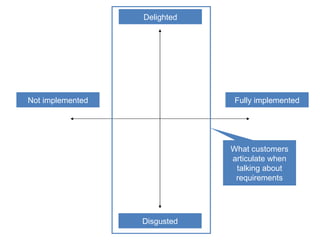
Delighted Disgusted Fully implemented Not implemented What customers articulate when talking about requirements
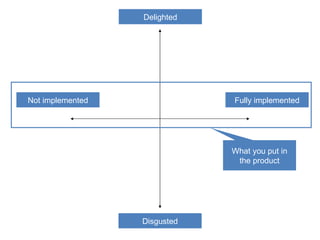
Delighted Disgusted Fully implemented Not implemented What you put in the product
Delighted Dissatisfied Fully implemented Not implemented Fully implemented Satisfied Performance needs
Satisfied Disgusted Fully implemented Not implemented Not implemented Dissatisfied Performance needs
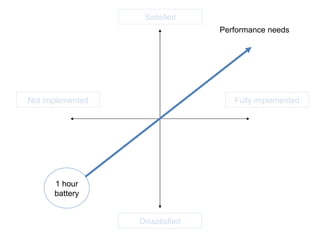
Satisfied Dissatisfied Fully implemented Not implemented 1 hour battery Performance needs
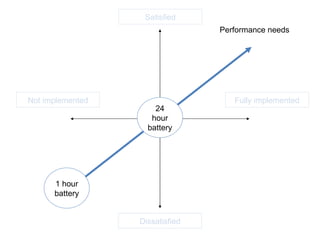
Satisfied Dissatisfied Fully implemented Not implemented 1 hour battery 24 hour battery Performance needs
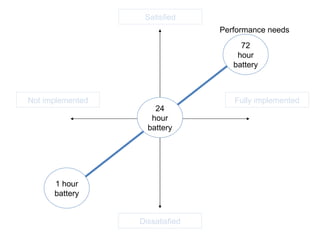
Satisfied Dissatisfied Fully implemented Not implemented Performance needs 1 hour battery 24 hour battery 72 hour battery
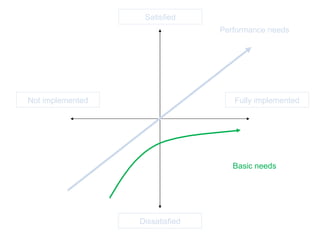
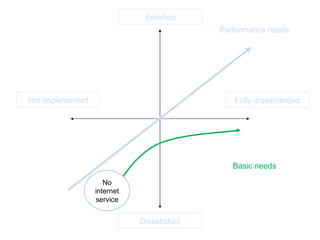
Satisfied Dissatisfied Fully implemented Not implemented Performance needs Basic needs
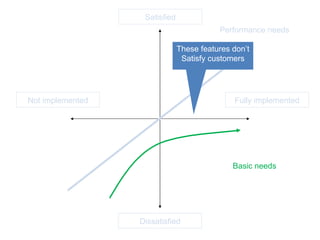
Satisfied Dissatisfied Fully implemented Not implemented Performance needs These features don’t Satisfy customers Basic needs
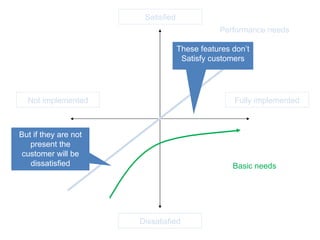
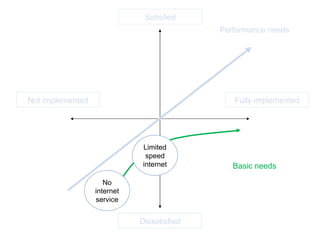
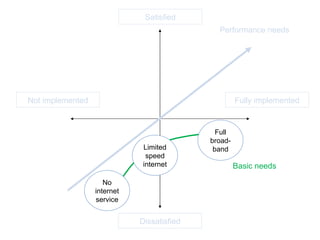
Satisfied Dissatisfied Fully implemented Not implemented Performance needs These features don’t Satisfy customers But if they are not present the customer will be dissatisfied Basic needs
Satisfied Dissatisfied Fully implemented Not implemented Performance needs Basic needs No internet service
Satisfied Dissatisfied Fully implemented Not implemented Performance needs Basic needs No internet service Limited speed internet
Satisfied Dissatisfied Fully implemented Not implemented Performance needs Basic needs No internet service Limited speed internet Full broad- band
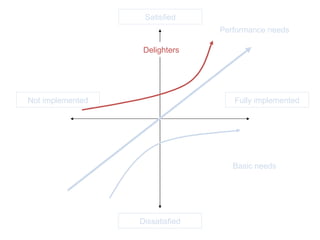
Satisfied Dissatisfied Fully implemented Not implemented Performance needs Basic needs Delighters
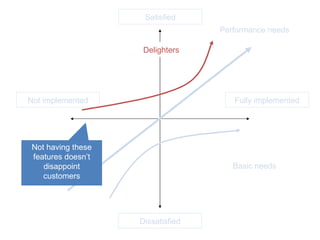
Satisfied Dissatisfied Fully implemented Not implemented Performance needs Basic needs Not having these features doesn’t disappoint customers Delighters
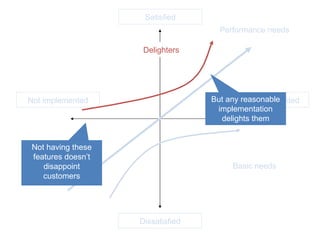
Satisfied Dissatisfied Fully implemented Not implemented Performance needs Basic needs Not having these features doesn’t disappoint customers But any reasonable implementation delights them Delighters
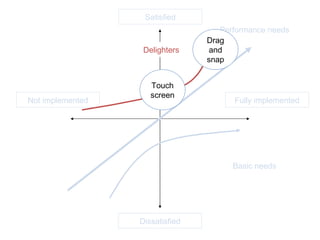
Satisfied Dissatisfied Fully implemented Not implemented Performance needs Basic needs Delighters Touch screen Drag and snap
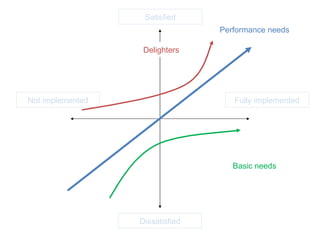
Satisfied Dissatisfied Fully implemented Not implemented Performance needs Basic needs Delighters
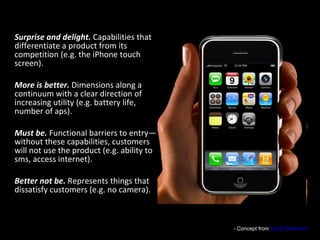
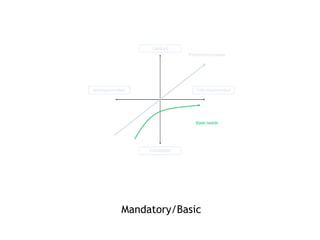
Surprise and delight.  Capabilities that differentiate a product from its competition (e.g. the iPhone touch screen). More is better.  Dimensions along a continuum with a clear direction of increasing utility (e.g. battery life, number of aps). Must be.  Functional barriers to entry—without these capabilities, customers will not use the product (e.g. ability to sms, access internet). Better not be.  Represents things that dissatisfy customers (e.g. no camera). - Concept from  Scott Sehlhorst
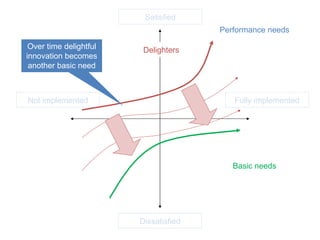
Satisfied Dissatisfied Fully implemented Not implemented Performance needs Basic needs Delighters Over time delightful innovation becomes another basic need
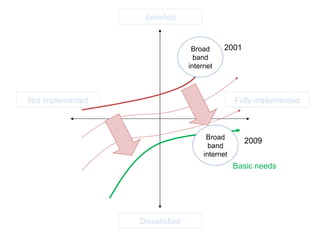
2001 2009 Satisfied Dissatisfied Fully implemented Not implemented Basic needs Broad band internet Broad band internet
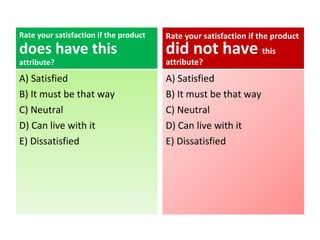
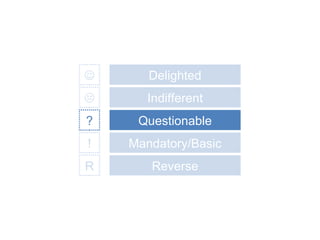
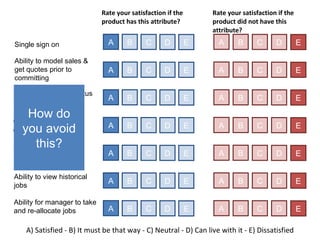
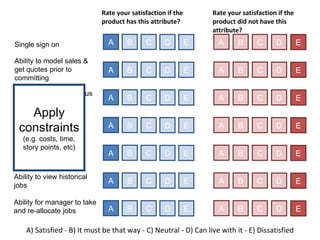
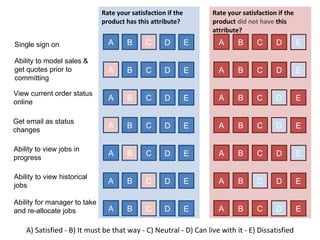
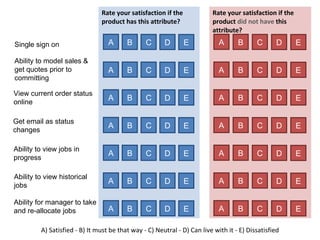
Rate your satisfaction if the product  does have this  attribute? A) Satisfied B) It must be that way C) Neutral D) Can live with it E) Dissatisfied Rate your satisfaction if the product  did not have  this attribute? A) Satisfied B) It must be that way C) Neutral D) Can live with it E) Dissatisfied
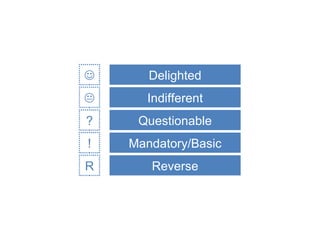
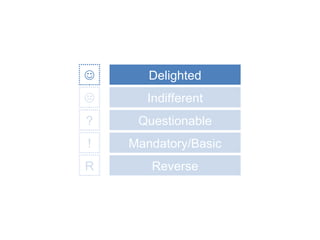
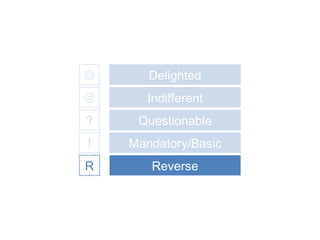
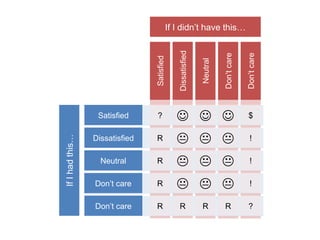
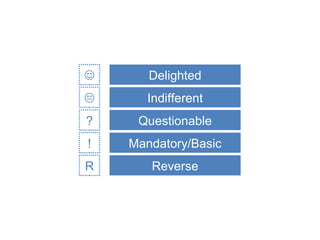
?   R ! Questionable Delighted Indifferent Reverse Mandatory/Basic
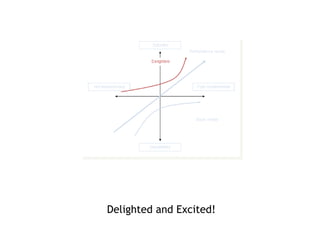
Delighted and Excited!
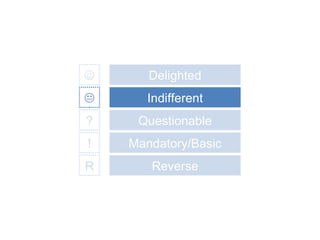
?   R ! Questionable Delighted Indifferent Reverse Mandatory/Basic
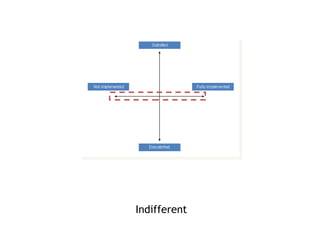
Indifferent
?   R ! Questionable Delighted Indifferent Reverse Mandatory/Basic
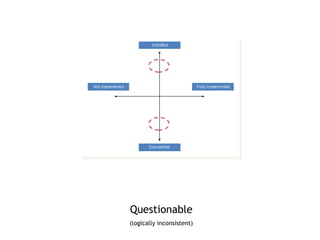
Questionable (logically inconsistent)
?   R ! Questionable Delighted Indifferent Reverse Mandatory/Basic
Mandatory/Basic
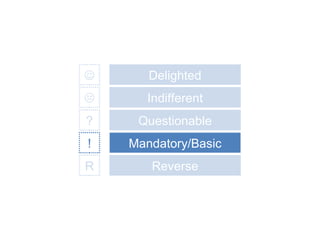
?   R ! Questionable Delighted Indifferent Reverse Mandatory/Basic
?
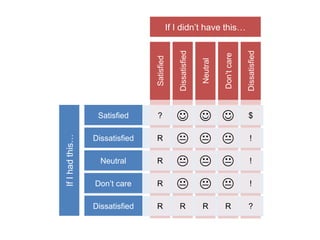
If I had this… Dissatisfied If I didn’t have this… Satisfied Dissatisfied Neutral Don’t care Satisfied Dissatisfied Neutral Don’t care ? R R R             Dissatisfied R R R R $ ! ! ! ?
Example requirements
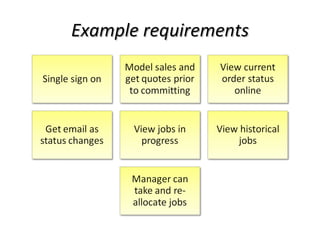
A) Satisfied - B) It must be that way - C) Neutral - D) Can live with it - E) Dissatisfied Rate your satisfaction if the product has this attribute? Rate your satisfaction if the product  did not have  this attribute? A A A A A A A A A A A A A A B B B B B B B C C C C C C C D D D D D D D E E E E E E E B B B B B B B C C C C C C C D D D D D D D E E E E E E E Single sign on Ability to model sales & get quotes prior to committing  View current order status online Get email as status changes Ability to view jobs in progress Ability to view historical jobs Ability for manager to take and re-allocate jobs
A) Satisfied - B) It must be that way - C) Neutral - D) Can live with it - E) Dissatisfied Rate your satisfaction if the product has this attribute? Rate your satisfaction if the product did not have this attribute? A A A A A A A A A A A A A A B B B B B B B C C C C C C C D D D D D D D E E E E E E E B B B B B B B C C C C C C C D D D D D D D E E E E E E E Single sign on Ability to model sales & get quotes prior to committing  View current order status online Get email as status changes Ability to view jobs in progress Ability to view historical jobs Ability for manager to take and re-allocate jobs How do you avoid this?
A) Satisfied - B) It must be that way - C) Neutral - D) Can live with it - E) Dissatisfied Rate your satisfaction if the product has this attribute? Rate your satisfaction if the product did not have this attribute? A A A A A A A A A A A A A A B B B B B B B C C C C C C C D D D D D D D E E E E E E E B B B B B B B C C C C C C C D D D D D D D E E E E E E E Single sign on Ability to model sales & get quotes prior to committing  View current order status online Get email as status changes Ability to view jobs in progress Ability to view historical jobs Ability for manager to take and re-allocate jobs Apply constraints (e.g. costs, time, story points, etc)
A) Satisfied - B) It must be that way - C) Neutral - D) Can live with it - E) Dissatisfied Rate your satisfaction if the product has this attribute? Rate your satisfaction if the product  did not have  this attribute? A A Single sign on A A A A A A A A A A A A Ability to model sales & get quotes prior to committing  View current order status online Get email as status changes Ability to view jobs in progress Ability to view historical jobs Ability for manager to take and re-allocate jobs B B B B B B B C C C C C C C D D D D D D D E E E E E E E B B B B B B B C C C C C C C D D D D D D D E E E E E E E
If I had this… Don’t care If I didn’t have this… Satisfied Dissatisfied Neutral Don’t care Satisfied Dissatisfied Neutral Don’t care ? R R R             Don’t care R R R R $ ! ! ! ?
?   R ! Questionable Delighted Indifferent Reverse Mandatory/Basic
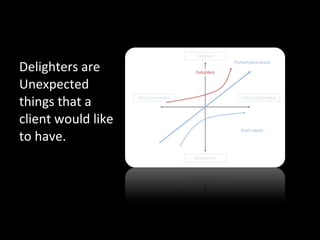
Delighters are Unexpected things that a client would like to have.
Satisfaction is based on perception and expectations Parasuraman and Berry (1991) Perceived performance Expected performance
“ So what does this mean for IT?  “ Making sure that you cover ALL basic requirements in a release, making sure you have some satisfiers and ONE delighter thrown in would always keep your business users happy. And no more than ONE delighter. Save some for future releases. “ Narri Kannan http://it.toolbox.com/blogs/narikannan/kano-analysis-in-it-1023
Planning releases Delighters Prove some in each release Basic features Release 1… Performance Indifferent Later stage features Not needed
Context
Caution
Satisfied Dissatisfied Fully implemented Not implemented Performance needs Basic needs Delighters
The business analyst  as  product manager Stakeholders don’t always see the big picture You have the  integrated  view Use your judgement
Questions? www.BetterProjects.net
References Ullman, David G.,  The Mechanical Design Process, McGraw-Hill, Inc., U.S.A., 1997  pp. 105-108 ISBN 0-07-065756-4 Jacobs, Randy,  Evaluating Satisfaction with Media Products and Services: An Attribute Based Approach, European Media Management Review, Winter 1999.  http://www.tukkk.fi/mediagroup/emmr/Previous%20Issues/Satisfaction.htm   Sehlhosrst,  Scott, Prioritising Software Requirements with Kano Analysis,  Pragmatic Marketing, Volume 4, Issue 3  http://www.pragmaticmarketing.com/publications/magazine/4/3/0605ss   Kanna, Nari Kano Analysis in IT , IT Toolbox,  http://it.toolbox.com/blogs/narikannan/kano-analysis-in-it-1023 Dave Verdyun, C2C-Solutons  www.c2c-solutions.com/kano_tutorial.htm  (Video tutorial)   http://www.servqual.com/html/kano.tml Lawrence Phillips, (2009) “Kano, How to delight your customers” Slideshare  http://www.slideshare.net/LawrencePhillips/kano-model-rev-1
More information can be found One of the best resources I found when researching this presentation was from Dave   Verduyn at  C2C Solutions Inc. See his further information here;    An 8 Step Systematic Innovation Process (Kano’s Excitement Quality): (1 of 2)  www.c2c-solutions.com/Videos/SI_1of2/SI_1of2.html (2 of 2)   www.c2c-solutions.com/Videos/SI_2of2/SI_2of2.html   Integrating Kano’s Model into a Product Development Process www.c2c-solutions.com/pdfs/C2CRoadmapNE.pdf    Kano, VOC, and QFD: www.c2c-solutions.com/tutorials/voc-qfd/player.html   3 more videos on Systematic Innovation: Video (1 of 3)  www.c2c-solutions.com/sys-inn01.html   Video (2 of 3)  www.c2c-solutions.com/sys-inn02.html   Video (3 of 3)  www.c2c-solutions.com/sys-inn03.html      Article on integrating Systematic Innovation into Product Development: http://www.c2c-solutions.com/pdfs/Integrating Innovation into DFSS_DMV1.pdf    8 minute tutorial on Customer Wants and Needs: http://www.kanomodel.com  

Kano Analysis and Software Requrements

  • 1.
    Kano Analysis Atalk on requirements prioritisation To ACS requirements SIG 25 th June 2009 By Craig Brown
  • 2.
    Whois: Craig BrownCraig Brown is a project consultant, project manager and business analyst. I have worked with several leading corporate brands in Australia as well as started two small businesses. I am currently lecturing in project management at Melbourne Institute of Technology's Sydney campus and contracting about town. Blog: www.betterprojects.net Sponsor: Ingena Group Limited Web: www.ingena.com.au
  • 3.
    Using Kano Analysisto prioritise Business Requirements Noriaki Kano, recipient of the Deming Prize, developed a model to work out what stakeholder requirements are mandatory, which ones are value for money proposition (i.e. more is better,) and which requirements will delight them. This talk introduces the Kano model in the business/software requirements context, and presents a step by step application of the model so that you can delight your stakeholders. Noriaki Kano
  • 4.
    What is therole of the business analyst? The business analyst as product manager
  • 5.
    The premise ofthis discussion, and most of what I say on the topic, is that the BA is responsible for…
  • 6.
    The delivery ofa valuable product to the client
  • 7.
    SOME PROBLEMS WITHREQUIREMENTS ELICITATION
  • 8.
    Over-engineered solutions Buildingin superfluous quality The mixed bag Scoring goals in one area but still failing to hit the right points “ That’s not what I meant” L istening to what stakeholders and customers say, rather than understanding what they really want Never ending requirements Dealing with budget and schedule constraints
  • 9.
  • 10.
    Multiple releases Productroadmaps Solution Layers What comes first?
  • 11.
  • 12.
    MOSCOW Mandatory –Optional Balancing the scorecard Other?
  • 13.
    PLUGGING KANO INTO BABOK 2
  • 14.
    Chapter 3; Requirementselicitation 3.2 Conduct elicitation activity The elicitation event takes place (brainstorming, focus groups, interviews, observation, prototyping, requirements workshops), or elicitation is performed (document analysis, interface analysis) or distributed (survey/questionnaire). Chapter 4; Requirements Management and Communications 4.1 Solution scope Obtain and maintain consensus among key stakeholders regarding the overall solution scope and the requirements that will be implemented. Chapter 5; Enterprise Analysis, 5.4 Solution scope The capabilities supported by solution components, such as business processes, organizational units, and software applications. Chapter 6; Requirements analysis 6.1 prioritise requirements Prioritization of requirements ensures that analysis and implementation efforts focus on the most critical requirements. 6.2 organise requirements The purpose of organizing requirements is to create a set of views of the requirements for the new business solution that are comprehensive, complete, consistent, and understood from all stakeholder perspectives. 6.6 validate requirements The purpose of requirements validation is to ensure that all requirements support the delivery of value to the business, fulfil its goals and objectives, and meet a stakeholder need. Chapter 7; Solution Assessment and Validation 7.2 Allocate Requirements Allocate stakeholder and solution requirements among solution components and releases in order to maximize the possible business value given the options and alternatives generated by the design team.
  • 15.
    Chapter 3; Requirementselicitation 3.2 Conduct elicitation activity The elicitation event takes place (brainstorming, focus groups, interviews, observation, prototyping, requirements workshops), or elicitation is performed (document analysis, interface analysis) or distributed (survey/questionnaire). Chapter 4; Requirements Management and Communications 4.1 Solution scope Obtain and maintain consensus among key stakeholders regarding the overall solution scope and the requirements that will be implemented. Chapter 5; Enterprise Analysis, 5.4 Solution scope The capabilities supported by solution components , such as business processes, organizational units, and software applications. Chapter 6; Requirements analysis 6.1 prioritise requirements Prioritization of requirements ensures that analysis and implementation efforts focus on the most critical requirements. 6.2 organise requirements The purpose of organizing requirements is to create a set of views of the requirements for the new business solution that are comprehensive, complete, consistent, and understood from all stakeholder perspectives. 6.6 validate requirements The purpose of requirements validation is to ensure that all requirements support the delivery of value to the business, fulfil its goals and objectives, and meet a stakeholder need. Chapter 7; Solution Assessment and Validation 7.2 Allocate Requirements Allocate stakeholder and solution requirements among solution components and releases in order to maximize the possible business value given the options and alternatives generated by the design team.
  • 16.
    Chapter 3; Requirementselicitation 3.2 Conduct elicitation activity The elicitation event takes place (brainstorming, focus groups, interviews, observation, prototyping, requirements workshops), or elicitation is performed (document analysis, interface analysis) or distributed (survey/questionnaire). Chapter 4; Requirements Management and Communications 4.1 Solution scope Obtain and maintain consensus among key stakeholders regarding the overall solution scope and the requirements that will be implemented. Chapter 5; Enterprise Analysis, 5.4 Solution scope The capabilities supported by solution components , such as business processes, organizational units, and software applications. Chapter 6; Requirements analysis 6.1 prioritise requirements Prioritization of requirements ensures that analysis and implementation efforts focus on the most critical requirements. 6.2 organise requirements The purpose of organizing requirements is to create a set of views of the requirements for the new business solution that are comprehensive, complete, consistent, and understood from all stakeholder perspectives. 6.6 validate requirements The purpose of requirements validation is to ensure that all requirements support the delivery of value to the business, fulfil its goals and objectives, and meet a stakeholder need. Chapter 7; Solution Assessment and Validation 7.2 Allocate Requirements Allocate stakeholder and solution requirements among solution components and releases in order to maximize the possible business value given the options and alternatives generated by the design team.
  • 17.
    Kano analysis tellsyou What is mandatory What is delightful What is a value for money proposition, and What doesn’t matter
  • 18.
    Herzberg’s Motivation-Hygiene TheoryIn the late 1960s Frederick Herzberg wrote about worker motivation. He distinguished between motivation factors and hygiene factors. motivation factors Help motivate workers directly eg. achievement, recognition, work, responsibility hygiene factors cause dissatisfaction if absent but do not motivate, eg. Money, working conditions,
  • 19.
    Achievement Recognition Workitself Responsibility Advancement Growth Company policy and administration Supervision Relationship with supervisor Work Conditions Salary Relationship with peers Personal life Relationship with subordinates Status Security Factors characterising 1,844 events on the job that led to extreme dissatisfaction Factors characterising 1,753 events on the job that led to extreme satisfaction 50% 40% 30% 20% 10% 10% 20% 30% 40% 50%
  • 20.
  • 21.
    Satisfied Dissatisfied Fullyimplemented Not implemented Performance needs Basic needs Delighters Indifferent
  • 22.
    Kano Requirement typesDelighters Things customers are excited about Basic features Things customers need “ Must Be” Performance Indifferent More is better Not needed
  • 23.
    Secondary Key PlusBasic Llosa (1997 [8] , 1999 [9] ) Low impact One-dimensional Attractive Basic Brandt and Scharioth (1998) [7] Low Key Value-added Flat Venkitaraman and Jaworski (1993) [6] Unimportant as determinant Hybrid Value enhancing Minimum requirement Brandt (1988) [5] Neutral Critical Satisfier Dissatisfier Cadotte and Turgeon (1988) [4] Indifferent One-dimensional Attractive Must-be Kano (1984) [3] Motivator Hygiene Herzberg et al. (1959) [2] Driver type 4 Driver type 3 Driver type 2 Driver type 1 Author(s)
  • 24.
    Satisfied Dissatisfied Fullyimplemented Not implemented Performance needs Basic needs Delighters Indifferent
  • 25.
  • 26.
    Satisfied Dissatisfied Fullyimplemented Not implemented
  • 27.
    Delighted Disgusted Fullyimplemented Not implemented What customers articulate when talking about requirements
  • 28.
    Delighted Disgusted Fullyimplemented Not implemented What you put in the product
  • 29.
    Delighted Dissatisfied Fullyimplemented Not implemented Fully implemented Satisfied Performance needs
  • 30.
    Satisfied Disgusted Fullyimplemented Not implemented Not implemented Dissatisfied Performance needs
  • 31.
    Satisfied Dissatisfied Fullyimplemented Not implemented 1 hour battery Performance needs
  • 32.
    Satisfied Dissatisfied Fullyimplemented Not implemented 1 hour battery 24 hour battery Performance needs
  • 33.
    Satisfied Dissatisfied Fullyimplemented Not implemented Performance needs 1 hour battery 24 hour battery 72 hour battery
  • 34.
    Satisfied Dissatisfied Fullyimplemented Not implemented Performance needs Basic needs
  • 35.
    Satisfied Dissatisfied Fullyimplemented Not implemented Performance needs These features don’t Satisfy customers Basic needs
  • 36.
    Satisfied Dissatisfied Fullyimplemented Not implemented Performance needs These features don’t Satisfy customers But if they are not present the customer will be dissatisfied Basic needs
  • 37.
    Satisfied Dissatisfied Fullyimplemented Not implemented Performance needs Basic needs No internet service
  • 38.
    Satisfied Dissatisfied Fullyimplemented Not implemented Performance needs Basic needs No internet service Limited speed internet
  • 39.
    Satisfied Dissatisfied Fullyimplemented Not implemented Performance needs Basic needs No internet service Limited speed internet Full broad- band
  • 40.
    Satisfied Dissatisfied Fullyimplemented Not implemented Performance needs Basic needs Delighters
  • 41.
    Satisfied Dissatisfied Fullyimplemented Not implemented Performance needs Basic needs Not having these features doesn’t disappoint customers Delighters
  • 42.
    Satisfied Dissatisfied Fullyimplemented Not implemented Performance needs Basic needs Not having these features doesn’t disappoint customers But any reasonable implementation delights them Delighters
  • 43.
    Satisfied Dissatisfied Fullyimplemented Not implemented Performance needs Basic needs Delighters Touch screen Drag and snap
  • 44.
    Satisfied Dissatisfied Fullyimplemented Not implemented Performance needs Basic needs Delighters
  • 45.
    Surprise and delight. Capabilities that differentiate a product from its competition (e.g. the iPhone touch screen). More is better. Dimensions along a continuum with a clear direction of increasing utility (e.g. battery life, number of aps). Must be. Functional barriers to entry—without these capabilities, customers will not use the product (e.g. ability to sms, access internet). Better not be. Represents things that dissatisfy customers (e.g. no camera). - Concept from Scott Sehlhorst
  • 46.
    Satisfied Dissatisfied Fullyimplemented Not implemented Performance needs Basic needs Delighters Over time delightful innovation becomes another basic need
  • 47.
    2001 2009 SatisfiedDissatisfied Fully implemented Not implemented Basic needs Broad band internet Broad band internet
  • 48.
    Rate your satisfactionif the product does have this attribute? A) Satisfied B) It must be that way C) Neutral D) Can live with it E) Dissatisfied Rate your satisfaction if the product did not have this attribute? A) Satisfied B) It must be that way C) Neutral D) Can live with it E) Dissatisfied
  • 49.
    ?  R ! Questionable Delighted Indifferent Reverse Mandatory/Basic
  • 50.
    ?  R ! Questionable Delighted Indifferent Reverse Mandatory/Basic
  • 51.
  • 52.
    ?  R ! Questionable Delighted Indifferent Reverse Mandatory/Basic
  • 53.
  • 54.
    ?  R ! Questionable Delighted Indifferent Reverse Mandatory/Basic
  • 55.
  • 56.
    ?  R ! Questionable Delighted Indifferent Reverse Mandatory/Basic
  • 57.
  • 58.
    ?  R ! Questionable Delighted Indifferent Reverse Mandatory/Basic
  • 59.
  • 60.
    If I hadthis… Dissatisfied If I didn’t have this… Satisfied Dissatisfied Neutral Don’t care Satisfied Dissatisfied Neutral Don’t care ? R R R             Dissatisfied R R R R $ ! ! ! ?
  • 61.
  • 62.
    A) Satisfied -B) It must be that way - C) Neutral - D) Can live with it - E) Dissatisfied Rate your satisfaction if the product has this attribute? Rate your satisfaction if the product did not have this attribute? A A A A A A A A A A A A A A B B B B B B B C C C C C C C D D D D D D D E E E E E E E B B B B B B B C C C C C C C D D D D D D D E E E E E E E Single sign on Ability to model sales & get quotes prior to committing View current order status online Get email as status changes Ability to view jobs in progress Ability to view historical jobs Ability for manager to take and re-allocate jobs
  • 63.
    A) Satisfied -B) It must be that way - C) Neutral - D) Can live with it - E) Dissatisfied Rate your satisfaction if the product has this attribute? Rate your satisfaction if the product did not have this attribute? A A A A A A A A A A A A A A B B B B B B B C C C C C C C D D D D D D D E E E E E E E B B B B B B B C C C C C C C D D D D D D D E E E E E E E Single sign on Ability to model sales & get quotes prior to committing View current order status online Get email as status changes Ability to view jobs in progress Ability to view historical jobs Ability for manager to take and re-allocate jobs How do you avoid this?
  • 64.
    A) Satisfied -B) It must be that way - C) Neutral - D) Can live with it - E) Dissatisfied Rate your satisfaction if the product has this attribute? Rate your satisfaction if the product did not have this attribute? A A A A A A A A A A A A A A B B B B B B B C C C C C C C D D D D D D D E E E E E E E B B B B B B B C C C C C C C D D D D D D D E E E E E E E Single sign on Ability to model sales & get quotes prior to committing View current order status online Get email as status changes Ability to view jobs in progress Ability to view historical jobs Ability for manager to take and re-allocate jobs Apply constraints (e.g. costs, time, story points, etc)
  • 65.
    A) Satisfied -B) It must be that way - C) Neutral - D) Can live with it - E) Dissatisfied Rate your satisfaction if the product has this attribute? Rate your satisfaction if the product did not have this attribute? A A Single sign on A A A A A A A A A A A A Ability to model sales & get quotes prior to committing View current order status online Get email as status changes Ability to view jobs in progress Ability to view historical jobs Ability for manager to take and re-allocate jobs B B B B B B B C C C C C C C D D D D D D D E E E E E E E B B B B B B B C C C C C C C D D D D D D D E E E E E E E
  • 66.
    If I hadthis… Don’t care If I didn’t have this… Satisfied Dissatisfied Neutral Don’t care Satisfied Dissatisfied Neutral Don’t care ? R R R             Don’t care R R R R $ ! ! ! ?
  • 67.
    ?  R ! Questionable Delighted Indifferent Reverse Mandatory/Basic
  • 68.
    Delighters are Unexpectedthings that a client would like to have.
  • 69.
    Satisfaction is basedon perception and expectations Parasuraman and Berry (1991) Perceived performance Expected performance
  • 70.
    “ So whatdoes this mean for IT? “ Making sure that you cover ALL basic requirements in a release, making sure you have some satisfiers and ONE delighter thrown in would always keep your business users happy. And no more than ONE delighter. Save some for future releases. “ Narri Kannan http://it.toolbox.com/blogs/narikannan/kano-analysis-in-it-1023
  • 71.
    Planning releases DelightersProve some in each release Basic features Release 1… Performance Indifferent Later stage features Not needed
  • 72.
  • 73.
  • 74.
    Satisfied Dissatisfied Fullyimplemented Not implemented Performance needs Basic needs Delighters
  • 75.
    The business analyst as product manager Stakeholders don’t always see the big picture You have the integrated view Use your judgement
  • 76.
  • 77.
    References Ullman, DavidG., The Mechanical Design Process, McGraw-Hill, Inc., U.S.A., 1997 pp. 105-108 ISBN 0-07-065756-4 Jacobs, Randy, Evaluating Satisfaction with Media Products and Services: An Attribute Based Approach, European Media Management Review, Winter 1999. http://www.tukkk.fi/mediagroup/emmr/Previous%20Issues/Satisfaction.htm Sehlhosrst, Scott, Prioritising Software Requirements with Kano Analysis, Pragmatic Marketing, Volume 4, Issue 3 http://www.pragmaticmarketing.com/publications/magazine/4/3/0605ss Kanna, Nari Kano Analysis in IT , IT Toolbox, http://it.toolbox.com/blogs/narikannan/kano-analysis-in-it-1023 Dave Verdyun, C2C-Solutons www.c2c-solutions.com/kano_tutorial.htm (Video tutorial) http://www.servqual.com/html/kano.tml Lawrence Phillips, (2009) “Kano, How to delight your customers” Slideshare http://www.slideshare.net/LawrencePhillips/kano-model-rev-1
  • 78.
    More information canbe found One of the best resources I found when researching this presentation was from Dave Verduyn at C2C Solutions Inc. See his further information here;   An 8 Step Systematic Innovation Process (Kano’s Excitement Quality): (1 of 2) www.c2c-solutions.com/Videos/SI_1of2/SI_1of2.html (2 of 2) www.c2c-solutions.com/Videos/SI_2of2/SI_2of2.html Integrating Kano’s Model into a Product Development Process www.c2c-solutions.com/pdfs/C2CRoadmapNE.pdf   Kano, VOC, and QFD: www.c2c-solutions.com/tutorials/voc-qfd/player.html  3 more videos on Systematic Innovation: Video (1 of 3) www.c2c-solutions.com/sys-inn01.html Video (2 of 3) www.c2c-solutions.com/sys-inn02.html Video (3 of 3) www.c2c-solutions.com/sys-inn03.html   Article on integrating Systematic Innovation into Product Development: http://www.c2c-solutions.com/pdfs/Integrating Innovation into DFSS_DMV1.pdf   8 minute tutorial on Customer Wants and Needs: http://www.kanomodel.com