Kano Model

Erica Lynn Farmer
CMQ/OE, CSSBB, MBB
Objectives
 Origins
 Purpose
 Process Model
 Key Elements
 Methodology
 Application
 Examples
Origins of the Kano Model

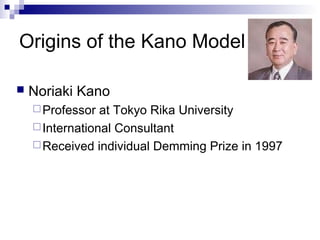
   Noriaki Kano
     Professor  at Tokyo Rika University
     International Consultant
     Received individual Demming Prize in 1997
Origins of the Kano Model
   Noriaki Kano
     Developed foundation for an approach on “Attractive Quality
      Creation” commonly referred to as the “Kano Model”
     Challenged traditional Customer Satisfaction Models that More
      is better, i.e. the more you perform on each service attribute the
      more satisfied the customers will be.
     Proposed new Customer Satisfaction model (Kano Model)
           Performance on product and service attributes is not equal in the
            eyes of the customers
           Performance on certain categories attributes produces higher levels
            of satisfaction than others.
When to use the Kano Model
   Project Selection
     Lean Six Sigma
     Design for Six Sigma
 New Product Development
 New Service Development
 Determine Market Strategies
Key Elements
 Identify the Voice of the Customer
 Translate Voice of the Customer into
  Critical to Quality Characteristics (CTQs)
 Rank the CTQs into three categories:
     Dissatisfier - Must be’s – Cost of Entry
     Satisfier – More is better – Competitive
     Delighter – Latent Need – Differentiator
   Evaluate Current Performance
Kano Model
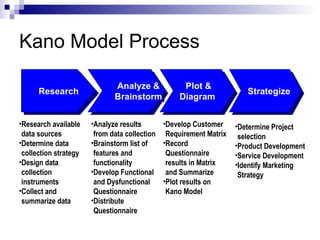
Kano Model Process

                             Analyze &
                              Analyze &           Plot &
                                                   Plot &
      Research
      Research                                                       Strategize
                                                                     Strategize
                             Brainstorm
                             Brainstorm          Diagram
                                                 Diagram

•Research available    •Analyze results      •Develop Customer    •Determine Project
 data sources           from data collection Requirement Matrix    selection
•Determine data        •Brainstorm list of   •Record              •Product Development
 collection strategy    features and          Questionnaire       •Service Development
•Design data            functionality         results in Matrix   •Identify Marketing
 collection            •Develop Functional and Summarize           Strategy
 instruments            and Dysfunctional    •Plot results on
•Collect and            Questionnaire         Kano Model
 summarize data        •Distribute
                        Questionnaire
Research
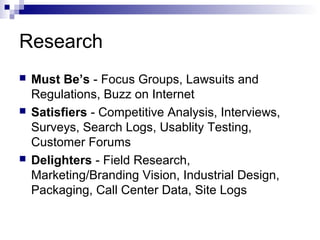
   Must Be’s - Focus Groups, Lawsuits and
    Regulations, Buzz on Internet
   Satisfiers - Competitive Analysis, Interviews,
    Surveys, Search Logs, Usablity Testing,
    Customer Forums
   Delighters - Field Research,
    Marketing/Branding Vision, Industrial Design,
    Packaging, Call Center Data, Site Logs
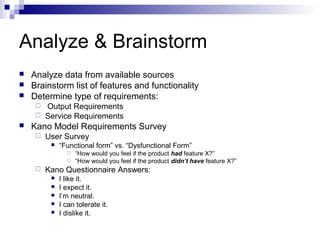
Analyze & Brainstorm
   Analyze data from available sources
   Brainstorm list of features and functionality
   Determine type of requirements:
      Output Requirements
      Service Requirements
   Kano Model Requirements Survey
        User Survey
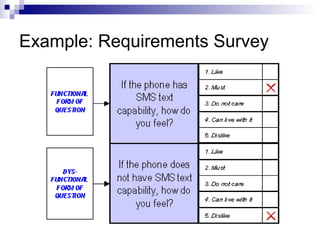
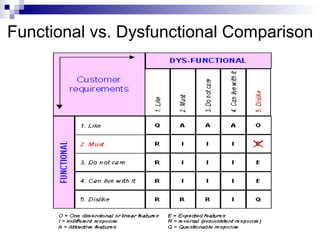
             “Functional form” vs. “Dysfunctional Form”
                   “How would you feel if the product had feature X?”
                   “How would you feel if the product didn’t have feature X?”
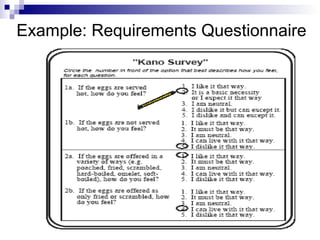
        Kano Questionnaire Answers:
             I like it.
             I expect it.
             I’m neutral.
             I can tolerate it.
             I dislike it.
Example: Requirements Survey
Example: Requirements Questionnaire
Functional vs. Dysfunctional Comparison
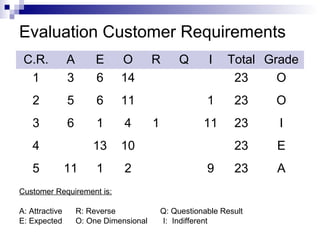
Evaluation Customer Requirements
 C.R.           A        E     O         R        Q      I    Total Grade
  1             3        6     14                              23     O
    2           5        6     11                        1      23    O
    3           6        1      4        1              11      23    I
    4                   13     10                               23    E
    5           11       1      2                        9      23    A
Customer Requirement is:

A: Attractive       R: Reverse               Q: Questionable Result
E: Expected         O: One Dimensional       I: Indifferent
Plot & Diagram
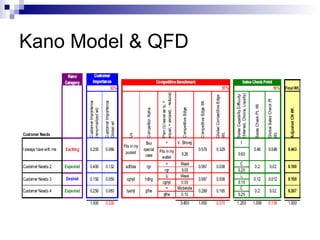
Kano Model & QFD
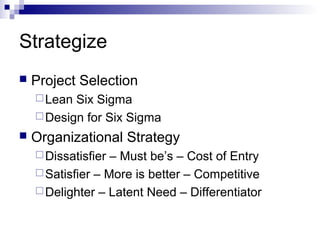
Strategize
   Project Selection
     Lean Six Sigma
     Design for Six Sigma
   Organizational Strategy
     Dissatisfier – Must be’s – Cost of Entry
     Satisfier – More is better – Competitive
     Delighter – Latent Need – Differentiator
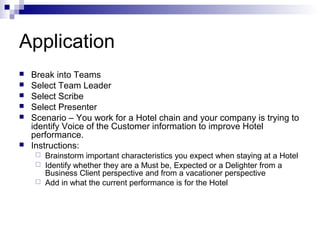
Application
   Break into Teams
   Select Team Leader
   Select Scribe
   Select Presenter
   Scenario – You work for a Hotel chain and your company is trying to
    identify Voice of the Customer information to improve Hotel
    performance.
   Instructions:
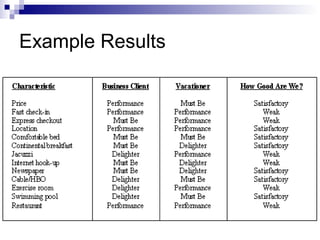
      Brainstorm important characteristics you expect when staying at a Hotel
      Identify whether they are a Must be, Expected or a Delighter from a
       Business Client perspective and from a vacationer perspective
      Add in what the current performance is for the Hotel
Example Results
Debrief
 Analysis
 Strategy Recommendations
Summary of Kano Model
 Analyze and rank the voice of the
  customer data
 Develop into Categories
     Dissatisfier – Must be’s – Cost of Entry
     Satisfier – More is better – Competitive
     Delighter – Latent Need – Differentiator
   Identify and implement strategy
Questions


   ?
References
   Walder, D., (1993). Kano’s model for understanding customer-
    defined quality. Center For Quality of Management Journal, 39, 65 –
    69.
   Jacobs, R., (1997). Evaluating customer satisfaction with media
    products and services. European Media Management Journal, 32,
    11 – 18.
   Ungvari, S., (1999). Adding the third dimension to auqlity. Triz
    Journal, 40, 31 – 35.
   Sauerwein, E., Bailom, F., Matzler, K., & Hinterhuber, H. (1996).
    The kano model: How to delight your customers. International
    Working Seminar on Production Economics, 19, 313 - 327
   Zultner, R.E. & Mazur, G. H. ( 2006). The Kano Model: Recent
    Developments. The eighteenth symposium on Quality Function
    Deployment.

Kano

  • 1.
    Kano Model Erica LynnFarmer CMQ/OE, CSSBB, MBB
  • 2.
    Objectives  Origins  Purpose Process Model  Key Elements  Methodology  Application  Examples
  • 3.
    Origins of theKano Model  Noriaki Kano  Professor at Tokyo Rika University  International Consultant  Received individual Demming Prize in 1997
  • 4.
    Origins of theKano Model  Noriaki Kano  Developed foundation for an approach on “Attractive Quality Creation” commonly referred to as the “Kano Model”  Challenged traditional Customer Satisfaction Models that More is better, i.e. the more you perform on each service attribute the more satisfied the customers will be.  Proposed new Customer Satisfaction model (Kano Model)  Performance on product and service attributes is not equal in the eyes of the customers  Performance on certain categories attributes produces higher levels of satisfaction than others.
  • 5.
    When to usethe Kano Model  Project Selection  Lean Six Sigma  Design for Six Sigma  New Product Development  New Service Development  Determine Market Strategies
  • 6.
    Key Elements  Identifythe Voice of the Customer  Translate Voice of the Customer into Critical to Quality Characteristics (CTQs)  Rank the CTQs into three categories:  Dissatisfier - Must be’s – Cost of Entry  Satisfier – More is better – Competitive  Delighter – Latent Need – Differentiator  Evaluate Current Performance
  • 7.
  • 8.
    Kano Model Process Analyze & Analyze & Plot & Plot & Research Research Strategize Strategize Brainstorm Brainstorm Diagram Diagram •Research available •Analyze results •Develop Customer •Determine Project data sources from data collection Requirement Matrix selection •Determine data •Brainstorm list of •Record •Product Development collection strategy features and Questionnaire •Service Development •Design data functionality results in Matrix •Identify Marketing collection •Develop Functional and Summarize Strategy instruments and Dysfunctional •Plot results on •Collect and Questionnaire Kano Model summarize data •Distribute Questionnaire
  • 9.
    Research  Must Be’s - Focus Groups, Lawsuits and Regulations, Buzz on Internet  Satisfiers - Competitive Analysis, Interviews, Surveys, Search Logs, Usablity Testing, Customer Forums  Delighters - Field Research, Marketing/Branding Vision, Industrial Design, Packaging, Call Center Data, Site Logs
  • 10.
    Analyze & Brainstorm  Analyze data from available sources  Brainstorm list of features and functionality  Determine type of requirements:  Output Requirements  Service Requirements  Kano Model Requirements Survey  User Survey  “Functional form” vs. “Dysfunctional Form”  “How would you feel if the product had feature X?”  “How would you feel if the product didn’t have feature X?”  Kano Questionnaire Answers:  I like it.  I expect it.  I’m neutral.  I can tolerate it.  I dislike it.
  • 11.
  • 12.
  • 13.
  • 14.
    Evaluation Customer Requirements C.R. A E O R Q I Total Grade 1 3 6 14 23 O 2 5 6 11 1 23 O 3 6 1 4 1 11 23 I 4 13 10 23 E 5 11 1 2 9 23 A Customer Requirement is: A: Attractive R: Reverse Q: Questionable Result E: Expected O: One Dimensional I: Indifferent
  • 15.
  • 16.
  • 17.
    Strategize  Project Selection  Lean Six Sigma  Design for Six Sigma  Organizational Strategy  Dissatisfier – Must be’s – Cost of Entry  Satisfier – More is better – Competitive  Delighter – Latent Need – Differentiator
  • 18.
    Application  Break into Teams  Select Team Leader  Select Scribe  Select Presenter  Scenario – You work for a Hotel chain and your company is trying to identify Voice of the Customer information to improve Hotel performance.  Instructions:  Brainstorm important characteristics you expect when staying at a Hotel  Identify whether they are a Must be, Expected or a Delighter from a Business Client perspective and from a vacationer perspective  Add in what the current performance is for the Hotel
  • 19.
  • 20.
  • 21.
    Summary of KanoModel  Analyze and rank the voice of the customer data  Develop into Categories  Dissatisfier – Must be’s – Cost of Entry  Satisfier – More is better – Competitive  Delighter – Latent Need – Differentiator  Identify and implement strategy
  • 22.
  • 23.
    References  Walder, D., (1993). Kano’s model for understanding customer- defined quality. Center For Quality of Management Journal, 39, 65 – 69.  Jacobs, R., (1997). Evaluating customer satisfaction with media products and services. European Media Management Journal, 32, 11 – 18.  Ungvari, S., (1999). Adding the third dimension to auqlity. Triz Journal, 40, 31 – 35.  Sauerwein, E., Bailom, F., Matzler, K., & Hinterhuber, H. (1996). The kano model: How to delight your customers. International Working Seminar on Production Economics, 19, 313 - 327  Zultner, R.E. & Mazur, G. H. ( 2006). The Kano Model: Recent Developments. The eighteenth symposium on Quality Function Deployment.

Editor's Notes

  • #4 Know the Voice of the Customer Translate the V Kano Model concept first published in an article by Kano, N., Takahshi, F & Tsuji, S. (1984). Attractive quality and must-be quality. The Journal of the Japanese Society for Quality Control, April, pp. 39-48.
  • #7 Surveys Interviews Focus Groups Observations Customer Complaints
  • #8   The Kano Model is a tool that can be used to prioritize the Critical to Quality characteristics, as defined by the Voice of the Customer and the three categories identified by the model are: Must Be: Whatever the quality characteristic is, it must be present, such that if it is not, the customer will go elsewhere! Performance: The better we are at meeting these needs, the happier the customer is. Delighter: Those qualities that the customer was not expecting, but received as a bonus. Link to Six Sigma: Lean Six Sigma Design for Six Sigma Model Structure The model is represented in an (x, y) graph The x-axis represents how good we are at achieving the customer’s outcome (s), or CTQ ’s. The y-axis records the customer’s level of satisfaction the customer should have, as a result of our level of achievement.
  • #11 Output Requirement – Features of the final product and service delivered to the customer at the end of the process Service Requirements – More subjective ways in which customer expects to be treated and served during the process itself - How should we interact with and treat customers?
  • #15 All CR are not created equal. Improving performance on a Must-be CR that is already at a satisfactory level is not productive compared with improving performance on a one dimensional or attractive CR. Insight into which CRs fall into which quality dimensions can improve one’s focus on the vital few. In general, must-be requirements must be adequately covered, the set of one dimensional requirements must be competitive, and some attractive requirements are needed for competitive differentiation.
  • #16 Plot Attributes Lean - Waste Six Sigma – Defects, Variability DFSS – New Product/Service Development