Computational  Methods  
and  Tools  for  Social  
Network  Analysis  of  
Networked  Learning  
Communities	
Tutorial at LAK 2013, 9/4/2013
Andreas Harrer, Tilman Göhnert,
Alejandra Martínez-Monés &
Christophe Reffay
Agenda	
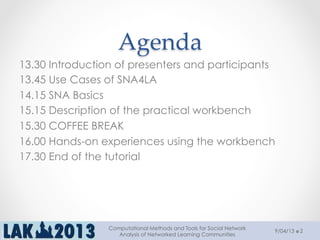
13.30 Introduction of presenters and participants
13.45 Use Cases of SNA4LA
14.15 SNA Basics
15.15 Description of the practical workbench
15.30 COFFEE BREAK
16.00 Hands-on experiences using the workbench
17.30 End of the tutorial
9/04/13
Computational Methods and Tools for Social Network
Analysis of Networked Learning Communities
2
Introduction  of  presenters  
&  participants	
9/04/13
Computational Methods and Tools for Social Network
Analysis of Networked Learning Communities
3
Tutorial  Presenters	
•  Andreas Harrer
•  Tillman Göhnert
•  Alejandra Martínez-Monés
•  Christophe Reffay
9/04/13
Computational Methods and Tools for Social Network
Analysis of Networked Learning Communities
4
Use  Cases  of  SNA  for  LA	
9/04/13
Computational Methods and Tools for Social Network
Analysis of Networked Learning Communities
5
Identifying  Participatory  
Roles  in  CSCL  scenarios	
Marcos García, J.A.,  Martínez Monés, A.,  Dimitriadis, Y.,  Anguita
Martínez, R. A role-based approach for the support of
collaborative learning activities e-Service Journal. 6(1):40-58,
Diciembre 2007
9/04/13
Computational Methods and Tools for Social Network
Analysis of Networked Learning Communities
6
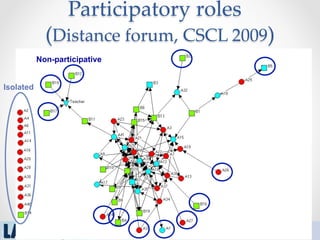
Participatory  roles	
•  Goal: Identifying roles based on their
position within a network of relationships
o  Description of expected roles, based on centrality indexes
o  Identify the emergence of those roles in an experience
o  Provide them with information adapted to their needs
•  Approach:
o  Description of roles based on “fuzzy” combinatios of SNA
indexes
9/04/13
Computational Methods and Tools for Social Network
Analysis of Networked Learning Communities
7
Participatory  roles    
(Distance  forum,  CSCL  2009)	
Isolated
Non-participative
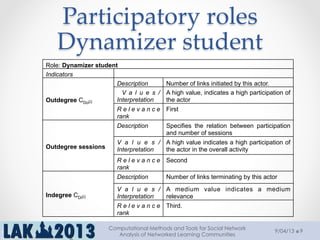
Role: Dynamizer student
Indicators
Outdegree CDo(i)
Description Number of links initiated by this actor.
V a l u e s /
Interpretation
A high value, indicates a high participation of
the actor
R e l e v a n c e
rank
First
Outdegree sessions
Description Specifies the relation between participation
and number of sessions
V a l u e s /
Interpretation
A high value indicates a high participation of
the actor in the overall activity
R e l e v a n c e
rank
Second
Indegree CDi(i)
Description Number of links terminating by this actor
V a l u e s /
Interpretation
A medium value indicates a medium
relevance
R e l e v a n c e
rank
Third.
Participatory  roles  
Dynamizer  student	
9/04/13
Computational Methods and Tools for Social Network
Analysis of Networked Learning Communities
9
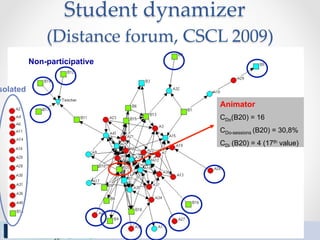
Student  dynamizer    
(Distance  forum,  CSCL  2009)	
Animator
CDo(B20) = 16
CDo-sessions (B20) = 30,8%
CDi (B20) = 4 (17th value)
solated
Non-participative
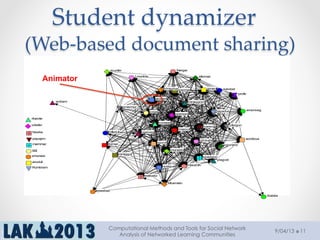
Student  dynamizer    
(Web-­‐‑based  document  sharing)	
9/04/13
Computational Methods and Tools for Social Network
Analysis of Networked Learning Communities
11
aalobel
abalarr
aordboa
arodull
cfergon
cgeiveg
cgonzrol
cjimcab
emonveg
emunsei epadgon
esasbaz
estibaliz
ggj
ibalala
ilizmar
imunado
jjimrio
jorge
lcaravi
lconase
lhergar
Lmunbla
marnmar
Mcamalo
mferrub
mlauroth
mmaygom
mmiggut
ncalgua
Noelia
papajim
plagvel
ppersan
profe
rapaduq
rfueote
rgorvil
rmarcol
rpermar
Rumbram
scilram
scunfer
sfermar
smarmor
vdiefer
Vmaybar
Animator
Cohesion  in  subgroups  	
Reffay, C. and Chanier, T., (2003) How social network analysis
can help to measure cohesion in collaborative distance
learning, Proc of CSCL, 2003
Reffay, C., Teplovs, C., & Blondel, F.-M. (2011). Productive re-
use of CSCL data and analytic tools to provide a new
perspective on group cohesion. Proc of CSCL 2011.
9/04/13
Computational Methods and Tools for Social Network
Analysis of Networked Learning Communities
12
Cohesion	
•  Simugline data set
o  4 online groups working on an French as foreign language simulation
o  Each group had an instructor and a
•  Data
o  Discussion forums that are local to each of the 4 groups
•  Network
o  The relation between “a” and “b” represents messages sent by “a” and
opened by “b” plus messages posted by “b” and opened by “a”
•  Indexes
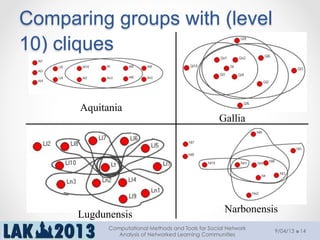
o  Cliques at level “c”: subgroup in which the ties between all pairs of agents
have values c or greater (i.e., have exchanged c or more messages).
o  “c” can be a value announced by the teacher as the desirable level of
interaction
9/04/13
Computational Methods and Tools for Social Network
Analysis of Networked Learning Communities
13
Comparing groups with (level
10) cliques
Aquitania
Gallia
Lugdunensis
Gallia
Narbonensis
9/04/13
Computational Methods and Tools for Social Network
Analysis of Networked Learning Communities
14
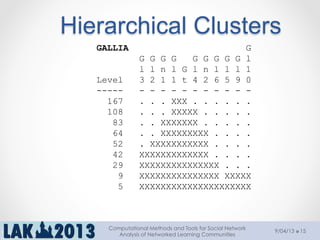
Hierarchical Clusters
GALLIA G
G G G G G G G G G l
l l n l G l n l l l 1
Level 3 2 1 1 t 4 2 6 5 9 0
----- - - - - - - - - - - -
167 . . . XXX . . . . . .
108 . . . XXXXX . . . . .
83 . . XXXXXXX . . . . .
64 . . XXXXXXXXX . . . .
52 . XXXXXXXXXXX . . . .
42 XXXXXXXXXXXXX . . . .
29 XXXXXXXXXXXXXXX . . .
9 XXXXXXXXXXXXXXX XXXXX
5 XXXXXXXXXXXXXXXXXXXXX
9/04/13
Computational Methods and Tools for Social Network
Analysis of Networked Learning Communities
15
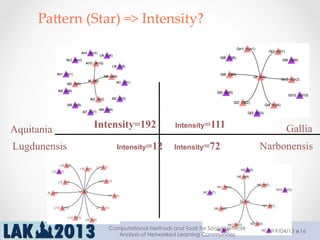
PaNern  (Star)  =>  Intensity?	
Aquitania
Lugdunensis Narbonensis
GalliaIntensity=192
Intensity=12 Intensity=72
Intensity=111
9/04/13
Computational Methods and Tools for Social Network
Analysis of Networked Learning Communities
16
The  “fourth”  man	
Malzahn, N., Harrer, A., & Zeini, S. (2007). The Fourth Man -
Supporting self-organizing group formation in learning
communities. In Proc. of CSCL 2007 (pp. 547–550).
9/04/13
Computational Methods and Tools for Social Network
Analysis of Networked Learning Communities
17
18
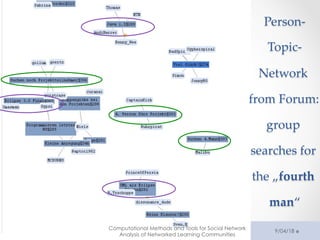
Person-­‐‑
Topic-­‐‑
Network  
from  Forum:  
group  
searches  for  
the  „fourth  
man“	
9/04/13
Computational Methods and Tools for Social Network
Analysis of Networked Learning Communities
19
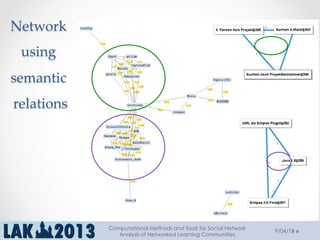
Network  
using  
semantic  
relations	
9/04/13
Computational Methods and Tools for Social Network
Analysis of Networked Learning Communities
Blockmodeling	
Harrer, A. & Schmidt, A. (to appear 2013). Blockmodeling and
role analysis in multi-relational networks. Social Networks and
Mining. Springer. 2013
9/04/13
Computational Methods and Tools for Social Network
Analysis of Networked Learning Communities
20
21
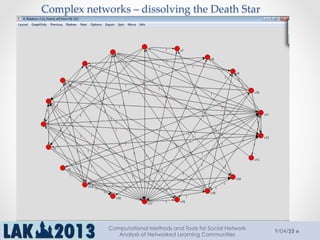
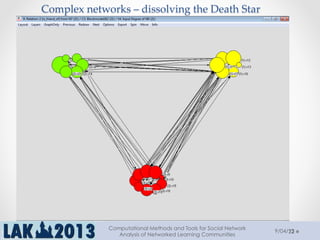
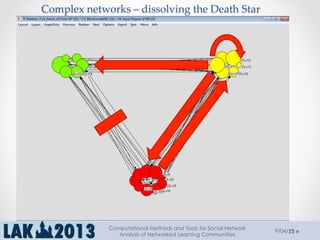
Complex  networks  –  dissolving  the  Death  Star	
9/04/13
Computational Methods and Tools for Social Network
Analysis of Networked Learning Communities
22
Complex  networks  –  dissolving  the  Death  Star	
9/04/13
Computational Methods and Tools for Social Network
Analysis of Networked Learning Communities
23
Complex  networks  –  dissolving  the  Death  Star	
9/04/13
Computational Methods and Tools for Social Network
Analysis of Networked Learning Communities
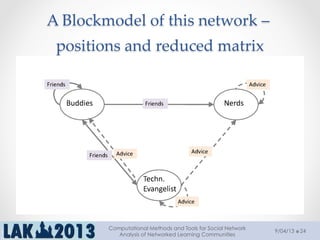
A  Blockmodel  of  this  network  –  
positions  and  reduced  matrix	
9/04/13
Computational Methods and Tools for Social Network
Analysis of Networked Learning Communities
24
SNA  basics	
9/04/13
Computational Methods and Tools for Social Network
Analysis of Networked Learning Communities
25
SNA  basics	
•  What is a Social Network?
•  Types of networks and network transformations
•  Useful definitions and measures on graphs
•  Grouping concepts
9/04/13
Computational Methods and Tools for Social Network
Analysis of Networked Learning Communities
26
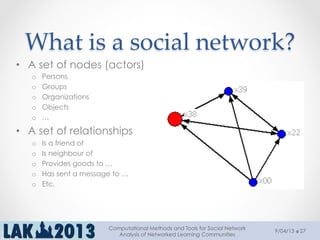
What  is  a  social  network?	
•  A set of nodes (actors)
o  Persons
o  Groups
o  Organizations
o  Objects
o  …
•  A set of relationships
o  Is a friend of
o  Is neighbour of
o  Provides goods to …
o  Has sent a message to …
o  Etc.
9/04/13
Computational Methods and Tools for Social Network
Analysis of Networked Learning Communities
27
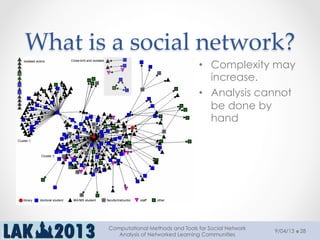
What  is  a  social  network?	
•  Complexity may
increase.
•  Analysis cannot
be done by
hand
9/04/13
Computational Methods and Tools for Social Network
Analysis of Networked Learning Communities
28
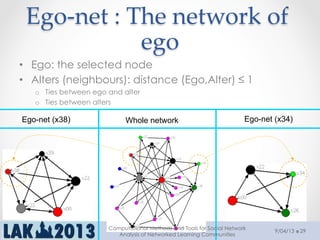
Ego-­‐‑net  :  The  network  of  
ego	
•  Ego: the selected node
•  Alters (neighbours): distance (Ego,Alter) ≤ 1
o  Ties between ego and alter
o  Ties between alters
Whole network Ego-net (x34)Ego-net (x38)
9/04/13
Computational Methods and Tools for Social Network
Analysis of Networked Learning Communities
29
Types  of  Social  Networks  
According  to…	
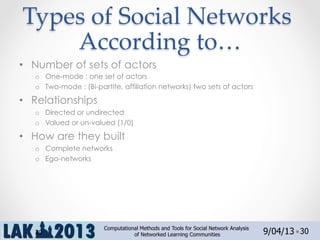
•  Number of sets of actors
o  One-mode : one set of actors
o  Two-mode : (Bi-partite, affiliation networks) two sets of actors
•  Relationships
o  Directed or undirected
o  Valued or un-valued (1/0)
•  How are they built
o  Complete networks
o  Ego-networks
9/04/13Computational Methods and Tools for Social Network Analysis
of Networked Learning Communities 3030
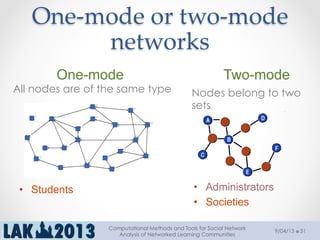
One-­‐‑mode  or  two-­‐‑mode  
networks	
All nodes are of the same type
•  Administrators
•  Societies
Two-modeOne-mode
9/04/13
Computational Methods and Tools for Social Network
Analysis of Networked Learning Communities
31
Nodes belong to two
sets
•  Students
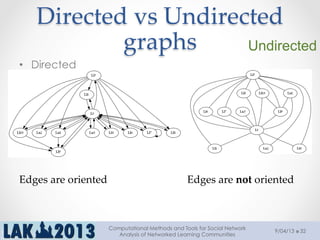
Directed  vs  Undirected  
graphs	
•  Directed
Undirected
Edges  are  oriented	
 Edges  are  not  oriented	
9/04/13
Computational Methods and Tools for Social Network
Analysis of Networked Learning Communities
32
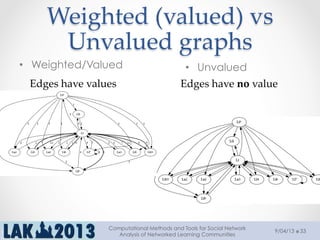
Weighted  (valued)  vs  
Unvalued  graphs	
•  Weighted/Valued •  Unvalued
Edges  have  values	
 Edges  have  no  value	
9/04/13
Computational Methods and Tools for Social Network
Analysis of Networked Learning Communities
33
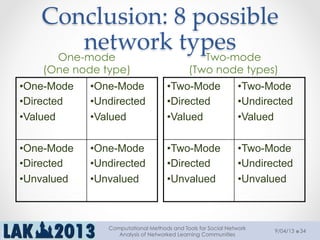
Conclusion:  8  possible  
network  types	
One-mode
(One node type)
Two-mode
(Two node types)
• One-Mode
• Directed
• Valued
• One-Mode
• Undirected
• Valued
• One-Mode
• Directed
• Unvalued
• One-Mode
• Undirected
• Unvalued
• Two-Mode
• Directed
• Valued
• Two-Mode
• Undirected
• Valued
• Two-Mode
• Directed
• Unvalued
• Two-Mode
• Undirected
• Unvalued
9/04/13
Computational Methods and Tools for Social Network
Analysis of Networked Learning Communities
34
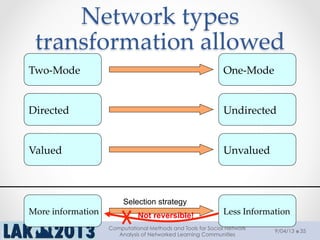
Network  types  
transformation  allowed	
Two-­‐‑Mode	
 One-­‐‑Mode	
Directed	
 Undirected	
Valued	
 Unvalued	
More  information	
 Less  Information	
Selection strategy
Not reversible!
9/04/13
Computational Methods and Tools for Social Network
Analysis of Networked Learning Communities
35
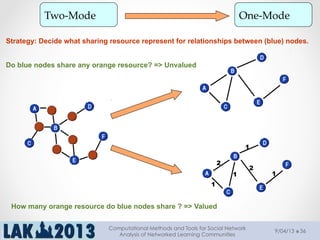
Two-­‐‑Mode	
 One-­‐‑Mode	
2
2
1
1
1
1
Do blue nodes share any orange resource? => Unvalued
How many orange resource do blue nodes share ? => Valued
Strategy: Decide what sharing resource represent for relationships between (blue) nodes.
9/04/13
Computational Methods and Tools for Social Network
Analysis of Networked Learning Communities
36
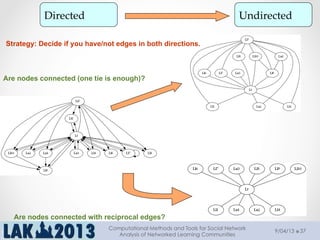
Directed	
 Undirected	
Are nodes connected (one tie is enough)?
Are nodes connected with reciprocal edges?
Strategy: Decide if you have/not edges in both directions.
9/04/13
Computational Methods and Tools for Social Network
Analysis of Networked Learning Communities
37
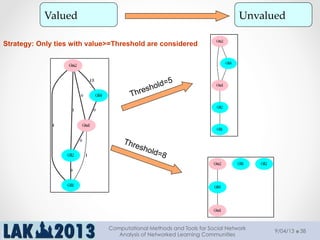
Valued	
 Unvalued	
Threshold=5
Strategy: Only ties with value>=Threshold are considered
9/04/13
Computational Methods and Tools for Social Network
Analysis of Networked Learning Communities
38
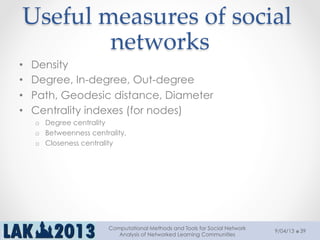
Useful  measures  of  social  
networks	
•  Density
•  Degree, In-degree, Out-degree
•  Path, Geodesic distance, Diameter
•  Centrality indexes (for nodes)
o  Degree centrality
o  Betweenness centrality,
o  Closeness centrality
9/04/13
Computational Methods and Tools for Social Network
Analysis of Networked Learning Communities
39
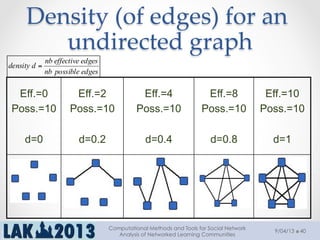
Eff.=0
Poss.=10
d=0
Eff.=2
Poss.=10
d=0.2
Eff.=4
Poss.=10
d=0.4
Eff.=8
Poss.=10
d=0.8
Eff.=10
Poss.=10
d=1
Density  (of  edges)  for  an  
undirected  graph	
edgespossiblenb
edgeseffectivenb
ddensity =
9/04/13
Computational Methods and Tools for Social Network
Analysis of Networked Learning Communities
40
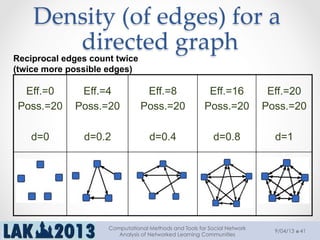
Density  (of  edges)  for  a  
directed  graph	
Eff.=0
Poss.=20
d=0
Eff.=4
Poss.=20
d=0.2
Eff.=8
Poss.=20
d=0.4
Eff.=16
Poss.=20
d=0.8
Eff.=20
Poss.=20
d=1
Reciprocal edges count twice
(twice more possible edges)
9/04/13
Computational Methods and Tools for Social Network
Analysis of Networked Learning Communities
41
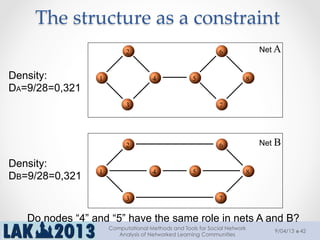
1 4
2 6
5 8
3 7
Net A
1
2
4 5
6
8
3 7
Net B
The  structure  as  a  constraint  
	
Do nodes “4” and “5” have the same role in nets A and B?
Density:
DA=9/28=0,321
Density:
DB=9/28=0,321
9/04/13
Computational Methods and Tools for Social Network
Analysis of Networked Learning Communities
42
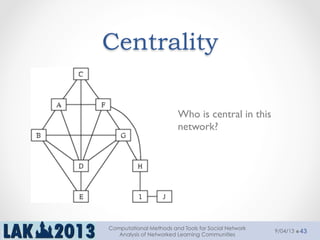
Centrality
•  Who is central in this
network?
439/04/13
Computational Methods and Tools for Social Network
Analysis of Networked Learning Communities
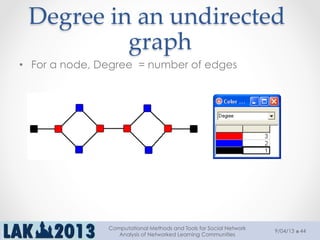
Degree  in  an  undirected  
graph	
•  For a node, Degree = number of edges
9/04/13
Computational Methods and Tools for Social Network
Analysis of Networked Learning Communities
44
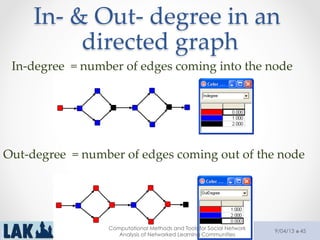
In-­‐‑  &  Out-­‐‑  degree  in  an  
directed  graph	
In-­‐‑degree    =  number  of  edges  coming  into  the  node	
Out-­‐‑degree    =  number  of  edges  coming  out  of  the  node	
9/04/13
Computational Methods and Tools for Social Network
Analysis of Networked Learning Communities
45
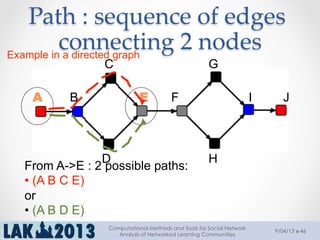
Path  :  sequence  of  edges  
connecting  2  nodes	
A
H
B
C G
D
E F I J
From A->E : 2 possible paths:
• (A B C E)
or
• (A B D E)
Example in a directed graph
9/04/13
Computational Methods and Tools for Social Network
Analysis of Networked Learning Communities
46
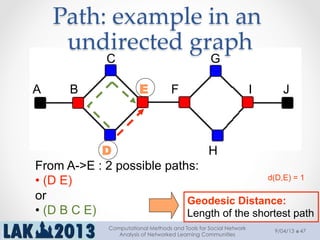
Path:  example  in  an  
undirected  graph	
A
H
B
C G
D
E F I J
From A->E : 2 possible paths:
• (D E)
or
• (D B C E)
Geodesic Distance:
Length of the shortest path
d(D,E) = 1
9/04/13
Computational Methods and Tools for Social Network
Analysis of Networked Learning Communities
47
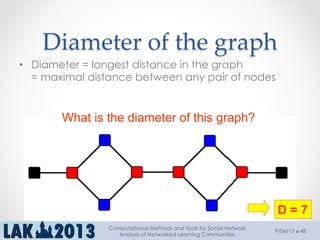
Diameter  of  the  graph	
•  Diameter = longest distance in the graph
= maximal distance between any pair of nodes
What is the diameter of this graph?
D = 7
9/04/13
Computational Methods and Tools for Social Network
Analysis of Networked Learning Communities
48
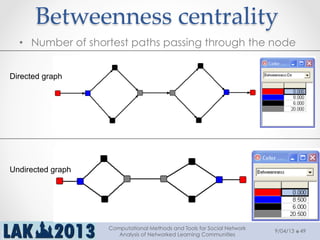
Betweenness  centrality  
	
•  Number of shortest paths passing through the node
Directed graph
Undirected graph
9/04/13
Computational Methods and Tools for Social Network
Analysis of Networked Learning Communities
49
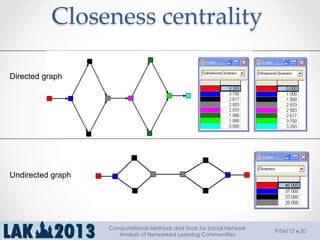
Closeness  centrality  
	
Scoring the closeness of one node to all others
Undirected graph
Directed graph
9/04/13
Computational Methods and Tools for Social Network
Analysis of Networked Learning Communities
50
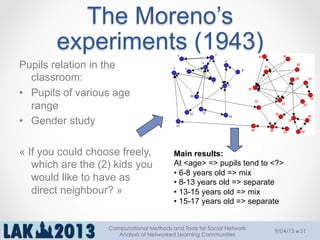
The Moreno’s
experiments (1943)
Pupils relation in the
classroom:
•  Pupils of various age
range
•  Gender study
« If you could choose freely,
which are the (2) kids you
would like to have as
direct neighbour? »
Main results:
At <age> => pupils tend to <?>
• 6-8 years old => mix
• 8-13 years old => separate
• 13-15 years old => mix
• 15-17 years old => separate
9/04/13
Computational Methods and Tools for Social Network
Analysis of Networked Learning Communities
51
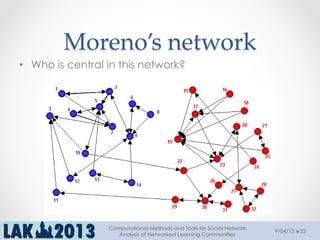
Moreno’s  network	
•  Who is central in this network?
9/04/13
Computational Methods and Tools for Social Network
Analysis of Networked Learning Communities
52
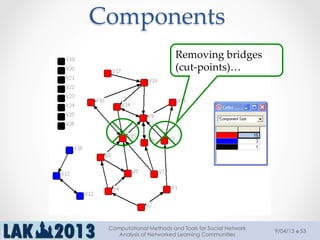
Components  
	
 Removing  bridges    
(cut-­‐‑points)…	
9/04/13
Computational Methods and Tools for Social Network
Analysis of Networked Learning Communities
53
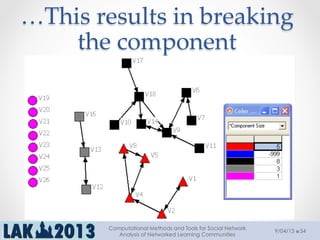
…This  results  in  breaking  
the  component  	
9/04/13
Computational Methods and Tools for Social Network
Analysis of Networked Learning Communities
54
Grouping  concepts  –  an  
overview	
Groups can be determined according to different criteria
•  Reachability and Distance – group member is
connected via short ways to all other group members
o  Direct links – Clique as complete subgraph
o  Relaxing the distance – n-Clique requires all nodes being connected via short
path (lesser and equal than n)
•  Node degree – group member should be connected to
many group members
o  Leaving out a small number of group members: k-Plex
o  Having at least k group members as direct neighbours – k-Core
•  Contrasting “ingroup” and “outgroup” – density inside is
much higher than outside
o  Alliance: only links to ingroup, no links to outside
9/04/13
Computational Methods and Tools for Social Network
Analysis of Networked Learning Communities
55
Grouping  concepts  –  an  
overview	
•  Group concepts fall in two categories:
o  Overlapping concepts
•  e.g. Cliques
o  Disjunct concepts
•  e.g. k-cyclic blocks
•  Depending on the type of analysis both categories
have their merits
o  Disjunct concepts allow clear-cut assignment to one group
o  Overlapping concepts allow analysis of transfer ideas, e.g. Clique
percolation
9/04/13
Computational Methods and Tools for Social Network
Analysis of Networked Learning Communities
56
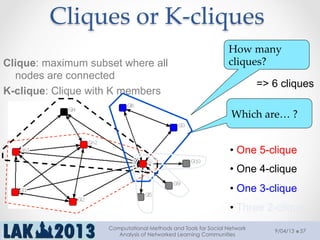
Cliques  or  K-­‐‑cliques  
	
Clique: maximum subset where all
nodes are connected
K-clique: Clique with K members
How  many    
cliques?	
• One 5-clique
• One 4-clique
• One 3-clique
• Three 2-cliques
=> 6 cliques
Which  are…  ?	
9/04/13
Computational Methods and Tools for Social Network
Analysis of Networked Learning Communities
57
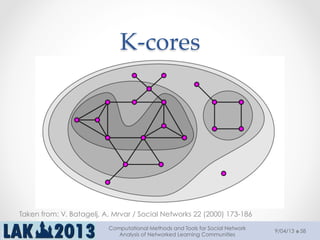
K-­‐‑cores	
9/04/13
Computational Methods and Tools for Social Network
Analysis of Networked Learning Communities
58
Taken from: V. Batagelj, A. Mrvar / Social Networks 22 (2000) 173-186
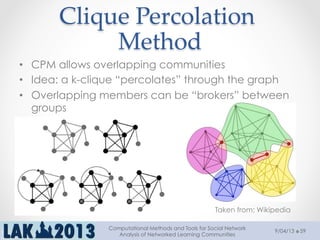
Clique  Percolation  
Method	
•  CPM allows overlapping communities
•  Idea: a k-clique “percolates” through the graph
•  Overlapping members can be “brokers” between
groups
9/04/13
Computational Methods and Tools for Social Network
Analysis of Networked Learning Communities
59
Taken from: Wikipedia
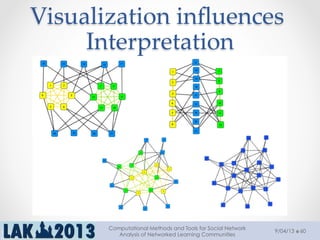
Visualization  influences  
Interpretation	
9/04/13
Computational Methods and Tools for Social Network
Analysis of Networked Learning Communities
60
Practical  Workbench    
Presentation	
9/04/13
Computational Methods and Tools for Social Network
Analysis of Networked Learning Communities
61
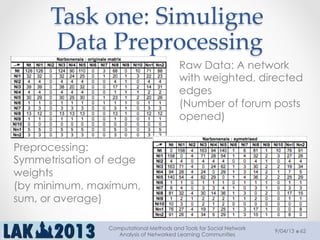
Task  one:  Simuligne  
Data  Preprocessing	
9/04/13
Computational Methods and Tools for Social Network
Analysis of Networked Learning Communities
62
Raw Data: A network
with weighted, directed
edges
(Number of forum posts
opened)
Preprocessing:
Symmetrisation of edge
weights
(by minimum, maximum,
sum, or average)
Task  one:  Simuligne	
•  Choose the data set based on preprocessing
o  Narbo_Max: Maximum of both directions
o  Narbo_Mean: Average of both directions
o  Narbo_Min: Minimum of both directions
o  Narbo_Sum: Sum of both directions
•  Think of the format transformation (UCINET -> SISOB)
•  Focus on the appropriate intensity level of the
relation
•  Identify groups
•  Choose an appropriate output representation
9/04/13
Computational Methods and Tools for Social Network
Analysis of Networked Learning Communities
63
Task  two:  Collaboration  
over  Artifacts  (BSCW)	
9/04/13
Computational Methods and Tools for Social Network
Analysis of Networked Learning Communities
64
•  Two node types
o  BSCW (document sharing) folders as artifacts (-..)
•  One folder for general information
•  Folders for individual case studies
o  Pairs of students, each working mainly on a single case (x..)
•  Edges weighted by access
Task  two:  Collaboration  
over  Artifacts  (BSCW)	
9/04/13
Computational Methods and Tools for Social Network
Analysis of Networked Learning Communities
65
•  Choose one of the data sets
o  sp1_B_cli_cp_U.txt
o  sp2_B_cli_cp_U.txt
o  sp3_B_cli_cp_U.txt
o  spf_B_cli_cp_U.txt
•  Think of the format transformation (UCINET -> SISOB)
•  Try to identify the general folder
•  Try to identify the projects the pairs of students
worked on
•  Analyse the collaboration between the students
(hint: Folding is also in the R-Analysis)

LAK13 Tutorial Social Network Analysis 4 Learning Analytics

  • 1.
    Computational  Methods   and Tools  for  Social   Network  Analysis  of   Networked  Learning   Communities Tutorial at LAK 2013, 9/4/2013 Andreas Harrer, Tilman Göhnert, Alejandra Martínez-Monés & Christophe Reffay
  • 2.
    Agenda 13.30 Introduction ofpresenters and participants 13.45 Use Cases of SNA4LA 14.15 SNA Basics 15.15 Description of the practical workbench 15.30 COFFEE BREAK 16.00 Hands-on experiences using the workbench 17.30 End of the tutorial 9/04/13 Computational Methods and Tools for Social Network Analysis of Networked Learning Communities 2
  • 3.
    Introduction  of  presenters  &  participants 9/04/13 Computational Methods and Tools for Social Network Analysis of Networked Learning Communities 3
  • 4.
    Tutorial  Presenters •  AndreasHarrer •  Tillman Göhnert •  Alejandra Martínez-Monés •  Christophe Reffay 9/04/13 Computational Methods and Tools for Social Network Analysis of Networked Learning Communities 4
  • 5.
    Use  Cases  of SNA  for  LA 9/04/13 Computational Methods and Tools for Social Network Analysis of Networked Learning Communities 5
  • 6.
    Identifying  Participatory   Roles in  CSCL  scenarios Marcos García, J.A.,  Martínez Monés, A.,  Dimitriadis, Y.,  Anguita Martínez, R. A role-based approach for the support of collaborative learning activities e-Service Journal. 6(1):40-58, Diciembre 2007 9/04/13 Computational Methods and Tools for Social Network Analysis of Networked Learning Communities 6
  • 7.
    Participatory  roles •  Goal:Identifying roles based on their position within a network of relationships o  Description of expected roles, based on centrality indexes o  Identify the emergence of those roles in an experience o  Provide them with information adapted to their needs •  Approach: o  Description of roles based on “fuzzy” combinatios of SNA indexes 9/04/13 Computational Methods and Tools for Social Network Analysis of Networked Learning Communities 7
  • 8.
    Participatory  roles    (Distance  forum,  CSCL  2009) Isolated Non-participative
  • 9.
    Role: Dynamizer student Indicators OutdegreeCDo(i) Description Number of links initiated by this actor. V a l u e s / Interpretation A high value, indicates a high participation of the actor R e l e v a n c e rank First Outdegree sessions Description Specifies the relation between participation and number of sessions V a l u e s / Interpretation A high value indicates a high participation of the actor in the overall activity R e l e v a n c e rank Second Indegree CDi(i) Description Number of links terminating by this actor V a l u e s / Interpretation A medium value indicates a medium relevance R e l e v a n c e rank Third. Participatory  roles   Dynamizer  student 9/04/13 Computational Methods and Tools for Social Network Analysis of Networked Learning Communities 9
  • 10.
    Student  dynamizer    (Distance  forum,  CSCL  2009) Animator CDo(B20) = 16 CDo-sessions (B20) = 30,8% CDi (B20) = 4 (17th value) solated Non-participative
  • 11.
    Student  dynamizer    (Web-­‐‑based  document  sharing) 9/04/13 Computational Methods and Tools for Social Network Analysis of Networked Learning Communities 11 aalobel abalarr aordboa arodull cfergon cgeiveg cgonzrol cjimcab emonveg emunsei epadgon esasbaz estibaliz ggj ibalala ilizmar imunado jjimrio jorge lcaravi lconase lhergar Lmunbla marnmar Mcamalo mferrub mlauroth mmaygom mmiggut ncalgua Noelia papajim plagvel ppersan profe rapaduq rfueote rgorvil rmarcol rpermar Rumbram scilram scunfer sfermar smarmor vdiefer Vmaybar Animator
  • 12.
    Cohesion  in  subgroups  Reffay, C. and Chanier, T., (2003) How social network analysis can help to measure cohesion in collaborative distance learning, Proc of CSCL, 2003 Reffay, C., Teplovs, C., & Blondel, F.-M. (2011). Productive re- use of CSCL data and analytic tools to provide a new perspective on group cohesion. Proc of CSCL 2011. 9/04/13 Computational Methods and Tools for Social Network Analysis of Networked Learning Communities 12
  • 13.
    Cohesion •  Simugline dataset o  4 online groups working on an French as foreign language simulation o  Each group had an instructor and a •  Data o  Discussion forums that are local to each of the 4 groups •  Network o  The relation between “a” and “b” represents messages sent by “a” and opened by “b” plus messages posted by “b” and opened by “a” •  Indexes o  Cliques at level “c”: subgroup in which the ties between all pairs of agents have values c or greater (i.e., have exchanged c or more messages). o  “c” can be a value announced by the teacher as the desirable level of interaction 9/04/13 Computational Methods and Tools for Social Network Analysis of Networked Learning Communities 13
  • 14.
    Comparing groups with(level 10) cliques Aquitania Gallia Lugdunensis Gallia Narbonensis 9/04/13 Computational Methods and Tools for Social Network Analysis of Networked Learning Communities 14
  • 15.
    Hierarchical Clusters GALLIA G GG G G G G G G G l l l n l G l n l l l 1 Level 3 2 1 1 t 4 2 6 5 9 0 ----- - - - - - - - - - - - 167 . . . XXX . . . . . . 108 . . . XXXXX . . . . . 83 . . XXXXXXX . . . . . 64 . . XXXXXXXXX . . . . 52 . XXXXXXXXXXX . . . . 42 XXXXXXXXXXXXX . . . . 29 XXXXXXXXXXXXXXX . . . 9 XXXXXXXXXXXXXXX XXXXX 5 XXXXXXXXXXXXXXXXXXXXX 9/04/13 Computational Methods and Tools for Social Network Analysis of Networked Learning Communities 15
  • 16.
    PaNern  (Star)  => Intensity? Aquitania Lugdunensis Narbonensis GalliaIntensity=192 Intensity=12 Intensity=72 Intensity=111 9/04/13 Computational Methods and Tools for Social Network Analysis of Networked Learning Communities 16
  • 17.
    The  “fourth”  man Malzahn,N., Harrer, A., & Zeini, S. (2007). The Fourth Man - Supporting self-organizing group formation in learning communities. In Proc. of CSCL 2007 (pp. 547–550). 9/04/13 Computational Methods and Tools for Social Network Analysis of Networked Learning Communities 17
  • 18.
    18 Person-­‐‑ Topic-­‐‑ Network   from  Forum:  group   searches  for   the  „fourth   man“ 9/04/13 Computational Methods and Tools for Social Network Analysis of Networked Learning Communities
  • 19.
    19 Network   using   semantic  relations 9/04/13 Computational Methods and Tools for Social Network Analysis of Networked Learning Communities
  • 20.
    Blockmodeling Harrer, A. &Schmidt, A. (to appear 2013). Blockmodeling and role analysis in multi-relational networks. Social Networks and Mining. Springer. 2013 9/04/13 Computational Methods and Tools for Social Network Analysis of Networked Learning Communities 20
  • 21.
    21 Complex  networks  – dissolving  the  Death  Star 9/04/13 Computational Methods and Tools for Social Network Analysis of Networked Learning Communities
  • 22.
    22 Complex  networks  – dissolving  the  Death  Star 9/04/13 Computational Methods and Tools for Social Network Analysis of Networked Learning Communities
  • 23.
    23 Complex  networks  – dissolving  the  Death  Star 9/04/13 Computational Methods and Tools for Social Network Analysis of Networked Learning Communities
  • 24.
    A  Blockmodel  of this  network  –   positions  and  reduced  matrix 9/04/13 Computational Methods and Tools for Social Network Analysis of Networked Learning Communities 24
  • 25.
    SNA  basics 9/04/13 Computational Methodsand Tools for Social Network Analysis of Networked Learning Communities 25
  • 26.
    SNA  basics •  Whatis a Social Network? •  Types of networks and network transformations •  Useful definitions and measures on graphs •  Grouping concepts 9/04/13 Computational Methods and Tools for Social Network Analysis of Networked Learning Communities 26
  • 27.
    What  is  a social  network? •  A set of nodes (actors) o  Persons o  Groups o  Organizations o  Objects o  … •  A set of relationships o  Is a friend of o  Is neighbour of o  Provides goods to … o  Has sent a message to … o  Etc. 9/04/13 Computational Methods and Tools for Social Network Analysis of Networked Learning Communities 27
  • 28.
    What  is  a social  network? •  Complexity may increase. •  Analysis cannot be done by hand 9/04/13 Computational Methods and Tools for Social Network Analysis of Networked Learning Communities 28
  • 29.
    Ego-­‐‑net  :  The network  of   ego •  Ego: the selected node •  Alters (neighbours): distance (Ego,Alter) ≤ 1 o  Ties between ego and alter o  Ties between alters Whole network Ego-net (x34)Ego-net (x38) 9/04/13 Computational Methods and Tools for Social Network Analysis of Networked Learning Communities 29
  • 30.
    Types  of  Social Networks   According  to… •  Number of sets of actors o  One-mode : one set of actors o  Two-mode : (Bi-partite, affiliation networks) two sets of actors •  Relationships o  Directed or undirected o  Valued or un-valued (1/0) •  How are they built o  Complete networks o  Ego-networks 9/04/13Computational Methods and Tools for Social Network Analysis of Networked Learning Communities 3030
  • 31.
    One-­‐‑mode  or  two-­‐‑mode  networks All nodes are of the same type •  Administrators •  Societies Two-modeOne-mode 9/04/13 Computational Methods and Tools for Social Network Analysis of Networked Learning Communities 31 Nodes belong to two sets •  Students
  • 32.
    Directed  vs  Undirected  graphs •  Directed Undirected Edges  are  oriented Edges  are  not  oriented 9/04/13 Computational Methods and Tools for Social Network Analysis of Networked Learning Communities 32
  • 33.
    Weighted  (valued)  vs  Unvalued  graphs •  Weighted/Valued •  Unvalued Edges  have  values Edges  have  no  value 9/04/13 Computational Methods and Tools for Social Network Analysis of Networked Learning Communities 33
  • 34.
    Conclusion:  8  possible  network  types One-mode (One node type) Two-mode (Two node types) • One-Mode • Directed • Valued • One-Mode • Undirected • Valued • One-Mode • Directed • Unvalued • One-Mode • Undirected • Unvalued • Two-Mode • Directed • Valued • Two-Mode • Undirected • Valued • Two-Mode • Directed • Unvalued • Two-Mode • Undirected • Unvalued 9/04/13 Computational Methods and Tools for Social Network Analysis of Networked Learning Communities 34
  • 35.
    Network  types   transformation allowed Two-­‐‑Mode One-­‐‑Mode Directed Undirected Valued Unvalued More  information Less  Information Selection strategy Not reversible! 9/04/13 Computational Methods and Tools for Social Network Analysis of Networked Learning Communities 35
  • 36.
    Two-­‐‑Mode One-­‐‑Mode 2 2 1 1 1 1 Do bluenodes share any orange resource? => Unvalued How many orange resource do blue nodes share ? => Valued Strategy: Decide what sharing resource represent for relationships between (blue) nodes. 9/04/13 Computational Methods and Tools for Social Network Analysis of Networked Learning Communities 36
  • 37.
    Directed Undirected Are nodesconnected (one tie is enough)? Are nodes connected with reciprocal edges? Strategy: Decide if you have/not edges in both directions. 9/04/13 Computational Methods and Tools for Social Network Analysis of Networked Learning Communities 37
  • 38.
    Valued Unvalued Threshold=5 Strategy: Onlyties with value>=Threshold are considered 9/04/13 Computational Methods and Tools for Social Network Analysis of Networked Learning Communities 38
  • 39.
    Useful  measures  of social   networks •  Density •  Degree, In-degree, Out-degree •  Path, Geodesic distance, Diameter •  Centrality indexes (for nodes) o  Degree centrality o  Betweenness centrality, o  Closeness centrality 9/04/13 Computational Methods and Tools for Social Network Analysis of Networked Learning Communities 39
  • 40.
    Eff.=0 Poss.=10 d=0 Eff.=2 Poss.=10 d=0.2 Eff.=4 Poss.=10 d=0.4 Eff.=8 Poss.=10 d=0.8 Eff.=10 Poss.=10 d=1 Density  (of  edges) for  an   undirected  graph edgespossiblenb edgeseffectivenb ddensity = 9/04/13 Computational Methods and Tools for Social Network Analysis of Networked Learning Communities 40
  • 41.
    Density  (of  edges) for  a   directed  graph Eff.=0 Poss.=20 d=0 Eff.=4 Poss.=20 d=0.2 Eff.=8 Poss.=20 d=0.4 Eff.=16 Poss.=20 d=0.8 Eff.=20 Poss.=20 d=1 Reciprocal edges count twice (twice more possible edges) 9/04/13 Computational Methods and Tools for Social Network Analysis of Networked Learning Communities 41
  • 42.
    1 4 2 6 58 3 7 Net A 1 2 4 5 6 8 3 7 Net B The  structure  as  a  constraint   Do nodes “4” and “5” have the same role in nets A and B? Density: DA=9/28=0,321 Density: DB=9/28=0,321 9/04/13 Computational Methods and Tools for Social Network Analysis of Networked Learning Communities 42
  • 43.
    Centrality •  Who iscentral in this network? 439/04/13 Computational Methods and Tools for Social Network Analysis of Networked Learning Communities
  • 44.
    Degree  in  an undirected   graph •  For a node, Degree = number of edges 9/04/13 Computational Methods and Tools for Social Network Analysis of Networked Learning Communities 44
  • 45.
    In-­‐‑  &  Out-­‐‑ degree  in  an   directed  graph In-­‐‑degree    =  number  of  edges  coming  into  the  node Out-­‐‑degree    =  number  of  edges  coming  out  of  the  node 9/04/13 Computational Methods and Tools for Social Network Analysis of Networked Learning Communities 45
  • 46.
    Path  :  sequence of  edges   connecting  2  nodes A H B C G D E F I J From A->E : 2 possible paths: • (A B C E) or • (A B D E) Example in a directed graph 9/04/13 Computational Methods and Tools for Social Network Analysis of Networked Learning Communities 46
  • 47.
    Path:  example  in an   undirected  graph A H B C G D E F I J From A->E : 2 possible paths: • (D E) or • (D B C E) Geodesic Distance: Length of the shortest path d(D,E) = 1 9/04/13 Computational Methods and Tools for Social Network Analysis of Networked Learning Communities 47
  • 48.
    Diameter  of  the graph •  Diameter = longest distance in the graph = maximal distance between any pair of nodes What is the diameter of this graph? D = 7 9/04/13 Computational Methods and Tools for Social Network Analysis of Networked Learning Communities 48
  • 49.
    Betweenness  centrality   • Number of shortest paths passing through the node Directed graph Undirected graph 9/04/13 Computational Methods and Tools for Social Network Analysis of Networked Learning Communities 49
  • 50.
    Closeness  centrality   Scoringthe closeness of one node to all others Undirected graph Directed graph 9/04/13 Computational Methods and Tools for Social Network Analysis of Networked Learning Communities 50
  • 51.
    The Moreno’s experiments (1943) Pupilsrelation in the classroom: •  Pupils of various age range •  Gender study « If you could choose freely, which are the (2) kids you would like to have as direct neighbour? » Main results: At <age> => pupils tend to <?> • 6-8 years old => mix • 8-13 years old => separate • 13-15 years old => mix • 15-17 years old => separate 9/04/13 Computational Methods and Tools for Social Network Analysis of Networked Learning Communities 51
  • 52.
    Moreno’s  network •  Whois central in this network? 9/04/13 Computational Methods and Tools for Social Network Analysis of Networked Learning Communities 52
  • 53.
    Components   Removing bridges     (cut-­‐‑points)… 9/04/13 Computational Methods and Tools for Social Network Analysis of Networked Learning Communities 53
  • 54.
    …This  results  in breaking   the  component   9/04/13 Computational Methods and Tools for Social Network Analysis of Networked Learning Communities 54
  • 55.
    Grouping  concepts  – an   overview Groups can be determined according to different criteria •  Reachability and Distance – group member is connected via short ways to all other group members o  Direct links – Clique as complete subgraph o  Relaxing the distance – n-Clique requires all nodes being connected via short path (lesser and equal than n) •  Node degree – group member should be connected to many group members o  Leaving out a small number of group members: k-Plex o  Having at least k group members as direct neighbours – k-Core •  Contrasting “ingroup” and “outgroup” – density inside is much higher than outside o  Alliance: only links to ingroup, no links to outside 9/04/13 Computational Methods and Tools for Social Network Analysis of Networked Learning Communities 55
  • 56.
    Grouping  concepts  – an   overview •  Group concepts fall in two categories: o  Overlapping concepts •  e.g. Cliques o  Disjunct concepts •  e.g. k-cyclic blocks •  Depending on the type of analysis both categories have their merits o  Disjunct concepts allow clear-cut assignment to one group o  Overlapping concepts allow analysis of transfer ideas, e.g. Clique percolation 9/04/13 Computational Methods and Tools for Social Network Analysis of Networked Learning Communities 56
  • 57.
    Cliques  or  K-­‐‑cliques  Clique: maximum subset where all nodes are connected K-clique: Clique with K members How  many     cliques? • One 5-clique • One 4-clique • One 3-clique • Three 2-cliques => 6 cliques Which  are…  ? 9/04/13 Computational Methods and Tools for Social Network Analysis of Networked Learning Communities 57
  • 58.
    K-­‐‑cores 9/04/13 Computational Methods andTools for Social Network Analysis of Networked Learning Communities 58 Taken from: V. Batagelj, A. Mrvar / Social Networks 22 (2000) 173-186
  • 59.
    Clique  Percolation   Method • CPM allows overlapping communities •  Idea: a k-clique “percolates” through the graph •  Overlapping members can be “brokers” between groups 9/04/13 Computational Methods and Tools for Social Network Analysis of Networked Learning Communities 59 Taken from: Wikipedia
  • 60.
    Visualization  influences   Interpretation 9/04/13 ComputationalMethods and Tools for Social Network Analysis of Networked Learning Communities 60
  • 61.
    Practical  Workbench    Presentation 9/04/13 Computational Methods and Tools for Social Network Analysis of Networked Learning Communities 61
  • 62.
    Task  one:  Simuligne  Data  Preprocessing 9/04/13 Computational Methods and Tools for Social Network Analysis of Networked Learning Communities 62 Raw Data: A network with weighted, directed edges (Number of forum posts opened) Preprocessing: Symmetrisation of edge weights (by minimum, maximum, sum, or average)
  • 63.
    Task  one:  Simuligne • Choose the data set based on preprocessing o  Narbo_Max: Maximum of both directions o  Narbo_Mean: Average of both directions o  Narbo_Min: Minimum of both directions o  Narbo_Sum: Sum of both directions •  Think of the format transformation (UCINET -> SISOB) •  Focus on the appropriate intensity level of the relation •  Identify groups •  Choose an appropriate output representation 9/04/13 Computational Methods and Tools for Social Network Analysis of Networked Learning Communities 63
  • 64.
    Task  two:  Collaboration  over  Artifacts  (BSCW) 9/04/13 Computational Methods and Tools for Social Network Analysis of Networked Learning Communities 64 •  Two node types o  BSCW (document sharing) folders as artifacts (-..) •  One folder for general information •  Folders for individual case studies o  Pairs of students, each working mainly on a single case (x..) •  Edges weighted by access
  • 65.
    Task  two:  Collaboration  over  Artifacts  (BSCW) 9/04/13 Computational Methods and Tools for Social Network Analysis of Networked Learning Communities 65 •  Choose one of the data sets o  sp1_B_cli_cp_U.txt o  sp2_B_cli_cp_U.txt o  sp3_B_cli_cp_U.txt o  spf_B_cli_cp_U.txt •  Think of the format transformation (UCINET -> SISOB) •  Try to identify the general folder •  Try to identify the projects the pairs of students worked on •  Analyse the collaboration between the students (hint: Folding is also in the R-Analysis)