POLITICS AND PARTICIPATION:
The construction of RE teachers’ identities through online
communities of practice in a time of subject change.
James Robson 9th May 2011
WHAT IS RE?
As a result of the 1988 education reform act RE
is:
 A statutory subject, but locally determined.
 Required to teach the principle religions
represented in the UK.
 Required to reflect ‘the fact that religious
traditions in the UK are in the main Christian’.
WHAT IS RE?
 Numbers of students taking RE GCSE and A
Level has consistently risen since 9/11.
 Nearly 60% of all students take short course
GCSE RE.
RE CONTRA MUNDUM
 RE is still seen as a ‘Cinderella subject’ and
afflicted by school hierarchies and prejudice.
 RE teachers frequently view themselves and
their subject as victims (Sikes and Everington
2004).
 RE is divided over aims, pedagogies, and the
future.
RE IN THE CURRENT POLITICAL CONTEXT
The Changing nature of RE in Schools:
 The English Baccalaureate (Ebac) proposals.
 Reduction in teaching time.
 Reduction in academic rigor as fewer students
take accredited RS courses.
 Challenges to statutory requirements.
RE IN THE CURRENT POLITICAL CONTEXT
Increasing Isolation of RE Teachers:
 Isolation a frequent complaint of RE teachers.
 Reduction in size of RE departments.
 Erosion of LA support structures.
 Reduction in CPD funding.
RE IN THE CURRENT POLITICAL CONTEXT
Changes in Teacher Training
 50% drop in ITT places.
 Further reductions due to subsequent closures
of courses.
 Erosion of mentor networks.
AIMS
To provide insight into the ongoing construction of
RE teacher identity through online communities of
practice at a time when RE as a subject is facing
significant changes and challenges.
To make recommendations on the role informal
online networking might play in RE teacher CPD
given the reduction of more traditional face-to-face
networking options.
THE TES RE TEACHER FORUM
 Extremely active.
 Wholly RE focused.
 A large number of regular contributors as well
as ‘power posters’.
 Micro and macro level discussions and
politicking.
 A vibrant online community of RE teachers.
CONCEPTUAL FRAMEWORK
 Rooted in socio-cultural theories of learning.
 Broadly Communities of Practice as espoused
by Lave and Wenger (1991) and Wenger
(1998), but critically adopted.
 Communities of Practice vs Affinity Spaces.
RESEARCH QUESTION 1
In what ways does the use of online communities of practice facilitate the
construction of RE teacher identities as compared to other professional
networks/ groups?
a. Using Wenger’s theory of social learning as an analytical lens, several sub
questions naturally emerge from this.
In what ways do RE teachers express and negotiate online as compared to other
professional networks/ groups:
 Subject meaning;
 Subject aims;
 Subject practice;
 A sense of belonging (to both a larger subject community and the smaller community
of practice that is the focus)?
b. What contextual factors might facilitate the expression and negotiation of these
aspects of identity?
RESEARCH QUESTION 2
What distinctive benefits, if any, do RE teachers see their use of online
communities of practice affording them?
a. Why do RE teachers use online communities of practice?
b. What benefits of such use do they report, as compared with other
professional groups/ networks?
c. Do RE teachers view their subject as being distinctively suited to
online professional networking?
d. How are the various communities, professional subject networks and
groups related to each other and how do RE teachers understand
and negotiate multi-group membership?
RESEARCH QUESTION 3
What are the implications of the changing political landscape for the use of
online communities of practice and the construction of RE teacher identities?
This questions is asked in relation to three main areas:
The changing nature of RE in schools (i.e. the likely non-inclusion of the subject
in the EBac, the further reduction of space on the timetable, the legal position
(statutory but not enforced), etc.).
Increasing isolation of RE teachers (i.e. in terms of locality with the reduction in
the number of LA RE advisors and the changing role of Local Authorities in general; and
at school level with the reduction of specialist RE teachers).
Changes in teacher training (i.e. the likely growth in on the job training and training
schools at the expense of university based teacher education and (potentially)
associated professional networks).
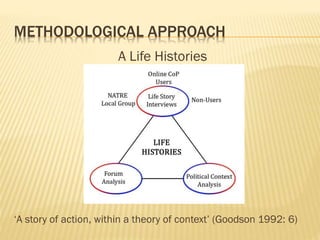
METHODOLOGICAL APPROACH
A Life Histories
‘A story of action, within a theory of context’ (Goodson 1992: 6)
LIFE HISTORY INTERVIEWS
 Purposive targeted sampling of forum users
based on number of posts users have made in
order to get a mixed picture of users.
 Random sampling of interviewees for NATRE
Local Groups and non-users based on
Culham’s database of national RE teachers.
 Likely cross-over between NATRE and forum
users – the messy reality of of group
membership and indistinct boundaries.
EMAIL INTERVIEWS
 Facilitate the long-term interviewer/ interviewee
relationships necessary for successful life-
history work.
 Allow participants more time and space to
construct their narratives.
 Provide more time and space for participant
reflexivity.
 Allow forum users to retain their online IDs
 Allow for a national study.
EMAIL INTERVIEWS ISSUES
 Maintain relationships through mutual personal
disclosure, legitimizing credentials with a
project website and short reasonably frequent
communications.
 Focus explicitly on the tension between online
and offline identities in the interview.
 Provide participants with the option of oral
interviews.
FORUM ANALYSIS
 Sampling based on life cycle of threads –
approximately 3 weeks (apart from stickies/
ongoing issues).
 A three week sample in the summer term for the
pilot.
 Three week samples taken from each term in the
main study to get a picture of the ebb and flow of
the whole academic year.
 All posts in an active thread will be taken, even if
they occur prior to the sampling period.
THE CURRENT POLITICAL CONTEXT
 Grey literature – policy documents and press
material.
 Observations of meeting of key RE
organizations (e.g. REC; Culham; St Gabriel’s).
 Elite interviews (e.g. Chair of the REC; Director
of NATRE; Director of Culham/ St Gabriel’s).
THE PILOT
 Analysis of a three-week sample of the TES RE
forum.
 Email interviews with two TES forum users.
 Email interviews with two NATRE group users.
 Ongoing contextual analysis.
 Aim to test the email interview (possibly trial a
telephone interview to compare levels of data)
MAIN STUDY
 Analysis of three (one per term over the course of
a year) three-week samples of the TES RE forum.
 Email interviews with approximately 10 TES forum
users, looking into range of experience.
 Email interviews with approximately 10 NATRE
group users.
 Email interviews with approximately 10 non-users.
 Validation of results with participants.
ANTICIPATED OUTCOMES
 Online forums are used to influence political
discourse which in turn can shape the way RE
teachers negotiate subject meaning, aims,
practice and their sense of belonging to a subject
community.
 Sectarian tendencies in the RE world may be
emphasized by online CoPs, reflected in identity
construction.
 Group membership and group boundaries are
highly complex.
NOTABLE ABSENCES
 Clarity of conceptual framework.
 Detailed interview schedule.
 Clear plan for analysis.
 Ethical discussion.

James Robson - Politics and Participation: The construction of RE teachers’ identities through online communities of practice in a time of subject change.

  • 1.
    POLITICS AND PARTICIPATION: Theconstruction of RE teachers’ identities through online communities of practice in a time of subject change. James Robson 9th May 2011
  • 2.
    WHAT IS RE? Asa result of the 1988 education reform act RE is:  A statutory subject, but locally determined.  Required to teach the principle religions represented in the UK.  Required to reflect ‘the fact that religious traditions in the UK are in the main Christian’.
  • 3.
    WHAT IS RE? Numbers of students taking RE GCSE and A Level has consistently risen since 9/11.  Nearly 60% of all students take short course GCSE RE.
  • 4.
    RE CONTRA MUNDUM RE is still seen as a ‘Cinderella subject’ and afflicted by school hierarchies and prejudice.  RE teachers frequently view themselves and their subject as victims (Sikes and Everington 2004).  RE is divided over aims, pedagogies, and the future.
  • 5.
    RE IN THECURRENT POLITICAL CONTEXT The Changing nature of RE in Schools:  The English Baccalaureate (Ebac) proposals.  Reduction in teaching time.  Reduction in academic rigor as fewer students take accredited RS courses.  Challenges to statutory requirements.
  • 6.
    RE IN THECURRENT POLITICAL CONTEXT Increasing Isolation of RE Teachers:  Isolation a frequent complaint of RE teachers.  Reduction in size of RE departments.  Erosion of LA support structures.  Reduction in CPD funding.
  • 7.
    RE IN THECURRENT POLITICAL CONTEXT Changes in Teacher Training  50% drop in ITT places.  Further reductions due to subsequent closures of courses.  Erosion of mentor networks.
  • 8.
    AIMS To provide insightinto the ongoing construction of RE teacher identity through online communities of practice at a time when RE as a subject is facing significant changes and challenges. To make recommendations on the role informal online networking might play in RE teacher CPD given the reduction of more traditional face-to-face networking options.
  • 9.
    THE TES RETEACHER FORUM  Extremely active.  Wholly RE focused.  A large number of regular contributors as well as ‘power posters’.  Micro and macro level discussions and politicking.  A vibrant online community of RE teachers.
  • 10.
    CONCEPTUAL FRAMEWORK  Rootedin socio-cultural theories of learning.  Broadly Communities of Practice as espoused by Lave and Wenger (1991) and Wenger (1998), but critically adopted.  Communities of Practice vs Affinity Spaces.
  • 11.
    RESEARCH QUESTION 1 Inwhat ways does the use of online communities of practice facilitate the construction of RE teacher identities as compared to other professional networks/ groups? a. Using Wenger’s theory of social learning as an analytical lens, several sub questions naturally emerge from this. In what ways do RE teachers express and negotiate online as compared to other professional networks/ groups:  Subject meaning;  Subject aims;  Subject practice;  A sense of belonging (to both a larger subject community and the smaller community of practice that is the focus)? b. What contextual factors might facilitate the expression and negotiation of these aspects of identity?
  • 12.
    RESEARCH QUESTION 2 Whatdistinctive benefits, if any, do RE teachers see their use of online communities of practice affording them? a. Why do RE teachers use online communities of practice? b. What benefits of such use do they report, as compared with other professional groups/ networks? c. Do RE teachers view their subject as being distinctively suited to online professional networking? d. How are the various communities, professional subject networks and groups related to each other and how do RE teachers understand and negotiate multi-group membership?
  • 13.
    RESEARCH QUESTION 3 Whatare the implications of the changing political landscape for the use of online communities of practice and the construction of RE teacher identities? This questions is asked in relation to three main areas: The changing nature of RE in schools (i.e. the likely non-inclusion of the subject in the EBac, the further reduction of space on the timetable, the legal position (statutory but not enforced), etc.). Increasing isolation of RE teachers (i.e. in terms of locality with the reduction in the number of LA RE advisors and the changing role of Local Authorities in general; and at school level with the reduction of specialist RE teachers). Changes in teacher training (i.e. the likely growth in on the job training and training schools at the expense of university based teacher education and (potentially) associated professional networks).
  • 14.
    METHODOLOGICAL APPROACH A LifeHistories ‘A story of action, within a theory of context’ (Goodson 1992: 6)
  • 15.
    LIFE HISTORY INTERVIEWS Purposive targeted sampling of forum users based on number of posts users have made in order to get a mixed picture of users.  Random sampling of interviewees for NATRE Local Groups and non-users based on Culham’s database of national RE teachers.  Likely cross-over between NATRE and forum users – the messy reality of of group membership and indistinct boundaries.
  • 16.
    EMAIL INTERVIEWS  Facilitatethe long-term interviewer/ interviewee relationships necessary for successful life- history work.  Allow participants more time and space to construct their narratives.  Provide more time and space for participant reflexivity.  Allow forum users to retain their online IDs  Allow for a national study.
  • 17.
    EMAIL INTERVIEWS ISSUES Maintain relationships through mutual personal disclosure, legitimizing credentials with a project website and short reasonably frequent communications.  Focus explicitly on the tension between online and offline identities in the interview.  Provide participants with the option of oral interviews.
  • 18.
    FORUM ANALYSIS  Samplingbased on life cycle of threads – approximately 3 weeks (apart from stickies/ ongoing issues).  A three week sample in the summer term for the pilot.  Three week samples taken from each term in the main study to get a picture of the ebb and flow of the whole academic year.  All posts in an active thread will be taken, even if they occur prior to the sampling period.
  • 19.
    THE CURRENT POLITICALCONTEXT  Grey literature – policy documents and press material.  Observations of meeting of key RE organizations (e.g. REC; Culham; St Gabriel’s).  Elite interviews (e.g. Chair of the REC; Director of NATRE; Director of Culham/ St Gabriel’s).
  • 20.
    THE PILOT  Analysisof a three-week sample of the TES RE forum.  Email interviews with two TES forum users.  Email interviews with two NATRE group users.  Ongoing contextual analysis.  Aim to test the email interview (possibly trial a telephone interview to compare levels of data)
  • 21.
    MAIN STUDY  Analysisof three (one per term over the course of a year) three-week samples of the TES RE forum.  Email interviews with approximately 10 TES forum users, looking into range of experience.  Email interviews with approximately 10 NATRE group users.  Email interviews with approximately 10 non-users.  Validation of results with participants.
  • 22.
    ANTICIPATED OUTCOMES  Onlineforums are used to influence political discourse which in turn can shape the way RE teachers negotiate subject meaning, aims, practice and their sense of belonging to a subject community.  Sectarian tendencies in the RE world may be emphasized by online CoPs, reflected in identity construction.  Group membership and group boundaries are highly complex.
  • 23.
    NOTABLE ABSENCES  Clarityof conceptual framework.  Detailed interview schedule.  Clear plan for analysis.  Ethical discussion.