
Kajang Local Plan for
Sustainable Development
INTRODUCTION
 Kajang is a town in the eastern part of Selangor, Malaysia
 Kajang is the district capital of Hulu Langat located 21
kilometers from Malaysia's capital, Kuala Lumpur
 Kajang population :342,657 in 2010
 In 2004, Kajang has grown rapidly ,new townships have been
developed
Kajang Old Town Main Junction
Vission
Producing a self reliance town with a higher
quality of living in Kajang that make up the
community , providing a healthy, productive,
meaningful life for all community residents,
present and future
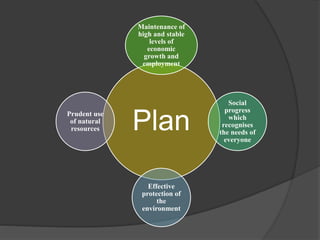
Plan
Maintenance of
high and stable
levels of
economic
growth and
employment
Social
progress
which
recognises
the needs of
everyone
Effective
protection of
the
environment
Prudent use
of natural
resources
Quality of Development
Integrating Transport and Development
Minimum environmental impact due to surge in travel
demands
Development Access: Pedestrians, disabled people, cyclists,
public. transport, private transport
Parking
Urban Design Principles
Context
Safety and Security
Landscape and Biodiversity
Renewable Energy
Air Quality
Water Quality and Drainage
1.Quality of Development
Proposed In a way that will be
able to:
a)Provide opportunities and
facilities for residents to attain
economic and social progress
b)Provide a clean pleasant access to
highy quality life
c)Create different type of public
tranpsort
d)Conserving the living
environment
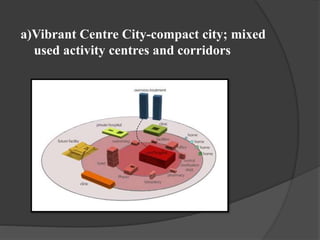
a)Vibrant Centre City-compact city; mixed
used activity centres and corridors
Proposed Development in Kajang
(Masjid as the Centre)
Activity Area
Major,Community &
Neighbourhood
Corridors
a)Urban
b)Neighbourhood
Adapted from Calgary,Canada Development
Manner in which new growth can be directed
with the Activities Centres and Corridors
 Provide concentration of Jobs and people close
to major transit facilities
 Meet the residential and employment thresholds
for each type of activity centre and corridors
 Support a concentrated built form that optimizes
public investment and infrastructure
 Provide a range of housing types,tenures, unit
sizes and affordibilty
 Are walkable and have excellent connectivity
b) Livable and vibrant City Centre
•Faster,distinctive complete community with strong sence of place
•Reinforced the stability of neighbourhood
2.Integrating Transport and
Development
a) Transit-supported landuse Framework
 Locating higher density developments and transits supportive
uses in Centres and Corridors along the Primary Network
 Ensuring Design and mix of land use in these areas
emphasing on pedestrian oriented environment and support
transit
 Managing traffic in station areas,particulary to reduce
pedestrian or vehicular conflicts
Smart Transportation Integrating Systems for More
Efficient Transportation.mp4
b)Subway or underground Metro systems Usage
 An electric passanger transport system with high
capacity and high frequency of services that totally
independent from other traffic, road or pedestrian
 The location of the subway connecting the
residential area to the commercial area at the centre
of the city and also to the Sungai Langat region.
 Currently under progress,is the Klang Valley MRT
from Sungai Buloh to Kajang.
https://www.youtube.com/watch?v=g_tAhEjw7WI
https://www.youtube.com/watch?v=bUyourDcWzw
c)Bus Rapid Transit Systems (BRT):
 Traffic light will be delayed for oncoming buses
 It will decrease the amount of time between stops
 A computer chip inside the bus signal will sensor
on the road
 Will alert the passengers at the next station if the
bus running on time
 Fair paid by using prepaid systems,reduce the
waiting time at bus stop and waiting platform are
elevated to allow for quicker entry and exit to the
bus
 The busses will travel in their own lanes which
keep the bus system independent to the congested
traffic.
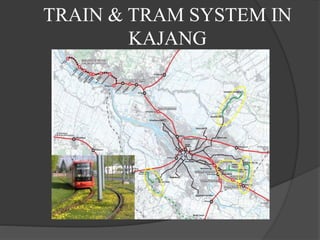
TRAIN & TRAM SYSTEM IN
KAJANG
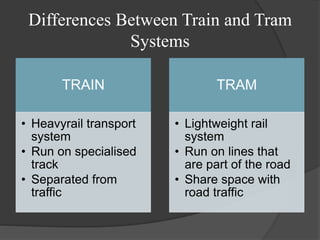
Differences Between Train and Tram
Systems
TRAIN
• Heavyrail transport
system
• Run on specialised
track
• Separated from
traffic
TRAM
• Lightweight rail
system
• Run on lines that
are part of the road
• Share space with
road traffic
TRAIN SYSTEM
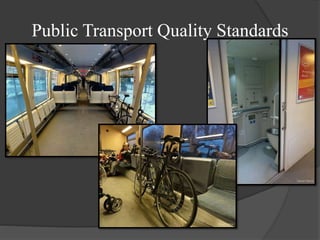
Public Transport Quality Standards
Real-time Information
TRAM SYSTEM
Adaptation from Bremen Best Practices
Advantages of Tram System in Kajang
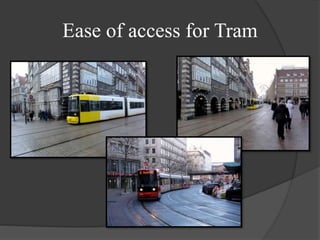
Low floor vehicles Ease of access
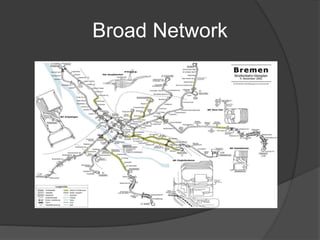
Efficient service Broad network
Low-floor Vehicles
 Convenient
 Handicapped-friendly
Ease of access
Efficient Service
Broad Network
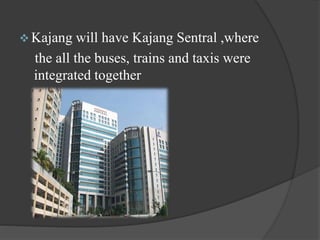
 Kajang will have Kajang Sentral ,where
the all the buses, trains and taxis were
integrated together
3.Minimum Environmental Impact
due to surge in travel demands
1) CAR BOOKING & SHARING
 Car booking can be done through call or
online system
 Various mobile points are available where
the booked car can be collected from the
nearest station (43 stations in total)
USING 1 INSTEAD OF
OWNING 1
Reduce
Parking
Demand
Reduce
the cost of
Housing
 It gives an alternative to car-ownership - and
supplements the environmentally friendly
modes of transport
 It is a kind of 'mobility insurance' for cases
when other modes are not sufficient
2) ENHANCED ENVIRONMENTAL
FRIENDLY VEHICLES (EEV)
 Emission standards for the definition of a clean vehicle
 Economic incentives to switch to more environmentally friendly
fuels will be implemented
Adaptation from Bremen Best Practices
 Clean Diesel Buses
 All new buses to fulfilled the EEV emission
standard and now almost the entire fleet
meets the EEV standard
(Enhanced Environmental Vehicles)
Clean cars
 Compressed natural gas (CNG)
- 350 CNG vehicles that results in a 60% decrease in NOx
emissions
- Partnership with gas provider
 Electric
- Partnership with energy provider
- Reduce the energy and emission of greenhouse gases
- The silent and emission free brings new possibilities for
improvement in quality of urban life.
4. Development Access: Pedestrians, disabled
people, cyclists, public transport, private
transport
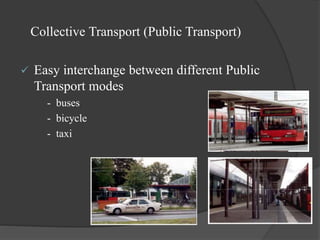
Collective Transport (Public Transport)
 Easy interchange between different Public
Transport modes
- buses
- bicycle
- taxi
Cycling /Walking– Individual Transport Modes
 The bicycle is the ultimate zero-emission-
vehicle
 ‘cycle streets’ with priority for cyclists
 Provides layers, well defined signs for people with a
visual impairment
 Infrastructure
 Cycle parking with good bicycle racks
(decentralised)
 On-street bike racks
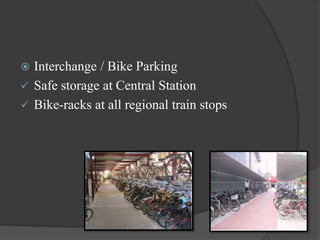
 Interchange / Bike Parking
 Safe storage at Central Station
 Bike-racks at all regional train stops
 Advantages
- reduction of space for cars
- better conditions for walking, cycling
and public transit
For Disable people
Bus Tram
Ease of access for Tram
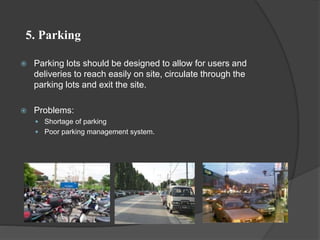
5. Parking
 Parking lots should be designed to allow for users and
deliveries to reach easily on site, circulate through the
parking lots and exit the site.
 Problems:
 Shortage of parking
 Poor parking management system.
Provide large parking area
 Propose park and ride system
 Facilities getting into the station to using public transport
 Fully accessable parking space
 Propose a multi storey park
 building designed for car parking and where there are a
number of floors or levels on which parking takes place.
 easier way to cater the parking demand and do not provide
large area
 Specialization Park for handicapped
 Parking-meter system
 duplicate parking rate during weekends to encourage people for using the
public transportation.
6. Urban Design Principle
 The combination of aspects of architecture, landscape,
public works, transportation system and public arts to create
dynamic urban environment.
 Problems :
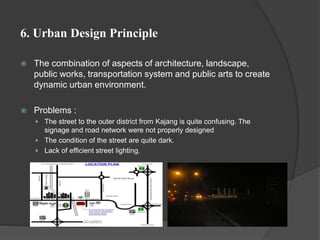
 The street to the outer district from Kajang is quite confusing. The
signage and road network were not properly designed
 The condition of the street are quite dark.
 Lack of efficient street lighting.
 Gateways are the main zones of the kajang city that could
make people realize that they were entering the kajang town.
 High quality of street lighting
 LED street lights with solar powered
 The panel helps in the absorption of the sunlight. The battery gives the
power for the LED lamp when night falls.
 Design public spaces “ Kajang theme park”
 Provide green space where there are more trees and landscaping
 Installation of fountains, sculptures, water gardens and
special lighting.
 Will create an aesthetic value
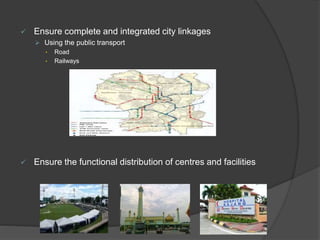
 Ensure complete and integrated city linkages
 Using the public transport
• Road
• Railways
 Ensure the functional distribution of centres and facilities
7. Context For Overall Plan
 New development should respond positively and integrate
well with its surroundings, taking full account of site features
and local character.
 Strategies for the overall design character of a proposal, to
be attractive and function well
 Respecting the local site
 Responding to the site
 Creating attractive surroundings and spaces to live
 Respecting the local site
 Respecting existing development patterns should not rule out different forms of
layout.
 Can help to provide variety, inject character and ensure that land within the
established boundaries of towns and villages is used efficiently.
 Responding to the site
 New development should respond positively to existing local landscape features,
including established patterns of fields or gardens, trees, ponds and ditches.
 Provide a framework for new development, that will help to integrate it into its
surroundings
 Creating attractive surroundings and spaces to live
 The existing pattern of development within an area; can provide a good starting
point for the layout of new buildings and spaces.
 Incorporating elements of existing local building patterns into the structure of new
developments can help to give them a clear identity and a sense of belonging.
8. Security and Safety
 A critical component and integral part of sustainability.
 This element is often not explicitly recognized.
 Problems :
 Many illegal residents that live at Kajang.
 High crime cases : robbery, snatch thieve and pickpocket
 Provide sufficient police stations, police posts and police
patrols
 Place the closed-circuit television (CCTV) at the place that
always happen crime activities
 Build overhead bridge or zebra crossing for pedestrians
 The resident cooperation to help people when they are in
difficult situation.
9.Landscape &
Biodiversity
Green-roofing system
 Varied substrate
depths to create
different habitats
 Planting a variety of
vegetation types
 Plant a particular
species of flora that
target species of
fauna
Vegetated wall structures
Curb
10.Renewable Energy
 Sunlight, or solar energy, can be used
directly for lighting homes and other
buildings, for generating electricity, and
for hot water heating, solar cooling, and
a variety of commercial and industrial
uses.
 The sun's heat also drives the winds,
whose energy, is captured with wind
turbines.
Solar Energy
11.Air Quality
 The improvement of air quality in Kajang
are dependent upon the other
sustainable development and is the
result of different cumulative efforts.
12.Water Quality &
Drainage
Urban water
management
Water
recycling &
irrigation
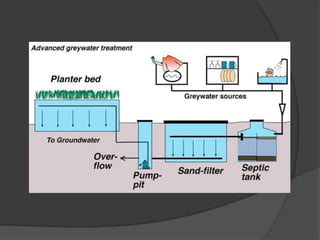
Grey water
recycling
CONCLUSION
 The redevelopment of a city requires a holistic
approach that encompasses all aspects of the
development
 The Kajang Municipal Council will need to reuse
the lands in the most efficient way
 Building at higher densities and with compact
layouts maximizes the use of land and reduces the
need to travel by car
Prepared for:
Prof. Ir. Dr. RIZAATIQ ABDULLAH BIN O.K.
RAHMAT
Dr. MUHAMAD NAZRI BIN BORHAN
Dr. Puan NORLIZA BINTI MOHD AKHIR

KAJANG LOCAL PLAN PROPOSAL/RESHMINDER KAUR

  • 1.
    Kajang Local Planfor Sustainable Development
  • 2.
    INTRODUCTION  Kajang isa town in the eastern part of Selangor, Malaysia  Kajang is the district capital of Hulu Langat located 21 kilometers from Malaysia's capital, Kuala Lumpur  Kajang population :342,657 in 2010  In 2004, Kajang has grown rapidly ,new townships have been developed Kajang Old Town Main Junction
  • 3.
    Vission Producing a selfreliance town with a higher quality of living in Kajang that make up the community , providing a healthy, productive, meaningful life for all community residents, present and future
  • 4.
    Plan Maintenance of high andstable levels of economic growth and employment Social progress which recognises the needs of everyone Effective protection of the environment Prudent use of natural resources
  • 5.
    Quality of Development IntegratingTransport and Development Minimum environmental impact due to surge in travel demands Development Access: Pedestrians, disabled people, cyclists, public. transport, private transport Parking Urban Design Principles Context Safety and Security Landscape and Biodiversity Renewable Energy Air Quality Water Quality and Drainage
  • 6.
    1.Quality of Development ProposedIn a way that will be able to: a)Provide opportunities and facilities for residents to attain economic and social progress b)Provide a clean pleasant access to highy quality life c)Create different type of public tranpsort d)Conserving the living environment
  • 7.
    a)Vibrant Centre City-compactcity; mixed used activity centres and corridors
  • 8.
    Proposed Development inKajang (Masjid as the Centre)
  • 11.
  • 12.
    Manner in whichnew growth can be directed with the Activities Centres and Corridors  Provide concentration of Jobs and people close to major transit facilities  Meet the residential and employment thresholds for each type of activity centre and corridors  Support a concentrated built form that optimizes public investment and infrastructure  Provide a range of housing types,tenures, unit sizes and affordibilty  Are walkable and have excellent connectivity
  • 13.
    b) Livable andvibrant City Centre •Faster,distinctive complete community with strong sence of place •Reinforced the stability of neighbourhood
  • 14.
    2.Integrating Transport and Development a)Transit-supported landuse Framework  Locating higher density developments and transits supportive uses in Centres and Corridors along the Primary Network  Ensuring Design and mix of land use in these areas emphasing on pedestrian oriented environment and support transit  Managing traffic in station areas,particulary to reduce pedestrian or vehicular conflicts
  • 15.
    Smart Transportation IntegratingSystems for More Efficient Transportation.mp4
  • 16.
    b)Subway or undergroundMetro systems Usage  An electric passanger transport system with high capacity and high frequency of services that totally independent from other traffic, road or pedestrian  The location of the subway connecting the residential area to the commercial area at the centre of the city and also to the Sungai Langat region.  Currently under progress,is the Klang Valley MRT from Sungai Buloh to Kajang. https://www.youtube.com/watch?v=g_tAhEjw7WI https://www.youtube.com/watch?v=bUyourDcWzw
  • 17.
    c)Bus Rapid TransitSystems (BRT):  Traffic light will be delayed for oncoming buses  It will decrease the amount of time between stops  A computer chip inside the bus signal will sensor on the road  Will alert the passengers at the next station if the bus running on time  Fair paid by using prepaid systems,reduce the waiting time at bus stop and waiting platform are elevated to allow for quicker entry and exit to the bus  The busses will travel in their own lanes which keep the bus system independent to the congested traffic.
  • 18.
    TRAIN & TRAMSYSTEM IN KAJANG
  • 19.
    Differences Between Trainand Tram Systems TRAIN • Heavyrail transport system • Run on specialised track • Separated from traffic TRAM • Lightweight rail system • Run on lines that are part of the road • Share space with road traffic
  • 20.
  • 21.
  • 22.
  • 23.
    TRAM SYSTEM Adaptation fromBremen Best Practices
  • 24.
    Advantages of TramSystem in Kajang Low floor vehicles Ease of access Efficient service Broad network
  • 25.
  • 26.
  • 27.
  • 28.
  • 29.
     Kajang willhave Kajang Sentral ,where the all the buses, trains and taxis were integrated together
  • 30.
    3.Minimum Environmental Impact dueto surge in travel demands
  • 31.
    1) CAR BOOKING& SHARING  Car booking can be done through call or online system  Various mobile points are available where the booked car can be collected from the nearest station (43 stations in total)
  • 32.
    USING 1 INSTEADOF OWNING 1 Reduce Parking Demand Reduce the cost of Housing
  • 33.
     It givesan alternative to car-ownership - and supplements the environmentally friendly modes of transport  It is a kind of 'mobility insurance' for cases when other modes are not sufficient
  • 34.
    2) ENHANCED ENVIRONMENTAL FRIENDLYVEHICLES (EEV)  Emission standards for the definition of a clean vehicle  Economic incentives to switch to more environmentally friendly fuels will be implemented Adaptation from Bremen Best Practices
  • 35.
     Clean DieselBuses  All new buses to fulfilled the EEV emission standard and now almost the entire fleet meets the EEV standard (Enhanced Environmental Vehicles)
  • 36.
    Clean cars  Compressednatural gas (CNG) - 350 CNG vehicles that results in a 60% decrease in NOx emissions - Partnership with gas provider  Electric - Partnership with energy provider - Reduce the energy and emission of greenhouse gases - The silent and emission free brings new possibilities for improvement in quality of urban life.
  • 37.
    4. Development Access:Pedestrians, disabled people, cyclists, public transport, private transport
  • 38.
    Collective Transport (PublicTransport)  Easy interchange between different Public Transport modes - buses - bicycle - taxi
  • 39.
    Cycling /Walking– IndividualTransport Modes  The bicycle is the ultimate zero-emission- vehicle  ‘cycle streets’ with priority for cyclists  Provides layers, well defined signs for people with a visual impairment
  • 40.
     Infrastructure  Cycleparking with good bicycle racks (decentralised)  On-street bike racks
  • 41.
     Interchange /Bike Parking  Safe storage at Central Station  Bike-racks at all regional train stops
  • 42.
     Advantages - reductionof space for cars - better conditions for walking, cycling and public transit
  • 43.
  • 44.
  • 45.
    5. Parking  Parkinglots should be designed to allow for users and deliveries to reach easily on site, circulate through the parking lots and exit the site.  Problems:  Shortage of parking  Poor parking management system.
  • 46.
    Provide large parkingarea  Propose park and ride system  Facilities getting into the station to using public transport  Fully accessable parking space  Propose a multi storey park  building designed for car parking and where there are a number of floors or levels on which parking takes place.  easier way to cater the parking demand and do not provide large area
  • 47.
     Specialization Parkfor handicapped  Parking-meter system  duplicate parking rate during weekends to encourage people for using the public transportation.
  • 48.
    6. Urban DesignPrinciple  The combination of aspects of architecture, landscape, public works, transportation system and public arts to create dynamic urban environment.  Problems :  The street to the outer district from Kajang is quite confusing. The signage and road network were not properly designed  The condition of the street are quite dark.  Lack of efficient street lighting.
  • 49.
     Gateways arethe main zones of the kajang city that could make people realize that they were entering the kajang town.  High quality of street lighting  LED street lights with solar powered  The panel helps in the absorption of the sunlight. The battery gives the power for the LED lamp when night falls.
  • 50.
     Design publicspaces “ Kajang theme park”  Provide green space where there are more trees and landscaping  Installation of fountains, sculptures, water gardens and special lighting.  Will create an aesthetic value
  • 51.
     Ensure completeand integrated city linkages  Using the public transport • Road • Railways  Ensure the functional distribution of centres and facilities
  • 52.
    7. Context ForOverall Plan  New development should respond positively and integrate well with its surroundings, taking full account of site features and local character.  Strategies for the overall design character of a proposal, to be attractive and function well  Respecting the local site  Responding to the site  Creating attractive surroundings and spaces to live
  • 53.
     Respecting thelocal site  Respecting existing development patterns should not rule out different forms of layout.  Can help to provide variety, inject character and ensure that land within the established boundaries of towns and villages is used efficiently.  Responding to the site  New development should respond positively to existing local landscape features, including established patterns of fields or gardens, trees, ponds and ditches.  Provide a framework for new development, that will help to integrate it into its surroundings  Creating attractive surroundings and spaces to live  The existing pattern of development within an area; can provide a good starting point for the layout of new buildings and spaces.  Incorporating elements of existing local building patterns into the structure of new developments can help to give them a clear identity and a sense of belonging.
  • 54.
    8. Security andSafety  A critical component and integral part of sustainability.  This element is often not explicitly recognized.  Problems :  Many illegal residents that live at Kajang.  High crime cases : robbery, snatch thieve and pickpocket
  • 55.
     Provide sufficientpolice stations, police posts and police patrols  Place the closed-circuit television (CCTV) at the place that always happen crime activities
  • 56.
     Build overheadbridge or zebra crossing for pedestrians  The resident cooperation to help people when they are in difficult situation.
  • 58.
  • 59.
    Green-roofing system  Variedsubstrate depths to create different habitats  Planting a variety of vegetation types  Plant a particular species of flora that target species of fauna
  • 60.
  • 61.
  • 62.
    10.Renewable Energy  Sunlight,or solar energy, can be used directly for lighting homes and other buildings, for generating electricity, and for hot water heating, solar cooling, and a variety of commercial and industrial uses.  The sun's heat also drives the winds, whose energy, is captured with wind turbines.
  • 63.
  • 66.
    11.Air Quality  Theimprovement of air quality in Kajang are dependent upon the other sustainable development and is the result of different cumulative efforts.
  • 67.
  • 69.
  • 72.
    CONCLUSION  The redevelopmentof a city requires a holistic approach that encompasses all aspects of the development  The Kajang Municipal Council will need to reuse the lands in the most efficient way  Building at higher densities and with compact layouts maximizes the use of land and reduces the need to travel by car
  • 73.
    Prepared for: Prof. Ir.Dr. RIZAATIQ ABDULLAH BIN O.K. RAHMAT Dr. MUHAMAD NAZRI BIN BORHAN Dr. Puan NORLIZA BINTI MOHD AKHIR