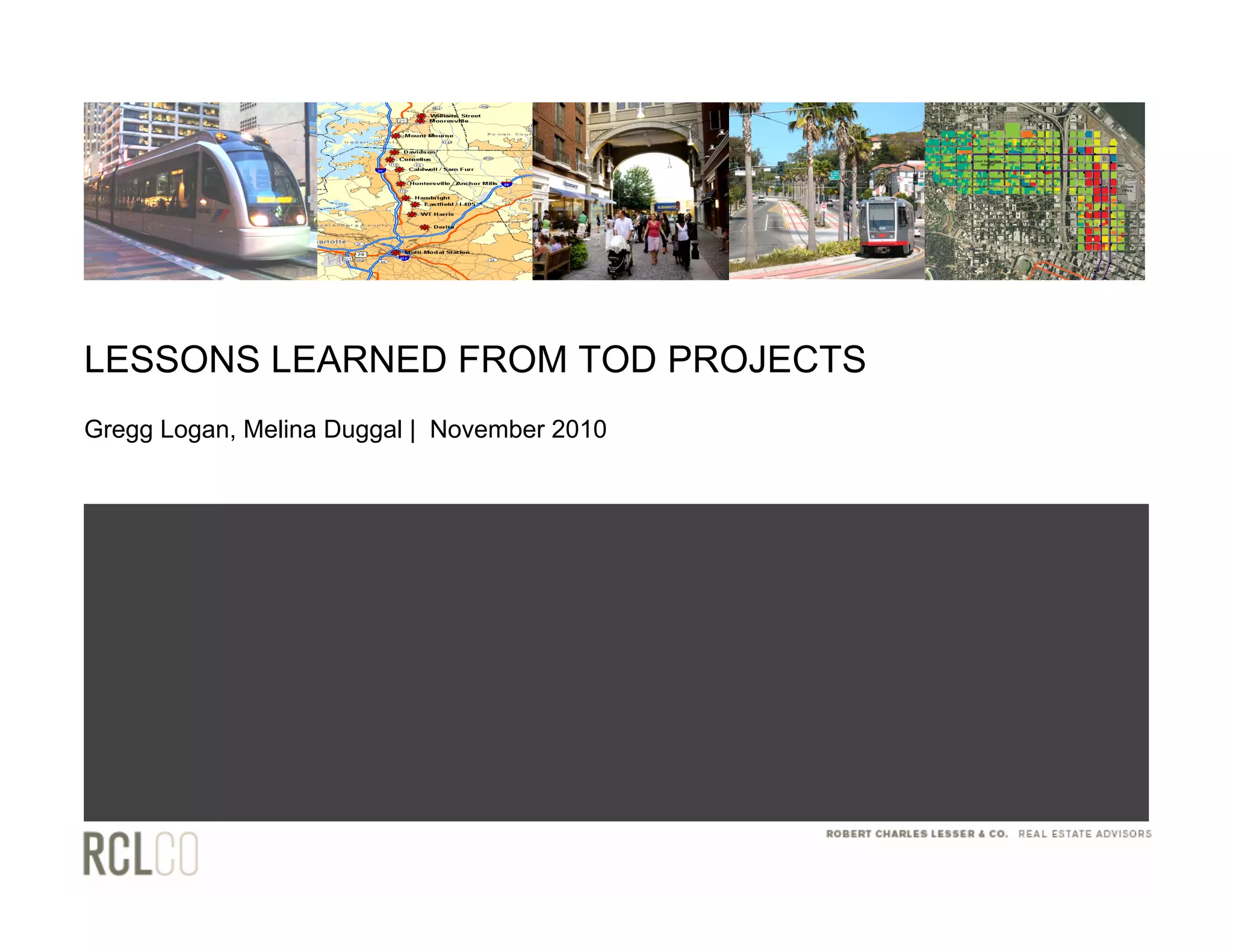
LESSONS LEARNED FROM TOD PROJECTS
Gregg Logan, Melina Duggal | November 2010
DEFINING TOD
       Mixed–use community (e.g. residential, retail, office, civic, park) within
        +/- 2000-ft walk to transit stop
       Walkable environment
       Convenient for multimodal travel for residents and employees
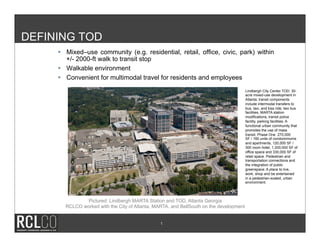
                                                                                        Lindbergh City Center TOD: 30-
                                                                                        acre mixed-use development in
                                                                                        Atlanta; transit components
                                                                                        include intermodal transfers to
                                                                                        bus, taxi, and kiss ride; two bus
                                                                                        facilities, MARTA station
                                                                                        modifications, transit police
                                                                                        facility, parking facilities. A
                                                                                        functional urban community that
                                                                                        promotes the use of mass
                                                                                        transit. Phase One 270,000
                                                                                        SF / 160 units of condominiums
                                                                                        and apartments, 120,000 SF /
                                                                                        300 room hotel, 1,200,000 SF of
                                                                                        office space and 330,000 SF of
                                                                                        retail space. Pedestrian and
                                                                                        transportation connections and
                                                                                        the integration of public
                                                                                        greenspace. A place to live,
                                                                                        work, shop and be entertained
                                                                                        in a pedestrian-scaled, urban
                                                                                        environment.


              Pictured: Lindbergh MARTA Station and TOD, Atlanta Georgia
       RCLCO worked with the City of Atlanta, MARTA, and BellSouth on the development


                                                1
PROPERTY VALUES
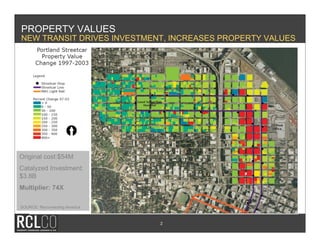
NEW TRANSIT DRIVES INVESTMENT, INCREASES PROPERTY VALUES


Original cost:$54M
Catalyzed Investment:
$3.8B
Multiplier: 74X

SOURCE: Reconnecting America


                               2
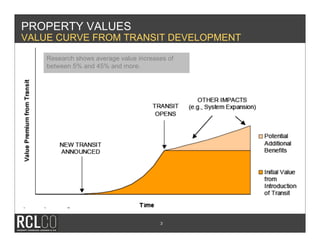
PROPERTY VALUES
VALUE CURVE FROM TRANSIT DEVELOPMENT

    Research shows average value increases of
    between 5% and 45% and more.


                                        3
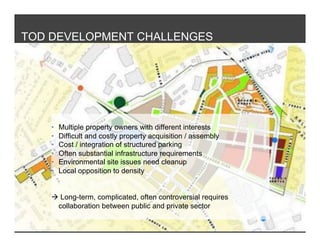
TOD DEVELOPMENT CHALLENGES


    •    Multiple property owners with different interests
    •    Difficult and costly property acquisition / assembly
    •    Cost / integration of structured parking
    •    Often substantial infrastructure requirements
    •    Environmental site issues need cleanup
    •    Local opposition to density


     Long-term, complicated, often controversial requires
     collaboration between public and private sector

                                         4
DEFINING THE OPPORTUNITY
MARKET, PRODUCTS, FINANCIAL, FISCAL, ECONOMIC

     •  Land Area: How much land, what are the opportunities and
        constraints (topo, access, environmental, improvements, …)?

     •  Market Demand: Based on economic/demographic outlook,
        competitive picture, what is the unmet demand for space
        (residential, retail, office, hospitality, industrial, …)?

     •  Financial Feasibility: How do projected revenues stack up against
        development costs, what subsidies are required, what impact can
        be expected on land values relative to current values?

     •  Fiscal and Economic Impact: Considering higher tax revenues
        but also higher cost of public services, what is the net fiscal
        impact (benefit) over the next 10, 20, 30 years relative to what’s
        there? How many jobs will be created?

     •  Program and Phasing: How do market demand and financial
        feasibility translate into a logical program and phasing plan for
        the next 10, 20, 30 years?


                                        5
CASE STUDY
EXPERIENCE IN CHARLOTTE
 •  Projects:
    •  Provision of Market and Economic Guidance into Allocations of Future Growth in
       Mecklenburg County, North Carolina for the Charlotte Department of Transportation
     •  Long-term transportation planning, helping Charlotte DOT) was understand the share of future
        growth that could be shifted over the next 25 years, via proactive policies, to locations more easily
        served by mass transportation corridors, and existing transportation infrastructure. December
        2004.


   •  Market and Build-out Analysis for the Third and Fourth Ward for the Charlotte-
      Mecklenburg Planning Commission and Charlotte Area Transit System (CATS)
     •  Provided market guidance relative to the Third and Fourth Ward neighborhoods in context of the
        planned Multi-Modal Station (MMS) between these two urban neighborhoods and the need to plan
        appropriately around the station. December 2004.


   •  Charlotte North Corridor TOD Station Analysis for The Charlotte-Mecklenburg Planning
      Commission and CATS
     •  Provided market guidance into future development potential at each station area along the
        planned North Corridor Light Rail Transit line.
     •  Assisted in selections of alternative station(s) or corridor alignment(s) opportunities as well as
        assisted planners and other government entities in planning long-term for development around
        each station location. January 2006.


                                                      6
DEFINING THE OPPORTUNITY
WHAT HAVE WE LEARNED

 •  All TODs are not the same

 •  Market potential around stations is still market-driven
   •  E.g. retail still needs good auto access
   •  More successful in the “favored” corridor of growth
   •  Certain land uses are more compatible with TOD than others

 •  However, TOD can change demographic and market patterns

 •  Pricing premiums for office and residential uses

 •  Reduced parking – cost saving possibilities

 •  High public sector expectations versus difficulty to serve all target markets

 •  Station design and integration

 •  Policies are not always in place that would allow for TOD-style development


                                           7
CHARLOTTE EXAMPLE


SOURCE: CATS


                     8
CHARLOTTE EXAMPLE


SOURCE: CATS


                     9
CHARLOTTE EXAMPLE


SOURCE: CATS


                     10
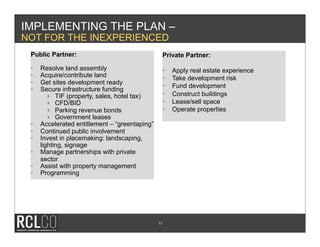
IMPLEMENTING THE PLAN –
NOT FOR THE INEXPERIENCED
 Public Partner:                                 Private Partner:

 •    Resolve land assembly                      •    Apply real estate experience
 •    Acquire/contribute land                    •    Take development risk
 •    Get sites development ready
                                                 •    Fund development
 •    Secure infrastructure funding
           TIF (property, sales, hotel tax)     •    Construct buildings
           CFD/BID                              •    Lease/sell space
           Parking revenue bonds                •    Operate properties
           Government leases
 •    Accelerated entitlement – “greentaping”
 •    Continued public involvement
 •    Invest in placemaking: landscaping,
      lighting, signage
 •    Manage partnerships with private
      sector
 •    Assist with property management
 •    Programming


                                                11
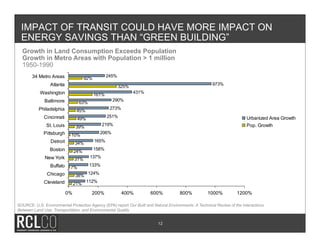
IMPACT OF TRANSIT COULD HAVE MORE IMPACT ON
  ENERGY SAVINGS THAN “GREEN BUILDING”
  Growth in Land Consumption Exceeds Population
  Growth in Metro Areas with Population > 1 million
  1950-1990
       34 Metro Areas                              245%
                                      92%
                 Atlanta                                                                                973%
                                                          325%
            Washington                                           431%
                                            161%
              Baltimore                               290%
                                  63%
           Philadelphia                             273%
                                 45%
              Cincinnati                           251%                                                                   Urbanized Area Growth
                                 49%
               St. Louis                       219%                                                                       Pop. Growth
                                39%
              Pittsburgh                       206%
                            10%
                 Detroit                    165%
                                34%
                 Boston                     158%
                                24%
              New York                  137%
                                31%
                 Buffalo                133%
                            7%
               Chicago                  124%
                                38%
              Cleveland                112%
                                21%

                           0%            200%              400%         600%           800%          1000%           1200%

SOURCE: U.S. Environmental Protection Agency (EPA) report Our Built and Natural Environments: A Technical Review of the Interactions
Between Land Use, Transportation, and Environmental Quality


                                                                           12
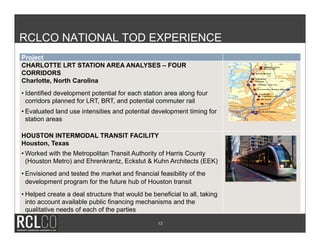
RCLCO NATIONAL TOD EXPERIENCE
Project
CHARLOTTE LRT STATION AREA ANALYSES – FOUR
CORRIDORS
Charlotte, North Carolina
• Identified development potential for each station area along four
  corridors planned for LRT, BRT, and potential commuter rail
• Evaluated land use intensities and potential development timing for
  station areas

HOUSTON INTERMODAL TRANSIT FACILITY
Houston, Texas
• Worked with the Metropolitan Transit Authority of Harris County
  (Houston Metro) and Ehrenkrantz, Eckstut & Kuhn Architects (EEK)
• Envisioned and tested the market and financial feasibility of the
  development program for the future hub of Houston transit
• Helped create a deal structure that would be beneficial to all, taking
  into account available public financing mechanisms and the
  qualitative needs of each of the parties

                                                  13
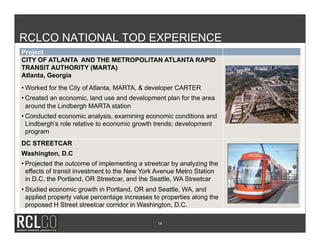
RCLCO NATIONAL TOD EXPERIENCE
Project
CITY OF ATLANTA AND THE METROPOLITAN ATLANTA RAPID
TRANSIT AUTHORITY (MARTA)
Atlanta, Georgia
• Worked for the City of Atlanta, MARTA, & developer CARTER
• Created an economic, land use and development plan for the area
  around the Lindbergh MARTA station
• Conducted economic analysis, examining economic conditions and
  Lindbergh’s role relative to economic growth trends; development
  program
DC STREETCAR
Washington, D.C
• Projected the outcome of implementing a streetcar by analyzing the
  effects of transit investment to the New York Avenue Metro Station
  in D.C, the Portland, OR Streetcar, and the Seattle, WA Streetcar
• Studied economic growth in Portland, OR and Seattle, WA, and
  applied property value percentage increases to properties along the
  proposed H Street streetcar corridor in Washington, D.C.

                                               14
RCLCO NATIONAL TOD EXPERIENCE
Project
ORLANDO AND TAMPA REGIONAL EMPLOYMENT CENTERS
ANALYSIS
“CONNECTING FOR GLOBAL COMPETITIVENESS PROJECT”
Central Florida
• Completed a Metro Center analysis for all of Central Florida
• Understood regional growth trends and how they impact the location
  of future jobs
• Analyzed the impact of transit on potential future Metro Cores

INTERNATIONAL CORPORATE PARK AND INNOVATION WAY
Orange County, Florida
•  Studied impact of future commuter, light rail, and BRT
• Quantified potential impact of transit
• Programmed communities based upon future transit opportunities
• Analysis of DOT requirements for TOD and their impact
• Considered the impact of an MMTD on the projects


                                                15
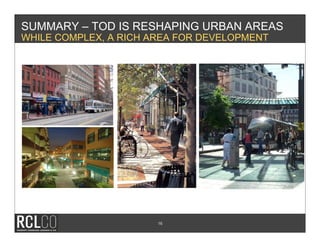
SUMMARY – TOD IS RESHAPING URBAN AREAS
WHILE COMPLEX, A RICH AREA FOR DEVELOPMENT


                       16

Transit Oriented Development

  • 1.
    LESSONS LEARNED FROMTOD PROJECTS Gregg Logan, Melina Duggal | November 2010
  • 2.
    DEFINING TOD   Mixed–use community (e.g. residential, retail, office, civic, park) within +/- 2000-ft walk to transit stop   Walkable environment   Convenient for multimodal travel for residents and employees Lindbergh City Center TOD: 30- acre mixed-use development in Atlanta; transit components include intermodal transfers to bus, taxi, and kiss ride; two bus facilities, MARTA station modifications, transit police facility, parking facilities. A functional urban community that promotes the use of mass transit. Phase One 270,000 SF / 160 units of condominiums and apartments, 120,000 SF / 300 room hotel, 1,200,000 SF of office space and 330,000 SF of retail space. Pedestrian and transportation connections and the integration of public greenspace. A place to live, work, shop and be entertained in a pedestrian-scaled, urban environment. Pictured: Lindbergh MARTA Station and TOD, Atlanta Georgia RCLCO worked with the City of Atlanta, MARTA, and BellSouth on the development 1
  • 3.
    PROPERTY VALUES NEW TRANSITDRIVES INVESTMENT, INCREASES PROPERTY VALUES Original cost:$54M Catalyzed Investment: $3.8B Multiplier: 74X SOURCE: Reconnecting America 2
  • 4.
    PROPERTY VALUES VALUE CURVEFROM TRANSIT DEVELOPMENT Research shows average value increases of between 5% and 45% and more. 3
  • 5.
    TOD DEVELOPMENT CHALLENGES •  Multiple property owners with different interests •  Difficult and costly property acquisition / assembly •  Cost / integration of structured parking •  Often substantial infrastructure requirements •  Environmental site issues need cleanup •  Local opposition to density  Long-term, complicated, often controversial requires collaboration between public and private sector 4
  • 6.
    DEFINING THE OPPORTUNITY MARKET,PRODUCTS, FINANCIAL, FISCAL, ECONOMIC •  Land Area: How much land, what are the opportunities and constraints (topo, access, environmental, improvements, …)? •  Market Demand: Based on economic/demographic outlook, competitive picture, what is the unmet demand for space (residential, retail, office, hospitality, industrial, …)? •  Financial Feasibility: How do projected revenues stack up against development costs, what subsidies are required, what impact can be expected on land values relative to current values? •  Fiscal and Economic Impact: Considering higher tax revenues but also higher cost of public services, what is the net fiscal impact (benefit) over the next 10, 20, 30 years relative to what’s there? How many jobs will be created? •  Program and Phasing: How do market demand and financial feasibility translate into a logical program and phasing plan for the next 10, 20, 30 years? 5
  • 7.
    CASE STUDY EXPERIENCE INCHARLOTTE •  Projects: •  Provision of Market and Economic Guidance into Allocations of Future Growth in Mecklenburg County, North Carolina for the Charlotte Department of Transportation •  Long-term transportation planning, helping Charlotte DOT) was understand the share of future growth that could be shifted over the next 25 years, via proactive policies, to locations more easily served by mass transportation corridors, and existing transportation infrastructure. December 2004. •  Market and Build-out Analysis for the Third and Fourth Ward for the Charlotte- Mecklenburg Planning Commission and Charlotte Area Transit System (CATS) •  Provided market guidance relative to the Third and Fourth Ward neighborhoods in context of the planned Multi-Modal Station (MMS) between these two urban neighborhoods and the need to plan appropriately around the station. December 2004. •  Charlotte North Corridor TOD Station Analysis for The Charlotte-Mecklenburg Planning Commission and CATS •  Provided market guidance into future development potential at each station area along the planned North Corridor Light Rail Transit line. •  Assisted in selections of alternative station(s) or corridor alignment(s) opportunities as well as assisted planners and other government entities in planning long-term for development around each station location. January 2006. 6
  • 8.
    DEFINING THE OPPORTUNITY WHATHAVE WE LEARNED •  All TODs are not the same •  Market potential around stations is still market-driven •  E.g. retail still needs good auto access •  More successful in the “favored” corridor of growth •  Certain land uses are more compatible with TOD than others •  However, TOD can change demographic and market patterns •  Pricing premiums for office and residential uses •  Reduced parking – cost saving possibilities •  High public sector expectations versus difficulty to serve all target markets •  Station design and integration •  Policies are not always in place that would allow for TOD-style development 7
  • 9.
  • 10.
  • 11.
  • 12.
    IMPLEMENTING THE PLAN– NOT FOR THE INEXPERIENCED Public Partner: Private Partner: •  Resolve land assembly •  Apply real estate experience •  Acquire/contribute land •  Take development risk •  Get sites development ready •  Fund development •  Secure infrastructure funding   TIF (property, sales, hotel tax) •  Construct buildings   CFD/BID •  Lease/sell space   Parking revenue bonds •  Operate properties   Government leases •  Accelerated entitlement – “greentaping” •  Continued public involvement •  Invest in placemaking: landscaping, lighting, signage •  Manage partnerships with private sector •  Assist with property management •  Programming 11
  • 13.
    IMPACT OF TRANSITCOULD HAVE MORE IMPACT ON ENERGY SAVINGS THAN “GREEN BUILDING” Growth in Land Consumption Exceeds Population Growth in Metro Areas with Population > 1 million 1950-1990 34 Metro Areas 245% 92% Atlanta 973% 325% Washington 431% 161% Baltimore 290% 63% Philadelphia 273% 45% Cincinnati 251% Urbanized Area Growth 49% St. Louis 219% Pop. Growth 39% Pittsburgh 206% 10% Detroit 165% 34% Boston 158% 24% New York 137% 31% Buffalo 133% 7% Chicago 124% 38% Cleveland 112% 21% 0% 200% 400% 600% 800% 1000% 1200% SOURCE: U.S. Environmental Protection Agency (EPA) report Our Built and Natural Environments: A Technical Review of the Interactions Between Land Use, Transportation, and Environmental Quality 12
  • 14.
    RCLCO NATIONAL TODEXPERIENCE Project CHARLOTTE LRT STATION AREA ANALYSES – FOUR CORRIDORS Charlotte, North Carolina • Identified development potential for each station area along four corridors planned for LRT, BRT, and potential commuter rail • Evaluated land use intensities and potential development timing for station areas HOUSTON INTERMODAL TRANSIT FACILITY Houston, Texas • Worked with the Metropolitan Transit Authority of Harris County (Houston Metro) and Ehrenkrantz, Eckstut & Kuhn Architects (EEK) • Envisioned and tested the market and financial feasibility of the development program for the future hub of Houston transit • Helped create a deal structure that would be beneficial to all, taking into account available public financing mechanisms and the qualitative needs of each of the parties 13
  • 15.
    RCLCO NATIONAL TODEXPERIENCE Project CITY OF ATLANTA AND THE METROPOLITAN ATLANTA RAPID TRANSIT AUTHORITY (MARTA) Atlanta, Georgia • Worked for the City of Atlanta, MARTA, & developer CARTER • Created an economic, land use and development plan for the area around the Lindbergh MARTA station • Conducted economic analysis, examining economic conditions and Lindbergh’s role relative to economic growth trends; development program DC STREETCAR Washington, D.C • Projected the outcome of implementing a streetcar by analyzing the effects of transit investment to the New York Avenue Metro Station in D.C, the Portland, OR Streetcar, and the Seattle, WA Streetcar • Studied economic growth in Portland, OR and Seattle, WA, and applied property value percentage increases to properties along the proposed H Street streetcar corridor in Washington, D.C. 14
  • 16.
    RCLCO NATIONAL TODEXPERIENCE Project ORLANDO AND TAMPA REGIONAL EMPLOYMENT CENTERS ANALYSIS “CONNECTING FOR GLOBAL COMPETITIVENESS PROJECT” Central Florida • Completed a Metro Center analysis for all of Central Florida • Understood regional growth trends and how they impact the location of future jobs • Analyzed the impact of transit on potential future Metro Cores INTERNATIONAL CORPORATE PARK AND INNOVATION WAY Orange County, Florida •  Studied impact of future commuter, light rail, and BRT • Quantified potential impact of transit • Programmed communities based upon future transit opportunities • Analysis of DOT requirements for TOD and their impact • Considered the impact of an MMTD on the projects 15
  • 17.
    SUMMARY – TODIS RESHAPING URBAN AREAS WHILE COMPLEX, A RICH AREA FOR DEVELOPMENT 16