CAREER POINT UNIVERSITY
PRESENTATION ON
Speed control of DC motor using Three-
Phase Full-Wave-Converter Drives
Introduction: DC Motor Drives
• Controlled rectifiers provide a variable dc output voltage from a fixed ac
voltage, whereas a dc-dc converter can provide a variable dc voltage from
a fixed dc voltage.
• Due to their ability to supply a continuously variable dc voltage,
controlled rectifiers and dc-dc converters made a revolution in modern
industrial control equipment and variable-speed drives, with power levels
ranging from fractional horsepower to several megawatts.
• Controlled rectifiers are generally used for the speed control of dc motors.
• The alternative form would be a diode rectifier followed by dc-dc
converter.
• DC drives can be classified, in general, into three types:
– 1. Single-phase drives
– 2. Three-phase drives
– 3. DC-DC converter drives
Three-Phase Drives
• The armature circuit is connected to the output of a three-phase
controlled rectifier.
• Three-phase drives are used for high-power applications up to
megawatt power levels.
• The ripple frequency of the armature voltage is higher than that of
single-phase drives and it requires less inductance in the armature
circuit to reduce the armature ripple current.
• The armature current is mostly continuous, and therefore the motor
performance is better compared with that of single-phase drives.
• Similar to the single-phase drives, three-phase drives may also be
subdivided into:
– Three-phase half-wave-converter drives.
– Three-phase semiconverter drives.
– Three-phase full-converter drives.
– Three-phase dual-converter drives.
Three-Phase Full-Wave-Converter Drives
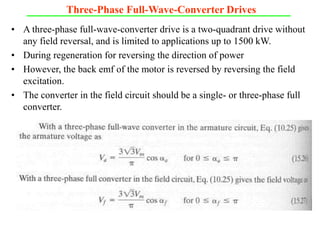
• A three-phase full-wave-converter drive is a two-quadrant drive without
any field reversal, and is limited to applications up to 1500 kW.
• During regeneration for reversing the direction of power
• However, the back emf of the motor is reversed by reversing the field
excitation.
• The converter in the field circuit should be a single- or three-phase full
converter.
Diagram
Result
Result
Discription
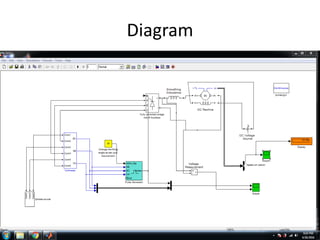
1. Three phase fully controlled bridge rectifier
with 6 thyristores.
2. Change the firing angle using 6-pulse
genreator.
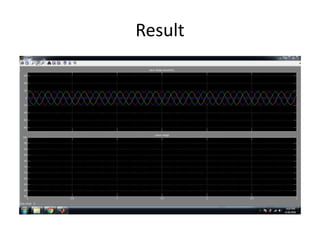
3. Voltmeter is used for measuring phase
voltages.
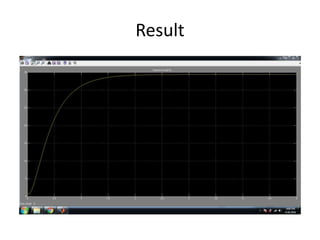
4. As the firing angle is increased speed of the
DC machine is decreased.
K10715 control thory ankit verma

K10715 control thory ankit verma

  • 1.
    CAREER POINT UNIVERSITY PRESENTATIONON Speed control of DC motor using Three- Phase Full-Wave-Converter Drives
  • 2.
    Introduction: DC MotorDrives • Controlled rectifiers provide a variable dc output voltage from a fixed ac voltage, whereas a dc-dc converter can provide a variable dc voltage from a fixed dc voltage. • Due to their ability to supply a continuously variable dc voltage, controlled rectifiers and dc-dc converters made a revolution in modern industrial control equipment and variable-speed drives, with power levels ranging from fractional horsepower to several megawatts. • Controlled rectifiers are generally used for the speed control of dc motors. • The alternative form would be a diode rectifier followed by dc-dc converter. • DC drives can be classified, in general, into three types: – 1. Single-phase drives – 2. Three-phase drives – 3. DC-DC converter drives
  • 3.
    Three-Phase Drives • Thearmature circuit is connected to the output of a three-phase controlled rectifier. • Three-phase drives are used for high-power applications up to megawatt power levels. • The ripple frequency of the armature voltage is higher than that of single-phase drives and it requires less inductance in the armature circuit to reduce the armature ripple current. • The armature current is mostly continuous, and therefore the motor performance is better compared with that of single-phase drives. • Similar to the single-phase drives, three-phase drives may also be subdivided into: – Three-phase half-wave-converter drives. – Three-phase semiconverter drives. – Three-phase full-converter drives. – Three-phase dual-converter drives.
  • 4.
    Three-Phase Full-Wave-Converter Drives •A three-phase full-wave-converter drive is a two-quadrant drive without any field reversal, and is limited to applications up to 1500 kW. • During regeneration for reversing the direction of power • However, the back emf of the motor is reversed by reversing the field excitation. • The converter in the field circuit should be a single- or three-phase full converter.
  • 5.
  • 6.
  • 7.
  • 8.
    Discription 1. Three phasefully controlled bridge rectifier with 6 thyristores. 2. Change the firing angle using 6-pulse genreator. 3. Voltmeter is used for measuring phase voltages. 4. As the firing angle is increased speed of the DC machine is decreased.