CAREER POINT UNIVERSITY
KOTA RAJASTHAN
MAJOR ASSIGNMENT
SUBJECT-OPC
TOPIC –QUALITY ASSURENCE OF HOSPITAL
SUBMITTED BY SUBMITTED TO
MOHAMMAD SHAHBAZ MR. BHUPENDRA GEHLOT
U.I.D.-K10611 ASST. PROFESSOR ME
BRANCH-M.E. DEPT. CPU
World without word “Quality”
 People and Organizations
must behave morally
Sensitivity toward
◦ Social
◦ Cultural
◦ Economic
◦ Environmental issues
CONTENT
 Literature view
 Definition
 The importance of Total Quality
 TQM movement in Healthcare
 TQM principles
 Quality Assurance and control
 Tools for Process Management
 Lean and Six Sigma concepts in Healthcare
 References
Literature view
 In 19 century: The root of quality assurance initiatives in
healthcare Florence Nightingale’s as far back
 In 1913 : The American College of Surgeons (ACS) was
founded great variations in the quality of healthcare
 By 1917 and 1930 : The ACS developed the Hospital
Standardization Process`
 By 1992: The American Society for Quality's (ASQ)
Healthcare played role of improving
healthcare quality.
 By 1997 : Quality Council of India (QCI) was established
as an autonomous body - National
Accreditation Board for Hospitals and Healthcare
Providers (NABH)
DEFINITION
The American National Standards Institute (ANSI) and
American Society Quality (ASQ) define quality as
“The totality of features and characterizes
of a care or service that bears on its
ability to satisfy given needs”
 According to Crosby, Quality is
“Conformance to Requirements or Specifications”
The Importance of Total Quality
 Total Quality of performance that is directly related to
healthcare safety, security, attitude staff, role of
doctors in terms of ‘time’ includes appointment, delay
time, service time, timing with regards to medical
treatment and surgery.
◦ Quality of administration and management
◦ Quality of doctors and supporting staff
◦ Quality of hospital care
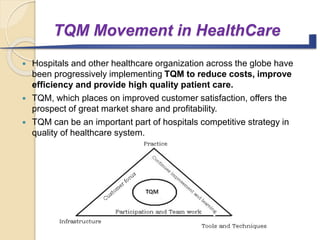
TQM Movement in HealthCare
 Hospitals and other healthcare organization across the globe have
been progressively implementing TQM to reduce costs, improve
efficiency and provide high quality patient care.
 TQM, which places on improved customer satisfaction, offers the
prospect of great market share and profitability.
 TQM can be an important part of hospitals competitive strategy in
quality of healthcare system.
TQM Principles
 Customer focused organization
 Leadership
 Involvement of people
 Process approach
 System approach to management
 Continual Improvement
 Factual approach to decision making
 Mutually beneficial supplier relationships
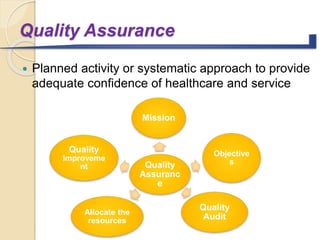
Quality Assurance
 Planned activity or systematic approach to provide
adequate confidence of healthcare and service
Quality
Assuranc
e
Mission
Objective
s
Allocate the
resources
Quality
Audit
Quality
Improveme
nt
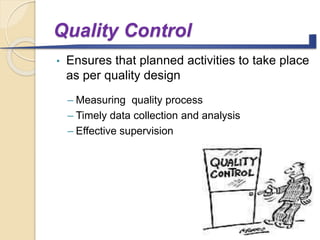
Quality Control
• Ensures that planned activities to take place
as per quality design
– Measuring quality process
– Timely data collection and analysis
– Effective supervision
Tools for Process Management
 The tools and techniques, that Support Quality
Management within the organizational
fundamental components of TQM
 7 Basic Quality techniques:
 Cause and Effect Diagrams
 Flow Charts
 Histograms
 Pareto Charts
 Run Charts
 Control Charts
 Scatter Diagrams
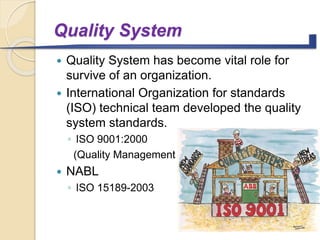
Quality System
 Quality System has become vital role for
survive of an organization.
 International Organization for standards
(ISO) technical team developed the quality
system standards.
◦ ISO 9001:2000
(Quality Management Systems)
 NABL
◦ ISO 15189-2003
Benchmarking
 Benchmarking is defined as
◦ Measuring of performance best in
hospitals
◦ Determining how the best in time achieve
◦ Performance levels
◦ The information of hospital’s
 Strategies
 Planning
 Implementation
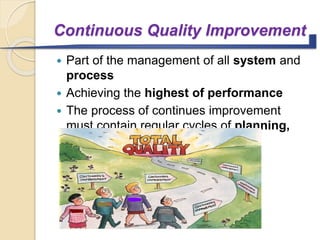
Continuous Quality Improvement
 Part of the management of all system and
process
 Achieving the highest of performance
 The process of continues improvement
must contain regular cycles of planning,
execution and evolution
CONCLUSION
 Learn the TQM during Industry experience:
◦ Transasia Bio-Medicals Ltd, Mumbai
◦ Inspired from Production team
◦ Quality Integration team
◦ Colleges and team my members
 Training Under the Japanees Quality
Consultant
◦ Mr. Yashiki San (43 years Experience in QMS in
Automobile Industry – TOYOTA and others)
 In future I want to start Quality Management
Consultants in Healthcare Management for
Hospital systems.

K10611 OPC

  • 1.
    CAREER POINT UNIVERSITY KOTARAJASTHAN MAJOR ASSIGNMENT SUBJECT-OPC TOPIC –QUALITY ASSURENCE OF HOSPITAL SUBMITTED BY SUBMITTED TO MOHAMMAD SHAHBAZ MR. BHUPENDRA GEHLOT U.I.D.-K10611 ASST. PROFESSOR ME BRANCH-M.E. DEPT. CPU
  • 2.
    World without word“Quality”  People and Organizations must behave morally Sensitivity toward ◦ Social ◦ Cultural ◦ Economic ◦ Environmental issues
  • 3.
    CONTENT  Literature view Definition  The importance of Total Quality  TQM movement in Healthcare  TQM principles  Quality Assurance and control  Tools for Process Management  Lean and Six Sigma concepts in Healthcare  References
  • 4.
    Literature view  In19 century: The root of quality assurance initiatives in healthcare Florence Nightingale’s as far back  In 1913 : The American College of Surgeons (ACS) was founded great variations in the quality of healthcare  By 1917 and 1930 : The ACS developed the Hospital Standardization Process`  By 1992: The American Society for Quality's (ASQ) Healthcare played role of improving healthcare quality.  By 1997 : Quality Council of India (QCI) was established as an autonomous body - National Accreditation Board for Hospitals and Healthcare Providers (NABH)
  • 5.
    DEFINITION The American NationalStandards Institute (ANSI) and American Society Quality (ASQ) define quality as “The totality of features and characterizes of a care or service that bears on its ability to satisfy given needs”  According to Crosby, Quality is “Conformance to Requirements or Specifications”
  • 6.
    The Importance ofTotal Quality  Total Quality of performance that is directly related to healthcare safety, security, attitude staff, role of doctors in terms of ‘time’ includes appointment, delay time, service time, timing with regards to medical treatment and surgery. ◦ Quality of administration and management ◦ Quality of doctors and supporting staff ◦ Quality of hospital care
  • 7.
    TQM Movement inHealthCare  Hospitals and other healthcare organization across the globe have been progressively implementing TQM to reduce costs, improve efficiency and provide high quality patient care.  TQM, which places on improved customer satisfaction, offers the prospect of great market share and profitability.  TQM can be an important part of hospitals competitive strategy in quality of healthcare system.
  • 8.
    TQM Principles  Customerfocused organization  Leadership  Involvement of people  Process approach  System approach to management  Continual Improvement  Factual approach to decision making  Mutually beneficial supplier relationships
  • 9.
    Quality Assurance  Plannedactivity or systematic approach to provide adequate confidence of healthcare and service Quality Assuranc e Mission Objective s Allocate the resources Quality Audit Quality Improveme nt
  • 10.
    Quality Control • Ensuresthat planned activities to take place as per quality design – Measuring quality process – Timely data collection and analysis – Effective supervision
  • 11.
    Tools for ProcessManagement  The tools and techniques, that Support Quality Management within the organizational fundamental components of TQM  7 Basic Quality techniques:  Cause and Effect Diagrams  Flow Charts  Histograms  Pareto Charts  Run Charts  Control Charts  Scatter Diagrams
  • 12.
    Quality System  QualitySystem has become vital role for survive of an organization.  International Organization for standards (ISO) technical team developed the quality system standards. ◦ ISO 9001:2000 (Quality Management Systems)  NABL ◦ ISO 15189-2003
  • 13.
    Benchmarking  Benchmarking isdefined as ◦ Measuring of performance best in hospitals ◦ Determining how the best in time achieve ◦ Performance levels ◦ The information of hospital’s  Strategies  Planning  Implementation
  • 14.
    Continuous Quality Improvement Part of the management of all system and process  Achieving the highest of performance  The process of continues improvement must contain regular cycles of planning, execution and evolution
  • 15.
    CONCLUSION  Learn theTQM during Industry experience: ◦ Transasia Bio-Medicals Ltd, Mumbai ◦ Inspired from Production team ◦ Quality Integration team ◦ Colleges and team my members  Training Under the Japanees Quality Consultant ◦ Mr. Yashiki San (43 years Experience in QMS in Automobile Industry – TOYOTA and others)  In future I want to start Quality Management Consultants in Healthcare Management for Hospital systems.