PRESENTATION ON AUTOMATIC STEERING
MECHANISM USING SENSOR
Name- Rupesh Kumar Das
UID- k10741
Course- B.Tech
Branch- Mechanical
Sem- 6th
Sub- IC engine
Introduction
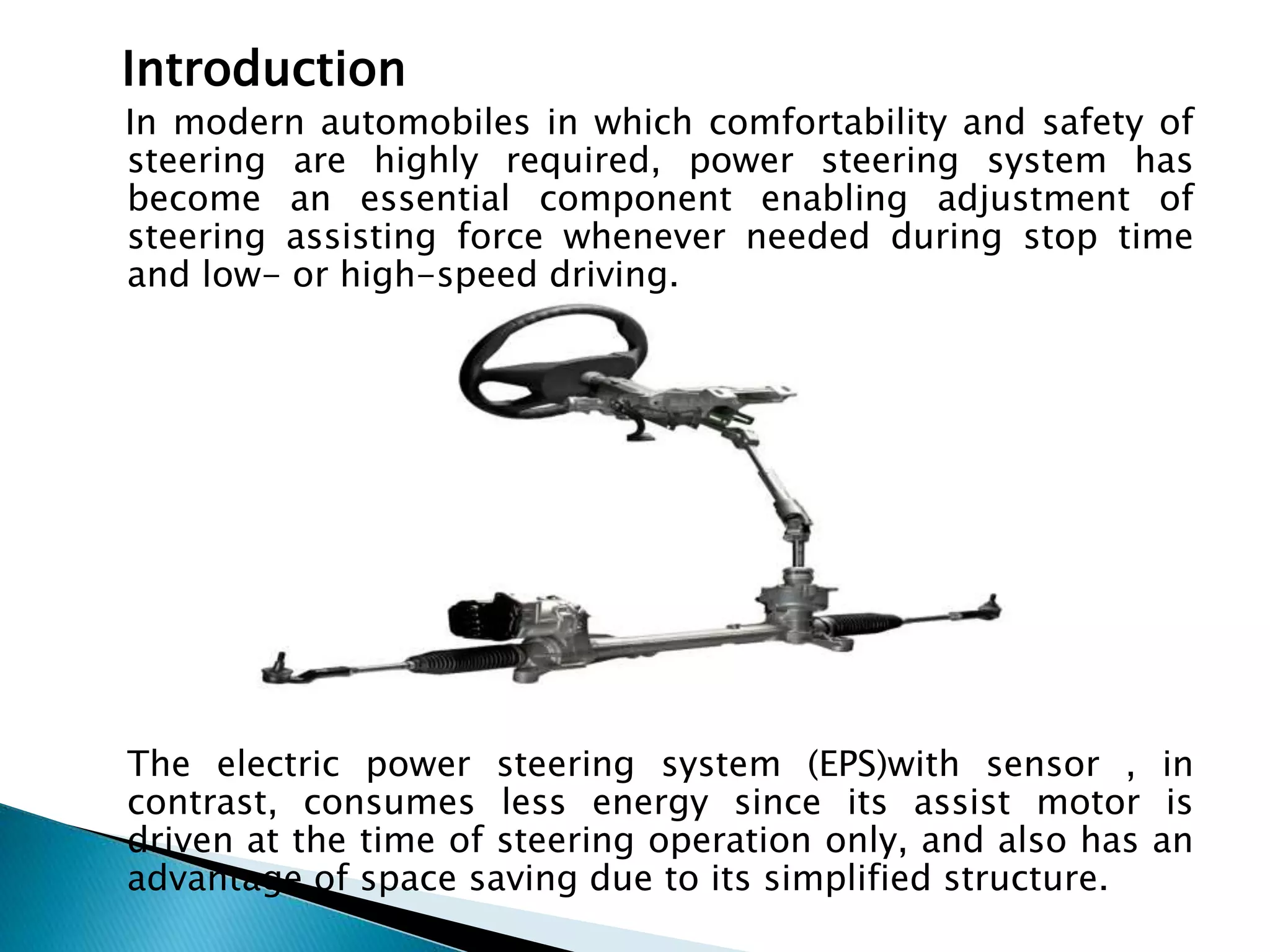
In modern automobiles in which comfortability and safety of
steering are highly required, power steering system has
become an essential component enabling adjustment of
steering assisting force whenever needed during stop time
and low- or high-speed driving.
The electric power steering system (EPS)with sensor , in
contrast, consumes less energy since its assist motor is
driven at the time of steering operation only, and also has an
advantage of space saving due to its simplified structure.
Required specification and mechanism
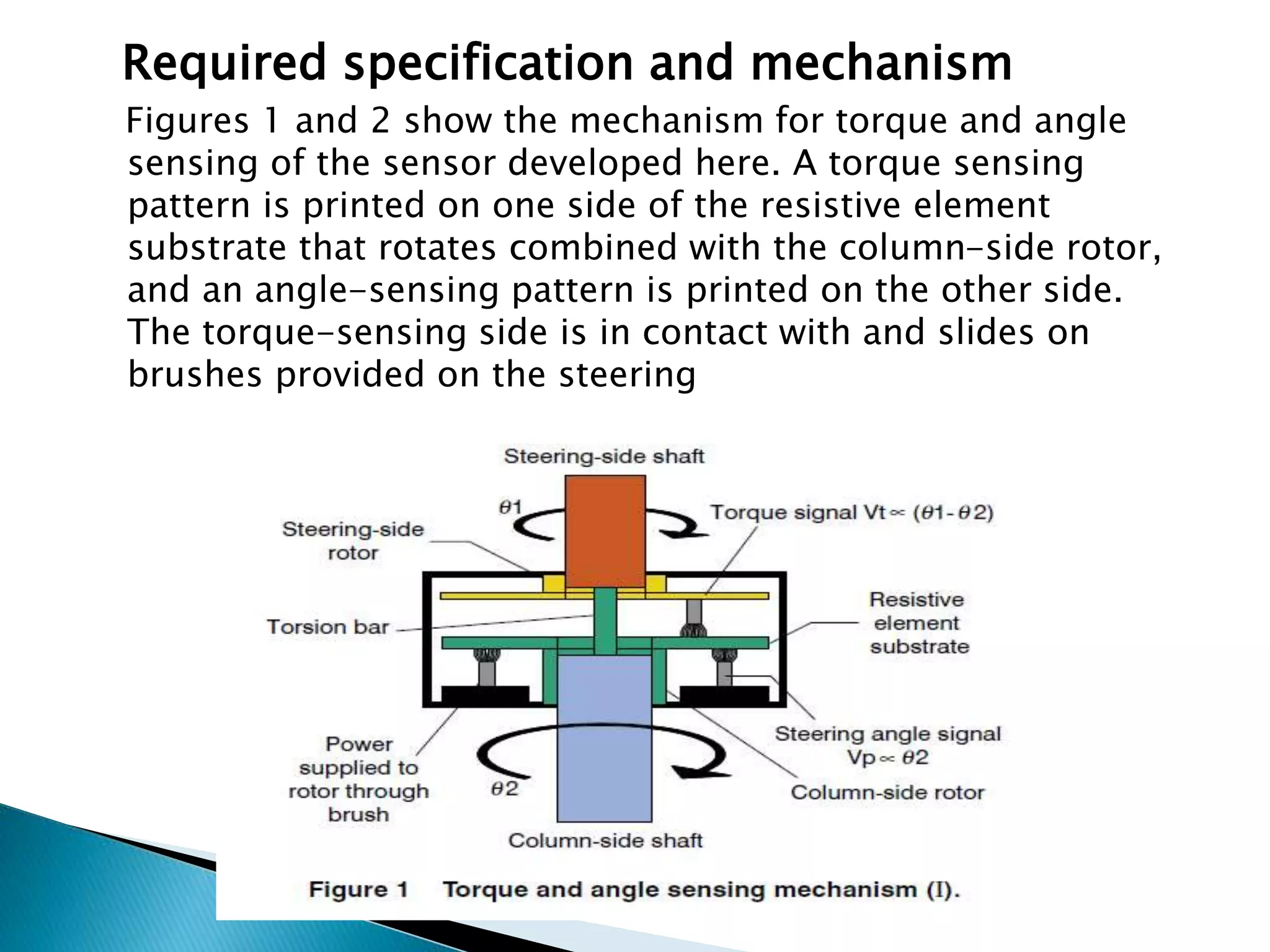
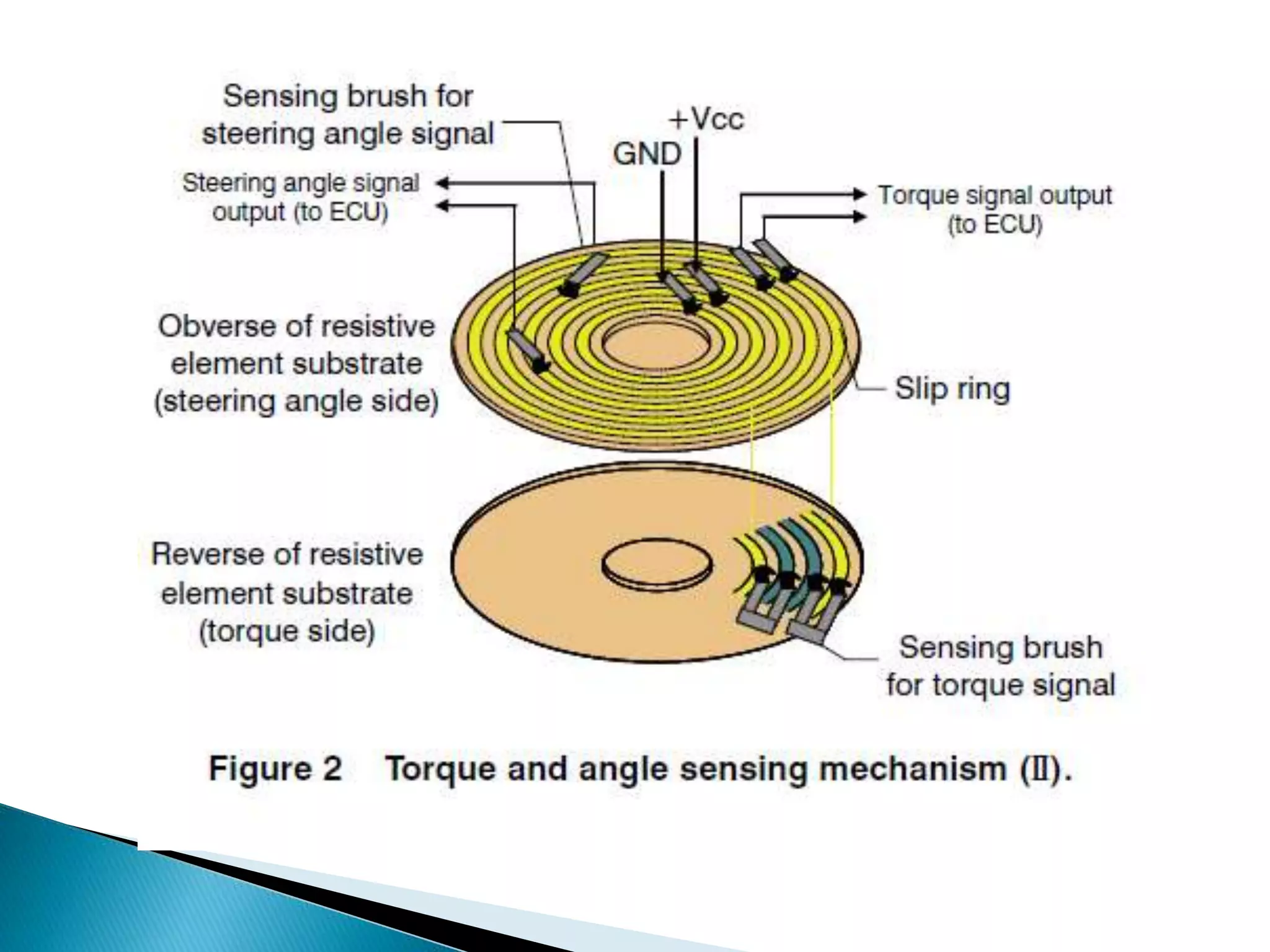
Figures 1 and 2 show the mechanism for torque and angle
sensing of the sensor developed here. A torque sensing
pattern is printed on one side of the resistive element
substrate that rotates combined with the column-side rotor,
and an angle-sensing pattern is printed on the other side.
The torque-sensing side is in contact with and slides on
brushes provided on the steering
Indispensable performance for the sensor
includes:
1) Steerability: To supply signal outputs of fast
response and high accuracy so as to offer a comfortable
steering feeling during car driving.
2) Durability: To supply noiseless output signals over
several hundreds thousands of kilometers of distance
driven.
3) Quietness: To reduce friction noise generated by
the sensor.
This report describes the development as well as the
improvement of steerability and quietness.
Solution of required specification
Steerability
Objectives in Steerability Improvement
Because in EPS the steering assisting force is adjusted based
on the output signals from its sensor, the sensing function of
an EPS sensor is very influential over the entire system. If the
sensor has poor responsiveness of output signals to shaft
rotation and oscillation during car driving, the smoothness of
steering feeling will be lost sometimes. Factors in
degradation of signal response include:
 1) Backlash in the shaft bearing portion comprising a number
of constituting parts
 2) Sliding friction at the bearing portions for the steering-side
rotor and for the column-side rotor
 3) Inertia due to rotation
 4) Deteriorated stiffness of constituting parts such as the
steering-side rotor
Improvement of signal responsiveness
In practice, signal responsiveness of the sensor itself was
improved to a certain degree by countermeasures such that
the backlash in the shaft bearing portion is reduced as much
as possible by fine tuning the molding dies to improve the
dimensional accuracy and tolerance of constituting parts, and
friction is decreased by finely polishing the molding dies for
the bearing portion to minimize the sliding surface roughness
of the bearing portion.
The inertia due to rotation was dealt with by reducing the
weight and volume of the steering-side rotor as much as
possible, but we had to be satisfied with a certain degree of
reduction.
The signal responsiveness would significantly improve if all
the structures from the fitting portion of the steering-side
shaft to the actual sensing portion were connected using a
rigid body without elasticity.
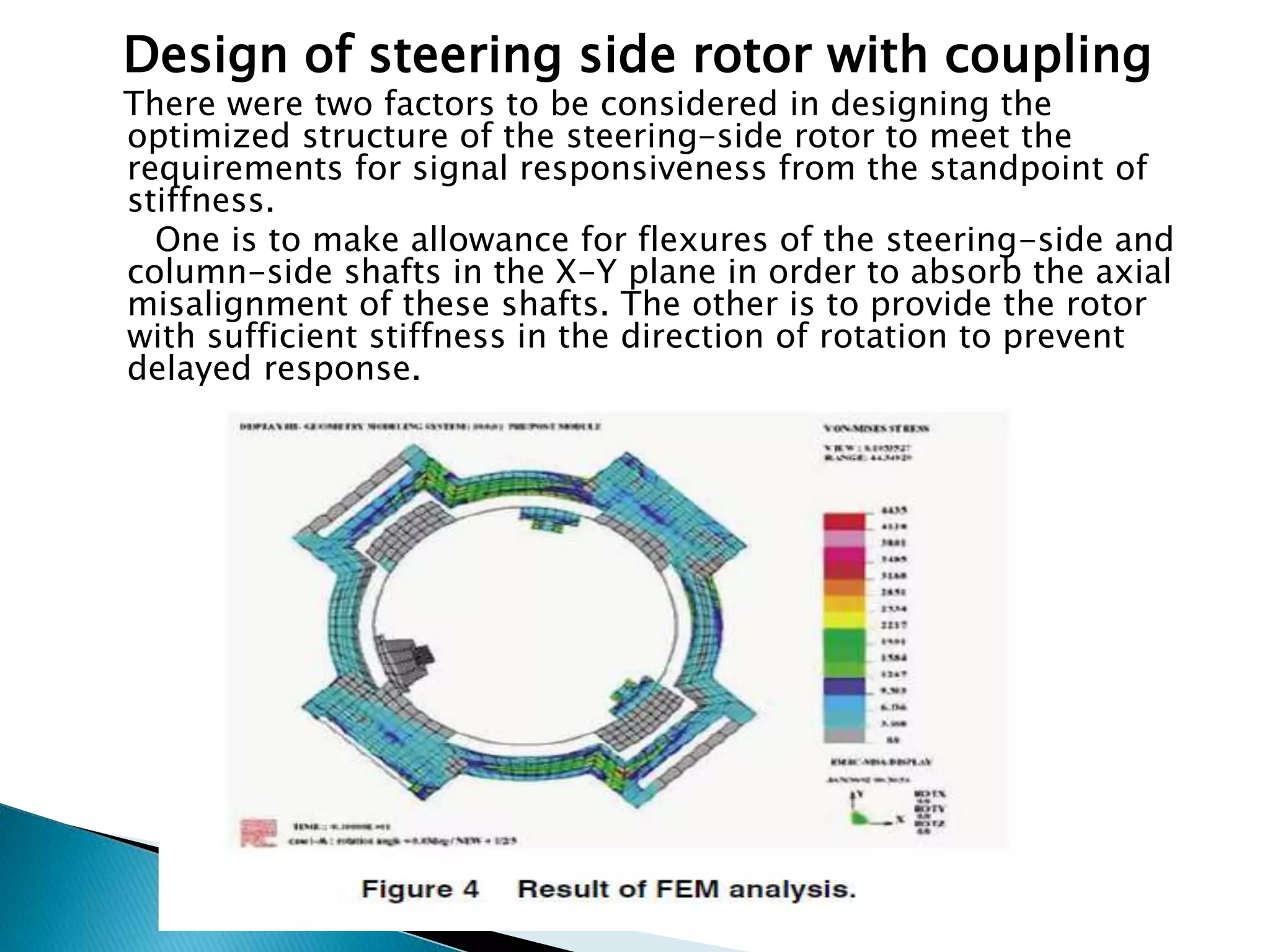
Design of steering side rotor with coupling
There were two factors to be considered in designing the
optimized structure of the steering-side rotor to meet the
requirements for signal responsiveness from the standpoint of
stiffness.
One is to make allowance for flexures of the steering-side and
column-side shafts in the X-Y plane in order to absorb the axial
misalignment of these shafts. The other is to provide the rotor
with sufficient stiffness in the direction of rotation to prevent
delayed response.
Future development
The sensor developed here has achieved the improvements
in terms of steerability, durability and quietness as were
required by our customers, and has been in mass production
since April, 2003. Photo 6 shows an appearance of the
sensor. In the future, we plan to reduce the cost as well as to
improve its steerability and quietness further.
Conclusion
In the development of this steering angle and torque sensor
of contact-type, which was required to provide higher
performance than conventional sensors, we have been
successful in overcoming many problems and in launching
into mass production through the concentration of efforts of
people involved. In view of the increasing demand for EPS that
is predicted, the demand for this sensor is expected to grow
also.
References
 [1] Automotive testing technology international: Awards
2007 special issue, Nov/Dec 2007.
 [2] Omead Amidi. Integrated mobile robot control.
Technical Report CMU-RI-TR-90-17, Carnegie Mellon
University
 Robotics Institute, 1990.
 [3] Eduardo F. Camacho and Carlos Bordons. Model
Predictive Control. Spinger, 2004.
 [4] Stefan F. Campbell. Steering control of an
autonomous ground vehicle with application to the
DARPA urban
 challenge. Master’s thesis, Massachusetts Institute of
Technology, 2007.
 k10741 major assig on ic engine

k10741 major assig on ic engine

  • 1.
    PRESENTATION ON AUTOMATICSTEERING MECHANISM USING SENSOR Name- Rupesh Kumar Das UID- k10741 Course- B.Tech Branch- Mechanical Sem- 6th Sub- IC engine
  • 2.
    Introduction In modern automobilesin which comfortability and safety of steering are highly required, power steering system has become an essential component enabling adjustment of steering assisting force whenever needed during stop time and low- or high-speed driving. The electric power steering system (EPS)with sensor , in contrast, consumes less energy since its assist motor is driven at the time of steering operation only, and also has an advantage of space saving due to its simplified structure.
  • 3.
    Required specification andmechanism Figures 1 and 2 show the mechanism for torque and angle sensing of the sensor developed here. A torque sensing pattern is printed on one side of the resistive element substrate that rotates combined with the column-side rotor, and an angle-sensing pattern is printed on the other side. The torque-sensing side is in contact with and slides on brushes provided on the steering
  • 4.
    Indispensable performance forthe sensor includes: 1) Steerability: To supply signal outputs of fast response and high accuracy so as to offer a comfortable steering feeling during car driving. 2) Durability: To supply noiseless output signals over several hundreds thousands of kilometers of distance driven. 3) Quietness: To reduce friction noise generated by the sensor. This report describes the development as well as the improvement of steerability and quietness.
  • 6.
    Solution of requiredspecification Steerability Objectives in Steerability Improvement Because in EPS the steering assisting force is adjusted based on the output signals from its sensor, the sensing function of an EPS sensor is very influential over the entire system. If the sensor has poor responsiveness of output signals to shaft rotation and oscillation during car driving, the smoothness of steering feeling will be lost sometimes. Factors in degradation of signal response include:  1) Backlash in the shaft bearing portion comprising a number of constituting parts  2) Sliding friction at the bearing portions for the steering-side rotor and for the column-side rotor  3) Inertia due to rotation  4) Deteriorated stiffness of constituting parts such as the steering-side rotor
  • 7.
    Improvement of signalresponsiveness In practice, signal responsiveness of the sensor itself was improved to a certain degree by countermeasures such that the backlash in the shaft bearing portion is reduced as much as possible by fine tuning the molding dies to improve the dimensional accuracy and tolerance of constituting parts, and friction is decreased by finely polishing the molding dies for the bearing portion to minimize the sliding surface roughness of the bearing portion. The inertia due to rotation was dealt with by reducing the weight and volume of the steering-side rotor as much as possible, but we had to be satisfied with a certain degree of reduction. The signal responsiveness would significantly improve if all the structures from the fitting portion of the steering-side shaft to the actual sensing portion were connected using a rigid body without elasticity.
  • 8.
    Design of steeringside rotor with coupling There were two factors to be considered in designing the optimized structure of the steering-side rotor to meet the requirements for signal responsiveness from the standpoint of stiffness. One is to make allowance for flexures of the steering-side and column-side shafts in the X-Y plane in order to absorb the axial misalignment of these shafts. The other is to provide the rotor with sufficient stiffness in the direction of rotation to prevent delayed response.
  • 9.
    Future development The sensordeveloped here has achieved the improvements in terms of steerability, durability and quietness as were required by our customers, and has been in mass production since April, 2003. Photo 6 shows an appearance of the sensor. In the future, we plan to reduce the cost as well as to improve its steerability and quietness further. Conclusion In the development of this steering angle and torque sensor of contact-type, which was required to provide higher performance than conventional sensors, we have been successful in overcoming many problems and in launching into mass production through the concentration of efforts of people involved. In view of the increasing demand for EPS that is predicted, the demand for this sensor is expected to grow also.
  • 10.
    References  [1] Automotivetesting technology international: Awards 2007 special issue, Nov/Dec 2007.  [2] Omead Amidi. Integrated mobile robot control. Technical Report CMU-RI-TR-90-17, Carnegie Mellon University  Robotics Institute, 1990.  [3] Eduardo F. Camacho and Carlos Bordons. Model Predictive Control. Spinger, 2004.  [4] Stefan F. Campbell. Steering control of an autonomous ground vehicle with application to the DARPA urban  challenge. Master’s thesis, Massachusetts Institute of Technology, 2007.