DR. EDUARD MANZANO ALBAY
Research Coordinator
Don Mariano Marcos Memorial State University
College of Arts and Sciences
PRACTICAL RESEARCH 2
Senior High School Teachers’ Training for the K to 12 Basic Education Program,
DMMMSU-SLUC,
May 28 to June 19, 2016
SESSION OBJECTIVES
•Describe the terms related to writing
a research paper;
•Determine the topics to be
discussed for each content of the
curriculum guide;
Senior High School Teachers’ Training for the K to 12 Basic Education Program, DMMMSU-SLUC, May 28 to June 19, 2016
SESSION OBJECTIVES
•Develop enrichment learning
competencies for each content
necessary in achieving the content
and performance standards of the
subject; and
•Construct research title, statement of
the problems, hypotheses, and
research design from a given
situation.
Senior High School Teachers’ Training for the K to 12 Basic Education Program, DMMMSU-SLUC, May 28 to June 19, 2016
ACTIVITY 1
ACTIVITY 1
Answer the following:
1. What innovations did you see
from the video presented?
2. What factors may bring about
advancement?
3. How was research applied to the
innovation presented in the video?
Senior High School Teachers’ Training for the K to 12 Basic Education Program, DMMMSU-SLUC, May 28 to June 19, 2016
How do you describe your attitude
towards conducting
a research study?
How did
help you achieve professional
What is the
ROLE of
RESEARCH in
ACTIVITY 2
ACTIVITY 2.
Senior High School Teachers’ Training for the K to 12 Basic Education Program, DMMMSU-SLUC, May 28 to June 19, 2016
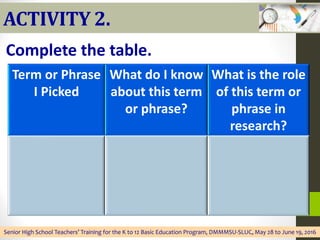
Complete the table.
Term or Phrase
I Picked
What do I know
about this term
or phrase?
What is the role
of this term or
phrase in
research?
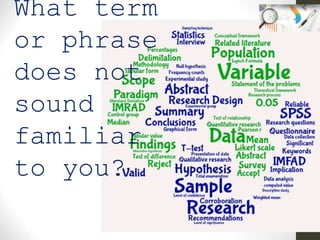
What term
or phrase
does not
sound
familiar
to you?
…development of
prescribed
learning
competencies.
Walkthrough
Curriculum Guide
Nature of Inquiry and Research
Senior High School Teachers’ Training for the K to 12 Basic Education Program, DMMMSU-SLUC, May 28 to June 19, 2016
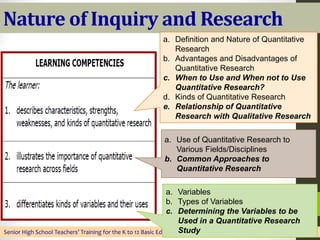
a. Definition and Nature of Quantitative
Research
b. Advantages and Disadvantages of
Quantitative Research
c. When to Use and When not to Use
Quantitative Research?
d. Kinds of Quantitative Research
e. Relationship of Quantitative
Research with Qualitative Research
a. Use of Quantitative Research to
Various Fields/Disciplines
b. Common Approaches to
Quantitative Research
a. Variables
b. Types of Variables
c. Determining the Variables to be
Used in a Quantitative Research
Study
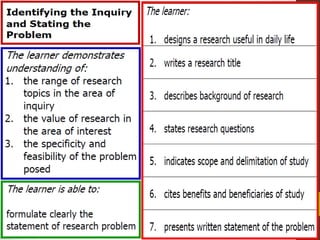
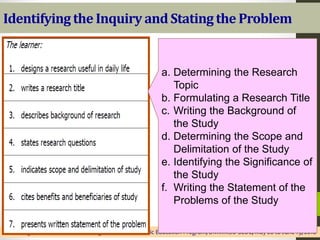
Identifying the Inquiry and Statingthe Problem
Senior High School Teachers’ Training for the K to 12 Basic Education Program, DMMMSU-SLUC, May 28 to June 19, 2016
a. Determining the Research
Topic
b. Formulating a Research Title
c. Writing the Background of
the Study
d. Determining the Scope and
Delimitation of the Study
e. Identifying the Significance of
the Study
f. Writing the Statement of the
Problems of the Study
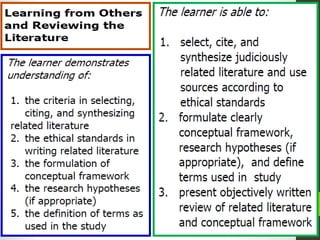
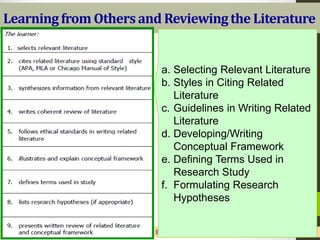
Learningfrom Othersand Reviewingthe Literature
Senior High School Teachers’ Training for the K to 12 Basic Education Program, DMMMSU-SLUC, May 28 to June 19, 2016
a. Selecting Relevant Literature
b. Styles in Citing Related
Literature
c. Guidelines in Writing Related
Literature
d. Developing/Writing
Conceptual Framework
e. Defining Terms Used in
Research Study
f. Formulating Research
Hypotheses
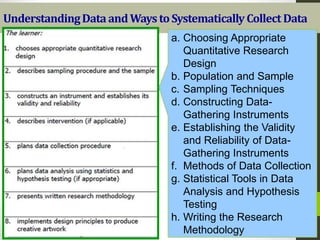
UnderstandingDataandWaystoSystematically Collect Data
a. Choosing Appropriate
Quantitative Research
Design
b. Population and Sample
c. Sampling Techniques
d. Constructing Data-
Gathering Instruments
e. Establishing the Validity
and Reliability of Data-
Gathering Instruments
f. Methods of Data Collection
g. Statistical Tools in Data
Analysis and Hypothesis
Testing
h. Writing the Research
Methodology
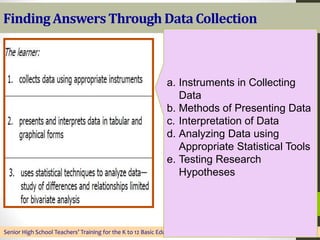
Finding AnswersThrough DataCollection
Senior High School Teachers’ Training for the K to 12 Basic Education Program, DMMMSU-SLUC, May 28 to June 19, 2016
a. Instruments in Collecting
Data
b. Methods of Presenting Data
c. Interpretation of Data
d. Analyzing Data using
Appropriate Statistical Tools
e. Testing Research
Hypotheses
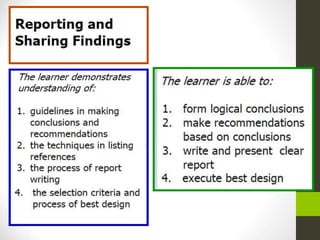
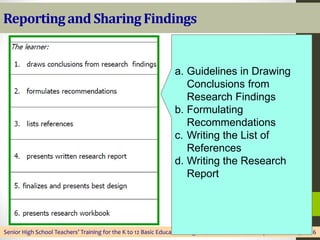
Reportingand Sharing Findings
Senior High School Teachers’ Training for the K to 12 Basic Education Program, DMMMSU-SLUC, May 28 to June 19, 2016
a. Guidelines in Drawing
Conclusions from
Research Findings
b. Formulating
Recommendations
c. Writing the List of
References
d. Writing the Research
Report
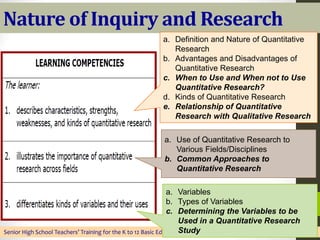
Nature of Inquiry and Research
Senior High School Teachers’ Training for the K to 12 Basic Education Program, DMMMSU-SLUC, May 28 to June 19, 2016
a. Definition and Nature of Quantitative
Research
b. Advantages and Disadvantages of
Quantitative Research
c. When to Use and When not to Use
Quantitative Research?
d. Kinds of Quantitative Research
e. Relationship of Quantitative
Research with Qualitative Research
a. Use of Quantitative Research to
Various Fields/Disciplines
b. Common Approaches to
Quantitative Research
a. Variables
b. Types of Variables
c. Determining the Variables to be
Used in a Quantitative Research
Study
Nature of Inquiry and Research
Senior High School Teachers’ Training for the K to 12 Basic Education Program, DMMMSU-SLUC, May 28 to June 19, 2016
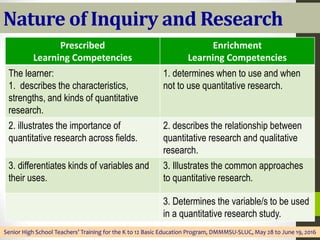
Prescribed
Learning Competencies
Enrichment
Learning Competencies
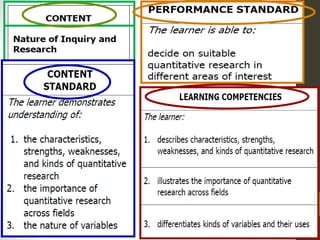
The learner:
1. describes the characteristics,
strengths, and kinds of quantitative
research.
1. determines when to use and when
not to use quantitative research.
2. illustrates the importance of
quantitative research across fields.
2. describes the relationship between
quantitative research and qualitative
research.
3. differentiates kinds of variables and
their uses.
3. Illustrates the common approaches
to quantitative research.
3. Determines the variable/s to be used
in a quantitative research study.
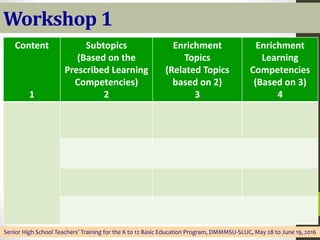
WORKSHOP 1
Workshop 1
Senior High School Teachers’ Training for the K to 12 Basic Education Program, DMMMSU-SLUC, May 28 to June 19, 2016
Content
1
Subtopics
(Based on the
Prescribed Learning
Competencies)
2
Enrichment
Topics
(Related Topics
based on 2)
3
Enrichment
Learning
Competencies
(Based on 3)
4
Presentation of Output
WORKSHOP 2
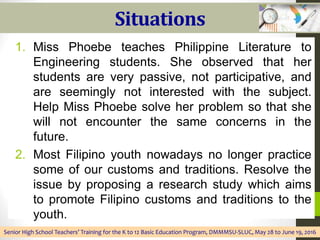
Situations
1. Miss Phoebe teaches Philippine Literature to
Engineering students. She observed that her
students are very passive, not participative, and
are seemingly not interested with the subject.

Help Miss Phoebe solve her problem so that she
will not encounter the same concerns in the
future.
2. Most Filipino youth nowadays no longer practice
some of our customs and traditions. Resolve the
issue by proposing a research study which aims
to promote Filipino customs and traditions to the
youth.
Senior High School Teachers’ Training for the K to 12 Basic Education Program, DMMMSU-SLUC, May 28 to June 19, 2016
Situations
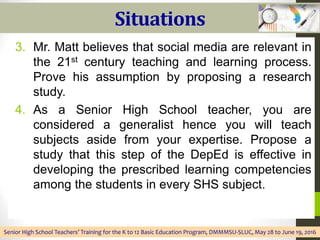
3. Mr. Matt believes that social media are relevant in
the 21st century teaching and learning process.
Prove his assumption by proposing a research
study.
4. As a Senior High School teacher, you are
considered a generalist hence you will teach
subjects aside from your expertise. Propose a
study that this step of the DepEd is effective in
developing the prescribed learning competencies
among the students in every SHS subject.
Senior High School Teachers’ Training for the K to 12 Basic Education Program, DMMMSU-SLUC, May 28 to June 19, 2016
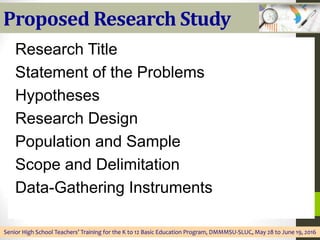
Proposed Research Study
Research Title
Statement of the Problems
Hypotheses
Research Design
Population and Sample
Scope and Delimitation
Data-Gathering Instruments
Senior High School Teachers’ Training for the K to 12 Basic Education Program, DMMMSU-SLUC, May 28 to June 19, 2016
Presentation of Output
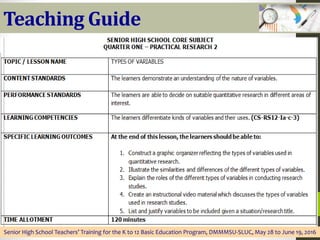
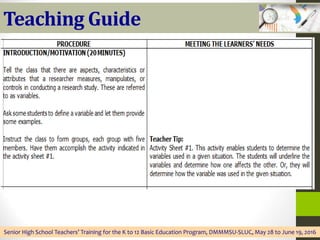
Teaching Guide
Teaching Guide
Senior High School Teachers’ Training for the K to 12 Basic Education Program, DMMMSU-SLUC, May 28 to June 19, 2016
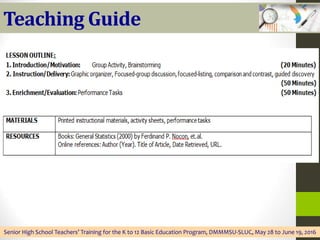
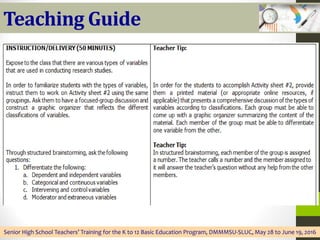
Teaching Guide
Senior High School Teachers’ Training for the K to 12 Basic Education Program, DMMMSU-SLUC, May 28 to June 19, 2016
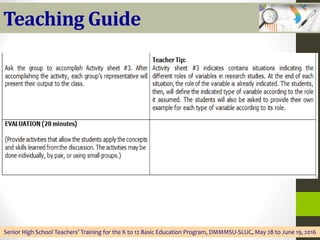
Teaching Guide
Senior High School Teachers’ Training for the K to 12 Basic Education Program, DMMMSU-SLUC, May 28 to June 19, 2016
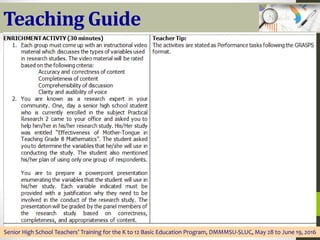
Teaching Guide
Senior High School Teachers’ Training for the K to 12 Basic Education Program, DMMMSU-SLUC, May 28 to June 19, 2016
Teaching Guide
Senior High School Teachers’ Training for the K to 12 Basic Education Program, DMMMSU-SLUC, May 28 to June 19, 2016
Teaching Guide
Senior High School Teachers’ Training for the K to 12 Basic Education Program, DMMMSU-SLUC, May 28 to June 19, 2016
Workshop 3
Demonstration Teaching
Workshop 4
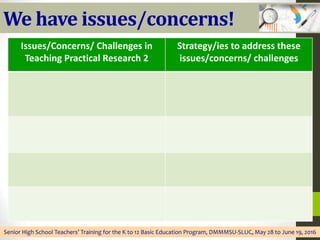
We have issues/concerns!
Senior High School Teachers’ Training for the K to 12 Basic Education Program, DMMMSU-SLUC, May 28 to June 19, 2016
Issues/Concerns/ Challenges in
Teaching Practical Research 2
Strategy/ies to address these
issues/concerns/ challenges
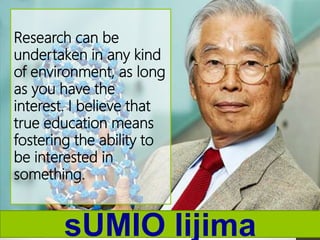
sUMIO Iijima
Research can be
undertaken in any kind
of environment, as long
as you have the
interest. I believe that
true education means
fostering the ability to
be interested in
something.
As a teacher in the
21st century, what
skill or attitude do
you possess or
need to have that
will effectively
foster my ability
to be interested
to things around
me?
We cannot tell our
future.
But you can greatly
influence, inspire,
and prepare us in
building our own
bright future.

K TO 12 TRAINING ON PRACTICAL RESEARCH 2.pptx

  • 1.
    DR. EDUARD MANZANOALBAY Research Coordinator Don Mariano Marcos Memorial State University College of Arts and Sciences PRACTICAL RESEARCH 2 Senior High School Teachers’ Training for the K to 12 Basic Education Program, DMMMSU-SLUC, May 28 to June 19, 2016
  • 2.
    SESSION OBJECTIVES •Describe theterms related to writing a research paper; •Determine the topics to be discussed for each content of the curriculum guide; Senior High School Teachers’ Training for the K to 12 Basic Education Program, DMMMSU-SLUC, May 28 to June 19, 2016
  • 3.
    SESSION OBJECTIVES •Develop enrichmentlearning competencies for each content necessary in achieving the content and performance standards of the subject; and •Construct research title, statement of the problems, hypotheses, and research design from a given situation. Senior High School Teachers’ Training for the K to 12 Basic Education Program, DMMMSU-SLUC, May 28 to June 19, 2016
  • 4.
    Senior High SchoolTeachers’ Training for the K to 12 Basic Education Program, DMMMSU-SLUC, May 28 to June 19, 2016
  • 5.
  • 6.
    ACTIVITY 1 Answer thefollowing: 1. What innovations did you see from the video presented? 2. What factors may bring about advancement? 3. How was research applied to the innovation presented in the video? Senior High School Teachers’ Training for the K to 12 Basic Education Program, DMMMSU-SLUC, May 28 to June 19, 2016
  • 8.
    How do youdescribe your attitude towards conducting a research study?
  • 9.
    How did help youachieve professional
  • 10.
    What is the ROLEof RESEARCH in
  • 12.
  • 13.
    ACTIVITY 2. Senior HighSchool Teachers’ Training for the K to 12 Basic Education Program, DMMMSU-SLUC, May 28 to June 19, 2016 Complete the table. Term or Phrase I Picked What do I know about this term or phrase? What is the role of this term or phrase in research?
  • 14.
    What term or phrase doesnot sound familiar to you?
  • 16.
  • 17.
  • 25.
    Nature of Inquiryand Research Senior High School Teachers’ Training for the K to 12 Basic Education Program, DMMMSU-SLUC, May 28 to June 19, 2016 a. Definition and Nature of Quantitative Research b. Advantages and Disadvantages of Quantitative Research c. When to Use and When not to Use Quantitative Research? d. Kinds of Quantitative Research e. Relationship of Quantitative Research with Qualitative Research a. Use of Quantitative Research to Various Fields/Disciplines b. Common Approaches to Quantitative Research a. Variables b. Types of Variables c. Determining the Variables to be Used in a Quantitative Research Study
  • 27.
    Identifying the Inquiryand Statingthe Problem Senior High School Teachers’ Training for the K to 12 Basic Education Program, DMMMSU-SLUC, May 28 to June 19, 2016 a. Determining the Research Topic b. Formulating a Research Title c. Writing the Background of the Study d. Determining the Scope and Delimitation of the Study e. Identifying the Significance of the Study f. Writing the Statement of the Problems of the Study
  • 29.
    Learningfrom Othersand ReviewingtheLiterature Senior High School Teachers’ Training for the K to 12 Basic Education Program, DMMMSU-SLUC, May 28 to June 19, 2016 a. Selecting Relevant Literature b. Styles in Citing Related Literature c. Guidelines in Writing Related Literature d. Developing/Writing Conceptual Framework e. Defining Terms Used in Research Study f. Formulating Research Hypotheses
  • 31.
    UnderstandingDataandWaystoSystematically Collect Data a.Choosing Appropriate Quantitative Research Design b. Population and Sample c. Sampling Techniques d. Constructing Data- Gathering Instruments e. Establishing the Validity and Reliability of Data- Gathering Instruments f. Methods of Data Collection g. Statistical Tools in Data Analysis and Hypothesis Testing h. Writing the Research Methodology
  • 33.
    Finding AnswersThrough DataCollection SeniorHigh School Teachers’ Training for the K to 12 Basic Education Program, DMMMSU-SLUC, May 28 to June 19, 2016 a. Instruments in Collecting Data b. Methods of Presenting Data c. Interpretation of Data d. Analyzing Data using Appropriate Statistical Tools e. Testing Research Hypotheses
  • 35.
    Reportingand Sharing Findings SeniorHigh School Teachers’ Training for the K to 12 Basic Education Program, DMMMSU-SLUC, May 28 to June 19, 2016 a. Guidelines in Drawing Conclusions from Research Findings b. Formulating Recommendations c. Writing the List of References d. Writing the Research Report
  • 36.
    Nature of Inquiryand Research Senior High School Teachers’ Training for the K to 12 Basic Education Program, DMMMSU-SLUC, May 28 to June 19, 2016 a. Definition and Nature of Quantitative Research b. Advantages and Disadvantages of Quantitative Research c. When to Use and When not to Use Quantitative Research? d. Kinds of Quantitative Research e. Relationship of Quantitative Research with Qualitative Research a. Use of Quantitative Research to Various Fields/Disciplines b. Common Approaches to Quantitative Research a. Variables b. Types of Variables c. Determining the Variables to be Used in a Quantitative Research Study
  • 37.
    Nature of Inquiryand Research Senior High School Teachers’ Training for the K to 12 Basic Education Program, DMMMSU-SLUC, May 28 to June 19, 2016 Prescribed Learning Competencies Enrichment Learning Competencies The learner: 1. describes the characteristics, strengths, and kinds of quantitative research. 1. determines when to use and when not to use quantitative research. 2. illustrates the importance of quantitative research across fields. 2. describes the relationship between quantitative research and qualitative research. 3. differentiates kinds of variables and their uses. 3. Illustrates the common approaches to quantitative research. 3. Determines the variable/s to be used in a quantitative research study.
  • 38.
  • 39.
    Workshop 1 Senior HighSchool Teachers’ Training for the K to 12 Basic Education Program, DMMMSU-SLUC, May 28 to June 19, 2016 Content 1 Subtopics (Based on the Prescribed Learning Competencies) 2 Enrichment Topics (Related Topics based on 2) 3 Enrichment Learning Competencies (Based on 3) 4
  • 40.
  • 41.
  • 42.
    Situations 1. Miss Phoebeteaches Philippine Literature to Engineering students. She observed that her students are very passive, not participative, and are seemingly not interested with the subject. Help Miss Phoebe solve her problem so that she will not encounter the same concerns in the future. 2. Most Filipino youth nowadays no longer practice some of our customs and traditions. Resolve the issue by proposing a research study which aims to promote Filipino customs and traditions to the youth. Senior High School Teachers’ Training for the K to 12 Basic Education Program, DMMMSU-SLUC, May 28 to June 19, 2016
  • 43.
    Situations 3. Mr. Mattbelieves that social media are relevant in the 21st century teaching and learning process. Prove his assumption by proposing a research study. 4. As a Senior High School teacher, you are considered a generalist hence you will teach subjects aside from your expertise. Propose a study that this step of the DepEd is effective in developing the prescribed learning competencies among the students in every SHS subject. Senior High School Teachers’ Training for the K to 12 Basic Education Program, DMMMSU-SLUC, May 28 to June 19, 2016
  • 44.
    Proposed Research Study ResearchTitle Statement of the Problems Hypotheses Research Design Population and Sample Scope and Delimitation Data-Gathering Instruments Senior High School Teachers’ Training for the K to 12 Basic Education Program, DMMMSU-SLUC, May 28 to June 19, 2016
  • 45.
  • 46.
  • 47.
  • 48.
    Teaching Guide Senior HighSchool Teachers’ Training for the K to 12 Basic Education Program, DMMMSU-SLUC, May 28 to June 19, 2016
  • 49.
    Teaching Guide Senior HighSchool Teachers’ Training for the K to 12 Basic Education Program, DMMMSU-SLUC, May 28 to June 19, 2016
  • 50.
    Teaching Guide Senior HighSchool Teachers’ Training for the K to 12 Basic Education Program, DMMMSU-SLUC, May 28 to June 19, 2016
  • 51.
    Teaching Guide Senior HighSchool Teachers’ Training for the K to 12 Basic Education Program, DMMMSU-SLUC, May 28 to June 19, 2016
  • 52.
    Teaching Guide Senior HighSchool Teachers’ Training for the K to 12 Basic Education Program, DMMMSU-SLUC, May 28 to June 19, 2016
  • 53.
    Teaching Guide Senior HighSchool Teachers’ Training for the K to 12 Basic Education Program, DMMMSU-SLUC, May 28 to June 19, 2016
  • 54.
  • 55.
  • 56.
  • 57.
    We have issues/concerns! SeniorHigh School Teachers’ Training for the K to 12 Basic Education Program, DMMMSU-SLUC, May 28 to June 19, 2016 Issues/Concerns/ Challenges in Teaching Practical Research 2 Strategy/ies to address these issues/concerns/ challenges
  • 58.
    sUMIO Iijima Research canbe undertaken in any kind of environment, as long as you have the interest. I believe that true education means fostering the ability to be interested in something.
  • 59.
    As a teacherin the 21st century, what skill or attitude do you possess or need to have that will effectively foster my ability to be interested to things around me?
  • 60.
    We cannot tellour future. But you can greatly influence, inspire, and prepare us in building our own bright future.