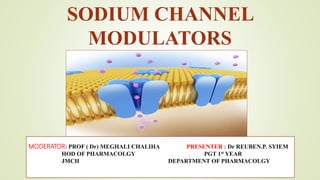
SODIUM CHANNEL
MODULATORS
MODERATOR: PROF ( Dr) MEGHALI CHALIHA PRESENTER : Dr REUBEN.P. SYIEM
HOD OF PHARMACOLGY PGT 1st YEAR
JMCH DEPARTMENT OF PHARMACOLGY
ION CHANNELS
• The lipid bilayer of the plasma membrane is Impermeable to anions and
cations.
• Ion channel are complex or single protein that catalyzes the passage of
specific ions through the membrane and establish Concentration gradient
across the membrane.
• Changes in the flux of ions across the plasma membrane are critical
regulatory events in both excitable and non-excitable cells.
SODIUM CHANNEL
Sodium channels are integral membrane proteins that form ion channels,
conducting Sodium ions (Na⁺) through a cell's plasma membrane.
TYPES
1. Voltage-gated Na⁺ channels (NavC).
2. Ligand-gated Na⁺ channels or Receptor operated Na⁺ channels (LGNaC).
3. Epithelial Na⁺ channels (ENaCs) .
4. Na⁺-K⁺ -ATPase Pump.
5. Na⁺ dependent transporters (Symport and Antiport systems).
VOLTAGE GATED
Na⁺ CHANNEL
VOLTAGE GATED Na⁺
CHANNEL
 These channels are responsible for the generation of action potentials that depolarize
the membrane from its resting potential of –70 mV up to a potential of +20 mV
within a few milliseconds.
 This channel has several function parts.
 One portion of the channel determines its ion selectivity and another portion of the
channel serves as Gate that can open or close.
 Incase of Na⁺V channel the gate is controlled by Voltage sensor which responds to
the level of Membrane Potential.
WHAT IS MEMBRANE POTENTIAL ?
 Membrane potential is the difference in electrical potential between the interior
and exterior of the cell.
 Electrical potential exists across the membranes of virtually all cells of the body.
 The Resting Membrane Potential of large nerve fibres when not transmitting
nerve signals is about -70 millivolts.
The Membrane potential established are used :
1. By Excitable tissues such as nerve and muscle to generate and transmit Electrical
impulses.
2. By non-excitable cells to trigger biochemical and secretory events.
3. By all cells to support a variety of secondary symport and antiport processes.
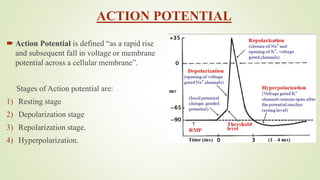
ACTION POTENTIAL
 Action Potential is defined “as a rapid rise
and subsequent fall in voltage or membrane
potential across a cellular membrane”.
Stages of Action potential are:
1) Resting stage
2) Depolarization stage
3) Repolarization stage.
4) Hyperpolarization.
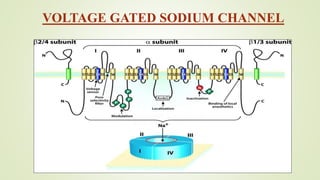
STRUCTURE OF VOLTAGE GATED SODIUM CHANNEL
NavC are composed of Three subunits.
One pore-forming α subunit, Two regulatory β subunits.
α Subunit: An α subunit forms the core of the channel and has
four repeat domains, labelled I through IV .
Each domain containing six membrane-spanning segments, labeled
S1 through S6.
The highly conserved S4 segment acts as the Channel voltage
sensor and is due to positive amino acids located at every fourth
position.
VOLTAGE GATED SODIUM CHANNEL
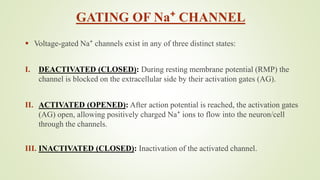
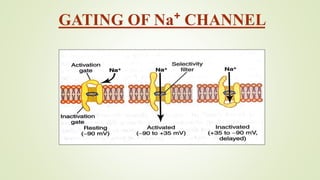
GATING OF Na⁺ CHANNEL
 Voltage-gated Na⁺ channels exist in any of three distinct states:
I. DEACTIVATED (CLOSED): During resting membrane potential (RMP) the
channel is blocked on the extracellular side by their activation gates (AG).
II. ACTIVATED (OPENED): After action potential is reached, the activation gates
(AG) open, allowing positively charged Na⁺ ions to flow into the neuron/cell
through the channels.
III. INACTIVATED (CLOSED): Inactivation of the activated channel.
GATING OF Na⁺ CHANNEL
DRUGS ACTING ON NaV CHANNEL
ACTIVATORS
 ACONITINE: A toxin produced by the Aconitum plant and was previously used as
antipyretic and analgesic.
 BATRACHOTOXIN (BTX): Extremely potent cardiotoxic and neurotoxic
steroidal alkaloid found in certain species of frogs (poison dart frog), melyrid
beetles, and birds.
 BREVETOXIN: Cyclic polyether compounds produced naturally by a species of
dinoflagellate known as Karenia brevis. Brevetoxins are neurotoxins.
 CIGUATOXIN: Produced by Gambierdiscus toxicus, a type of dinoflagellate
Accumulates in skin, head, viscera of big reef fishes. Causes Ciguatera.
DRUGS ACTING ON NaV CHANNEL
ACTIVATORS
 DELPHININE: Toxic diterpenoid alkaloid found in plants from the Delphinium
and Atragene genera. Has similar effects to aconitine, acting as an allosteric
modulator of NavC. It is mostly cardiotoxic.
 GRAYANATOXINS : produced by plants in the Ericaceae family. Prevents
sodium channel inactivation.
 VERATRIDINE: It is a steroid-derived alkaloid from plants in the Liliaceae
family that functions as a neurotoxin.
Na⁺V CHANNEL BLOCKERS
EXTRACELLULAR
1) Tetrodotoxin(TTX): Derived from puffer fish, toads (Atelopus), blue ringed
octopus and bacteria like Vibrio, Pseudomonas etc.
2) Saxitoxin (STX) : a Neurotoxin naturally produced by certain species of marine
dinoflagellates. Ingestion of saxitoxin by humans, is responsible for the illness
known as Paralytic shellfish poisoning (PSP).
3) Neosaxitoxin (NSTX): included, as other Saxitoxin-analogs, in a broad group of
natural neurotoxic alkaloids, commonly known as the paralytic shellfish toxins
(PSTs).
INTRACELLULAR
1) Local anesthetics :
I. Long acting: Bupivacaine, Ropivacaine, Tetracaine.
II. Intermediate acting: Lignocaine, Prilocaine, Cocaine.
III. Short acting : Procaine, Benzocaine.
2) Class I Antiarrhythmic Agents:
I. Class I A: Quinidine, Procainamide, Amiodarone.
II. Class I B: Lignocaine, Phenytoin, Tocainide, Mexiletine.
III. Class I C: Flecainide, Encainide, Propafenone, Moricizine.
3) Anticonvulsants : Phenytoin, Carbamazepine, Valproate,
Lacosamide, Lamotrigine.
LOCALANAESTHETICS
CLASSIFICATION
AMIDES:
 Long Acting: Bupivacaine, Ropivacaine, Dibucaine.
 Intermediate Acting: Lignocaine, Prilocaine, Mepivacaine.
ESTERS:
 Long Acting: Tetracaine.
 Intermediate Acting: Cocaine.
 Short Acting: Procaine, Benzocaine.
MISCELLANOUS:
 Pramoxine/pramocaine.
 Dyclonine/Dyclocaine.
MECHANISM OF ACTION
 Block the NavC and consequently block the nerve conduction by reducing the
permeation of Na⁺ ions during depolarization.
 The blocking action of Local anaesthetics is favoured by Depolarization.
 Resting membrane is less sensitive to Local anaesthetics.
USES
SURFACE ANAESTHESIA
 Topical application of an Local Anaesthetics to mucus membrane or skin.
 Sites:
 Eyes- Tonometry, surgery.
 Nose/Ear- painful lesions, polyps.
 Mouth/Throat- Painful ulcers, stomatitis.
 Pharynx/Larynx- Tonsillectomy, Endotracheal intubation.
 Urethra- Dilatation, Catheterization.
INFILTRATION ANAESTHESIA
 Dilute solution of LA is infiltrated under the skin in the area of operation. Used
for incision, excision, hydrocele, herniorrhaphy etc.
CONDUCTION BLOCK
LA is injected around nerve trunk. Area distal to injection is anaesthetized and
paralyzed.
 Field block: Used in herniorrhaphy, appendicectomy, dental procedures.
 Nerve block: Lingual block, Ulnar block, Brachial plexus block, Sciatic and
femoral block etc.
SPINALANAESTHESIA
 LA is injected in the subarachnoid space between L2-3 or L3-4.Nerve roots in the
cauda equina are blocked. Used in prostatectomy, fracture setting, obstetric
procedures etc.
EPIDURAL ANAESTHESIA
 Categories: Thoracic, lumber and caudal; depending on the site of injection.
Uses- obstetric purposes and post operative pain relief.
INTRAVENOUS REGIONALANAESTHESIA
 Injection of LA into vein of a tourniquet occlude limb. Used for the orthopaedic
procedures in the upper limb.
CLASS I ANTI ARRHYMITIC AGENTS
 These drugs block the Voltage gated Na⁺ channels same as Local anaesthetics.
 Reduce Maximum rate of depolarization (MRD) during Phase 0 of action potential
(AP).
 Binds more strongly to the Activated and the Inactivated channels.
 Inhibitory property is ‘use dependence’, more frequently the Na⁺ channels are
activated the greater will be the block.
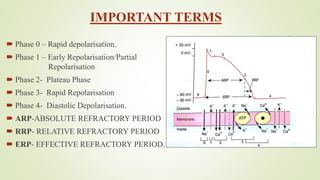
IMPORTANT TERMS
 Phase 0 – Rapid depolarisation.
 Phase 1 – Early Repolarisation/Partial
Repolarisation
 Phase 2- Plateau Phase
 Phase 3- Rapid Repolarisation
 Phase 4- Diastolic Depolarisation.
 ARP-ABSOLUTE REFRACTORY PERIOD
 RRP- RELATIVE REFRACTORY PERIOD
 ERP- EFFECTIVE REFRACTORY PERIOD.
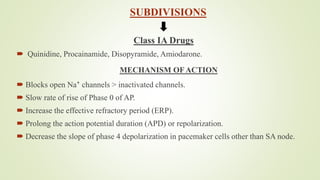
SUBDIVISIONS
Class IA Drugs
 Quinidine, Procainamide, Disopyramide, Amiodarone.
MECHANISM OF ACTION
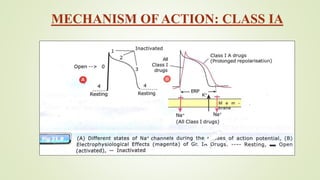
 Blocks open Na⁺ channels > inactivated channels.
 Slow rate of rise of Phase 0 of AP.
 Increase the effective refractory period (ERP).
 Prolong the action potential duration (APD) or repolarization.
 Decrease the slope of phase 4 depolarization in pacemaker cells other than SA node.
MECHANISM OF ACTION: CLASS IA
USES
 To prevent Paroxysmal supraventricular tachycardia (PSVTs).
 Premature ventricular contractions (PVCs).
 Premature Atrial contractions (PACs).
 Ventricular Tachycardia (VT).
Class IB Drugs
 Lignocaine, Phenytoin, Mexiletine and Tocainide.
MECHANISM OFACTION
 Blocks open < Inactivated Na⁺ channels. Have a rapid rate of association and
dissociation.
 Shortening of the phase 3 repolarization.
 Decrease ERP and APD.
 Prolong the diastolic phase 4 depolarization.
 Lack effect on Healthy myocardium and conducting tissue but blocks Na⁺ channels
in diseased myocardium.
MECHANISM OF ACTION : CLASS IB
THERAPEUTIC USES
 Ventricular tachycardia (VT).
 Premature ventricular contractions (PVCs).
 Ventricular extra-systoles that result from Acute MI and open heart
surgery.
 Not useful for treatment of arrhythmias due to automaticity changes.
Class IC Drugs
 Flecainide, Encainide, Propafenone, Moricizine.
MECHANISM OFACTION
I. Blocks open Na⁺ channels > Inactivated Na⁺ channels. Dissociates very
slowly.
II. Markedly decrease the rate of phase 0 depolarization in Purkinje and ventricular
myocardial fibers.
III. Reduce automaticity, decrease AV conduction and contractility. Have prominent
effect on normal heart as well.
IV. Retard re-entry of retrograde as well as antegrade impulses.
THERAPEUTIC USE
 Refractory Premature ventricular contractions and ventricular tachyarrhythmia.
 Supraventricular arrhythmias (except moricizine).
 Wolf-Parkinson-White (WPW) Syndrome.
NAV CHANNEL BLOCKER
ANTICONVULSANTS
• Phenytoin, Carbamazepine, Valproate, Lacosamide, Lamotrigine ,Topiramate.
MECHANISM OFACTION:
• Preferentially block the NavC channels in a ‘Use dependent’ manner. Higher the
frequency of firing, greater is the block.
• Prolong the duration of Inactivation phase. And delay its reversion to resting
phase.
• Inhibition of NavC channels diminish glutamate release from excitatory
glutaminergic neurons.
PHENYTOIN
USES
1. Generalized tonic-clonic seizure (GTCS).
2. Partial seizure (Psychomotor type).
3. Status epilepticus.
4. Trigeminal neuralgia (2nd choice).
5. Ventricular arrhythmias due to digitalis toxicity.
6. To enhance wound healing.
ADVERSE EFFECTS
 Over dose toxicity : CNS depression, lethargy.
 Chronic toxicity:
I. Gingival hyperplasia & coarsening of facial features.
II. Megaloblastic anaemia, Vitamin D, K deficiency.
III. Hirsutism (in females) & acne.
 Congenital malformations- cleft lip & palate, CHD.
 Hypersensitivity.
 Contraindications: Petit mal (absence seizure).
Myoclonic seizure.
CARBAMAZEPINE/OXCARBAZEPIBE
THERAPEUTIC USES
1. Generalized tonic-clonic seizure (GTCS).
2. Partial seizures (complex and simple).
3. Trigeminal neuralgia.(Drug of choice)
4. Glossopharyngeal neuralgia.
5. Post herpetic neuralgia.
6. Manic depressive psychosis (Carbamazepine).
CONTRAINDICATIONS
 Absence seizures.
ADVERSE EFFECTS
 Dose related- Dizziness, vertigo, ataxia, diplopia.
 Idiosyncrasy- Allergy, aplastic anaemia, hepatitis, SLE, leucopenia.
 Water retention and hyponatraemia.
 Teratogenicity- Finger nail hypoplasia, craniofacial defects.
VALPROATE
 Broad spectrum anticonvulsant.
MECHANISM OF ACTION
• Increase GABA activity. Activates glutamic acid decarboxylase (GAD) & inhibits
GABA transaminase.
• Decrease glutamate synthesis and release in brain.
• Blocks T type Ca²⁺channels.
USES
I. Absence seizure.
II. GTCSs.
III. Myoclonic seizures.
IV. Atonic seizure.
ADVERSE EFFECTS
DOSE RELATED
I. Weight gain
II. Reversible alopecia
III. Tremors.
IDIOSYNCRATIC TOXICITY
 Hepatitis, Pancreatitis, Thrombocytopenia and allergy.
TERTATOGENICITY
 Neural tube defects.
LIGAND - GATED Na⁺
CHANNEL
LIGAND - GATED Na⁺ CHANNEL
 Activated by Binding of a Ligand instead of a change in membrane potential.
 Members of a superfamily of ligand-gated ion channels (LGIC).They don’t
possess the exquisite ion selectivity.
TYPES
1. Nicotinic acetylcholine receptor (nAChR).
2. N-methyl-D-aspartate (NMDA) receptor.
3. α-amino-3-hydroxy-5-methyl-4-isoxazolepropionic acid (AMPA) receptor.
NICOTINIC ACETYLCHOLINE RECEPTOR
(nAChR)
TYPES
 MUSCLE-TYPE nAChRs (NM).
 NEURONAL -TYPE nAChRs
I. Peripheral neuronal type (NN).
II. Central neuronal type.
STRUCTURE: NICOTINIC ACETYLCHOLINE
RECEPTOR
 Pentameric Channel.
 Muscle-Type nAChR consists of 4 different
subunits (2α, β, δ, ε/γ).
 Neuronal-Type nAChR consists of 2
different subunits (2α, 3β).
 Each α subunits has an identical negatively
charged binding site for ACh.
DRUGS ACTING ON NAChR
1) AGONISTS: Acetylcholine, Nicotine.
2) NEUROMUSCULAR BLOCKING AGENTS :
A. (I) Depolarising Nm blockers : Succinylcholine, Decamethonium.
B. (II) Nondepolarizing/Competitive blockers:
I. Long acting: d-Tubocurarine, Pancuronium, Doxacurium, Pipecuronium.
II. Intermediate acting: Vecuronium, Atracurium, Rocuronium, Rapacuronium.
III. Short acting: Mivacurium.
3) GANGLION BLOCKER: Trimethaphan.
Mecamylamine.
ACETYLCHOLINE
 This is the endogenous ligand for nAChRs.
 ACh does not have any therapeutic uses due to it’s ultra short duration of action.
NICOTINE
 It is the principal alkaloid in tobacco.
 Ganglionic stimulant. Large doses cause persistent depolarization and ganglionic
blocked.
THERAPEUTIC USE
I. Short term nicotine replacement in tobacco abstinence.
II. Treatment of tobacco cessation.
NEUROMUSCULAR BLOCKING AGENTS
(DEPOLARISING BLOCKERS)
SUCCINYLCHOLINE (SCh)
MECHANISM OFACTION:
 Structural analogue of Ach hydrolysed by pseudocholinesterase.
 Stimulates NM receptor and depolarizes the membrane. Initial fasciculation
occurs.
 Prolong Depolarisation renders the membrane refractory to other impulses and
muscle relaxation occurs.
USES
1) Electro-convulsive therapy.
2) Endotracheal intubation.
3) Esophagoscopy.
4) Laryngoscopy.
5) Bronchoscopy.
6) Reduction of fractures and dislocations.
7) To treat laryngospasm.
ADVERSE EFFECTS & CONTRAINDICATIONS
1. Hyperkalaemia (CI in nerve and muscle diseases).
2. Prolonged apnoea in Atypical Pseudocholinesterase.
3. Increases IOP (CI in Glaucoma).
4. Increases ICT (CI in head injury).
5. Increases BP (Sympathetic ganglia stimulation).
6. Malignant hyperthermia.
7. Post operative muscle pain and soreness (due to initial fasciculation).
COMPETATIVE NEUROMUSCULAR BLOCKERS
CLASSIFICATION:
ISOQUINOLONE DERIVATIVES:
I. Long acting: d-Tubocurarine, Metocurine, Doxacurium.
II. Intermediate acting: Atracurium, Cisatracurium.
III. Short acting: Mivacurium.
STEROIDAL DERIVATIVES:
I. Long acting: Pancuronium, Pipecuronium.
II. Intermediate acting: Vecuronium, Rocuronium.
III. Short acting: Rapacuronium.
MECHANISM OF ACTION
 These have an affinity for the Nm cholinergic
receptors at the motor end plate, but have no
intrinsic activity over them.
 Bulk of the molecule block the Nm receptor and
prevent its binding to Ach.
 As a result necessary conformational change
needed for sodium channel opening is prevented.
ACTIONS
 Skeletal muscle- Flaccid paralysis without initial fasciculation.
 Autonomic ganglia blocked.
 Histamine release by d-Tubocurarine.
 Significant fall in BP.
USES
 Adjuvant to GA.
 Assisted ventilation.
 Status epilepticus.
 Severe tetanus.
ADVERSE EFFECTS
I. Respiratory paralysis.
II. Flushing (d-TC).
III. Fall in BP.
IV. Precipitation of asthma.
V. Life threatening bronchospasm by Rapacuronium
GANGLION BLOCKERS
 Antagonist at NN receptors
 Compete with ACh for the receptor site on the autonomic Ganglia thereby
blocking the transmission of impulse from preganglionic to postganglionic neuron.
NN RECEPTOR ANTAGONISTS:
A. Persistent Depolarising blockers : Nicotine (high doses) , Anticholinesterase
(High doses)
B. Non depolarising Blockers (Competitive blockers ): Trimethaphan,
Mecamylamine.
NN RECEPTOR ANTAGONISTS
TRIMETHAPTHAN
 Ultra short acting ganglion blocker given by IV infusion.
USES:
I. In Hypertensive Emergencies and produce Controlled hypotension.
II. Hypertensive emergencies due to aortic aneurysm.
III. Management of autonomic hyper-reflexia.
N-METHYL-D-ASPARTATE (NMDA) RECEPTOR
 Widely distributed in the CNS. Stimulated by Glutamate.
 Ligand gated ion channel receptor
 High permeability to Na⁺ and Ca²⁺ ions.
STRUCTURE
 Heterotetramer consisting two NR-1 And two NR-2 subunits.
 Six pharmacologically distinct modulatory or binding sites present:
1) GLU/NMDA binding site.
2) Modulatory site that binds to Glycine.
NMDA RECEPTOR SITES
3) Polyamines Regulatory site.
4) PCP site: Binds to Phencyclidine and antagonists
like Ketamine, Memantine, Amantidine.
5) Voltage dependent Mg²⁺ binding site: Inhibitory.
6) Voltage dependent Zn²⁺ binding site: Inhibitory.
DRUGS ACTING ON NMDA RECEPTOR
NMDA RECEPTOR BLOCKERS
1. Antiepileptic agents- Felbamate
2. General anaesthetic- Ketamine
3. Anti-parkinsonian drug- Amantadine
4. Drugs against Alzheimer’s disease- Memantine
DRUGS ACTING ON NMDA RECEPTOR
FELBAMATE
 Blocks glycine binding site.
 Also blocks NaVC (minor).
USES
I. Lennox-Gastaut Syndrome
II. Atonic seizures.
III. Atypical absence seizures.
IV. Partial seizure, GTCS.
ADVERSE EFFECTS
I. Unpredictable aplastic anaemia,
II. Hepatotoxicity.
KETAMINE
 Produces Dissociative Anaesthesia.
 Blocks NMDAR at in cortex and limbic system.
 Very strong analgesic agent.
 Acts by blocking action of Glutamate at NMDA Receptor.
USES
I. IV anaesthesia of choice in/for patient with shock (increases BP, ICT, IOP).
II. Emergency surgery with full stomach (does not depress laryngeal & pharyngeal
reflexes).
III. Patient with bronchial asthma.
IV. Induction in children.
AMPA and KAINATE Receptor
 α-amino-3-hydroxy-5-methylisoxazole-4-propionic acid receptor (AMPA) and
Kainate receptors are also known as Non-NMDA receptor.
 Widely distributed in the CNS. Mediate fast excitatory synaptic transmission
associated with Na⁺ & Ca²⁺influx.
 Stimulated by Glutamate.
STRUCTURE
 AMPA Receptors are pentamers consisting of GLUR₁₋₄ subunits.
 Kainate receptors are also pentamers consisting of GLUR₅₋₇ subunits and KA₁₋₂
subunits.
AMPA RECEPTOR BLOCKERS
ANTIEPILEPTIC DRUGS
1. Topiramate.
2. Lamotrigine.
3. Phenobarbital
4. Primidone.
TOPIRAMATE
 Broad spectrum anticonvulsant.
MECHANISM OFACTION
 Inhibition of AMPA receptor for Glutamate.
 Blockade of use dependent Na⁺ channels (NaVC).
 Activation of GABA receptor.
USES
1. Generalised tonic clonic seizure.
2. Absence seizure
3. Lennox-Gastaut syndrome.
Na⁺-K⁺-ATPase PUMP
Na⁺-K⁺-ATPase PUMP
 Na⁺-K⁺-ATPase enzyme actively Transports Na⁺ and K⁺ across all mammalian
cell membrane.
 Virtually presents in all mammalian cells.
 Its function is essential for all mammalian cell physiology.
 Belongs to P-type ATPase family of cation pump.
STRUCTURE
 It is a membrane protein.
 Consists of Large catalytic α subunit with ten trans-membrane segments.
 Glycosylated β subunit with single trans-membrane segment (Stabilization).
 Regulatory FXYD proteins (γ subunit).
 Isoforms of α, β & FXYD proteins: α 1-4, β 1-3, FXYD 1-7.
 α1 is the housekeeping form. α2 is present in heart and other muscles.
STRUCTURE : Na⁺-K⁺-ATPase PUMP
 diagram
 Covalent phosphorylation of an active site
aspartate residue by ATP.
 Conformational change from E1 to E2 form
coupled with cation movement.
 Moves three Na⁺ out and two K⁺ into the cell
against concentration gradient.
 Hydrolysis of phosphoenzyme brings back
E2-E1 conformational change.
FUNCTIONS
Maintains Resting membrane potential (RMP).
Transport of ions, glucose and amino acids (by use of Na⁺ gradient).
Controlling cell volume.
Functioning as signal transducer.
Controlling neuron activity states.
Na⁺-K⁺-ATPase Pump
MODULATOR
 ENDOGENOUS :
I. cAMP- Upregulation
II. Aldosterone
INHIBITOR of Na⁺ K⁺ ATPase PUMP :
 CARDIAC GLYCOSIDES
I. Digoxin
II. Digitoxin
III. Ouabain
SODIUM CHANNEL MODULATOR
ALDOSTERONE
 Most important mineralocorticoid in humans. Secreted from Zona
glomerulosa of adrenal glands.
MECHANISM OF ACTION
I. Direct stimulation of Na⁺/H⁺ exchanger in the apical membrane.
II. Acts by binding to the cytosolic Mineralocorticoid receptor and inducing
synthesis of Aldosterone induced protein (AIP).
III. Increases number of Na⁺/K⁺ ATPase molecules ( Na⁺ pumps) in the
basolateral membrane.
ADVERSE EFFECTS
1. Fluid retention.
2. Hypertension.
3. Oedema.
4. Hypokalaemia.
5. Metabolic alkalosis.
CARDIAC GLYCOSIDES
 The cardiac glycosides are often called digitalis or digitalis glycosides.
 They are a group of chemically similar compounds that increase the contractility
of the heart muscle and therefore are used in treating heart failure.
 The digitalis glycosides have a low therapeutic index.
 The most widely used cardiac glycosides is digoxin.
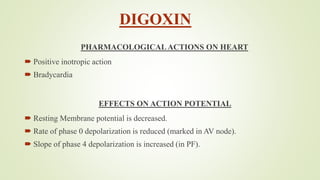
DIGOXIN
PHARMACOLOGICALACTIONS ON HEART
 Positive inotropic action
 Bradycardia
EFFECTS ON ACTION POTENTIAL
 Resting Membrane potential is decreased.
 Rate of phase 0 depolarization is reduced (marked in AV node).
 Slope of phase 4 depolarization is increased (in PF).
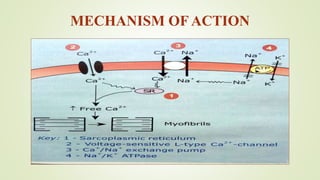
MECHANISM OF ACTION
USES
I. Congestive cardiac failure (CHF).
II. To control ventricular rate in Atrial fibrillation and Atrial flutter.
III. Paroxysmal supraventricular tachycardia (PSVT).
ADVERSE EFFECTS
1) Extra-cardiac: Anorexia, Nausea, Vomitting, gynaecomastia.
2) Cardiac:
 Bradycardia
 Arrhythmias.
 Atrial or Ventricular extrasystoles.
 Ventricular fibrillation.
CONTRAINDICATIONS
 Hypokalemia, Hypomagnesaemia & Hypocalcaemia.
 Elderly with severe renal or hepatic disease.
 Myocardial ischemia.
 Thyrotoxicosis and Myxoedema.
 Ventricular tachycardias.
 Partial heart block.
 Acute myocarditis.
 Wolff-Parkinson-White syndrome.
EPITHELIAL
SODIUM CHANNEL
EPITHELIAL SODIUM CHANNEL
 It is also known as Sodium Channel non-neuronal 1(SCNN 1)
 Is a membrane-bound ion-channel that is permeable for Li⁺-ions, protons, and
especially Na⁺-ions.
 It is a constitutively active ion-channel.
Location:
 Kidney, colon, lung & sweat gland.
 Also in pancreas, testes & ovaries.
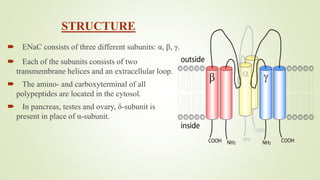
STRUCTURE
 ENaC consists of three different subunits: α, β, γ.
 Each of the subunits consists of two
transmembrane helices and an extracellular loop.
 The amino- and carboxyterminal of all
polypeptides are located in the cytosol.
 In pancreas, testes and ovary, δ-subunit is
present in place of α-subunit.
FUNCTION
1. It is involved in the transepithelial Na⁺-ion transport, which it accomplishes
together with the Na⁺-K⁺-ATPase pump.
2. Na⁺- and K⁺- ion homeostasis of blood and epithelia and extra-epithelial fluids
by reabsorption of Na⁺-ions.
3. Plays an important role in salt taste perception.
4. Involves in pathophysiology of cystic fibrosis.
EPITHELIAL SODIUM CHANNEL
(MODULATORS)
ACTIVATOR
 Aldosterone- in kidney and colon.
INHIBITORS: (renal ENaC)
 Atrial natriuretic peptide.
 Amiloride.
 Triamterene.
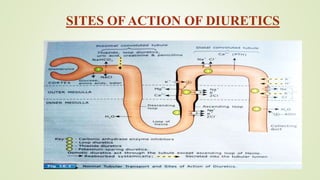
SITES OF ACTION OF DIURETICS
AMILORIDE/TRIAMTERENE
• They are Potassium sparing diuretics.
MECHANISM OFACTION
• Inhibits the amiloride-sensitive epithelial Na⁺ channels present on the luminal
membrane of late distal tubule (DT) and collecting duct (CD).
• Amiloride at high dosage inhibit Na⁺ reabsorption at PT.
PHARMACOLOGICALACTIONS
I. Weak diuretic.
II. Indirectly inhibit K⁺ secretion from DCT.
III. Also inhibit H⁺ secretion from the CD.
USES
I. Used with high ceiling diuretics or thiazides to prevent hypokalaemia.
II. Cystic fibrosis.
ADVERSE EFFECTS
I. Common: Risk of hyperkalaemia
II. Acidosis
III. Triamterene: Impaired glucose tolerance. Photosensitivity.
IV. Amiloride: Nausea, diarrhoea.
Na⁺DEPENDANT
TRANSPORTERS
HIGH CEILING DIURETICS
(Na⁺-K⁺-2Cl CO-TRANSPORTER BLOCKER)
 Furosemide, Torsemide, Bumetanide.
MECHANISM OF ACTION
 Inhibit Na⁺-K⁺-2Cl⁻ symport from the luminal side.
 Increases urinary excretion of Mg²⁺ ,Ca²⁺ in addition to Na⁺
SITE OF ACTION
I. Thick ascending loop of Henle.
II. Also a weak carbonic anhydrase inhibitor.
MECHANISM OF ACTION
USES
1. Acute pulmonary oedema.
2. Oedema of cardiac, hepatic and renal origin.
3. Cerebral oedema.
4. Hypertension.
5. Hypercalcaemia of malignancy.
Na-Cl SYMPORT INHIBITOR
CLASSIFICATION
1) Benzothiazides: Chlorothiazide, Benzethiazide , Hydrochlorothiazide
Bendroflumethiazide.
2) Thiazide like: Chlorthalidone, Indapamide, Metolazone,
Quinethazone, Xipamide
MECHANISM OF ACTION
 Inhibit Na+-Cl- Symport located in the luminal membrane of early distal tubule
(DT).
MECHANISM OF ACTION
USES
1) Mild to moderate cases of oedema.
2) Oedema of cardiac origins respond better.
3) Hypertension.
4) Diabetes insipidus.
5) Hypercalciuria.
Complications of High Ceiling and Thiazide Type
Diuretics
 Hypokalaemia, Hypocalcaemia with high ceiling diuretics, Hypomagnesaemia.
 Hyperuricaemia-more with thiazides.
 Hyperglycaemia & hyperlipidaemia.
 Hearing loss.
 Allergic manifestations.
 Dilutional hyponatraemia.
 Thiazides may aggravate renal insufficiency. Should be avoided in Pre-eclampsia.
 May precipitate mental disturbances and hepatic coma in cirrhotic patients on brisk
diuresis.
REFERENCES
 Goodman and Gilman’s the pharmacological basis of therapeutics.
 Principles of pharmacology, 3rd edition, HL Sharma, KK Sharma.
 Essentials of medical pharmacology, 7th edition. KD Tripathy.
 Guyton and hall textbook of Medical physiology,12 edition. John E.Hall
 Various internet sources.
Sodium channel modulator

Sodium channel modulator

  • 1.
    SODIUM CHANNEL MODULATORS MODERATOR: PROF( Dr) MEGHALI CHALIHA PRESENTER : Dr REUBEN.P. SYIEM HOD OF PHARMACOLGY PGT 1st YEAR JMCH DEPARTMENT OF PHARMACOLGY
  • 2.
    ION CHANNELS • Thelipid bilayer of the plasma membrane is Impermeable to anions and cations. • Ion channel are complex or single protein that catalyzes the passage of specific ions through the membrane and establish Concentration gradient across the membrane. • Changes in the flux of ions across the plasma membrane are critical regulatory events in both excitable and non-excitable cells.
  • 3.
    SODIUM CHANNEL Sodium channelsare integral membrane proteins that form ion channels, conducting Sodium ions (Na⁺) through a cell's plasma membrane. TYPES 1. Voltage-gated Na⁺ channels (NavC). 2. Ligand-gated Na⁺ channels or Receptor operated Na⁺ channels (LGNaC). 3. Epithelial Na⁺ channels (ENaCs) . 4. Na⁺-K⁺ -ATPase Pump. 5. Na⁺ dependent transporters (Symport and Antiport systems).
  • 4.
  • 5.
    VOLTAGE GATED Na⁺ CHANNEL These channels are responsible for the generation of action potentials that depolarize the membrane from its resting potential of –70 mV up to a potential of +20 mV within a few milliseconds.  This channel has several function parts.  One portion of the channel determines its ion selectivity and another portion of the channel serves as Gate that can open or close.  Incase of Na⁺V channel the gate is controlled by Voltage sensor which responds to the level of Membrane Potential.
  • 6.
    WHAT IS MEMBRANEPOTENTIAL ?  Membrane potential is the difference in electrical potential between the interior and exterior of the cell.  Electrical potential exists across the membranes of virtually all cells of the body.  The Resting Membrane Potential of large nerve fibres when not transmitting nerve signals is about -70 millivolts.
  • 7.
    The Membrane potentialestablished are used : 1. By Excitable tissues such as nerve and muscle to generate and transmit Electrical impulses. 2. By non-excitable cells to trigger biochemical and secretory events. 3. By all cells to support a variety of secondary symport and antiport processes.
  • 8.
    ACTION POTENTIAL  ActionPotential is defined “as a rapid rise and subsequent fall in voltage or membrane potential across a cellular membrane”. Stages of Action potential are: 1) Resting stage 2) Depolarization stage 3) Repolarization stage. 4) Hyperpolarization.
  • 9.
    STRUCTURE OF VOLTAGEGATED SODIUM CHANNEL NavC are composed of Three subunits. One pore-forming α subunit, Two regulatory β subunits. α Subunit: An α subunit forms the core of the channel and has four repeat domains, labelled I through IV . Each domain containing six membrane-spanning segments, labeled S1 through S6. The highly conserved S4 segment acts as the Channel voltage sensor and is due to positive amino acids located at every fourth position.
  • 10.
  • 11.
    GATING OF Na⁺CHANNEL  Voltage-gated Na⁺ channels exist in any of three distinct states: I. DEACTIVATED (CLOSED): During resting membrane potential (RMP) the channel is blocked on the extracellular side by their activation gates (AG). II. ACTIVATED (OPENED): After action potential is reached, the activation gates (AG) open, allowing positively charged Na⁺ ions to flow into the neuron/cell through the channels. III. INACTIVATED (CLOSED): Inactivation of the activated channel.
  • 12.
  • 13.
    DRUGS ACTING ONNaV CHANNEL ACTIVATORS  ACONITINE: A toxin produced by the Aconitum plant and was previously used as antipyretic and analgesic.  BATRACHOTOXIN (BTX): Extremely potent cardiotoxic and neurotoxic steroidal alkaloid found in certain species of frogs (poison dart frog), melyrid beetles, and birds.  BREVETOXIN: Cyclic polyether compounds produced naturally by a species of dinoflagellate known as Karenia brevis. Brevetoxins are neurotoxins.  CIGUATOXIN: Produced by Gambierdiscus toxicus, a type of dinoflagellate Accumulates in skin, head, viscera of big reef fishes. Causes Ciguatera.
  • 14.
    DRUGS ACTING ONNaV CHANNEL ACTIVATORS  DELPHININE: Toxic diterpenoid alkaloid found in plants from the Delphinium and Atragene genera. Has similar effects to aconitine, acting as an allosteric modulator of NavC. It is mostly cardiotoxic.  GRAYANATOXINS : produced by plants in the Ericaceae family. Prevents sodium channel inactivation.  VERATRIDINE: It is a steroid-derived alkaloid from plants in the Liliaceae family that functions as a neurotoxin.
  • 15.
    Na⁺V CHANNEL BLOCKERS EXTRACELLULAR 1)Tetrodotoxin(TTX): Derived from puffer fish, toads (Atelopus), blue ringed octopus and bacteria like Vibrio, Pseudomonas etc. 2) Saxitoxin (STX) : a Neurotoxin naturally produced by certain species of marine dinoflagellates. Ingestion of saxitoxin by humans, is responsible for the illness known as Paralytic shellfish poisoning (PSP). 3) Neosaxitoxin (NSTX): included, as other Saxitoxin-analogs, in a broad group of natural neurotoxic alkaloids, commonly known as the paralytic shellfish toxins (PSTs).
  • 16.
    INTRACELLULAR 1) Local anesthetics: I. Long acting: Bupivacaine, Ropivacaine, Tetracaine. II. Intermediate acting: Lignocaine, Prilocaine, Cocaine. III. Short acting : Procaine, Benzocaine. 2) Class I Antiarrhythmic Agents: I. Class I A: Quinidine, Procainamide, Amiodarone. II. Class I B: Lignocaine, Phenytoin, Tocainide, Mexiletine. III. Class I C: Flecainide, Encainide, Propafenone, Moricizine. 3) Anticonvulsants : Phenytoin, Carbamazepine, Valproate, Lacosamide, Lamotrigine.
  • 17.
    LOCALANAESTHETICS CLASSIFICATION AMIDES:  Long Acting:Bupivacaine, Ropivacaine, Dibucaine.  Intermediate Acting: Lignocaine, Prilocaine, Mepivacaine. ESTERS:  Long Acting: Tetracaine.  Intermediate Acting: Cocaine.  Short Acting: Procaine, Benzocaine. MISCELLANOUS:  Pramoxine/pramocaine.  Dyclonine/Dyclocaine.
  • 18.
    MECHANISM OF ACTION Block the NavC and consequently block the nerve conduction by reducing the permeation of Na⁺ ions during depolarization.  The blocking action of Local anaesthetics is favoured by Depolarization.  Resting membrane is less sensitive to Local anaesthetics.
  • 19.
    USES SURFACE ANAESTHESIA  Topicalapplication of an Local Anaesthetics to mucus membrane or skin.  Sites:  Eyes- Tonometry, surgery.  Nose/Ear- painful lesions, polyps.  Mouth/Throat- Painful ulcers, stomatitis.  Pharynx/Larynx- Tonsillectomy, Endotracheal intubation.  Urethra- Dilatation, Catheterization.
  • 20.
    INFILTRATION ANAESTHESIA  Dilutesolution of LA is infiltrated under the skin in the area of operation. Used for incision, excision, hydrocele, herniorrhaphy etc. CONDUCTION BLOCK LA is injected around nerve trunk. Area distal to injection is anaesthetized and paralyzed.  Field block: Used in herniorrhaphy, appendicectomy, dental procedures.  Nerve block: Lingual block, Ulnar block, Brachial plexus block, Sciatic and femoral block etc.
  • 21.
    SPINALANAESTHESIA  LA isinjected in the subarachnoid space between L2-3 or L3-4.Nerve roots in the cauda equina are blocked. Used in prostatectomy, fracture setting, obstetric procedures etc. EPIDURAL ANAESTHESIA  Categories: Thoracic, lumber and caudal; depending on the site of injection. Uses- obstetric purposes and post operative pain relief. INTRAVENOUS REGIONALANAESTHESIA  Injection of LA into vein of a tourniquet occlude limb. Used for the orthopaedic procedures in the upper limb.
  • 22.
    CLASS I ANTIARRHYMITIC AGENTS  These drugs block the Voltage gated Na⁺ channels same as Local anaesthetics.  Reduce Maximum rate of depolarization (MRD) during Phase 0 of action potential (AP).  Binds more strongly to the Activated and the Inactivated channels.  Inhibitory property is ‘use dependence’, more frequently the Na⁺ channels are activated the greater will be the block.
  • 23.
    IMPORTANT TERMS  Phase0 – Rapid depolarisation.  Phase 1 – Early Repolarisation/Partial Repolarisation  Phase 2- Plateau Phase  Phase 3- Rapid Repolarisation  Phase 4- Diastolic Depolarisation.  ARP-ABSOLUTE REFRACTORY PERIOD  RRP- RELATIVE REFRACTORY PERIOD  ERP- EFFECTIVE REFRACTORY PERIOD.
  • 24.
    SUBDIVISIONS Class IA Drugs Quinidine, Procainamide, Disopyramide, Amiodarone. MECHANISM OF ACTION  Blocks open Na⁺ channels > inactivated channels.  Slow rate of rise of Phase 0 of AP.  Increase the effective refractory period (ERP).  Prolong the action potential duration (APD) or repolarization.  Decrease the slope of phase 4 depolarization in pacemaker cells other than SA node.
  • 25.
  • 26.
    USES  To preventParoxysmal supraventricular tachycardia (PSVTs).  Premature ventricular contractions (PVCs).  Premature Atrial contractions (PACs).  Ventricular Tachycardia (VT).
  • 27.
    Class IB Drugs Lignocaine, Phenytoin, Mexiletine and Tocainide. MECHANISM OFACTION  Blocks open < Inactivated Na⁺ channels. Have a rapid rate of association and dissociation.  Shortening of the phase 3 repolarization.  Decrease ERP and APD.  Prolong the diastolic phase 4 depolarization.  Lack effect on Healthy myocardium and conducting tissue but blocks Na⁺ channels in diseased myocardium.
  • 28.
  • 29.
    THERAPEUTIC USES  Ventriculartachycardia (VT).  Premature ventricular contractions (PVCs).  Ventricular extra-systoles that result from Acute MI and open heart surgery.  Not useful for treatment of arrhythmias due to automaticity changes.
  • 30.
    Class IC Drugs Flecainide, Encainide, Propafenone, Moricizine. MECHANISM OFACTION I. Blocks open Na⁺ channels > Inactivated Na⁺ channels. Dissociates very slowly. II. Markedly decrease the rate of phase 0 depolarization in Purkinje and ventricular myocardial fibers. III. Reduce automaticity, decrease AV conduction and contractility. Have prominent effect on normal heart as well. IV. Retard re-entry of retrograde as well as antegrade impulses.
  • 31.
    THERAPEUTIC USE  RefractoryPremature ventricular contractions and ventricular tachyarrhythmia.  Supraventricular arrhythmias (except moricizine).  Wolf-Parkinson-White (WPW) Syndrome.
  • 32.
    NAV CHANNEL BLOCKER ANTICONVULSANTS •Phenytoin, Carbamazepine, Valproate, Lacosamide, Lamotrigine ,Topiramate. MECHANISM OFACTION: • Preferentially block the NavC channels in a ‘Use dependent’ manner. Higher the frequency of firing, greater is the block. • Prolong the duration of Inactivation phase. And delay its reversion to resting phase. • Inhibition of NavC channels diminish glutamate release from excitatory glutaminergic neurons.
  • 33.
    PHENYTOIN USES 1. Generalized tonic-clonicseizure (GTCS). 2. Partial seizure (Psychomotor type). 3. Status epilepticus. 4. Trigeminal neuralgia (2nd choice). 5. Ventricular arrhythmias due to digitalis toxicity. 6. To enhance wound healing.
  • 34.
    ADVERSE EFFECTS  Overdose toxicity : CNS depression, lethargy.  Chronic toxicity: I. Gingival hyperplasia & coarsening of facial features. II. Megaloblastic anaemia, Vitamin D, K deficiency. III. Hirsutism (in females) & acne.  Congenital malformations- cleft lip & palate, CHD.  Hypersensitivity.  Contraindications: Petit mal (absence seizure). Myoclonic seizure.
  • 35.
    CARBAMAZEPINE/OXCARBAZEPIBE THERAPEUTIC USES 1. Generalizedtonic-clonic seizure (GTCS). 2. Partial seizures (complex and simple). 3. Trigeminal neuralgia.(Drug of choice) 4. Glossopharyngeal neuralgia. 5. Post herpetic neuralgia. 6. Manic depressive psychosis (Carbamazepine). CONTRAINDICATIONS  Absence seizures.
  • 36.
    ADVERSE EFFECTS  Doserelated- Dizziness, vertigo, ataxia, diplopia.  Idiosyncrasy- Allergy, aplastic anaemia, hepatitis, SLE, leucopenia.  Water retention and hyponatraemia.  Teratogenicity- Finger nail hypoplasia, craniofacial defects.
  • 37.
    VALPROATE  Broad spectrumanticonvulsant. MECHANISM OF ACTION • Increase GABA activity. Activates glutamic acid decarboxylase (GAD) & inhibits GABA transaminase. • Decrease glutamate synthesis and release in brain. • Blocks T type Ca²⁺channels. USES I. Absence seizure. II. GTCSs. III. Myoclonic seizures. IV. Atonic seizure.
  • 38.
    ADVERSE EFFECTS DOSE RELATED I.Weight gain II. Reversible alopecia III. Tremors. IDIOSYNCRATIC TOXICITY  Hepatitis, Pancreatitis, Thrombocytopenia and allergy. TERTATOGENICITY  Neural tube defects.
  • 39.
    LIGAND - GATEDNa⁺ CHANNEL
  • 40.
    LIGAND - GATEDNa⁺ CHANNEL  Activated by Binding of a Ligand instead of a change in membrane potential.  Members of a superfamily of ligand-gated ion channels (LGIC).They don’t possess the exquisite ion selectivity. TYPES 1. Nicotinic acetylcholine receptor (nAChR). 2. N-methyl-D-aspartate (NMDA) receptor. 3. α-amino-3-hydroxy-5-methyl-4-isoxazolepropionic acid (AMPA) receptor.
  • 41.
    NICOTINIC ACETYLCHOLINE RECEPTOR (nAChR) TYPES MUSCLE-TYPE nAChRs (NM).  NEURONAL -TYPE nAChRs I. Peripheral neuronal type (NN). II. Central neuronal type.
  • 42.
    STRUCTURE: NICOTINIC ACETYLCHOLINE RECEPTOR Pentameric Channel.  Muscle-Type nAChR consists of 4 different subunits (2α, β, δ, ε/γ).  Neuronal-Type nAChR consists of 2 different subunits (2α, 3β).  Each α subunits has an identical negatively charged binding site for ACh.
  • 43.
    DRUGS ACTING ONNAChR 1) AGONISTS: Acetylcholine, Nicotine. 2) NEUROMUSCULAR BLOCKING AGENTS : A. (I) Depolarising Nm blockers : Succinylcholine, Decamethonium. B. (II) Nondepolarizing/Competitive blockers: I. Long acting: d-Tubocurarine, Pancuronium, Doxacurium, Pipecuronium. II. Intermediate acting: Vecuronium, Atracurium, Rocuronium, Rapacuronium. III. Short acting: Mivacurium. 3) GANGLION BLOCKER: Trimethaphan. Mecamylamine.
  • 44.
    ACETYLCHOLINE  This isthe endogenous ligand for nAChRs.  ACh does not have any therapeutic uses due to it’s ultra short duration of action. NICOTINE  It is the principal alkaloid in tobacco.  Ganglionic stimulant. Large doses cause persistent depolarization and ganglionic blocked. THERAPEUTIC USE I. Short term nicotine replacement in tobacco abstinence. II. Treatment of tobacco cessation.
  • 45.
    NEUROMUSCULAR BLOCKING AGENTS (DEPOLARISINGBLOCKERS) SUCCINYLCHOLINE (SCh) MECHANISM OFACTION:  Structural analogue of Ach hydrolysed by pseudocholinesterase.  Stimulates NM receptor and depolarizes the membrane. Initial fasciculation occurs.  Prolong Depolarisation renders the membrane refractory to other impulses and muscle relaxation occurs.
  • 46.
    USES 1) Electro-convulsive therapy. 2)Endotracheal intubation. 3) Esophagoscopy. 4) Laryngoscopy. 5) Bronchoscopy. 6) Reduction of fractures and dislocations. 7) To treat laryngospasm.
  • 47.
    ADVERSE EFFECTS &CONTRAINDICATIONS 1. Hyperkalaemia (CI in nerve and muscle diseases). 2. Prolonged apnoea in Atypical Pseudocholinesterase. 3. Increases IOP (CI in Glaucoma). 4. Increases ICT (CI in head injury). 5. Increases BP (Sympathetic ganglia stimulation). 6. Malignant hyperthermia. 7. Post operative muscle pain and soreness (due to initial fasciculation).
  • 48.
    COMPETATIVE NEUROMUSCULAR BLOCKERS CLASSIFICATION: ISOQUINOLONEDERIVATIVES: I. Long acting: d-Tubocurarine, Metocurine, Doxacurium. II. Intermediate acting: Atracurium, Cisatracurium. III. Short acting: Mivacurium. STEROIDAL DERIVATIVES: I. Long acting: Pancuronium, Pipecuronium. II. Intermediate acting: Vecuronium, Rocuronium. III. Short acting: Rapacuronium.
  • 49.
    MECHANISM OF ACTION These have an affinity for the Nm cholinergic receptors at the motor end plate, but have no intrinsic activity over them.  Bulk of the molecule block the Nm receptor and prevent its binding to Ach.  As a result necessary conformational change needed for sodium channel opening is prevented.
  • 50.
    ACTIONS  Skeletal muscle-Flaccid paralysis without initial fasciculation.  Autonomic ganglia blocked.  Histamine release by d-Tubocurarine.  Significant fall in BP. USES  Adjuvant to GA.  Assisted ventilation.  Status epilepticus.  Severe tetanus.
  • 51.
    ADVERSE EFFECTS I. Respiratoryparalysis. II. Flushing (d-TC). III. Fall in BP. IV. Precipitation of asthma. V. Life threatening bronchospasm by Rapacuronium
  • 52.
    GANGLION BLOCKERS  Antagonistat NN receptors  Compete with ACh for the receptor site on the autonomic Ganglia thereby blocking the transmission of impulse from preganglionic to postganglionic neuron. NN RECEPTOR ANTAGONISTS: A. Persistent Depolarising blockers : Nicotine (high doses) , Anticholinesterase (High doses) B. Non depolarising Blockers (Competitive blockers ): Trimethaphan, Mecamylamine.
  • 53.
    NN RECEPTOR ANTAGONISTS TRIMETHAPTHAN Ultra short acting ganglion blocker given by IV infusion. USES: I. In Hypertensive Emergencies and produce Controlled hypotension. II. Hypertensive emergencies due to aortic aneurysm. III. Management of autonomic hyper-reflexia.
  • 54.
    N-METHYL-D-ASPARTATE (NMDA) RECEPTOR Widely distributed in the CNS. Stimulated by Glutamate.  Ligand gated ion channel receptor  High permeability to Na⁺ and Ca²⁺ ions. STRUCTURE  Heterotetramer consisting two NR-1 And two NR-2 subunits.  Six pharmacologically distinct modulatory or binding sites present: 1) GLU/NMDA binding site. 2) Modulatory site that binds to Glycine.
  • 55.
    NMDA RECEPTOR SITES 3)Polyamines Regulatory site. 4) PCP site: Binds to Phencyclidine and antagonists like Ketamine, Memantine, Amantidine. 5) Voltage dependent Mg²⁺ binding site: Inhibitory. 6) Voltage dependent Zn²⁺ binding site: Inhibitory.
  • 56.
    DRUGS ACTING ONNMDA RECEPTOR NMDA RECEPTOR BLOCKERS 1. Antiepileptic agents- Felbamate 2. General anaesthetic- Ketamine 3. Anti-parkinsonian drug- Amantadine 4. Drugs against Alzheimer’s disease- Memantine
  • 57.
    DRUGS ACTING ONNMDA RECEPTOR FELBAMATE  Blocks glycine binding site.  Also blocks NaVC (minor). USES I. Lennox-Gastaut Syndrome II. Atonic seizures. III. Atypical absence seizures. IV. Partial seizure, GTCS. ADVERSE EFFECTS I. Unpredictable aplastic anaemia, II. Hepatotoxicity.
  • 58.
    KETAMINE  Produces DissociativeAnaesthesia.  Blocks NMDAR at in cortex and limbic system.  Very strong analgesic agent.  Acts by blocking action of Glutamate at NMDA Receptor. USES I. IV anaesthesia of choice in/for patient with shock (increases BP, ICT, IOP). II. Emergency surgery with full stomach (does not depress laryngeal & pharyngeal reflexes). III. Patient with bronchial asthma. IV. Induction in children.
  • 59.
    AMPA and KAINATEReceptor  α-amino-3-hydroxy-5-methylisoxazole-4-propionic acid receptor (AMPA) and Kainate receptors are also known as Non-NMDA receptor.  Widely distributed in the CNS. Mediate fast excitatory synaptic transmission associated with Na⁺ & Ca²⁺influx.  Stimulated by Glutamate. STRUCTURE  AMPA Receptors are pentamers consisting of GLUR₁₋₄ subunits.  Kainate receptors are also pentamers consisting of GLUR₅₋₇ subunits and KA₁₋₂ subunits.
  • 60.
    AMPA RECEPTOR BLOCKERS ANTIEPILEPTICDRUGS 1. Topiramate. 2. Lamotrigine. 3. Phenobarbital 4. Primidone.
  • 61.
    TOPIRAMATE  Broad spectrumanticonvulsant. MECHANISM OFACTION  Inhibition of AMPA receptor for Glutamate.  Blockade of use dependent Na⁺ channels (NaVC).  Activation of GABA receptor. USES 1. Generalised tonic clonic seizure. 2. Absence seizure 3. Lennox-Gastaut syndrome.
  • 62.
  • 63.
    Na⁺-K⁺-ATPase PUMP  Na⁺-K⁺-ATPaseenzyme actively Transports Na⁺ and K⁺ across all mammalian cell membrane.  Virtually presents in all mammalian cells.  Its function is essential for all mammalian cell physiology.  Belongs to P-type ATPase family of cation pump.
  • 64.
    STRUCTURE  It isa membrane protein.  Consists of Large catalytic α subunit with ten trans-membrane segments.  Glycosylated β subunit with single trans-membrane segment (Stabilization).  Regulatory FXYD proteins (γ subunit).  Isoforms of α, β & FXYD proteins: α 1-4, β 1-3, FXYD 1-7.  α1 is the housekeeping form. α2 is present in heart and other muscles.
  • 65.
  • 66.
     Covalent phosphorylationof an active site aspartate residue by ATP.  Conformational change from E1 to E2 form coupled with cation movement.  Moves three Na⁺ out and two K⁺ into the cell against concentration gradient.  Hydrolysis of phosphoenzyme brings back E2-E1 conformational change.
  • 67.
    FUNCTIONS Maintains Resting membranepotential (RMP). Transport of ions, glucose and amino acids (by use of Na⁺ gradient). Controlling cell volume. Functioning as signal transducer. Controlling neuron activity states.
  • 68.
    Na⁺-K⁺-ATPase Pump MODULATOR  ENDOGENOUS: I. cAMP- Upregulation II. Aldosterone INHIBITOR of Na⁺ K⁺ ATPase PUMP :  CARDIAC GLYCOSIDES I. Digoxin II. Digitoxin III. Ouabain
  • 69.
    SODIUM CHANNEL MODULATOR ALDOSTERONE Most important mineralocorticoid in humans. Secreted from Zona glomerulosa of adrenal glands. MECHANISM OF ACTION I. Direct stimulation of Na⁺/H⁺ exchanger in the apical membrane. II. Acts by binding to the cytosolic Mineralocorticoid receptor and inducing synthesis of Aldosterone induced protein (AIP). III. Increases number of Na⁺/K⁺ ATPase molecules ( Na⁺ pumps) in the basolateral membrane.
  • 70.
    ADVERSE EFFECTS 1. Fluidretention. 2. Hypertension. 3. Oedema. 4. Hypokalaemia. 5. Metabolic alkalosis.
  • 71.
    CARDIAC GLYCOSIDES  Thecardiac glycosides are often called digitalis or digitalis glycosides.  They are a group of chemically similar compounds that increase the contractility of the heart muscle and therefore are used in treating heart failure.  The digitalis glycosides have a low therapeutic index.  The most widely used cardiac glycosides is digoxin.
  • 72.
    DIGOXIN PHARMACOLOGICALACTIONS ON HEART Positive inotropic action  Bradycardia EFFECTS ON ACTION POTENTIAL  Resting Membrane potential is decreased.  Rate of phase 0 depolarization is reduced (marked in AV node).  Slope of phase 4 depolarization is increased (in PF).
  • 73.
  • 74.
    USES I. Congestive cardiacfailure (CHF). II. To control ventricular rate in Atrial fibrillation and Atrial flutter. III. Paroxysmal supraventricular tachycardia (PSVT). ADVERSE EFFECTS 1) Extra-cardiac: Anorexia, Nausea, Vomitting, gynaecomastia. 2) Cardiac:  Bradycardia  Arrhythmias.  Atrial or Ventricular extrasystoles.  Ventricular fibrillation.
  • 75.
    CONTRAINDICATIONS  Hypokalemia, Hypomagnesaemia& Hypocalcaemia.  Elderly with severe renal or hepatic disease.  Myocardial ischemia.  Thyrotoxicosis and Myxoedema.  Ventricular tachycardias.  Partial heart block.  Acute myocarditis.  Wolff-Parkinson-White syndrome.
  • 76.
  • 77.
    EPITHELIAL SODIUM CHANNEL It is also known as Sodium Channel non-neuronal 1(SCNN 1)  Is a membrane-bound ion-channel that is permeable for Li⁺-ions, protons, and especially Na⁺-ions.  It is a constitutively active ion-channel. Location:  Kidney, colon, lung & sweat gland.  Also in pancreas, testes & ovaries.
  • 78.
    STRUCTURE  ENaC consistsof three different subunits: α, β, γ.  Each of the subunits consists of two transmembrane helices and an extracellular loop.  The amino- and carboxyterminal of all polypeptides are located in the cytosol.  In pancreas, testes and ovary, δ-subunit is present in place of α-subunit.
  • 79.
    FUNCTION 1. It isinvolved in the transepithelial Na⁺-ion transport, which it accomplishes together with the Na⁺-K⁺-ATPase pump. 2. Na⁺- and K⁺- ion homeostasis of blood and epithelia and extra-epithelial fluids by reabsorption of Na⁺-ions. 3. Plays an important role in salt taste perception. 4. Involves in pathophysiology of cystic fibrosis.
  • 80.
    EPITHELIAL SODIUM CHANNEL (MODULATORS) ACTIVATOR Aldosterone- in kidney and colon. INHIBITORS: (renal ENaC)  Atrial natriuretic peptide.  Amiloride.  Triamterene.
  • 81.
    SITES OF ACTIONOF DIURETICS
  • 82.
    AMILORIDE/TRIAMTERENE • They arePotassium sparing diuretics. MECHANISM OFACTION • Inhibits the amiloride-sensitive epithelial Na⁺ channels present on the luminal membrane of late distal tubule (DT) and collecting duct (CD). • Amiloride at high dosage inhibit Na⁺ reabsorption at PT. PHARMACOLOGICALACTIONS I. Weak diuretic. II. Indirectly inhibit K⁺ secretion from DCT. III. Also inhibit H⁺ secretion from the CD.
  • 83.
    USES I. Used withhigh ceiling diuretics or thiazides to prevent hypokalaemia. II. Cystic fibrosis. ADVERSE EFFECTS I. Common: Risk of hyperkalaemia II. Acidosis III. Triamterene: Impaired glucose tolerance. Photosensitivity. IV. Amiloride: Nausea, diarrhoea.
  • 84.
  • 85.
    HIGH CEILING DIURETICS (Na⁺-K⁺-2ClCO-TRANSPORTER BLOCKER)  Furosemide, Torsemide, Bumetanide. MECHANISM OF ACTION  Inhibit Na⁺-K⁺-2Cl⁻ symport from the luminal side.  Increases urinary excretion of Mg²⁺ ,Ca²⁺ in addition to Na⁺ SITE OF ACTION I. Thick ascending loop of Henle. II. Also a weak carbonic anhydrase inhibitor.
  • 86.
  • 87.
    USES 1. Acute pulmonaryoedema. 2. Oedema of cardiac, hepatic and renal origin. 3. Cerebral oedema. 4. Hypertension. 5. Hypercalcaemia of malignancy.
  • 88.
    Na-Cl SYMPORT INHIBITOR CLASSIFICATION 1)Benzothiazides: Chlorothiazide, Benzethiazide , Hydrochlorothiazide Bendroflumethiazide. 2) Thiazide like: Chlorthalidone, Indapamide, Metolazone, Quinethazone, Xipamide MECHANISM OF ACTION  Inhibit Na+-Cl- Symport located in the luminal membrane of early distal tubule (DT).
  • 89.
  • 90.
    USES 1) Mild tomoderate cases of oedema. 2) Oedema of cardiac origins respond better. 3) Hypertension. 4) Diabetes insipidus. 5) Hypercalciuria.
  • 91.
    Complications of HighCeiling and Thiazide Type Diuretics  Hypokalaemia, Hypocalcaemia with high ceiling diuretics, Hypomagnesaemia.  Hyperuricaemia-more with thiazides.  Hyperglycaemia & hyperlipidaemia.  Hearing loss.  Allergic manifestations.  Dilutional hyponatraemia.  Thiazides may aggravate renal insufficiency. Should be avoided in Pre-eclampsia.  May precipitate mental disturbances and hepatic coma in cirrhotic patients on brisk diuresis.
  • 92.
    REFERENCES  Goodman andGilman’s the pharmacological basis of therapeutics.  Principles of pharmacology, 3rd edition, HL Sharma, KK Sharma.  Essentials of medical pharmacology, 7th edition. KD Tripathy.  Guyton and hall textbook of Medical physiology,12 edition. John E.Hall  Various internet sources.