



Junkbots and
Computational
Thinking
ScottTurner
5th June 2015
ComputationalThinking
Junkbot
Where the project is now?
What is the link?
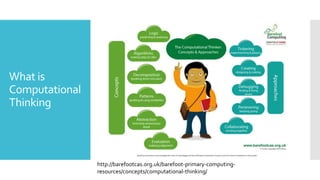
What is
Computational
Thinking
Wing (2006) “ComputationalThinking”
COMMUNICATIONSOFTHE ACM March
2006/Vol. 49, No. 3 pp. 33-35
http://www.cs.cmu.edu/afs/cs/usr/wing/w
ww/publications/Wing06.pdf
What is
Computational
Thinking
Conceptualizing, not programming.
Computer science is not computer
programming.Thinking like a computer
scientist means more than being able to
program a computer
What is
Computational
Thinking
Fundamental, not rote skill. A
fundamental skill is something every
human being must know to function in
modern society
What is
Computational
Thinking
A way that humans, not computers,
think. Computational thinking is a way
humans solve problems; it is not trying to
get humans to think like computers.
Computer ‘thinking’ is dull.
What is
Computational
Thinking
Complements and combines
mathematical and engineering
thinking.
Computer science:
- draws on mathematical thinking
- draws on engineering thinking, given
that we build systems that interact with
the real world.
What is
Computational
Thinking
For everyone, everywhere.
Computational thinking will be a reality
when it is so integral to human endeavors
it disappears as an explicit philosophy.
- it is reality when we no longer need to
define it seperately – it just is!
Education
changes
There is a move in many countries to
address the lack of computational
thinking in schools.
In the UK -
https://www.gov.uk/government/publicat
ions/national-curriculum-in-england-
computing-programmes-of-
study/national-curriculum-in-england-
computing-programmes-of-study
What is
Computational
Thinking
http://barefootcas.org.uk/barefoot-primary-computing-
resources/concepts/computational-thinking/
Junkbots
12 hours of STEM activities to over 100
secondary school students.
Junkbots
Three areas
Programming a Lego robot to clear junk.
A set of activities onWaste Management
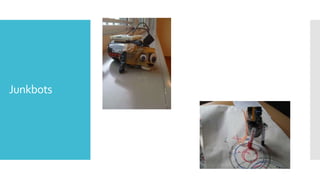
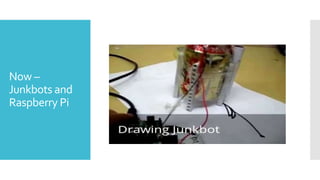
Building a moving ‘bot’ out of junk.
Junkbots
Programming a Lego robot to clear junk.
Building a moving ‘bot’ out of junk.
… ComputationalThinking elements
Junkbots
Success
Original target of 100 students getting 12
hours of STEM activity – meet
Approx. 200 (and growing) have had the
two computing/engineering focussed
activities.
Now for the Primary Schools/Youth
Groups
This is the growth area.
Success.
http://junkbots.blogspot.co.uk/2013/12/r
obot-day-videos.html
What
Happened
Next
The computing elements strengthened.
Others start delivering sessions.
Now –
Junkbots and
Raspberry Pi
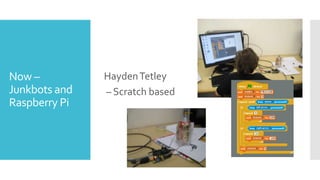
HaydenTetley
– Scratch based
Now –
Junkbots and
Raspberry Pi
Now –
Junkbots and
Raspberry Pi
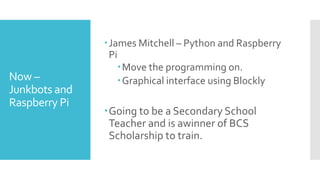
James Mitchell – Python and Raspberry
Pi
Move the programming on.
Graphical interface using Blockly
Going to be a Secondary School
Teacher and is awinner of BCS
Scholarship to train.
What is
Computational
Thinking
http://barefootcas.org.uk/barefoot-primary-computing-
resources/concepts/computational-thinking/
SoWhat?
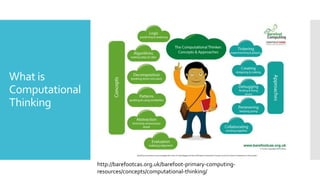
All the approaches are facilitated
Tinkering
Creating
Debugging
Perseverance
Collaboration
SoWhat?
Non Programming junkbots
Abstraction
Decomposition
Patterns
Logic
Evaluation
Programming adds the Algorithms
Funders
East Midlands DevelopmentAgency
STEM SouthWest
Nuffield Bursary
Resources
 https://www.gov.uk/government/publications/national-
curriculum-in-england-computing-programmes-of-
study/national-curriculum-in-england-computing-programmes-
of-study
 http://junkbots.blogspot.co.uk/
Question
How are the changes in curriculum going
to effect University curriculum?

Junkbots and computational thinking