Teaching Computational Thinking
Technologies Education
3:45
Big Problem
Project Based Learning
Thinking Skills
Curriculum Outcomes
TechnologiesLearningArea
DesignandTechnologies
DigitalTechnologies
ICTGeneralCapabilities
GeneralCapabilities
Developmental
Curriculum
Foundation Year 10
Indicative Timings
F-2 10 Hours
3-4 20 Hours
5-6 30 Hours
7-10 40 Hours
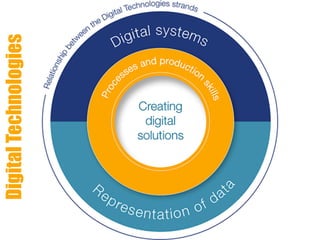
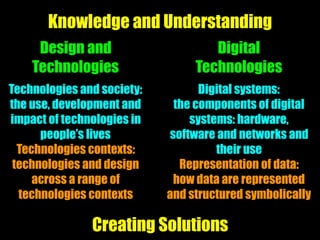
Digital systems:
the components of digital
systems: hardware,
software and networks and
their use
Representation of data:
how data are represented
and structured symbolically
Knowledge and Understanding
Design and
Technologies
Digital
Technologies
Creating Solutions
Technologies and society:
the use, development and
impact of technologies in
people’s lives
Technologies contexts:
technologies and design
across a range of
technologies contexts
Investigating and Defining
Generating and Designing
Producing and Implementing
Evaluating
Collaborating and Managing
Processes and Production Skills
Design and
Technologies
Digital
Technologies
Creating Solutions
Engineering principles and
systems
Food and fibre production
Food specialisations
Materials and technologies
specialisations
DesignandTechnologies
Information systems
Information technology
Software engineering
Computer engineering
DigitalTechnologies
DigitalSystemsRepresentationofData
Solution Type
• product
• environment
• service
Futures Thinking
Systems Thinking
Design Thinking
Computational Thinking
Strategic Thinking
Trends, Visioning, Scenarios, Big Idea
B/COT, Circle, Stocks, Flows, Loops
Contexts, Design Challenges, PSE Type
Data, Automation/Programming
Entrepreneurship, Planning, Teamwork
Assessment Criteria
• Interpretive and analytical ability in
developing design challenges.
• Interpretive and analytical ability in
developing programming challenges.
• Intellectual initiative in research,
planning and development of solutions.
• Intellectual initiative in the articulation
and presentation.
Two Digital Technologies Contexts
• Data

• Programming / Automation
Two Design Technologies Contexts
• Engineering principles and systems
• Food and fibre production
• Food specialisations
• Materials and technologies
specialisations
Thinking Skills Development
• Teaching Design Thinking;
• Teaching Computational Thinking;
• Teaching Systems Thinking;
• Teaching Strategic Thinking; and
• Teaching Futures Thinking.
https://www.qcaa.qld.edu.au/p-10/aciq/p-10-technologies
Digital Technologies Challenges
Algorithmic Sequences (F-2)
Sensor driven interface solutions (3-4)
Sensor driven robotic solutions (5-6)
Database integrated automation
solutions (7-8)
Digital Technologies Challenges
Algorithmic Sequences (F-2)
Game based programming (Icon
Based) (Guessing Game 3-4, Maze
Game 5-6)
HTML Website Development solutions
(7-8)
Digital Technologies Challenges
Algorithmic Sequences (F-2)
Sensor driven interface solutions (3-4)
Sensor driven robotic solutions (5-6)
Database integrated automation
solutions (7-8)
Digital Technologies Challenges
Spreadsheet Decision Based Solutions
(3-4)
Expert System solutions (5-6, 7-8)
Spreadsheet data analysis (7-8)
Database and GIS driven websites (7-8)
Data Driven App solutions (9-10)
Cryptography and Object Oriented
Database Solutions (9-10)
Design Technologies Challenges
Making Toys, Puppet Show (F-2)
Repurposed Clothing, Lunch Item,
Pinball Game (3-4)
Healthy Drink, Security System,
Garden, Wildlife Protection System
(5-6)
Cultural Fusions, Farming, etc. (7-8)
Expectations for most students
• Present standard activities taken
directly from existing examples and
contextualised for the Gold Coast;
Expectations for some students
• Demonstrate that students will have
opportunities to develop a range of
learning outcomes as detailed in the
curriculum and you have made a
significant new contribution to the
project idea;
Expectations for a few students
• Incorporate, in an integrated way, the
development of the range of student
thinking skills into your design
challenges and show real innovation in
your project ideas.
Systems Thinking
Computational Thinking
Design Thinking
Futures Thinking
Strategic Thinking
Solutions Thinking
3:16
1:16
Models of integration
Service Connections
Symmetric Correlations
Syntegration
The Investigation stage
does not investigate the
problem to better
understand it
Common Unit Problems
Project is the teachers, with
students following directions
to support the creative ideas
of the teacher
Common Unit Problems
There is no opportunity for
students to be creative and
design their own solutions
Common Unit Problems
There is no demonstration of
the iterative nature of the
design cycle, using what was
learnt from evaluation to
inform further investigation,
generation and production
Common Unit Problems
It is an ICT unit that supports
the learning of another
learning area
Common Unit Problems
Evaluation is little more than
reflection, with no criteria or
possibility of failure
Common Unit Problems
Creativity
Creativity
Creativity is the process of having
original ideas that have value
6:00
Creativity is the process of producing something that is
both original and worthwhile. Wallas (1926) presented one
of the first models of the creative process where creative
insights and illuminations may be explained by a process
consisting of 5 stages:
Creativity
preparation
preparatory work on a problem that focuses the
individual's mind on the problem and explores the
problem's dimensions
Creativity
incubation
where the problem is internalised into the unconscious
mind and nothing appears externally to be happening
Creativity
intimation
the creative person gets a "feeling"
that a solution is on its way
Creativity
illumination or insight
where the creative idea bursts forth from its preconscious
processing into conscious awareness
Creativity
verification
where the idea is consciously verified, elaborated, and
then applied
Creativity
1:22
The best way to have a good idea is to have lots of ideas
Linus Pauling
Creativity
2:53
There are three groups of creativity techniques:
Aleatoricism introduces chance into the creative process;
Improvisation encourages spontaneity and free thought;
and
problem solving has a wide range of tools and
methodologies that can support creativity.
Creativity Techniques
1:24
Problem solving creativity techniques include:
TRIZ;
Brainstorming and Brainwriting;
Six Thinking Hats;
Think outside the box;
SWOT analysis;
USIT;
Five Ws;
Thought experiments; and
Dilemmas.
Creativity Techniques
4:18
It is better to have enough ideas for some of them to be
wrong, than to be always right by having no ideas at all.
Edward de Bono
Creativity
More general approaches for inspiring creativity include:
Linking (word association);
Black Box (inputs and outputs);
Parallels (past solutions);
Variation (focus on a single tool);
Additive Examples (combinations).
Creativity Techniques
0:57
Innovation is the development of new solutions, products,
services, and ways of doing.
Innovation is not just improvement but doing something
different rather than doing the same thing better.
Through Technologies education, students develop the
ability to be innovative, using their thinking processes and
creativity to develop novel innovations to solve problems
and develop opportunities.
Innovation
1:14
Failure
3:26
0:27
Griffith University
Dr Jason Zagami
www.zagami.info

Lecture 6 Teaching Computational Thinking 2016