Development and Application of New
Approach Methods for Regulatory
Decisions: A Research Perspective
Russell Thomas
Director
National Center for Computational Toxicology
Helsinki Chemicals Forum
June 9, 2017
The views expressed in this presentation are those of the author and do not necessarily reflect
the views or policies of the U.S. EPA
National Center for
Computational Toxicology
1
Progress in Developing New
Approach Methods
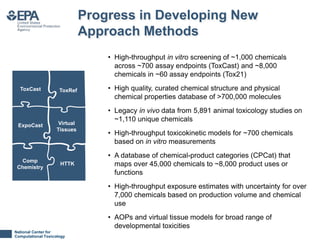
ToxCast
ExpoCast Virtual
Tissues
Comp
Chemistry
HTTK
ToxRef
• High-throughput in vitro screening of ~1,000 chemicals
across ~700 assay endpoints (ToxCast) and ~8,000
chemicals in ~60 assay endpoints (Tox21)
• High quality, curated chemical structure and physical
chemical properties database of >700,000 molecules
• Legacy in vivo data from 5,891 animal toxicology studies on
~1,110 unique chemicals
• High-throughput toxicokinetic models for ~700 chemicals
based on in vitro measurements
• A database of chemical-product categories (CPCat) that
maps over 45,000 chemicals to ~8,000 product uses or
functions
• High-throughput exposure estimates with uncertainty for over
7,000 chemicals based on production volume and chemical
use
• AOPs and virtual tissue models for broad range of
developmental toxicities
National Center for
Computational Toxicology
2
Progress in Applying New
Approach Methods
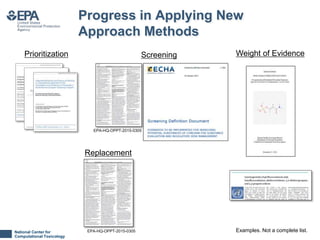
Prioritization Screening Weight of Evidence
Replacement
Examples. Not a complete list.EPA-HQ-OPPT-2015-0305
EPA-HQ-OPPT-2015-0305
National Center for
Computational Toxicology
3
Hazard Characterization
• Lack of metabolic competence of many current in vitro assays
• Biological coverage of assay portfolio
• Limited biological complexity of current assays
• Testing of volatile and non-DMSO soluble compounds
Dosimetry
• Predicting which chemicals or classes require more sophisticated toxicokinetic modeling
• In vitro assays not available for all important ADME processes
• Reliance on nominal concentrations for potency estimates
Exposure
• Biomonitoring data for a greater diversity of chemicals
• Quantitative data on chemicals in consumer products and emissivity from household items
Other
• Quantifying and incorporating uncertainty and variability
Scientific Challenges and Data
Gaps
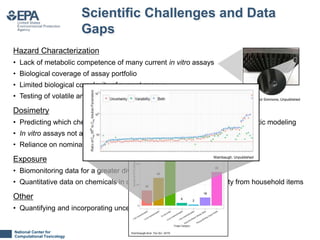
DeGroot and Simmons, Unpublished
Wambaugh, Unpublished
National Center for
Computational Toxicology
4
Philosophical and Social
Challenges
• Developing an acceptable and efficient validation approach
• Accepting and understanding qualitative and quantitative differences in
uncertainty in the new approach methods and traditional in vivo studies
• Agreeing on the role of in vivo rodent studies in validation
• Moving from an apical to a molecular paradigm
• Defining “adversity” in a molecular world (not that it was solved in an
apical world)
• Predicting human safety vs. toxicity
Courage to change…
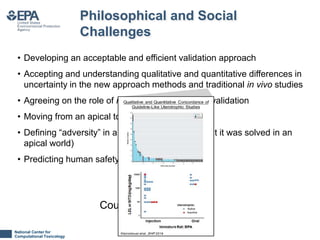
Kleinstreuer et al., EHP 2016
Qualitative and Quantitative Concordance of
Guideline-Like Uterotrophic Studies

June 9 2017 Panel 4 Russell Thomas

  • 1.
    Development and Applicationof New Approach Methods for Regulatory Decisions: A Research Perspective Russell Thomas Director National Center for Computational Toxicology Helsinki Chemicals Forum June 9, 2017 The views expressed in this presentation are those of the author and do not necessarily reflect the views or policies of the U.S. EPA
  • 2.
    National Center for ComputationalToxicology 1 Progress in Developing New Approach Methods ToxCast ExpoCast Virtual Tissues Comp Chemistry HTTK ToxRef • High-throughput in vitro screening of ~1,000 chemicals across ~700 assay endpoints (ToxCast) and ~8,000 chemicals in ~60 assay endpoints (Tox21) • High quality, curated chemical structure and physical chemical properties database of >700,000 molecules • Legacy in vivo data from 5,891 animal toxicology studies on ~1,110 unique chemicals • High-throughput toxicokinetic models for ~700 chemicals based on in vitro measurements • A database of chemical-product categories (CPCat) that maps over 45,000 chemicals to ~8,000 product uses or functions • High-throughput exposure estimates with uncertainty for over 7,000 chemicals based on production volume and chemical use • AOPs and virtual tissue models for broad range of developmental toxicities
  • 3.
    National Center for ComputationalToxicology 2 Progress in Applying New Approach Methods Prioritization Screening Weight of Evidence Replacement Examples. Not a complete list.EPA-HQ-OPPT-2015-0305 EPA-HQ-OPPT-2015-0305
  • 4.
    National Center for ComputationalToxicology 3 Hazard Characterization • Lack of metabolic competence of many current in vitro assays • Biological coverage of assay portfolio • Limited biological complexity of current assays • Testing of volatile and non-DMSO soluble compounds Dosimetry • Predicting which chemicals or classes require more sophisticated toxicokinetic modeling • In vitro assays not available for all important ADME processes • Reliance on nominal concentrations for potency estimates Exposure • Biomonitoring data for a greater diversity of chemicals • Quantitative data on chemicals in consumer products and emissivity from household items Other • Quantifying and incorporating uncertainty and variability Scientific Challenges and Data Gaps DeGroot and Simmons, Unpublished Wambaugh, Unpublished
  • 5.
    National Center for ComputationalToxicology 4 Philosophical and Social Challenges • Developing an acceptable and efficient validation approach • Accepting and understanding qualitative and quantitative differences in uncertainty in the new approach methods and traditional in vivo studies • Agreeing on the role of in vivo rodent studies in validation • Moving from an apical to a molecular paradigm • Defining “adversity” in a molecular world (not that it was solved in an apical world) • Predicting human safety vs. toxicity Courage to change… Kleinstreuer et al., EHP 2016 Qualitative and Quantitative Concordance of Guideline-Like Uterotrophic Studies