Toxicity Testing in the 21st Century: A
Strategy and A Vision
Wednesday
February 13, 2008
Risk Assessment Specialty Section Seminar
Mel Andersen and Dan Krewski
Director, Center for Dose Response Modeling
The Hamner Institutes for Health Sciences &
Professor, University of Ottawa
Toxicity Testing in the 21st Century:
A Vision and Strategy
Committee on Toxicity Testing and Assessment of
Environmental Agents
Board on Environmental Studies and Toxicology
Institute for Laboratory Animal Research
Division on Earth and Life Studies
National Research Council
Committee Roster
Daniel Krewski (Chair), University of Ottawa, Ottawa, ON
Daniel Acosta, Jr., University of Cincinnati, Cincinnati, OH
Melvin Andersen, CIIT Centers for Health Research, Research Triangle Park, NC
Henry Anderson, Wisconsin Division of Public Health, Madison, WI
John Bailar III, University of Chicago, Chicago, IL
Kim Boekelheide, Brown University, Providence, RI
Robert Brent, Thomas Jefferson University, Wilmington, DE
Gail Charnley, HealthRisk Strategies, Washington, DC
Vivian Cheung, University of Pennsylvania, Philadelphia, PA
Sidney Green, Howard University, Washington, DC
Karl Kelsey, Harvard University, Boston, MA
Nancy Kerkvliet, Oregon State University, Corvallis, OR
Abby Li, Exponent, Inc., San Francisco, CA
Lawrence McCray, Massachusetts Institute of Technology, Cambridge MA
Otto Meyer, Danish Institute for Food and Veterinary Research, Søborg, Denmark
D. Reid Patterson, Reid Patterson Consulting, Inc., Grayslake, IL
William Pennie, Pfizer, Inc., Groton, CT
Robert Scala, Exxon Biomedical Sciences (Ret.), Tucson, AZ
Gina Solomon, Natural Resources Defense Council, San Francisco, CA
Martin Stephens, The Humane Society of the United States, Washington, DC
James Yager, Jr., Johns Hopkins University, Baltimore, MD
Lauren Zeise, California Environmental Protection Agency, Oakland, CA
Content
June 12, 2007
Design a ‘modern’ toxicity testing
program to assess potential
human risks posed by exposures
to environmental agents over a
broad range of doses and
compounds and to be in a
position to use this information in
quantitative human health risk
assessment.
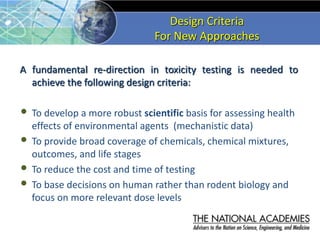
Design Criteria
For New Approaches
A fundamental re-direction in toxicity testing is needed to
achieve the following design criteria:
• To develop a more robust scientific basis for assessing health
effects of environmental agents (mechanistic data)
• To provide broad coverage of chemicals, chemical mixtures,
outcomes, and life stages
• To reduce the cost and time of testing
• To base decisions on human rather than rodent biology and
focus on more relevant dose levels
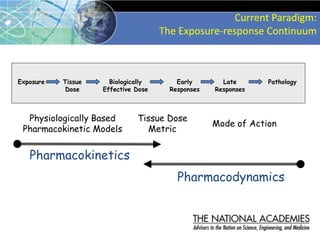
Current Paradigm:
The Exposure-response Continuum
Exposure Tissue
Dose
Biologically
Effective Dose
Early
Responses
Late
Responses
Pathology
Physiologically Based
Pharmacokinetic Models
Mode of Action
Tissue Dose
Metric
Pharmacokinetics
Pharmacodynamics
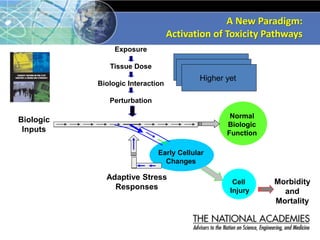
Biologic
Inputs
Normal
Biologic
Function
Morbidity
and
Mortality
Cell
Injury
Adaptive Stress
Responses
Early Cellular
Changes
Exposure
Tissue Dose
Biologic Interaction
Perturbation
Low Dose
Higher Dose
Higher yet
A New Paradigm:
Activation of Toxicity Pathways
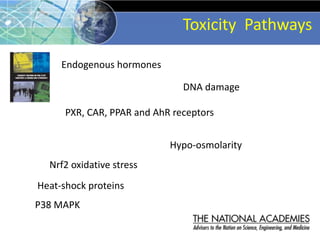
Toxicity Pathways
Toxicity Pathway: A cellular response
pathway that, when sufficiently perturbed,
is expected to result in an adverse health
effect.
Nrf2 oxidative stress
Heat-shock proteins
P38 MAPK
PXR, CAR, PPAR and AhR receptors
Hypo-osmolarity
DNA damage
Endogenous hormones
Toxicity Pathways
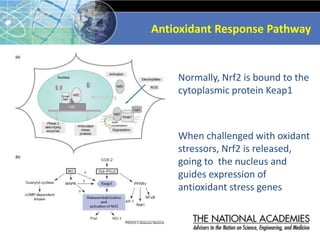
Normally, Nrf2 is bound to the
cytoplasmic protein Keap1
Antioxidant Response Pathway
When challenged with oxidant
stressors, Nrf2 is released,
going to the nucleus and
guides expression of
antioxidant stress genes
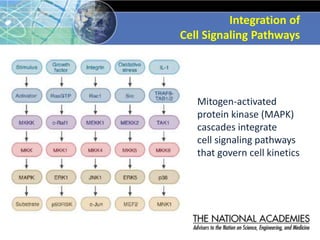
Mitogen-activated
protein kinase (MAPK)
cascades integrate
cell signaling pathways
that govern cell kinetics
Integration of
Cell Signaling Pathways
Nrf2
Maf
Nrf2-Maf
ARE(GR)
Nrf2-Maf
-ARE(GR)
Φ
GRon
GRoff GR mRNA
Φ Φ
GR
GCLon
GCLoff GCL mRNA GCL
Φ Φ
Nrf2-Maf
-ARE(GCL)
ARE(GCL)
Nrf2-Maf
HO-1on
HO-1off HO-1 mRNA
Φ Φ
Nrf2-Maf
-ARE(HO-1)
ARE(HO-1)
Nrf2-Maf
Catalase
H2O
O2
Cytosol
Peroxisome
Nucleus
GSH GSSG
GPx export
export
GR
r-GC
GS
GCL
NADP NADPH
G6PD
H2O
Nrf2
Nrf2-Keap1o
Nrf2-Keap1
Keap1o
Keap1
Keap1o
Keap1
Φ Φ
Φ
Syn
HO-1
H2O2
H2O2
H2O2
H2O2
H2O2
+ +
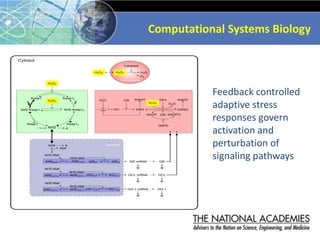
Feedback controlled
adaptive stress
responses govern
activation and
perturbation of
signaling pathways
Computational Systems Biology
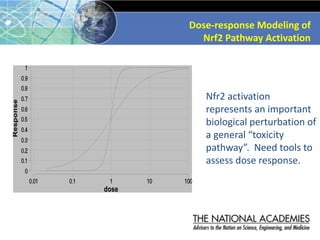
Nfr2 activation
represents an important
biological perturbation of
a general “toxicity
pathway”. Need tools to
assess dose response.
Dose-response Modeling of
Nrf2 Pathway Activation
dose
Response
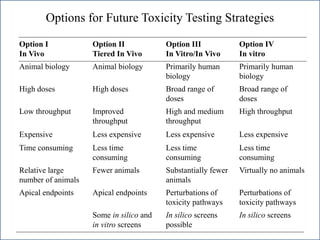
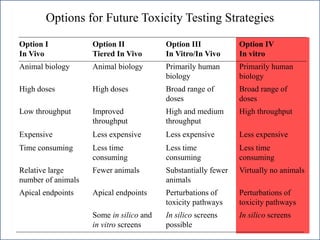
Option I
In Vivo
Option II
Tiered In Vivo
Option III
In Vitro/In Vivo
Option IV
In vitro
Animal biology Animal biology Primarily human
biology
Primarily human
biology
High doses High doses Broad range of
doses
Broad range of
doses
Low throughput Improved
throughput
High and medium
throughput
High throughput
Expensive Less expensive Less expensive Less expensive
Time consuming Less time
consuming
Less time
consuming
Less time
consuming
Relative large
number of animals
Fewer animals Substantially fewer
animals
Virtually no animals
Apical endpoints Apical endpoints Perturbations of
toxicity pathways
Perturbations of
toxicity pathways
Some in silico and
in vitro screens
In silico screens
possible
In silico screens
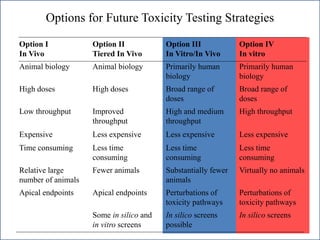
Options for Future Toxicity Testing Strategies
Option I
In Vivo
Option II
Tiered In Vivo
Option III
In Vitro/In Vivo
Option IV
In vitro
Animal biology Animal biology Primarily human
biology
Primarily human
biology
High doses High doses Broad range of
doses
Broad range of
doses
Low throughput Improved
throughput
High and medium
throughput
High throughput
Expensive Less expensive Less expensive Less expensive
Time consuming Less time
consuming
Less time
consuming
Less time
consuming
Relative large
number of animals
Fewer animals Substantially fewer
animals
Virtually no animals
Apical endpoints Apical endpoints Perturbations of
toxicity pathways
Perturbations of
toxicity pathways
Some in silico and
in vitro screens
In silico screens
possible
In silico screens
Options for Future Toxicity Testing Strategies
Option I
In Vivo
Option II
Tiered In Vivo
Option III
In Vitro/In Vivo
Option IV
In vitro
Animal biology Animal biology Primarily human
biology
Primarily human
biology
High doses High doses Broad range of
doses
Broad range of
doses
Low throughput Improved
throughput
High and medium
throughput
High throughput
Expensive Less expensive Less expensive Less expensive
Time consuming Less time
consuming
Less time
consuming
Less time
consuming
Relative large
number of animals
Fewer animals Substantially fewer
animals
Virtually no animals
Apical endpoints Apical endpoints Perturbations of
toxicity pathways
Perturbations of
toxicity pathways
Some in silico and
in vitro screens
In silico screens
possible
In silico screens
Options for Future Toxicity Testing Strategies
Option I
In Vivo
Option II
Tiered In Vivo
Option III
In Vitro/In Vivo
Option IV
In vitro
Animal biology Animal biology Primarily human
biology
Primarily human
biology
High doses High doses Broad range of
doses
Broad range of
doses
Low throughput Improved
throughput
High and medium
throughput
High throughput
Expensive Less expensive Less expensive Less expensive
Time consuming Less time
consuming
Less time
consuming
Less time
consuming
Relative large
number of animals
Fewer animals Substantially fewer
animals
Virtually no animals
Apical endpoints Apical endpoints Perturbations of
toxicity pathways
Perturbations of
toxicity pathways
Some in silico and
in vitro screens
In silico screens
possible
In silico screens
Option I
In Vivo
Option II
Tiered In Vivo
Option III
In Vitro/In Vivo
Option IV
In vitro
Animal biology Animal biology Primarily human
biology
Primarily human
biology
High doses High doses Broad range of
doses
Broad range of
doses
Low throughput Improved
throughput
High and medium
throughput
High throughput
Expensive Less expensive Less expensive Less expensive
Time consuming Less time
consuming
Less time
consuming
Less time
consuming
Relative large
number of animals
Fewer animals Substantially fewer
animals
Virtually no animals
Apical endpoints Apical endpoints Perturbations of
toxicity pathways
Perturbations of
toxicity pathways
Some in silico and
in vitro screens
In silico screens
possible
In silico screens
Options for Future Toxicity Testing Strategies
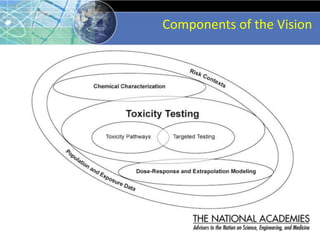
Components of the Vision
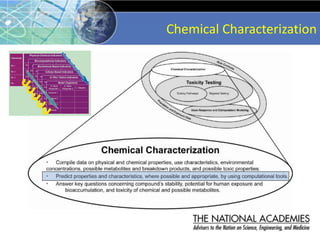
Chemical Characterization
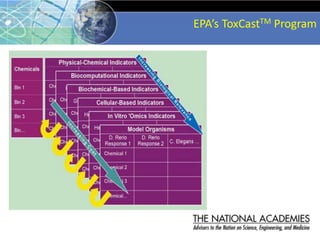
EPA’s ToxCastTM Program
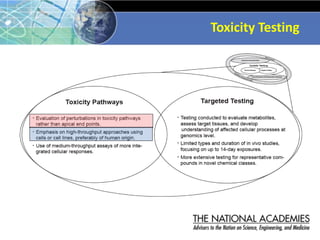
Toxicity Testing
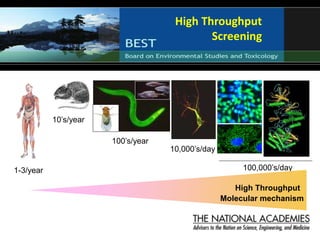
High Throughput
Screening
10’s/year
100’s/year
10,000’s/day
100,000’s/day
High Throughput
Molecular mechanism
1-3/year
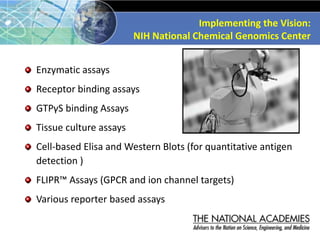
Enzymatic assays
Receptor binding assays
GTPγS binding Assays
Tissue culture assays
Cell-based Elisa and Western Blots (for quantitative antigen
detection )
FLIPR™ Assays (GPCR and ion channel targets)
Various reporter based assays
Implementing the Vision:
NIH National Chemical Genomics Center
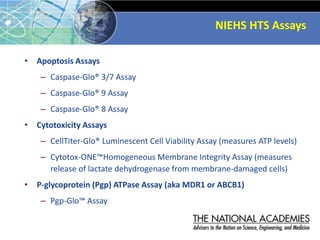
NIEHS HTS Assays
• Apoptosis Assays
– Caspase-Glo® 3/7 Assay
– Caspase-Glo® 9 Assay
– Caspase-Glo® 8 Assay
• Cytotoxicity Assays
– CellTiter-Glo® Luminescent Cell Viability Assay (measures ATP levels)
– Cytotox-ONE™Homogeneous Membrane Integrity Assay (measures
release of lactate dehydrogenase from membrane-damaged cells)
• P-glycoprotein (Pgp) ATPase Assay (aka MDR1 or ABCB1)
– Pgp-Glo™ Assay
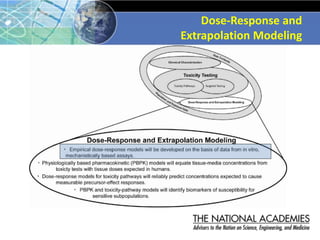
Dose-Response and
Extrapolation Modeling
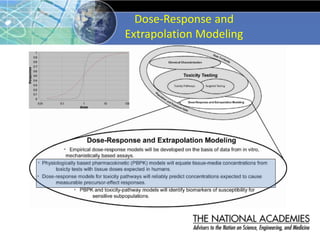
Dose-Response and
Extrapolation Modeling
dose
Response
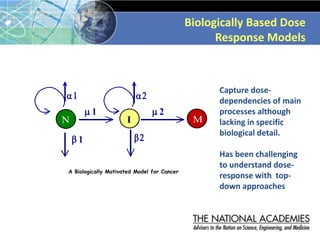
N I M
 1  2
 1 
 
A Biologically Motivated Model for Cancer
Biologically Based Dose
Response Models
Capture dose-
dependencies of main
processes although
lacking in specific
biological detail.
Has been challenging
to understand dose-
response with top-
down approaches
Nrf2
Maf
Nrf2-Maf
ARE(GR)
Nrf2-Maf
-ARE(GR)
Φ
GRon
GRoff GR mRNA
Φ Φ
GR
GCLon
GCLoff GCL mRNA GCL
Φ Φ
Nrf2-Maf
-ARE(GCL)
ARE(GCL)
Nrf2-Maf
HO-1on
HO-1off HO-1 mRNA
Φ Φ
Nrf2-Maf
-ARE(HO-1)
ARE(HO-1)
Nrf2-Maf
Catalase
H2O
O2
Cytosol
Peroxisome
Nucleus
GSH GSSG
GPx export
export
GR
r-GC
GS
GCL
NADP NADPH
G6PD
H2O
Nrf2
Nrf2-Keap1o
Nrf2-Keap1
Keap1o
Keap1
Keap1o
Keap1
Φ Φ
Φ
Syn
HO-1
H2O2
H2O2
H2O2
H2O2
H2O2
+ +
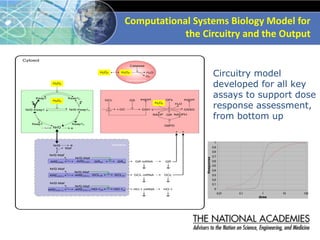
Computational Systems Biology Model for
the Circuitry and the Output
Circuitry model
developed for all key
assays to support dose
response assessment,
from bottom up
dose
Response
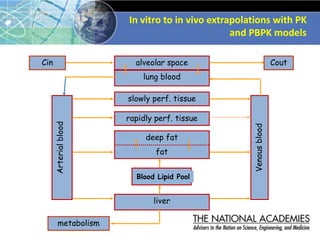
In vitro to in vivo extrapolations with PK
and PBPK models
Arterial
blood alveolar space
lung blood
rapidly perf. tissue
deep fat
fat
liver
metabolism
slowly perf. tissue
Venous
blood
Cin Cout
lipid pool
Blood Lipid Pool
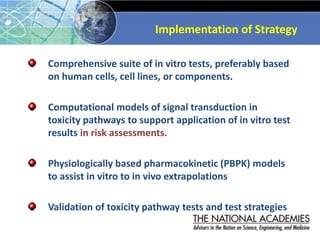
Implementation of Strategy
Comprehensive suite of in vitro tests, preferably based
on human cells, cell lines, or components.
Computational models of signal transduction in
toxicity pathways to support application of in vitro test
results in risk assessments.
Physiologically based pharmacokinetic (PBPK) models
to assist in vitro to in vivo extrapolations
Validation of toxicity pathway tests and test strategies
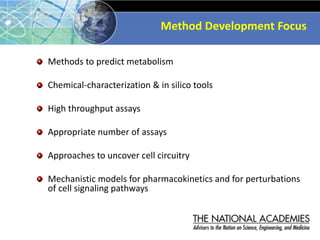
Method Development Focus
Methods to predict metabolism
Chemical-characterization & in silico tools
High throughput assays
Appropriate number of assays
Approaches to uncover cell circuitry
Mechanistic models for pharmacokinetics and for perturbations
of cell signaling pathways
Infrastructure
A long-term, large-scale concerted effort is needed to
bring the vision to fruition.
An appropriate institutional structure that fosters
multidisciplinary intramural and extramural research
is needed to achieve the vision.
The effort will not succeed merely by creating a
virtual institution to link and integrate organizations
that perform relevant research.
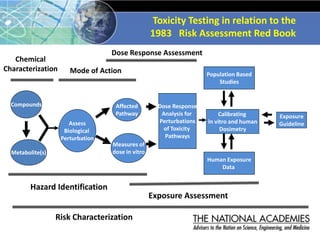
Toxicity Testing in relation to the
1983 Risk Assessment Red Book
Compounds
Metabolite(s)
Assess
Biological
Perturbation
Affected
Pathway
Measures of
dose in vitro
Dose Response
Analysis for
Perturbations
of Toxicity
Pathways
Calibrating
in vitro and human
Dosimetry
Human Exposure
Data
Population Based
Studies
Exposure
Guideline
Mode of Action
Chemical
Characterization
Dose Response Assessment
Exposure Assessment
Risk Characterization
Hazard Identification
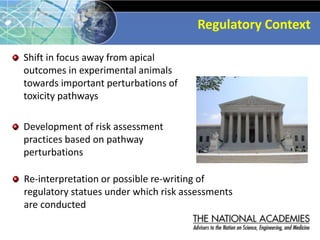
Regulatory Context
Shift in focus away from apical
outcomes in experimental animals
towards important perturbations of
toxicity pathways
Development of risk assessment
practices based on pathway
perturbations
Re-interpretation or possible re-writing of
regulatory statues under which risk assessments
are conducted
Biologic
Inputs
Normal
Biologic
Function
Morbidity
and
Mortality
Cell
Injury
Adaptive Stress
Responses
Early Cellular
Changes
Exposure
Tissue Dose
Biologic Interaction
Perturbation
Low Dose
Higher Dose
Higher yet
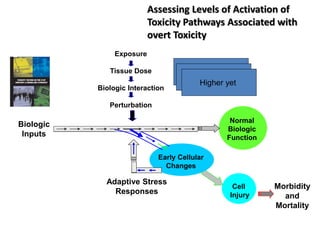
Assessing Levels of Activation of
Toxicity Pathways Associated with
overt Toxicity
What it is and what it isn’t
Approach based on in vitro, high throughput, mechanistic tests
to assess perturbations of ‘toxicity pathways’ of relevance for
human biology and to interpret them in a dose-response
context
Perturbations assessed over wide range of doses and
interpreted in relation to exposures that are not expected to
cause significant perturbations of these key pathways
IT IS NOT an approach to use suites of in vitro tests to predict
high dose animal toxicity. In this manner, its goals are different
from those of ECVAM, ICCVAM, the US EPA ToxCast, or the
NIEHS high throughput initiatives.
Conclusions
Paradigm shift away from apical endpoints in test animals to
perturbation of toxicity pathways in human cells
Providing much broader coverage of the universe of environmental
agents that warrant our attention
Has consequences for toxicity testing and in the search for
alternatives to animal testing
Already, at this point in time, this vision is an applied sciences
problem rather than a research-driven process
Topsy-turvy compared to present: testing in vitro based – research in
vivo based

Tox_Testing.ppt

  • 1.
    Toxicity Testing inthe 21st Century: A Strategy and A Vision Wednesday February 13, 2008 Risk Assessment Specialty Section Seminar Mel Andersen and Dan Krewski Director, Center for Dose Response Modeling The Hamner Institutes for Health Sciences & Professor, University of Ottawa
  • 2.
    Toxicity Testing inthe 21st Century: A Vision and Strategy Committee on Toxicity Testing and Assessment of Environmental Agents Board on Environmental Studies and Toxicology Institute for Laboratory Animal Research Division on Earth and Life Studies National Research Council
  • 3.
    Committee Roster Daniel Krewski(Chair), University of Ottawa, Ottawa, ON Daniel Acosta, Jr., University of Cincinnati, Cincinnati, OH Melvin Andersen, CIIT Centers for Health Research, Research Triangle Park, NC Henry Anderson, Wisconsin Division of Public Health, Madison, WI John Bailar III, University of Chicago, Chicago, IL Kim Boekelheide, Brown University, Providence, RI Robert Brent, Thomas Jefferson University, Wilmington, DE Gail Charnley, HealthRisk Strategies, Washington, DC Vivian Cheung, University of Pennsylvania, Philadelphia, PA Sidney Green, Howard University, Washington, DC Karl Kelsey, Harvard University, Boston, MA Nancy Kerkvliet, Oregon State University, Corvallis, OR Abby Li, Exponent, Inc., San Francisco, CA Lawrence McCray, Massachusetts Institute of Technology, Cambridge MA Otto Meyer, Danish Institute for Food and Veterinary Research, Søborg, Denmark D. Reid Patterson, Reid Patterson Consulting, Inc., Grayslake, IL William Pennie, Pfizer, Inc., Groton, CT Robert Scala, Exxon Biomedical Sciences (Ret.), Tucson, AZ Gina Solomon, Natural Resources Defense Council, San Francisco, CA Martin Stephens, The Humane Society of the United States, Washington, DC James Yager, Jr., Johns Hopkins University, Baltimore, MD Lauren Zeise, California Environmental Protection Agency, Oakland, CA
  • 4.
    Content June 12, 2007 Designa ‘modern’ toxicity testing program to assess potential human risks posed by exposures to environmental agents over a broad range of doses and compounds and to be in a position to use this information in quantitative human health risk assessment.
  • 5.
    Design Criteria For NewApproaches A fundamental re-direction in toxicity testing is needed to achieve the following design criteria: • To develop a more robust scientific basis for assessing health effects of environmental agents (mechanistic data) • To provide broad coverage of chemicals, chemical mixtures, outcomes, and life stages • To reduce the cost and time of testing • To base decisions on human rather than rodent biology and focus on more relevant dose levels
  • 6.
    Current Paradigm: The Exposure-responseContinuum Exposure Tissue Dose Biologically Effective Dose Early Responses Late Responses Pathology Physiologically Based Pharmacokinetic Models Mode of Action Tissue Dose Metric Pharmacokinetics Pharmacodynamics
  • 7.
    Biologic Inputs Normal Biologic Function Morbidity and Mortality Cell Injury Adaptive Stress Responses Early Cellular Changes Exposure TissueDose Biologic Interaction Perturbation Low Dose Higher Dose Higher yet A New Paradigm: Activation of Toxicity Pathways
  • 8.
    Toxicity Pathways Toxicity Pathway:A cellular response pathway that, when sufficiently perturbed, is expected to result in an adverse health effect.
  • 9.
    Nrf2 oxidative stress Heat-shockproteins P38 MAPK PXR, CAR, PPAR and AhR receptors Hypo-osmolarity DNA damage Endogenous hormones Toxicity Pathways
  • 10.
    Normally, Nrf2 isbound to the cytoplasmic protein Keap1 Antioxidant Response Pathway When challenged with oxidant stressors, Nrf2 is released, going to the nucleus and guides expression of antioxidant stress genes
  • 11.
    Mitogen-activated protein kinase (MAPK) cascadesintegrate cell signaling pathways that govern cell kinetics Integration of Cell Signaling Pathways
  • 12.
    Nrf2 Maf Nrf2-Maf ARE(GR) Nrf2-Maf -ARE(GR) Φ GRon GRoff GR mRNA ΦΦ GR GCLon GCLoff GCL mRNA GCL Φ Φ Nrf2-Maf -ARE(GCL) ARE(GCL) Nrf2-Maf HO-1on HO-1off HO-1 mRNA Φ Φ Nrf2-Maf -ARE(HO-1) ARE(HO-1) Nrf2-Maf Catalase H2O O2 Cytosol Peroxisome Nucleus GSH GSSG GPx export export GR r-GC GS GCL NADP NADPH G6PD H2O Nrf2 Nrf2-Keap1o Nrf2-Keap1 Keap1o Keap1 Keap1o Keap1 Φ Φ Φ Syn HO-1 H2O2 H2O2 H2O2 H2O2 H2O2 + + Feedback controlled adaptive stress responses govern activation and perturbation of signaling pathways Computational Systems Biology
  • 13.
    Nfr2 activation represents animportant biological perturbation of a general “toxicity pathway”. Need tools to assess dose response. Dose-response Modeling of Nrf2 Pathway Activation dose Response
  • 14.
    Option I In Vivo OptionII Tiered In Vivo Option III In Vitro/In Vivo Option IV In vitro Animal biology Animal biology Primarily human biology Primarily human biology High doses High doses Broad range of doses Broad range of doses Low throughput Improved throughput High and medium throughput High throughput Expensive Less expensive Less expensive Less expensive Time consuming Less time consuming Less time consuming Less time consuming Relative large number of animals Fewer animals Substantially fewer animals Virtually no animals Apical endpoints Apical endpoints Perturbations of toxicity pathways Perturbations of toxicity pathways Some in silico and in vitro screens In silico screens possible In silico screens Options for Future Toxicity Testing Strategies
  • 15.
    Option I In Vivo OptionII Tiered In Vivo Option III In Vitro/In Vivo Option IV In vitro Animal biology Animal biology Primarily human biology Primarily human biology High doses High doses Broad range of doses Broad range of doses Low throughput Improved throughput High and medium throughput High throughput Expensive Less expensive Less expensive Less expensive Time consuming Less time consuming Less time consuming Less time consuming Relative large number of animals Fewer animals Substantially fewer animals Virtually no animals Apical endpoints Apical endpoints Perturbations of toxicity pathways Perturbations of toxicity pathways Some in silico and in vitro screens In silico screens possible In silico screens Options for Future Toxicity Testing Strategies
  • 16.
    Option I In Vivo OptionII Tiered In Vivo Option III In Vitro/In Vivo Option IV In vitro Animal biology Animal biology Primarily human biology Primarily human biology High doses High doses Broad range of doses Broad range of doses Low throughput Improved throughput High and medium throughput High throughput Expensive Less expensive Less expensive Less expensive Time consuming Less time consuming Less time consuming Less time consuming Relative large number of animals Fewer animals Substantially fewer animals Virtually no animals Apical endpoints Apical endpoints Perturbations of toxicity pathways Perturbations of toxicity pathways Some in silico and in vitro screens In silico screens possible In silico screens Options for Future Toxicity Testing Strategies
  • 17.
    Options for FutureToxicity Testing Strategies Option I In Vivo Option II Tiered In Vivo Option III In Vitro/In Vivo Option IV In vitro Animal biology Animal biology Primarily human biology Primarily human biology High doses High doses Broad range of doses Broad range of doses Low throughput Improved throughput High and medium throughput High throughput Expensive Less expensive Less expensive Less expensive Time consuming Less time consuming Less time consuming Less time consuming Relative large number of animals Fewer animals Substantially fewer animals Virtually no animals Apical endpoints Apical endpoints Perturbations of toxicity pathways Perturbations of toxicity pathways Some in silico and in vitro screens In silico screens possible In silico screens
  • 18.
    Option I In Vivo OptionII Tiered In Vivo Option III In Vitro/In Vivo Option IV In vitro Animal biology Animal biology Primarily human biology Primarily human biology High doses High doses Broad range of doses Broad range of doses Low throughput Improved throughput High and medium throughput High throughput Expensive Less expensive Less expensive Less expensive Time consuming Less time consuming Less time consuming Less time consuming Relative large number of animals Fewer animals Substantially fewer animals Virtually no animals Apical endpoints Apical endpoints Perturbations of toxicity pathways Perturbations of toxicity pathways Some in silico and in vitro screens In silico screens possible In silico screens Options for Future Toxicity Testing Strategies
  • 19.
  • 20.
  • 21.
  • 22.
  • 23.
  • 24.
    Enzymatic assays Receptor bindingassays GTPγS binding Assays Tissue culture assays Cell-based Elisa and Western Blots (for quantitative antigen detection ) FLIPR™ Assays (GPCR and ion channel targets) Various reporter based assays Implementing the Vision: NIH National Chemical Genomics Center
  • 25.
    NIEHS HTS Assays •Apoptosis Assays – Caspase-Glo® 3/7 Assay – Caspase-Glo® 9 Assay – Caspase-Glo® 8 Assay • Cytotoxicity Assays – CellTiter-Glo® Luminescent Cell Viability Assay (measures ATP levels) – Cytotox-ONE™Homogeneous Membrane Integrity Assay (measures release of lactate dehydrogenase from membrane-damaged cells) • P-glycoprotein (Pgp) ATPase Assay (aka MDR1 or ABCB1) – Pgp-Glo™ Assay
  • 26.
  • 27.
  • 28.
    N I M 1  2  1    A Biologically Motivated Model for Cancer Biologically Based Dose Response Models Capture dose- dependencies of main processes although lacking in specific biological detail. Has been challenging to understand dose- response with top- down approaches
  • 29.
    Nrf2 Maf Nrf2-Maf ARE(GR) Nrf2-Maf -ARE(GR) Φ GRon GRoff GR mRNA ΦΦ GR GCLon GCLoff GCL mRNA GCL Φ Φ Nrf2-Maf -ARE(GCL) ARE(GCL) Nrf2-Maf HO-1on HO-1off HO-1 mRNA Φ Φ Nrf2-Maf -ARE(HO-1) ARE(HO-1) Nrf2-Maf Catalase H2O O2 Cytosol Peroxisome Nucleus GSH GSSG GPx export export GR r-GC GS GCL NADP NADPH G6PD H2O Nrf2 Nrf2-Keap1o Nrf2-Keap1 Keap1o Keap1 Keap1o Keap1 Φ Φ Φ Syn HO-1 H2O2 H2O2 H2O2 H2O2 H2O2 + + Computational Systems Biology Model for the Circuitry and the Output Circuitry model developed for all key assays to support dose response assessment, from bottom up dose Response
  • 30.
    In vitro toin vivo extrapolations with PK and PBPK models Arterial blood alveolar space lung blood rapidly perf. tissue deep fat fat liver metabolism slowly perf. tissue Venous blood Cin Cout lipid pool Blood Lipid Pool
  • 31.
    Implementation of Strategy Comprehensivesuite of in vitro tests, preferably based on human cells, cell lines, or components. Computational models of signal transduction in toxicity pathways to support application of in vitro test results in risk assessments. Physiologically based pharmacokinetic (PBPK) models to assist in vitro to in vivo extrapolations Validation of toxicity pathway tests and test strategies
  • 32.
    Method Development Focus Methodsto predict metabolism Chemical-characterization & in silico tools High throughput assays Appropriate number of assays Approaches to uncover cell circuitry Mechanistic models for pharmacokinetics and for perturbations of cell signaling pathways
  • 33.
    Infrastructure A long-term, large-scaleconcerted effort is needed to bring the vision to fruition. An appropriate institutional structure that fosters multidisciplinary intramural and extramural research is needed to achieve the vision. The effort will not succeed merely by creating a virtual institution to link and integrate organizations that perform relevant research.
  • 34.
    Toxicity Testing inrelation to the 1983 Risk Assessment Red Book Compounds Metabolite(s) Assess Biological Perturbation Affected Pathway Measures of dose in vitro Dose Response Analysis for Perturbations of Toxicity Pathways Calibrating in vitro and human Dosimetry Human Exposure Data Population Based Studies Exposure Guideline Mode of Action Chemical Characterization Dose Response Assessment Exposure Assessment Risk Characterization Hazard Identification
  • 35.
    Regulatory Context Shift infocus away from apical outcomes in experimental animals towards important perturbations of toxicity pathways Development of risk assessment practices based on pathway perturbations Re-interpretation or possible re-writing of regulatory statues under which risk assessments are conducted
  • 38.
    Biologic Inputs Normal Biologic Function Morbidity and Mortality Cell Injury Adaptive Stress Responses Early Cellular Changes Exposure TissueDose Biologic Interaction Perturbation Low Dose Higher Dose Higher yet Assessing Levels of Activation of Toxicity Pathways Associated with overt Toxicity
  • 39.
    What it isand what it isn’t Approach based on in vitro, high throughput, mechanistic tests to assess perturbations of ‘toxicity pathways’ of relevance for human biology and to interpret them in a dose-response context Perturbations assessed over wide range of doses and interpreted in relation to exposures that are not expected to cause significant perturbations of these key pathways IT IS NOT an approach to use suites of in vitro tests to predict high dose animal toxicity. In this manner, its goals are different from those of ECVAM, ICCVAM, the US EPA ToxCast, or the NIEHS high throughput initiatives.
  • 40.
    Conclusions Paradigm shift awayfrom apical endpoints in test animals to perturbation of toxicity pathways in human cells Providing much broader coverage of the universe of environmental agents that warrant our attention Has consequences for toxicity testing and in the search for alternatives to animal testing Already, at this point in time, this vision is an applied sciences problem rather than a research-driven process Topsy-turvy compared to present: testing in vitro based – research in vivo based