Priority setting of chemicals
Potential for harmonisation and synergies
Mike Rasenberg
Head of Unit
Computational Assessment and Dissemination
European Chemicals Agency
Helsinki Chemicals Forum - Panel 3
Messukeskus Conference Centre
14-15 June 2018 Helsinki - Finland
2
Where are we now?
3
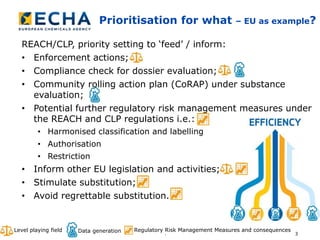
Prioritisation for what – EU as example?
REACH/CLP, priority setting to ‘feed’ / inform:
• Enforcement actions;
• Compliance check for dossier evaluation;
• Community rolling action plan (CoRAP) under substance
evaluation;
• Potential further regulatory risk management measures under
the REACH and CLP regulations i.e.:
• Harmonised classification and labelling
• Authorisation
• Restriction
• Inform other EU legislation and activities;
• Stimulate substitution;
• Avoid regrettable substitution.
Data generationLevel playing field Regulatory Risk Management Measures and consequences
4
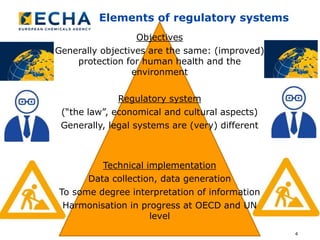
Elements of regulatory systems
Objectives
Generally objectives are the same: (improved)
protection for human health and the
environment
Regulatory system
(“the law”, economical and cultural aspects)
Generally, legal systems are (very) different
Technical implementation
Data collection, data generation
To some degree interpretation of information
Harmonisation in progress at OECD and UN
level
1. Collect/share available information
hazard + exposure
2. Analyse and prioritise
(designate low priority)
3. Generate knowledge where needed
(designate low priority)
4. Hazard/Risk assessment
(designate low hazard/low risk)
5. Regulary Risk Management
5
The flow of events
Technical / data
Regulatory / legal
Increasedchacesof
succesfullcollaboration
6
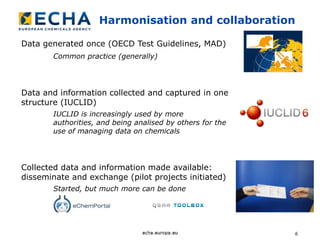
Harmonisation and collaboration
Data generated once (OECD Test Guidelines, MAD)
Common practice (generally)
Data and information collected and captured in one
structure (IUCLID)
IUCLID is increasingly used by more
authorities, and being analised by others for the
use of managing data on chemicals
Collected data and information made available:
disseminate and exchange (pilot projects initiated)
Started, but much more can be done
7
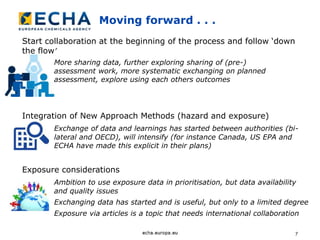
Moving forward . . .
Start collaboration at the beginning of the process and follow ‘down
the flow’
More sharing data, further exploring sharing of (pre-)
assessment work, more systematic exchanging on planned
assessment, explore using each others outcomes
Integration of New Approach Methods (hazard and exposure)
Exchange of data and learnings has started between authorities (bi-
lateral and OECD), will intensify (for instance Canada, US EPA and
ECHA have made this explicit in their plans)
Exposure considerations
Ambition to use exposure data in prioritisation, but data availability
and quality issues
Exchanging data has started and is useful, but only to a limited degree
Exposure via articles is a topic that needs international collaboration
Thank you!
mike.rasenberg@echa.europa.eu

HCF 2018 Panel 3: Mike Rasenberg

  • 1.
    Priority setting ofchemicals Potential for harmonisation and synergies Mike Rasenberg Head of Unit Computational Assessment and Dissemination European Chemicals Agency Helsinki Chemicals Forum - Panel 3 Messukeskus Conference Centre 14-15 June 2018 Helsinki - Finland
  • 2.
  • 3.
    3 Prioritisation for what– EU as example? REACH/CLP, priority setting to ‘feed’ / inform: • Enforcement actions; • Compliance check for dossier evaluation; • Community rolling action plan (CoRAP) under substance evaluation; • Potential further regulatory risk management measures under the REACH and CLP regulations i.e.: • Harmonised classification and labelling • Authorisation • Restriction • Inform other EU legislation and activities; • Stimulate substitution; • Avoid regrettable substitution. Data generationLevel playing field Regulatory Risk Management Measures and consequences
  • 4.
    4 Elements of regulatorysystems Objectives Generally objectives are the same: (improved) protection for human health and the environment Regulatory system (“the law”, economical and cultural aspects) Generally, legal systems are (very) different Technical implementation Data collection, data generation To some degree interpretation of information Harmonisation in progress at OECD and UN level
  • 5.
    1. Collect/share availableinformation hazard + exposure 2. Analyse and prioritise (designate low priority) 3. Generate knowledge where needed (designate low priority) 4. Hazard/Risk assessment (designate low hazard/low risk) 5. Regulary Risk Management 5 The flow of events Technical / data Regulatory / legal Increasedchacesof succesfullcollaboration
  • 6.
    6 Harmonisation and collaboration Datagenerated once (OECD Test Guidelines, MAD) Common practice (generally) Data and information collected and captured in one structure (IUCLID) IUCLID is increasingly used by more authorities, and being analised by others for the use of managing data on chemicals Collected data and information made available: disseminate and exchange (pilot projects initiated) Started, but much more can be done
  • 7.
    7 Moving forward .. . Start collaboration at the beginning of the process and follow ‘down the flow’ More sharing data, further exploring sharing of (pre-) assessment work, more systematic exchanging on planned assessment, explore using each others outcomes Integration of New Approach Methods (hazard and exposure) Exchange of data and learnings has started between authorities (bi- lateral and OECD), will intensify (for instance Canada, US EPA and ECHA have made this explicit in their plans) Exposure considerations Ambition to use exposure data in prioritisation, but data availability and quality issues Exchanging data has started and is useful, but only to a limited degree Exposure via articles is a topic that needs international collaboration
  • 8.