Development of a Tool for Integrating
Traditional and New Approach
Methodologies (NAMs) for Chemical
Safety Decisions
Antony Williams, Richard Judson, Chris Grulke and Rusty Thomas
National Center for Computational Toxicology, U.S. Environmental Protection Agency, RTP, NC
March 2018
ACS Spring Meeting, New Orleans
http://www.orcid.org/0000-0002-2668-4821
The views expressed in this presentation are those of the author and do not necessarily reflect the views or policies of the U.S. EPA
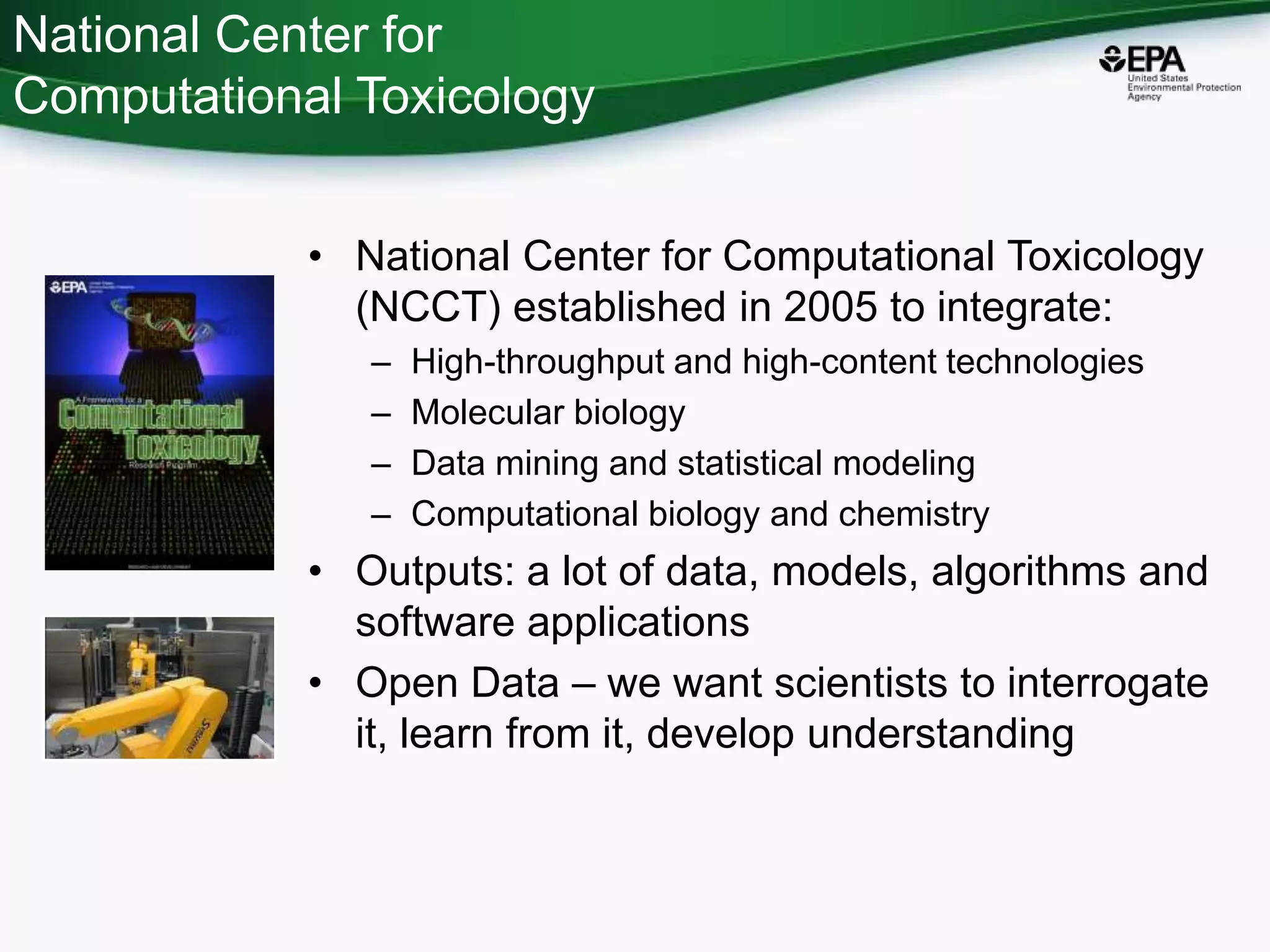
• National Center for Computational Toxicology
(NCCT) established in 2005 to integrate:
– High-throughput and high-content technologies
– Molecular biology
– Data mining and statistical modeling
– Computational biology and chemistry
• Outputs: a lot of data, models, algorithms and
software applications
• Open Data – we want scientists to interrogate
it, learn from it, develop understanding
National Center for
Computational Toxicology
Background
• EPA must designate a set of high-priority
chemicals for detailed risk assessment.
• NCCT is building a web-based tool as one
approach to help guide that selection
2
The CompTox Chemistry Dashboard
• NCCT has lots of data to build relevant tools and approaches. The
source data are available via the CompTox Chemistry Dashboard
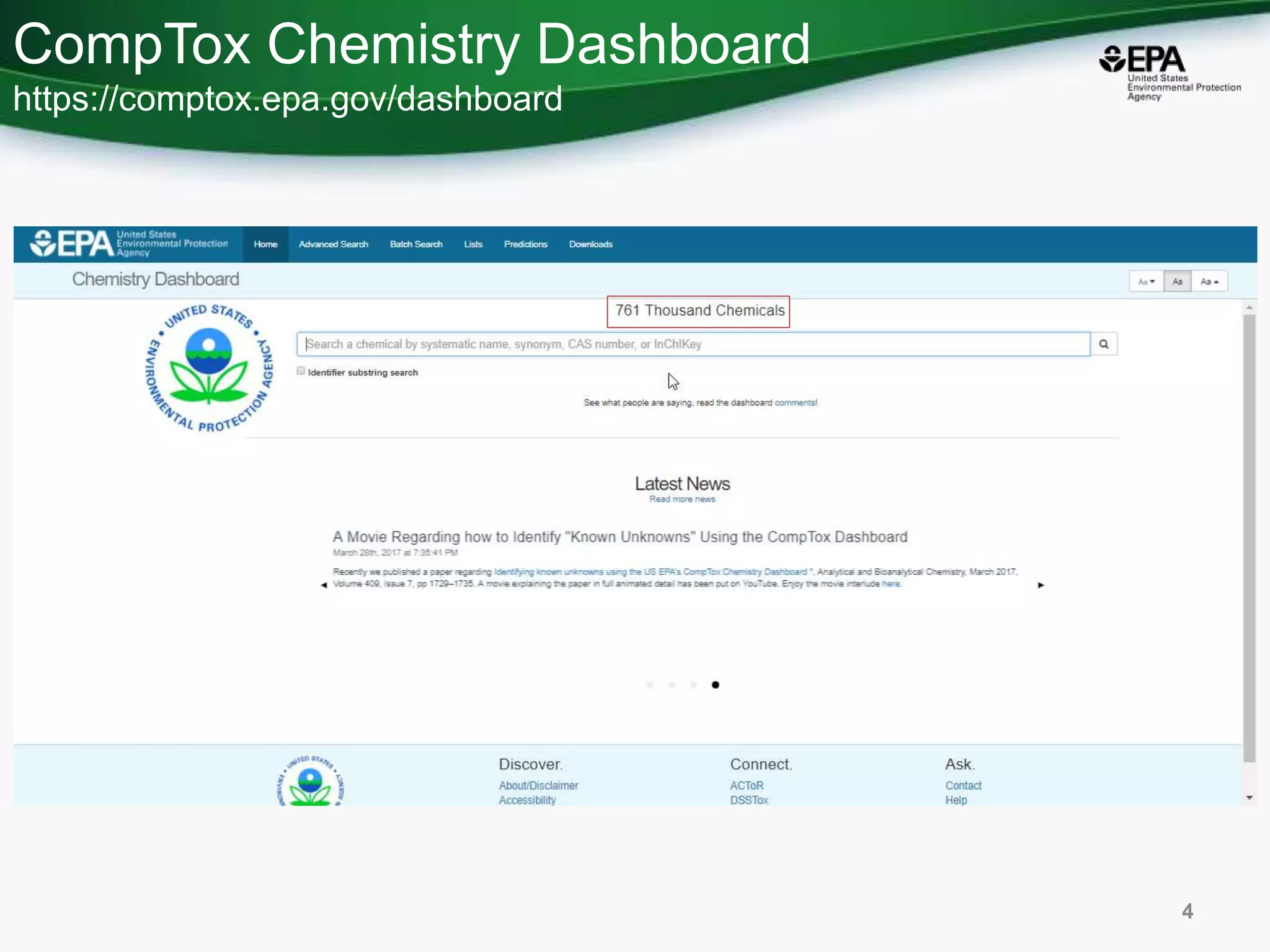
• A publicly accessible website delivering access:
– ~760,000 chemicals with related property data
– Experimental and predicted physicochemical property data
– Integration to “biological assay data” for 1000s of chemicals
– Data regarding chemical exposure
– Links to other agency websites and public data resources
– “Literature” searches for chemicals using public resources
– “Batch searching” for thousands of chemicals
3
CompTox Chemistry Dashboard
https://comptox.epa.gov/dashboard
4
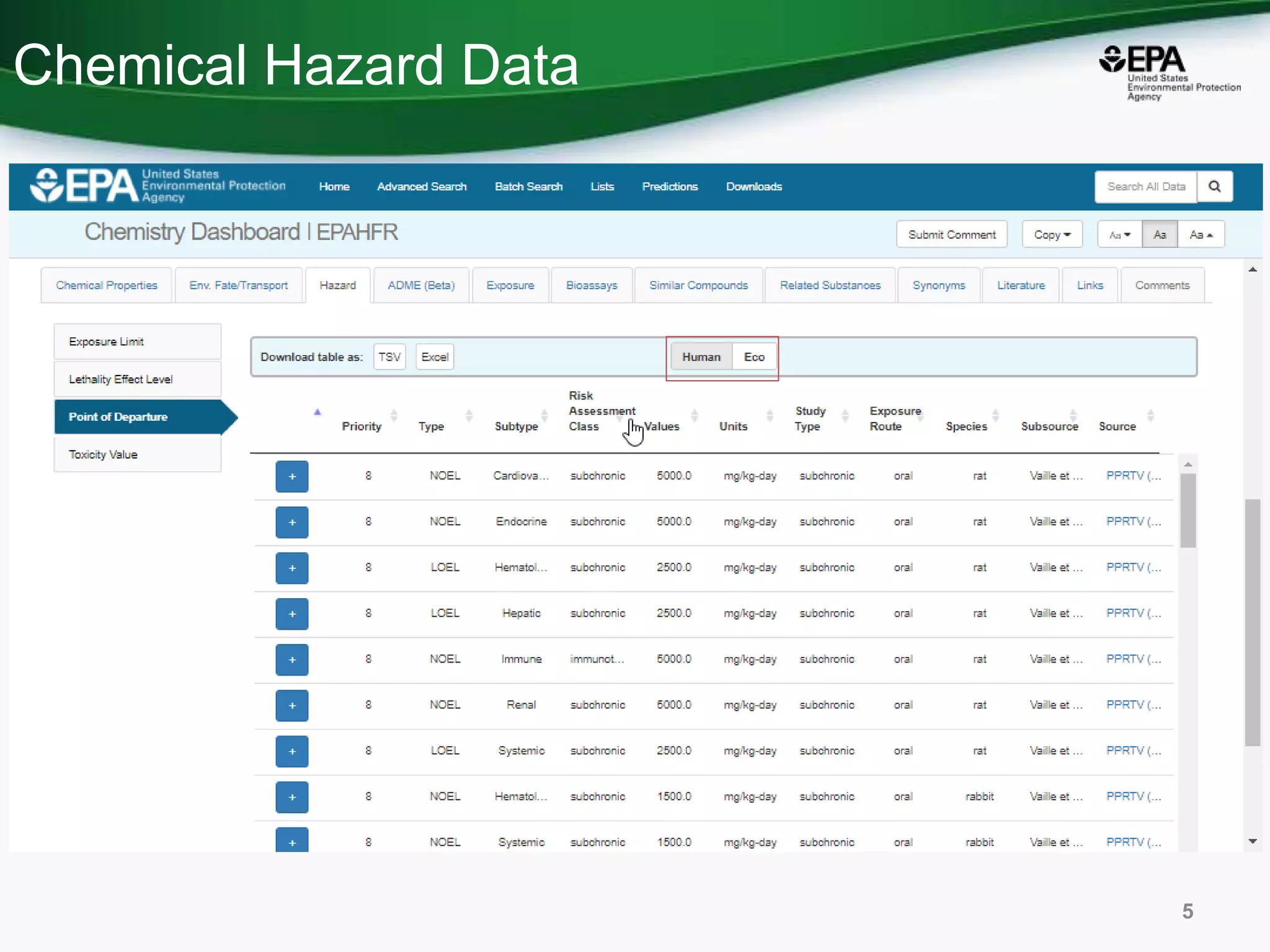
Chemical Hazard Data
5
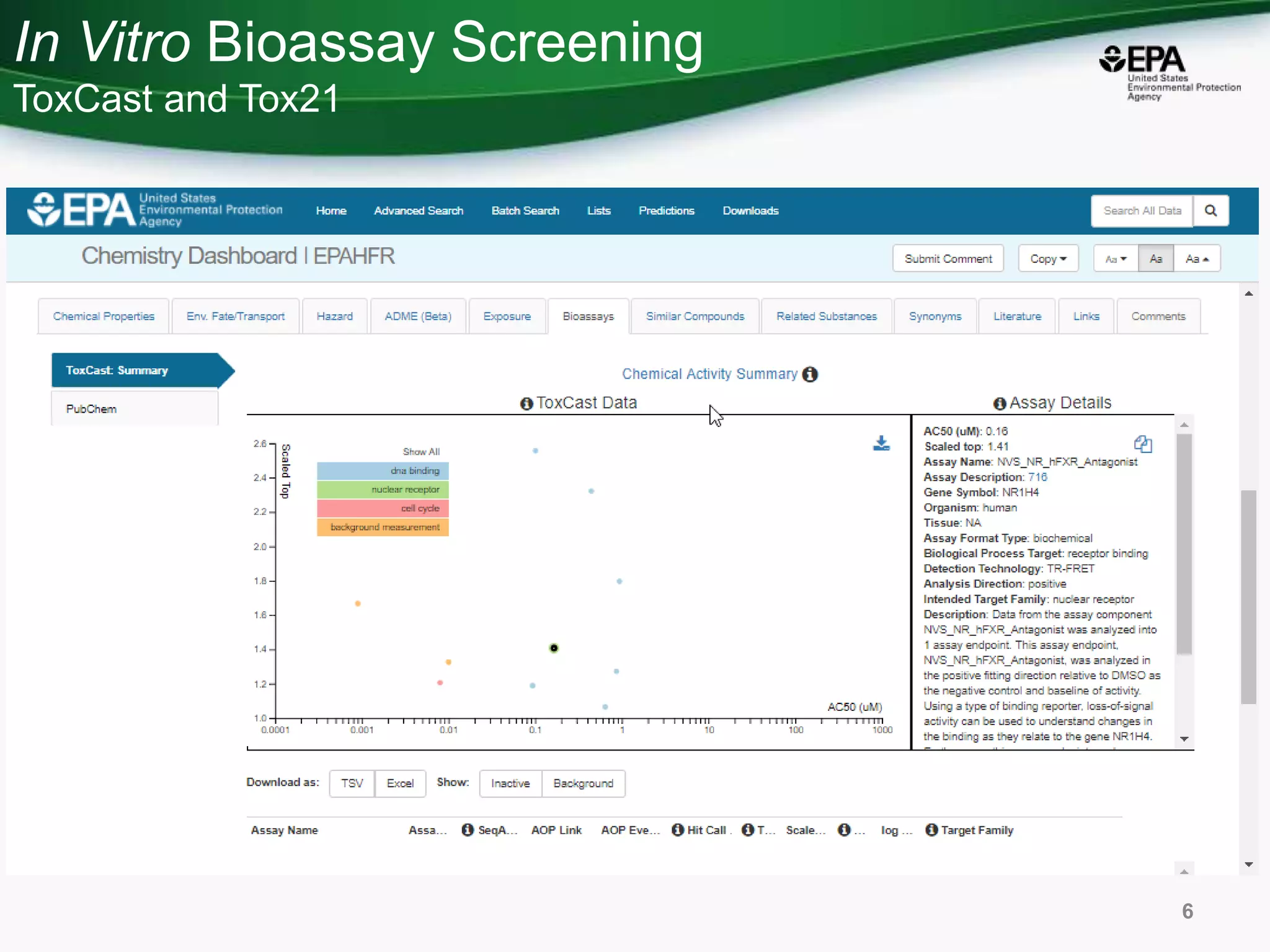
In Vitro Bioassay Screening
ToxCast and Tox21
6
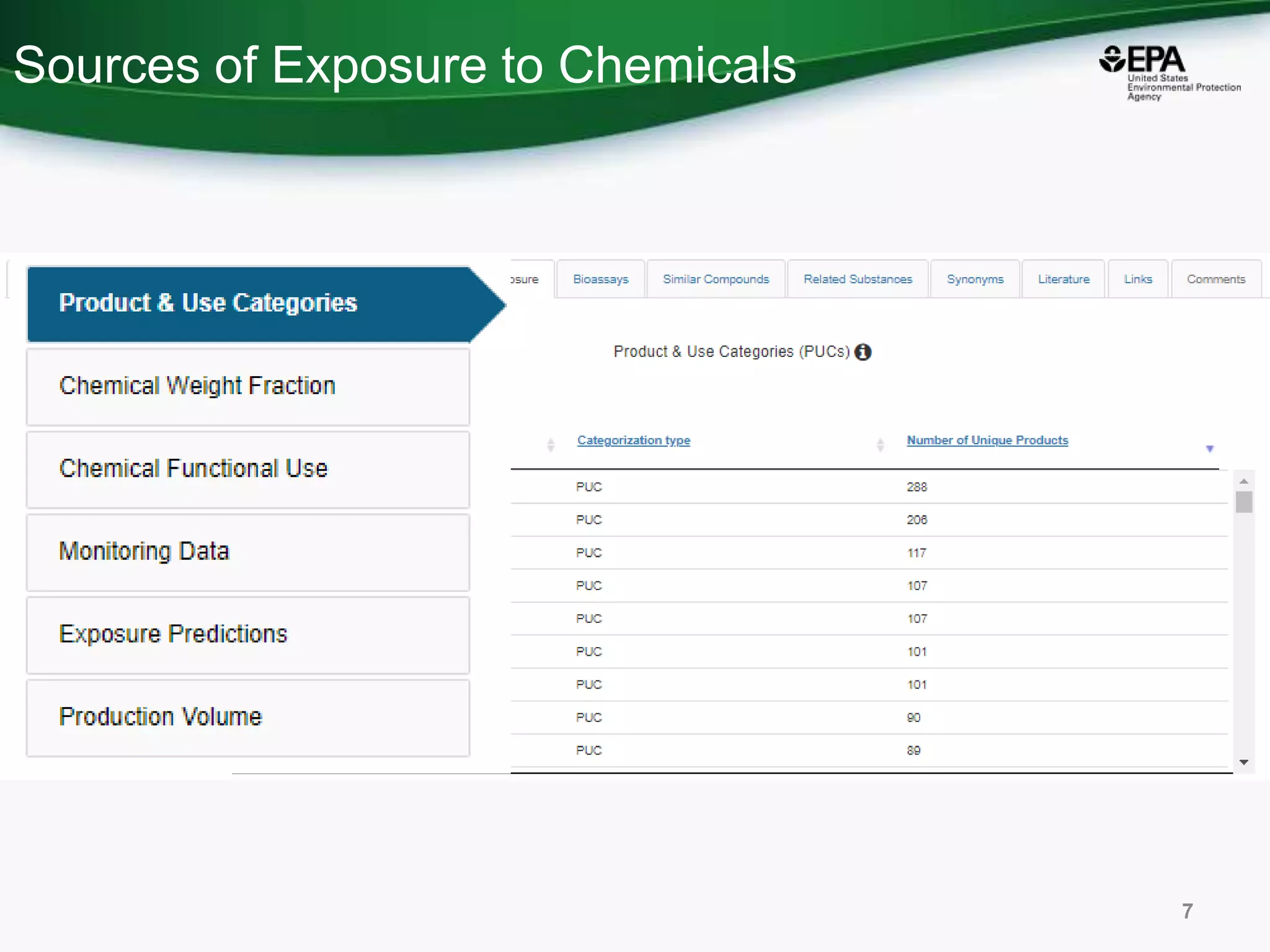
Sources of Exposure to Chemicals
7
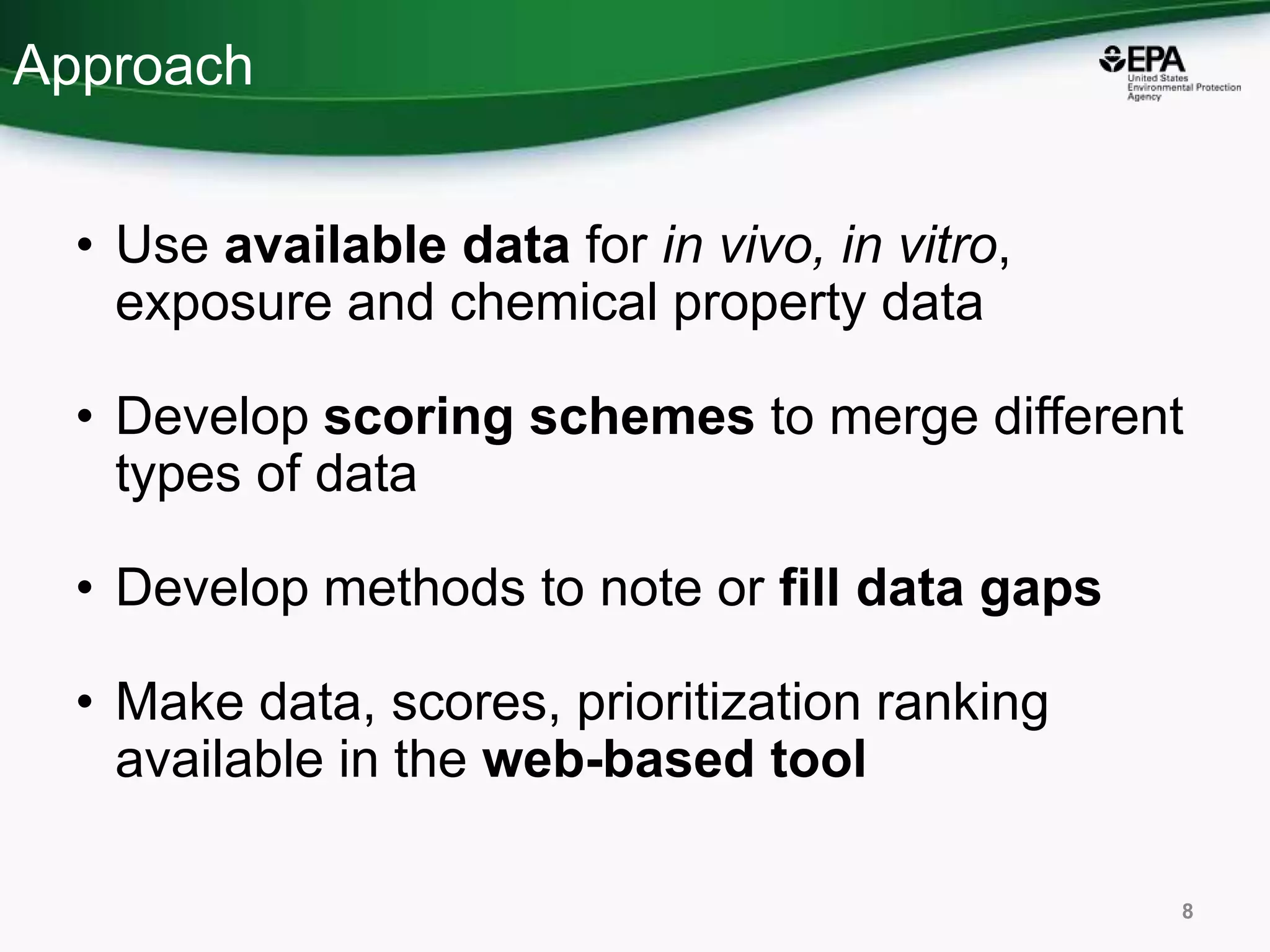
Approach
• Use available data for in vivo, in vitro,
exposure and chemical property data
• Develop scoring schemes to merge different
types of data
• Develop methods to note or fill data gaps
• Make data, scores, prioritization ranking
available in the web-based tool
8
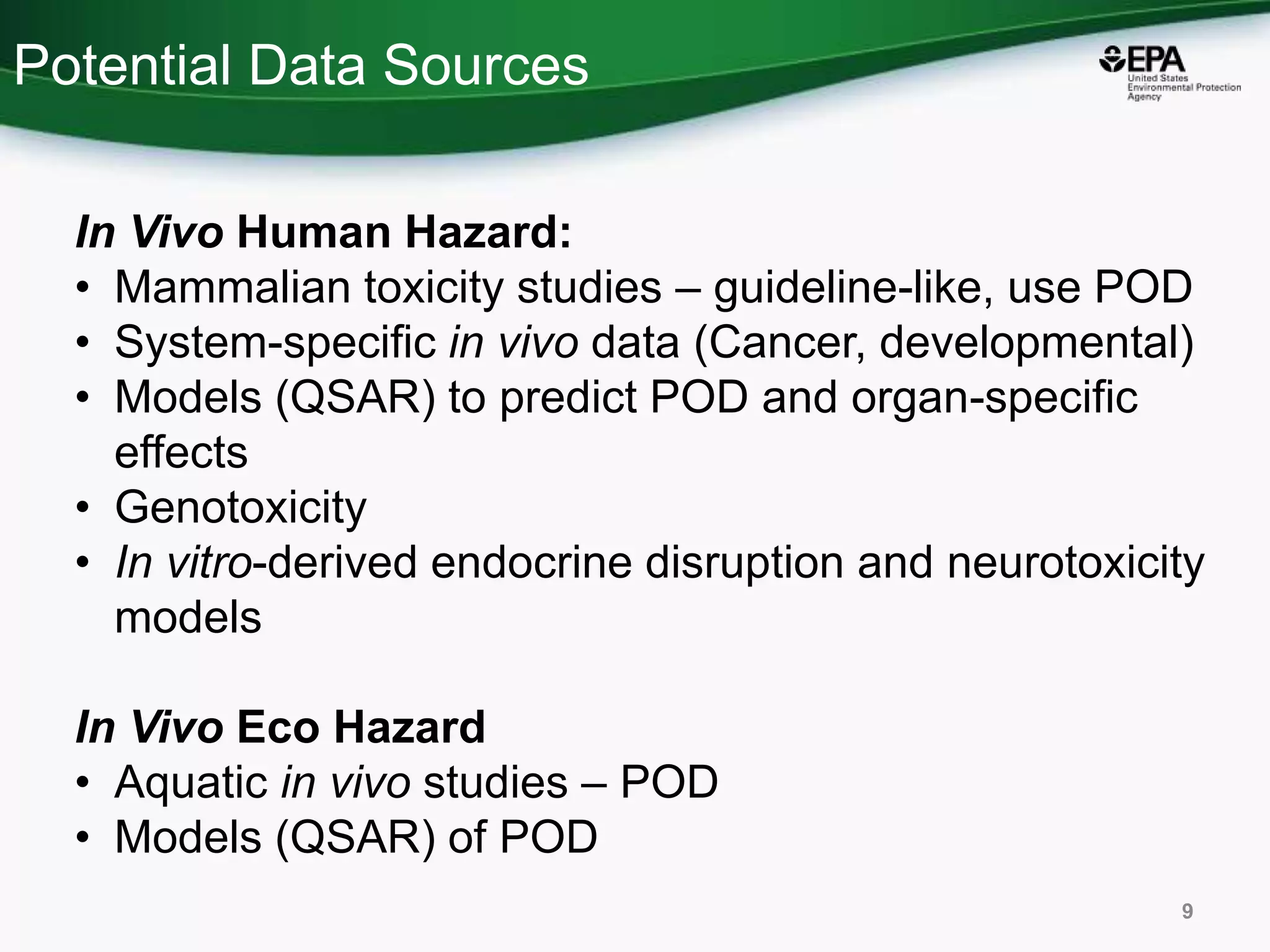
Potential Data Sources
In Vivo Human Hazard:
• Mammalian toxicity studies – guideline-like, use POD
• System-specific in vivo data (Cancer, developmental)
• Models (QSAR) to predict POD and organ-specific
effects
• Genotoxicity
• In vitro-derived endocrine disruption and neurotoxicity
models
In Vivo Eco Hazard
• Aquatic in vivo studies – POD
• Models (QSAR) of POD
9
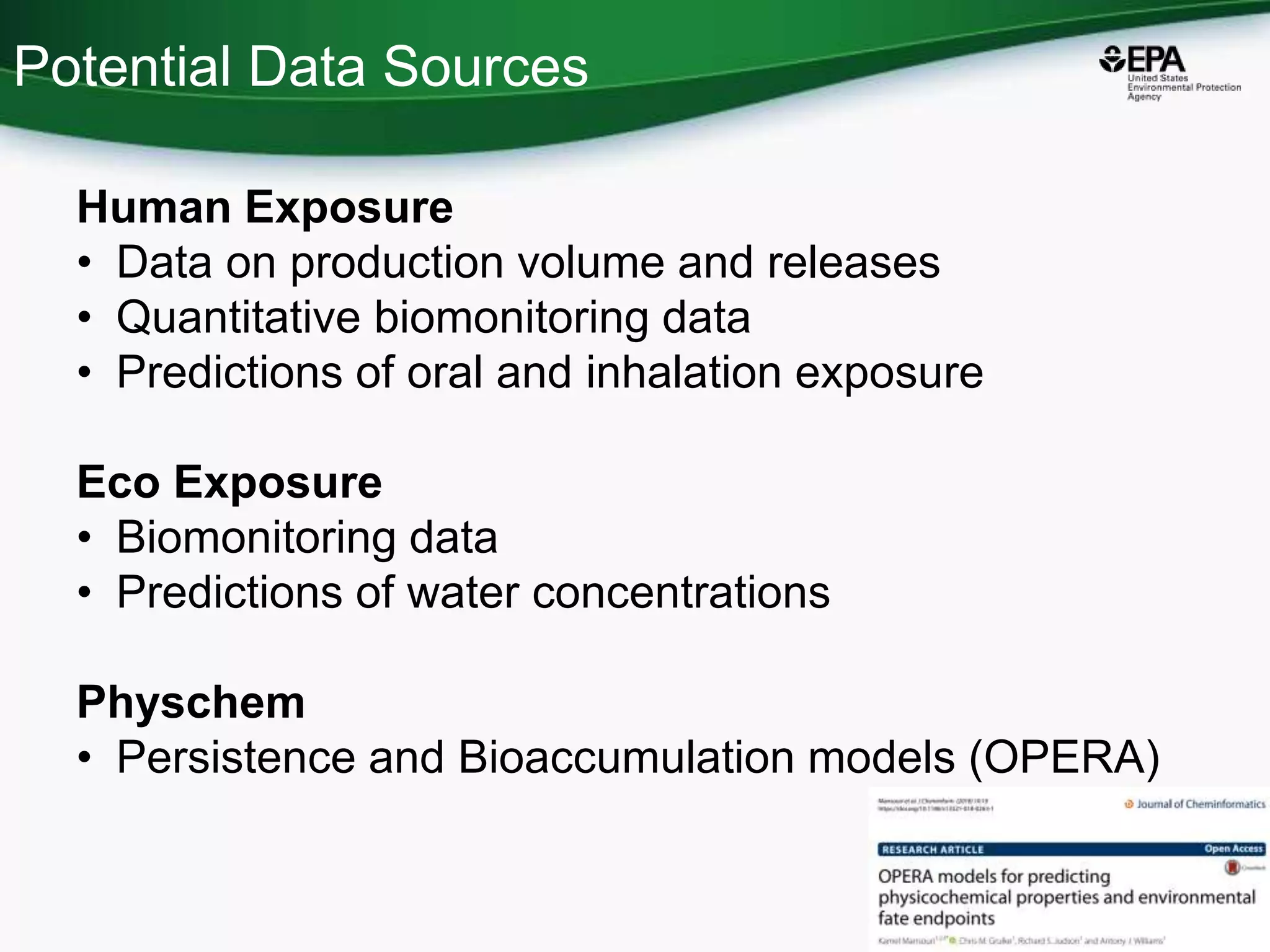
Human Exposure
• Data on production volume and releases
• Quantitative biomonitoring data
• Predictions of oral and inhalation exposure
Eco Exposure
• Biomonitoring data
• Predictions of water concentrations
Physchem
• Persistence and Bioaccumulation models (OPERA)
10
Potential Data Sources
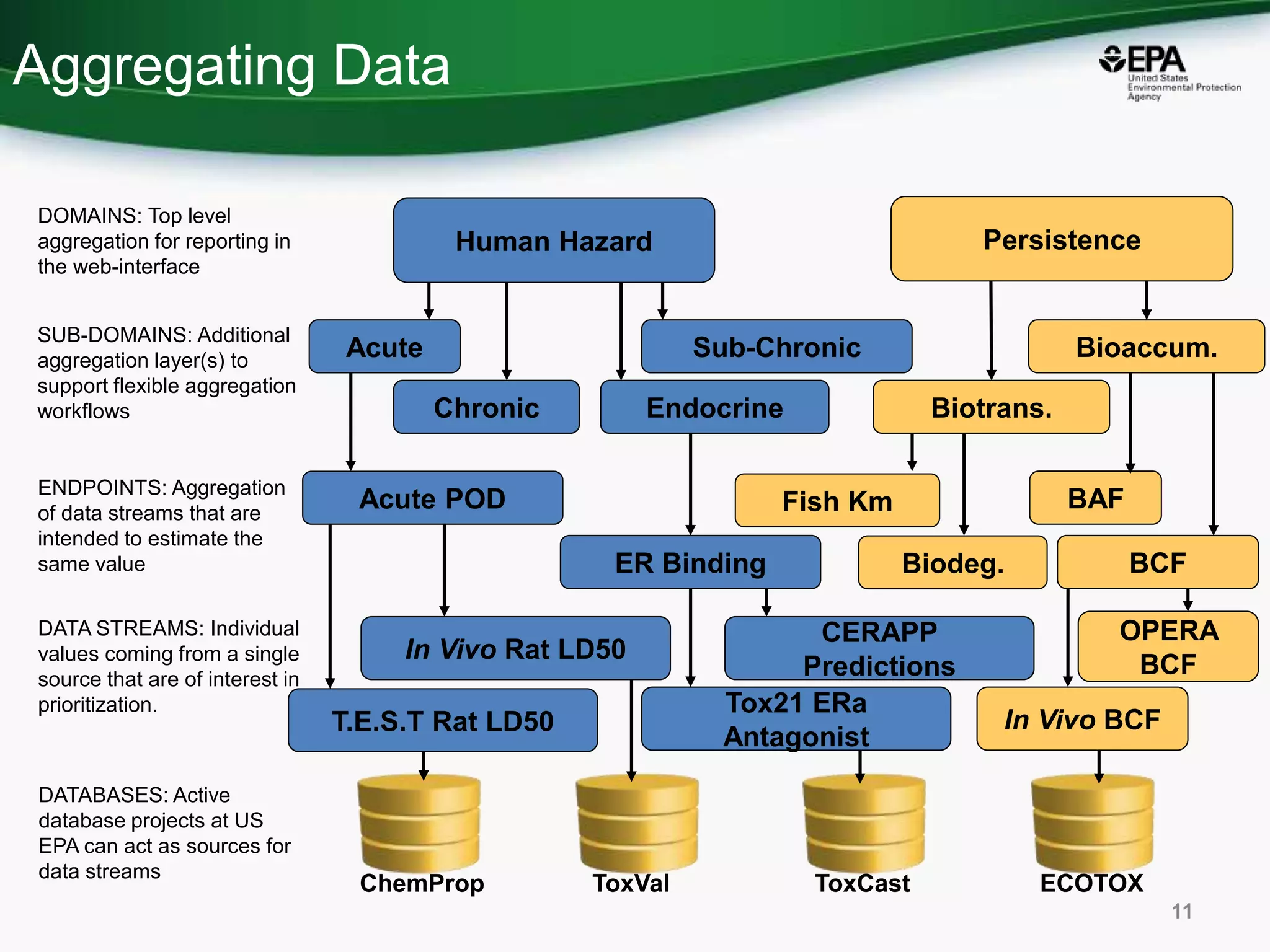
Aggregating Data
11
DOMAINS: Top level
aggregation for reporting in
the web-interface
SUB-DOMAINS: Additional
aggregation layer(s) to
support flexible aggregation
workflows
ENDPOINTS: Aggregation
of data streams that are
intended to estimate the
same value
DATA STREAMS: Individual
values coming from a single
source that are of interest in
prioritization.
DATABASES: Active
database projects at US
EPA can act as sources for
data streams
Human Hazard Persistence
Acute
Chronic
Sub-Chronic
Endocrine Biotrans.
Bioaccum.
BAF
BCF
Fish Km
Biodeg.
Acute POD
ER Binding
In Vivo Rat LD50
T.E.S.T Rat LD50
Tox21 ERa
Antagonist
CERAPP
Predictions
In Vivo BCF
OPERA
BCF
ChemProp ToxVal ToxCast ECOTOX
Scoring approaches
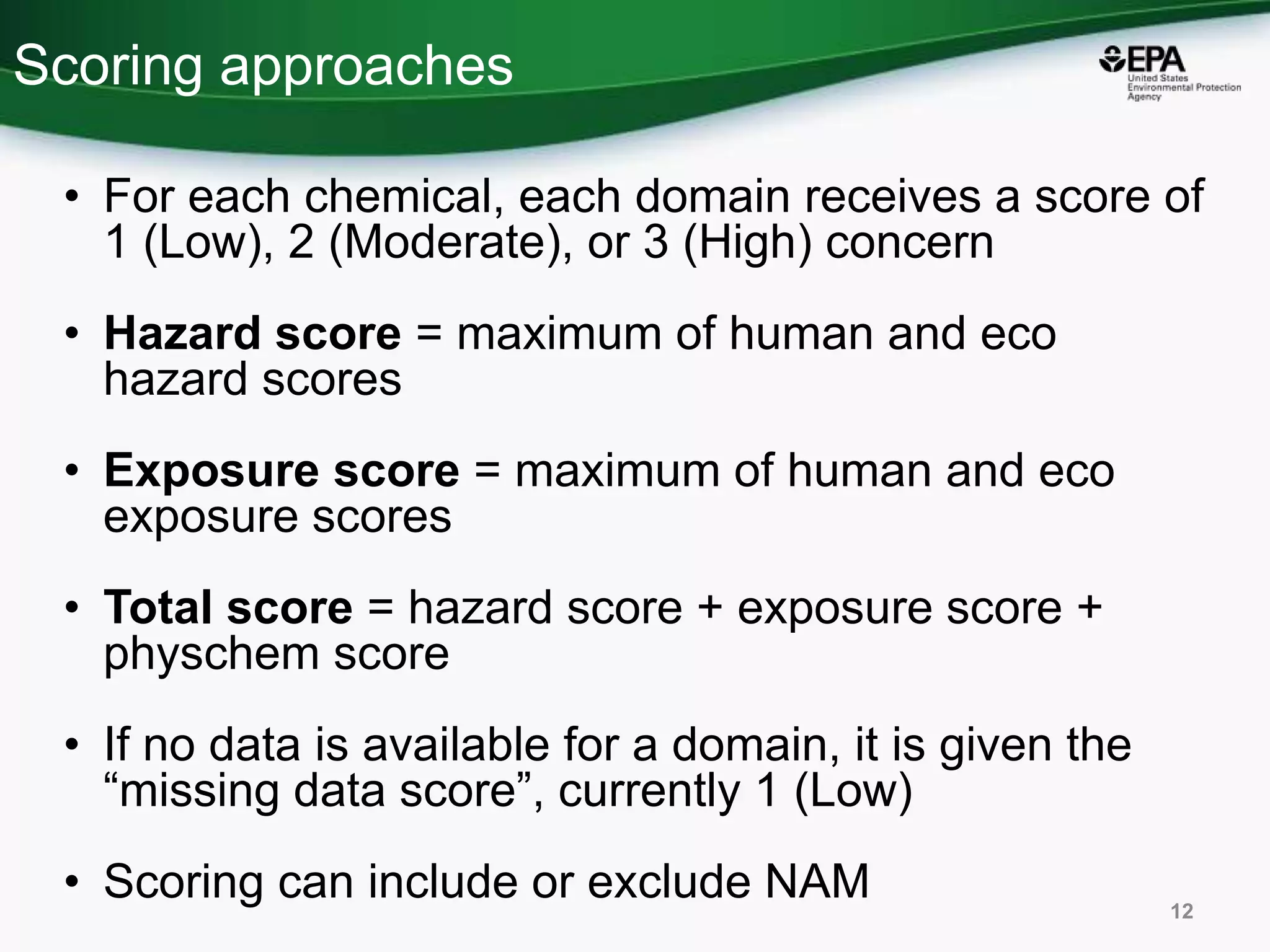
• For each chemical, each domain receives a score of
1 (Low), 2 (Moderate), or 3 (High) concern
• Hazard score = maximum of human and eco
hazard scores
• Exposure score = maximum of human and eco
exposure scores
• Total score = hazard score + exposure score +
physchem score
• If no data is available for a domain, it is given the
“missing data score”, currently 1 (Low)
• Scoring can include or exclude NAM 12
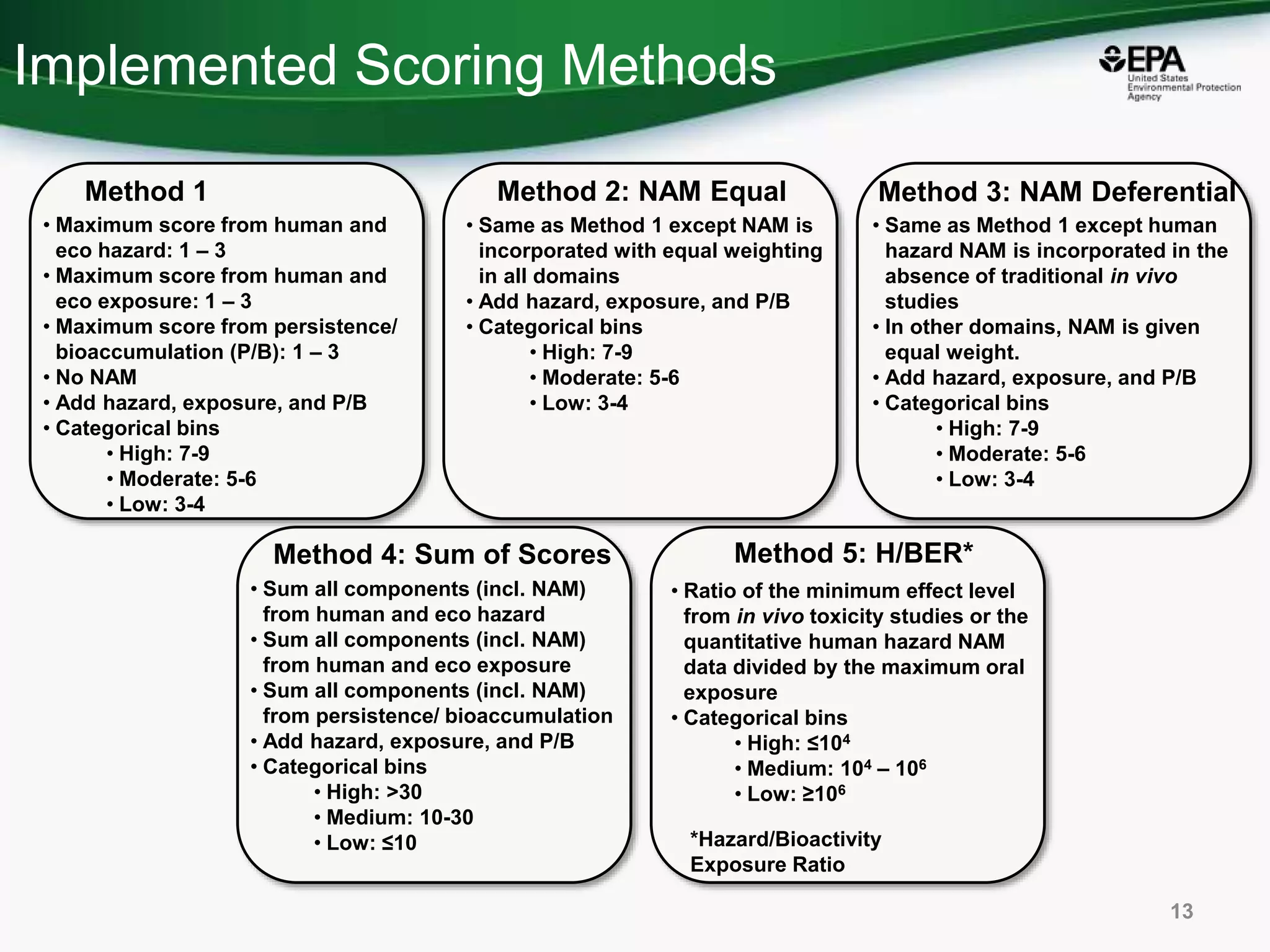
Implemented Scoring Methods
13
Method 1 Method 2: NAM Equal Method 3: NAM Deferential
• Maximum score from human and
eco hazard: 1 – 3
• Maximum score from human and
eco exposure: 1 – 3
• Maximum score from persistence/
bioaccumulation (P/B): 1 – 3
• No NAM
• Add hazard, exposure, and P/B
• Categorical bins
• High: 7-9
• Moderate: 5-6
• Low: 3-4
• Same as Method 1 except NAM is
incorporated with equal weighting
in all domains
• Add hazard, exposure, and P/B
• Categorical bins
• High: 7-9
• Moderate: 5-6
• Low: 3-4
• Same as Method 1 except human
hazard NAM is incorporated in the
absence of traditional in vivo
studies
• In other domains, NAM is given
equal weight.
• Add hazard, exposure, and P/B
• Categorical bins
• High: 7-9
• Moderate: 5-6
• Low: 3-4
Method 4: Sum of Scores Method 5: H/BER*
• Sum all components (incl. NAM)
from human and eco hazard
• Sum all components (incl. NAM)
from human and eco exposure
• Sum all components (incl. NAM)
from persistence/ bioaccumulation
• Add hazard, exposure, and P/B
• Categorical bins
• High: >30
• Medium: 10-30
• Low: ≤10
• Ratio of the minimum effect level
from in vivo toxicity studies or the
quantitative human hazard NAM
data divided by the maximum oral
exposure
• Categorical bins
• High: ≤104
• Medium: 104 – 106
• Low: ≥106
*Hazard/Bioactivity
Exposure Ratio
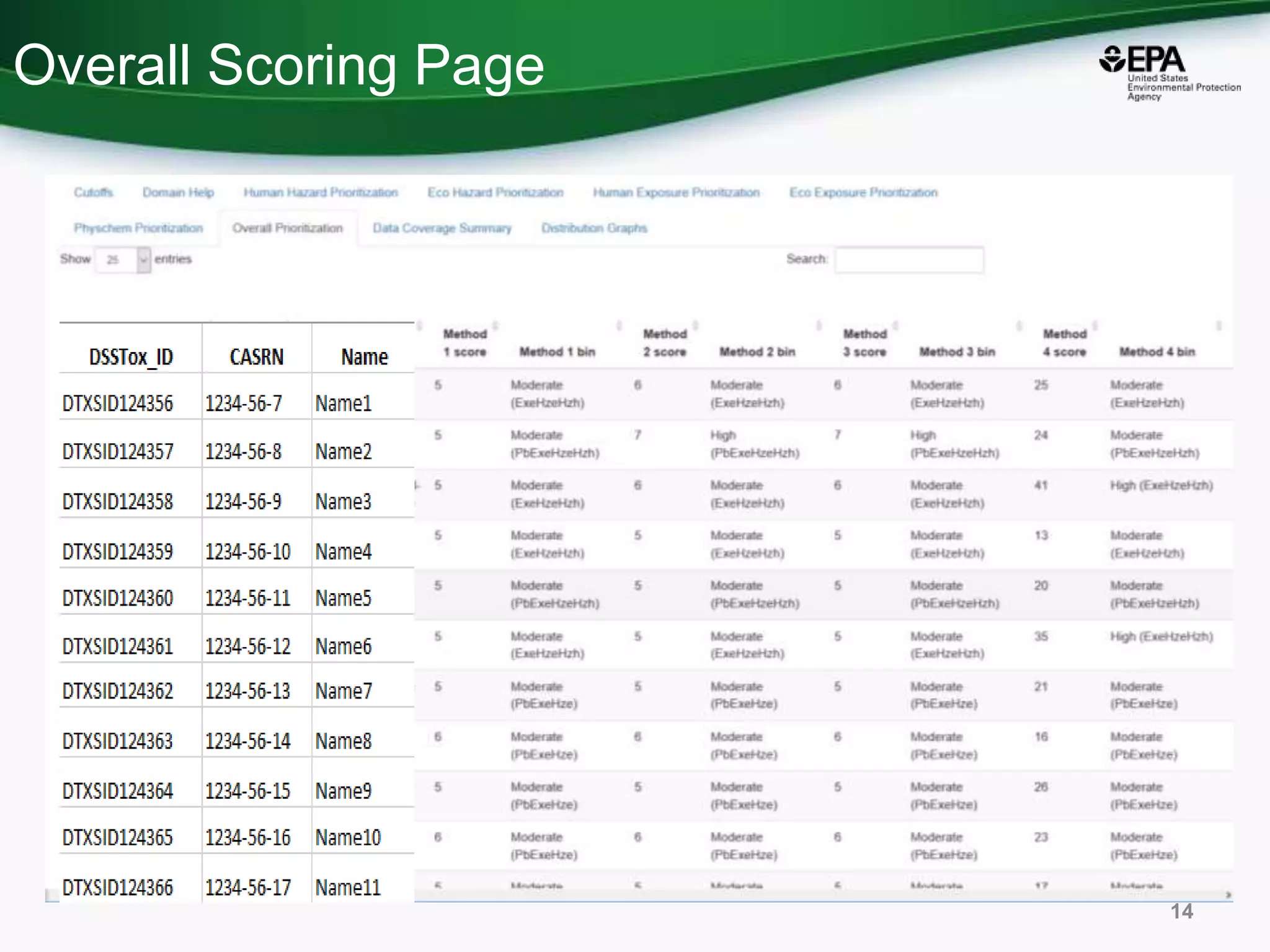
Overall Scoring Page
14
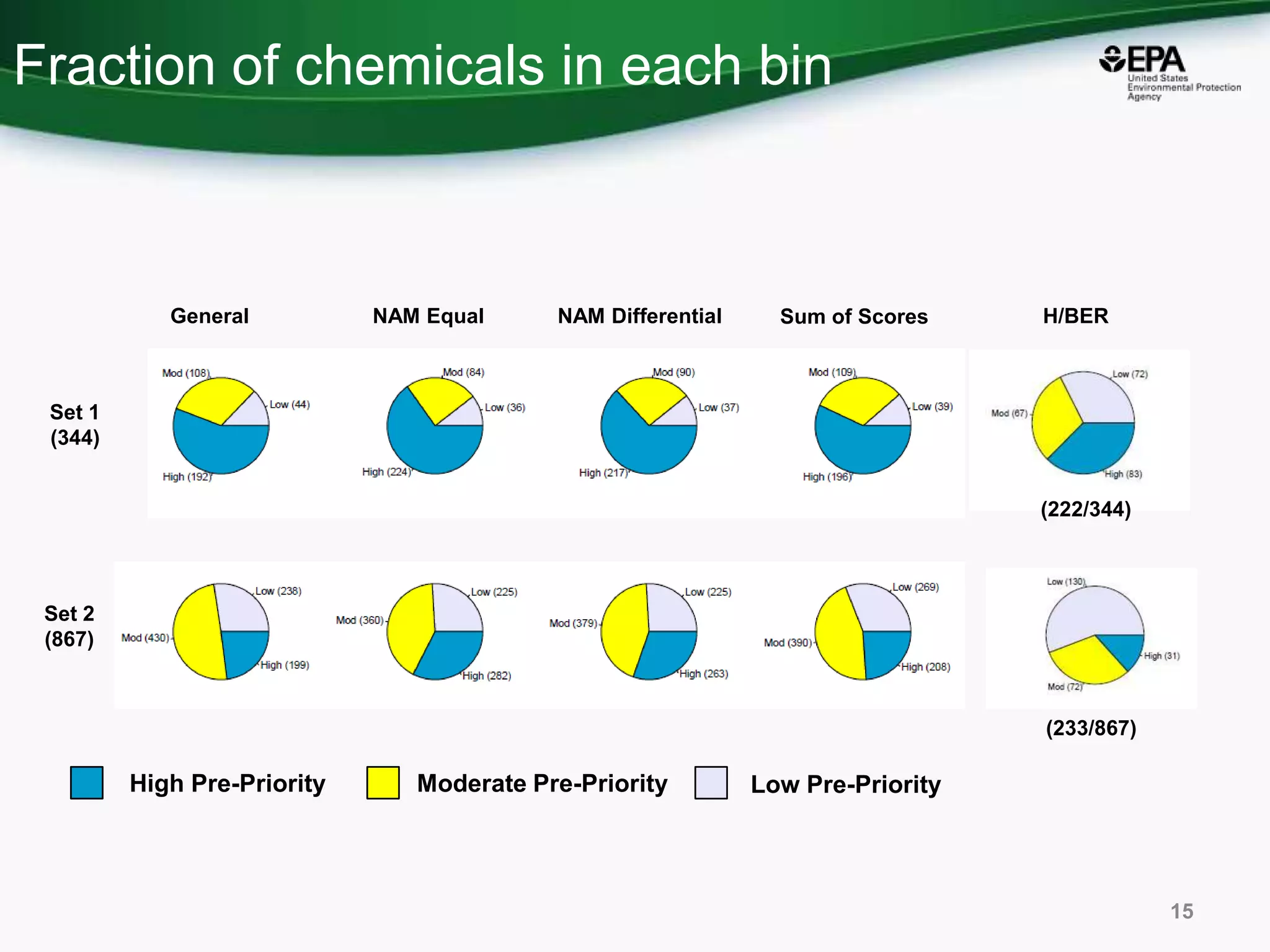
Fraction of chemicals in each bin
15
High Pre-Priority Moderate Pre-Priority Low Pre-Priority
General NAM Equal NAM Differential Sum of Scores H/BER
Set 1
(344)
Set 2
(867)
(233/867)
(222/344)
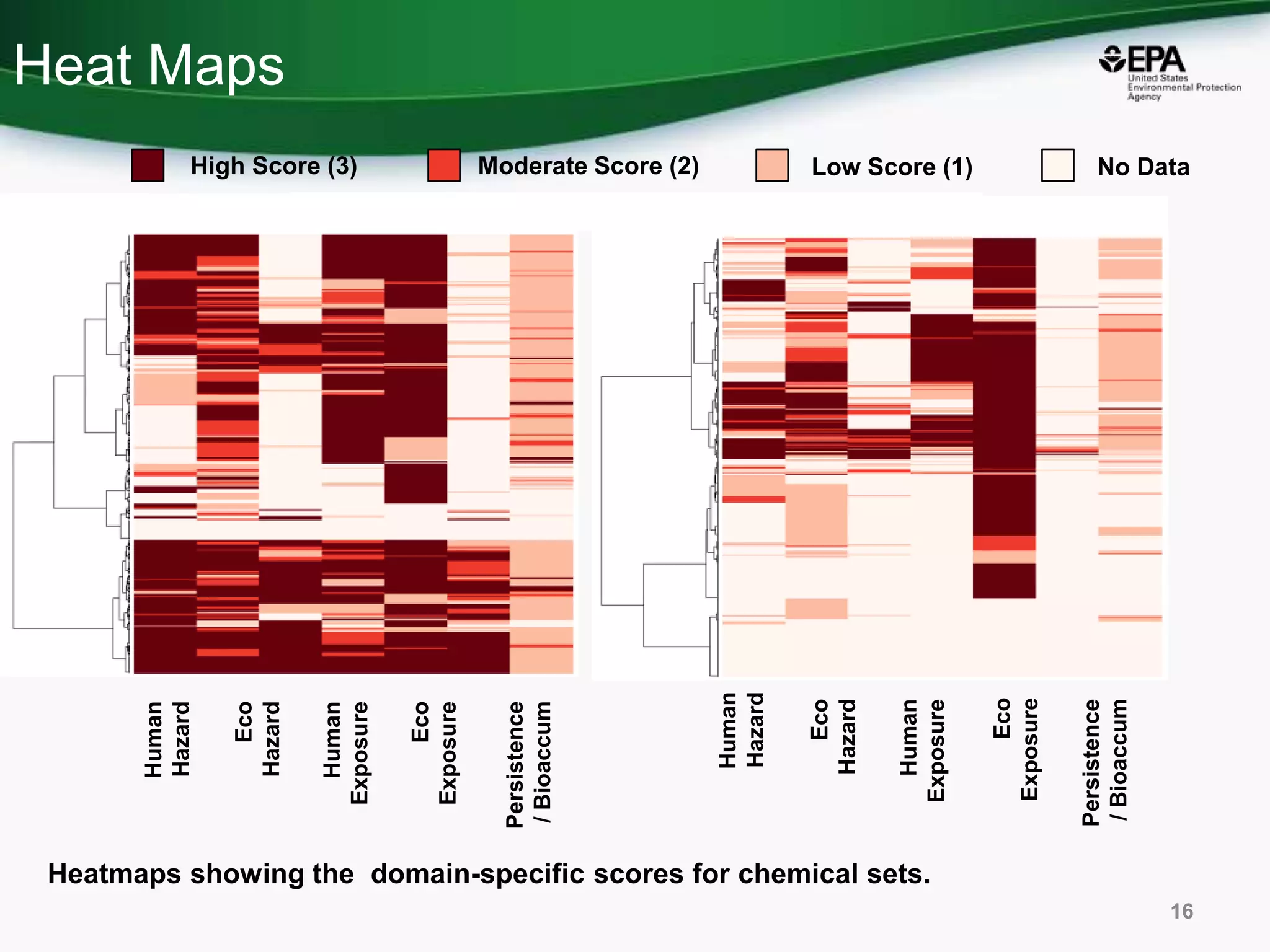
Heat Maps
16
Chemicals
Human
Hazard
Eco
Hazard
Human
Exposure
Eco
Exposure
Persistence
/Bioaccum
Human
Hazard
Eco
Hazard
Human
Exposure
Eco
Exposure
Persistence
/Bioaccum
Heatmaps showing the domain-specific scores for chemical sets.
High Score (3) Moderate Score (2) Low Score (1) No Data
Registration and Curation
of Chemicals
• Consolidation and registration of the original
chemical lists into the underlying database
(DSSTox)
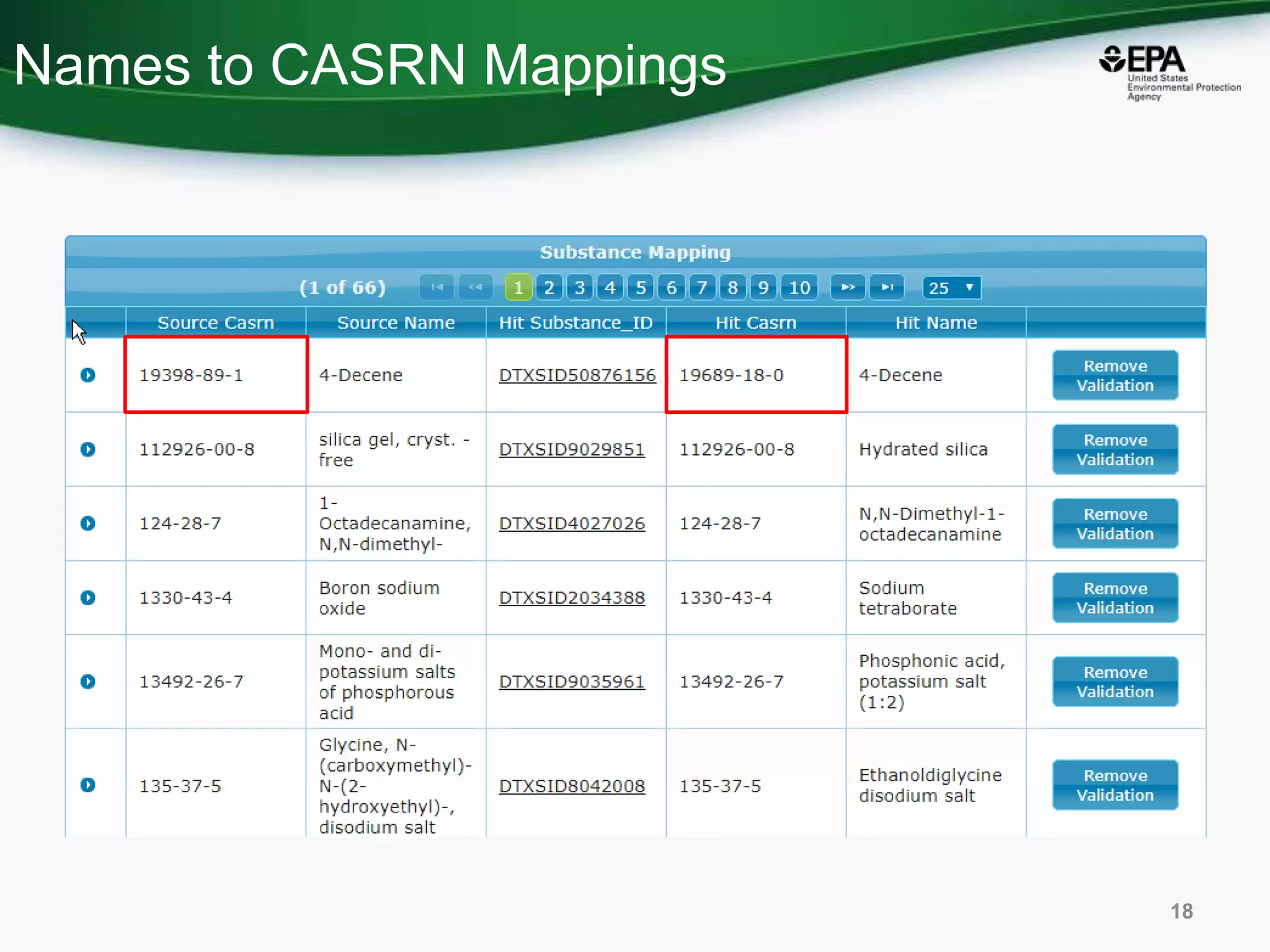
• Careful (and time-consuming) curation
– Confirming mappings of chemical names and CASRNs
17
Names to CASRN Mappings
18
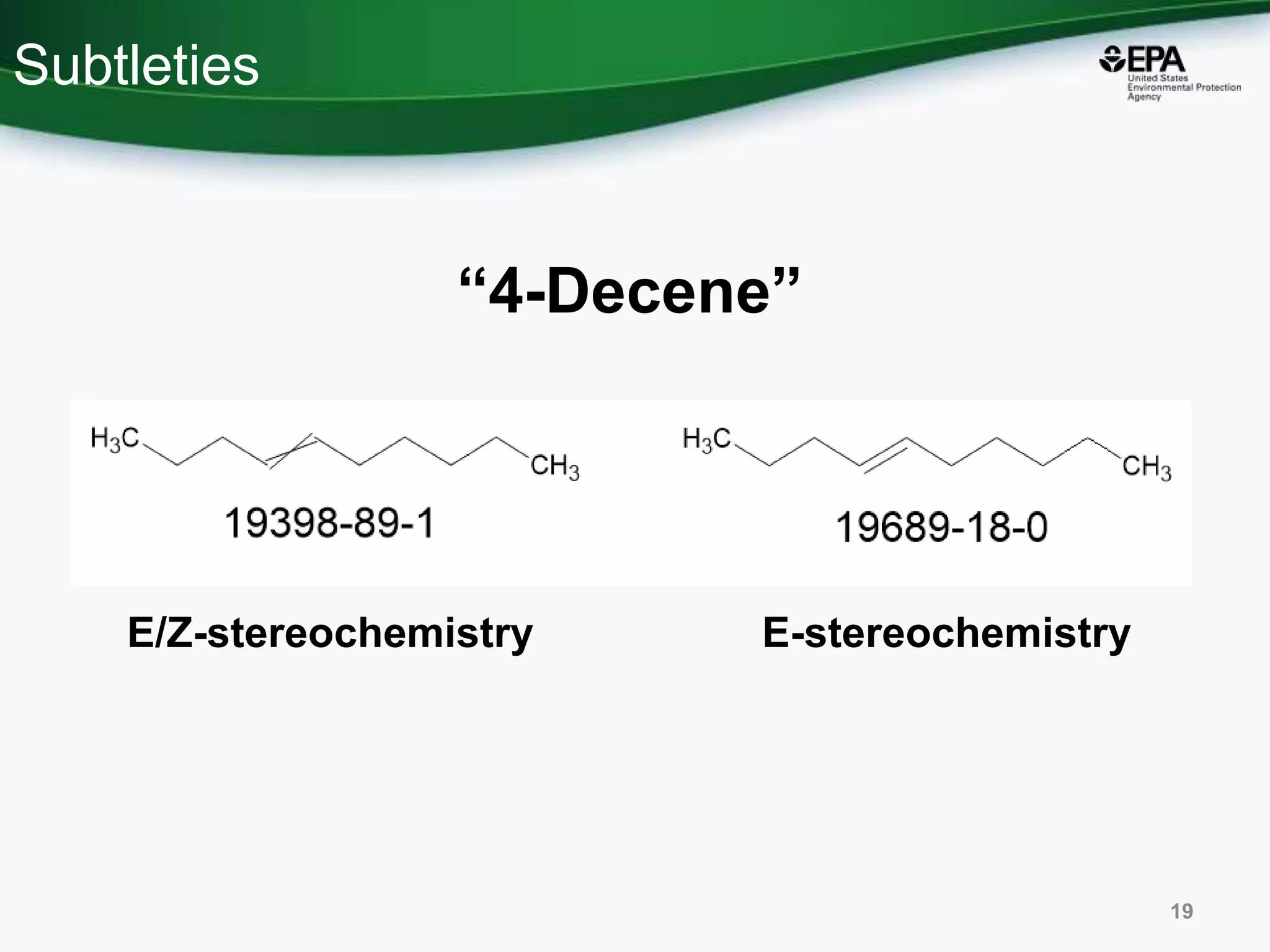
Subtleties
19
E/Z-stereochemistry E-stereochemistry
“4-Decene”
Registration and Curation
• Registration of the chemical list into the
underlying database (DSSTox)
• Careful (and time-consuming) curation
– Confirming mappings of chemical names and CASRNs
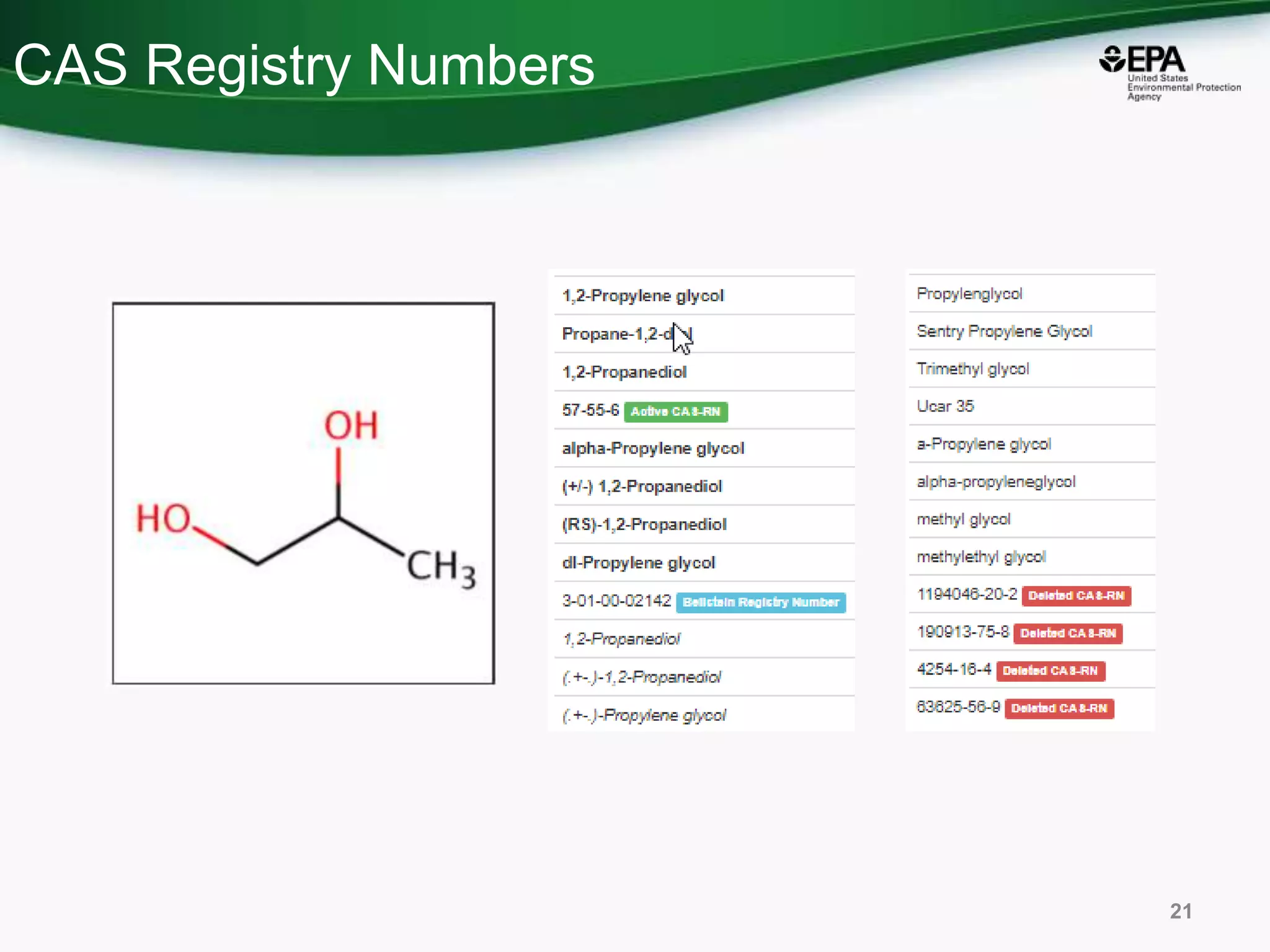
– CASRN checking – Active, Alternate and Deleted
20
CAS Registry Numbers
21
Registration and Curation
• Registration of the chemical list into the
underlying database (DSSTox)
• Careful (and time-consuming) curation
– Confirming mappings of chemical names and CASRNs
– CASRN checking – Active, Alternate and Deleted
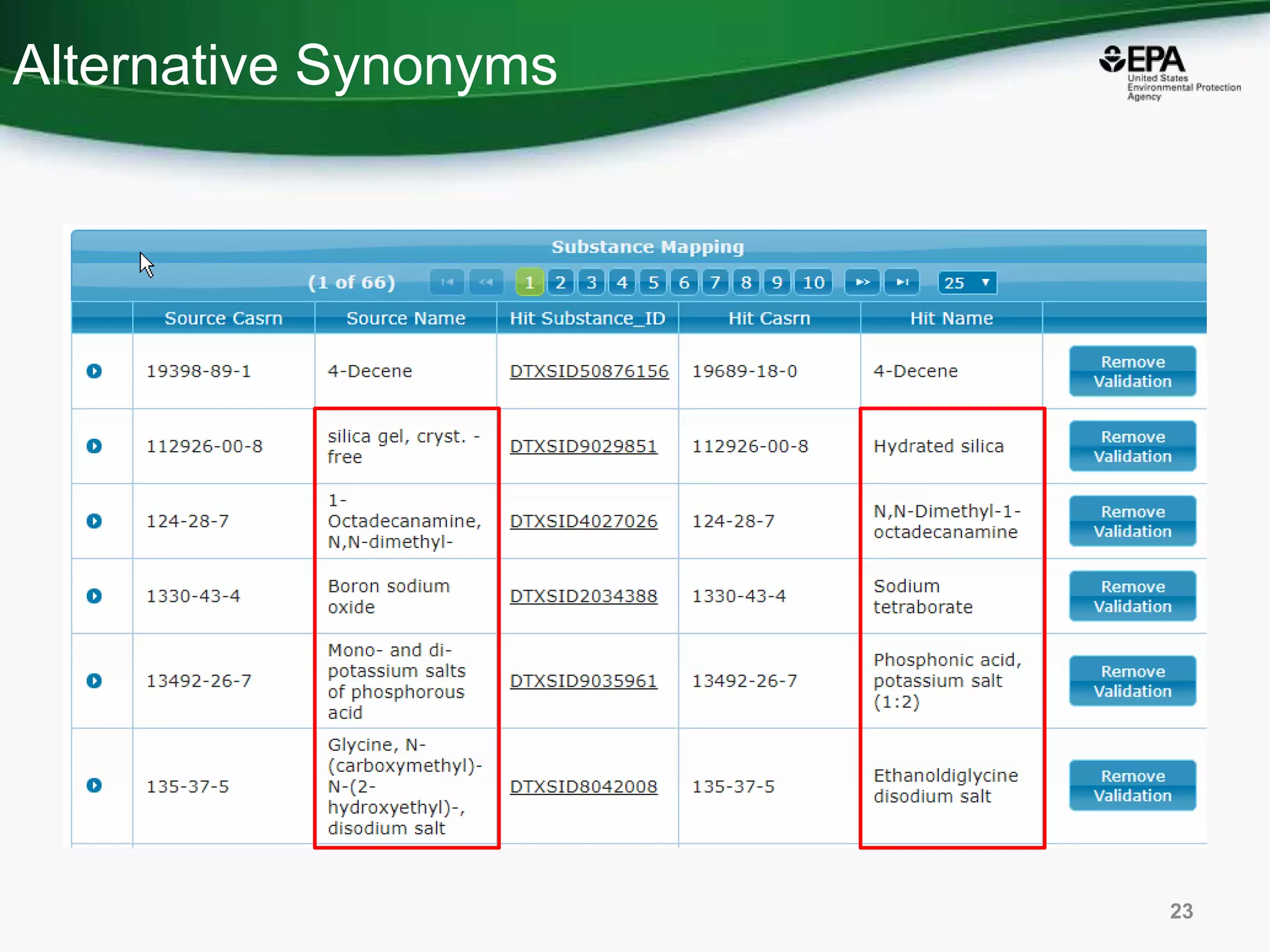
– Misspellings, alternative synonyms, misassociations
22
Alternative Synonyms
23
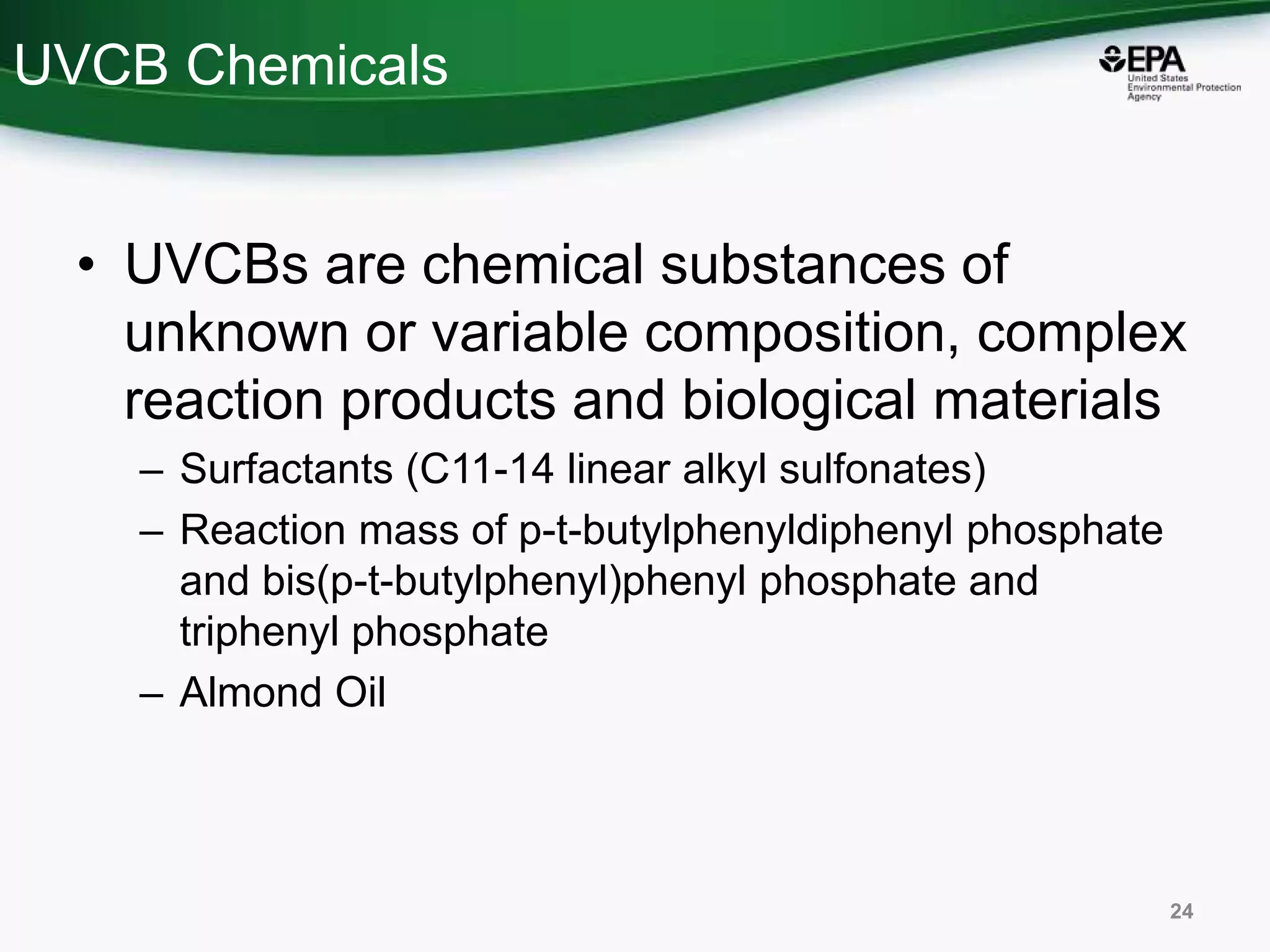
UVCB Chemicals
• UVCBs are chemical substances of
unknown or variable composition, complex
reaction products and biological materials
– Surfactants (C11-14 linear alkyl sulfonates)
– Reaction mass of p-t-butylphenyldiphenyl phosphate
and bis(p-t-butylphenyl)phenyl phosphate and
triphenyl phosphate
– Almond Oil
24
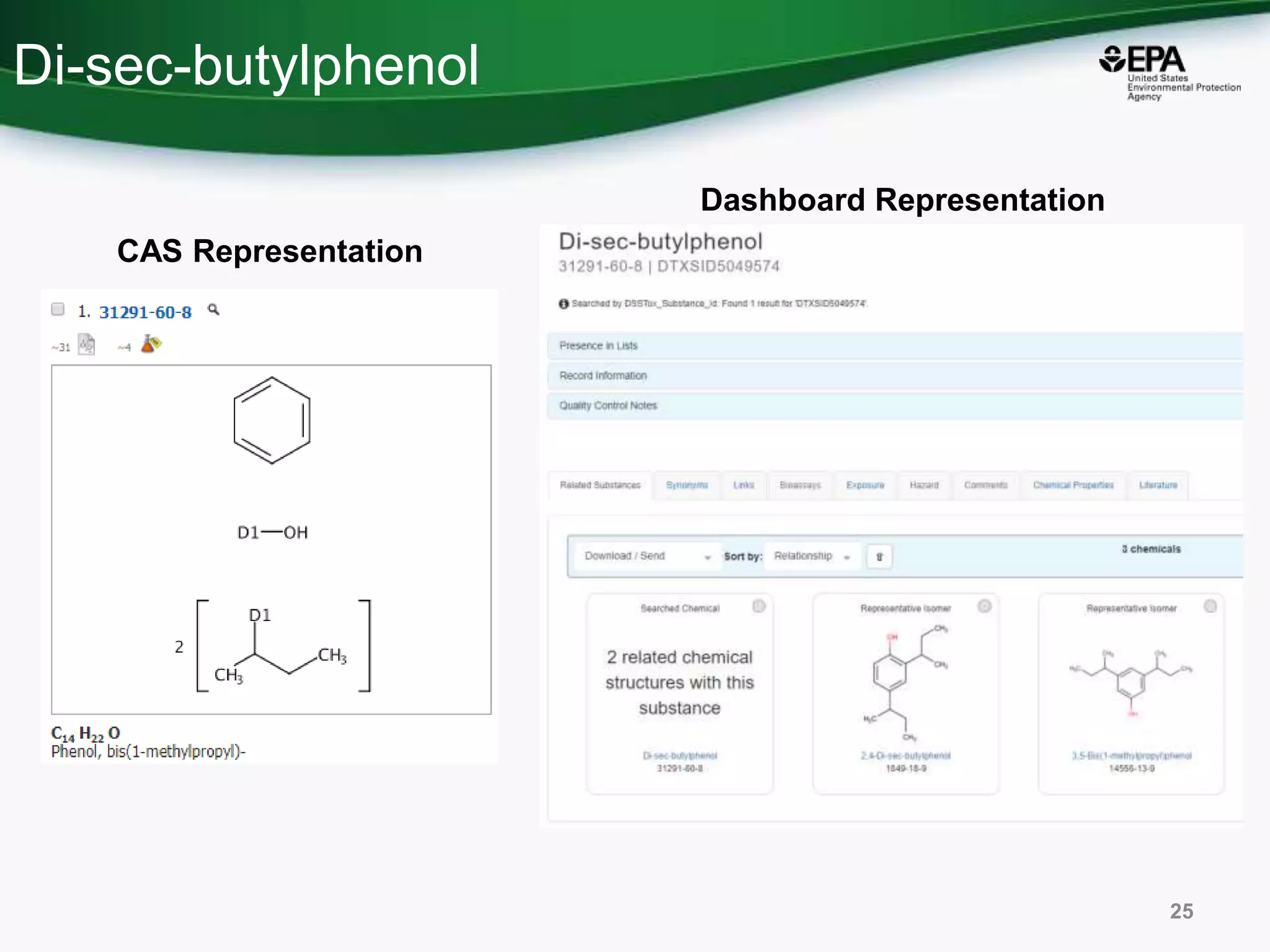
Di-sec-butylphenol
25
CAS Representation
Dashboard Representation
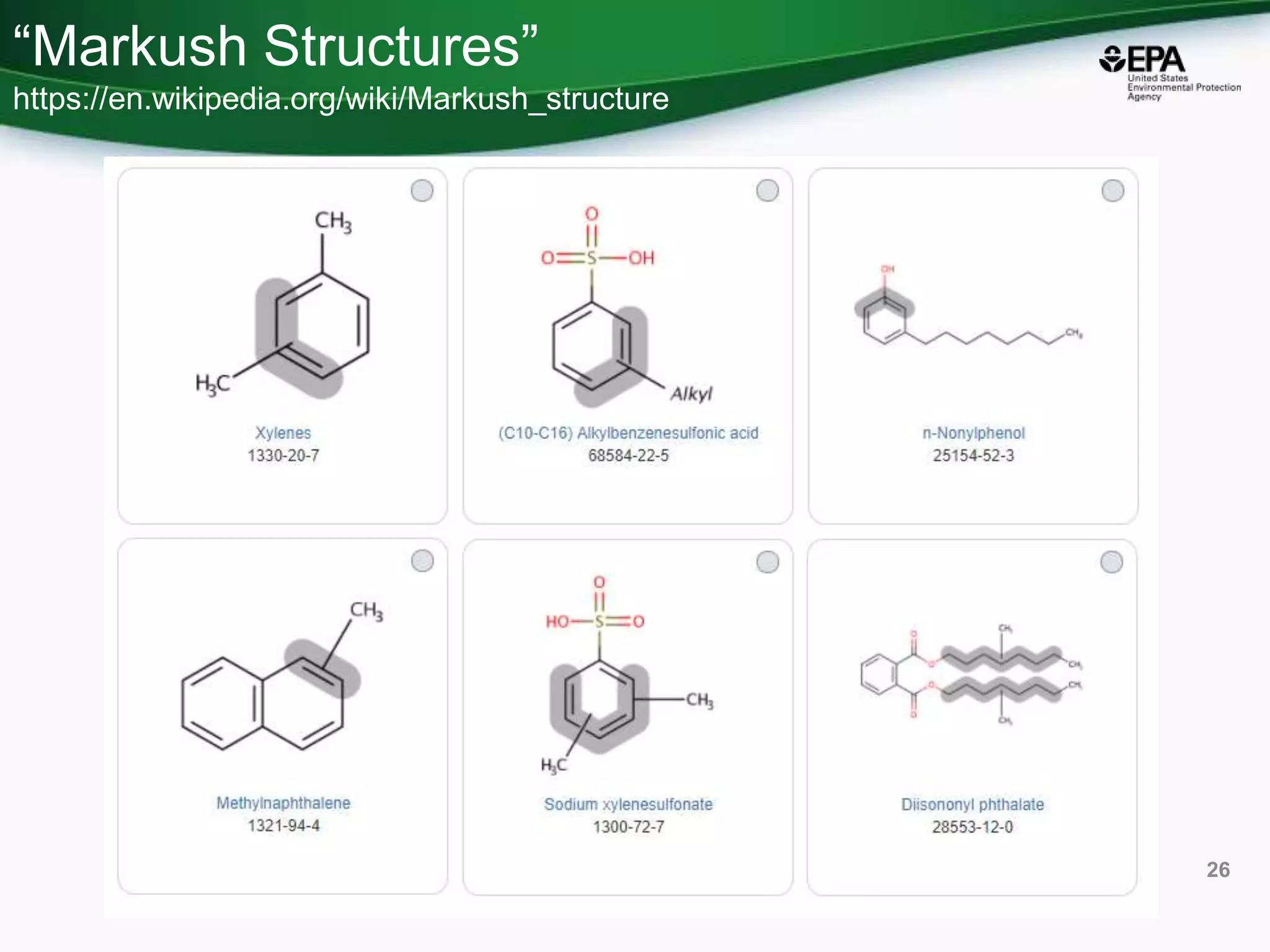
“Markush Structures”
https://en.wikipedia.org/wiki/Markush_structure
26
Summary
• RapidTox workflow enabled identification of data
that contributed most to candidate selection
• Allowed flexible exploration of prioritization
methods
• Incorporation of NAM data does result in
changes for chemical test sets, either by adding
data or by changing the overall bin (Low,
Moderate, High)
27
Acknowledgments
• The NCCT CompTox Chemistry Dashboard
Development Team
• Kamel Mansouri – OPERA models
• Todd Martin – TEST predictions
28
Contact
Antony Williams
US EPA Office of Research and Development
National Center for Computational Toxicology (NCCT)
Williams.Antony@epa.gov
ORCID: https://orcid.org/0000-0002-2668-4821
29

Development of a Tool for Systematic Integration of Traditional and New Approach Methods for Prioritizing Chemical Lists

  • 1.
    Development of aTool for Integrating Traditional and New Approach Methodologies (NAMs) for Chemical Safety Decisions Antony Williams, Richard Judson, Chris Grulke and Rusty Thomas National Center for Computational Toxicology, U.S. Environmental Protection Agency, RTP, NC March 2018 ACS Spring Meeting, New Orleans http://www.orcid.org/0000-0002-2668-4821 The views expressed in this presentation are those of the author and do not necessarily reflect the views or policies of the U.S. EPA
  • 2.
    • National Centerfor Computational Toxicology (NCCT) established in 2005 to integrate: – High-throughput and high-content technologies – Molecular biology – Data mining and statistical modeling – Computational biology and chemistry • Outputs: a lot of data, models, algorithms and software applications • Open Data – we want scientists to interrogate it, learn from it, develop understanding National Center for Computational Toxicology
  • 3.
    Background • EPA mustdesignate a set of high-priority chemicals for detailed risk assessment. • NCCT is building a web-based tool as one approach to help guide that selection 2
  • 4.
    The CompTox ChemistryDashboard • NCCT has lots of data to build relevant tools and approaches. The source data are available via the CompTox Chemistry Dashboard • A publicly accessible website delivering access: – ~760,000 chemicals with related property data – Experimental and predicted physicochemical property data – Integration to “biological assay data” for 1000s of chemicals – Data regarding chemical exposure – Links to other agency websites and public data resources – “Literature” searches for chemicals using public resources – “Batch searching” for thousands of chemicals 3
  • 5.
  • 6.
  • 7.
    In Vitro BioassayScreening ToxCast and Tox21 6
  • 8.
    Sources of Exposureto Chemicals 7
  • 9.
    Approach • Use availabledata for in vivo, in vitro, exposure and chemical property data • Develop scoring schemes to merge different types of data • Develop methods to note or fill data gaps • Make data, scores, prioritization ranking available in the web-based tool 8
  • 10.
    Potential Data Sources InVivo Human Hazard: • Mammalian toxicity studies – guideline-like, use POD • System-specific in vivo data (Cancer, developmental) • Models (QSAR) to predict POD and organ-specific effects • Genotoxicity • In vitro-derived endocrine disruption and neurotoxicity models In Vivo Eco Hazard • Aquatic in vivo studies – POD • Models (QSAR) of POD 9
  • 11.
    Human Exposure • Dataon production volume and releases • Quantitative biomonitoring data • Predictions of oral and inhalation exposure Eco Exposure • Biomonitoring data • Predictions of water concentrations Physchem • Persistence and Bioaccumulation models (OPERA) 10 Potential Data Sources
  • 12.
    Aggregating Data 11 DOMAINS: Toplevel aggregation for reporting in the web-interface SUB-DOMAINS: Additional aggregation layer(s) to support flexible aggregation workflows ENDPOINTS: Aggregation of data streams that are intended to estimate the same value DATA STREAMS: Individual values coming from a single source that are of interest in prioritization. DATABASES: Active database projects at US EPA can act as sources for data streams Human Hazard Persistence Acute Chronic Sub-Chronic Endocrine Biotrans. Bioaccum. BAF BCF Fish Km Biodeg. Acute POD ER Binding In Vivo Rat LD50 T.E.S.T Rat LD50 Tox21 ERa Antagonist CERAPP Predictions In Vivo BCF OPERA BCF ChemProp ToxVal ToxCast ECOTOX
  • 13.
    Scoring approaches • Foreach chemical, each domain receives a score of 1 (Low), 2 (Moderate), or 3 (High) concern • Hazard score = maximum of human and eco hazard scores • Exposure score = maximum of human and eco exposure scores • Total score = hazard score + exposure score + physchem score • If no data is available for a domain, it is given the “missing data score”, currently 1 (Low) • Scoring can include or exclude NAM 12
  • 14.
    Implemented Scoring Methods 13 Method1 Method 2: NAM Equal Method 3: NAM Deferential • Maximum score from human and eco hazard: 1 – 3 • Maximum score from human and eco exposure: 1 – 3 • Maximum score from persistence/ bioaccumulation (P/B): 1 – 3 • No NAM • Add hazard, exposure, and P/B • Categorical bins • High: 7-9 • Moderate: 5-6 • Low: 3-4 • Same as Method 1 except NAM is incorporated with equal weighting in all domains • Add hazard, exposure, and P/B • Categorical bins • High: 7-9 • Moderate: 5-6 • Low: 3-4 • Same as Method 1 except human hazard NAM is incorporated in the absence of traditional in vivo studies • In other domains, NAM is given equal weight. • Add hazard, exposure, and P/B • Categorical bins • High: 7-9 • Moderate: 5-6 • Low: 3-4 Method 4: Sum of Scores Method 5: H/BER* • Sum all components (incl. NAM) from human and eco hazard • Sum all components (incl. NAM) from human and eco exposure • Sum all components (incl. NAM) from persistence/ bioaccumulation • Add hazard, exposure, and P/B • Categorical bins • High: >30 • Medium: 10-30 • Low: ≤10 • Ratio of the minimum effect level from in vivo toxicity studies or the quantitative human hazard NAM data divided by the maximum oral exposure • Categorical bins • High: ≤104 • Medium: 104 – 106 • Low: ≥106 *Hazard/Bioactivity Exposure Ratio
  • 15.
  • 16.
    Fraction of chemicalsin each bin 15 High Pre-Priority Moderate Pre-Priority Low Pre-Priority General NAM Equal NAM Differential Sum of Scores H/BER Set 1 (344) Set 2 (867) (233/867) (222/344)
  • 17.
  • 18.
    Registration and Curation ofChemicals • Consolidation and registration of the original chemical lists into the underlying database (DSSTox) • Careful (and time-consuming) curation – Confirming mappings of chemical names and CASRNs 17
  • 19.
    Names to CASRNMappings 18
  • 20.
  • 21.
    Registration and Curation •Registration of the chemical list into the underlying database (DSSTox) • Careful (and time-consuming) curation – Confirming mappings of chemical names and CASRNs – CASRN checking – Active, Alternate and Deleted 20
  • 22.
  • 23.
    Registration and Curation •Registration of the chemical list into the underlying database (DSSTox) • Careful (and time-consuming) curation – Confirming mappings of chemical names and CASRNs – CASRN checking – Active, Alternate and Deleted – Misspellings, alternative synonyms, misassociations 22
  • 24.
  • 25.
    UVCB Chemicals • UVCBsare chemical substances of unknown or variable composition, complex reaction products and biological materials – Surfactants (C11-14 linear alkyl sulfonates) – Reaction mass of p-t-butylphenyldiphenyl phosphate and bis(p-t-butylphenyl)phenyl phosphate and triphenyl phosphate – Almond Oil 24
  • 26.
  • 27.
  • 28.
    Summary • RapidTox workflowenabled identification of data that contributed most to candidate selection • Allowed flexible exploration of prioritization methods • Incorporation of NAM data does result in changes for chemical test sets, either by adding data or by changing the overall bin (Low, Moderate, High) 27
  • 29.
    Acknowledgments • The NCCTCompTox Chemistry Dashboard Development Team • Kamel Mansouri – OPERA models • Todd Martin – TEST predictions 28
  • 30.
    Contact Antony Williams US EPAOffice of Research and Development National Center for Computational Toxicology (NCCT) Williams.Antony@epa.gov ORCID: https://orcid.org/0000-0002-2668-4821 29