An agency of the European Union
Opening clinical trial data:
the EMA experience
Hans-Georg Eichler
EFSA@EXPO, Milan, October 2015
The basis of medicines (“drugs”) regulation
Marketing authorisation requires demonstration of:
• Quality, Safety, Efficacy (“QSE”)
Companies seeking marketing authorisation submit
“dossier”:
• Pharmaceutical module
• Non-clinical part
• Clinical module
1
Mostly reports of (randomised)
clinical trials in patients.
Arguably the most important
part of the dossier
The challenges for EMA
• Strong political push to share data of clinical
trials that support marketing authorisations
• Need to find the best possible balance between
different stakeholders’ competing interests, 
• Long process of consultation to find such
balance 
• Agreement on policy on 'Publication and access
to clinical-trial data'
2
Date of coming into effect of policy
1/1/2015 Any new Marketing Authorisation Applications […],
submitted after this date
1/7/2015 Extension of indication applications and line extension
applications for existing products, submitted after this
date
3
First phase: Clinical study reports
Second phase: Individual patient data (IPD) sharing
modalities to be discussed
Not in scope: Legacy data (submitted before
01/01/2015) [or non-centrally authorised products].
Terms of use governing access / use of clinical
study reports
Need to allow access to clinical data and discourage
unfair commercial use, prevent re-identification of
patients
– Redaction consultation procedure with sponsor company 
ensure appropriate level of redaction of commercial
confidential information
– Clinical reports, available on-screen only, for any user, limited
registration process
– Clinical reports, downloadable for academic and non-
commercial research purposes; requires identity of the user
– Terms of use governing the access to and use of clinical
reports
4
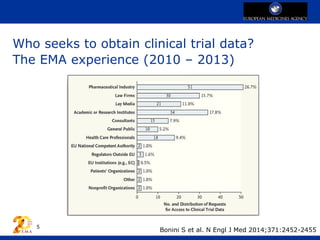
Who seeks to obtain clinical trial data?
The EMA experience (2010 – 2013)
5
Bonini S et al. N Engl J Med 2014;371:2452-2455
Hypothesis: Access to clinical trials data will
benefit the industry
• Improvements in the design and analysis of
subsequent trials
• Comprehensive, quality-controlled databases that
may inform future projects and research questions
• Explore heterogeneity of treatment effects
• Comparative-effectiveness information
• Avoid repetition of clinical trials
6
HG Eichler, et al., N Engl J Med 2013; 369:1577-1579
Experience: Data Sharing, Year 1 (GSK),
Requests for clinical trials data (n).
• Studies of risk factors or biomarkers (6)
• Methodological studies (5)
• Studies comparing treatment regimens (3)
• Studies aimed at optimizing treatments (3)
• Patient-stratification efforts (3)
7
Strom BL et al. N Engl J Med 2014;371:2052-2054
Conclusion: What have we achieved so far?
• Stimulated pharma companies to become pro-
active in sharing data.
• Moved the debate from ‘all clinical trial data are
commercial confidential’ to ‘what in a clinical trial
report can be commercial confidential’?
• Moved the debate from “lack of trust” to a
constructive use supporting future drug
development.
8
Thank you for your attention
European Medicines Agency
30 Churchill Place • Canary Wharf • London E14 5EU • United Kingdom
Telephone +44 (0)20 3660 6000 Facsimile +44 (0)20 3660 5555
Send a question via our website www.ema.europa.eu/contact
Follow us on @EMA_News

Opening clinical trial data

  • 1.
    An agency ofthe European Union Opening clinical trial data: the EMA experience Hans-Georg Eichler EFSA@EXPO, Milan, October 2015
  • 2.
    The basis ofmedicines (“drugs”) regulation Marketing authorisation requires demonstration of: • Quality, Safety, Efficacy (“QSE”) Companies seeking marketing authorisation submit “dossier”: • Pharmaceutical module • Non-clinical part • Clinical module 1 Mostly reports of (randomised) clinical trials in patients. Arguably the most important part of the dossier
  • 3.
    The challenges forEMA • Strong political push to share data of clinical trials that support marketing authorisations • Need to find the best possible balance between different stakeholders’ competing interests,  • Long process of consultation to find such balance  • Agreement on policy on 'Publication and access to clinical-trial data' 2
  • 4.
    Date of cominginto effect of policy 1/1/2015 Any new Marketing Authorisation Applications […], submitted after this date 1/7/2015 Extension of indication applications and line extension applications for existing products, submitted after this date 3 First phase: Clinical study reports Second phase: Individual patient data (IPD) sharing modalities to be discussed Not in scope: Legacy data (submitted before 01/01/2015) [or non-centrally authorised products].
  • 5.
    Terms of usegoverning access / use of clinical study reports Need to allow access to clinical data and discourage unfair commercial use, prevent re-identification of patients – Redaction consultation procedure with sponsor company  ensure appropriate level of redaction of commercial confidential information – Clinical reports, available on-screen only, for any user, limited registration process – Clinical reports, downloadable for academic and non- commercial research purposes; requires identity of the user – Terms of use governing the access to and use of clinical reports 4
  • 6.
    Who seeks toobtain clinical trial data? The EMA experience (2010 – 2013) 5 Bonini S et al. N Engl J Med 2014;371:2452-2455
  • 7.
    Hypothesis: Access toclinical trials data will benefit the industry • Improvements in the design and analysis of subsequent trials • Comprehensive, quality-controlled databases that may inform future projects and research questions • Explore heterogeneity of treatment effects • Comparative-effectiveness information • Avoid repetition of clinical trials 6 HG Eichler, et al., N Engl J Med 2013; 369:1577-1579
  • 8.
    Experience: Data Sharing,Year 1 (GSK), Requests for clinical trials data (n). • Studies of risk factors or biomarkers (6) • Methodological studies (5) • Studies comparing treatment regimens (3) • Studies aimed at optimizing treatments (3) • Patient-stratification efforts (3) 7 Strom BL et al. N Engl J Med 2014;371:2052-2054
  • 9.
    Conclusion: What havewe achieved so far? • Stimulated pharma companies to become pro- active in sharing data. • Moved the debate from ‘all clinical trial data are commercial confidential’ to ‘what in a clinical trial report can be commercial confidential’? • Moved the debate from “lack of trust” to a constructive use supporting future drug development. 8
  • 10.
    Thank you foryour attention European Medicines Agency 30 Churchill Place • Canary Wharf • London E14 5EU • United Kingdom Telephone +44 (0)20 3660 6000 Facsimile +44 (0)20 3660 5555 Send a question via our website www.ema.europa.eu/contact Follow us on @EMA_News