Helsinki Chemicals Forum, June 8-9, 2017
PANEL 1: What has chemicals
legislation done for us over the
last decade?
Dr. Andrea Paetz, Bayer AG, Leverkusen, Germany
Where do we come from?
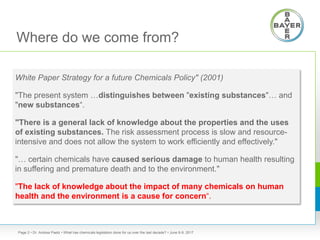
White Paper Strategy for a future Chemicals Policy" (2001)
"The present system …distinguishes between "existing substances"… and
"new substances“.
"There is a general lack of knowledge about the properties and the uses
of existing substances. The risk assessment process is slow and resource-
intensive and does not allow the system to work efficiently and effectively."
"… certain chemicals have caused serious damage to human health resulting
in suffering and premature death and to the environment."
"The lack of knowledge about the impact of many chemicals on human
health and the environment is a cause for concern“.
• Dr. Andrea Paetz • What has chemicals legislation done for us over the last decade? • June 8-9, 2017Page 2
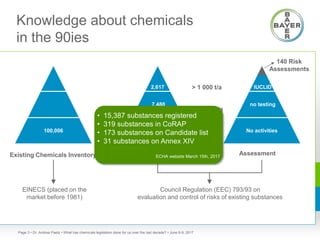
Knowledge about chemicals
in the 90ies
> 1 000 t/a
10 - 1 000 t/a
< 10 t/a
Council Regulation (EEC) 793/93 on
evaluation and control of risks of existing substances
Notification
2,617
7,480
Not recorded
• Dr. Andrea Paetz • What has chemicals legislation done for us over the last decade? • June 8-9, 2017Page 3
100,006
EINECS (placed on the
market before 1981)
Existing Chemicals Inventory Assessment
140 Risk
Assessments
IUCLID
no testing
No activities
• 15,387 substances registered
• 319 substances in CoRAP
• 173 substances on Candidate list
• 31 substances on Annex XIV
ECHA website March 15th, 2017
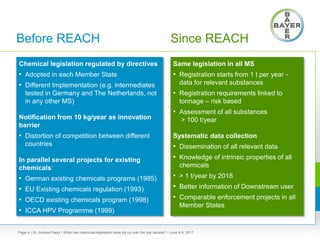
Before REACH
Same legislation in all MS
• Registration starts from 1 t per year -
data for relevant substances
• Registration requirements linked to
tonnage – risk based
• Assessment of all substances
> 100 t/year
Systematic data collection
• Dissemination of all relevant data
• Knowledge of intrinsic properties of all
chemicals
• > 1 t/year by 2018
• Better information of Downstream user
• Comparable enforcement projects in all
Member States
• Dr. Andrea Paetz • What has chemicals legislation done for us over the last decade? • June 8-9, 2017Page 4
Since REACH
Chemical legislation regulated by directives
• Adopted in each Member State
• Different Implementation (e.g. intermediates
tested in Germany and The Netherlands, not
in any other MS)
Notification from 10 kg/year as innovation
barrier
• Distortion of competition between different
countries
In parallel several projects for existing
chemicals:
• German existing chemicals programs (1985)
• EU Existing chemicals regulation (1993)
• OECD existing chemicals program (1998)
• ICCA HPV Programme (1999)
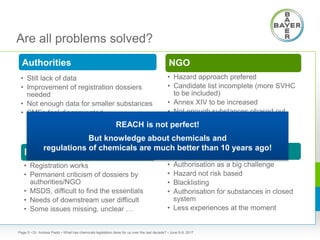
Are all problems solved?
Authorities
• Still lack of data
• Improvement of registration dossiers
needed
• Not enough data for smaller substances
• SMEs feel discriminated
NGO
• Hazard approach prefered
• Candidate list incomplete (more SVHC
to be included)
• Annex XIV to be increased
• Not enough substances phased out
• Too many animal tests
• Dr. Andrea Paetz • What has chemicals legislation done for us over the last decade? • June 8-9, 2017Page 5
Industry
• Registration works
• Permanent criticism of dossiers by
authorities/NGO
• MSDS, difficult to find the essentials
• Needs of downstream user difficult
• Some issues missing, unclear …
Industry
• Authorisation as a big challenge
• Hazard not risk based
• Blacklisting
• Authorisation for substances in closed
system
• Less experiences at the moment
REACH is not perfect!
But knowledge about chemicals and
regulations of chemicals are much better than 10 years ago!

June 8 2017 Panel 1 Andrea Paetz

  • 1.
    Helsinki Chemicals Forum,June 8-9, 2017 PANEL 1: What has chemicals legislation done for us over the last decade? Dr. Andrea Paetz, Bayer AG, Leverkusen, Germany
  • 2.
    Where do wecome from? White Paper Strategy for a future Chemicals Policy" (2001) "The present system …distinguishes between "existing substances"… and "new substances“. "There is a general lack of knowledge about the properties and the uses of existing substances. The risk assessment process is slow and resource- intensive and does not allow the system to work efficiently and effectively." "… certain chemicals have caused serious damage to human health resulting in suffering and premature death and to the environment." "The lack of knowledge about the impact of many chemicals on human health and the environment is a cause for concern“. • Dr. Andrea Paetz • What has chemicals legislation done for us over the last decade? • June 8-9, 2017Page 2
  • 3.
    Knowledge about chemicals inthe 90ies > 1 000 t/a 10 - 1 000 t/a < 10 t/a Council Regulation (EEC) 793/93 on evaluation and control of risks of existing substances Notification 2,617 7,480 Not recorded • Dr. Andrea Paetz • What has chemicals legislation done for us over the last decade? • June 8-9, 2017Page 3 100,006 EINECS (placed on the market before 1981) Existing Chemicals Inventory Assessment 140 Risk Assessments IUCLID no testing No activities • 15,387 substances registered • 319 substances in CoRAP • 173 substances on Candidate list • 31 substances on Annex XIV ECHA website March 15th, 2017
  • 4.
    Before REACH Same legislationin all MS • Registration starts from 1 t per year - data for relevant substances • Registration requirements linked to tonnage – risk based • Assessment of all substances > 100 t/year Systematic data collection • Dissemination of all relevant data • Knowledge of intrinsic properties of all chemicals • > 1 t/year by 2018 • Better information of Downstream user • Comparable enforcement projects in all Member States • Dr. Andrea Paetz • What has chemicals legislation done for us over the last decade? • June 8-9, 2017Page 4 Since REACH Chemical legislation regulated by directives • Adopted in each Member State • Different Implementation (e.g. intermediates tested in Germany and The Netherlands, not in any other MS) Notification from 10 kg/year as innovation barrier • Distortion of competition between different countries In parallel several projects for existing chemicals: • German existing chemicals programs (1985) • EU Existing chemicals regulation (1993) • OECD existing chemicals program (1998) • ICCA HPV Programme (1999)
  • 5.
    Are all problemssolved? Authorities • Still lack of data • Improvement of registration dossiers needed • Not enough data for smaller substances • SMEs feel discriminated NGO • Hazard approach prefered • Candidate list incomplete (more SVHC to be included) • Annex XIV to be increased • Not enough substances phased out • Too many animal tests • Dr. Andrea Paetz • What has chemicals legislation done for us over the last decade? • June 8-9, 2017Page 5 Industry • Registration works • Permanent criticism of dossiers by authorities/NGO • MSDS, difficult to find the essentials • Needs of downstream user difficult • Some issues missing, unclear … Industry • Authorisation as a big challenge • Hazard not risk based • Blacklisting • Authorisation for substances in closed system • Less experiences at the moment REACH is not perfect! But knowledge about chemicals and regulations of chemicals are much better than 10 years ago!