PRIORITIZATION UNDER THE TOXIC
SUBSTANCES CONTROL ACT
Tala Henry
Office of Pollution Prevention and Toxics
U.S. Environmental Protection Agency
June 2018
henry.tala@ epa.gov
2
Prioritization
Statutory Requirements
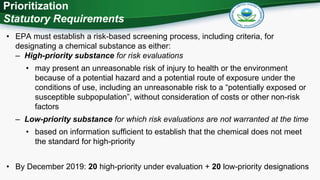
• EPA must establish a risk-based screening process, including criteria, for
designating a chemical substance as either:
– High-priority substance for risk evaluations
• may present an unreasonable risk of injury to health or the environment
because of a potential hazard and a potential route of exposure under the
conditions of use, including an unreasonable risk to a “potentially exposed or
susceptible subpopulation”, without consideration of costs or other non-risk
factors
– Low-priority substance for which risk evaluations are not warranted at the time
• based on information sufficient to establish that the chemical does not meet
the standard for high-priority
• By December 2019: 20 high-priority under evaluation + 20 low-priority designations
3
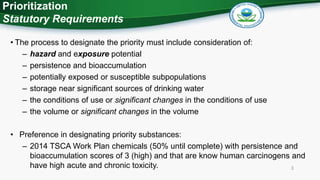
• The process to designate the priority must include consideration of:
– hazard and exposure potential
– persistence and bioaccumulation
– potentially exposed or susceptible subpopulations
– storage near significant sources of drinking water
– the conditions of use or significant changes in the conditions of use
– the volume or significant changes in the volume
• Preference in designating priority substances:
– 2014 TSCA Work Plan chemicals (50% until complete) with persistence and
bioaccumulation scores of 3 (high) and that are know human carcinogens and
have high acute and chronic toxicity.
Prioritization
Statutory Requirements
4
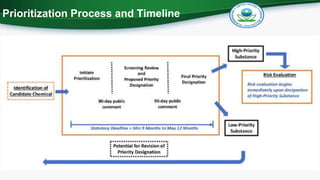
Prioritization Process and Timeline
Evaluating Risks of Existing Chemicals
5

HCF 2018 Panel 3: Tala Henry

  • 1.
    PRIORITIZATION UNDER THETOXIC SUBSTANCES CONTROL ACT Tala Henry Office of Pollution Prevention and Toxics U.S. Environmental Protection Agency June 2018 henry.tala@ epa.gov
  • 2.
    2 Prioritization Statutory Requirements • EPAmust establish a risk-based screening process, including criteria, for designating a chemical substance as either: – High-priority substance for risk evaluations • may present an unreasonable risk of injury to health or the environment because of a potential hazard and a potential route of exposure under the conditions of use, including an unreasonable risk to a “potentially exposed or susceptible subpopulation”, without consideration of costs or other non-risk factors – Low-priority substance for which risk evaluations are not warranted at the time • based on information sufficient to establish that the chemical does not meet the standard for high-priority • By December 2019: 20 high-priority under evaluation + 20 low-priority designations
  • 3.
    3 • The processto designate the priority must include consideration of: – hazard and exposure potential – persistence and bioaccumulation – potentially exposed or susceptible subpopulations – storage near significant sources of drinking water – the conditions of use or significant changes in the conditions of use – the volume or significant changes in the volume • Preference in designating priority substances: – 2014 TSCA Work Plan chemicals (50% until complete) with persistence and bioaccumulation scores of 3 (high) and that are know human carcinogens and have high acute and chronic toxicity. Prioritization Statutory Requirements
  • 4.
  • 5.
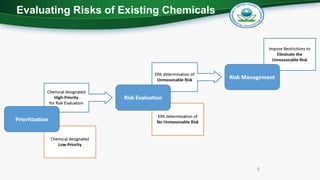
    Evaluating Risks ofExisting Chemicals 5

Editor's Notes

  • #2 On June 22, 2016, “The Frank R. Lautenberg Chemical Safety for the 21st Century Act” amended the Toxic Substances Control Act (TSCA). A key new provision in the amendments was a MANDATE to conduct risk evaluations to determine whether a chemical substance presents an unreasonable risk of injury to health or the environment, without consideration of costs or other nonrisk factors, including unreasonable risk to a potentially exposed or susceptible subpopulation identified as relevant to the risk evaluations by the Administrator, under the conditions of use. [section 6(b)(4)] Identification of Priorities for Risk Evaluation is a precursor requirement to the mandate to evaluate risks [section 6(b)(1)].
  • #3 Under TSCA, Prioritization is a risk-based screening process, that includes criteria for designating chemical substances as: high-priority for risk evaluation or low priority for which risk evaluation is not warranted at the time. The process to designate the priority must include consideration of: Hazard potential and Exposure potential, including consideration of: persistence and bioaccumulation potentially exposed or susceptible subpopulations storage near significant sources of drinking water the conditions of use or significant changes in the conditions of use the volume or significant changes in the volume
  • #4 Under TSCA, Prioritization is a risk-based screening process, that includes criteria for designating chemical substances as: high-priority for risk evaluation or low priority for which risk evaluation is not warranted at the time. The process to designate the priority must include consideration of: Hazard potential and Exposure potential, including consideration of: persistence and bioaccumulation potentially exposed or susceptible subpopulations storage near significant sources of drinking water the conditions of use or significant changes in the conditions of use the volume or significant changes in the volume
  • #5 In addition to definitions and considerations, the statue also requires: Specific steps and timeframes in the process Preferences for certain TSCA Work Plan chemicals