Assessing and Managing Medicines in the
Environment at a Global Pharma Company
OECD Workshop on Managing CECs in Surface Waters, Paris, February 5th, 2018
Jürg Oliver Straub, F.Hoffmann-La Roche Ltd, Basle, Switzerland
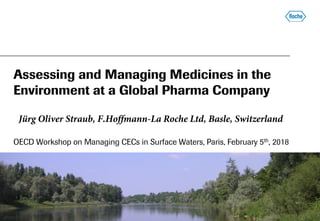
photo©Straub
JO Straub: Assessing & Managing Medicines in the Environment at a Global Pharma Company; OECD Workshop on CECs in Surface Waters, Paris, 05.02.2018 2
F.Hoffmann-La Roche Ltd
• F.Hoffmann-La Roche Ltd, founded in Basle, Switzerland in 1896
• Swiss-based international pharmaceuticals and diagnostics company
• global player, >150 countries, >85,000 employees
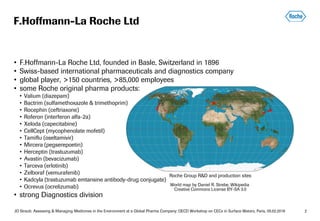
• some Roche original pharma products:
• Valium (diazepam)
• Bactrim (sulfamethoxazole & trimethoprim)
• Rocephin (ceftriaxone)
• Roferon (interferon alfa-2a)
• Xeloda (capecitabine)
• CellCept (mycophenolate mofetil)
• Tamiflu (oseltamivir)
• Mircera (pegserepoetin)
• Herceptin (trastuzumab)
• Avastin (bevacizumab)
• Tarceva (erlotinib)
• Zelboraf (vemurafenib)
• Kadcyla (trastuzumab emtansine antibody-drug conjugate)
• Ocrevus (ocrelizumab)
• strong Diagnostics division
Roche Group R&D and production sites
World map by Daniel R. Strebe, Wikipedia
Creative Commons License BY-SA 3.0
JO Straub: Assessing & Managing Medicines in the Environment at a Global Pharma Company; OECD Workshop on CECs in Surface Waters, Paris, 05.02.2018 3
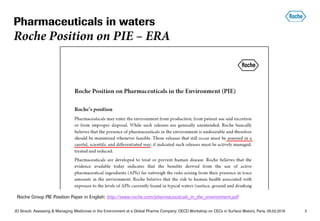
Roche Group PIE Position Paper in English: http://www.roche.com/pharmaceuticals_in_the_environment.pdf
Pharmaceuticals in waters
Roche Position on PIE – ERA
JO Straub: Assessing & Managing Medicines in the Environment at a Global Pharma Company; OECD Workshop on CECs in Surface Waters, Paris, 05.02.2018 4
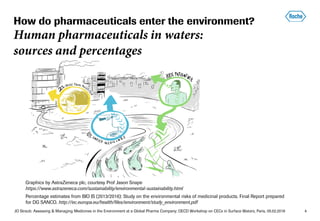
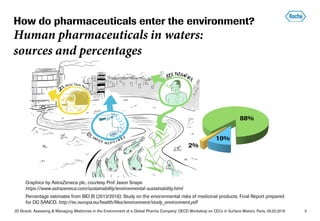
How do pharmaceuticals enter the environment?
Human pharmaceuticals in waters:
sources and percentages
Graphics by AstraZeneca plc, courtesy Prof Jason Snape
https://www.astrazeneca.com/sustainability/environmental-sustainability.html
Percentage estimates from BIO IS (2013/2016): Study on the environmental risks of medicinal products. Final Report prepared
for DG SANCO. http://ec.europa.eu/health/files/environment/study_environment.pdf
JO Straub: Assessing & Managing Medicines in the Environment at a Global Pharma Company; OECD Workshop on CECs in Surface Waters, Paris, 05.02.2018 5
88%
10%
How do pharmaceuticals enter the environment?
Human pharmaceuticals in waters:
sources and percentages
Graphics by AstraZeneca plc, courtesy Prof Jason Snape
https://www.astrazeneca.com/sustainability/environmental-sustainability.html
Percentage estimates from BIO IS (2013/2016): Study on the environmental risks of medicinal products. Final Report prepared
for DG SANCO. http://ec.europa.eu/health/files/environment/study_environment.pdf
2%
JO Straub: Assessing & Managing Medicines in the Environment at a Global Pharma Company; OECD Workshop on CECs in Surface Waters, Paris, 05.02.2018 6
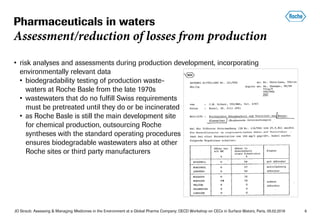
• risk analyses and assessments during production development, incorporating
environmentally relevant data
• biodegradability testing of production waste-
waters at Roche Basle from the late 1970s
• wastewaters that do no fulfill Swiss requirements
must be pretreated until they do or be incinerated
• as Roche Basle is still the main development site
for chemical production, outsourcing Roche
syntheses with the standard operating procedures
ensures biodegradable wastewaters also at other
Roche sites or third party manufacturers
Pharmaceuticals in waters
Assessment/reduction of losses from production
JO Straub: Assessing & Managing Medicines in the Environment at a Global Pharma Company; OECD Workshop on CECs in Surface Waters, Paris, 05.02.2018 7
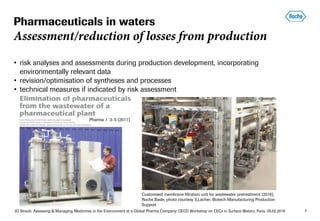
• risk analyses and assessments during production development, incorporating
environmentally relevant data
• revision/optimisation of syntheses and processes
• technical measures if indicated by risk assessment
Customised membrane filtration unit for wastewater pretreatment (2016),
Roche Basle, photo courtesy S.Lacher, Biotech Manufacturing Production
Support
Pharma 1: 3–5 (2011)
Pharmaceuticals in waters
Assessment/reduction of losses from production
JO Straub: Assessing & Managing Medicines in the Environment at a Global Pharma Company; OECD Workshop on CECs in Surface Waters, Paris, 05.02.2018 8
• risk analyses and assessments during production development, incorporating
environmentally relevant data
• revision/optimisation of syntheses and processes
• technical measures if indicated by risk assessment
• SHE (safety, health & environment)-auditing of our own production sites
• SHE-auditing of third party/contract manufacturers
Pharmaceuticals in waters
Assessment/reduction of losses from production
JO Straub: Assessing & Managing Medicines in the Environment at a Global Pharma Company; OECD Workshop on CECs in Surface Waters, Paris, 05.02.2018 9
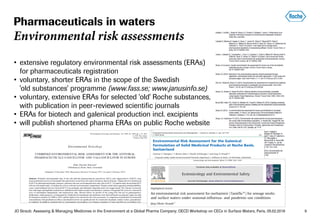
• extensive regulatory environmental risk assessments (ERAs)
for pharmaceuticals registration
• voluntary, shorter ERAs in the scope of the Swedish
'old substances' programme (www.fass.se; www.janusinfo.se)
• voluntary, extensive ERAs for selected 'old' Roche substances,
with publication in peer-reviewed scientific journals
• ERAs for biotech and galenical production incl. excipients
• will publish shortened pharma ERAs on public Roche website
Pharmaceuticals in waters
Environmental risk assessments
JO Straub: Assessing & Managing Medicines in the Environment at a Global Pharma Company; OECD Workshop on CECs in Surface Waters, Paris, 05.02.2018 10
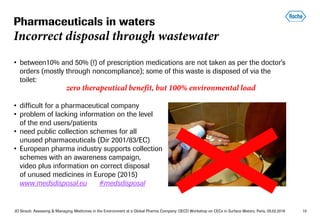
• between10% and 50% (!) of prescription medications are not taken as per the doctor's
orders (mostly through noncompliance); some of this waste is disposed of via the
toilet:
zero therapeutical benefit, but 100% environmental load
• difficult for a pharmaceutical company
• problem of lacking information on the level
of the end users/patients
• need public collection schemes for all
unused pharmaceuticals (Dir 2001/83/EC)
• European pharma industry supports collection
schemes with an awareness campaign,
video plus information on correct disposal
of unused medicines in Europe (2015)
www.medsdisposal.eu #medsdisposal
Pharmaceuticals in waters
Incorrect disposal through wastewater
JO Straub: Assessing & Managing Medicines in the Environment at a Global Pharma Company; OECD Workshop on CECs in Surface Waters, Paris, 05.02.2018 11
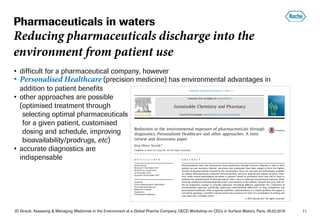
• difficult for a pharmaceutical company, however
• Personalised Healthcare (precision medicine) has environmental advantages in
addition to patient benefits
• other approaches are possible
(optimised treatment through
(selecting optimal pharmaceuticals
(for a given patient, customised
(dosing and schedule, improving
(bioavailability/prodrugs, etc)
• accurate diagnostics are
indispensable
Pharmaceuticals in waters
Reducing pharmaceuticals discharge into the
environment from patient use
JO Straub: Assessing & Managing Medicines in the Environment at a Global Pharma Company; OECD Workshop on CECs in Surface Waters, Paris, 05.02.2018 12
• European human pharmaceuticals industry task force on PIE, comprising AESGP
(self-medication), EFPIA (research pharma) and Medicines for Europe (generics &
biosimilars), since 2012
• EcoPharmacoStewardship (EPS) life-cycle approach, programme with four pillars:
Pharmaceuticals in waters
Industry co-operation on Pharmaceuticals in the
Environment (PIE)
Effluent Management
assessing & managing
production effluents,
wastewater maturity
ladder concept
[Caldwell et al. 2016]
eERA
extended environmental
risk assessment
concept for
pharmaceuticals, going
beyond patent duration
Outreach
awareness campaign
for correct disposal of
unused medicines
in Europe:
www.medsdisposal.eu
#medsdisposal
iPiE
€10m EU/EFPIA
research project on
intelligent assessment
and prioritisation of
pharmaceuticals in the
environment: i-pie.org
Caldwell DJ et al. (2016): A risk-based approach to managing active pharmaceutical ingredients in manufacturing effluent. Environ Toxicol Chem 35: 813–822.
www.aesgp.eu www.efpia.eu www.medicinesforeurope.com
JO Straub: Assessing & Managing Medicines in the Environment at a Global Pharma Company; OECD Workshop on CECs in Surface Waters, Paris, 05.02.2018 13
Assessing and Managing Medicines in the
Environment at a Global Pharma Company
Many thanks for your attention
Dr Jürg Oliver Straub
CBiol FRSB EurProBiol MIEnvSc
Environmental Risk Assessor
F. Hoffmann-La Roche Ltd
Group SHE (LSO), 654/334B
CH–4070 Basle, Switzerland
juerg.straub@roche.com
The 'Old Rhine'
north of Basle
photo©Straub
JO Straub: Assessing & Managing Medicines in the Environment at a Global Pharma Company; OECD Workshop on CECs in Surface Waters, Paris, 05.02.2018 14
Doing now what patients need next
JO Straub: Assessing & Managing Medicines in the Environment at a Global Pharma Company; OECD Workshop on CECs in Surface Waters, Paris, 05.02.2018 15
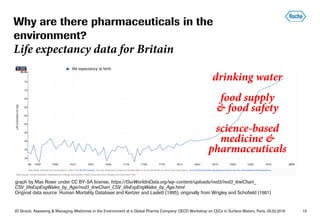
Why are there pharmaceuticals in the
environment?
Life expectancy data for Britain
graph by Max Roser under CC BY-SA license, https://OurWorldinData.org/wp-content/uploads/nvd3/nvd3_lineChart_
CSV_lifeExpEngWales_by_Age/nvd3_lineChart_CSV_lifeExpEngWales_by_Age.html
Original data source: Human Mortality Database and Kertzer and Laslett (1995), originally from Wrigley and Schofield (1981)
life expectancy at birth
drinking water
food supply
& food safety
science-based
medicine &
pharmaceuticals
JO Straub: Assessing & Managing Medicines in the Environment at a Global Pharma Company; OECD Workshop on CECs in Surface Waters, Paris, 05.02.2018 16
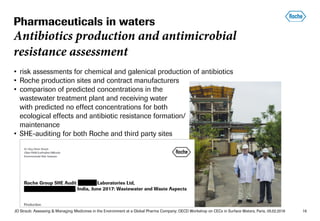
• risk assessments for chemical and galenical production of antibiotics
• Roche production sites and contract manufacturers
• comparison of predicted concentrations in the
wastewater treatment plant and receiving water
with predicted no effect concentrations for both
ecological effects and antibiotic resistance formation/
maintenance
• SHE-auditing for both Roche and third party sites
Pharmaceuticals in waters
Antibiotics production and antimicrobial
resistance assessment
JO Straub: Assessing & Managing Medicines in the Environment at a Global Pharma Company; OECD Workshop on CECs in Surface Waters, Paris, 05.02.2018 17
Pharmaceuticals in waters
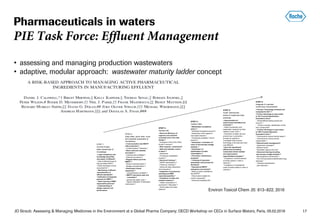
PIE Task Force: Effluent Management
• assessing and managing production wastewaters
• adaptive, modular approach: wastewater maturity ladder concept
Environ Toxicol Chem 35: 813–822, 2016
JO Straub: Assessing & Managing Medicines in the Environment at a Global Pharma Company; OECD Workshop on CECs in Surface Waters, Paris, 05.02.2018 18
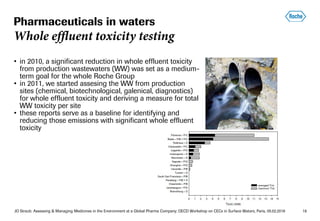
• in 2010, a significant reduction in whole effluent toxicity
from production wastewaters (WW) was set as a medium-
term goal for the whole Roche Group
• in 2011, we started assesing the WW from production
sites (chemical, biotechnological, galenical, diagnostics)
for whole effluent toxicity and deriving a measure for total
WW toxicity per site
• these reports serve as a baseline for identifying and
reducing those emissions with significant whole effluent
toxicity
Pharmaceuticals in waters
Whole effluent toxicity testing
JO Straub: Assessing & Managing Medicines in the Environment at a Global Pharma Company; OECD Workshop on CECs in Surface Waters, Paris, 05.02.2018 19
Pharmaceuticals in waters
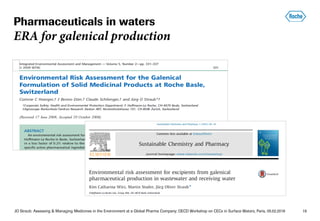
ERA for galenical production
JO Straub: Assessing & Managing Medicines in the Environment at a Global Pharma Company; OECD Workshop on CECs in Surface Waters, Paris, 05.02.2018 20
Pharmaceuticals in waters
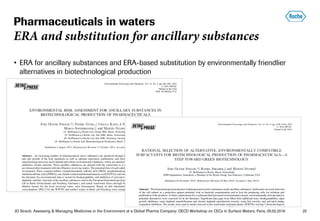
ERA and substitution for ancillary substances
• ERA for ancillary substances and ERA-based substitution by environmentally friendlier
alternatives in biotechnological production
JO Straub: Assessing & Managing Medicines in the Environment at a Global Pharma Company; OECD Workshop on CECs in Surface Waters, Paris, 05.02.2018 21
Pharmaceuticals in waters
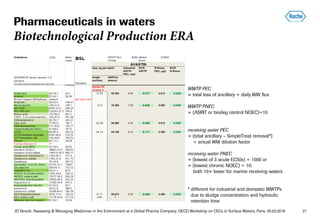
Biotechnological Production ERA
WWTP PEC
= total loss of ancillary ÷ daily WW flux
WWTP PNEC
= (ASRIT or biodeg control NOEC)÷10
receiving water PEC
= (total ancillary – SimpleTreat removal*)
÷ actual WW dilution factor
receiving water PNEC
= (lowest of 3 acute EC50s) ÷ 1000 or
= (lowest chronic NOEC) ÷ 10;
both 10× lower for marine receiving waters
* different for industrial and domestic WWTPs
* due to sludge concentration and hydraulic
* retention time
JO Straub: Assessing & Managing Medicines in the Environment at a Global Pharma Company; OECD Workshop on CECs in Surface Waters, Paris, 05.02.2018 22
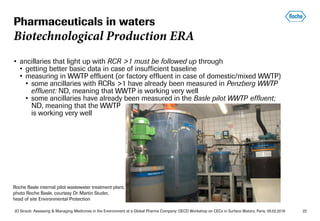
• ancillaries that light up with RCR >1 must be followed up through
• getting better basic data in case of insufficient baseline
• measuring in WWTP effluent (or factory effluent in case of domestic/mixed WWTP)
• some ancillaries with RCRs >1 have already been measured in Penzberg WWTP
effluent: ND, meaning that WWTP is working very well
• some ancillaries have already been measured in the Basle pilot WWTP effluent;
ND, meaning that the WWTP
is working very well
Roche Basle internal pilot wastewater treatment plant,
photo Roche Basle, courtesy Dr Martin Studer,
head of site Environmental Protection
Pharmaceuticals in waters
Biotechnological Production ERA
JO Straub: Assessing & Managing Medicines in the Environment at a Global Pharma Company; OECD Workshop on CECs in Surface Waters, Paris, 05.02.2018 23
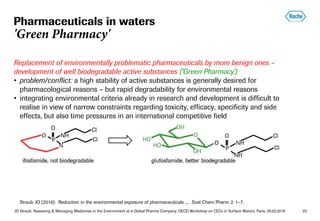
Replacement of environmentally problematic pharmaceuticals by more benign ones –
development of well biodegradable active substances ('Green Pharmacy')
• problem/conflict: a high stability of active substances is generally desired for
pharmacological reasons – but rapid degradability for environmental reasons
• integrating environmental criteria already in research and development is difficult to
realise in view of narrow constraints regarding toxicity, efficacy, specificity and side
effects, but also time pressures in an international competitive field
Straub JO (2016): Reduction in the environmental exposure of pharmaceuticals .... Sust Chem Pharm 3: 1–7.
Pharmaceuticals in waters
'Green Pharmacy'
JO Straub: Assessing & Managing Medicines in the Environment at a Global Pharma Company; OECD Workshop on CECs in Surface Waters, Paris, 05.02.2018 24
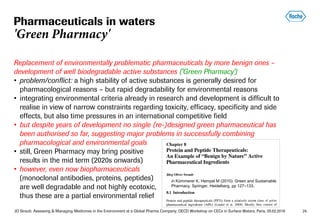
Replacement of environmentally problematic pharmaceuticals by more benign ones –
development of well biodegradable active substances ('Green Pharmacy')
• problem/conflict: a high stability of active substances is generally desired for
pharmacological reasons – but rapid degradability for environmental reasons
• integrating environmental criteria already in research and development is difficult to
realise in view of narrow constraints regarding toxicity, efficacy, specificity and side
effects, but also time pressures in an international competitive field
• but despite years of development no single (re-)designed green pharmaceutical has
been authorised so far, suggesting major problems in successfully combining
pharmacological and environmental goals
• still, Green Pharmacy may bring positive
results in the mid term (2020s onwards)
• however, even now biopharmaceuticals
(monoclonal antibodies, proteins, peptides)
are well degradable and not highly ecotoxic,
thus these are a partial environmental relief
Pharmaceuticals in waters
'Green Pharmacy'
in Kümmerer K, Hempel M (2010): Green and Sustainable
Pharmacy. Springer, Heidelberg, pp 127–133.
JO Straub: Assessing & Managing Medicines in the Environment at a Global Pharma Company; OECD Workshop on CECs in Surface Waters, Paris, 05.02.2018 25
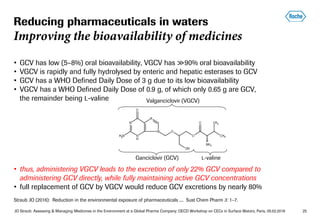
• GCV has low (5–8%) oral bioavailability, VGCV has >90% oral bioavailability
• VGCV is rapidly and fully hydrolysed by enteric and hepatic esterases to GCV
• GCV has a WHO Defined Daily Dose of 3 g due to its low bioavailability
• VGCV has a WHO Defined Daily Dose of 0.9 g, of which only 0.65 g are GCV,
the remainder being L-valine
• thus, administering VGCV leads to the excretion of only 22% GCV compared to
administering GCV directly, while fully maintaining active GCV concentrations
• full replacement of GCV by VGCV would reduce GCV excretions by nearly 80%
Straub JO (2016): Reduction in the environmental exposure of pharmaceuticals .... Sust Chem Pharm 3: 1–7.
Reducing pharmaceuticals in waters
Improving the bioavailability of medicines
>
Ganciclovir (GCV) L-valine
Valganciclovir (VGCV)
JO Straub: Assessing & Managing Medicines in the Environment at a Global Pharma Company; OECD Workshop on CECs in Surface Waters, Paris, 05.02.2018 26
• problem: public sewage works have been built since the 1960s because of
eutrophication and foaming; they have massively improved receiving waters quality,
but have never been designed for the removal of micropollutants
• national and international research projects (eg, EU: REMPHARMAWATER,
POSEIDON; DE: RISKWA; CH: Strategie Micropoll, etc) investigate potential upgrading
technologies for the removal of organic trace substances, including ozonation,
'advanced oxidation processes' and activated charcoal, in drinking water production
also ultrafiltration
 increased removal of
personal care products; insect repellants;
fragrances; detergents; biocides; disinfection
byproducts; pharmaceuticals; nanomaterials;
flame retardants; halogenated compounds;
corrosion inhibitors; stabilisers; complexing
agents; plasticisers; artificial sweeteners;
illicit drugs; industrial & technical chemicals;
UV filters; microplastics; metals ...
Pharmaceuticals in waters
Improvement/retrofitting of water treatment
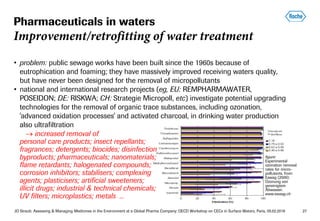
figure:
Experimental
ozonation removal
rates for micro-
pollutants, from:
Eawag (2009):
Ozonung von
gereinigtem
Abwasser.
www.eawag.ch
JO Straub: Assessing & Managing Medicines in the Environment at a Global Pharma Company; OECD Workshop on CECs in Surface Waters, Paris, 05.02.2018 27
• problem: public sewage works have been built since the 1960s because of
eutrophication and foaming; they have massively improved receiving waters quality,
but have never been designed for the removal of micropollutants
• national and international research projects (eg, EU: REMPHARMAWATER,
POSEIDON; DE: RISKWA; CH: Strategie Micropoll, etc) investigate potential upgrading
technologies for the removal of organic trace substances, including ozonation,
'advanced oxidation processes' and activated charcoal, in drinking water production
also ultrafiltration
 increased removal of
personal care products; insect repellants;
fragrances; detergents; biocides; disinfection
byproducts; pharmaceuticals; nanomaterials;
flame retardants; halogenated compounds;
corrosion inhibitors; stabilisers; complexing
agents; plasticisers; artificial sweeteners;
illicit drugs; industrial & technical chemicals;
UV filters; microplastics; metals ...
Pharmaceuticals in waters
Improvement/retrofitting of water treatment
figure:
Experimental
ozonation removal
rates for micro-
pollutants, from:
Eawag (2009):
Ozonung von
gereinigtem
Abwasser.
www.eawag.ch

Session 3- Jurg Oliver Straub

  • 1.
    Assessing and ManagingMedicines in the Environment at a Global Pharma Company OECD Workshop on Managing CECs in Surface Waters, Paris, February 5th, 2018 Jürg Oliver Straub, F.Hoffmann-La Roche Ltd, Basle, Switzerland photo©Straub
  • 2.
    JO Straub: Assessing& Managing Medicines in the Environment at a Global Pharma Company; OECD Workshop on CECs in Surface Waters, Paris, 05.02.2018 2 F.Hoffmann-La Roche Ltd • F.Hoffmann-La Roche Ltd, founded in Basle, Switzerland in 1896 • Swiss-based international pharmaceuticals and diagnostics company • global player, >150 countries, >85,000 employees • some Roche original pharma products: • Valium (diazepam) • Bactrim (sulfamethoxazole & trimethoprim) • Rocephin (ceftriaxone) • Roferon (interferon alfa-2a) • Xeloda (capecitabine) • CellCept (mycophenolate mofetil) • Tamiflu (oseltamivir) • Mircera (pegserepoetin) • Herceptin (trastuzumab) • Avastin (bevacizumab) • Tarceva (erlotinib) • Zelboraf (vemurafenib) • Kadcyla (trastuzumab emtansine antibody-drug conjugate) • Ocrevus (ocrelizumab) • strong Diagnostics division Roche Group R&D and production sites World map by Daniel R. Strebe, Wikipedia Creative Commons License BY-SA 3.0
  • 3.
    JO Straub: Assessing& Managing Medicines in the Environment at a Global Pharma Company; OECD Workshop on CECs in Surface Waters, Paris, 05.02.2018 3 Roche Group PIE Position Paper in English: http://www.roche.com/pharmaceuticals_in_the_environment.pdf Pharmaceuticals in waters Roche Position on PIE – ERA
  • 4.
    JO Straub: Assessing& Managing Medicines in the Environment at a Global Pharma Company; OECD Workshop on CECs in Surface Waters, Paris, 05.02.2018 4 How do pharmaceuticals enter the environment? Human pharmaceuticals in waters: sources and percentages Graphics by AstraZeneca plc, courtesy Prof Jason Snape https://www.astrazeneca.com/sustainability/environmental-sustainability.html Percentage estimates from BIO IS (2013/2016): Study on the environmental risks of medicinal products. Final Report prepared for DG SANCO. http://ec.europa.eu/health/files/environment/study_environment.pdf
  • 5.
    JO Straub: Assessing& Managing Medicines in the Environment at a Global Pharma Company; OECD Workshop on CECs in Surface Waters, Paris, 05.02.2018 5 88% 10% How do pharmaceuticals enter the environment? Human pharmaceuticals in waters: sources and percentages Graphics by AstraZeneca plc, courtesy Prof Jason Snape https://www.astrazeneca.com/sustainability/environmental-sustainability.html Percentage estimates from BIO IS (2013/2016): Study on the environmental risks of medicinal products. Final Report prepared for DG SANCO. http://ec.europa.eu/health/files/environment/study_environment.pdf 2%
  • 6.
    JO Straub: Assessing& Managing Medicines in the Environment at a Global Pharma Company; OECD Workshop on CECs in Surface Waters, Paris, 05.02.2018 6 • risk analyses and assessments during production development, incorporating environmentally relevant data • biodegradability testing of production waste- waters at Roche Basle from the late 1970s • wastewaters that do no fulfill Swiss requirements must be pretreated until they do or be incinerated • as Roche Basle is still the main development site for chemical production, outsourcing Roche syntheses with the standard operating procedures ensures biodegradable wastewaters also at other Roche sites or third party manufacturers Pharmaceuticals in waters Assessment/reduction of losses from production
  • 7.
    JO Straub: Assessing& Managing Medicines in the Environment at a Global Pharma Company; OECD Workshop on CECs in Surface Waters, Paris, 05.02.2018 7 • risk analyses and assessments during production development, incorporating environmentally relevant data • revision/optimisation of syntheses and processes • technical measures if indicated by risk assessment Customised membrane filtration unit for wastewater pretreatment (2016), Roche Basle, photo courtesy S.Lacher, Biotech Manufacturing Production Support Pharma 1: 3–5 (2011) Pharmaceuticals in waters Assessment/reduction of losses from production
  • 8.
    JO Straub: Assessing& Managing Medicines in the Environment at a Global Pharma Company; OECD Workshop on CECs in Surface Waters, Paris, 05.02.2018 8 • risk analyses and assessments during production development, incorporating environmentally relevant data • revision/optimisation of syntheses and processes • technical measures if indicated by risk assessment • SHE (safety, health & environment)-auditing of our own production sites • SHE-auditing of third party/contract manufacturers Pharmaceuticals in waters Assessment/reduction of losses from production
  • 9.
    JO Straub: Assessing& Managing Medicines in the Environment at a Global Pharma Company; OECD Workshop on CECs in Surface Waters, Paris, 05.02.2018 9 • extensive regulatory environmental risk assessments (ERAs) for pharmaceuticals registration • voluntary, shorter ERAs in the scope of the Swedish 'old substances' programme (www.fass.se; www.janusinfo.se) • voluntary, extensive ERAs for selected 'old' Roche substances, with publication in peer-reviewed scientific journals • ERAs for biotech and galenical production incl. excipients • will publish shortened pharma ERAs on public Roche website Pharmaceuticals in waters Environmental risk assessments
  • 10.
    JO Straub: Assessing& Managing Medicines in the Environment at a Global Pharma Company; OECD Workshop on CECs in Surface Waters, Paris, 05.02.2018 10 • between10% and 50% (!) of prescription medications are not taken as per the doctor's orders (mostly through noncompliance); some of this waste is disposed of via the toilet: zero therapeutical benefit, but 100% environmental load • difficult for a pharmaceutical company • problem of lacking information on the level of the end users/patients • need public collection schemes for all unused pharmaceuticals (Dir 2001/83/EC) • European pharma industry supports collection schemes with an awareness campaign, video plus information on correct disposal of unused medicines in Europe (2015) www.medsdisposal.eu #medsdisposal Pharmaceuticals in waters Incorrect disposal through wastewater
  • 11.
    JO Straub: Assessing& Managing Medicines in the Environment at a Global Pharma Company; OECD Workshop on CECs in Surface Waters, Paris, 05.02.2018 11 • difficult for a pharmaceutical company, however • Personalised Healthcare (precision medicine) has environmental advantages in addition to patient benefits • other approaches are possible (optimised treatment through (selecting optimal pharmaceuticals (for a given patient, customised (dosing and schedule, improving (bioavailability/prodrugs, etc) • accurate diagnostics are indispensable Pharmaceuticals in waters Reducing pharmaceuticals discharge into the environment from patient use
  • 12.
    JO Straub: Assessing& Managing Medicines in the Environment at a Global Pharma Company; OECD Workshop on CECs in Surface Waters, Paris, 05.02.2018 12 • European human pharmaceuticals industry task force on PIE, comprising AESGP (self-medication), EFPIA (research pharma) and Medicines for Europe (generics & biosimilars), since 2012 • EcoPharmacoStewardship (EPS) life-cycle approach, programme with four pillars: Pharmaceuticals in waters Industry co-operation on Pharmaceuticals in the Environment (PIE) Effluent Management assessing & managing production effluents, wastewater maturity ladder concept [Caldwell et al. 2016] eERA extended environmental risk assessment concept for pharmaceuticals, going beyond patent duration Outreach awareness campaign for correct disposal of unused medicines in Europe: www.medsdisposal.eu #medsdisposal iPiE €10m EU/EFPIA research project on intelligent assessment and prioritisation of pharmaceuticals in the environment: i-pie.org Caldwell DJ et al. (2016): A risk-based approach to managing active pharmaceutical ingredients in manufacturing effluent. Environ Toxicol Chem 35: 813–822. www.aesgp.eu www.efpia.eu www.medicinesforeurope.com
  • 13.
    JO Straub: Assessing& Managing Medicines in the Environment at a Global Pharma Company; OECD Workshop on CECs in Surface Waters, Paris, 05.02.2018 13 Assessing and Managing Medicines in the Environment at a Global Pharma Company Many thanks for your attention Dr Jürg Oliver Straub CBiol FRSB EurProBiol MIEnvSc Environmental Risk Assessor F. Hoffmann-La Roche Ltd Group SHE (LSO), 654/334B CH–4070 Basle, Switzerland juerg.straub@roche.com The 'Old Rhine' north of Basle photo©Straub
  • 14.
    JO Straub: Assessing& Managing Medicines in the Environment at a Global Pharma Company; OECD Workshop on CECs in Surface Waters, Paris, 05.02.2018 14 Doing now what patients need next
  • 15.
    JO Straub: Assessing& Managing Medicines in the Environment at a Global Pharma Company; OECD Workshop on CECs in Surface Waters, Paris, 05.02.2018 15 Why are there pharmaceuticals in the environment? Life expectancy data for Britain graph by Max Roser under CC BY-SA license, https://OurWorldinData.org/wp-content/uploads/nvd3/nvd3_lineChart_ CSV_lifeExpEngWales_by_Age/nvd3_lineChart_CSV_lifeExpEngWales_by_Age.html Original data source: Human Mortality Database and Kertzer and Laslett (1995), originally from Wrigley and Schofield (1981) life expectancy at birth drinking water food supply & food safety science-based medicine & pharmaceuticals
  • 16.
    JO Straub: Assessing& Managing Medicines in the Environment at a Global Pharma Company; OECD Workshop on CECs in Surface Waters, Paris, 05.02.2018 16 • risk assessments for chemical and galenical production of antibiotics • Roche production sites and contract manufacturers • comparison of predicted concentrations in the wastewater treatment plant and receiving water with predicted no effect concentrations for both ecological effects and antibiotic resistance formation/ maintenance • SHE-auditing for both Roche and third party sites Pharmaceuticals in waters Antibiotics production and antimicrobial resistance assessment
  • 17.
    JO Straub: Assessing& Managing Medicines in the Environment at a Global Pharma Company; OECD Workshop on CECs in Surface Waters, Paris, 05.02.2018 17 Pharmaceuticals in waters PIE Task Force: Effluent Management • assessing and managing production wastewaters • adaptive, modular approach: wastewater maturity ladder concept Environ Toxicol Chem 35: 813–822, 2016
  • 18.
    JO Straub: Assessing& Managing Medicines in the Environment at a Global Pharma Company; OECD Workshop on CECs in Surface Waters, Paris, 05.02.2018 18 • in 2010, a significant reduction in whole effluent toxicity from production wastewaters (WW) was set as a medium- term goal for the whole Roche Group • in 2011, we started assesing the WW from production sites (chemical, biotechnological, galenical, diagnostics) for whole effluent toxicity and deriving a measure for total WW toxicity per site • these reports serve as a baseline for identifying and reducing those emissions with significant whole effluent toxicity Pharmaceuticals in waters Whole effluent toxicity testing
  • 19.
    JO Straub: Assessing& Managing Medicines in the Environment at a Global Pharma Company; OECD Workshop on CECs in Surface Waters, Paris, 05.02.2018 19 Pharmaceuticals in waters ERA for galenical production
  • 20.
    JO Straub: Assessing& Managing Medicines in the Environment at a Global Pharma Company; OECD Workshop on CECs in Surface Waters, Paris, 05.02.2018 20 Pharmaceuticals in waters ERA and substitution for ancillary substances • ERA for ancillary substances and ERA-based substitution by environmentally friendlier alternatives in biotechnological production
  • 21.
    JO Straub: Assessing& Managing Medicines in the Environment at a Global Pharma Company; OECD Workshop on CECs in Surface Waters, Paris, 05.02.2018 21 Pharmaceuticals in waters Biotechnological Production ERA WWTP PEC = total loss of ancillary ÷ daily WW flux WWTP PNEC = (ASRIT or biodeg control NOEC)÷10 receiving water PEC = (total ancillary – SimpleTreat removal*) ÷ actual WW dilution factor receiving water PNEC = (lowest of 3 acute EC50s) ÷ 1000 or = (lowest chronic NOEC) ÷ 10; both 10× lower for marine receiving waters * different for industrial and domestic WWTPs * due to sludge concentration and hydraulic * retention time
  • 22.
    JO Straub: Assessing& Managing Medicines in the Environment at a Global Pharma Company; OECD Workshop on CECs in Surface Waters, Paris, 05.02.2018 22 • ancillaries that light up with RCR >1 must be followed up through • getting better basic data in case of insufficient baseline • measuring in WWTP effluent (or factory effluent in case of domestic/mixed WWTP) • some ancillaries with RCRs >1 have already been measured in Penzberg WWTP effluent: ND, meaning that WWTP is working very well • some ancillaries have already been measured in the Basle pilot WWTP effluent; ND, meaning that the WWTP is working very well Roche Basle internal pilot wastewater treatment plant, photo Roche Basle, courtesy Dr Martin Studer, head of site Environmental Protection Pharmaceuticals in waters Biotechnological Production ERA
  • 23.
    JO Straub: Assessing& Managing Medicines in the Environment at a Global Pharma Company; OECD Workshop on CECs in Surface Waters, Paris, 05.02.2018 23 Replacement of environmentally problematic pharmaceuticals by more benign ones – development of well biodegradable active substances ('Green Pharmacy') • problem/conflict: a high stability of active substances is generally desired for pharmacological reasons – but rapid degradability for environmental reasons • integrating environmental criteria already in research and development is difficult to realise in view of narrow constraints regarding toxicity, efficacy, specificity and side effects, but also time pressures in an international competitive field Straub JO (2016): Reduction in the environmental exposure of pharmaceuticals .... Sust Chem Pharm 3: 1–7. Pharmaceuticals in waters 'Green Pharmacy'
  • 24.
    JO Straub: Assessing& Managing Medicines in the Environment at a Global Pharma Company; OECD Workshop on CECs in Surface Waters, Paris, 05.02.2018 24 Replacement of environmentally problematic pharmaceuticals by more benign ones – development of well biodegradable active substances ('Green Pharmacy') • problem/conflict: a high stability of active substances is generally desired for pharmacological reasons – but rapid degradability for environmental reasons • integrating environmental criteria already in research and development is difficult to realise in view of narrow constraints regarding toxicity, efficacy, specificity and side effects, but also time pressures in an international competitive field • but despite years of development no single (re-)designed green pharmaceutical has been authorised so far, suggesting major problems in successfully combining pharmacological and environmental goals • still, Green Pharmacy may bring positive results in the mid term (2020s onwards) • however, even now biopharmaceuticals (monoclonal antibodies, proteins, peptides) are well degradable and not highly ecotoxic, thus these are a partial environmental relief Pharmaceuticals in waters 'Green Pharmacy' in Kümmerer K, Hempel M (2010): Green and Sustainable Pharmacy. Springer, Heidelberg, pp 127–133.
  • 25.
    JO Straub: Assessing& Managing Medicines in the Environment at a Global Pharma Company; OECD Workshop on CECs in Surface Waters, Paris, 05.02.2018 25 • GCV has low (5–8%) oral bioavailability, VGCV has >90% oral bioavailability • VGCV is rapidly and fully hydrolysed by enteric and hepatic esterases to GCV • GCV has a WHO Defined Daily Dose of 3 g due to its low bioavailability • VGCV has a WHO Defined Daily Dose of 0.9 g, of which only 0.65 g are GCV, the remainder being L-valine • thus, administering VGCV leads to the excretion of only 22% GCV compared to administering GCV directly, while fully maintaining active GCV concentrations • full replacement of GCV by VGCV would reduce GCV excretions by nearly 80% Straub JO (2016): Reduction in the environmental exposure of pharmaceuticals .... Sust Chem Pharm 3: 1–7. Reducing pharmaceuticals in waters Improving the bioavailability of medicines > Ganciclovir (GCV) L-valine Valganciclovir (VGCV)
  • 26.
    JO Straub: Assessing& Managing Medicines in the Environment at a Global Pharma Company; OECD Workshop on CECs in Surface Waters, Paris, 05.02.2018 26 • problem: public sewage works have been built since the 1960s because of eutrophication and foaming; they have massively improved receiving waters quality, but have never been designed for the removal of micropollutants • national and international research projects (eg, EU: REMPHARMAWATER, POSEIDON; DE: RISKWA; CH: Strategie Micropoll, etc) investigate potential upgrading technologies for the removal of organic trace substances, including ozonation, 'advanced oxidation processes' and activated charcoal, in drinking water production also ultrafiltration  increased removal of personal care products; insect repellants; fragrances; detergents; biocides; disinfection byproducts; pharmaceuticals; nanomaterials; flame retardants; halogenated compounds; corrosion inhibitors; stabilisers; complexing agents; plasticisers; artificial sweeteners; illicit drugs; industrial & technical chemicals; UV filters; microplastics; metals ... Pharmaceuticals in waters Improvement/retrofitting of water treatment figure: Experimental ozonation removal rates for micro- pollutants, from: Eawag (2009): Ozonung von gereinigtem Abwasser. www.eawag.ch
  • 27.
    JO Straub: Assessing& Managing Medicines in the Environment at a Global Pharma Company; OECD Workshop on CECs in Surface Waters, Paris, 05.02.2018 27 • problem: public sewage works have been built since the 1960s because of eutrophication and foaming; they have massively improved receiving waters quality, but have never been designed for the removal of micropollutants • national and international research projects (eg, EU: REMPHARMAWATER, POSEIDON; DE: RISKWA; CH: Strategie Micropoll, etc) investigate potential upgrading technologies for the removal of organic trace substances, including ozonation, 'advanced oxidation processes' and activated charcoal, in drinking water production also ultrafiltration  increased removal of personal care products; insect repellants; fragrances; detergents; biocides; disinfection byproducts; pharmaceuticals; nanomaterials; flame retardants; halogenated compounds; corrosion inhibitors; stabilisers; complexing agents; plasticisers; artificial sweeteners; illicit drugs; industrial & technical chemicals; UV filters; microplastics; metals ... Pharmaceuticals in waters Improvement/retrofitting of water treatment figure: Experimental ozonation removal rates for micro- pollutants, from: Eawag (2009): Ozonung von gereinigtem Abwasser. www.eawag.ch