Plant safety
Helsinki Chemicals Forum
Panel 4: Plant Safety – Is it taking a back seat to economic
pressures?
Ms. Sandra Averous Monnery – Programme Officer UNEP
27 May 2016
UNEP Programmes on Safer Production and
Industrial Risk Reduction
2
Awareness and Preparedness for Emergencies at
Local Level (APELL) ProgrammeLocal Level
•promotes multi-stakeholder preparedness to disasters through community participation
•UNEP D&C Sub-programme
Flexible Framework Initiative for Chemical Accident
Prevention and PreparednessNational Level
•provides guidance for governments wishing to develop, review, strengthen or improve their
chemical accident prevention and preparedness programmes
• UNEP C&W subprogramme
Responsible Production approach for Chemical
Hazards Management
Sectoral level /
SMEs
•guidance and tool for SMEs aimed at engaging all stakeholders along the supply-chain in
improved safer production, risk communication and emergency preparedness practices
•UNEP C&W subprogramme
Support Eco-innovation Technical component on
Chemicals sector
Sectoral Level /
SMEs
•Eco-innovation guidance and tools to create conditions for service providers, to support SMEs
to improve their sustainability performance through eco-innovation.
•Applied to chemicals use and production
•UNEP RE subprogramme
APELL : Awareness and Preparedness
for Emergencies at Local Level
• Goal: Help communities prevent loss of life, damage
to health, well-being and livelihoods, minimize
property damage, and protect the environment
• Objectives:
• Raising awareness, communicating and educating the
community
• Improving emergency preparedness planning
LOCAL LEVEL
MULTI-STAKEHOLDER
COOPERATION AND COORDINATION
OPEN COMMUNICATION
APELL Process : multi-
stakeholder approach at
community level
4
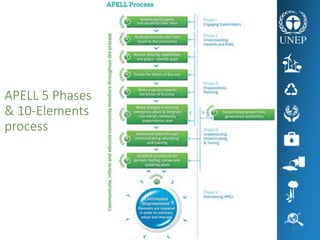
APELL 5 Phases
& 10-Elements
process
5
Expected APELL results
• Enhanced local knowledge of industrial and natural hazards
• Informed community about the risks they are exposed to
• Educated community on how to react to accidents/disasters
• Promotion of co-ordination between representatives from the
industry, local institutions and the public
• Preparation of an integrated plan for community response to
emergencies
APELL History
7
• 1986: UNEP launched the Awareness and Preparedness for
Emergencies at Local Level (APELL) Programme to improve local
level emergency preparedness through a community‐oriented effort
• 1988: APELL Handbook
• Development of community emergency preparedness plans
• 2000: Sectoral applications
• APELL for Mining, TransAPELL, Ports Areas…
• 2010: Multi-Hazard training kit, APELL for coastal tourism
destination
• 2015: 2nd edition of the Handbook
• 2015-2016: APELL Training of Trainers and APELL Network of
trainers.
APELL Resources
• Global APELL Platform:
• News & Events
• Online Resources
• Guidance on APELL in different sectors:
• Chemical, Mining, Transport, Port Areas, Multi-
hazards, Tourism, Coastal Destinations
9
www.unep.org/apell
www.apell.eecentre.org
Flexible Framework on CAPP
• A need (2007):
• No globally binding legal instrument
• No global guidance material adaptable in differing country
contexts worldwide
• SAICM Global Plan of Action, Action Point calling for
collaborative, practically-oriented tools for chemical accident
prevention and preparedness
• A Purpose:
• Increase countries’ understanding of issues related to chemical
accident prevention and preparedness
• Improve the capacity of relevant institutions, agencies and
experts to address the risks of chemical accidents
• Help countries to develop and implement an appropriate CAPP
Programme
CHEMICAL ACCIDENTS PREVENTION AND PREPAREDNESS
NATIONAL LEVEL
GOVERNMENTS CAPACITY AND INSTITUTIONS
ADAPTABILITY and LEGAL FRAMEWORK
FF resources
• Developed with Expert Working Group
(OECD, UNECE, JEU, JRC…):
• Flexible Framework Guidance (2010),
• the Implementation Support Package (2012) and
• Webportal: www.capp.eecentre.org
• The Guidance has been designed to be
flexible to ensure that:
• it can be applied in different national contexts
worldwide;
• countries can focus on elements relevant to their
particular context and adapt them as required;
and
• countries can decide how to define actions,
depending on priorities, resources and
experience.
Case study of implementation
2015
• Lessons learnt from “CAPP
Programme Projects” in 6
countries : Cambodia,
Philippines, Mali, Senegal,
Tanzania, Sri Lanka
• Adaptability: large scope for
application in all countries
• High Level political and
stakeholder commitmment
• Multistakeholder collaboration
• Follow up projects and activities
• Info sharing
Plant safety – main messages
• Engagement and collaboration amongst different
actors
• National and local approaches to chemical
accidents prevention and preparedness require
adaptability, flexibility and transparency.
• Reinforcement of shared safety culture is needed.
• Economic, environmental and social benefits, at
all levels. A local benefits: building trust.
25 years of working in partnership
14
Thank you
Contact
United Nations Environment Programme
Division of Technology, Industry and Economics
Sustainable Lifestyles, Cities and Industries Branch
Responsible Industry and Value Chain Unit
1 rue Miollis, 75015 Paris, France
E-mail : elisa.tonda@unep.org;
sandra.averous@unep.org
http://apell.eecentre.org/
http://www.unep.org/apell/

HCF 2016: Sandra Averous Monnery

  • 1.
    Plant safety Helsinki ChemicalsForum Panel 4: Plant Safety – Is it taking a back seat to economic pressures? Ms. Sandra Averous Monnery – Programme Officer UNEP 27 May 2016
  • 2.
    UNEP Programmes onSafer Production and Industrial Risk Reduction 2 Awareness and Preparedness for Emergencies at Local Level (APELL) ProgrammeLocal Level •promotes multi-stakeholder preparedness to disasters through community participation •UNEP D&C Sub-programme Flexible Framework Initiative for Chemical Accident Prevention and PreparednessNational Level •provides guidance for governments wishing to develop, review, strengthen or improve their chemical accident prevention and preparedness programmes • UNEP C&W subprogramme Responsible Production approach for Chemical Hazards Management Sectoral level / SMEs •guidance and tool for SMEs aimed at engaging all stakeholders along the supply-chain in improved safer production, risk communication and emergency preparedness practices •UNEP C&W subprogramme Support Eco-innovation Technical component on Chemicals sector Sectoral Level / SMEs •Eco-innovation guidance and tools to create conditions for service providers, to support SMEs to improve their sustainability performance through eco-innovation. •Applied to chemicals use and production •UNEP RE subprogramme
  • 3.
    APELL : Awarenessand Preparedness for Emergencies at Local Level • Goal: Help communities prevent loss of life, damage to health, well-being and livelihoods, minimize property damage, and protect the environment • Objectives: • Raising awareness, communicating and educating the community • Improving emergency preparedness planning LOCAL LEVEL MULTI-STAKEHOLDER COOPERATION AND COORDINATION OPEN COMMUNICATION
  • 4.
    APELL Process :multi- stakeholder approach at community level 4
  • 5.
    APELL 5 Phases &10-Elements process 5
  • 6.
    Expected APELL results •Enhanced local knowledge of industrial and natural hazards • Informed community about the risks they are exposed to • Educated community on how to react to accidents/disasters • Promotion of co-ordination between representatives from the industry, local institutions and the public • Preparation of an integrated plan for community response to emergencies
  • 7.
    APELL History 7 • 1986:UNEP launched the Awareness and Preparedness for Emergencies at Local Level (APELL) Programme to improve local level emergency preparedness through a community‐oriented effort • 1988: APELL Handbook • Development of community emergency preparedness plans • 2000: Sectoral applications • APELL for Mining, TransAPELL, Ports Areas… • 2010: Multi-Hazard training kit, APELL for coastal tourism destination • 2015: 2nd edition of the Handbook • 2015-2016: APELL Training of Trainers and APELL Network of trainers.
  • 8.
    APELL Resources • GlobalAPELL Platform: • News & Events • Online Resources • Guidance on APELL in different sectors: • Chemical, Mining, Transport, Port Areas, Multi- hazards, Tourism, Coastal Destinations 9 www.unep.org/apell www.apell.eecentre.org
  • 9.
    Flexible Framework onCAPP • A need (2007): • No globally binding legal instrument • No global guidance material adaptable in differing country contexts worldwide • SAICM Global Plan of Action, Action Point calling for collaborative, practically-oriented tools for chemical accident prevention and preparedness • A Purpose: • Increase countries’ understanding of issues related to chemical accident prevention and preparedness • Improve the capacity of relevant institutions, agencies and experts to address the risks of chemical accidents • Help countries to develop and implement an appropriate CAPP Programme CHEMICAL ACCIDENTS PREVENTION AND PREPAREDNESS NATIONAL LEVEL GOVERNMENTS CAPACITY AND INSTITUTIONS ADAPTABILITY and LEGAL FRAMEWORK
  • 10.
    FF resources • Developedwith Expert Working Group (OECD, UNECE, JEU, JRC…): • Flexible Framework Guidance (2010), • the Implementation Support Package (2012) and • Webportal: www.capp.eecentre.org • The Guidance has been designed to be flexible to ensure that: • it can be applied in different national contexts worldwide; • countries can focus on elements relevant to their particular context and adapt them as required; and • countries can decide how to define actions, depending on priorities, resources and experience.
  • 11.
    Case study ofimplementation 2015 • Lessons learnt from “CAPP Programme Projects” in 6 countries : Cambodia, Philippines, Mali, Senegal, Tanzania, Sri Lanka • Adaptability: large scope for application in all countries • High Level political and stakeholder commitmment • Multistakeholder collaboration • Follow up projects and activities • Info sharing
  • 12.
    Plant safety –main messages • Engagement and collaboration amongst different actors • National and local approaches to chemical accidents prevention and preparedness require adaptability, flexibility and transparency. • Reinforcement of shared safety culture is needed. • Economic, environmental and social benefits, at all levels. A local benefits: building trust.
  • 13.
    25 years ofworking in partnership 14
  • 14.
    Thank you Contact United NationsEnvironment Programme Division of Technology, Industry and Economics Sustainable Lifestyles, Cities and Industries Branch Responsible Industry and Value Chain Unit 1 rue Miollis, 75015 Paris, France E-mail : elisa.tonda@unep.org; sandra.averous@unep.org http://apell.eecentre.org/ http://www.unep.org/apell/

Editor's Notes

  • #4 Identify neighboring hazards and risks >>> assess existing capacities and gaps in the community >>> plan to improve capacities and to prepare for eventual emergencies >>> review and update the plan
  • #5 Process: A multi-stakeholder participatory approach involving industry, the communities and local authorities
  • #6 A Process: Working through a structured 5 phases and 10-element process that creates a multi-stakeholder dialogue
  • #8 In late 1986, after the major technological accidents in Seveso, Bhopal, Mexico City and Basle resulted in serious adverse impacts on the local communities and environment, UNEP established the Awareness and Preparedness for Emergencies at Local Level (APELL) Programme to enable governments, in co-operation with industry, to work with local leaders to identify the potential hazards in their communities and to prepare measures to respond and control emergencies that might threaten public health, safety and the environment. The APELL Handbook was published in 1988 providing guidance to national governments, local authorities and plant managers for establishing well-coordinated actions of individuals and institutions in order to build greater awareness of facilities with hazardous materials in a local community and to prepare appropriate emergency plans. The core of the Handbook was a 10-step conceptual approach for community action on incident preparedness. Starting in 2000, guidance was developed on how to use the APELL Process in other contexts to address emergency preparedness and response, specifically for the transport, mining and tourism sectors. Most recently, UNEP has considered how APELL could be helpful to address emergency preparedness and response to risks of all kinds, in light of a number of recent natural disasters that caused extensive damage to health, property and the environment as well as efforts to address climate change adaptation. The issue of Natural Disaster Induced Technological Accidents is furthermore becoming more important on countries’ agendas. In 2010, UNEP published APELL Multi-Hazard Training Kit for Local Authorities - For Community Vulnerability Reduction, Prevention, and Preparedness to assist local authorities in preventing and improving preparedness for emergencies from the multiple hazards that may be present in their community. In 2014, to better reflect the increased complexity of industrial operations new global emergency preparedness measures, UNEP has revised the 1988 edition of the Awareness and Preparedness for Emergencies at Local Level (APELL) Handbook, therefore responding to the still-existing need for concerted efforts of all stakeholders to build local capacity for better emergency preparedness. In 2015-2016, 56 representatives from government, the private sector and civil society organizations were trained on APELL methodology, from Asia Pacific, Latin America and the Caribbean and Africa, and are now part of an APELL Network of trainers. Introduced in more than 30 countries and in over 80 communities in the past 3 decades
  • #9 Between 1989 and 2014, UNEP has carried out a series of activities with communities around the world to explain the APELL Process, help them implement the practical steps, and provide related support. Activities includes awareness-raising workshops, pilot projects, technical support, promotional workshop… This has resulted in long-lasting partnerships and led to successful multistakeholder emergency preparedness in the chemical and mining sectors, including some that have been active for more than 15 years.
  • #10 Guidance documents were developed on how to use the APELL Process in other contexts to address emergency preparedness and response, specifically for the transport, mining and tourism sectors. More recently, case studies of implementation were developed (Latin America, Mining, Transport) The Global APELL Platform provides a forum for APELL experts promoting the programme at the local level in over 40 countries. The Platform aims to: - provide access to unique expertise and up-to date sources of knowledge about environmental emergency preparedness at the global, regional, national and local levels by offering APELL related tools and guidelines; - offer a place to promote sharing lessons learned from APELL implementation worldwide among the peers; facilitate partnership building between governments, the private sector and the community; support the identification, dissemination and replication of best practices on APELL; support identification of the needs of APELL practitioners; and provide access news and events on APELL worldwide.
  • #11 provides guidance for governments wishing to develop, review, strengthen or improve their chemical accident prevention and preparedness programmes Adaptability : relying on the Flexible Framework’s adaptability to the country’s level and nature of risks, to the resources available and to the political and legal contexts.
  • #13  Example of governmnent level short term activities identified in CAPP implementaion in developing countries : Philippines: well-funtioning management systems for chemical accideint prevention and preparedness in place for hazardous installations & appropriate mechanisms for effective on-site and off-site coordination on CAPP between orpeators of installations, authorities and expert agencies. Mali: preparedness planning, incl involvement of community; mobile intervention unit specialised on intervention in case of accident Conclusion and recommendation from CAPP: Gaps in information management Gap in enforcement of existing legal obligations Reinforcement of shared regional safety culture needed International and National benefits. At local level, to build trust between local leaders, public and other stakeholders.
  • #14 Not only about plant emergency plan but about community preparedness plans. Multistakholder approach, can be led by companies. Example APELL implementation (Barranquilla: Coordination group and response to an Assembly representing different stakeholders: the chemicals companies, the neighboring community, local authorities…). Example APELL in China: cooperation UNEP – MEP - Dow Chemicals: « safety, planning and transparency ». In Zangjiagang free trade zone for integrated emergency plan. Example of government level short term activities identified in CAPP implementaion in developing countries : Philippines: well-funtioning management systems for chemical accideint prevention and preparedness in place for hazardous installations & appropriate mechanisms for effective on-site and off-site coordination on CAPP between orpeators of installations, authorities and expert agencies. Mali: preparedness planning, incl involvement of community; mobile intervention unit specialised on intervention in case of accident Conclusion and recommendation from CAPP: Gaps in information management Gap in enforcement of existing legal obligations Reinforcement of shared regional safety culture needed International and National benefits. At local level, to build trust between local leaders, public and other stakeholders.