1
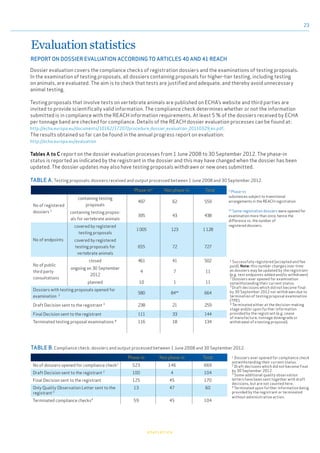
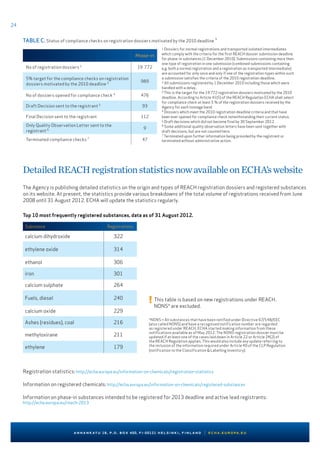
October
2012
5
3 ECHA welcomed lead
registrants back for
a second workshop
With the 2013 deadline for phase-in
chemicals fast approaching, the Second
Lead Registrants Workshop provided a
good opportunity for lead registrants to
share their experiences, information and
tips for registration.
6 Candidate List -
the way ahead
Having 136 substances on the Candidate
List of substances of very high concern
(SVHC) by the end of 2012 is the policy
target set out by the Commission in
spring 2010. This target is likely to be
achieved.
13 How can I find my
co-registrants?
To support potential and existing
registrants to better fulfil their REACH
obligations on data sharing and joint
submissions, ECHA has developed a new
functionality in REACH-IT.
16 Taking an interest in
interest management
Independence and transparency are core
values of the Agency. Every day, in all of
its activities, the Agency aims to ensure
that it is independent from all external
interests, takes science-based decisions
and that it is as transparent as possible.
Greetings from an autumnal Helsinki. As the days start to shorten and the winter
beckons, I realise that the next REACH deadline will be over by the time we experi-
ence our next wonderful 24 hour day of sunshine here in Helsinki. So the big work-
load for us, as well as for many of you, lies ahead!
With that in mind, just last week we had our second lead registrant workshop.
We welcomed around 100 participants and 200 online who are preparing for the
upcoming 2013 REACH deadline to share best practice with ECHA and with each
other about leading a SIEF, sharing data and preparing joint submissions. The event
was organised together with a number of our Accredited Stakeholder organisations
and much of the content was provided by stakeholders, particularly lead registrants
with experience from the 2010 registration deadline. Their practical input was
invaluable and we’re very grateful for their help. You can read about the workshop
on pages 3-5.
In this edition of the newsletter, we are also talking about the importance of data
sharing and introducing the new possibilities offered by the upcoming update
to REACH-IT, the Co-registrants page, which will support potential and existing
registrants in sharing data and preparing joint submissions. In addition, we highlight
the problems contained in many intermediate dossiers – where the substance is
arguably not an intermediate and therefore should not benefit from the reduced
information requirements (and costs) under REACH. We are following all of those
dossiers up as we speak.
Thebigpushtowards2013
annankatu 18, p.o. box 400, fi-00121 helsinki, finland | echa.europa.eu

2
Inthisissue:
4	 Smaller companies taking the lead
7	 ECHA finds over 2 000 potentially non-compliant dossiers
8	 Reaching the nano scale
10	 ECHA holds a scientific discussion session on in vivo mutagenicity tests
11	 The world is watching: ECHA at ICCM-3
12	 Make every effort to share data within your SIEF
18	 Airing new strategies for REACH implementation
19	 Events; Chair of the Risk Assessment Committee appointed
20	 Substitution of chemicals on the Candidate List for authorisation is already
happening
21	 Executive Director visits authorities in Romania and Bulgaria
22	 Highlights of the 27th Management Board meeting
23	 Evaluation statistics
24	 Making information on the registered chemicals publicly available
To subscribe to the ECHA news alerts
and newsletter, register at:
http://echa.europa.eu/en/news-and-
events/news-alerts
Disclaimer: The views presented in
the Newsletter do not necessarily
represent the official position of the
European Chemicals Agency. All the
links are up to date at the time of
publication.
ISSN: 1831-4953
Editor-in-chief: Lindsay Jackson
Editor: Hanna-Kaisa Torkkeli
European Chemicals Agency
Annankatu 18, P.O. Box 400,
FI-00121 Helsinki Finland
Tel. +358 9 6861 80
Fax +358 9 6861 8210
http://echa.europa.eu
echanewsletter@echa.europa.eu
“Acting on your
feedback, and in
particular, your desire
to have the Newsletter
in a more user
friendly format,
we will be going
'online'. ”
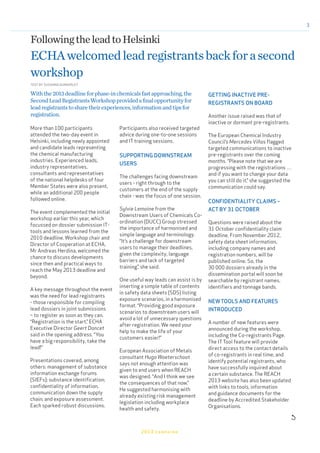
Head of Communications
Lindsay Jackson
© ECHAIn the beginning of September we took a major step towards the target
of having 136 substances of very high concern (SVHC) on the Candidate
List for authorisation by the end of 2012. As you will recall, this target
was set by Commission Vice President Tajani and Commissioner Potočnik
in 2010. We launched our biggest public consultation yet of 54 potential
SVHCs asking for your comments on the identity and properties of the
substances. Currently, there are 84 SVHCs on the Candidate List. After the
consultation, which ends on Thursday (18 October), the proposal will go to
the Member State Committee for agreement. You can learn more about
the next steps on page 6.
Finally, we are hoping that you will have an extra little “gift” in our Decem-
ber Newsletter. Acting on your feedback, and in particular, your desire
to have the Newsletter in a more user friendly format, we will be going
'online'.
We hope that the new format will help you find and share the stories that
are relevant to you and your colleagues more easily. We’re always on the
lookout for ways to make the Newsletter more valuable for you, so please
let us know what you would like to see covered in the coming issues, what
has been good, and what we can improve. Get in touch with Hanna and me
at echanewsletter@echa.europa.eu.
3
More than 100 participants
attended the two-day event in
Helsinki, including newly appointed
and candidate leads representing
the chemical manufacturing
industries. Experienced leads,
industry representatives,
consultants and representatives
of the national helpdesks of four
Member States were also present,
while an additional 200 people
followed online.
The event complemented the initial
workshop earlier this year, which
focussed on dossier submission IT-
tools and lessons learned from the
2010 deadline. Workshop chair and
Director of Cooperation at ECHA,
Mr Andreas Herdina, welcomed the
chance to discuss developments
since then and practical ways to
reach the May 2013 deadline and
beyond.
A key message throughout the event
was the need for lead registrants
- those responsible for compiling
lead dossiers in joint submissions
– to register as soon as they can.
“Registration is the start,” ECHA
Executive Director Geert Dancet
said in the opening address. “You
have a big responsibility, take the
lead!”
Presentations covered, among
others: management of substance
information exchange forums
(SIEFs); substance identification;
confidentiality of information,
communication down the supply
chain; and exposure assessment.
Each sparked robust discussions.
FollowingtheleadtoHelsinki
ECHAwelcomedleadregistrantsbackforasecond
workshop
Participants also received targeted
advice during one-to-one sessions
and IT training sessions.
SUPPORTING DOWNSTREAM
USERS
The challenges facing downstream
users - right through to the
customers at the end of the supply
chain - was the focus of one session.
Sylvie Lemoine from the
Downstream Users of Chemicals Co-
ordination (DUCC) Group stressed
the importance of harmonised and
simple language and terminology.
“It’s a challenge for downstream
users to manage their deadlines,
given the complexity, language
barriers and lack of targeted
training”, she said.
One useful way leads can assist is by
inserting a simple table of contents
in safety data sheets (SDS) listing
exposure scenarios, in a harmonised
format. “Providing good exposure
scenarios to downstream users will
avoid a lot of unnecessary questions
after registration. We need your
help to make the life of your
customers easier!”
European Association of Metals
consultant Hugo Waeterschoot
says not enough attention was
given to end users when REACH
was designed. “And I think we see
the consequences of that now.”
He suggested harmonising with
already existing risk management
legislation including workplace
health and safety.
2013 campaign
Withthe2013deadlineforphase-inchemicalsfastapproaching,the
SecondLeadRegistrantsWorkshopprovidedafinalopportunityfor
leadregistrantstosharetheirexperiences,informationandtipsfor
registration.
TEXT BY SUSANNA DUNKERLEY
GETTING INACTIVE PRE-
REGISTRANTS ON BOARD
Another issue raised was that of
inactive or dormant pre-registrants.
The European Chemical Industry
Council’s Mercedes Viñas flagged
targeted communications to inactive
pre-registrants over the coming
months. “Please note that we are
progressing with the registrations …
and if you want to change your data
you can still do it,” she suggested the
communication could say.
CONFIDENTIALITY CLAIMS –
ACT BY 31 OCTOBER
Questions were raised about the
31 October confidentiality claim
deadline. From November 2012,
safety data sheet information,
including company names and
registration numbers, will be
published online. So, the
30 000 dossiers already in the
dissemination portal will soon be
searchable by registrant names,
identifiers and tonnage bands.
NEWTOOLS AND FEATURES
INTRODUCED
A number of new features were
announced during the workshop,
including the Co-registrants Page.
The ITTool feature will provide
direct access to the contact details
of co-registrants in real time, and
identify potential registrants, who
have successfully inquired about
a certain substance. The REACH
2013 website has also been updated
with links to tools, information
and guidance documents for the
deadline by Accredited Stakeholder
Organisations.

4
Adding colour, Dr Rene Hunziker
from the Dow Chemical Company,
told a tale of crossing the ‘roaming
river REACH’ to the new frontier.
“Imagine there are no maps, no-one
has ever gone there. Many have told
stories of … an agency somewhere
far off in the north.”
“Everybody knew they had to cross
the river REACH … and the promise,
if you succeed, was a land of safe
chemicals, a public with confidence
in the chemical industry and its
products.”
“This land exists, it’s not a dream.”
2013 campaign
HIGH QUALITY DATA AND
REGULAR EVALUATION NEEDED
TO ENSURE SAFE USE OF
CHEMICALS
ECHA experts spoke about the
need to provide quality data in
dossiers and gave practical advice
on updating them.
Registrants were reminded that the
May 2013 deadline for chemicals
at or above 100 tonnes a year
was not the finish line. ECHA
Scientific officer Rupert Simon
described registration as a long-
term commitment. “Leads should
evaluate and update dossiers
ideally every six months and take
note of emails and information
requests from ECHA”, he added.
“The earlier you react the earlier we
can help you, and we are dedicated
to do so.”
Mr Waeterschoot concurred,
sharing his experience of
registrants missing the 2010
deadlines because they did not
check their mailbox. “Act for the
deadline, it may look like a Swiss
watch but I can tell you the Finnish
watch is just as precise in timing.”
The presentations and a video
recording of the event are available
on ECHA’s website:
http://echa.europa.eu/en/view-article/-/
journal_content/2b6c9ef3-b8c8-4ee1-
a15d-bee72a3b47ea
INTERVIEWS BY VIRGINIA MERCOURI & HANNA-KAISA TORKKELI
Smallercompaniestakingthelead
Mariano Alessio Verni from SILC
Fertilizzanti Srl, is the co-ordinator
of the Potassium Phosphites
Consortium. His company has
experience as a member registrant
from the 2010 deadline and recently
stepped in to become a lead
registrant for 2013. He is quick to
point out that there is a substantial
change in communication within
the SIEFs from two years ago. “It is
not like in 2010 registration, when
we had a couple of big companies
with enough people to work on
REACH inside the company itself.
Smaller companies usually have
to outsource this work. It is not
profitable to train people internally
if you have to register only a couple
of substances.” He explains that
usually the lead registrants call
on an external consultant and the
companies that are members also
call on consultants. “The dialogue is
between the consultants themselves
and not between companies, so it is
AttheLeadRegistrantsWorkshop,ECHANewsletterinterviewedfewof
theparticipantsontheirexperiencewithREACHregistration,managing
substanceinformationexchangeforums(SIEFs)andthechallengesfor
smallercompaniesofbeingaleadregistrant.
an indirect communication. Moreover,
different consultants have different
approaches on how to make the gap
analysis. This makes it very hard to
manage the consortium.“
To address this challenge, Mariano
Alessio Verni considers that the lead
registrant’s company or a core group
of companies should have sufficient
expertise to guide the consultants. “I
have enough expertise in the sector, so
I can help our consultant not only with
the chemical issues, but also with the
technical, marketing and commercial
issues.” He is convinced that good
knowledge of the market is also
important. “I already know other SIEF
members from my past commercial
 As of September 2012, ECHA has received 1 949 self-nominations
as lead registrants for the 2013 deadline. They are published on
the ECHA website. These nominations came from 568 legal
entities. More than a quarter of these lead registrants have no
previous experience of being a lead registrant.
 A total of 2 607 lead registrant nominations are listed, including
those intending to register for the 2018 deadline.
 ECHA has received an authorisation from 425 lead registrants to
disclose their names. That is 16% of total nominations.
 Intentions to register for 2013 deadline: 2 968 substances, and of
these 75% already have leads.
5
2013 campaign
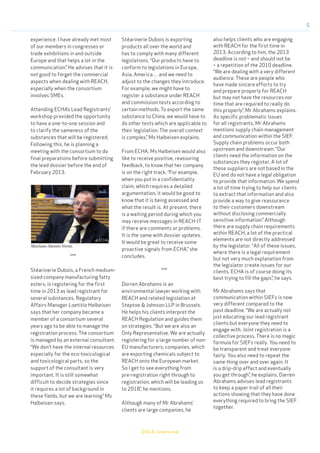
Mariano Alessio Verni.
© ECHA
experience. I have already met most
of our members in congresses or
trade exhibitions in and outside
Europe and that helps a lot in the
communication.” He advises that it is
not good to forget the commercial
aspects when dealing with REACH,
especially when the consortium
involves SMEs.
Attending ECHA’s Lead Registrants’
workshop provided the opportunity
to have a one-to-one session and
to clarify the sameness of the
substances that will be registered.
Following this, he is planning a
meeting with the consortium to do
final preparations before submitting
the lead dossier before the end of
February 2013.
***
Stéarinerie Dubois, a French medium-
sized company manufacturing fatty
esters, is registering for the first
time in 2013 as lead registrant for
several substances. Regulatory
Affairs Manager Laetitia Halbeisen
says that her company became a
member of a consortium several
years ago to be able to manage the
registration process. The consortium
is managed by an external consultant.
“We don’t have the internal resources
especially for the eco-toxicological
and toxicological parts, so the
support of the consultant is very
important. It is still somewhat
difficult to decide strategies since
it requires a lot of background in
these fields, but we are learning” Ms
Halbeisen says.
Stéarinerie Dubois is exporting
products all over the world and
has to comply with many different
legislations. “Our products have to
conform to legislations in Europe,
Asia, America… and we need to
adjust to the changes they introduce.
For example, we might have to
register a substance under REACH
and commission tests according to
certain methods. To export the same
substance to China, we would have to
do other tests which are applicable to
their legislation. The overall context
is complex,” Ms Halbeisen explains.
From ECHA, Ms Halbeisen would also
like to receive positive, reassuring
feedback, to know that her company
is on the right track. “For example,
when you put in a confidentiality
claim, which requires a detailed
argumentation, it would be good to
know that it is being assessed and
what the result is. At present, there
is a waiting period during which you
may receive messages in REACH-IT
if there are comments or problems.
It is the same with dossier updates.
It would be great to receive some
proactive signals from ECHA,” she
concludes.
***
Darren Abrahams is an
environmental lawyer working with
REACH and related legislation at
Steptoe & Johnson LLP in Brussels.
He helps his clients interpret the
REACH Regulation and guides them
on strategies. “But we are also an
Only Representative. We are actually
registering for a large number of non-
EU manufacturers; companies, which
are exporting chemicals subject to
REACH onto the European market.
So I get to see everything from
pre-registration right through to
registration, which will be leading us
to 2018”, he mentions.
Although many of Mr Abrahams’
clients are large companies, he
also helps clients who are engaging
with REACH for the first time in
2013. According to him, the 2013
deadline is not – and should not be
– a repetition of the 2010 deadline.
“We are dealing with a very different
audience. These are people who
have made sincere efforts to try
and prepare properly for REACH
but may not have the resources nor
time that are required to really do
this properly”, Mr Abrahams explains.
As specific problematic issues
for all registrants, Mr Abrahams
mentions supply chain management
and communication within the SIEF.
Supply chain problems occur both
upstream and downstream. “Our
clients need the information on the
substances they register. A lot of
these suppliers are not based in the
EU and do not have a legal obligation
to provide that information. We spend
a lot of time trying to help our clients
to extract that information and also
provide a way to give reassurance
to their customers downstream
without disclosing commercially
sensitive information.” Although
there are supply chain requirements
within REACH, a lot of the practical
elements are not directly addressed
by the legislator. “All of these issues,
where there is a legal requirement
but not very much explanation from
the legislator create issues for our
clients. ECHA is of course doing its
best trying to fill the gaps”, he says.
Mr Abrahams says that
communication within SIEFs is now
very different compared to the
past deadline. “We are actually not
just educating our lead registrant
clients but everyone they need to
engage with. Joint registration is a
collective process. There is no magic
formula for SIEFs really. You need to
be transparent and treat everyone
fairly. You also need to repeat the
same thing over and over again. It
is a drip-drip effect and eventually
you get through”, he explains. Darren
Abrahams advises lead registrants
to keep a paper trail of all their
actions showing that they have done
everything required to bring the SIEF
together.
6
2013 campaign
Having136substancesontheCandidateListofsubstancesofveryhigh
concern(SVHC)bytheendof2012isthepolicytargetsetoutbythe
Commissioninspring2010.Thistargetislikelytobeachieved.The
focushasnowshiftedtohowtousetheREACHandCLPinformationto
identifynewsubstancesanduseswhichwouldrequireregulatoryrisk
managementactionsandhowtochoosethebestapproachtotacklethe
concernsineachcase.
CandidateList–thewayahead
TEXT BY ELINA KARHU
The eighth round of SVHC identi-
fication is currently under work.
Out of the 17 proposals submitted
by the Member States, five are
based on PBT/vPvB* properties and
six on equivalent level of concern
considerations: three on endocrine
disruption properties and three
substances classified as res-
piratory sensitisers. In addition to
these Member State proposals, in
August the European Commission
requested ECHA to prepare SVHC
dossiers for 37 CMR** (Cat 1A/B)
substances.
With this request, the Commission
aimed to achieve the policy target
set out by Vice President Tajani and
Commissioner Potočnik in spring
2010 to have 136 substances on
the Candidate List by the end of
this year. The Commission has
started further discussion with the
Member States and ECHA on how
to reach the policy target of get-
ting all relevant SVHC substances
identified by 2020.
REACH places the primary re-
sponsibility for ensuring the safe
use of chemicals on industry:
manufacturers, importers and
downstream users of substances.
Regulatory interventions can be
seen as complementary measures
where the actions taken by indus-
try are for one or more reasons
insufficient. The main focus of the
further developments and discus-
sions is how to make the best use
of the REACH and CLP information
and of the regulatory risk manage-
ment tools that REACH provides.
In other words, how to guarantee
that the concerns are identified as
early as possible and addressed by
a set of tools which ensure efficient,
timely and proportionate regulatory
actions.
Registration and classification
and labelling notification require-
ments have and will continue to
bring in new information. However,
in order to have sufficient basis to
address concerns related to new
types of substances, which are not
yet regulated for instance due to
their recognised CMR properties,
often requires further information.
Substance evaluation starts to take
its role in filling the data gaps where
necessary to support regulatory risk
management.
Furthermore, ECHA has established
a PBT expert group bringing togeth-
er experts from Member States,
industry, NGOs and ECHA to support
the work of identifying information
needs and assessing the informa-
tion related to potential PBT and
vPvB substances. Shifting the focus
on new substances and concerns
provides a possibility to achieve a
real difference in human health and
environmental protection but also
requires considerable work and
resources both from industry and
authorities.
The Candidate List and the other
parts of the authorisation process
are new regulatory tools. While
restrictions are not new – the first
ones were adopted in 1976 – REACH
provides a better information basis
and a well structured and transpar-
ent framework to establish new
restrictions. The challenge of the
coming years is to ensure that these
tools are implemented in an ef-
fective and proportionate manner
as part of the wider Union regula-
tory framework for managing risks
related to chemicals.
Candidate List table:
http://echa.europa.eu/candidate-list-table
* PBT - persistent, bioaccumulative and
toxic chemicals
vPvB - very persistent and very bioaccumulative
** CMR - carcinogenic, mutagenic or toxic
to reproduction
CANDIDATE LIST
The identification of a substance as substance of very high concern and its
inclusion in the Candidate List is the first step of the authorisation procedure.
Companies may have immediate legal obligations following such inclusion which
are linked to the listed substance on its own, in preparations and articles.
Further documentation or more detailed information on the identification
process of substances of very high concern can be found on the web pages of
ECHA's Member State Committee.
7
Registrants affected by the findings
have received a letter via REACH-
IT asking them to carefully review
the reported uses and update their
registration dossiers. In the letter,
the Agency also offers practical
advice for registrants on how
to better report intermediates
in IUCLID 5.4 or how to update
the registration to a full (Article
10) Registration. “We hope that
the support and information in
our letters will provide enough
information for the registrants
to update their dossiers either
by providing correct information
to register their substance as an
intermediate under Articles 17 and
18, or by doing a full registration
by submitting information as
specified in Article 10 of REACH,” Mr
Rasenberg states.
FOLLOW-UP ACTIONS WILL ALSO
COVER UPDATED DOSSIERS
So far, ECHA has received 84
updates for the intermediate
dossiers included in the recent
screening. In addition, several
industry associations have contacted
ECHA for additional support for
updating dossiers, or for advice on
how to integrate the information
from the ECHA letters in the overall
approach to update intermediate
TheIT-basedscreeningofall
REACHintermediatedossiers
conductedbytheAgencyhas
raisedseriousqualityandpotential
complianceconcerns.Asaresult
ofthescreening,ECHAidentified
2388potentiallynon-compliant
dossiersfrom574registrants,
representing760substances
registeredwithintermediateuse.
The concerned registrants have
been directly informed about the
findings for their dossier(s) along
with information on how to update
their dossiers via REACH-IT. They are
requested to review and update their
dossiers with correct information
by the end of the year. ECHA intends
to screen these dossiers again and
identify those that require further
regulatory action.
“We have already reported on the
previous screening exercise done
in 2010 and 2011, which raised
concerns in terms of compliance. This
new approach identifies additional
substances through our IT-screening
tools and focuses on inconsistencies
in the information on uses provided
in the dossier with regard to the
intermediate status or strictly
controlled conditions”, explains Mike
Rasenberg, ECHA’s Head of Unit for
Computational Assessment. The
Agency has excluded all substances
that have already received a
clarification request (Article 36
letter) or are about to receive
one in the near future as a result
of the initial screening. However,
the previously screened dossiers,
which had not received clarification
requests, were included in this
screening.
ITscreeningofintermediatedossiers
ECHAfindsover2000potentiallynon-compliant
dossiers
dossiers. ECHA continues to monitor
the situation. “Take care! The fact that
a company updates their dossier by
simply removing incorrect uses does
not mean that we forget about the
dossier. As we receive more updates,
we are reviewing where best to put our
efforts to be as effective as possible”,
Mr Rasenberg says.
TOWARDS A COMMON
UNDERSTANDING
The definition of intermediates and the
interpretation of strictly controlled
conditions have been popular topics
of debate. ECHA has been, and will
continue to be, in dialogue with industry
to facilitate a common understanding
of the Guidance on Intermediates and
the related legal obligations. “It is
important to us to ensure the safe use
of chemicals, including intermediates.
We are therefore taking industry
concerns for intermediates seriously
and are open to further discussions”,
Mike Rasenberg concludes.
Further information:
News alert, 14 September 2012
http://echa.europa.eu/view-article/-/
journal_content/0d1a14fe-9c63-4807-a3de-
380c0dbffdf5
news from echa
TEXT BY HANNA-KAISA TORKKELI
INTERMEDIATES IN REACH
Substances used as an intermediate are intended to be transformed into
another substance, and shall be manufactured and used under strictly controlled
conditions at chemical manufacturing sites. Due to these special circumstances,
the exposure to humans and the environment is considered to be minimised.
On that basis, REACH allows intermediates manufactured and used under
strictly controlled conditions to be registered with reduced information on their
properties and without a chemical safety report (Articles 17 and 18 of REACH).
8
The nano particles, which represent
a giant leap in modern chemistry
and which have formed a growing
multi-billion Euro industry, have
intensified the scientific and
regulatory discussions in REACH.
Wim De Coen, ECHA’s Head of Unit
for Evaluation I and the leader
of the Agency’s task force on
nanomaterials, is quick to point
out: “The scientific uncertainty
of nanos forces the regulator
to be more cautious, but it does
not mean stigmatising nanos.” He
clarifies that ECHA’s approach
responds to the recommendations
of the Scientific Committee which
advises the European Commission
on Emerging and Newly Identified
Health Risks (SCENIHR) to assess
nanoforms on a case-by-case basis.
“From an early stage, we have
not considered nanos to be
more hazardous than any other
substances.” Dr De Coen explains
that the classical principles of
toxicology (i.e. hazard assessment)
do not necessarily apply to all
types of nanomaterials because
of their tiny size and their
relatively large surface area.
Furthermore, experts involved
in the work of the Organisation
ECHAstepsupevaluationofdossierscontainingnanomaterials
Reachingthenanoscale
of Economic Cooperation and
Development (OECD) on the safety
of manufactured nanomaterials
have acknowledged that adaptation
of current test guidelines may be
necessary in some cases and that
specific guidance will have to be
developed, for example, on sample
preparation and dosimetry.
REACH AND CLP NANO BASICS
The starting point is the REACH and
CLP definitions for substances. They
are not explicit about nanomaterials,
but apply to them as to all other
forms of chemicals. This was again
confirmed by the Second Regulatory
Review of Nanomaterials, published
this month*, which states that
REACH sets the best possible
framework for the risk management
of nanomaterials when they occur as
substances or mixtures.
The next step was the recent
recommendation** of the European
Commission on the definition of
nano, which provides more clarity
in the debate between regulators
and registrants regarding the size
(in the range of 1 nm-100 nm) and
number (50 % or more as default)
of particles in a nanomaterial.
ECHA will use this definition as the
benchmark for registration and
evaluation.
From the GAARN forum, where
companies shared their experience
from the registration of nanos for
the first REACH deadline, and the
recent workshop on nanomaterials,
another important message for
current and future registrants came
forward: nanos are synthesised
by design; they do not occur by
accident. If companies make them,
they know what specific properties
they want them to have in order to
achieve their market objective. These
properties should be documented
in the registrants’ dossiers and the
information provided should be in line
with the new harmonised definition
for nanomaterials. ECHA and the
Member States are in agreement on
this approach.
DEALING WITH THE NANO
INFORMATION GAP
Following the first REACH
registration deadline in 2010, ECHA
has been screening the dossiers
containing nanos in a common project
with the European Commission’s
Joint Research Centre (JRC). Since
nanomaterials are registered
together with bulk materials, the
project team expected that many
of those substances, which exist
both in the bulk and in the nanoform,
would be reported on both types of
properties in the registration dossier.
“We have found a surprinsingly low
number of explicit claims that the
substance is used in a nanoform.
news from echa
TEXT BY VIRGINIA MERCOURI
ECHAismovingaheadwiththeevaluationofnanomaterials,following
theagreementoftheMemberStates’competentauthoritiesduringits
workshoponnanomaterialsattheendofMay.Thecommonapproach
ispragmaticandstep-wise,balancingthescientificuncertaintieswith
thelegislativeframeworkofREACH.TheAgencyisafocalpointforthe
nano-relateddiscussionsthroughtheestablishmentofananomaterials’
workinggroupandbytakingoverthecoordinationoftheGroup
AssessingAlreadyRegisteredNanomaterials(GAARN).Bothinvolvethe
Commission,nationalauthoritiesandotherstakeholders.
9
news from echa
This is the case even for substances,
which are included in the OECD list of
manufactured nanomaterials”, says
Frank Le Curieux, who is a member of
ECHA’s task force on nanomaterials
and represented the Agency in
the tenth OECD Working Party on
Manufactured Nanomaterials.
This lack of nano-specific
information prompted ECHA to act
using both the carrot and the stick.
The Agency is now implementing
a two year programme for internal
and external capacity building,
sharing experience, participation
in and contribution to international
regulatory activities.
ECHA is providing feedback and
advice to registrants on nanos and
supporting the preparations for
REACH 2013. This advice is based
on compliance checks of registration
dossiers, the results from the
ongoing JRC project and the good
practice of registrants taking part
in the GAARN initiative. ECHA has
also released new annexes to the
Guidance on Registration specific for
nanomaterials.
Regulatory actions are also now
under way. ECHA has sent draft
decisions requesting nano-specific
information from registrants
of dossiers in which nano
properties were not sufficiently
documented (under Art. 41 of
REACH). Registrants who may be
manufacturers of nanos, but did
not indicate this in their dossiers,
have received letters under Article
36 of the REACH Regulation, which
imposes on registrants the duty
to gather and provide on request
‘all the information the registrant
requires to carry out his duties under
this Regulation’. “These Article 36
letters by no means request the
generation of new information,” Wim
De Coen points out. “This is their
main difference with the draft
decisions. An Article 36 decision
is asking a company to submit to
ECHA already available information
regarding a specific property, in
this case particle characteristics;
because we have reason to believe
that the company may already have
such information. Of course, this
is legally binding and registrants
need to reply. Not replying means
enforcement actions”, Dr De Coen
stresses and advises registrants to
update their dossiers.
To support industry in providing
complete information, ECHA has
developed a questionnaire. “The
more information you give already,
the more unlikely you are to receive
a draft decision” , Wim De Coen
highlights and insists that ECHA has
a pragmatic approach. “Currently,
we are looking for a constructive
and proactive response from
registrants to provide us with
information on their nanomaterial
properties. This is also a wake-up
call for future registrants: it is
necessary to include nano-specific
information in the dossiers.”
STEPPING UP NANOMATERIALS’
SAFETY
Both the draft decisions and
the Article 36 letters request
registrants to characterise their
nanomaterials. “Our aim is to
provide clarity primarily on the
particle characteristics. This is
the first step. What we want at
this stage is for companies not
to go away and say they cannot
characterise their material. Yes,
this is scientifically challenging,
but we know from the discussions
with registrants that it is possible”,
says Dr De Coen. For example, the
manufacturers will tend to know
which properties they need: size,
form, surface, volume, surface
treatment. This is exactly the type
of information that ECHA requires.
“Currently, we are not instructing
registrants which method to use.
There are many methods available
and we let them decide which ones
are the most suitable to describe
the characteristics of their specific
nanoforms. Our aim is to develop
a matrix approach, so that all
registrants who wish to cover
nanomaterials in their registration
should be able to document it with
the best available methods”, says Dr
De Coen. One of the most important
messages from the last GAARN
meeting was the ‘can do’ approach.
“Documenting the characteristics
of your particles is just a start. If
the registrants do not do it, we will
not achieve any breakthrough in the
nano discussion.”
Focusing on the physico-chemical
properties is the first step in
ECHA’s strategy and one of the
main outcomes from the workshop
with the Member States. This
will be the approach to follow
through evaluation. “First we
want to clean up the landscape”,
says Dr De Coen, continuing “Let’s
resolve in the first place the
uncertainty about the particulate
aspects such as size, shape and
surface treatment. Then we can
go further towards addressing the
potential hazards. The hazards
will be largely driven by the
physico-chemical characterisation,
so it will only be possible to do
this gradually.” By knowing the
properties of the substances and
their characteristics better, it
will be easier for registrants to
find the best approach to start
testing and address the potential
hazards strategically, from a risk
perspective.
In parallel with the work done by the
10
news from echa
ECHAholdsascientificdiscussionsessionon
invivomutagenicitytests
There have been discussions on
which test to use, partly triggered
by the recent adoption of a new
OECD test guideline, the Transgenic
Rodent Gene Mutation (TGR) Assay,
which is an alternative to the long-
er-established Unscheduled DNA
Synthesis (UDS) Assay. In order
to clarify the scientific considera-
tions in selecting an appropriate in
vivo somatic cell mutagenicity test,
ECHA held a Technical Discussion
Session on 4 October 2012.
Forty-four experts from sixteen
Member States or Associated
Member State Competent Authori-
ties, the European Commission, the
ECHAevaluatesinformationonmutagenicityindossiers,bothfor
compliancechecksandtestingproposalexaminations.Ahigher-tier
studymaybenecessarytoexaminethepotentialforsomaticcellmuta-
genicityinvivo.
TEXT BY INGO BICHLMAIER
European Medicines Agency, the Eu-
ropean Food Safety Authority, indus-
try, consultants, contract research
organisations and non-governmental
organisations visited ECHA for this
one-day session.
Experts provided detailed accounts
on the science, limitations and prac-
ticalities of the two tests. Scientific
comparisons and an in-depth analysis
of concordance with carcinogenicity
of the two assays were presented.
The industry experience and per-
registrants, ECHA is setting up a
working group on nanomaterials to
informally provide scientific advice
on any aspects of nanomaterials
under REACH and CLP. Frank Le
Curieux and Ofelia Bercaru, who
are in charge of gathering the
nominations and preparing the
first meeting of the group, stress
that the activities of the working
group should not interfere with
ECHA’s decision-making. On the
contrary, it aims to facilitate
ECHA’s functioning by bringing
in scientific expertise that can
clarify nano-issues at the Member
State Committee level. “With the
increased knowledge, it should be
possible in the future to identify
and test the nanoforms that are
relevant for the safe use of a given
chemical”, says Wim De Coen. “We
aim at setting up, collectively
with the Commission, Member
States and stakeholders, a level
playing field for manufacturers
of nanomaterials. Where needed,
dossier and substance evaluation
are crucial for getting this job
done. If we can achieve this, we will
improve European competitiveness
and innovation, as well as safeguard
DID YOU KNOW?
The revised EU Biocides Regulation has already taken on board
the nanoscale. It contains explicit requirements for the labelling
of biocidal products for non-agricultural uses, by indicating the
material and using the word “nano”. The text refers to the EC
definition of nanomaterials and asks for a separate evaluation of
the risks deriving from them.
chemical safety to protect human
health and the environment.”
ECHA is starting a series of webinars
on nanomaterials. The first one will
take place on 30 October.
The Agency now has a dedicated
section for nanomaterials on its
website:
http://echa.europa.eu/chemicals-in-our-
life/nanomaterials
Best practice on physicochemical
and substance identity information
for nanomaterials - Report from first
GAARN meeting
http://echa.europa.eu/
documents/10162/5399565/best_
practices_physiochem_subst_id_nano_en.pdf
Workshop on Nanomaterials Proceedings
http://echa.europa.eu/view-article/-/
journal_content/c299bea5-ccd1-495b-ba2b-
c596fd8c0bed
ECHA Guidance on Information
Requirements and Chemical Safety
Assessment - recommendations for
nanomaterials
http://echa.europa.eu/guidance-documents/
guidance-on-information-requirements-and-
chemical-safety-assessment
*Communication on the Second Regulatory Review of
Nanomaterials (COM(2012) 572 final)
http://eur-lex.europa.eu/LexUriServ/LexUriServ.
do?uri=COM:2012:0572:FIN:EN:PDF
**Commission Recommendation of 18 October 2011 on
the definition of nanomaterial (2011/696/EU)
http://eur-lex.europa.eu/LexUriServ/LexUriServ.
do?uri=OJ:L:2011:275:0038:0040:EN:PDF
11
news from echa
spective on the two tests was pre-
sented by one of ECHA's accredited
stakeholder organisations, ECETOC.
ECHA's sister agencies, the European
Medicines Agency and the European
Food Safety Authority presented
their views on the two tests as well
as case studies demonstrating their
scientific applicability.
The presentations were followed by
a discussion which focused on the
question of whether each assay is
adequate to detect substances that
cause gene mutations in vivo and
if there were specific conditions
which modified the applicability
of the assay. Furthermore, it was
discussed whether certain condi-
tions could be defined under which
either one of the two tests, the TGR
or the UDS assay, should preferably
be performed.
The event focussing exclusively
on science is the first ‘Technical
Discussion Session’ organised by
ECHA. The meeting was welcomed
by participants. It was in particular
acknowledged that the discussion
session involving experts from
different backgrounds, including
regulatory bodies, to share their
expertise and views was a success-
ful concept.
ECHA will publish a summary report
of the Technical Discussion Session
on its website.
ECHA had an information stand
- "European Chemicals Agency
Working for the safe use of
chemicals" - and organised a side-
event - "European Union Progress
towards the World Summit on
Sustainable Development 2020
Goals for Chemicals" - together
with the European Commission at
the third session of International
Conference on Chemicals
Management (ICCM-3).
The objectives were to inform the
conference participants about
the current status of REACH and
CLP implementation and how
the European Union is achieving
its objectives towards the World
Theworldiswatching
ECHAatICCM-3
TEXT BY PETTERI MÄKELÄ
DelegatesparticipatinginthetriennialglobalchemicalsmanagementconferenceinNairobiinmid-
SeptembertookakeeninterestinthenewEUchemicalslegislationandECHA. Theyaskedquestionsabout
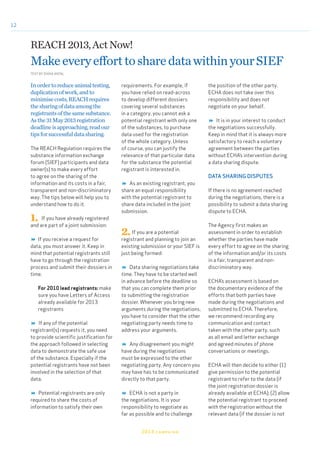
thecurrentstatusofREACHandCLPimplementationandconsideredoursimpleCLPgameasanexcellent
toolinteachingtheGHSclassificationandlabellingpictograms.
Summit of Sustainable Development
2020 Chemical Goals.
The conference at the United Nations
Centre in Nairobi was attended by over
400 delegates. Around 280 people
from 55 countries visited the ECHA
stand and approximately 50 attended
the side-event.
The ICCM-3 documents can be
accessed through the SAICM website:
http://www.saicm.org/index.php?option=com_
content&view=article&id=96&Itemid=485
The CLP game attracted visitors to the
stand.
© ECHA
12
Inordertoreduceanimaltesting,
duplicationofwork,andto
minimisecosts,REACHrequires
thesharingofdataamongthe
registrantsofthesamesubstance.
Asthe31May2013registration
deadlineisapproaching,readour
tipsforsuccessfuldatasharing.
The REACH Regulation requires the
substance information exchange
forum (SIEF) participants and data
owner(s) to make every effort
to agree on the sharing of the
information and its costs in a fair,
transparent and non-discriminatory
way. The tips below will help you to
understand how to do it.
1. If you have already registered
and are part of a joint submission:
 If you receive a request for
data, you must answer it. Keep in
mind that potential registrants still
have to go through the registration
process and submit their dossiers in
time.
For 2010 lead registrants: make
sure you have Letters of Access
already available for 2013
registrants
 If any of the potential
registrant(s) requests it, you need
to provide scientific justification for
the approach followed in selecting
data to demonstrate the safe use
of the substance. Especially if the
potential registrants have not been
involved in the selection of that
data.
 Potential registrants are only
required to share the costs of
information to satisfy their own
requirements. For example, if
you have relied on read-across
to develop different dossiers
covering several substances
in a category, you cannot ask a
potential registrant with only one
of the substances, to purchase
data used for the registration
of the whole category. Unless
of course, you can justify the
relevance of that particular data
for the substance the potential
registrant is interested in.
 As an existing registrant, you
share an equal responsibility
with the potential registrant to
share data included in the joint
submission.
2.If you are a potential
registrant and planning to join an
existing submission or your SIEF is
just being formed:
 Data sharing negotiations take
time. They have to be started well
in advance before the deadline so
that you can complete them prior
to submitting the registration
dossier. Whenever you bring new
arguments during the negotiations,
you have to consider that the other
negotiating party needs time to
address your arguments.
 Any disagreement you might
have during the negotiations
must be expressed to the other
negotiating party. Any concern you
may have has to be communicated
directly to that party.
 ECHA is not a party in
the negotiations. It is your
responsibility to negotiate as
far as possible and to challenge
the position of the other party.
ECHA does not take over this
responsibility and does not
negotiate on your behalf.
 It is in your interest to conduct
the negotiations successfully.
Keep in mind that it is always more
satisfactory to reach a voluntary
agreement between the parties
without ECHA’s intervention during
a data sharing dispute.
DATA SHARING DISPUTES
If there is no agreement reached
during the negotiations, there is a
possibility to submit a data sharing
dispute to ECHA.
The Agency first makes an
assessment in order to establish
whether the parties have made
every effort to agree on the sharing
of the information and/or its costs
in a fair, transparent and non-
discriminatory way.
ECHA’s assessment is based on
the documentary evidence of the
efforts that both parties have
made during the negotiations and
submitted to ECHA. Therefore,
we recommend recording any
communication and contact
taken with the other party, such
as all email and letter exchange
and agreed minutes of phone
conversations or meetings.
ECHA will then decide to either (1)
give permission to the potential
registrant to refer to the data (if
the joint registration dossier is
already available at ECHA); (2) allow
the potential registrant to proceed
with the registration without the
relevant data (if the dossier is not
REACH2013,ActNow!
MakeeveryefforttosharedatawithinyourSIEF
TEXT BY DIANA ANTAL
2013 campaign
13
2013 campaign

yet available at ECHA); or (3) ask the
potential registrant to continue with
the negotiations.
Keep in mind that disagreements
on the sharing of the costs and
information are covered by Article
30(3) of the REACH Regulation.
This article only refers to “any study
which involves testing on vertebrate
animals”. Consequently, if you submit
a data sharing dispute and receive
a positive decision from ECHA (i.e.
permission to refer to the requested
endpoints), this permission will only
refer to the vertebrate animal data.
You will have to generate or obtain
non-vertebrate animal data from
another source.
Finally, bear in mind that if you
submit a data sharing dispute, you
have to obtain the ECHA decision
before submitting your registration
dossier.
In any case, we advise you to keep
on negotiating while the procedure
is handled by ECHA and inform
ECHA if an agreement is reached.
FURTHER INFORMATION
Web page on Data sharing, with links
to supporting material
http://echa.europa.eu/regulations/reach/
substance-registration/data-sharing
•	 Guidance on data sharing
•	 Questions and Answers on Data
sharing and related disputes
•	 SIEF Formation and Data
Sharing fact sheet
•	 Webform to indicate failure to
reach an agreement according
to article 30 (3)
Webinars on data sharing
http://echa.europa.eu/support/training-
material/webinars
•	 Webinar to Lead Registrants on
data sharing obligations and
data sharing disputes on 17
January 2012
•	 Webinar to Member Registrants on
the importance of proper substance
identification, data sharing and
related disputes on 27 March 2012
Newsletters
http://echa.europa.eu/news-and-events/
newsletters
•	 Newsletter of December 2011: Get
your data sharing activities ready
and be aware of your rights and
obligations
•	 Newsletter of April 2012: Best
practice in data sharing
Presentation during the Lead registrant
workshop (2-3 February 2012, Helsinki)
http://echa.europa.eu/view-article/-/
journal_content/b5961cb7-ee61-4c40-9a14-
9068f23f28f9
REACH2013,ActNow!
HowcanIfindmyco-registrants?
Tosupportpotentialandexisting
registrantstobetterfulfiltheir
REACHobligationsondatashar-
ingandjointsubmissions,ECHA
hasdevelopedanewfunctionality
inREACH-IT.
Multiple registrants of the same
substance share two main obliga-
tions under the REACH regulation:
data sharing and joint submission.
While the Regulation provides a
framework for interaction between
registrants, it does not recommend
any particular means of coopera-
tion.
At the end of November 2012,
ECHA will release an update of
REACH-IT, which will help.
WHO CAN BENEFIT FROM THIS
NEW FUNCTIONALITY?
ECHA will put in contact companies
that either received a valid registra-
tion number or an inquiry number.
Consequently potential registrants
that did not successfully inquire or
previous notifiers under the Directive
67/548/EEC that did not claim their
registration number to ECHA will not
benefit from this new functionality.
DIRECT ACCESS TO THE
CONTACT DETAILS OF YOUR
CO-REGISTRANTS
The new functionality will enable
companies to access the contact
details of existing registrants within
REACH-IT. A new page, the Co-
registrants page, will provide access
to the identity and contact details
of other existing registrants (or of
their Third Party Representative, or
TPR) for substances with the same
numerical identifier. So, registrants
can see who else has registered their
substance and therefore shares
obligations under REACH.
ROLES IN JOINT SUBMISSION
VISIBLE
The role of the registrants within the
joint submission will also be visible.
To support companies to further
improve their compliance with the
TEXT BY LAURENCE HOFFSTADT
14
2013 campaign
joint submission obligation, the Co-
registrants page will display which
legal entity is the lead registrant or
a member of a joint submission. In
addition, legal entities which have
submitted within different joint
submissions or even outside of any
joint submission will be visible to the
other registrants.
MAKE SURE YOU ARE PART OF A
JOINT SUBMISSION!
ECHA urges all registrants to use
this new functionality to ensure
compliance with their obligations.
For example, a registrant that has
submitted their registration out-
side an existing joint submission is
required to contact the lead regis-
trant. Both parties share a common
responsibility to make every effort
to ensure that they are part of the
same joint registration dossier.
ENSURE YOUR CONTACT
DETAILS ARE CORRECT AND CAN
BE DISPLAYED
The identity of the nominated
TPR of (potential) registrants will
be automatically extracted from
section 1.1 of the IUCLID dossier.
ECHA strongly recommends that
existing registrants and potential
registrants that made successful
inquiries check the consistency of
the information they have submit-
ted in their dossiers (registrations,
inquiries etc.) to avoid their own
company information from being
unexpectedly disclosed. In the
specific case of notifications under
Directive 67/548/EEC (NONS),
whether claimed under REACH or
not, ECHA advises the owner to
assess whether their identity needs
to be protected.
Companies who want to amend
their dossier(s), for example to
introduce updated TPR contact de-
tails or join or merge existing joint
submissions, will need to update
their registration dossier before
the end of November 2012.
INQUIRY PROCESS
STREAMLINED
The next REACH-IT release will also
enhance the inquiry process. The
main requirements to prepare and
submit inquiry dossiers will not be
affected. However, registrants will
be asked to specify their registra-
tion intentions, with regards to the
expected registration date. Once
ECHA has identified the substance
and processed the inquiry to an
end, the Co-registrants page will
then provide direct access to the
identity and contact details of the
potential and previous registrants,
so that inquirers are put imme-
diately in touch with their fellow
registrants.
Successful inquirers will access the
same information related to other po-
tential and existing registrants. Hav-
ing said that, any potential difference
in company details between inquiry
and registration dossiers will become
automatically visible to all co-regis-
trants and potential registrants.
So the important benefit for the
inquirers is to get up-to-date and real
time information using REACH-IT.
This is a major improvement to the
existing procedure where ECHA sends
the contact details in a paper format,
reflecting the status at the sending
time. ECHA will continue to improve
its technical completeness check
plug-in tool (TCC), so that potential
registrants can increase the overall
quality of the dossiers they submit
and increase the success rate of their
submissions. These enhancements
are expected to shorten the time for
succesful inquirers to get the infor-
mation necessary to register.
VISIBILITY OF ENDPOINTS' DATA
The REACH-IT Co-registrants page
will display the endpoints’ data
requested as part of an inquiry or a
request for further information about
a substance. This aims to facilitate
data sharing between potential and
existing registrants.
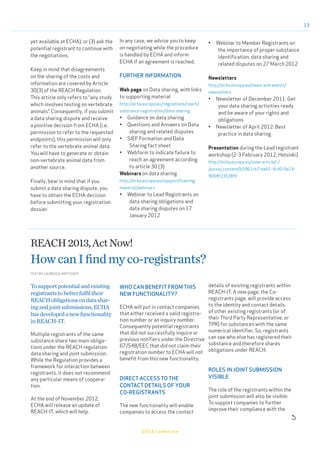
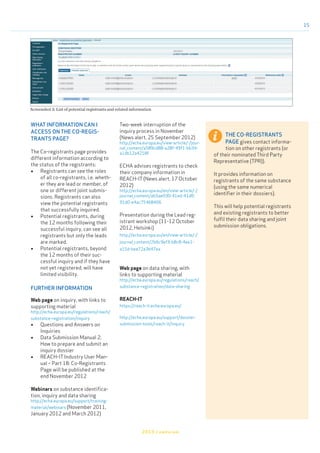
Screenshot 1: List of existing registrants and related information.
15
2013 campaign
WHAT INFORMATION CAN I
ACCESS ON THE CO-REGIS-
TRANTS PAGE?
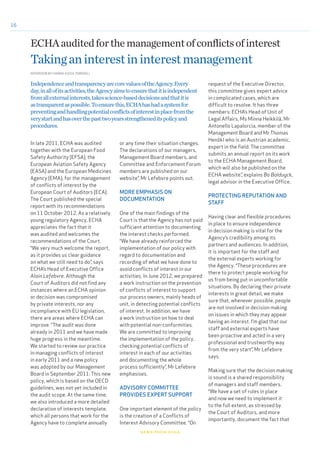
The Co-registrants page provides
different information according to
the status of the registrants:
•	 Registrants can see the roles
of all co-registrants, i.e. wheth-
er they are lead or member, of
one or different joint submis-
sions. Registrants can also
view the potential registrants
that successfully inquired.
•	 Potential registrants, during
the 12 months following their
successful inquiry, can see all
registrants but only the leads
are marked.
•	 Potential registrants, beyond
the 12 months of their suc-
cessful inquiry and if they have
not yet registered, will have
limited visibility.
FURTHER INFORMATION
Web page on inquiry, with links to
supporting material
http://echa.europa.eu/regulations/reach/
substance-registration/inquiry
•	 Questions and Answers on
Inquiries
•	 Data Submission Manual 2:
How to prepare and submit an
inquiry dossier
•	 REACH-IT Industry User Man-
ual – Part 18: Co-Registrants
Page will be published at the
end November 2012
Webinars on substance identifica-
tion, inquiry and data sharing
http://echa.europa.eu/support/training-
material/webinars (November 2011,
January 2012 and March 2012)
Two-week interruption of the
inquiry process in November
(News alert, 25 September 2012)
http://echa.europa.eu/view-article/-/jour-
nal_content/a589cd88-a28f-49f1-bb34-
a1db12a4218f
ECHA advises registrants to check
their company information in
REACH-IT (News alert, 17 October
2012)
http://echa.europa.eu/en/view-article/-/
journal_content/ab5ae030-41ed-41d0-
91d0-e4ac75468406
Presentation during the Lead reg-
istrant workshop (11-12 October
2012, Helsinki)
http://echa.europa.eu/en/view-article/-/
journal_content/2b6c9ef3-b8c8-4ee1-
a15d-bee72a3b47ea
Web page on data sharing, with
links to supporting material
http://echa.europa.eu/regulations/reach/
substance-registration/data-sharing
REACH-IT
https://reach-it.echa.europa.eu/
http://echa.europa.eu/support/dossier-
submission-tools/reach-it/inquiry
THE CO-REGISTRANTS
PAGE gives contact informa-
tion on other registrants (or
of their nominated Third Party
Representative (TPR)).
It provides information on
registrants of the same substance
(using the same numerical
identifier in their dossiers).
This will help potential registrants
and existing registrants to better
fulfil their data sharing and joint
submission obligations.
Screenshot 2: List of potential registrants and related information
16
In late 2011, ECHA was audited
together with the European Food
Safety Authority (EFSA), the
European Aviation Safety Agency
(EASA) and the European Medicines
Agency (EMA), for the management
of conflicts of interest by the
European Court of Auditors (ECA).
The Court published the special
report with its recommendations
on 11 October 2012. As a relatively
young regulatory Agency, ECHA
appreciates the fact that it
was audited and welcomes the
recommendations of the Court.
“We very much welcome the report,
as it provides us clear guidance
on what we still need to do”, says
ECHA’s Head of Executive Office
Alain Lefebvre. Although the
Court of Auditors did not find any
instances where an ECHA opinion
or decision was compromised
by private interests, nor any
incompliance with EU legislation,
there are areas where ECHA can
improve. “The audit was done
already in 2011 and we have made
huge progress in the meantime.
We started to review our practice
in managing conflicts of interest
in early 2011 and a new policy
was adopted by our Management
Board in September 2011. This new
policy, which is based on the OECD
guidelines, was not yet included in
the audit scope. At the same time,
we also introduced a more detailed
declaration of interests template,
which all persons that work for the
Agency have to complete annually
or any time their situation changes.
The declarations of our managers,
Management Board members, and
Committee and Enforcement Forum
members are published on our
website”, Mr Lefebvre points out.
MORE EMPHASIS ON
DOCUMENTATION
One of the main findings of the
Court is that the Agency has not paid
sufficient attention to documenting
the interest checks performed.
“We have already reinforced the
implementation of our policy with
regard to documentation and
recording of what we have done to
avoid conflicts of interest in our
activities. In June 2012, we prepared
a work instruction on the prevention
of conflicts of interest to support
our process owners, mainly heads of
unit, in detecting potential conflicts
of interest. In addition, we have
a work instruction on how to deal
with potential non-conformities.
We are committed to improving
the implementation of the policy,
checking potential conflicts of
interest in each of our activities
and documenting the whole
process sufficiently”, Mr Lefebvre
emphasises.
ADVISORY COMMITTEE
PROVIDES EXPERT SUPPORT
One important element of the policy
is the creation of a Conflicts of
Interest Advisory Committee. “On
INTERVIEW BY HANNA-KAISA TORKKELI
news from echa
ECHAauditedforthemanagementofconflictsofinterest
Takinganinterestininterestmanagement
IndependenceandtransparencyarecorevaluesoftheAgency.Every
day,inallofitsactivities,theAgencyaimstoensurethatitisindependent
fromallexternalinterests,takesscience-baseddecisionsandthatitis
astransparentaspossible.Toensurethis,ECHAhashadasystemfor
preventingandhandlingpotentialconflictsofinterestinplacefromthe
verystartandhasoverthepasttwoyearsstrengtheneditspolicyand
procedures.
request of the Executive Director,
this committee gives expert advice
in complicated cases, which are
difficult to resolve. It has three
members: ECHA’s Head of Unit of
Legal Affairs, Ms Minna Heikkilä, Mr
Antonello Lapalorcia, member of the
Management Board and Mr Thomas
Henökl who is an Austrian academic,
expert in the field. The committee
submits an annual report on its work
to the ECHA Management Board,
which will also be published on the
ECHA website.”, explains Bo Balduyck,
legal advisor in the Executive Office.
PROTECTING REPUTATION AND
STAFF
Having clear and flexible procedures
in place to ensure independence
in decision making is vital for the
Agency’s credibility among its
partners and audiences. In addition,
it is important for the staff and
the external experts working for
the Agency. “These procedures are
there to protect people working for
us from being put in uncomfortable
situations. By declaring their private
interests in great detail, we make
sure that, whenever possible, people
are not involved in decision making
on issues in which they may appear
having an interest. I’m glad that our
staff and external experts have
been proactive and acted in a very
professional and trustworthy way
from the very start”, Mr Lefebvre
says.
Making sure that the decision making
is sound is a shared responsibility
of managers and staff members.
“We have a set of rules in place
and now we need to implement it
to the full extent, as stressed by
the Court of Auditors, and more
importantly, document the fact that
17
news from echa
we are following the rules. We have
increased training to our staff.
Every newcomer is introduced to
ethics and conflicts of interest.
In the coming months, we will
have a set of obligatory training
sessions for all staff to refresh
the awareness of these principles
and explain in more detail how to
prevent conflicts of interest. We
have also held a specific workshop
on this issue for all managers”, says
Mr Balduyck.
TRANSPARENCY IN
COMMITTEES’ WORK
All the committees, the
Enforcement Forum and
Management Board members
have their declarations of interest
published on ECHA’s website. In
addition, all specific interests are
declared at the beginning of each
meeting. If someone declares an
interest on a topic, they will be
excluded from the decision or
opinion making. “Furthermore, it
is important to remember that
the Committees and Forum are
collegial bodies that work in full
transparency. Decisions are taken
by consensus or by majority vote,
which prevents that an individual
can determine the outcome. In
addition, stakeholder observers are
allowed to follow the discussions
and the minutes of each meeting
are published online.”, says Bo
Balduyck.
DEVELOPING AND SETTING
EXAMPLES
Introducing policies and procedures
requires constant evaluation
and revision. By the end of the
year, ECHA will already revise its
two work instructions related to
conflicts of interest. If needed,
improvements will be introduced
in early 2013. “We have also
planned an audit in 2013 on how
we are implementing the conflicts
of interest policy and how our
procedures are working. The
topic will remain a priority for our
Agency, and awareness raising and
training of our staff will continue”,
Mr Balduyck points out.
The report of the Court of
Auditors could also forms a basis
for shared work undertaken by
the EU institutions to develop a
common Union framework for the
management of conflicts of interest.
However, this will not happen over
night. “A common framework would
provide more consistency, but in the
meantime we will continue to learn
and develop our own practices. As
a regulatory Agency, we have to be
forerunners”, Mr Lefebvre concludes.
FURTHER INFORMATION
ECHA news item, 11 October 2012
http://echa.europa.eu/view-article/-/
journal_content/cf3b6aad-7b96-4b78-
b399-9586199fbadb
ECHA's independence policies:
http://echa.europa.eu/about-us/the-
way-we-work/procedures-and-policies/
conflicts-of-interest
European Court of Auditors, special
report and ECHA's replies:
http://eca.europa.eu/
OECD AND EU FRAMEWORKS ON CONFLICT OF INTEREST MATTERS
The OECD Framework
To effectively manage conflicts of interest in the public sector and ensure that effective procedures to
resolve conflict of interest situations, the OECD has mapped “at risk” areas and positions within the public
service and has identified a set of core principles and standards for the design and implementation of
conflict of interest policies. The results of these analyses are outlined in Guidelines for Managing Conflict
of Interest in the Public Service. The publication provides a practical framework of reference for reviewing
and modernising existing policy solutions in line with good practice. EU institutions consider its principles
and recommendations as an international benchmark when designing conflict of interest policies for the
EU public service.
http://www.oecd.org/gov/fightingcorruptioninthepublicsector/managingconflictofinterestinthepublicservice.htm
The European Union Framework
In the European Union, the principles governing the management of conflicts of interest are set by the
EU Charter of Fundamental Rights (Article 41), the code of good administrative behavior, and the public
services principles for the EU civil servants. Good administration by EU institutions and bodies is a funda-
mental right defined in Article 41 of the EU Charter of Fundamental Rights. The code of good administra-
tive behaviour, adopted by European Parliament in September 2001, tells citizens what this right means in
practice and concretely, what they can expect from the European administration specifically mentioning in
Article 8 the importance of impartiality and independence. Finally, the avoidance of conflicts of interest is
an important aspect of the second of five EU public service principles: integrity. This principle states that
EU Civil servants should be guided by a sense of propriety and conduct themselves at all times in a manner
that would bear the closest public scrutiny.
18
Recent years have been a testing
time for the European economy. To
better understand industry’s needs
at this time and to explore ways
of helping competitiveness and
innovation, ECHA hosted this visit.
Industry was represented by a CEFIC
high level delegation led by Giorgio
Squinzi who is also President of the
leading Italian Industry Association
and included Hubert Mandery, CEFIC
Director General, and Erwin Annys,
Director of REACH Chemicals'
policy.
Also attending were the DG
Enterprise and Industry Director-
General Daniel Calleja, Deputy
Director-General Antti Peltomäki
and Director Gwenole Cozigou.
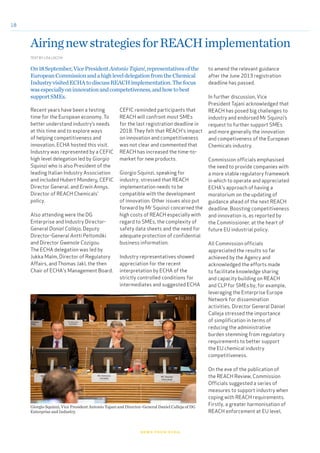
The ECHA delegation was led by
Jukka Malm, Director of Regulatory
Affairs, and Thomas Jakl, the then
Chair of ECHA's Management Board.
CEFIC reminded participants that
REACH will confront most SMEs
for the last registration deadline in
2018. They felt that REACH's impact
on innovation and competitiveness
was not clear and commented that
REACH has increased the time-to-
market for new products.
Giorgio Squinzi, speaking for
industry, stressed that REACH
implementation needs to be
compatible with the development
of innovation. Other issues also put
forward by Mr Squinzi concerned the
high costs of REACH especially with
regard to SMEs, the complexity of
safety data sheets and the need for
adequate protection of confidential
business information.
Industry representatives showed
appreciation for the recent
interpretation by ECHA of the
strictly controlled conditions for
intermediates and suggested ECHA
to amend the relevant guidance
after the June 2013 registration
deadline has passed.
In further discussion, Vice
President Tajani acknowledged that
REACH has posed big challenges to
industry and endorsed Mr Squinzi’s
request to further support SMEs
and more generally the innovation
and competiveness of the European
Chemicals industry.
Commission officials emphasised
the need to provide companies with
a more stable regulatory framework
in which to operate and appreciated
ECHA's approach of having a
moratorium on the updating of
guidance ahead of the next REACH
deadline. Boosting competitiveness
and innovation is, as reported by
the Commissioner, at the heart of
future EU industrial policy.
All Commission officials
appreciated the results so far
achieved by the Agency and
acknowledged the efforts made
to facilitate knowledge sharing
and capacity building on REACH
and CLP for SMEs by, for example,
leveraging the Enterprise Europe
Network for dissemination
activities. Director General Daniel
Calleja stressed the importance
of simplification in terms of
reducing the administrative
burden stemming from regulatory
requirements to better support
the EU chemical industry
competitiveness.
On the eve of the publication of
the REACH Review, Commission
Officials suggested a series of
measures to support industry when
coping with REACH requirements.
Firstly, a greater harmonisation of
REACH enforcement at EU level,
AiringnewstrategiesforREACHimplementation
news from echa
Giorgio Squinzi, Vice President Antonio Tajani and Director-General Daniel Calleja of DG
Enterprise and Industry.
On18September,VicePresidentAntonioTajani,representativesofthe
EuropeanCommissionandahighleveldelegationfromtheChemical
IndustryvisitedECHAtodiscussREACHimplementation.Thefocus
wasespeciallyoninnovationandcompetetiveness,andhowtobest
supportSMEs.
TEXT BY LISA LOCCHI
© EU, 2012
19
news from echa
© FOTOLIA
October-December 2012
•	 Member State competent authorities
meeting at ECHA: 8 November
•	 Workshop on QSAR Toolbox
version 3.0: 20 November
•	 ECHA Management Board: 13-14
December
Tentative dates:
•	 Forum Working Group - Training for
the enforcement trainers 2012:
7-8 November
•	 ECHA Committee for Risk
Assessment (RAC): 26-30 November
•	 Forum for Exchange of Information
on Enforcement: 26-30 November
•	 ECHA Committee for Socio-economic
Analysis (SEAC): 3-5 December
•	 Member State Committee (MSC):
23-25 October, 10-14 December
EventCalendar
International
cooperation
Visits to ECHA
29 and 31 October
Israeli Authorities
Speaking engagements
24 October
Shanghai Summit on Chemical
Regulation 2012
Kevin Pollard
Tim Bowmer has joined ECHA as Chairman of
Committee for Risk Assessment on 1 September.
Over the last ten years, Mr Bowmer has been working
at TNO in the Netherlands in different positions
related to the risk assessment of chemicals.
He has been chairing several bodies at international
level such as the United Nations Joint Group
of Experts on the Scientific Aspects of Marine
Environmental Protection (GESAMP) and its working
groups, in particular on the hazard sof chemicals
in bulk maritime transport. Mr Bowmer is Irish, has
lived in the Netherlands for many years and he is an
ecotoxicologist by training.
ChairoftheRiskAssessmentCommittee
appointed
© ECHA
which has also been requested
by Industry; secondly, a better
integration with other EU
regulations on chemicals including
possible support for innovation by
ad hoc EU funding and, last but not
least, a simplification of REACH
procedures for SMEs.
For ECHA the visit reinforced
that it is on the right course
when listening to the concerns of
industry and other stakeholders,
and doing its best to support all
actors in their efforts to comply
with REACH.
ECHA will continue to place
special emphasis on SME support,
especially with regard to the 2018
registration deadline. Ensuring a
high level of protection of human
health and the environment, and
supporting competitiveness and
innovation are both objectives of
REACH and also included in ECHA’s
mission. By ensuring an effective
and balanced implementation of
the legislation ECHA is contributing
to these policy aims.
ECHA Director of Regulatory Affairs Jukka Malm and Vice President Antonio Tajani.
© EU, 2012
Tim Bowmer.
20
One of the objectives of the REACH Regulation is the
progressive replacement of substances of very high
concern by suitable alternatives. There is already
some evidence that companies have started to avoid
manufacturing chemicals that have been placed on the
Candidate List for authorisation with the result that
some chemicals are gradually being withdrawn from the
market. Although the full extent of this is still unclear, a
survey commissioned by the European Commission and
conducted by the Centre of Strategy and Evaluation
Services (CSES), showed that 22% of European
manufacturers had withdrawn a substance due to its
introduction in the Candidate List.
Many well-known companies have already declared
that they will phase out the manufacturing or use of
substances on the Candidate List. Dr Chris Eacott,
Stewardship Solutions Ltd, UK tells ECHA Newsletter
that one major benefit of the REACH Regulation
should be that the most toxic products will disappear
from the EU market. “In one case known to me, the
HBCD (hexabromocyclododecane) which is currently
applied as a flame retardant to polystyrene beads
used to fill some bean bags, might well be replaced
by an alternative in the not-too-distant future, due to
pressure from a leading UK retailer. Certainly, there
have been public announcements about the imminent
launch of new, alternative, flame retardants that
hopefully will be less toxic than HBCD”, he says.
The CSES survey indicates that companies are trying to
substitute the substances with less hazardous ones. In
fact, only very few respondents had said that they had
decided to register a substance on the Candidate List
and pay the registration costs.
According to Dr Chris Eacott, many companies are also
looking at existing, less harmful chemicals to replace
the most toxic ones, which is usually an easier and less
expensive approach compared with introducing brand-
new substances. “The challenge is often to substitute
SubstitutionofchemicalsontheCandidateList
forauthorisationisalreadyhappening
toxic chemicals with replacements that deliver the same,
or at least very similar, technical effects. In practice,
chemicals that are taken out from the market can often
not be easily substituted. "
A recent development in this field is the SUBSPORT
project jointly run by several organisations and funded by
the LIFE+ programme of the European Union; the Federal
Institute for Occupational Safety and Health (BAuA),
Germany; and the Federal Ministry of Agriculture,
Forestry, Environment and Water Management
(Lebensministerium), Austria. The SUBSPORT is a free of
charge, multilingual web-portal for information exchange
on alternative substances and technologies. It also
contains tools and guidance for substance evaluation
and substitution management.
Ms Anne-Sofie Andersson, Director of ChemSec, one
of the partner organisations of SUBSPORT, tells ECHA
Newsletter that REACH acts as an incentive to find
less harmful alternatives. “The REACH Regulation is
encouraging substitution thanks to the Candidate List
for authorisation as well the Article 33 pressure coming
from the consumer side”, Ms Andersson points out.
The CSES survey concludes that even though businesses
complain about the time and resources necessary
to substitute critical substances and point to the
uncertainty of developing substances of similar quality,
this is a development that is already taking place.
FURTHER INFORMATION
REACH Regulation (Article 33):
http://echa.europa.eu/regulations/reach/legislation
Subsport:
http://www.subsport.eu
Source: Centre for Strategy & Evaluation Services, CSES, 2012, Interim
Evaluation of the European Chemical Market after the Introduction of
REACH, Final Report, Appendix.
stakeholders
TEXT BY PIA FALLSTRÖM MUJKIĆ
Substitutionofchemicalsisnoteasy,butitisaprocessthatisalreadyongoing,concludesasurveyreporton
REACH.ECHANewsletterinterviewedMrChrisEacottfromStewardshipSolutionsLtd,UKandMsAnne-
SofieAnderssonfromtheInternationalChemicalSecretariat(ChemSec)togettheirviewsonsubstitution.
21
	 executive office & management board
© ECHA
TEXT BYTIIU BRÄUTIGAM
ExecutiveDirectorvisitsauthoritiesinRomaniaandBulgaria
“Moreresourcesneededforchemicalsmanagement”
The Romanian Minister for Environment and Forests,
Rovana Plumb, discussed with him about resources
and possibilities of cooperation. The Ministry staff
explained to Mr Dancet that before 2002, no national
law on chemicals had existed in Romania. With the
help of two twinning projects with EU countries, a real
framework and authorities had been established in the
last ten years. Also ECHA’s training, meetings, events
and the continuous guidance had been helpful for the
authorities.
In a meeting with the Bulgarian Minister of Environ-
ment and Water, Nona Karadzhova, current national
priorities regarding chemicals management were
outlined: support to companies with the upcoming
2013 registration deadline, providing electronic access
to information and further training on REACH and CLP
implementation and enforcement. The main challenge
for the Bulgarian Ministry was the specific scientific
expertise required for new REACH processes, such as
substance evaluation.
In both countries, the Executive Director highlighted
the need for sufficient resources for chemicals man-
agement: REACH, CLP and Biocides related tasks re-
quire multidisciplinary teams with scientific, legal and
IT competence. Therefore, efficient cooperation with
different national authorities and research institutions
was needed. ECHA could support the national authori-
ties in capacity-building through targeted training in
IT-tools and legal matters, workshops, study visits to
ECHA and direct contacts with the Agency’s experts.
ECHA’sExecutiveDirectorGeertDancetvisitedRomaniaandBulgariainSeptemberandOctober,meeting
withtheMinistersforEnvironment.Furtherimprovementofcooperation,resourceneedsandsupportfor
industrywereamongthetopicsdiscussedinbothcountries.
INDUSTRY CONCERNS DISCUSSED
The coordinating Ministries in Romania and Bulgaria have
regular contact with stakeholders, providing helpdesks,
training and information activities.
In Romania, the chemicals industry has a long tradition,
but many areas had lost importance in the last years.
Currently, the most important sectors were petroleum
processes and petrochemicals, chlor-alkali products,
fertilizers, and the manufacturing of mixtures.
During the visit to Sofia, Mr Dancet met representatives
of the Bulgarian chambers and associations of chemical,
metallurgical and other industrial branches as well as
Bulgarian manufacturers and importers of chemicals.
The industry stakeholders raised questions concerning
especially the financial burden for small companies fac-
ing the registration deadline 2013 and possibilities for
training on ECHA’s IT-tools. Other topics were the access
to currently available registration data, details of the
registration process and the guidance on nanomaterials.
Mr Dancet recommended that industry contact the
national REACH and CLP Helpdesks for support. He re-
minded that ECHA’s guidance documents were available
in 23 EU languages. Furthermore, the national branch
chambers and associations could organise training
themselves for companies and provide also consultancy
services.
Mr Dancet met representatives of six different organisations implementing distinct areas of REACH and CLP in Romania. He also visited the
national helpdesk for REACH and CLP and the REACH-IT facilities in the National Environmental Protection Agency.
© ECHA
22
executive office & management board
Highlightsofthe27thManagementBoardmeeting
Duringitsmeetingon27-28
September,ECHA’sManagement
BoardelectedNinaCromnier
asitsnewChairandadopted
theworkprogrammefor2013.
TheBoardalsoendorsedanew
approachforthemulti-annual
workprogrammeandadopted
provisionaleligibilitycriteriafor
theappointmentofmembersof
ECHA'sbodiesandkeystaff.
WORK PROGRAMME ADOPTED
FOR 2013
The Board adopted ECHA’s work
programme for 2013. Among
the main challenges of the “peak
year” are the second registration
deadline in May, the number of
compliance check decisions and
an increasing work in substance
evaluation. The Agency will also
face the first authorisation applica-
tions and a high workload related
to proposals for harmonised clas-
sification and labelling. In addition,
the Biocidal Products Regulation
will become operational on 1 Sep-
tember 2013. In order to manage
all challenges with the available
resources, increased efficiency will
be required in all areas.
The final programme will be
published on ECHA’s website and
available in 23 EU languages.
MULTI-ANNUAL WORK PRO-
GRAMME BUILT ALONG STRA-
TEGIC OBJECTIVES
A new strategic approach to ECHA’s
multi-annual work programme was
endorsed. In future, the programme
covers a five-year cycle instead of
three and will be structured around
ECHA’s four strategic objectives.
This approach should help the
Agency to prioritise its future
work load and to allocate its reduced
resources in an efficient way.
NEW ELIGIBILITY CRITERIA FOR
APPOINTMENTS
The Management Board adopted pro-
visional eligibility criteria and guide-
lines for the appointment of mem-
bers of ECHA’s bodies and key staff.
These followed from ECHA’s policy on
managing potential conflicts of inter-
est. The aim is to safeguard the inde-
pendence, integrity and credibility of
ECHA’s decision-making process.
Further items on the agenda included
budgetary amendments, discussion
about biocides related tasks and
implementing rules for Staff Regula-
tions.
The preliminary conclusions of the
meeting have been published on
ECHA’s website
http://echa.europa.eu/management-board-
documents
Nina Cromnier has been the Director General of the Swedish Chemicals Agency since 2010. Before that, she worked
at the Swedish Ministry of Environment, her last position being the Director for Chemicals and Waste Division. Ms
Cromnier has lead EU delegations in international negotiation meetings of the UN Environment Programme. During the
Swedish EU Presidency in 2009, she chaired the EU’s international working group on chemical issues. Previous career
steps included posts at the Swedish Environmental Protection Agency and the Swedish Waste Research Council. She
holds a degree in Chemical Engineering and another in Business Administration. Ms Cromnier has been a member of
ECHA’s Management Board since 2010.
The former Chair, Mr Thomas Jakl, the Austrian member, led the
Board for two full terms from 2008. He steered the Board
during the crucial set-up phase of the Agency and through a suc-
cessful first REACH registration deadline. He was at the helm
during the recent challenges including the start of the prepa-
rations for an extended ECHA mandate under Biocides and PIC
as well as the preparations for the 2013 REACH deadline. The
term of office for the Chair is two years and can be
renewed once.
NinaCromnier,newChairofECHA’sManagementBoard
Nina Cromnier (left) is the new Chair
of ECHA's Management Board. Thomas Jakl
led the Board for two full terms, from 2008.
© ECHA© KEMI
The ECHA Management Board elected Nina Cromnier, the Swedish member, as its new Chair for a period of two
years. She took up the post on 1 October 2012.
23
Phase-in* Non phase-in Total
No of registered
dossiers 1
containing testing
proposals
497 62 559
containing testing propos-
als for vertebrate animals
395 43 438
No of endpoints
covered by registered
testing proposals
1005 123 1128
covered by registered
testing proposals for
vertebrate animals
655 72 727
No of public
third party
consultations
closed 461 41 502
ongoing on 30 September
2012
4 7 11
planned 10 1 11
Dossiers with testing proposals opened for
examination 2
580 84** 664
Draft Decision sent to the registrant 3
238 21 259
Final Decision sent to the registrant 111 33 144
Terminated testing proposal examinations 4 116 18 134
1 Successfully registered (accepted and fee
paid). Note: this number changes over time
as dossiers may be updated by the registrant
(e.g. test endpoints added and/or withdrawn)
2
Dossiers ever opened for examination
notwithstanding their current status.
3
Draft decisions which did not become final
by 30 September 2012 nor withdrawn due to
termination of testing proposal examination
(TPE).
4 Terminated either at the decision-making
stage and/or upon further information
provided by the registrant (e.g. cease
of manufacture, tonnage downgrade or
withdrawal of a testing proposal).
TABLE A. Testing proposals: dossiers received and output processed between 1 June 2008 and 30 September 2012.
Phase-in Non phase-in Total
No of dossiers opened for compliance check1
523 146 669
Draft Decision sent to the registrant 2
100 4 104
Final Decision sent to the registrant 125 45 170
Only Quality Observation Letter sent to the
registrant3
13 47 60
Terminated compliance checks4
59 45 104
TABLE B. Compliance check: dossiers and output processed between 1 June 2008 and 30 September 2012.
1 Dossiers ever opened for compliance check
notwithstanding their current status.
2
Draft decisions which did not become final
by 30 September 2012.
3
Some additional quality observation
letters have been sent together with draft
decisions, but are not counted here.
4 Terminated upon further information being
provided by the registrant or terminated
without administrative action.
Evaluationstatistics
REPORT ON DOSSIER EVALUATION ACCORDING TO ARTICLES 40 AND 41 REACH
Dossier evaluation covers the compliance checks of registration dossiers and the examinations of testing proposals.
In the examination of testing proposals, all dossiers containing proposals for higher-tier testing, including testing
on animals, are evaluated. The aim is to check that tests are justified and adequate, and thereby avoid unnecessary
animal testing.
Testing proposals that involve tests on vertebrate animals are published on ECHA’s website and third parties are
invited to provide scientifically valid information. The compliance check determines whether or not the information
submitted is in compliance with the REACH information requirements. At least 5 % of the dossiers received by ECHA
per tonnage band are checked for compliance. Details of the REACH dossier evaluation processes can be found at:
http://echa.europa.eu/documents/10162/17207/procedure_dossier_evaluation_20110329_en.pdf.
The results obtained so far can be found in the annual progress report on evaluation:
http://echa.europa.eu/evaluation
Tables A to C report on the dossier evaluation processes from 1 June 2008 to 30 September 2012. The phase-in
status is reported as indicated by the registrant in the dossier and this may have changed when the dossier has been
updated. The dossier updates may also have testing proposals withdrawn or new ones submitted.
* Phase-in:	
substances subject to transitional
arrangements in the REACH registration
** Some registration dossiers were opened for
examination more than once, hence the
difference vs. the number of
registered dossiers.
statistics
24
Substance Registrations
calcium dihydroxide 322
ethylene oxide 314
ethanol 306
iron 301
calcium sulphate 264
Fuels, diesel 240
calcium oxide 229
Ashes (residues), coal 216
methyloxirane 211
ethylene 179
				
annankatu 18, p.o. box 400, fi-00121 helsinki, finland | echa.europa.eu
Phase-in
No of registration dossiers 2
19 772
5% target for the compliance checks on registration
dossiers motivated by the 2010 deadline 3 989
No of dossiers opened for compliance check 4
476
Draft Decision sent to the registrant 5
93
Final Decision sent to the registrant 112
Only Quality Observation Letter sent to the
registrant 6 9
Terminated compliance checks 7
47
1 Dossiers for normal registrations and transported isolated intermediates
which comply with the criteria for the first REACH dossier submission deadline
for phase-in substances (1 December 2010). Submissions containing more then
one type of registration in one submission (combined submissions containing
e.g. both a normal registration and a registration as transported intermediate)
are accounted for only once and only if one of the registration types within such
a submission satisfies the criteria of the 2010 registration deadline.
2 All submissions registered by 1 December 2010 including those which were
handled with a delay.
3 This is the target for the 19 772 registration dossiers motivated by the 2010
deadline. According to Article 41(5) of the REACH Regulation ECHA shall select
for compliance check at least 5 % of the registration dossiers received by the
Agency for each tonnage band.
4 Dossiers which meet the 2010 registration deadline criteria and that have
been ever opened for compliance check notwithstanding their current status.
5 Draft decisions which did not become final by 30 September 2012.
6 Some additional quality observation letters have been sent together with
draft decisions, but are not counted here.
7 Terminated upon further information being provided by the registrant or
terminated without administrative action.
TABLE C. Status of compliance checks on registration dossiers motivated by the 2010 deadline 1
DetailedREACHregistrationstatisticsnowavailableonECHA’swebsite
*NONS = All substances that have been notified under Directive 67/548/EEC
(also called NONS) and have a recognised notification number are regarded
as registered under REACH. ECHA started making information from these
notifications available as of May 2012. The NONS registration dossier must be
updated if at least one of the cases laid down in Article 22 or Article 24(2) of
the REACH Regulation applies. This would also include any update referring to
the inclusion of the information required under Article 40 of the CLP Regulation
(notification to the Classification & Labelling Inventory).
Registration statistics: http://echa.europa.eu/information-on-chemicals/registration-statistics
Information on registered chemicals: http://echa.europa.eu/information-on-chemicals/registered-substances
Information on phase-in substances intended to be registered for 2013 deadline and active lead registrants:
http://echa.europa.eu/reach-2013
The Agency is publishing detailed statistics on the origin and types of REACH registration dossiers and registered substances
on its website. At present, the statistics provide various breakdowns of the total volume of registrations received from June
2008 until 31 August 2012. ECHA will update the statistics regularly.
Top 10 most frequently registered substances, data as of 31 August 2012.
! This table is based on new registrations under REACH.
NONS* are excluded.

ECHA_Newsletter_October_2012

  • 1.
    1 October 2012 5 3 ECHA welcomedlead registrants back for a second workshop With the 2013 deadline for phase-in chemicals fast approaching, the Second Lead Registrants Workshop provided a good opportunity for lead registrants to share their experiences, information and tips for registration. 6 Candidate List - the way ahead Having 136 substances on the Candidate List of substances of very high concern (SVHC) by the end of 2012 is the policy target set out by the Commission in spring 2010. This target is likely to be achieved. 13 How can I find my co-registrants? To support potential and existing registrants to better fulfil their REACH obligations on data sharing and joint submissions, ECHA has developed a new functionality in REACH-IT. 16 Taking an interest in interest management Independence and transparency are core values of the Agency. Every day, in all of its activities, the Agency aims to ensure that it is independent from all external interests, takes science-based decisions and that it is as transparent as possible. Greetings from an autumnal Helsinki. As the days start to shorten and the winter beckons, I realise that the next REACH deadline will be over by the time we experi- ence our next wonderful 24 hour day of sunshine here in Helsinki. So the big work- load for us, as well as for many of you, lies ahead! With that in mind, just last week we had our second lead registrant workshop. We welcomed around 100 participants and 200 online who are preparing for the upcoming 2013 REACH deadline to share best practice with ECHA and with each other about leading a SIEF, sharing data and preparing joint submissions. The event was organised together with a number of our Accredited Stakeholder organisations and much of the content was provided by stakeholders, particularly lead registrants with experience from the 2010 registration deadline. Their practical input was invaluable and we’re very grateful for their help. You can read about the workshop on pages 3-5. In this edition of the newsletter, we are also talking about the importance of data sharing and introducing the new possibilities offered by the upcoming update to REACH-IT, the Co-registrants page, which will support potential and existing registrants in sharing data and preparing joint submissions. In addition, we highlight the problems contained in many intermediate dossiers – where the substance is arguably not an intermediate and therefore should not benefit from the reduced information requirements (and costs) under REACH. We are following all of those dossiers up as we speak. Thebigpushtowards2013 annankatu 18, p.o. box 400, fi-00121 helsinki, finland | echa.europa.eu 
  • 2.
    2 Inthisissue: 4 Smaller companiestaking the lead 7 ECHA finds over 2 000 potentially non-compliant dossiers 8 Reaching the nano scale 10 ECHA holds a scientific discussion session on in vivo mutagenicity tests 11 The world is watching: ECHA at ICCM-3 12 Make every effort to share data within your SIEF 18 Airing new strategies for REACH implementation 19 Events; Chair of the Risk Assessment Committee appointed 20 Substitution of chemicals on the Candidate List for authorisation is already happening 21 Executive Director visits authorities in Romania and Bulgaria 22 Highlights of the 27th Management Board meeting 23 Evaluation statistics 24 Making information on the registered chemicals publicly available To subscribe to the ECHA news alerts and newsletter, register at: http://echa.europa.eu/en/news-and- events/news-alerts Disclaimer: The views presented in the Newsletter do not necessarily represent the official position of the European Chemicals Agency. All the links are up to date at the time of publication. ISSN: 1831-4953 Editor-in-chief: Lindsay Jackson Editor: Hanna-Kaisa Torkkeli European Chemicals Agency Annankatu 18, P.O. Box 400, FI-00121 Helsinki Finland Tel. +358 9 6861 80 Fax +358 9 6861 8210 http://echa.europa.eu echanewsletter@echa.europa.eu “Acting on your feedback, and in particular, your desire to have the Newsletter in a more user friendly format, we will be going 'online'. ” Head of Communications Lindsay Jackson © ECHAIn the beginning of September we took a major step towards the target of having 136 substances of very high concern (SVHC) on the Candidate List for authorisation by the end of 2012. As you will recall, this target was set by Commission Vice President Tajani and Commissioner Potočnik in 2010. We launched our biggest public consultation yet of 54 potential SVHCs asking for your comments on the identity and properties of the substances. Currently, there are 84 SVHCs on the Candidate List. After the consultation, which ends on Thursday (18 October), the proposal will go to the Member State Committee for agreement. You can learn more about the next steps on page 6. Finally, we are hoping that you will have an extra little “gift” in our Decem- ber Newsletter. Acting on your feedback, and in particular, your desire to have the Newsletter in a more user friendly format, we will be going 'online'. We hope that the new format will help you find and share the stories that are relevant to you and your colleagues more easily. We’re always on the lookout for ways to make the Newsletter more valuable for you, so please let us know what you would like to see covered in the coming issues, what has been good, and what we can improve. Get in touch with Hanna and me at echanewsletter@echa.europa.eu.
  • 3.
    3 More than 100participants attended the two-day event in Helsinki, including newly appointed and candidate leads representing the chemical manufacturing industries. Experienced leads, industry representatives, consultants and representatives of the national helpdesks of four Member States were also present, while an additional 200 people followed online. The event complemented the initial workshop earlier this year, which focussed on dossier submission IT- tools and lessons learned from the 2010 deadline. Workshop chair and Director of Cooperation at ECHA, Mr Andreas Herdina, welcomed the chance to discuss developments since then and practical ways to reach the May 2013 deadline and beyond. A key message throughout the event was the need for lead registrants - those responsible for compiling lead dossiers in joint submissions – to register as soon as they can. “Registration is the start,” ECHA Executive Director Geert Dancet said in the opening address. “You have a big responsibility, take the lead!” Presentations covered, among others: management of substance information exchange forums (SIEFs); substance identification; confidentiality of information, communication down the supply chain; and exposure assessment. Each sparked robust discussions. FollowingtheleadtoHelsinki ECHAwelcomedleadregistrantsbackforasecond workshop Participants also received targeted advice during one-to-one sessions and IT training sessions. SUPPORTING DOWNSTREAM USERS The challenges facing downstream users - right through to the customers at the end of the supply chain - was the focus of one session. Sylvie Lemoine from the Downstream Users of Chemicals Co- ordination (DUCC) Group stressed the importance of harmonised and simple language and terminology. “It’s a challenge for downstream users to manage their deadlines, given the complexity, language barriers and lack of targeted training”, she said. One useful way leads can assist is by inserting a simple table of contents in safety data sheets (SDS) listing exposure scenarios, in a harmonised format. “Providing good exposure scenarios to downstream users will avoid a lot of unnecessary questions after registration. We need your help to make the life of your customers easier!” European Association of Metals consultant Hugo Waeterschoot says not enough attention was given to end users when REACH was designed. “And I think we see the consequences of that now.” He suggested harmonising with already existing risk management legislation including workplace health and safety. 2013 campaign Withthe2013deadlineforphase-inchemicalsfastapproaching,the SecondLeadRegistrantsWorkshopprovidedafinalopportunityfor leadregistrantstosharetheirexperiences,informationandtipsfor registration. TEXT BY SUSANNA DUNKERLEY GETTING INACTIVE PRE- REGISTRANTS ON BOARD Another issue raised was that of inactive or dormant pre-registrants. The European Chemical Industry Council’s Mercedes Viñas flagged targeted communications to inactive pre-registrants over the coming months. “Please note that we are progressing with the registrations … and if you want to change your data you can still do it,” she suggested the communication could say. CONFIDENTIALITY CLAIMS – ACT BY 31 OCTOBER Questions were raised about the 31 October confidentiality claim deadline. From November 2012, safety data sheet information, including company names and registration numbers, will be published online. So, the 30 000 dossiers already in the dissemination portal will soon be searchable by registrant names, identifiers and tonnage bands. NEWTOOLS AND FEATURES INTRODUCED A number of new features were announced during the workshop, including the Co-registrants Page. The ITTool feature will provide direct access to the contact details of co-registrants in real time, and identify potential registrants, who have successfully inquired about a certain substance. The REACH 2013 website has also been updated with links to tools, information and guidance documents for the deadline by Accredited Stakeholder Organisations. 
  • 4.
    4 Adding colour, DrRene Hunziker from the Dow Chemical Company, told a tale of crossing the ‘roaming river REACH’ to the new frontier. “Imagine there are no maps, no-one has ever gone there. Many have told stories of … an agency somewhere far off in the north.” “Everybody knew they had to cross the river REACH … and the promise, if you succeed, was a land of safe chemicals, a public with confidence in the chemical industry and its products.” “This land exists, it’s not a dream.” 2013 campaign HIGH QUALITY DATA AND REGULAR EVALUATION NEEDED TO ENSURE SAFE USE OF CHEMICALS ECHA experts spoke about the need to provide quality data in dossiers and gave practical advice on updating them. Registrants were reminded that the May 2013 deadline for chemicals at or above 100 tonnes a year was not the finish line. ECHA Scientific officer Rupert Simon described registration as a long- term commitment. “Leads should evaluate and update dossiers ideally every six months and take note of emails and information requests from ECHA”, he added. “The earlier you react the earlier we can help you, and we are dedicated to do so.” Mr Waeterschoot concurred, sharing his experience of registrants missing the 2010 deadlines because they did not check their mailbox. “Act for the deadline, it may look like a Swiss watch but I can tell you the Finnish watch is just as precise in timing.” The presentations and a video recording of the event are available on ECHA’s website: http://echa.europa.eu/en/view-article/-/ journal_content/2b6c9ef3-b8c8-4ee1- a15d-bee72a3b47ea INTERVIEWS BY VIRGINIA MERCOURI & HANNA-KAISA TORKKELI Smallercompaniestakingthelead Mariano Alessio Verni from SILC Fertilizzanti Srl, is the co-ordinator of the Potassium Phosphites Consortium. His company has experience as a member registrant from the 2010 deadline and recently stepped in to become a lead registrant for 2013. He is quick to point out that there is a substantial change in communication within the SIEFs from two years ago. “It is not like in 2010 registration, when we had a couple of big companies with enough people to work on REACH inside the company itself. Smaller companies usually have to outsource this work. It is not profitable to train people internally if you have to register only a couple of substances.” He explains that usually the lead registrants call on an external consultant and the companies that are members also call on consultants. “The dialogue is between the consultants themselves and not between companies, so it is AttheLeadRegistrantsWorkshop,ECHANewsletterinterviewedfewof theparticipantsontheirexperiencewithREACHregistration,managing substanceinformationexchangeforums(SIEFs)andthechallengesfor smallercompaniesofbeingaleadregistrant. an indirect communication. Moreover, different consultants have different approaches on how to make the gap analysis. This makes it very hard to manage the consortium.“ To address this challenge, Mariano Alessio Verni considers that the lead registrant’s company or a core group of companies should have sufficient expertise to guide the consultants. “I have enough expertise in the sector, so I can help our consultant not only with the chemical issues, but also with the technical, marketing and commercial issues.” He is convinced that good knowledge of the market is also important. “I already know other SIEF members from my past commercial  As of September 2012, ECHA has received 1 949 self-nominations as lead registrants for the 2013 deadline. They are published on the ECHA website. These nominations came from 568 legal entities. More than a quarter of these lead registrants have no previous experience of being a lead registrant.  A total of 2 607 lead registrant nominations are listed, including those intending to register for the 2018 deadline.  ECHA has received an authorisation from 425 lead registrants to disclose their names. That is 16% of total nominations.  Intentions to register for 2013 deadline: 2 968 substances, and of these 75% already have leads.
  • 5.
    5 2013 campaign Mariano AlessioVerni. © ECHA experience. I have already met most of our members in congresses or trade exhibitions in and outside Europe and that helps a lot in the communication.” He advises that it is not good to forget the commercial aspects when dealing with REACH, especially when the consortium involves SMEs. Attending ECHA’s Lead Registrants’ workshop provided the opportunity to have a one-to-one session and to clarify the sameness of the substances that will be registered. Following this, he is planning a meeting with the consortium to do final preparations before submitting the lead dossier before the end of February 2013. *** Stéarinerie Dubois, a French medium- sized company manufacturing fatty esters, is registering for the first time in 2013 as lead registrant for several substances. Regulatory Affairs Manager Laetitia Halbeisen says that her company became a member of a consortium several years ago to be able to manage the registration process. The consortium is managed by an external consultant. “We don’t have the internal resources especially for the eco-toxicological and toxicological parts, so the support of the consultant is very important. It is still somewhat difficult to decide strategies since it requires a lot of background in these fields, but we are learning” Ms Halbeisen says. Stéarinerie Dubois is exporting products all over the world and has to comply with many different legislations. “Our products have to conform to legislations in Europe, Asia, America… and we need to adjust to the changes they introduce. For example, we might have to register a substance under REACH and commission tests according to certain methods. To export the same substance to China, we would have to do other tests which are applicable to their legislation. The overall context is complex,” Ms Halbeisen explains. From ECHA, Ms Halbeisen would also like to receive positive, reassuring feedback, to know that her company is on the right track. “For example, when you put in a confidentiality claim, which requires a detailed argumentation, it would be good to know that it is being assessed and what the result is. At present, there is a waiting period during which you may receive messages in REACH-IT if there are comments or problems. It is the same with dossier updates. It would be great to receive some proactive signals from ECHA,” she concludes. *** Darren Abrahams is an environmental lawyer working with REACH and related legislation at Steptoe & Johnson LLP in Brussels. He helps his clients interpret the REACH Regulation and guides them on strategies. “But we are also an Only Representative. We are actually registering for a large number of non- EU manufacturers; companies, which are exporting chemicals subject to REACH onto the European market. So I get to see everything from pre-registration right through to registration, which will be leading us to 2018”, he mentions. Although many of Mr Abrahams’ clients are large companies, he also helps clients who are engaging with REACH for the first time in 2013. According to him, the 2013 deadline is not – and should not be – a repetition of the 2010 deadline. “We are dealing with a very different audience. These are people who have made sincere efforts to try and prepare properly for REACH but may not have the resources nor time that are required to really do this properly”, Mr Abrahams explains. As specific problematic issues for all registrants, Mr Abrahams mentions supply chain management and communication within the SIEF. Supply chain problems occur both upstream and downstream. “Our clients need the information on the substances they register. A lot of these suppliers are not based in the EU and do not have a legal obligation to provide that information. We spend a lot of time trying to help our clients to extract that information and also provide a way to give reassurance to their customers downstream without disclosing commercially sensitive information.” Although there are supply chain requirements within REACH, a lot of the practical elements are not directly addressed by the legislator. “All of these issues, where there is a legal requirement but not very much explanation from the legislator create issues for our clients. ECHA is of course doing its best trying to fill the gaps”, he says. Mr Abrahams says that communication within SIEFs is now very different compared to the past deadline. “We are actually not just educating our lead registrant clients but everyone they need to engage with. Joint registration is a collective process. There is no magic formula for SIEFs really. You need to be transparent and treat everyone fairly. You also need to repeat the same thing over and over again. It is a drip-drip effect and eventually you get through”, he explains. Darren Abrahams advises lead registrants to keep a paper trail of all their actions showing that they have done everything required to bring the SIEF together.
  • 6.
    6 2013 campaign Having136substancesontheCandidateListofsubstancesofveryhigh concern(SVHC)bytheendof2012isthepolicytargetsetoutbythe Commissioninspring2010.Thistargetislikelytobeachieved.The focushasnowshiftedtohowtousetheREACHandCLPinformationto identifynewsubstancesanduseswhichwouldrequireregulatoryrisk managementactionsandhowtochoosethebestapproachtotacklethe concernsineachcase. CandidateList–thewayahead TEXT BYELINA KARHU The eighth round of SVHC identi- fication is currently under work. Out of the 17 proposals submitted by the Member States, five are based on PBT/vPvB* properties and six on equivalent level of concern considerations: three on endocrine disruption properties and three substances classified as res- piratory sensitisers. In addition to these Member State proposals, in August the European Commission requested ECHA to prepare SVHC dossiers for 37 CMR** (Cat 1A/B) substances. With this request, the Commission aimed to achieve the policy target set out by Vice President Tajani and Commissioner Potočnik in spring 2010 to have 136 substances on the Candidate List by the end of this year. The Commission has started further discussion with the Member States and ECHA on how to reach the policy target of get- ting all relevant SVHC substances identified by 2020. REACH places the primary re- sponsibility for ensuring the safe use of chemicals on industry: manufacturers, importers and downstream users of substances. Regulatory interventions can be seen as complementary measures where the actions taken by indus- try are for one or more reasons insufficient. The main focus of the further developments and discus- sions is how to make the best use of the REACH and CLP information and of the regulatory risk manage- ment tools that REACH provides. In other words, how to guarantee that the concerns are identified as early as possible and addressed by a set of tools which ensure efficient, timely and proportionate regulatory actions. Registration and classification and labelling notification require- ments have and will continue to bring in new information. However, in order to have sufficient basis to address concerns related to new types of substances, which are not yet regulated for instance due to their recognised CMR properties, often requires further information. Substance evaluation starts to take its role in filling the data gaps where necessary to support regulatory risk management. Furthermore, ECHA has established a PBT expert group bringing togeth- er experts from Member States, industry, NGOs and ECHA to support the work of identifying information needs and assessing the informa- tion related to potential PBT and vPvB substances. Shifting the focus on new substances and concerns provides a possibility to achieve a real difference in human health and environmental protection but also requires considerable work and resources both from industry and authorities. The Candidate List and the other parts of the authorisation process are new regulatory tools. While restrictions are not new – the first ones were adopted in 1976 – REACH provides a better information basis and a well structured and transpar- ent framework to establish new restrictions. The challenge of the coming years is to ensure that these tools are implemented in an ef- fective and proportionate manner as part of the wider Union regula- tory framework for managing risks related to chemicals. Candidate List table: http://echa.europa.eu/candidate-list-table * PBT - persistent, bioaccumulative and toxic chemicals vPvB - very persistent and very bioaccumulative ** CMR - carcinogenic, mutagenic or toxic to reproduction CANDIDATE LIST The identification of a substance as substance of very high concern and its inclusion in the Candidate List is the first step of the authorisation procedure. Companies may have immediate legal obligations following such inclusion which are linked to the listed substance on its own, in preparations and articles. Further documentation or more detailed information on the identification process of substances of very high concern can be found on the web pages of ECHA's Member State Committee.
  • 7.
    7 Registrants affected bythe findings have received a letter via REACH- IT asking them to carefully review the reported uses and update their registration dossiers. In the letter, the Agency also offers practical advice for registrants on how to better report intermediates in IUCLID 5.4 or how to update the registration to a full (Article 10) Registration. “We hope that the support and information in our letters will provide enough information for the registrants to update their dossiers either by providing correct information to register their substance as an intermediate under Articles 17 and 18, or by doing a full registration by submitting information as specified in Article 10 of REACH,” Mr Rasenberg states. FOLLOW-UP ACTIONS WILL ALSO COVER UPDATED DOSSIERS So far, ECHA has received 84 updates for the intermediate dossiers included in the recent screening. In addition, several industry associations have contacted ECHA for additional support for updating dossiers, or for advice on how to integrate the information from the ECHA letters in the overall approach to update intermediate TheIT-basedscreeningofall REACHintermediatedossiers conductedbytheAgencyhas raisedseriousqualityandpotential complianceconcerns.Asaresult ofthescreening,ECHAidentified 2388potentiallynon-compliant dossiersfrom574registrants, representing760substances registeredwithintermediateuse. The concerned registrants have been directly informed about the findings for their dossier(s) along with information on how to update their dossiers via REACH-IT. They are requested to review and update their dossiers with correct information by the end of the year. ECHA intends to screen these dossiers again and identify those that require further regulatory action. “We have already reported on the previous screening exercise done in 2010 and 2011, which raised concerns in terms of compliance. This new approach identifies additional substances through our IT-screening tools and focuses on inconsistencies in the information on uses provided in the dossier with regard to the intermediate status or strictly controlled conditions”, explains Mike Rasenberg, ECHA’s Head of Unit for Computational Assessment. The Agency has excluded all substances that have already received a clarification request (Article 36 letter) or are about to receive one in the near future as a result of the initial screening. However, the previously screened dossiers, which had not received clarification requests, were included in this screening. ITscreeningofintermediatedossiers ECHAfindsover2000potentiallynon-compliant dossiers dossiers. ECHA continues to monitor the situation. “Take care! The fact that a company updates their dossier by simply removing incorrect uses does not mean that we forget about the dossier. As we receive more updates, we are reviewing where best to put our efforts to be as effective as possible”, Mr Rasenberg says. TOWARDS A COMMON UNDERSTANDING The definition of intermediates and the interpretation of strictly controlled conditions have been popular topics of debate. ECHA has been, and will continue to be, in dialogue with industry to facilitate a common understanding of the Guidance on Intermediates and the related legal obligations. “It is important to us to ensure the safe use of chemicals, including intermediates. We are therefore taking industry concerns for intermediates seriously and are open to further discussions”, Mike Rasenberg concludes. Further information: News alert, 14 September 2012 http://echa.europa.eu/view-article/-/ journal_content/0d1a14fe-9c63-4807-a3de- 380c0dbffdf5 news from echa TEXT BY HANNA-KAISA TORKKELI INTERMEDIATES IN REACH Substances used as an intermediate are intended to be transformed into another substance, and shall be manufactured and used under strictly controlled conditions at chemical manufacturing sites. Due to these special circumstances, the exposure to humans and the environment is considered to be minimised. On that basis, REACH allows intermediates manufactured and used under strictly controlled conditions to be registered with reduced information on their properties and without a chemical safety report (Articles 17 and 18 of REACH).
  • 8.
    8 The nano particles,which represent a giant leap in modern chemistry and which have formed a growing multi-billion Euro industry, have intensified the scientific and regulatory discussions in REACH. Wim De Coen, ECHA’s Head of Unit for Evaluation I and the leader of the Agency’s task force on nanomaterials, is quick to point out: “The scientific uncertainty of nanos forces the regulator to be more cautious, but it does not mean stigmatising nanos.” He clarifies that ECHA’s approach responds to the recommendations of the Scientific Committee which advises the European Commission on Emerging and Newly Identified Health Risks (SCENIHR) to assess nanoforms on a case-by-case basis. “From an early stage, we have not considered nanos to be more hazardous than any other substances.” Dr De Coen explains that the classical principles of toxicology (i.e. hazard assessment) do not necessarily apply to all types of nanomaterials because of their tiny size and their relatively large surface area. Furthermore, experts involved in the work of the Organisation ECHAstepsupevaluationofdossierscontainingnanomaterials Reachingthenanoscale of Economic Cooperation and Development (OECD) on the safety of manufactured nanomaterials have acknowledged that adaptation of current test guidelines may be necessary in some cases and that specific guidance will have to be developed, for example, on sample preparation and dosimetry. REACH AND CLP NANO BASICS The starting point is the REACH and CLP definitions for substances. They are not explicit about nanomaterials, but apply to them as to all other forms of chemicals. This was again confirmed by the Second Regulatory Review of Nanomaterials, published this month*, which states that REACH sets the best possible framework for the risk management of nanomaterials when they occur as substances or mixtures. The next step was the recent recommendation** of the European Commission on the definition of nano, which provides more clarity in the debate between regulators and registrants regarding the size (in the range of 1 nm-100 nm) and number (50 % or more as default) of particles in a nanomaterial. ECHA will use this definition as the benchmark for registration and evaluation. From the GAARN forum, where companies shared their experience from the registration of nanos for the first REACH deadline, and the recent workshop on nanomaterials, another important message for current and future registrants came forward: nanos are synthesised by design; they do not occur by accident. If companies make them, they know what specific properties they want them to have in order to achieve their market objective. These properties should be documented in the registrants’ dossiers and the information provided should be in line with the new harmonised definition for nanomaterials. ECHA and the Member States are in agreement on this approach. DEALING WITH THE NANO INFORMATION GAP Following the first REACH registration deadline in 2010, ECHA has been screening the dossiers containing nanos in a common project with the European Commission’s Joint Research Centre (JRC). Since nanomaterials are registered together with bulk materials, the project team expected that many of those substances, which exist both in the bulk and in the nanoform, would be reported on both types of properties in the registration dossier. “We have found a surprinsingly low number of explicit claims that the substance is used in a nanoform. news from echa TEXT BY VIRGINIA MERCOURI ECHAismovingaheadwiththeevaluationofnanomaterials,following theagreementoftheMemberStates’competentauthoritiesduringits workshoponnanomaterialsattheendofMay.Thecommonapproach ispragmaticandstep-wise,balancingthescientificuncertaintieswith thelegislativeframeworkofREACH.TheAgencyisafocalpointforthe nano-relateddiscussionsthroughtheestablishmentofananomaterials’ workinggroupandbytakingoverthecoordinationoftheGroup AssessingAlreadyRegisteredNanomaterials(GAARN).Bothinvolvethe Commission,nationalauthoritiesandotherstakeholders.
  • 9.
    9 news from echa Thisis the case even for substances, which are included in the OECD list of manufactured nanomaterials”, says Frank Le Curieux, who is a member of ECHA’s task force on nanomaterials and represented the Agency in the tenth OECD Working Party on Manufactured Nanomaterials. This lack of nano-specific information prompted ECHA to act using both the carrot and the stick. The Agency is now implementing a two year programme for internal and external capacity building, sharing experience, participation in and contribution to international regulatory activities. ECHA is providing feedback and advice to registrants on nanos and supporting the preparations for REACH 2013. This advice is based on compliance checks of registration dossiers, the results from the ongoing JRC project and the good practice of registrants taking part in the GAARN initiative. ECHA has also released new annexes to the Guidance on Registration specific for nanomaterials. Regulatory actions are also now under way. ECHA has sent draft decisions requesting nano-specific information from registrants of dossiers in which nano properties were not sufficiently documented (under Art. 41 of REACH). Registrants who may be manufacturers of nanos, but did not indicate this in their dossiers, have received letters under Article 36 of the REACH Regulation, which imposes on registrants the duty to gather and provide on request ‘all the information the registrant requires to carry out his duties under this Regulation’. “These Article 36 letters by no means request the generation of new information,” Wim De Coen points out. “This is their main difference with the draft decisions. An Article 36 decision is asking a company to submit to ECHA already available information regarding a specific property, in this case particle characteristics; because we have reason to believe that the company may already have such information. Of course, this is legally binding and registrants need to reply. Not replying means enforcement actions”, Dr De Coen stresses and advises registrants to update their dossiers. To support industry in providing complete information, ECHA has developed a questionnaire. “The more information you give already, the more unlikely you are to receive a draft decision” , Wim De Coen highlights and insists that ECHA has a pragmatic approach. “Currently, we are looking for a constructive and proactive response from registrants to provide us with information on their nanomaterial properties. This is also a wake-up call for future registrants: it is necessary to include nano-specific information in the dossiers.” STEPPING UP NANOMATERIALS’ SAFETY Both the draft decisions and the Article 36 letters request registrants to characterise their nanomaterials. “Our aim is to provide clarity primarily on the particle characteristics. This is the first step. What we want at this stage is for companies not to go away and say they cannot characterise their material. Yes, this is scientifically challenging, but we know from the discussions with registrants that it is possible”, says Dr De Coen. For example, the manufacturers will tend to know which properties they need: size, form, surface, volume, surface treatment. This is exactly the type of information that ECHA requires. “Currently, we are not instructing registrants which method to use. There are many methods available and we let them decide which ones are the most suitable to describe the characteristics of their specific nanoforms. Our aim is to develop a matrix approach, so that all registrants who wish to cover nanomaterials in their registration should be able to document it with the best available methods”, says Dr De Coen. One of the most important messages from the last GAARN meeting was the ‘can do’ approach. “Documenting the characteristics of your particles is just a start. If the registrants do not do it, we will not achieve any breakthrough in the nano discussion.” Focusing on the physico-chemical properties is the first step in ECHA’s strategy and one of the main outcomes from the workshop with the Member States. This will be the approach to follow through evaluation. “First we want to clean up the landscape”, says Dr De Coen, continuing “Let’s resolve in the first place the uncertainty about the particulate aspects such as size, shape and surface treatment. Then we can go further towards addressing the potential hazards. The hazards will be largely driven by the physico-chemical characterisation, so it will only be possible to do this gradually.” By knowing the properties of the substances and their characteristics better, it will be easier for registrants to find the best approach to start testing and address the potential hazards strategically, from a risk perspective. In parallel with the work done by the
  • 10.
    10 news from echa ECHAholdsascientificdiscussionsessionon invivomutagenicitytests Therehave been discussions on which test to use, partly triggered by the recent adoption of a new OECD test guideline, the Transgenic Rodent Gene Mutation (TGR) Assay, which is an alternative to the long- er-established Unscheduled DNA Synthesis (UDS) Assay. In order to clarify the scientific considera- tions in selecting an appropriate in vivo somatic cell mutagenicity test, ECHA held a Technical Discussion Session on 4 October 2012. Forty-four experts from sixteen Member States or Associated Member State Competent Authori- ties, the European Commission, the ECHAevaluatesinformationonmutagenicityindossiers,bothfor compliancechecksandtestingproposalexaminations.Ahigher-tier studymaybenecessarytoexaminethepotentialforsomaticcellmuta- genicityinvivo. TEXT BY INGO BICHLMAIER European Medicines Agency, the Eu- ropean Food Safety Authority, indus- try, consultants, contract research organisations and non-governmental organisations visited ECHA for this one-day session. Experts provided detailed accounts on the science, limitations and prac- ticalities of the two tests. Scientific comparisons and an in-depth analysis of concordance with carcinogenicity of the two assays were presented. The industry experience and per- registrants, ECHA is setting up a working group on nanomaterials to informally provide scientific advice on any aspects of nanomaterials under REACH and CLP. Frank Le Curieux and Ofelia Bercaru, who are in charge of gathering the nominations and preparing the first meeting of the group, stress that the activities of the working group should not interfere with ECHA’s decision-making. On the contrary, it aims to facilitate ECHA’s functioning by bringing in scientific expertise that can clarify nano-issues at the Member State Committee level. “With the increased knowledge, it should be possible in the future to identify and test the nanoforms that are relevant for the safe use of a given chemical”, says Wim De Coen. “We aim at setting up, collectively with the Commission, Member States and stakeholders, a level playing field for manufacturers of nanomaterials. Where needed, dossier and substance evaluation are crucial for getting this job done. If we can achieve this, we will improve European competitiveness and innovation, as well as safeguard DID YOU KNOW? The revised EU Biocides Regulation has already taken on board the nanoscale. It contains explicit requirements for the labelling of biocidal products for non-agricultural uses, by indicating the material and using the word “nano”. The text refers to the EC definition of nanomaterials and asks for a separate evaluation of the risks deriving from them. chemical safety to protect human health and the environment.” ECHA is starting a series of webinars on nanomaterials. The first one will take place on 30 October. The Agency now has a dedicated section for nanomaterials on its website: http://echa.europa.eu/chemicals-in-our- life/nanomaterials Best practice on physicochemical and substance identity information for nanomaterials - Report from first GAARN meeting http://echa.europa.eu/ documents/10162/5399565/best_ practices_physiochem_subst_id_nano_en.pdf Workshop on Nanomaterials Proceedings http://echa.europa.eu/view-article/-/ journal_content/c299bea5-ccd1-495b-ba2b- c596fd8c0bed ECHA Guidance on Information Requirements and Chemical Safety Assessment - recommendations for nanomaterials http://echa.europa.eu/guidance-documents/ guidance-on-information-requirements-and- chemical-safety-assessment *Communication on the Second Regulatory Review of Nanomaterials (COM(2012) 572 final) http://eur-lex.europa.eu/LexUriServ/LexUriServ. do?uri=COM:2012:0572:FIN:EN:PDF **Commission Recommendation of 18 October 2011 on the definition of nanomaterial (2011/696/EU) http://eur-lex.europa.eu/LexUriServ/LexUriServ. do?uri=OJ:L:2011:275:0038:0040:EN:PDF
  • 11.
    11 news from echa spectiveon the two tests was pre- sented by one of ECHA's accredited stakeholder organisations, ECETOC. ECHA's sister agencies, the European Medicines Agency and the European Food Safety Authority presented their views on the two tests as well as case studies demonstrating their scientific applicability. The presentations were followed by a discussion which focused on the question of whether each assay is adequate to detect substances that cause gene mutations in vivo and if there were specific conditions which modified the applicability of the assay. Furthermore, it was discussed whether certain condi- tions could be defined under which either one of the two tests, the TGR or the UDS assay, should preferably be performed. The event focussing exclusively on science is the first ‘Technical Discussion Session’ organised by ECHA. The meeting was welcomed by participants. It was in particular acknowledged that the discussion session involving experts from different backgrounds, including regulatory bodies, to share their expertise and views was a success- ful concept. ECHA will publish a summary report of the Technical Discussion Session on its website. ECHA had an information stand - "European Chemicals Agency Working for the safe use of chemicals" - and organised a side- event - "European Union Progress towards the World Summit on Sustainable Development 2020 Goals for Chemicals" - together with the European Commission at the third session of International Conference on Chemicals Management (ICCM-3). The objectives were to inform the conference participants about the current status of REACH and CLP implementation and how the European Union is achieving its objectives towards the World Theworldiswatching ECHAatICCM-3 TEXT BY PETTERI MÄKELÄ DelegatesparticipatinginthetriennialglobalchemicalsmanagementconferenceinNairobiinmid- SeptembertookakeeninterestinthenewEUchemicalslegislationandECHA. Theyaskedquestionsabout thecurrentstatusofREACHandCLPimplementationandconsideredoursimpleCLPgameasanexcellent toolinteachingtheGHSclassificationandlabellingpictograms. Summit of Sustainable Development 2020 Chemical Goals. The conference at the United Nations Centre in Nairobi was attended by over 400 delegates. Around 280 people from 55 countries visited the ECHA stand and approximately 50 attended the side-event. The ICCM-3 documents can be accessed through the SAICM website: http://www.saicm.org/index.php?option=com_ content&view=article&id=96&Itemid=485 The CLP game attracted visitors to the stand. © ECHA
  • 12.
    12 Inordertoreduceanimaltesting, duplicationofwork,andto minimisecosts,REACHrequires thesharingofdataamongthe registrantsofthesamesubstance. Asthe31May2013registration deadlineisapproaching,readour tipsforsuccessfuldatasharing. The REACH Regulationrequires the substance information exchange forum (SIEF) participants and data owner(s) to make every effort to agree on the sharing of the information and its costs in a fair, transparent and non-discriminatory way. The tips below will help you to understand how to do it. 1. If you have already registered and are part of a joint submission:  If you receive a request for data, you must answer it. Keep in mind that potential registrants still have to go through the registration process and submit their dossiers in time. For 2010 lead registrants: make sure you have Letters of Access already available for 2013 registrants  If any of the potential registrant(s) requests it, you need to provide scientific justification for the approach followed in selecting data to demonstrate the safe use of the substance. Especially if the potential registrants have not been involved in the selection of that data.  Potential registrants are only required to share the costs of information to satisfy their own requirements. For example, if you have relied on read-across to develop different dossiers covering several substances in a category, you cannot ask a potential registrant with only one of the substances, to purchase data used for the registration of the whole category. Unless of course, you can justify the relevance of that particular data for the substance the potential registrant is interested in.  As an existing registrant, you share an equal responsibility with the potential registrant to share data included in the joint submission. 2.If you are a potential registrant and planning to join an existing submission or your SIEF is just being formed:  Data sharing negotiations take time. They have to be started well in advance before the deadline so that you can complete them prior to submitting the registration dossier. Whenever you bring new arguments during the negotiations, you have to consider that the other negotiating party needs time to address your arguments.  Any disagreement you might have during the negotiations must be expressed to the other negotiating party. Any concern you may have has to be communicated directly to that party.  ECHA is not a party in the negotiations. It is your responsibility to negotiate as far as possible and to challenge the position of the other party. ECHA does not take over this responsibility and does not negotiate on your behalf.  It is in your interest to conduct the negotiations successfully. Keep in mind that it is always more satisfactory to reach a voluntary agreement between the parties without ECHA’s intervention during a data sharing dispute. DATA SHARING DISPUTES If there is no agreement reached during the negotiations, there is a possibility to submit a data sharing dispute to ECHA. The Agency first makes an assessment in order to establish whether the parties have made every effort to agree on the sharing of the information and/or its costs in a fair, transparent and non- discriminatory way. ECHA’s assessment is based on the documentary evidence of the efforts that both parties have made during the negotiations and submitted to ECHA. Therefore, we recommend recording any communication and contact taken with the other party, such as all email and letter exchange and agreed minutes of phone conversations or meetings. ECHA will then decide to either (1) give permission to the potential registrant to refer to the data (if the joint registration dossier is already available at ECHA); (2) allow the potential registrant to proceed with the registration without the relevant data (if the dossier is not REACH2013,ActNow! MakeeveryefforttosharedatawithinyourSIEF TEXT BY DIANA ANTAL 2013 campaign
  • 13.
    13 2013 campaign  yet availableat ECHA); or (3) ask the potential registrant to continue with the negotiations. Keep in mind that disagreements on the sharing of the costs and information are covered by Article 30(3) of the REACH Regulation. This article only refers to “any study which involves testing on vertebrate animals”. Consequently, if you submit a data sharing dispute and receive a positive decision from ECHA (i.e. permission to refer to the requested endpoints), this permission will only refer to the vertebrate animal data. You will have to generate or obtain non-vertebrate animal data from another source. Finally, bear in mind that if you submit a data sharing dispute, you have to obtain the ECHA decision before submitting your registration dossier. In any case, we advise you to keep on negotiating while the procedure is handled by ECHA and inform ECHA if an agreement is reached. FURTHER INFORMATION Web page on Data sharing, with links to supporting material http://echa.europa.eu/regulations/reach/ substance-registration/data-sharing • Guidance on data sharing • Questions and Answers on Data sharing and related disputes • SIEF Formation and Data Sharing fact sheet • Webform to indicate failure to reach an agreement according to article 30 (3) Webinars on data sharing http://echa.europa.eu/support/training- material/webinars • Webinar to Lead Registrants on data sharing obligations and data sharing disputes on 17 January 2012 • Webinar to Member Registrants on the importance of proper substance identification, data sharing and related disputes on 27 March 2012 Newsletters http://echa.europa.eu/news-and-events/ newsletters • Newsletter of December 2011: Get your data sharing activities ready and be aware of your rights and obligations • Newsletter of April 2012: Best practice in data sharing Presentation during the Lead registrant workshop (2-3 February 2012, Helsinki) http://echa.europa.eu/view-article/-/ journal_content/b5961cb7-ee61-4c40-9a14- 9068f23f28f9 REACH2013,ActNow! HowcanIfindmyco-registrants? Tosupportpotentialandexisting registrantstobetterfulfiltheir REACHobligationsondatashar- ingandjointsubmissions,ECHA hasdevelopedanewfunctionality inREACH-IT. Multiple registrants of the same substance share two main obliga- tions under the REACH regulation: data sharing and joint submission. While the Regulation provides a framework for interaction between registrants, it does not recommend any particular means of coopera- tion. At the end of November 2012, ECHA will release an update of REACH-IT, which will help. WHO CAN BENEFIT FROM THIS NEW FUNCTIONALITY? ECHA will put in contact companies that either received a valid registra- tion number or an inquiry number. Consequently potential registrants that did not successfully inquire or previous notifiers under the Directive 67/548/EEC that did not claim their registration number to ECHA will not benefit from this new functionality. DIRECT ACCESS TO THE CONTACT DETAILS OF YOUR CO-REGISTRANTS The new functionality will enable companies to access the contact details of existing registrants within REACH-IT. A new page, the Co- registrants page, will provide access to the identity and contact details of other existing registrants (or of their Third Party Representative, or TPR) for substances with the same numerical identifier. So, registrants can see who else has registered their substance and therefore shares obligations under REACH. ROLES IN JOINT SUBMISSION VISIBLE The role of the registrants within the joint submission will also be visible. To support companies to further improve their compliance with the TEXT BY LAURENCE HOFFSTADT
  • 14.
    14 2013 campaign joint submissionobligation, the Co- registrants page will display which legal entity is the lead registrant or a member of a joint submission. In addition, legal entities which have submitted within different joint submissions or even outside of any joint submission will be visible to the other registrants. MAKE SURE YOU ARE PART OF A JOINT SUBMISSION! ECHA urges all registrants to use this new functionality to ensure compliance with their obligations. For example, a registrant that has submitted their registration out- side an existing joint submission is required to contact the lead regis- trant. Both parties share a common responsibility to make every effort to ensure that they are part of the same joint registration dossier. ENSURE YOUR CONTACT DETAILS ARE CORRECT AND CAN BE DISPLAYED The identity of the nominated TPR of (potential) registrants will be automatically extracted from section 1.1 of the IUCLID dossier. ECHA strongly recommends that existing registrants and potential registrants that made successful inquiries check the consistency of the information they have submit- ted in their dossiers (registrations, inquiries etc.) to avoid their own company information from being unexpectedly disclosed. In the specific case of notifications under Directive 67/548/EEC (NONS), whether claimed under REACH or not, ECHA advises the owner to assess whether their identity needs to be protected. Companies who want to amend their dossier(s), for example to introduce updated TPR contact de- tails or join or merge existing joint submissions, will need to update their registration dossier before the end of November 2012. INQUIRY PROCESS STREAMLINED The next REACH-IT release will also enhance the inquiry process. The main requirements to prepare and submit inquiry dossiers will not be affected. However, registrants will be asked to specify their registra- tion intentions, with regards to the expected registration date. Once ECHA has identified the substance and processed the inquiry to an end, the Co-registrants page will then provide direct access to the identity and contact details of the potential and previous registrants, so that inquirers are put imme- diately in touch with their fellow registrants. Successful inquirers will access the same information related to other po- tential and existing registrants. Hav- ing said that, any potential difference in company details between inquiry and registration dossiers will become automatically visible to all co-regis- trants and potential registrants. So the important benefit for the inquirers is to get up-to-date and real time information using REACH-IT. This is a major improvement to the existing procedure where ECHA sends the contact details in a paper format, reflecting the status at the sending time. ECHA will continue to improve its technical completeness check plug-in tool (TCC), so that potential registrants can increase the overall quality of the dossiers they submit and increase the success rate of their submissions. These enhancements are expected to shorten the time for succesful inquirers to get the infor- mation necessary to register. VISIBILITY OF ENDPOINTS' DATA The REACH-IT Co-registrants page will display the endpoints’ data requested as part of an inquiry or a request for further information about a substance. This aims to facilitate data sharing between potential and existing registrants. Screenshot 1: List of existing registrants and related information.
  • 15.
    15 2013 campaign WHAT INFORMATIONCAN I ACCESS ON THE CO-REGIS- TRANTS PAGE? The Co-registrants page provides different information according to the status of the registrants: • Registrants can see the roles of all co-registrants, i.e. wheth- er they are lead or member, of one or different joint submis- sions. Registrants can also view the potential registrants that successfully inquired. • Potential registrants, during the 12 months following their successful inquiry, can see all registrants but only the leads are marked. • Potential registrants, beyond the 12 months of their suc- cessful inquiry and if they have not yet registered, will have limited visibility. FURTHER INFORMATION Web page on inquiry, with links to supporting material http://echa.europa.eu/regulations/reach/ substance-registration/inquiry • Questions and Answers on Inquiries • Data Submission Manual 2: How to prepare and submit an inquiry dossier • REACH-IT Industry User Man- ual – Part 18: Co-Registrants Page will be published at the end November 2012 Webinars on substance identifica- tion, inquiry and data sharing http://echa.europa.eu/support/training- material/webinars (November 2011, January 2012 and March 2012) Two-week interruption of the inquiry process in November (News alert, 25 September 2012) http://echa.europa.eu/view-article/-/jour- nal_content/a589cd88-a28f-49f1-bb34- a1db12a4218f ECHA advises registrants to check their company information in REACH-IT (News alert, 17 October 2012) http://echa.europa.eu/en/view-article/-/ journal_content/ab5ae030-41ed-41d0- 91d0-e4ac75468406 Presentation during the Lead reg- istrant workshop (11-12 October 2012, Helsinki) http://echa.europa.eu/en/view-article/-/ journal_content/2b6c9ef3-b8c8-4ee1- a15d-bee72a3b47ea Web page on data sharing, with links to supporting material http://echa.europa.eu/regulations/reach/ substance-registration/data-sharing REACH-IT https://reach-it.echa.europa.eu/ http://echa.europa.eu/support/dossier- submission-tools/reach-it/inquiry THE CO-REGISTRANTS PAGE gives contact informa- tion on other registrants (or of their nominated Third Party Representative (TPR)). It provides information on registrants of the same substance (using the same numerical identifier in their dossiers). This will help potential registrants and existing registrants to better fulfil their data sharing and joint submission obligations. Screenshot 2: List of potential registrants and related information
  • 16.
    16 In late 2011,ECHA was audited together with the European Food Safety Authority (EFSA), the European Aviation Safety Agency (EASA) and the European Medicines Agency (EMA), for the management of conflicts of interest by the European Court of Auditors (ECA). The Court published the special report with its recommendations on 11 October 2012. As a relatively young regulatory Agency, ECHA appreciates the fact that it was audited and welcomes the recommendations of the Court. “We very much welcome the report, as it provides us clear guidance on what we still need to do”, says ECHA’s Head of Executive Office Alain Lefebvre. Although the Court of Auditors did not find any instances where an ECHA opinion or decision was compromised by private interests, nor any incompliance with EU legislation, there are areas where ECHA can improve. “The audit was done already in 2011 and we have made huge progress in the meantime. We started to review our practice in managing conflicts of interest in early 2011 and a new policy was adopted by our Management Board in September 2011. This new policy, which is based on the OECD guidelines, was not yet included in the audit scope. At the same time, we also introduced a more detailed declaration of interests template, which all persons that work for the Agency have to complete annually or any time their situation changes. The declarations of our managers, Management Board members, and Committee and Enforcement Forum members are published on our website”, Mr Lefebvre points out. MORE EMPHASIS ON DOCUMENTATION One of the main findings of the Court is that the Agency has not paid sufficient attention to documenting the interest checks performed. “We have already reinforced the implementation of our policy with regard to documentation and recording of what we have done to avoid conflicts of interest in our activities. In June 2012, we prepared a work instruction on the prevention of conflicts of interest to support our process owners, mainly heads of unit, in detecting potential conflicts of interest. In addition, we have a work instruction on how to deal with potential non-conformities. We are committed to improving the implementation of the policy, checking potential conflicts of interest in each of our activities and documenting the whole process sufficiently”, Mr Lefebvre emphasises. ADVISORY COMMITTEE PROVIDES EXPERT SUPPORT One important element of the policy is the creation of a Conflicts of Interest Advisory Committee. “On INTERVIEW BY HANNA-KAISA TORKKELI news from echa ECHAauditedforthemanagementofconflictsofinterest Takinganinterestininterestmanagement IndependenceandtransparencyarecorevaluesoftheAgency.Every day,inallofitsactivities,theAgencyaimstoensurethatitisindependent fromallexternalinterests,takesscience-baseddecisionsandthatitis astransparentaspossible.Toensurethis,ECHAhashadasystemfor preventingandhandlingpotentialconflictsofinterestinplacefromthe verystartandhasoverthepasttwoyearsstrengtheneditspolicyand procedures. request of the Executive Director, this committee gives expert advice in complicated cases, which are difficult to resolve. It has three members: ECHA’s Head of Unit of Legal Affairs, Ms Minna Heikkilä, Mr Antonello Lapalorcia, member of the Management Board and Mr Thomas Henökl who is an Austrian academic, expert in the field. The committee submits an annual report on its work to the ECHA Management Board, which will also be published on the ECHA website.”, explains Bo Balduyck, legal advisor in the Executive Office. PROTECTING REPUTATION AND STAFF Having clear and flexible procedures in place to ensure independence in decision making is vital for the Agency’s credibility among its partners and audiences. In addition, it is important for the staff and the external experts working for the Agency. “These procedures are there to protect people working for us from being put in uncomfortable situations. By declaring their private interests in great detail, we make sure that, whenever possible, people are not involved in decision making on issues in which they may appear having an interest. I’m glad that our staff and external experts have been proactive and acted in a very professional and trustworthy way from the very start”, Mr Lefebvre says. Making sure that the decision making is sound is a shared responsibility of managers and staff members. “We have a set of rules in place and now we need to implement it to the full extent, as stressed by the Court of Auditors, and more importantly, document the fact that
  • 17.
    17 news from echa weare following the rules. We have increased training to our staff. Every newcomer is introduced to ethics and conflicts of interest. In the coming months, we will have a set of obligatory training sessions for all staff to refresh the awareness of these principles and explain in more detail how to prevent conflicts of interest. We have also held a specific workshop on this issue for all managers”, says Mr Balduyck. TRANSPARENCY IN COMMITTEES’ WORK All the committees, the Enforcement Forum and Management Board members have their declarations of interest published on ECHA’s website. In addition, all specific interests are declared at the beginning of each meeting. If someone declares an interest on a topic, they will be excluded from the decision or opinion making. “Furthermore, it is important to remember that the Committees and Forum are collegial bodies that work in full transparency. Decisions are taken by consensus or by majority vote, which prevents that an individual can determine the outcome. In addition, stakeholder observers are allowed to follow the discussions and the minutes of each meeting are published online.”, says Bo Balduyck. DEVELOPING AND SETTING EXAMPLES Introducing policies and procedures requires constant evaluation and revision. By the end of the year, ECHA will already revise its two work instructions related to conflicts of interest. If needed, improvements will be introduced in early 2013. “We have also planned an audit in 2013 on how we are implementing the conflicts of interest policy and how our procedures are working. The topic will remain a priority for our Agency, and awareness raising and training of our staff will continue”, Mr Balduyck points out. The report of the Court of Auditors could also forms a basis for shared work undertaken by the EU institutions to develop a common Union framework for the management of conflicts of interest. However, this will not happen over night. “A common framework would provide more consistency, but in the meantime we will continue to learn and develop our own practices. As a regulatory Agency, we have to be forerunners”, Mr Lefebvre concludes. FURTHER INFORMATION ECHA news item, 11 October 2012 http://echa.europa.eu/view-article/-/ journal_content/cf3b6aad-7b96-4b78- b399-9586199fbadb ECHA's independence policies: http://echa.europa.eu/about-us/the- way-we-work/procedures-and-policies/ conflicts-of-interest European Court of Auditors, special report and ECHA's replies: http://eca.europa.eu/ OECD AND EU FRAMEWORKS ON CONFLICT OF INTEREST MATTERS The OECD Framework To effectively manage conflicts of interest in the public sector and ensure that effective procedures to resolve conflict of interest situations, the OECD has mapped “at risk” areas and positions within the public service and has identified a set of core principles and standards for the design and implementation of conflict of interest policies. The results of these analyses are outlined in Guidelines for Managing Conflict of Interest in the Public Service. The publication provides a practical framework of reference for reviewing and modernising existing policy solutions in line with good practice. EU institutions consider its principles and recommendations as an international benchmark when designing conflict of interest policies for the EU public service. http://www.oecd.org/gov/fightingcorruptioninthepublicsector/managingconflictofinterestinthepublicservice.htm The European Union Framework In the European Union, the principles governing the management of conflicts of interest are set by the EU Charter of Fundamental Rights (Article 41), the code of good administrative behavior, and the public services principles for the EU civil servants. Good administration by EU institutions and bodies is a funda- mental right defined in Article 41 of the EU Charter of Fundamental Rights. The code of good administra- tive behaviour, adopted by European Parliament in September 2001, tells citizens what this right means in practice and concretely, what they can expect from the European administration specifically mentioning in Article 8 the importance of impartiality and independence. Finally, the avoidance of conflicts of interest is an important aspect of the second of five EU public service principles: integrity. This principle states that EU Civil servants should be guided by a sense of propriety and conduct themselves at all times in a manner that would bear the closest public scrutiny.
  • 18.
    18 Recent years havebeen a testing time for the European economy. To better understand industry’s needs at this time and to explore ways of helping competitiveness and innovation, ECHA hosted this visit. Industry was represented by a CEFIC high level delegation led by Giorgio Squinzi who is also President of the leading Italian Industry Association and included Hubert Mandery, CEFIC Director General, and Erwin Annys, Director of REACH Chemicals' policy. Also attending were the DG Enterprise and Industry Director- General Daniel Calleja, Deputy Director-General Antti Peltomäki and Director Gwenole Cozigou. The ECHA delegation was led by Jukka Malm, Director of Regulatory Affairs, and Thomas Jakl, the then Chair of ECHA's Management Board. CEFIC reminded participants that REACH will confront most SMEs for the last registration deadline in 2018. They felt that REACH's impact on innovation and competitiveness was not clear and commented that REACH has increased the time-to- market for new products. Giorgio Squinzi, speaking for industry, stressed that REACH implementation needs to be compatible with the development of innovation. Other issues also put forward by Mr Squinzi concerned the high costs of REACH especially with regard to SMEs, the complexity of safety data sheets and the need for adequate protection of confidential business information. Industry representatives showed appreciation for the recent interpretation by ECHA of the strictly controlled conditions for intermediates and suggested ECHA to amend the relevant guidance after the June 2013 registration deadline has passed. In further discussion, Vice President Tajani acknowledged that REACH has posed big challenges to industry and endorsed Mr Squinzi’s request to further support SMEs and more generally the innovation and competiveness of the European Chemicals industry. Commission officials emphasised the need to provide companies with a more stable regulatory framework in which to operate and appreciated ECHA's approach of having a moratorium on the updating of guidance ahead of the next REACH deadline. Boosting competitiveness and innovation is, as reported by the Commissioner, at the heart of future EU industrial policy. All Commission officials appreciated the results so far achieved by the Agency and acknowledged the efforts made to facilitate knowledge sharing and capacity building on REACH and CLP for SMEs by, for example, leveraging the Enterprise Europe Network for dissemination activities. Director General Daniel Calleja stressed the importance of simplification in terms of reducing the administrative burden stemming from regulatory requirements to better support the EU chemical industry competitiveness. On the eve of the publication of the REACH Review, Commission Officials suggested a series of measures to support industry when coping with REACH requirements. Firstly, a greater harmonisation of REACH enforcement at EU level, AiringnewstrategiesforREACHimplementation news from echa Giorgio Squinzi, Vice President Antonio Tajani and Director-General Daniel Calleja of DG Enterprise and Industry. On18September,VicePresidentAntonioTajani,representativesofthe EuropeanCommissionandahighleveldelegationfromtheChemical IndustryvisitedECHAtodiscussREACHimplementation.Thefocus wasespeciallyoninnovationandcompetetiveness,andhowtobest supportSMEs. TEXT BY LISA LOCCHI © EU, 2012
  • 19.
    19 news from echa ©FOTOLIA October-December 2012 • Member State competent authorities meeting at ECHA: 8 November • Workshop on QSAR Toolbox version 3.0: 20 November • ECHA Management Board: 13-14 December Tentative dates: • Forum Working Group - Training for the enforcement trainers 2012: 7-8 November • ECHA Committee for Risk Assessment (RAC): 26-30 November • Forum for Exchange of Information on Enforcement: 26-30 November • ECHA Committee for Socio-economic Analysis (SEAC): 3-5 December • Member State Committee (MSC): 23-25 October, 10-14 December EventCalendar International cooperation Visits to ECHA 29 and 31 October Israeli Authorities Speaking engagements 24 October Shanghai Summit on Chemical Regulation 2012 Kevin Pollard Tim Bowmer has joined ECHA as Chairman of Committee for Risk Assessment on 1 September. Over the last ten years, Mr Bowmer has been working at TNO in the Netherlands in different positions related to the risk assessment of chemicals. He has been chairing several bodies at international level such as the United Nations Joint Group of Experts on the Scientific Aspects of Marine Environmental Protection (GESAMP) and its working groups, in particular on the hazard sof chemicals in bulk maritime transport. Mr Bowmer is Irish, has lived in the Netherlands for many years and he is an ecotoxicologist by training. ChairoftheRiskAssessmentCommittee appointed © ECHA which has also been requested by Industry; secondly, a better integration with other EU regulations on chemicals including possible support for innovation by ad hoc EU funding and, last but not least, a simplification of REACH procedures for SMEs. For ECHA the visit reinforced that it is on the right course when listening to the concerns of industry and other stakeholders, and doing its best to support all actors in their efforts to comply with REACH. ECHA will continue to place special emphasis on SME support, especially with regard to the 2018 registration deadline. Ensuring a high level of protection of human health and the environment, and supporting competitiveness and innovation are both objectives of REACH and also included in ECHA’s mission. By ensuring an effective and balanced implementation of the legislation ECHA is contributing to these policy aims. ECHA Director of Regulatory Affairs Jukka Malm and Vice President Antonio Tajani. © EU, 2012 Tim Bowmer.
  • 20.
    20 One of theobjectives of the REACH Regulation is the progressive replacement of substances of very high concern by suitable alternatives. There is already some evidence that companies have started to avoid manufacturing chemicals that have been placed on the Candidate List for authorisation with the result that some chemicals are gradually being withdrawn from the market. Although the full extent of this is still unclear, a survey commissioned by the European Commission and conducted by the Centre of Strategy and Evaluation Services (CSES), showed that 22% of European manufacturers had withdrawn a substance due to its introduction in the Candidate List. Many well-known companies have already declared that they will phase out the manufacturing or use of substances on the Candidate List. Dr Chris Eacott, Stewardship Solutions Ltd, UK tells ECHA Newsletter that one major benefit of the REACH Regulation should be that the most toxic products will disappear from the EU market. “In one case known to me, the HBCD (hexabromocyclododecane) which is currently applied as a flame retardant to polystyrene beads used to fill some bean bags, might well be replaced by an alternative in the not-too-distant future, due to pressure from a leading UK retailer. Certainly, there have been public announcements about the imminent launch of new, alternative, flame retardants that hopefully will be less toxic than HBCD”, he says. The CSES survey indicates that companies are trying to substitute the substances with less hazardous ones. In fact, only very few respondents had said that they had decided to register a substance on the Candidate List and pay the registration costs. According to Dr Chris Eacott, many companies are also looking at existing, less harmful chemicals to replace the most toxic ones, which is usually an easier and less expensive approach compared with introducing brand- new substances. “The challenge is often to substitute SubstitutionofchemicalsontheCandidateList forauthorisationisalreadyhappening toxic chemicals with replacements that deliver the same, or at least very similar, technical effects. In practice, chemicals that are taken out from the market can often not be easily substituted. " A recent development in this field is the SUBSPORT project jointly run by several organisations and funded by the LIFE+ programme of the European Union; the Federal Institute for Occupational Safety and Health (BAuA), Germany; and the Federal Ministry of Agriculture, Forestry, Environment and Water Management (Lebensministerium), Austria. The SUBSPORT is a free of charge, multilingual web-portal for information exchange on alternative substances and technologies. It also contains tools and guidance for substance evaluation and substitution management. Ms Anne-Sofie Andersson, Director of ChemSec, one of the partner organisations of SUBSPORT, tells ECHA Newsletter that REACH acts as an incentive to find less harmful alternatives. “The REACH Regulation is encouraging substitution thanks to the Candidate List for authorisation as well the Article 33 pressure coming from the consumer side”, Ms Andersson points out. The CSES survey concludes that even though businesses complain about the time and resources necessary to substitute critical substances and point to the uncertainty of developing substances of similar quality, this is a development that is already taking place. FURTHER INFORMATION REACH Regulation (Article 33): http://echa.europa.eu/regulations/reach/legislation Subsport: http://www.subsport.eu Source: Centre for Strategy & Evaluation Services, CSES, 2012, Interim Evaluation of the European Chemical Market after the Introduction of REACH, Final Report, Appendix. stakeholders TEXT BY PIA FALLSTRÖM MUJKIĆ Substitutionofchemicalsisnoteasy,butitisaprocessthatisalreadyongoing,concludesasurveyreporton REACH.ECHANewsletterinterviewedMrChrisEacottfromStewardshipSolutionsLtd,UKandMsAnne- SofieAnderssonfromtheInternationalChemicalSecretariat(ChemSec)togettheirviewsonsubstitution.
  • 21.
    21 executive office& management board © ECHA TEXT BYTIIU BRÄUTIGAM ExecutiveDirectorvisitsauthoritiesinRomaniaandBulgaria “Moreresourcesneededforchemicalsmanagement” The Romanian Minister for Environment and Forests, Rovana Plumb, discussed with him about resources and possibilities of cooperation. The Ministry staff explained to Mr Dancet that before 2002, no national law on chemicals had existed in Romania. With the help of two twinning projects with EU countries, a real framework and authorities had been established in the last ten years. Also ECHA’s training, meetings, events and the continuous guidance had been helpful for the authorities. In a meeting with the Bulgarian Minister of Environ- ment and Water, Nona Karadzhova, current national priorities regarding chemicals management were outlined: support to companies with the upcoming 2013 registration deadline, providing electronic access to information and further training on REACH and CLP implementation and enforcement. The main challenge for the Bulgarian Ministry was the specific scientific expertise required for new REACH processes, such as substance evaluation. In both countries, the Executive Director highlighted the need for sufficient resources for chemicals man- agement: REACH, CLP and Biocides related tasks re- quire multidisciplinary teams with scientific, legal and IT competence. Therefore, efficient cooperation with different national authorities and research institutions was needed. ECHA could support the national authori- ties in capacity-building through targeted training in IT-tools and legal matters, workshops, study visits to ECHA and direct contacts with the Agency’s experts. ECHA’sExecutiveDirectorGeertDancetvisitedRomaniaandBulgariainSeptemberandOctober,meeting withtheMinistersforEnvironment.Furtherimprovementofcooperation,resourceneedsandsupportfor industrywereamongthetopicsdiscussedinbothcountries. INDUSTRY CONCERNS DISCUSSED The coordinating Ministries in Romania and Bulgaria have regular contact with stakeholders, providing helpdesks, training and information activities. In Romania, the chemicals industry has a long tradition, but many areas had lost importance in the last years. Currently, the most important sectors were petroleum processes and petrochemicals, chlor-alkali products, fertilizers, and the manufacturing of mixtures. During the visit to Sofia, Mr Dancet met representatives of the Bulgarian chambers and associations of chemical, metallurgical and other industrial branches as well as Bulgarian manufacturers and importers of chemicals. The industry stakeholders raised questions concerning especially the financial burden for small companies fac- ing the registration deadline 2013 and possibilities for training on ECHA’s IT-tools. Other topics were the access to currently available registration data, details of the registration process and the guidance on nanomaterials. Mr Dancet recommended that industry contact the national REACH and CLP Helpdesks for support. He re- minded that ECHA’s guidance documents were available in 23 EU languages. Furthermore, the national branch chambers and associations could organise training themselves for companies and provide also consultancy services. Mr Dancet met representatives of six different organisations implementing distinct areas of REACH and CLP in Romania. He also visited the national helpdesk for REACH and CLP and the REACH-IT facilities in the National Environmental Protection Agency. © ECHA
  • 22.
    22 executive office &management board Highlightsofthe27thManagementBoardmeeting Duringitsmeetingon27-28 September,ECHA’sManagement BoardelectedNinaCromnier asitsnewChairandadopted theworkprogrammefor2013. TheBoardalsoendorsedanew approachforthemulti-annual workprogrammeandadopted provisionaleligibilitycriteriafor theappointmentofmembersof ECHA'sbodiesandkeystaff. WORK PROGRAMME ADOPTED FOR 2013 The Board adopted ECHA’s work programme for 2013. Among the main challenges of the “peak year” are the second registration deadline in May, the number of compliance check decisions and an increasing work in substance evaluation. The Agency will also face the first authorisation applica- tions and a high workload related to proposals for harmonised clas- sification and labelling. In addition, the Biocidal Products Regulation will become operational on 1 Sep- tember 2013. In order to manage all challenges with the available resources, increased efficiency will be required in all areas. The final programme will be published on ECHA’s website and available in 23 EU languages. MULTI-ANNUAL WORK PRO- GRAMME BUILT ALONG STRA- TEGIC OBJECTIVES A new strategic approach to ECHA’s multi-annual work programme was endorsed. In future, the programme covers a five-year cycle instead of three and will be structured around ECHA’s four strategic objectives. This approach should help the Agency to prioritise its future work load and to allocate its reduced resources in an efficient way. NEW ELIGIBILITY CRITERIA FOR APPOINTMENTS The Management Board adopted pro- visional eligibility criteria and guide- lines for the appointment of mem- bers of ECHA’s bodies and key staff. These followed from ECHA’s policy on managing potential conflicts of inter- est. The aim is to safeguard the inde- pendence, integrity and credibility of ECHA’s decision-making process. Further items on the agenda included budgetary amendments, discussion about biocides related tasks and implementing rules for Staff Regula- tions. The preliminary conclusions of the meeting have been published on ECHA’s website http://echa.europa.eu/management-board- documents Nina Cromnier has been the Director General of the Swedish Chemicals Agency since 2010. Before that, she worked at the Swedish Ministry of Environment, her last position being the Director for Chemicals and Waste Division. Ms Cromnier has lead EU delegations in international negotiation meetings of the UN Environment Programme. During the Swedish EU Presidency in 2009, she chaired the EU’s international working group on chemical issues. Previous career steps included posts at the Swedish Environmental Protection Agency and the Swedish Waste Research Council. She holds a degree in Chemical Engineering and another in Business Administration. Ms Cromnier has been a member of ECHA’s Management Board since 2010. The former Chair, Mr Thomas Jakl, the Austrian member, led the Board for two full terms from 2008. He steered the Board during the crucial set-up phase of the Agency and through a suc- cessful first REACH registration deadline. He was at the helm during the recent challenges including the start of the prepa- rations for an extended ECHA mandate under Biocides and PIC as well as the preparations for the 2013 REACH deadline. The term of office for the Chair is two years and can be renewed once. NinaCromnier,newChairofECHA’sManagementBoard Nina Cromnier (left) is the new Chair of ECHA's Management Board. Thomas Jakl led the Board for two full terms, from 2008. © ECHA© KEMI The ECHA Management Board elected Nina Cromnier, the Swedish member, as its new Chair for a period of two years. She took up the post on 1 October 2012.
  • 23.
    23 Phase-in* Non phase-inTotal No of registered dossiers 1 containing testing proposals 497 62 559 containing testing propos- als for vertebrate animals 395 43 438 No of endpoints covered by registered testing proposals 1005 123 1128 covered by registered testing proposals for vertebrate animals 655 72 727 No of public third party consultations closed 461 41 502 ongoing on 30 September 2012 4 7 11 planned 10 1 11 Dossiers with testing proposals opened for examination 2 580 84** 664 Draft Decision sent to the registrant 3 238 21 259 Final Decision sent to the registrant 111 33 144 Terminated testing proposal examinations 4 116 18 134 1 Successfully registered (accepted and fee paid). Note: this number changes over time as dossiers may be updated by the registrant (e.g. test endpoints added and/or withdrawn) 2 Dossiers ever opened for examination notwithstanding their current status. 3 Draft decisions which did not become final by 30 September 2012 nor withdrawn due to termination of testing proposal examination (TPE). 4 Terminated either at the decision-making stage and/or upon further information provided by the registrant (e.g. cease of manufacture, tonnage downgrade or withdrawal of a testing proposal). TABLE A. Testing proposals: dossiers received and output processed between 1 June 2008 and 30 September 2012. Phase-in Non phase-in Total No of dossiers opened for compliance check1 523 146 669 Draft Decision sent to the registrant 2 100 4 104 Final Decision sent to the registrant 125 45 170 Only Quality Observation Letter sent to the registrant3 13 47 60 Terminated compliance checks4 59 45 104 TABLE B. Compliance check: dossiers and output processed between 1 June 2008 and 30 September 2012. 1 Dossiers ever opened for compliance check notwithstanding their current status. 2 Draft decisions which did not become final by 30 September 2012. 3 Some additional quality observation letters have been sent together with draft decisions, but are not counted here. 4 Terminated upon further information being provided by the registrant or terminated without administrative action. Evaluationstatistics REPORT ON DOSSIER EVALUATION ACCORDING TO ARTICLES 40 AND 41 REACH Dossier evaluation covers the compliance checks of registration dossiers and the examinations of testing proposals. In the examination of testing proposals, all dossiers containing proposals for higher-tier testing, including testing on animals, are evaluated. The aim is to check that tests are justified and adequate, and thereby avoid unnecessary animal testing. Testing proposals that involve tests on vertebrate animals are published on ECHA’s website and third parties are invited to provide scientifically valid information. The compliance check determines whether or not the information submitted is in compliance with the REACH information requirements. At least 5 % of the dossiers received by ECHA per tonnage band are checked for compliance. Details of the REACH dossier evaluation processes can be found at: http://echa.europa.eu/documents/10162/17207/procedure_dossier_evaluation_20110329_en.pdf. The results obtained so far can be found in the annual progress report on evaluation: http://echa.europa.eu/evaluation Tables A to C report on the dossier evaluation processes from 1 June 2008 to 30 September 2012. The phase-in status is reported as indicated by the registrant in the dossier and this may have changed when the dossier has been updated. The dossier updates may also have testing proposals withdrawn or new ones submitted. * Phase-in: substances subject to transitional arrangements in the REACH registration ** Some registration dossiers were opened for examination more than once, hence the difference vs. the number of registered dossiers. statistics
  • 24.
    24 Substance Registrations calcium dihydroxide322 ethylene oxide 314 ethanol 306 iron 301 calcium sulphate 264 Fuels, diesel 240 calcium oxide 229 Ashes (residues), coal 216 methyloxirane 211 ethylene 179 annankatu 18, p.o. box 400, fi-00121 helsinki, finland | echa.europa.eu Phase-in No of registration dossiers 2 19 772 5% target for the compliance checks on registration dossiers motivated by the 2010 deadline 3 989 No of dossiers opened for compliance check 4 476 Draft Decision sent to the registrant 5 93 Final Decision sent to the registrant 112 Only Quality Observation Letter sent to the registrant 6 9 Terminated compliance checks 7 47 1 Dossiers for normal registrations and transported isolated intermediates which comply with the criteria for the first REACH dossier submission deadline for phase-in substances (1 December 2010). Submissions containing more then one type of registration in one submission (combined submissions containing e.g. both a normal registration and a registration as transported intermediate) are accounted for only once and only if one of the registration types within such a submission satisfies the criteria of the 2010 registration deadline. 2 All submissions registered by 1 December 2010 including those which were handled with a delay. 3 This is the target for the 19 772 registration dossiers motivated by the 2010 deadline. According to Article 41(5) of the REACH Regulation ECHA shall select for compliance check at least 5 % of the registration dossiers received by the Agency for each tonnage band. 4 Dossiers which meet the 2010 registration deadline criteria and that have been ever opened for compliance check notwithstanding their current status. 5 Draft decisions which did not become final by 30 September 2012. 6 Some additional quality observation letters have been sent together with draft decisions, but are not counted here. 7 Terminated upon further information being provided by the registrant or terminated without administrative action. TABLE C. Status of compliance checks on registration dossiers motivated by the 2010 deadline 1 DetailedREACHregistrationstatisticsnowavailableonECHA’swebsite *NONS = All substances that have been notified under Directive 67/548/EEC (also called NONS) and have a recognised notification number are regarded as registered under REACH. ECHA started making information from these notifications available as of May 2012. The NONS registration dossier must be updated if at least one of the cases laid down in Article 22 or Article 24(2) of the REACH Regulation applies. This would also include any update referring to the inclusion of the information required under Article 40 of the CLP Regulation (notification to the Classification & Labelling Inventory). Registration statistics: http://echa.europa.eu/information-on-chemicals/registration-statistics Information on registered chemicals: http://echa.europa.eu/information-on-chemicals/registered-substances Information on phase-in substances intended to be registered for 2013 deadline and active lead registrants: http://echa.europa.eu/reach-2013 The Agency is publishing detailed statistics on the origin and types of REACH registration dossiers and registered substances on its website. At present, the statistics provide various breakdowns of the total volume of registrations received from June 2008 until 31 August 2012. ECHA will update the statistics regularly. Top 10 most frequently registered substances, data as of 31 August 2012. ! This table is based on new registrations under REACH. NONS* are excluded.