
ANIMAL TESTING SAFETY END POINTS IN CHEMICAL INDUSTRY(Precisely EU legislation on registration, evaluation & authorisation of chemicals or REACH) SUBMITTED BY-MIHIR PUJARADEPT. OF PHARMACEUTICAL MANAGEMENT,NIPER,MOHALI
                                               FLOW OF PRESENTATIONIntroduction
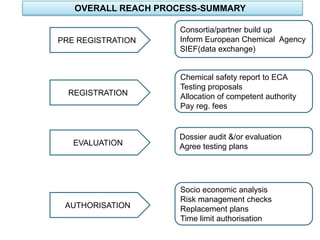
About REACH
REACH process in detail
What are “end points”?
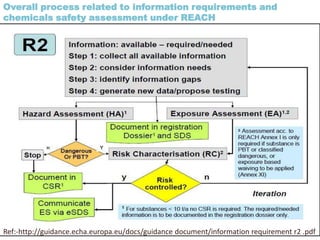
Chart describing overall process related to chemical safety assessment
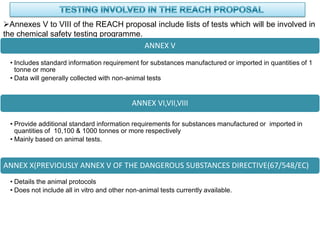
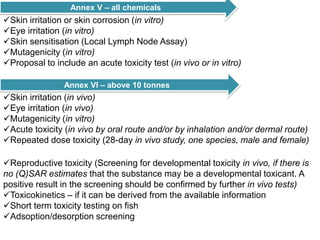
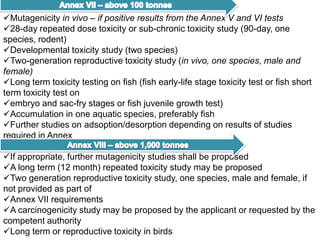
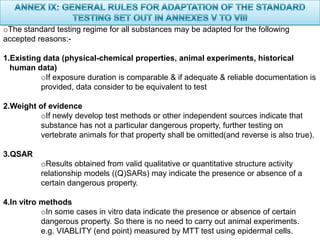
Testing involved in REACH proposal(annex V to X)
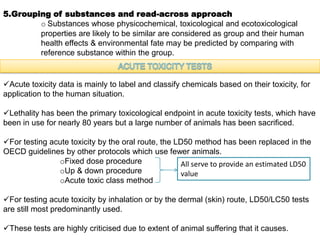
Acute toxicity tests
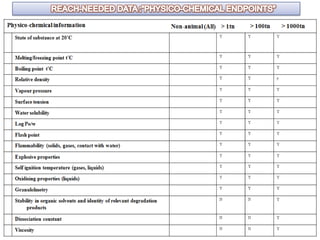
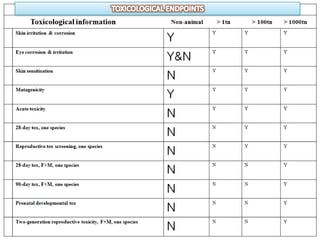
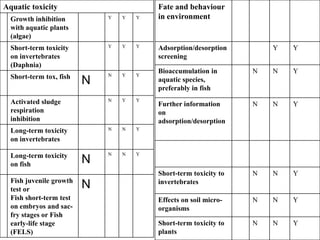
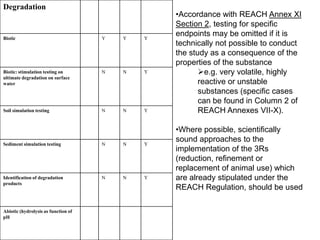
REACH-needed data of all the “end points”
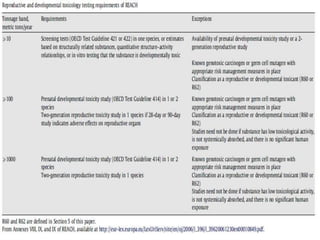
Reproductive & developmental toxicology testing requirements
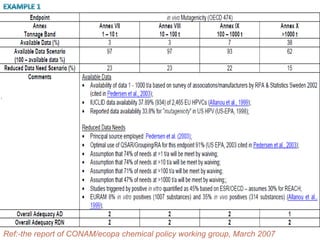
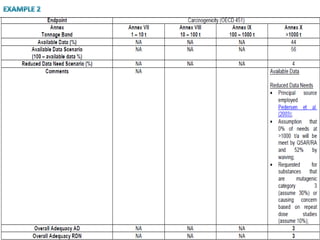
Examples
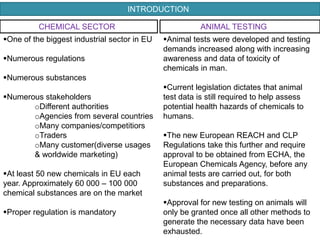
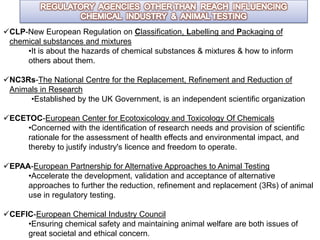
Brief introduction of other regulatory agencies                                                        INTRODUCTION                CHEMICAL SECTOR                 ANIMAL TESTINGOne of the biggest industrial sector in EU
Numerous regulations
Numerous substances
Numerous stakeholders
Different authorities
Agencies from several countries
Many companies/competitiors
Traders
Many customer(diverse usages& worldwide marketing)At least 50 new chemicals in EU eachyear. Approximately 60 000 – 100 000 chemical substances are on the marketProper regulation is mandatory
Animal tests were developed and testing demands increased along with increasing awareness and data of toxicity of chemicals in man.
Current legislation dictates that animal test data is still required to help assess potential health hazards of chemicals to humans.
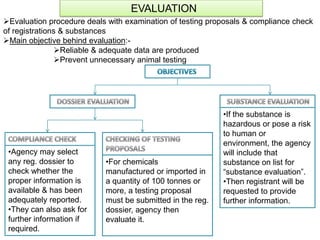
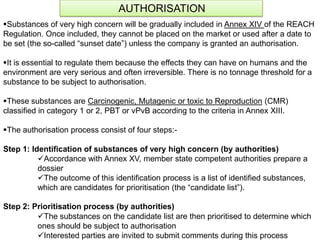
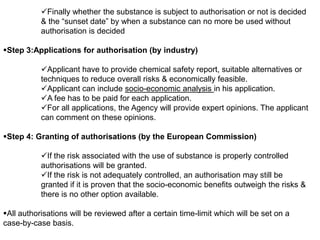
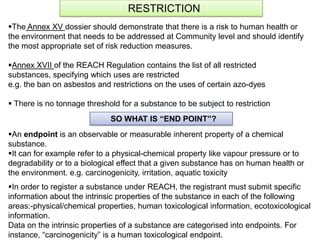
The new European REACH and CLP Regulations take this further and require approval to be obtained from ECHA, the European Chemicals Agency, before any animal tests are carried out, for both substances and preparations.
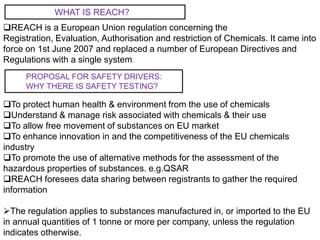
Approval for new testing on animals will only be granted once all other methods to generate the necessary data have been exhausted.REACH is a European Union regulation concerning the Registration, Evaluation, Authorisation and restriction of Chemicals. It came into force on 1st June 2007 and replaced a number of European Directives and Regulations with a single system.
To protect human health & environment from the use of chemicals
Understand & manage risk associated with chemicals & their use
To allow free movement of substances on EU market
To enhance innovation in and the competitiveness of the EU chemicals industry
To promote the use of alternative methods for the assessment of the hazardous properties of substances. e.g.QSAR

Animal testing safety endpoints in chemical industry

Editor's Notes

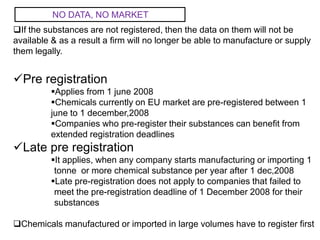
  • #6 Substances which have long been on EU market are called phase-in substances & those which have not previously been placed on the EU market are called non phase in substances
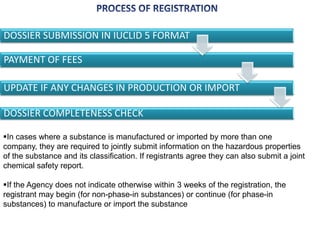
  • #8 IUCLID-international uniform chemical information database-IUCLID5 is built using internationally harmonized formats for reporting data on chemicals that were prepared and accepted by many national and international regulatory authorities within the OECD
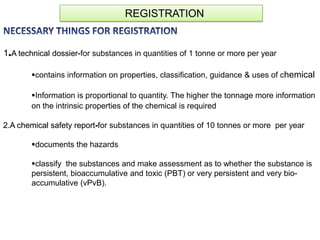
  • #10 1.Sunset date-the date (called 'the sunset date") from which the placing on the market and the use of that substance shall be prohibited unless an exemption applies or an authorisation is granted or an authorisation application has been submitted before the application date also specified in Annex XIV, but the Commission decision on the application for authorisation has not yet been taken2.PBT-Persistent, bioaccumulative & toxic-PBTs are substances of very high concern (SVHC) and may be included in Annex XIV and by that be made subject to authorisation3.vPvB-very persistent & very bioaccumulative-these are the substances which are very difficult to break downand very bio-accumulative in living organisms
  • #11 Socio economic analysis-is to evaluate what costs and benefits an action will create for society by comparing what will happen if this action is implemented as compared to the situation where the action is not implemented
  • #14 CSR-chemical safety reportPBT-persistent, bioaccumulative & toxicES-exposure scenario-Set of conditions, including operational conditions and risk management measures, that describe how the substance is manufactured or used during its life-cycle(REACH Article 3 (37))eSDS-extended safety data sheet
  • #15 It took 11 years to produce risk assessments for 140 chemicals, yet REACH proposes that industryproduce similar data for 30,000 chemicals, in the same timescale
  • #16 In vitro-taking place outside the body of an organism. It refers to studies in the laboratory usually involving isolated organs, tissues, cells or biochemical systemIn vivo-testing within a living organism
  • #19 1.LD50:-is the dose that kills half(50%) of the animals tested2.LC50:-is the concentration of a chemical which kills 50% of a sample population3.Trevan (1927) was the first to attempt to standardize a method for assessing the toxicity of potent biologicaltoxicants, the progenitor of the "lethal dose, 50% (LD50) test.4.more recently, the acute toxicity test procedure has been modified in various ways to refine and furtherreduce the number of animals used to a maximum of 16.
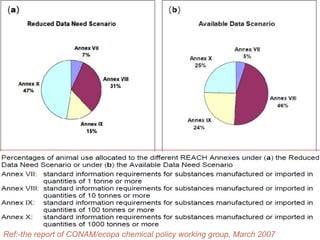
  • #20 In the “ReducedData Need” scenario, the overwhelming importance of the 2-generation reproductive study isvery evident accounting for 71% of animal use.When all reproduction or developmentaltests are considered together, this equates to >80% of animal use.
  • #21 Intrinsic property-An intrinsic property of a chemical substance is a characteristic of the substance which can be used to determine its fate or to identify potential hazards.