
Overview of the regulatory
work on PFASs under
REACH and CLP
Johanna Peltola-Thies
European Chemicals Agency
2
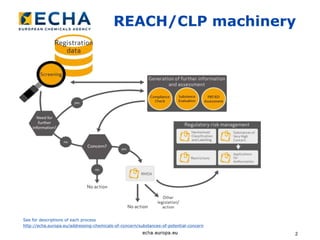
REACH/CLP machinery
See for descriptions of each process
http://echa.europa.eu/addressing-chemicals-of-concern/substances-of-potential-concern
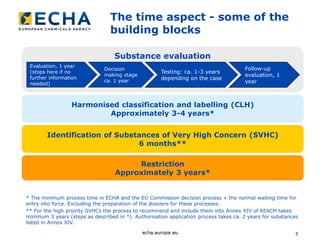
The time aspect - some of the
building blocks
3
Harmonised classification and labelling (CLH)
Approximately 3-4 years*
Identification of Substances of Very High Concern (SVHC)
6 months**
Restriction
Approximately 3 years*
Substance evaluation
Evaluation, 1 year
(stops here if no
further information
needed)
Decision
making stage
ca. 1 year
Testing: ca. 1-3 years
depending on the case
Follow-up
evaluation, 1
year
* The minimum process time in ECHA and the EU Commission decision process + the normal waiting time for
entry into force. Excluding the preparation of the dossiers for these processes.
** For the high priority SVHCs the process to recommend and include them into Annex XIV of REACH takes
minimum 3 years (steps as described in *). Authorisation application process takes ca. 2 years for substances
listed in Annex XIV.
4
Collaboration on PFASs
Informal collaboration focusing on PFASs in the regulatory
work started 2014
BE, DE, DK, NL, NO, SE, The European Commission, ECHA
Purpose to gain efficiency in handling PFASs of (potential) concern
PFASs are one of the substance categories to which ECHA
and the REACH Member State Competent Authorities pay
particular attention currently
ECHA supports and facilitates the work of the Member States
5
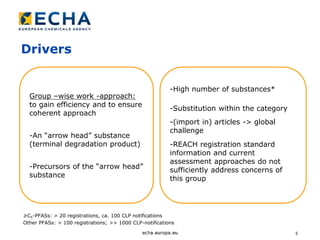
Drivers
Group –wise work -approach:
to gain efficiency and to ensure
coherent approach
-An “arrow head” substance
(terminal degradation product)
-Precursors of the “arrow head”
substance
-High number of substances*
-Substitution within the category
-(import in) articles -> global
challenge
-REACH registration standard
information and current
assessment approaches do not
sufficiently address concerns of
this group
≥C5-PFASs: > 20 registrations, ca. 100 CLP notifications
Other PFASs: > 100 registrations; >> 1000 CLP-notifications
6
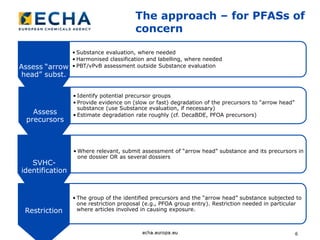
The approach – for PFASs of
concern
Assess “arrow
head” subst.
• Substance evaluation, where needed
• Harmonised classification and labelling, where needed
• PBT/vPvB assessment outside Substance evaluation
Assess
precursors
• Identify potential precursor groups
• Provide evidence on (slow or fast) degradation of the precursors to “arrow head”
substance (use Substance evaluation, if necessary)
• Estimate degradation rate roughly (cf. DecaBDE, PFOA precursors)
• Where relevant, submit assessment of “arrow head” substance and its precursors in
one dossier OR as several dossiers
• The group of the identified precursors and the “arrow head” substance subjected to
one restriction proposal (e.g., PFOA group entry). Restriction needed in particular
where articles involved in causing exposure.
SVHC-
identification
Restriction
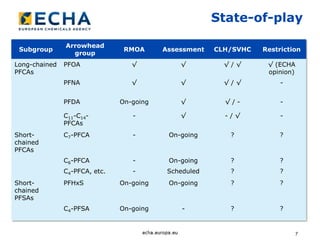
State-of-play
7
Subgroup
Arrowhead
group
RMOA Assessment CLH/SVHC Restriction
Long-chained
PFCAs
PFOA √ √ √ / √ √ (ECHA
opinion)
PFNA √ √ √ / √ -
PFDA On-going √ √ / - -
C11-C14-
PFCAs
- √ - / √ -
Short-
chained
PFCAs
C7-PFCA - On-going ? ?
C6-PFCA - On-going ? ?
C4-PFCA, etc. - Scheduled ? ?
Short-
chained
PFSAs
PFHxS On-going On-going ? ?
C4-PFSA On-going - ? ?
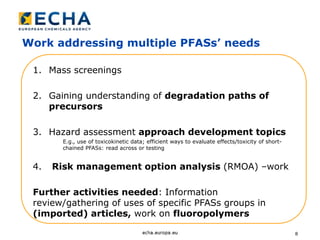
Work addressing multiple PFASs’ needs
8
1. Mass screenings
2. Gaining understanding of degradation paths of
precursors
3. Hazard assessment approach development topics
E.g., use of toxicokinetic data; efficient ways to evaluate effects/toxicity of short-
chained PFASs: read across or testing
4. Risk management option analysis (RMOA) –work
Further activities needed: Information
review/gathering of uses of specific PFASs groups in
(imported) articles, work on fluoropolymers
9
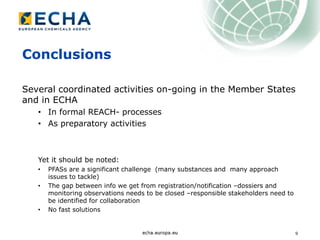
Conclusions
Several coordinated activities on-going in the Member States
and in ECHA
• In formal REACH- processes
• As preparatory activities
Yet it should be noted:
• PFASs are a significant challenge (many substances and many approach
issues to tackle)
• The gap between info we get from registration/notification –dossiers and
monitoring observations needs to be closed –responsible stakeholders need to
be identified for collaboration
• No fast solutions
10
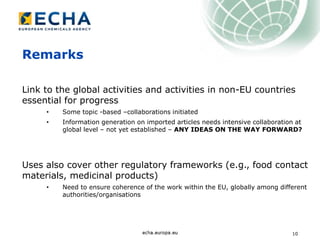
Remarks
Link to the global activities and activities in non-EU countries
essential for progress
• Some topic -based –collaborations initiated
• Information generation on imported articles needs intensive collaboration at
global level – not yet established – ANY IDEAS ON THE WAY FORWARD?
Uses also cover other regulatory frameworks (e.g., food contact
materials, medicinal products)
• Need to ensure coherence of the work within the EU, globally among different
authorities/organisations
Thank you!
Subscribe to our news at
echa.europa.eu/subscribe
Follow us on Twitter
@EU_ECHA
Follow us on Facebook
Facebook.com/EUECHA
johanna.peltola-thies@echa.europa.eu

HCF 2016: Johanna Peltola-Thies

  • 1.
    Overview of theregulatory work on PFASs under REACH and CLP Johanna Peltola-Thies European Chemicals Agency
  • 2.
    2 REACH/CLP machinery See fordescriptions of each process http://echa.europa.eu/addressing-chemicals-of-concern/substances-of-potential-concern
  • 3.
    The time aspect- some of the building blocks 3 Harmonised classification and labelling (CLH) Approximately 3-4 years* Identification of Substances of Very High Concern (SVHC) 6 months** Restriction Approximately 3 years* Substance evaluation Evaluation, 1 year (stops here if no further information needed) Decision making stage ca. 1 year Testing: ca. 1-3 years depending on the case Follow-up evaluation, 1 year * The minimum process time in ECHA and the EU Commission decision process + the normal waiting time for entry into force. Excluding the preparation of the dossiers for these processes. ** For the high priority SVHCs the process to recommend and include them into Annex XIV of REACH takes minimum 3 years (steps as described in *). Authorisation application process takes ca. 2 years for substances listed in Annex XIV.
  • 4.
    4 Collaboration on PFASs Informalcollaboration focusing on PFASs in the regulatory work started 2014 BE, DE, DK, NL, NO, SE, The European Commission, ECHA Purpose to gain efficiency in handling PFASs of (potential) concern PFASs are one of the substance categories to which ECHA and the REACH Member State Competent Authorities pay particular attention currently ECHA supports and facilitates the work of the Member States
  • 5.
    5 Drivers Group –wise work-approach: to gain efficiency and to ensure coherent approach -An “arrow head” substance (terminal degradation product) -Precursors of the “arrow head” substance -High number of substances* -Substitution within the category -(import in) articles -> global challenge -REACH registration standard information and current assessment approaches do not sufficiently address concerns of this group ≥C5-PFASs: > 20 registrations, ca. 100 CLP notifications Other PFASs: > 100 registrations; >> 1000 CLP-notifications
  • 6.
    6 The approach –for PFASs of concern Assess “arrow head” subst. • Substance evaluation, where needed • Harmonised classification and labelling, where needed • PBT/vPvB assessment outside Substance evaluation Assess precursors • Identify potential precursor groups • Provide evidence on (slow or fast) degradation of the precursors to “arrow head” substance (use Substance evaluation, if necessary) • Estimate degradation rate roughly (cf. DecaBDE, PFOA precursors) • Where relevant, submit assessment of “arrow head” substance and its precursors in one dossier OR as several dossiers • The group of the identified precursors and the “arrow head” substance subjected to one restriction proposal (e.g., PFOA group entry). Restriction needed in particular where articles involved in causing exposure. SVHC- identification Restriction
  • 7.
    State-of-play 7 Subgroup Arrowhead group RMOA Assessment CLH/SVHCRestriction Long-chained PFCAs PFOA √ √ √ / √ √ (ECHA opinion) PFNA √ √ √ / √ - PFDA On-going √ √ / - - C11-C14- PFCAs - √ - / √ - Short- chained PFCAs C7-PFCA - On-going ? ? C6-PFCA - On-going ? ? C4-PFCA, etc. - Scheduled ? ? Short- chained PFSAs PFHxS On-going On-going ? ? C4-PFSA On-going - ? ?
  • 8.
    Work addressing multiplePFASs’ needs 8 1. Mass screenings 2. Gaining understanding of degradation paths of precursors 3. Hazard assessment approach development topics E.g., use of toxicokinetic data; efficient ways to evaluate effects/toxicity of short- chained PFASs: read across or testing 4. Risk management option analysis (RMOA) –work Further activities needed: Information review/gathering of uses of specific PFASs groups in (imported) articles, work on fluoropolymers
  • 9.
    9 Conclusions Several coordinated activitieson-going in the Member States and in ECHA • In formal REACH- processes • As preparatory activities Yet it should be noted: • PFASs are a significant challenge (many substances and many approach issues to tackle) • The gap between info we get from registration/notification –dossiers and monitoring observations needs to be closed –responsible stakeholders need to be identified for collaboration • No fast solutions
  • 10.
    10 Remarks Link to theglobal activities and activities in non-EU countries essential for progress • Some topic -based –collaborations initiated • Information generation on imported articles needs intensive collaboration at global level – not yet established – ANY IDEAS ON THE WAY FORWARD? Uses also cover other regulatory frameworks (e.g., food contact materials, medicinal products) • Need to ensure coherence of the work within the EU, globally among different authorities/organisations
  • 11.
    Thank you! Subscribe toour news at echa.europa.eu/subscribe Follow us on Twitter @EU_ECHA Follow us on Facebook Facebook.com/EUECHA johanna.peltola-thies@echa.europa.eu