Substances of concern in products – whose
job is to control these in a free trade world?
The global challenge
Ravi Agarwal
Toxics Link
www.toxicslink.org
Helsinki Chemicals Forum
9 June 2017
Toxics Link
• Not-for-profit organisation since 1995
• Close to two decades work on chemicals and waste
• Research; Informing national and international policy;
Consumer information; Best practice models; Sector shift
• Chemicals safety and management (POPs, Pesticides, heavy
metals ( mercury, lead) EDCs, and other chemicals of
concern, food safety.
• Municipal Waste , Biomedical Waste, E-waste, Plastics,
Hazardous Waste, Contaminated sites, radioactive waste,
waste trade etc.)
• “Of the tens of thousands of chemicals on the market,
only a fraction has been thoroughly evaluated to
determine their effects on human health and the
environment…”*
• “Articles are important vehicles of the global transport
of chemicals with potentially significant impacts at
every stage of the product life cycle. *
• “The chemical intensification of developing country
economies has the potential to make this situation
worse. The supply chain is now longer and more
complex.” *
• “Annual global chemical sales doubled over the period
2000 to 2009, OECD’s share decreased from 77% to
63% and of the BRIICS countries (Brazil, Russia,
India, Indonesia, China, and South Africa) from 13%
to 28%. (OECD’s Environmental Outlook to 2050)
* Source : UNEP Global Chemicals Outlook (GCO)- 2012
Shifting and Increasing Global Burden
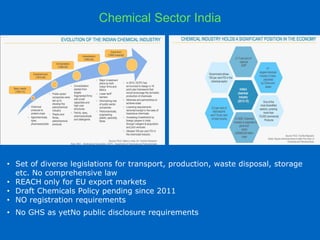
Chemical Sector India
• Set of diverse legislations for transport, production, waste disposal, storage
etc. No comprehensive law
• REACH only for EU export markets
• Draft Chemicals Policy pending since 2011
• NO registration requirements
• No GHS as yetNo public disclosure requirements
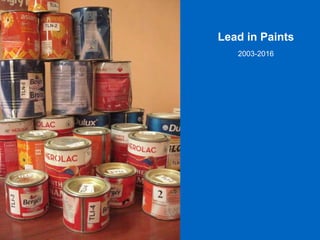
Lead in Paints
2003-2016
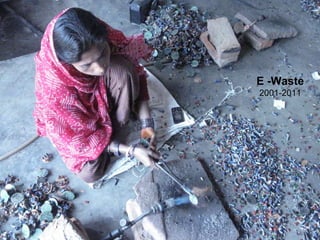
E -Waste
2001-2011
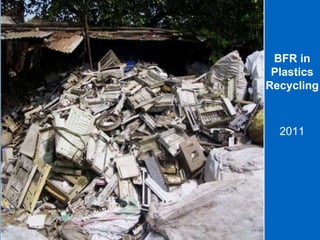
BFR in
Plastics
Recycling
2011
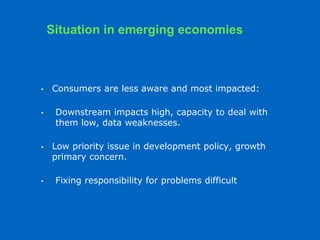
• Consumers are less aware and most impacted:
• Downstream impacts high, capacity to deal with
them low, data weaknesses.
• Low priority issue in development policy, growth
primary concern.
• Fixing responsibility for problems difficult
Situation in emerging economies
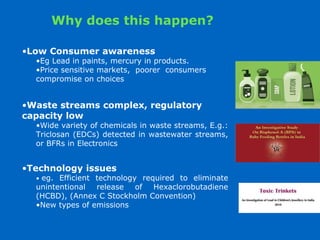
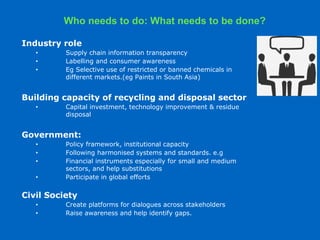
•Low Consumer awareness
•Eg Lead in paints, mercury in products.
•Price sensitive markets, poorer consumers
compromise on choices
•Waste streams complex, regulatory
capacity low
•Wide variety of chemicals in waste streams, E.g.:
Triclosan (EDCs) detected in wastewater streams,
or BFRs in Electronics
•Technology issues
• eg. Efficient technology required to eliminate
unintentional release of Hexaclorobutadiene
(HCBD), (Annex C Stockholm Convention)
•New types of emissions
Why does this happen?
Who needs to do: What needs to be done?
Industry role
• Supply chain information transparency
• Labelling and consumer awareness
• Eg Selective use of restricted or banned chemicals in
different markets.(eg Paints in South Asia)
Building capacity of recycling and disposal sector
• Capital investment, technology improvement & residue
disposal
Government:
• Policy framework, institutional capacity
• Following harmonised systems and standards. e.g
• Financial instruments especially for small and medium
sectors, and help substitutions
• Participate in global efforts
Civil Society
• Create platforms for dialogues across stakeholders
• Raise awareness and help identify gaps.
• “The vast majority of human health costs linked to chemicals
production, consumption and disposal are not borne by chemicals
producers or shared down the value-chain. Uncompensated harms
to human health and the environment are market failures that
need correction.”
• The increasing variety and complexity of chemicals and the ever
longer and more intricate chemical supply chains and waste
streams exposes serious gaps, lapses and inconsistencies in
government and international policies and corporate practices
• (UNEP’s Global Chemicals Outlook 2012)
Market Drivers alone are insufficient
•Where consumer awareness is low - market drivers are
insufficient
• Labelling etc. help create product differentiation, but without better options
do not necessarily provide change
• Awareness of risks is low
•Regulation as well as voluntary agreements helps
substitutions
• E.g.: BPA phase out in baby feeding bottles, BPA phase out from baby sippy
cups is voluntarily action to be included in the Infant Milk Substitutes Act,
Mercury to membrane based technology in Chlor-Alkali plants
•International lists help pinpoint chemicals, can they be
drivers?
• E.g.: SIN List, REACH, Stockholm Convention (POPs), Rotterdam Convention
•International/ national / regional actions are all needed
• Only International actions are insufficient since both markets and priorities
can be different and chemical industry is fragmented in size and products
• Developing countries need technology up-gradation and coping up with
several issues like education, cultural differences, basic amenities etc.
• Regulation needs to follow even norms and practices.
Thank You!
www.toxicslink.org

June 9 2017 Panel 5 Ravi Agarwal

  • 1.
    Substances of concernin products – whose job is to control these in a free trade world? The global challenge Ravi Agarwal Toxics Link www.toxicslink.org Helsinki Chemicals Forum 9 June 2017
  • 2.
    Toxics Link • Not-for-profitorganisation since 1995 • Close to two decades work on chemicals and waste • Research; Informing national and international policy; Consumer information; Best practice models; Sector shift • Chemicals safety and management (POPs, Pesticides, heavy metals ( mercury, lead) EDCs, and other chemicals of concern, food safety. • Municipal Waste , Biomedical Waste, E-waste, Plastics, Hazardous Waste, Contaminated sites, radioactive waste, waste trade etc.)
  • 3.
    • “Of thetens of thousands of chemicals on the market, only a fraction has been thoroughly evaluated to determine their effects on human health and the environment…”* • “Articles are important vehicles of the global transport of chemicals with potentially significant impacts at every stage of the product life cycle. * • “The chemical intensification of developing country economies has the potential to make this situation worse. The supply chain is now longer and more complex.” * • “Annual global chemical sales doubled over the period 2000 to 2009, OECD’s share decreased from 77% to 63% and of the BRIICS countries (Brazil, Russia, India, Indonesia, China, and South Africa) from 13% to 28%. (OECD’s Environmental Outlook to 2050) * Source : UNEP Global Chemicals Outlook (GCO)- 2012 Shifting and Increasing Global Burden
  • 4.
    Chemical Sector India •Set of diverse legislations for transport, production, waste disposal, storage etc. No comprehensive law • REACH only for EU export markets • Draft Chemicals Policy pending since 2011 • NO registration requirements • No GHS as yetNo public disclosure requirements
  • 5.
  • 6.
  • 7.
  • 8.
    • Consumers areless aware and most impacted: • Downstream impacts high, capacity to deal with them low, data weaknesses. • Low priority issue in development policy, growth primary concern. • Fixing responsibility for problems difficult Situation in emerging economies
  • 9.
    •Low Consumer awareness •EgLead in paints, mercury in products. •Price sensitive markets, poorer consumers compromise on choices •Waste streams complex, regulatory capacity low •Wide variety of chemicals in waste streams, E.g.: Triclosan (EDCs) detected in wastewater streams, or BFRs in Electronics •Technology issues • eg. Efficient technology required to eliminate unintentional release of Hexaclorobutadiene (HCBD), (Annex C Stockholm Convention) •New types of emissions Why does this happen?
  • 10.
    Who needs todo: What needs to be done? Industry role • Supply chain information transparency • Labelling and consumer awareness • Eg Selective use of restricted or banned chemicals in different markets.(eg Paints in South Asia) Building capacity of recycling and disposal sector • Capital investment, technology improvement & residue disposal Government: • Policy framework, institutional capacity • Following harmonised systems and standards. e.g • Financial instruments especially for small and medium sectors, and help substitutions • Participate in global efforts Civil Society • Create platforms for dialogues across stakeholders • Raise awareness and help identify gaps.
  • 11.
    • “The vastmajority of human health costs linked to chemicals production, consumption and disposal are not borne by chemicals producers or shared down the value-chain. Uncompensated harms to human health and the environment are market failures that need correction.” • The increasing variety and complexity of chemicals and the ever longer and more intricate chemical supply chains and waste streams exposes serious gaps, lapses and inconsistencies in government and international policies and corporate practices • (UNEP’s Global Chemicals Outlook 2012) Market Drivers alone are insufficient
  • 12.
    •Where consumer awarenessis low - market drivers are insufficient • Labelling etc. help create product differentiation, but without better options do not necessarily provide change • Awareness of risks is low •Regulation as well as voluntary agreements helps substitutions • E.g.: BPA phase out in baby feeding bottles, BPA phase out from baby sippy cups is voluntarily action to be included in the Infant Milk Substitutes Act, Mercury to membrane based technology in Chlor-Alkali plants •International lists help pinpoint chemicals, can they be drivers? • E.g.: SIN List, REACH, Stockholm Convention (POPs), Rotterdam Convention •International/ national / regional actions are all needed • Only International actions are insufficient since both markets and priorities can be different and chemical industry is fragmented in size and products • Developing countries need technology up-gradation and coping up with several issues like education, cultural differences, basic amenities etc. • Regulation needs to follow even norms and practices.
  • 13.