An Australian perspective
on the smarter use of available data
Panel 3: Global Data Sharing
Helsinki Chemicals Forum 2016
Dr Brian Richards
Executive Director, Office of Chemical Safety, Department of Health
Director, National Industrial Chemicals Notification and Assessment Scheme (NICNAS)
Lawmaking and regulation in Australia
May 2016 1
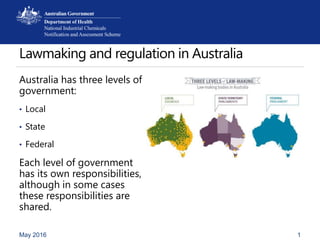
Australia has three levels of
government:
• Local
• State
• Federal
Each level of government
has its own responsibilities,
although in some cases
these responsibilities are
shared.
Industrial chemical regulation in Australia
All three levels of government regulate industrial chemicals.
1. NICNAS regulates the introduction of chemicals at the
Federal level.
2. States and territories regulate chemical use.
3. Local government regulates disposal.
May 2106 2
Rethinking the regulatory framework
2006 The Council of Australian Governments (COAG)
identified chemicals and plastics as a
‘regulatory hotspot’
2008 Australia’s Productivity Commission identified
a number of reform initiatives to improve the
efficiency and effectiveness of the chemical
management framework in Australia
2012-14 Review of NICNAS recommended reforms to the
regulation of industrial chemicals in Australia
May 2016 3
NICNAS Reforms
NICNAS Reforms were announced in May 2015 (to be
implemented by September 2018), and include:
• rebalancing pre- and post-market regulatory requirements
to match the indicative risk profile of a new chemical
• streamlining risk assessment processes for new
and existing industrial chemicals (including
‘International pathways’)
• greater utilisation of international assessment materials
• more appropriate compliance tools.
May 2016 4
NICNAS needs global data sharing
The new framework will:
• Use internationally available data for hazard categorisation
• Adopt common software for data management (i.e. IUCLID)
• Harmonise data requirements with comparable regulators,
international standards and risk assessment materials where
possible
• Enable ‘international pathways’ to facilitate a lighter regulatory
touch
• Improve public access to assessment data by linking inventory
entry to the assessment report about the chemical.
May 2016 5
NICNAS information sharing to date
NICNAS already shares assessment materials through:
• Bilateral engagement, primarily with Canada, US, Europe and
New Zealand
• Multilateral engagement through OECD (e.g. TFHA,CHNC,
WPMN), UNEP, WHO programs
• Assessment activities, informed by international public
databases, standards and guidelines, regulations and alerts (e.g.
IMAP Framework)
May 2016 6
Future global data sharing
NICNAS will continue to:
• publish information in the public interest
• engage with bilateral and multilateral partners
• encourage data sharing (such as QSAR results) with
international governments (with appropriate protection of
commercially confidential information)
• promote harmonisation by aligning regulatory approaches and
standardising criteria (eg polymers), volume thresholds, etc.
May 2016 7
IMAP - a NICNAS data sharing success story
• IMAP has assessed over 3300 existing chemicals since 2012
• IMAP assessments have resulted in significant risk management
action in Australia
• NICNAS engagement with other regulators and industry bodies
on chemical assessments has improved assessment outcomes
• NICNAS has enhanced the availability of chemicals safety
information by publishing its assessment outcomes for use by
other stakeholders, including other regulators
• NICNAS’s experience with IMAP is shared with other regulators
to inform future directions
May 2016 8
Why is IMAP successful?
• Builds on frameworks developed internationally, taking into
account lessons learned and evolving data sources i.e. CMP, REACH
• Makes use of the range of data generated or gathered by many
national and international agencies
• Applies available data in the Australian context to increase risk
assessment efficiency, reduce duplication of effort, and inform risk
management decisions
• Develops data management tools, QSAR strategies and
assessment methodologies based on international best practice
• Aligns human health and environmental scientific criteria with
hazard classification frameworks in use internationally
27 May, 2016 9
Should we aim for a global chemical dossier?
May 2016 10
• Already established in pharmaceutical
and IP sectors
• Possible where there is global
agreement on desirable minimum
data set (even if not mandatory)
• Facilitates further harmonisation
between regulators, while recognising
jurisdictional differences
• IUCLID enhancements that suit different
jurisdictions may make this easier
Summary
• Australia has already obtained significant benefit from
global data sharing
• We look forward to participating in ongoing efforts
to achieve greater global harmonisation of chemical
regulation
May 2016 11

HCF 2016: Brian Richards

  • 1.
    An Australian perspective onthe smarter use of available data Panel 3: Global Data Sharing Helsinki Chemicals Forum 2016 Dr Brian Richards Executive Director, Office of Chemical Safety, Department of Health Director, National Industrial Chemicals Notification and Assessment Scheme (NICNAS)
  • 2.
    Lawmaking and regulationin Australia May 2016 1 Australia has three levels of government: • Local • State • Federal Each level of government has its own responsibilities, although in some cases these responsibilities are shared.
  • 3.
    Industrial chemical regulationin Australia All three levels of government regulate industrial chemicals. 1. NICNAS regulates the introduction of chemicals at the Federal level. 2. States and territories regulate chemical use. 3. Local government regulates disposal. May 2106 2
  • 4.
    Rethinking the regulatoryframework 2006 The Council of Australian Governments (COAG) identified chemicals and plastics as a ‘regulatory hotspot’ 2008 Australia’s Productivity Commission identified a number of reform initiatives to improve the efficiency and effectiveness of the chemical management framework in Australia 2012-14 Review of NICNAS recommended reforms to the regulation of industrial chemicals in Australia May 2016 3
  • 5.
    NICNAS Reforms NICNAS Reformswere announced in May 2015 (to be implemented by September 2018), and include: • rebalancing pre- and post-market regulatory requirements to match the indicative risk profile of a new chemical • streamlining risk assessment processes for new and existing industrial chemicals (including ‘International pathways’) • greater utilisation of international assessment materials • more appropriate compliance tools. May 2016 4
  • 6.
    NICNAS needs globaldata sharing The new framework will: • Use internationally available data for hazard categorisation • Adopt common software for data management (i.e. IUCLID) • Harmonise data requirements with comparable regulators, international standards and risk assessment materials where possible • Enable ‘international pathways’ to facilitate a lighter regulatory touch • Improve public access to assessment data by linking inventory entry to the assessment report about the chemical. May 2016 5
  • 7.
    NICNAS information sharingto date NICNAS already shares assessment materials through: • Bilateral engagement, primarily with Canada, US, Europe and New Zealand • Multilateral engagement through OECD (e.g. TFHA,CHNC, WPMN), UNEP, WHO programs • Assessment activities, informed by international public databases, standards and guidelines, regulations and alerts (e.g. IMAP Framework) May 2016 6
  • 8.
    Future global datasharing NICNAS will continue to: • publish information in the public interest • engage with bilateral and multilateral partners • encourage data sharing (such as QSAR results) with international governments (with appropriate protection of commercially confidential information) • promote harmonisation by aligning regulatory approaches and standardising criteria (eg polymers), volume thresholds, etc. May 2016 7
  • 9.
    IMAP - aNICNAS data sharing success story • IMAP has assessed over 3300 existing chemicals since 2012 • IMAP assessments have resulted in significant risk management action in Australia • NICNAS engagement with other regulators and industry bodies on chemical assessments has improved assessment outcomes • NICNAS has enhanced the availability of chemicals safety information by publishing its assessment outcomes for use by other stakeholders, including other regulators • NICNAS’s experience with IMAP is shared with other regulators to inform future directions May 2016 8
  • 10.
    Why is IMAPsuccessful? • Builds on frameworks developed internationally, taking into account lessons learned and evolving data sources i.e. CMP, REACH • Makes use of the range of data generated or gathered by many national and international agencies • Applies available data in the Australian context to increase risk assessment efficiency, reduce duplication of effort, and inform risk management decisions • Develops data management tools, QSAR strategies and assessment methodologies based on international best practice • Aligns human health and environmental scientific criteria with hazard classification frameworks in use internationally 27 May, 2016 9
  • 11.
    Should we aimfor a global chemical dossier? May 2016 10 • Already established in pharmaceutical and IP sectors • Possible where there is global agreement on desirable minimum data set (even if not mandatory) • Facilitates further harmonisation between regulators, while recognising jurisdictional differences • IUCLID enhancements that suit different jurisdictions may make this easier
  • 12.
    Summary • Australia hasalready obtained significant benefit from global data sharing • We look forward to participating in ongoing efforts to achieve greater global harmonisation of chemical regulation May 2016 11