J. Allen Jeffrey et al Int. Journal of Engineering Research and Applications www.ijera.com
ISSN : 2248-9622, Vol. 4, Issue 4( Version 5), April 2014, pp.23-28
www.ijera.com 23 | P a g e
Experimental Analysis of Performance and Emission Parameters
of Neem Oil Ethyl Ester and HHO Gas Addition with Neem Oil
Ethyl Ester in a Single Cylinder Four Stroke Compression
Ignition Engine
J. Allen Jeffrey*, M Subramanian**
*Department of Automobile engineering, Hindustan University, Chennai-103
** Department of Automobile engineering, Hindustan University, Chennai-103
ABSTRACT
Need for alternate fuel is increasing day by day due various problems associated with the conventional fuels.
Present work is focussed on analysing experimentally the performance and emission characteristics of Neem oil
biodiesel and addition of HHO gas along with Neem oil biodiesel in a single cylinder compression ignition
engine. Biodiesel is extracted by tranesterification of non edible crude Neem oil using ethanol and Naoh as
catalyst. The biodiesel is blended with diesel. The blends used are N30 and N40. HHO gas is produced from the
process of electrolysis the HHO gas is the combination of hydrogen and oxygen. The produced gas is made to
pass through a moisture separator and sent along the intake manifold with the intake air. The performance and
emission characteristics are noted down and compared. It was observed that there was a rise in brake thermal
efficiency and lesser specific fuel consumption, Reduced Oxygen content in exhaust gases, lesser HC and CO
emission and there was a rise in NOX emission when HHO is supplemented with biodiesel
Keywords – Biodiesel, HHO (oxygen enriched hydrogen),Neem oil, Tranesterification
I. INTRODUCTION
The requirement of alternate fuel is
gradually increasing day by day due to limited supply
of fossil fuels a conventional engine requires diesel
or petrol for its combustion. This combustion of
fossil fuel releases huge amount of green house gases
these gases catches the heat in the atmosphere and
increasing price of fuel and scarcity alternate fuel
that is biodiesel from vegetable oil is a good
replacement for conventional petrol and diesel since
there is not much modification required in a present
IC engine. Vegetable oils have mesmerized attention
and have a potential renewable source for the
production of an alternative for conventional fuel.
There are various outcomes from vegetable oils
which have been utilized as an alternative fuel for
compression ignition engines, including straight
vegetable oil, mixtures of vegetable oil with diesel
fuel known as biodiesel blends and alcohol esters of
vegetable oils. Premkarthikkumar [1] has made an
analysis of combustion emission and performance
parameters of HHO Addition on a CI engine and
observed that the brake thermal efficiency increased
in terms of performance and in terms of emission
observed that the CO emission decreased and NOX
and CO2 emission increased on addition of HHO
gases.ALIchanyilmaz [2] investigated experimentally
the performance and emission parameters of HHO
addition and observed that there was a reduction in
HC and CO emission and reduced fuel consumption
S.Bari[3]investigated experimentally the performance
characteristics of H2/O2 gas addition and observed
higher peak pressure the brake thermal efficiency
increased and brake specific fuel consumption
reduced. Nagarajan [4] investigated experimentally
on performance and emission characteristics of Neem
oil Methyl Ester and found out that improved brake
thermal efficiency in certain blends and NOX
emission increased than diesel CO and HC emissions
were quite low. This work deals with studying the
performance and emission characteristics of biodiesel
(Neem oil Ethyl Ester) blends N30 (30% biodiesel
and 70% diesel) N40(40%biodiesel and 60%diesel)
and HHO biodiesel blends in a single cylinder
compression ignition engine HHO gas is produced
from the process of electrolysis the produced gas is
sent along the intake air. The extracted results are
compared and studied.
II. MATERIALS AND METHOD
2.1Transesterification of Neem oil
Vegetable oils are triglycerides of fatty acids
and alcohol esters of fatty acids have been prepared
by the transesterification of the glycerides, wherein
linear, monohydroxy alcohols reacts with the
vegetable oils in the presence of catalyst to produce
alcohol esters of vegetable oil. The alcohol esters of
vegetable oil when used as an alternative diesel fuel
have been identified as a biodiesel [15] .This process
RESEARCH ARTICLE OPEN ACCESS
J. Allen Jeffrey et al Int. Journal of Engineering Research and Applications www.ijera.com
ISSN : 2248-9622, Vol. 4, Issue 4( Version 5), April 2014, pp.23-28
www.ijera.com 24 | P a g e
is the well known process for preparing biodiesel
from raw Neem oil it is the process of breaking
heavier molecules present in Neem oil into lighter
ones. In this process 500 ml of crude Neem oil is
taken in a flask and it is heated and maintained at a
temperature of 500
C-650
C for 2hr and 45 min. Then
5grams of sodium hydroxide is completely made to
dissolve with 100 ml of ethanol after dissolving
sodium ethoxide solution is obtained. The obtained
solution is poured in the 500 ml of neem oil which is
maintained at 500
C-650
C. After pouring ethoxide
solution the oil is stirred for another hour and the
heated solution oil is poured in a separating flask for
separating glycerol and Neem oil ethyl ester biodiesel
and Neem oil ethyl ester (NOEE) is washed with
10% of distilled water to eradicate impurities the
obtained NOEE is given for fatty acid test and it is
blended with diesel.
Table (1) Fuel Properties of Neem oil biodiesel
blends
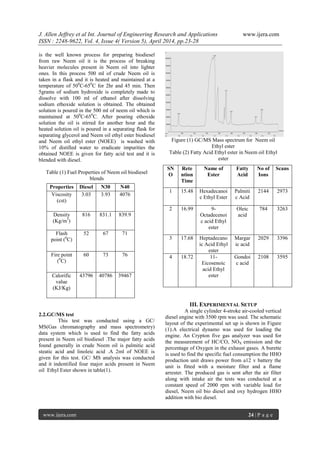
2.2.GC/MS test
This test was conducted using a GC/
MS(Gas chromatography and mass spectrometry)
data system which is used to find the fatty acids
present in Neem oil biodiesel .The major fatty acids
found generally in crude Neem oil is palmitic acid
steatic acid and linoleic acid .A 2ml of NOEE is
given for this test. GC/ MS analysis was conducted
and it indentified four major acids present in Neem
oil Ethyl Ester shown in table(1).
Figure (1) GC/MS Mass spectrum for Neem oil
Ethyl ester
Table (2) Fatty Acid Ethyl ester in Neem oil Ethyl
ester
III. EXPERIMENTAL SETUP
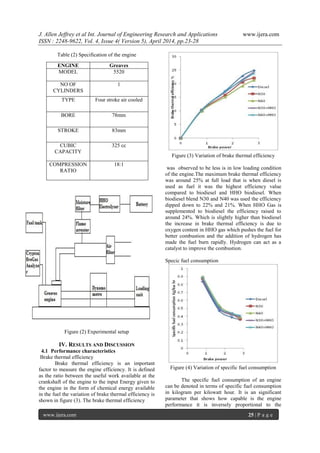
A single cylinder 4-stroke air-cooled vertical
diesel engine with 3500 rpm was used. The schematic
layout of the experimental set up is shown in Figure
(1).A electrical dynamo was used for loading the
engine. An Crypton five gas analyzer was used for
the measurement of HC/CO, NOX emission and the
percentage of Oxygen in the exhaust gases. A burette
is used to find the specific fuel consumption the HHO
production unit draws power from a12 v battery the
unit is fitted with a moisture filter and a flame
arrester. The produced gas is sent after the air filter
along with intake air the tests was conducted at a
constant speed of 2000 rpm with variable load for
diesel, Neem oil bio diesel and oxy hydrogen HHO
addition with bio diesel.
Properties Diesel N30 N40
Viscosity
(cst)
3.03 3.93 4076
Density
(Kg/m3
)
816 831.1 839.9
Flash
point (0
C)
52 67 71
Fire point
(0
C)
60 73 76
Calorific
value
(KJ/Kg)
43796 40786 39467
SN
O
Rete
ntion
Time
Name of
Ester
Fatty
Acid
No of
Ions
Scans
1 15.48 Hexadecanoi
c Ethyl Ester
Palmiti
c Acid
2144 2973
2 16.99 9-
Octadecenoi
c acid Ethyl
ester
Oleic
acid
784 3263
3 17.68 Heptadecano
ic Acid Ethyl
ester
Margar
ic acid
2029 3396
4 18.72 11-
Eicosenoic
acid Ethyl
ester
Gondoi
c acid
2108 3595
J. Allen Jeffrey et al Int. Journal of Engineering Research and Applications www.ijera.com
ISSN : 2248-9622, Vol. 4, Issue 4( Version 5), April 2014, pp.23-28
www.ijera.com 25 | P a g e
Table (2) Specification of the engine
Figure (2) Experimental setup
IV. RESULTS AND DISCUSSION
4.1 Performance characteristics
Brake thermal efficiency
Brake thermal efficiency is an important
factor to measure the engine efficiency. It is defined
as the ratio between the useful work available at the
crankshaft of the engine to the input Energy given to
the engine in the form of chemical energy available
in the fuel the variation of brake thermal efficiency is
shown in figure (3). The brake thermal efficiency
Figure (3) Variation of brake thermal efficiency
was observed to be less is in low loading condition
of the engine.The maximum brake thermal efficiency
was around 25% at full load that is when diesel is
used as fuel it was the highest efficiency value
compared to biodiesel and HHO biodiesel. When
biodiesel blend N30 and N40 was used the efficiency
dipped down to 22% and 21%. When HHO Gas is
supplemented to biodiesel the efficiency raised to
around 24%. Which is slightly higher than biodiesel
the increase in brake thermal efficiency is due to
oxygen content in HHO gas which pushes the fuel for
better combustion and the addition of hydrogen has
made the fuel burn rapidly. Hydrogen can act as a
catalyst to improve the combustion.
Specic fuel consumption
Figure (4) Variation of specific fuel consumption
The specific fuel consumption of an engine
can be denoted in terms of specific fuel consumption
in kilogram per kilowatt hour. It is an significant
parameter that shows how capable is the engine
performance it is inversely proportional to the
ENGINE Greaves
MODEL 5520
NO OF
CYLINDERS
1
TYPE Four stroke air cooled
BORE 78mm
STROKE 83mm
CUBIC
CAPACITY
325 cc
COMPRESSION
RATIO
18:1
J. Allen Jeffrey et al Int. Journal of Engineering Research and Applications www.ijera.com
ISSN : 2248-9622, Vol. 4, Issue 4( Version 5), April 2014, pp.23-28
www.ijera.com 26 | P a g e
thermal efficiency. The variation of the specific fuel
consumption is shown in figure (4). The diesel curve
remains at the bottom with least values the specific
consumption for biodiesel increased but when HHO
gas is supplemented it reduced but not less as
compared to diesel.
4.2.Emission Characteristics
CO emission
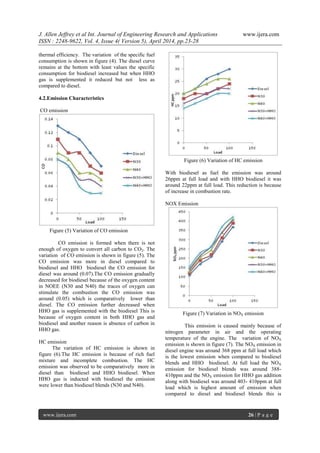
Figure (5) Variation of CO emission
CO emission is formed when there is not
enough of oxygen to convert all carbon to CO2. The
variation of CO emission is shown in figure (5). The
CO emission was more in diesel compared to
biodiesel and HHO biodiesel the CO emission for
diesel was around (0.07).The CO emission gradually
decreased for biodiesel because of the oxygen content
in NOEE (N30 and N40) the traces of oxygen can
stimulate the combustion the CO emission was
around (0.05) which is comparatively lower than
diesel. The CO emission further decreased when
HHO gas is supplemented with the biodiesel This is
because of oxygen content in both HHO gas and
biodiesel and another reason is absence of carbon in
HHO gas.
HC emission
The variation of HC emission is shown in
figure (6).The HC emission is because of rich fuel
mixture and incomplete combustion. The HC
emission was observed to be comparatively more in
diesel than biodiesel and HHO biodiesel. When
HHO gas is inducted with biodiesel the emission
were lower than biodiesel blends (N30 and N40).
Figure (6) Variation of HC emission
With biodiesel as fuel the emission was around
26ppm at full load and with HHO biodiesel it was
around 22ppm at full load. This reduction is because
of increase in combustion rate.
NOX Emission
Figure (7) Variation in NOX emission
This emission is caused mainly because of
nitrogen parameter in air and the operating
temperature of the engine. The variation of NOX
emission is shown in figure (7). The NOX emission in
diesel engine was around 368 ppm at full load which
is the lowest emission when compared to biodiesel
blends and HHO biodiesel. At full load the NOX
emission for biodiesel blends was around 388-
410ppm and the NOX emission for HHO gas addition
along with biodiesel was around 403- 410ppm at full
load which is highest amount of emission when
compared to diesel and biodiesel blends this is
J. Allen Jeffrey et al Int. Journal of Engineering Research and Applications www.ijera.com
ISSN : 2248-9622, Vol. 4, Issue 4( Version 5), April 2014, pp.23-28
www.ijera.com 27 | P a g e
because increase in operating temperature when
HHO gas is added.
Oxygen content in the exhaust
Figure (8) Variation of oxygen present in exhaust
The variation of Oxygen content in the
exhaust gases is shown in Figure (8). The average
percentage of oxygen content in exhaust gases when
diesel is used as a fuel was around 17%. When the
engine was operated at no load the percentage of
oxygen content was 17.79% and when engine is
operated at full load it was around 17.68% there was
a minute amount of reduction in oxygen when diesel
is used as fuel Now in case of biodiesel blends the
oxygen content was around 17.99% and 18% at no
load and 17.89% and 17.91%at full load it was
observed that there was a minute reduction in oxygen
content. But in case of HHO gas addition along with
biodiesel blends the percentage of oxygen was
around 17.98% and 18.01% at no load condition and
it reduced gradually to 17.21% and 17.25% at full
load this shows that hydrogen can enhance the
combustion rapidly and reduce the oxygen content in
the exhaust.
V. CONCLUSION
The single cylinder four stroke compression
ignition engine was triumphantly functioned with
NOEE blends and HHO NOEE blends and the
following results are concluded based on
experimental investigation
 The brake thermal efficiency increased when
HHO gas is supplemented with Biodiesel
compared to biodiesel blends.
 The specific fuel consumption remained low for
HHO supplementing biodiesel compared to
biodiesel blends.
 The CO emission were low for both biodiesel
and HHO biodiesel compared to diesel but in
terms of biodiesel and HHO biodiesel the
emission were low for HHO biodiesel.
 The HC emission were low for biodiesel and
HHO biodiesel compared to diesel but HC
emission was high for biodiesel compared to
HHO biodiesel.
 The NOX emission was observed to be high in
HHO biodiesel than biodiesel. There was an rise
in NOX emission in both biodiesel and HHO
biodiesel when compared to diesel.
 The oxygen content in the exhaust gradually
reduced when HHO is supplemented with
biodiesel when compared to diesel and biodiesel
blends this shows that HHO gas can enhance the
combustion.
ACKNOWLEDGEMENTS
The Authors likes to thank the Department
of Automobile Engineering Hindustan University for
their kind co-operation and SAIF lab IITM.
REFERENCES
[1] Premkarthik SR Annamalai Effectiveness of
oxygen enriched hydrogen along with intake
air in a CI engine performance and emission
2011
[2] Ali can yilmaz Effects of HHO Gas addition
on performance and exhaust emission in
compression ignition engine 2010 1-7
Science direct
[3] S.Brai Effects of H2/O2 gas addition in
increasing the thermal efficiency Elseiver
fuel 89 (2010) 378-383
[4] Ngarajan and Tamilporai Evaluation of
performance and emission of NOME in a DI
engine AJCSIT 3:4 2013 50-55
[5] Adrian Birtas the Effect of HRG gas
addition on diesel engine combustion and
emission characteristics 2011 internal
journal hydrogen energy 36
[6] R B Durairaj shanker sivasankaran HHO gas
with bio diesel as a duel fuel with air pre
heating technology 2012 procedia 1112-
1119
[7] Adrian Birtas the Effect of HRG gas
addition on diesel engine combustion and
emission characteristics 2011 internal
journal hydrogen energy 36
[8] Radu Chiriac, Nicolae Apostolescu Effects
of Gasoline-Air Enrichment with HRG Gas
on Efficiency and Emissions of a SI Engine
2006- 01- 3431 SAE International
[9] Combustion performance and emission
characteristics of diesel engine with neem
oil methyl ester and its diesel blends
American journal of applied sciences 10
810-813 2013
J. Allen Jeffrey et al Int. Journal of Engineering Research and Applications www.ijera.com
ISSN : 2248-9622, Vol. 4, Issue 4( Version 5), April 2014, pp.23-28
www.ijera.com 28 | P a g e
[10] Stasa Puskarici,Damir Effects of Various
Fuel blends in a SI Engine Performance of a
Two-stroke Internal Combustion
Engine2010 RI Think, Vol. 2
[11] Hanumanth Navindgi Extraction of
Biodiesel from vegetable oil and their
comparison 2012 April ISSN 2249-9954
[12] Lovekush Prasad Alka Agarwal
Experimental investigation of Performance
of diesel engine working on diesel and
Neem oil blends August 2012 ISSN 2278-
1684
[13] Vivek pathak amitesh paul Experimental
investigation of Performance and Emission
characteristics of diesel engine with Neem
oil methyl ester October 2013 ISSN 2249-
6645
[14] T Sathya Manivanan Biodiesel production
from neem oil using two step
transesterification May 2013 ISSN 2248-
9622
[15] Paragsaxena Jayali Jawale Milind H
Joshipura A review on prediction of
properties of biodiesel and blends of
biodiesel 51(2013) 395-402
[16] Vijyabalan Govindan Performance emission
combustion characteristics of a CI engine
using LPG and Neem oil in a duel fuel mode
Thermal science: 2010 Vol 14.
[17] Analysis and identification of fatty acid
methyl ester composition in different
vegetable oils source using GC/MS
Experimental notes gcms clarus
[18] Prabhu sathish kumar combustion
performance emission characteristic of CI
engine with neem oil methyl ester and its
diesel blends 2013 American Journal of
Applied Sciences 10 810-818

E044052328

  • 1.
    J. Allen Jeffreyet al Int. Journal of Engineering Research and Applications www.ijera.com ISSN : 2248-9622, Vol. 4, Issue 4( Version 5), April 2014, pp.23-28 www.ijera.com 23 | P a g e Experimental Analysis of Performance and Emission Parameters of Neem Oil Ethyl Ester and HHO Gas Addition with Neem Oil Ethyl Ester in a Single Cylinder Four Stroke Compression Ignition Engine J. Allen Jeffrey*, M Subramanian** *Department of Automobile engineering, Hindustan University, Chennai-103 ** Department of Automobile engineering, Hindustan University, Chennai-103 ABSTRACT Need for alternate fuel is increasing day by day due various problems associated with the conventional fuels. Present work is focussed on analysing experimentally the performance and emission characteristics of Neem oil biodiesel and addition of HHO gas along with Neem oil biodiesel in a single cylinder compression ignition engine. Biodiesel is extracted by tranesterification of non edible crude Neem oil using ethanol and Naoh as catalyst. The biodiesel is blended with diesel. The blends used are N30 and N40. HHO gas is produced from the process of electrolysis the HHO gas is the combination of hydrogen and oxygen. The produced gas is made to pass through a moisture separator and sent along the intake manifold with the intake air. The performance and emission characteristics are noted down and compared. It was observed that there was a rise in brake thermal efficiency and lesser specific fuel consumption, Reduced Oxygen content in exhaust gases, lesser HC and CO emission and there was a rise in NOX emission when HHO is supplemented with biodiesel Keywords – Biodiesel, HHO (oxygen enriched hydrogen),Neem oil, Tranesterification I. INTRODUCTION The requirement of alternate fuel is gradually increasing day by day due to limited supply of fossil fuels a conventional engine requires diesel or petrol for its combustion. This combustion of fossil fuel releases huge amount of green house gases these gases catches the heat in the atmosphere and increasing price of fuel and scarcity alternate fuel that is biodiesel from vegetable oil is a good replacement for conventional petrol and diesel since there is not much modification required in a present IC engine. Vegetable oils have mesmerized attention and have a potential renewable source for the production of an alternative for conventional fuel. There are various outcomes from vegetable oils which have been utilized as an alternative fuel for compression ignition engines, including straight vegetable oil, mixtures of vegetable oil with diesel fuel known as biodiesel blends and alcohol esters of vegetable oils. Premkarthikkumar [1] has made an analysis of combustion emission and performance parameters of HHO Addition on a CI engine and observed that the brake thermal efficiency increased in terms of performance and in terms of emission observed that the CO emission decreased and NOX and CO2 emission increased on addition of HHO gases.ALIchanyilmaz [2] investigated experimentally the performance and emission parameters of HHO addition and observed that there was a reduction in HC and CO emission and reduced fuel consumption S.Bari[3]investigated experimentally the performance characteristics of H2/O2 gas addition and observed higher peak pressure the brake thermal efficiency increased and brake specific fuel consumption reduced. Nagarajan [4] investigated experimentally on performance and emission characteristics of Neem oil Methyl Ester and found out that improved brake thermal efficiency in certain blends and NOX emission increased than diesel CO and HC emissions were quite low. This work deals with studying the performance and emission characteristics of biodiesel (Neem oil Ethyl Ester) blends N30 (30% biodiesel and 70% diesel) N40(40%biodiesel and 60%diesel) and HHO biodiesel blends in a single cylinder compression ignition engine HHO gas is produced from the process of electrolysis the produced gas is sent along the intake air. The extracted results are compared and studied. II. MATERIALS AND METHOD 2.1Transesterification of Neem oil Vegetable oils are triglycerides of fatty acids and alcohol esters of fatty acids have been prepared by the transesterification of the glycerides, wherein linear, monohydroxy alcohols reacts with the vegetable oils in the presence of catalyst to produce alcohol esters of vegetable oil. The alcohol esters of vegetable oil when used as an alternative diesel fuel have been identified as a biodiesel [15] .This process RESEARCH ARTICLE OPEN ACCESS
  • 2.
    J. Allen Jeffreyet al Int. Journal of Engineering Research and Applications www.ijera.com ISSN : 2248-9622, Vol. 4, Issue 4( Version 5), April 2014, pp.23-28 www.ijera.com 24 | P a g e is the well known process for preparing biodiesel from raw Neem oil it is the process of breaking heavier molecules present in Neem oil into lighter ones. In this process 500 ml of crude Neem oil is taken in a flask and it is heated and maintained at a temperature of 500 C-650 C for 2hr and 45 min. Then 5grams of sodium hydroxide is completely made to dissolve with 100 ml of ethanol after dissolving sodium ethoxide solution is obtained. The obtained solution is poured in the 500 ml of neem oil which is maintained at 500 C-650 C. After pouring ethoxide solution the oil is stirred for another hour and the heated solution oil is poured in a separating flask for separating glycerol and Neem oil ethyl ester biodiesel and Neem oil ethyl ester (NOEE) is washed with 10% of distilled water to eradicate impurities the obtained NOEE is given for fatty acid test and it is blended with diesel. Table (1) Fuel Properties of Neem oil biodiesel blends 2.2.GC/MS test This test was conducted using a GC/ MS(Gas chromatography and mass spectrometry) data system which is used to find the fatty acids present in Neem oil biodiesel .The major fatty acids found generally in crude Neem oil is palmitic acid steatic acid and linoleic acid .A 2ml of NOEE is given for this test. GC/ MS analysis was conducted and it indentified four major acids present in Neem oil Ethyl Ester shown in table(1). Figure (1) GC/MS Mass spectrum for Neem oil Ethyl ester Table (2) Fatty Acid Ethyl ester in Neem oil Ethyl ester III. EXPERIMENTAL SETUP A single cylinder 4-stroke air-cooled vertical diesel engine with 3500 rpm was used. The schematic layout of the experimental set up is shown in Figure (1).A electrical dynamo was used for loading the engine. An Crypton five gas analyzer was used for the measurement of HC/CO, NOX emission and the percentage of Oxygen in the exhaust gases. A burette is used to find the specific fuel consumption the HHO production unit draws power from a12 v battery the unit is fitted with a moisture filter and a flame arrester. The produced gas is sent after the air filter along with intake air the tests was conducted at a constant speed of 2000 rpm with variable load for diesel, Neem oil bio diesel and oxy hydrogen HHO addition with bio diesel. Properties Diesel N30 N40 Viscosity (cst) 3.03 3.93 4076 Density (Kg/m3 ) 816 831.1 839.9 Flash point (0 C) 52 67 71 Fire point (0 C) 60 73 76 Calorific value (KJ/Kg) 43796 40786 39467 SN O Rete ntion Time Name of Ester Fatty Acid No of Ions Scans 1 15.48 Hexadecanoi c Ethyl Ester Palmiti c Acid 2144 2973 2 16.99 9- Octadecenoi c acid Ethyl ester Oleic acid 784 3263 3 17.68 Heptadecano ic Acid Ethyl ester Margar ic acid 2029 3396 4 18.72 11- Eicosenoic acid Ethyl ester Gondoi c acid 2108 3595
  • 3.
    J. Allen Jeffreyet al Int. Journal of Engineering Research and Applications www.ijera.com ISSN : 2248-9622, Vol. 4, Issue 4( Version 5), April 2014, pp.23-28 www.ijera.com 25 | P a g e Table (2) Specification of the engine Figure (2) Experimental setup IV. RESULTS AND DISCUSSION 4.1 Performance characteristics Brake thermal efficiency Brake thermal efficiency is an important factor to measure the engine efficiency. It is defined as the ratio between the useful work available at the crankshaft of the engine to the input Energy given to the engine in the form of chemical energy available in the fuel the variation of brake thermal efficiency is shown in figure (3). The brake thermal efficiency Figure (3) Variation of brake thermal efficiency was observed to be less is in low loading condition of the engine.The maximum brake thermal efficiency was around 25% at full load that is when diesel is used as fuel it was the highest efficiency value compared to biodiesel and HHO biodiesel. When biodiesel blend N30 and N40 was used the efficiency dipped down to 22% and 21%. When HHO Gas is supplemented to biodiesel the efficiency raised to around 24%. Which is slightly higher than biodiesel the increase in brake thermal efficiency is due to oxygen content in HHO gas which pushes the fuel for better combustion and the addition of hydrogen has made the fuel burn rapidly. Hydrogen can act as a catalyst to improve the combustion. Specic fuel consumption Figure (4) Variation of specific fuel consumption The specific fuel consumption of an engine can be denoted in terms of specific fuel consumption in kilogram per kilowatt hour. It is an significant parameter that shows how capable is the engine performance it is inversely proportional to the ENGINE Greaves MODEL 5520 NO OF CYLINDERS 1 TYPE Four stroke air cooled BORE 78mm STROKE 83mm CUBIC CAPACITY 325 cc COMPRESSION RATIO 18:1
  • 4.
    J. Allen Jeffreyet al Int. Journal of Engineering Research and Applications www.ijera.com ISSN : 2248-9622, Vol. 4, Issue 4( Version 5), April 2014, pp.23-28 www.ijera.com 26 | P a g e thermal efficiency. The variation of the specific fuel consumption is shown in figure (4). The diesel curve remains at the bottom with least values the specific consumption for biodiesel increased but when HHO gas is supplemented it reduced but not less as compared to diesel. 4.2.Emission Characteristics CO emission Figure (5) Variation of CO emission CO emission is formed when there is not enough of oxygen to convert all carbon to CO2. The variation of CO emission is shown in figure (5). The CO emission was more in diesel compared to biodiesel and HHO biodiesel the CO emission for diesel was around (0.07).The CO emission gradually decreased for biodiesel because of the oxygen content in NOEE (N30 and N40) the traces of oxygen can stimulate the combustion the CO emission was around (0.05) which is comparatively lower than diesel. The CO emission further decreased when HHO gas is supplemented with the biodiesel This is because of oxygen content in both HHO gas and biodiesel and another reason is absence of carbon in HHO gas. HC emission The variation of HC emission is shown in figure (6).The HC emission is because of rich fuel mixture and incomplete combustion. The HC emission was observed to be comparatively more in diesel than biodiesel and HHO biodiesel. When HHO gas is inducted with biodiesel the emission were lower than biodiesel blends (N30 and N40). Figure (6) Variation of HC emission With biodiesel as fuel the emission was around 26ppm at full load and with HHO biodiesel it was around 22ppm at full load. This reduction is because of increase in combustion rate. NOX Emission Figure (7) Variation in NOX emission This emission is caused mainly because of nitrogen parameter in air and the operating temperature of the engine. The variation of NOX emission is shown in figure (7). The NOX emission in diesel engine was around 368 ppm at full load which is the lowest emission when compared to biodiesel blends and HHO biodiesel. At full load the NOX emission for biodiesel blends was around 388- 410ppm and the NOX emission for HHO gas addition along with biodiesel was around 403- 410ppm at full load which is highest amount of emission when compared to diesel and biodiesel blends this is
  • 5.
    J. Allen Jeffreyet al Int. Journal of Engineering Research and Applications www.ijera.com ISSN : 2248-9622, Vol. 4, Issue 4( Version 5), April 2014, pp.23-28 www.ijera.com 27 | P a g e because increase in operating temperature when HHO gas is added. Oxygen content in the exhaust Figure (8) Variation of oxygen present in exhaust The variation of Oxygen content in the exhaust gases is shown in Figure (8). The average percentage of oxygen content in exhaust gases when diesel is used as a fuel was around 17%. When the engine was operated at no load the percentage of oxygen content was 17.79% and when engine is operated at full load it was around 17.68% there was a minute amount of reduction in oxygen when diesel is used as fuel Now in case of biodiesel blends the oxygen content was around 17.99% and 18% at no load and 17.89% and 17.91%at full load it was observed that there was a minute reduction in oxygen content. But in case of HHO gas addition along with biodiesel blends the percentage of oxygen was around 17.98% and 18.01% at no load condition and it reduced gradually to 17.21% and 17.25% at full load this shows that hydrogen can enhance the combustion rapidly and reduce the oxygen content in the exhaust. V. CONCLUSION The single cylinder four stroke compression ignition engine was triumphantly functioned with NOEE blends and HHO NOEE blends and the following results are concluded based on experimental investigation  The brake thermal efficiency increased when HHO gas is supplemented with Biodiesel compared to biodiesel blends.  The specific fuel consumption remained low for HHO supplementing biodiesel compared to biodiesel blends.  The CO emission were low for both biodiesel and HHO biodiesel compared to diesel but in terms of biodiesel and HHO biodiesel the emission were low for HHO biodiesel.  The HC emission were low for biodiesel and HHO biodiesel compared to diesel but HC emission was high for biodiesel compared to HHO biodiesel.  The NOX emission was observed to be high in HHO biodiesel than biodiesel. There was an rise in NOX emission in both biodiesel and HHO biodiesel when compared to diesel.  The oxygen content in the exhaust gradually reduced when HHO is supplemented with biodiesel when compared to diesel and biodiesel blends this shows that HHO gas can enhance the combustion. ACKNOWLEDGEMENTS The Authors likes to thank the Department of Automobile Engineering Hindustan University for their kind co-operation and SAIF lab IITM. REFERENCES [1] Premkarthik SR Annamalai Effectiveness of oxygen enriched hydrogen along with intake air in a CI engine performance and emission 2011 [2] Ali can yilmaz Effects of HHO Gas addition on performance and exhaust emission in compression ignition engine 2010 1-7 Science direct [3] S.Brai Effects of H2/O2 gas addition in increasing the thermal efficiency Elseiver fuel 89 (2010) 378-383 [4] Ngarajan and Tamilporai Evaluation of performance and emission of NOME in a DI engine AJCSIT 3:4 2013 50-55 [5] Adrian Birtas the Effect of HRG gas addition on diesel engine combustion and emission characteristics 2011 internal journal hydrogen energy 36 [6] R B Durairaj shanker sivasankaran HHO gas with bio diesel as a duel fuel with air pre heating technology 2012 procedia 1112- 1119 [7] Adrian Birtas the Effect of HRG gas addition on diesel engine combustion and emission characteristics 2011 internal journal hydrogen energy 36 [8] Radu Chiriac, Nicolae Apostolescu Effects of Gasoline-Air Enrichment with HRG Gas on Efficiency and Emissions of a SI Engine 2006- 01- 3431 SAE International [9] Combustion performance and emission characteristics of diesel engine with neem oil methyl ester and its diesel blends American journal of applied sciences 10 810-813 2013
  • 6.
    J. Allen Jeffreyet al Int. Journal of Engineering Research and Applications www.ijera.com ISSN : 2248-9622, Vol. 4, Issue 4( Version 5), April 2014, pp.23-28 www.ijera.com 28 | P a g e [10] Stasa Puskarici,Damir Effects of Various Fuel blends in a SI Engine Performance of a Two-stroke Internal Combustion Engine2010 RI Think, Vol. 2 [11] Hanumanth Navindgi Extraction of Biodiesel from vegetable oil and their comparison 2012 April ISSN 2249-9954 [12] Lovekush Prasad Alka Agarwal Experimental investigation of Performance of diesel engine working on diesel and Neem oil blends August 2012 ISSN 2278- 1684 [13] Vivek pathak amitesh paul Experimental investigation of Performance and Emission characteristics of diesel engine with Neem oil methyl ester October 2013 ISSN 2249- 6645 [14] T Sathya Manivanan Biodiesel production from neem oil using two step transesterification May 2013 ISSN 2248- 9622 [15] Paragsaxena Jayali Jawale Milind H Joshipura A review on prediction of properties of biodiesel and blends of biodiesel 51(2013) 395-402 [16] Vijyabalan Govindan Performance emission combustion characteristics of a CI engine using LPG and Neem oil in a duel fuel mode Thermal science: 2010 Vol 14. [17] Analysis and identification of fatty acid methyl ester composition in different vegetable oils source using GC/MS Experimental notes gcms clarus [18] Prabhu sathish kumar combustion performance emission characteristic of CI engine with neem oil methyl ester and its diesel blends 2013 American Journal of Applied Sciences 10 810-818