Developmental Education
Redesign in Colorado
Community Colleges
ALP at BCCC 2014
The problem
“The more levels of developmental courses a student
needs to go through, the less likely that student is to
ever complete college English or math.”
- Thomas Bailey (2009) CCRC Brief.
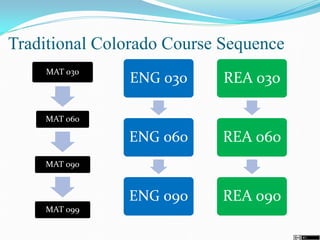
Traditional Colorado Course Sequence
MAT 030
MAT 060
MAT 090
MAT 099
ENG 030
ENG 060
ENG 090
REA 030
REA 060
REA 090
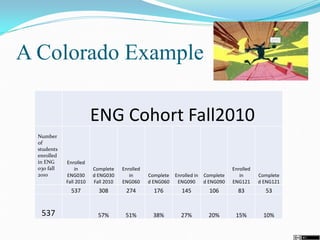
A Colorado Example
ENG Cohort Fall2010
Number
of
students
enrolled
in ENG
030 fall
2010
Enrolled
in
ENG030
Fall 2010
Complete
d ENG030
Fall 2010
Enrolled
in
ENG060
Complete
d ENG060
Enrolled in
ENG090
Complete
d ENG090
Enrolled
in
ENG121
Complete
d ENG121
537 308 274 176 145 106 83 53
537 57% 51% 38% 27% 20% 15% 10%
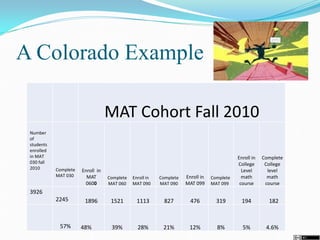
A Colorado Example
MAT Cohort Fall 2010
Number
of
students
enrolled
in MAT
030 fall
2010 Complete
MAT 030
Enroll in
MAT
0600
Complete
MAT 060
Enroll in
MAT 090
Complete
MAT 090
Enroll in
MAT 099
Complete
MAT 099
Enroll in
College
Level
math
course
Complete
College
level
math
course
3926
2245 1896 1521 1113 827 476 319 194 182
57% 48% 39% 28% 21% 12% 8% 5% 4.6%
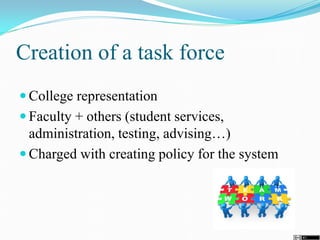
Creation of a task force
 College representation
 Faculty + others (student services,
administration, testing, advising…)
 Charged with creating policy for the system
The goal of the redesign
.
A developmental education redesign that
will move students quickly and
effectively (and successfully) through
their first college level course.
National models considered
 Washington State - iBest
 Tennessee – emporium
 Los Medinos - acceleration in math
 Community College Baltimore County - ALP
 Chabot College – Integrated reading and English
 University of Texas - new mathways
 Austin Peay State - mainstreaming
February 2013
CCCS Board approves the
Task Force recommendations
To accelerate students by reducing the amount of time,
number of developmental credits, and number of courses
in the developmental sequence so students can have access
to and be supported for success in a college level course.
Timeline
 Spring/summer 2013: discipline team developed curriculum
and created professional development training for faculty
and staff
 Fall of 2013: schools who were already working on redesign
ramped up projects
 Spring 2014: all colleges transition to the new models
 PCC, TSJC, NJC, CNCC, LCC, and OJC are in full
implementation for spring 2014
 Fall of 2014: all colleges will be operating with the new
models in place
What “Redesign” looks like
 Math – pathways at the developmental level
 Algebra
 Non-Algebra (statistics and math for liberal arts)
 Non-transfer (career math, clinical calculations)
 Mainstreaming with supplemental instruction when possible
 College Composition and Reading (formerly reading and
English)
 Integrated disciplines
 Options for delivery (CCR 092 0r CCR 093 or CCR 094)
 Mainstreaming when possible
 Tiers of student support in classrooms
Implementation teams
 Core implementation team
 Faculty
 Focused on curriculum, content, training, and professional
development
 Redesign advisory process
 Administrative (Banner, fiscal, advising, financial aid)
 Testing – faculty for content. Testing center directors when
we have a platform to experiment with.
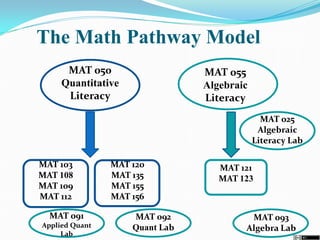
The Math Pathway Model
MAT 050
Quantitative
Literacy
MAT 103
MAT 108
MAT 109
MAT 112
MAT 055
Algebraic
Literacy
MAT 121
MAT 123
MAT 025
Algebraic
Literacy Lab
MAT 120
MAT 135
MAT 155
MAT 156
MAT 093
Algebra Lab
MAT 091
Applied Quant
Lab
MAT 092
Quant Lab
Why Two Pathways?
Students pursuing Non-STEM majors need different math skills than
students pursuing STEM majors
Examples of Career and Technical: Medical Office Technology,
Automotive Tech, Radiology
Examples of Non-STEM: Journalism, Communications, Education
Examples of STEM: Engineering and the Sciences
As a result of these different needs, the learning objectives for the new
courses were created using reverse design and overlap was removed
Assessment Prep
 Non-credit, low-cost to the student, not
Financial Aid eligible
 Expected outcomes:
 Students re-test to place into chosen
pathway
 Refresh to raise placement
 Suggested topics
 Institutional choices
MAT050 Quantitative Literacy
EA >30-84 or AR >40
 4 credit course
 Expected Outcome:
Students are prepared to succeed in the college-
level non-STEM or career and technical math
course that is part of their career pathway
 Institutional choices
MAT 055 Algebraic Literacy
EA 60-84
 4 credits
 Expected Outcome:
Students are prepared to succeed in MAT 121 or MAT
123
 Institutional choices
Co-Requisite Labs
MAT 025 Algebraic Literacy Lab
 EA 45 - 59 Supports MAT 055 Algebraic Literacy
MAT 091 Applied Quant Lab
 EA 30 - 84 or AR >40 Supports MAT 103, 107, 108, 109, 112
MAT 092 Quant Lab
 EA 80 - 84 Support MAT 120, 135, 155, 156
MAT 093 Algebra Lab
 EA 80 - 84 Supports MAT 121, 123
New English and Reading Courses
New Developmental Education Courses
 CCR091
 CCR 092
 CCR 093
 CCR 094
CCR = College Composition and Reading
All courses integrate reading and writing
• CCR 092, CCR 093, and CCR 094 are NEW
paths to help students become confident readers
and writers.

• CCR courses are not an attempt to condense
several classes into one; each CCR course serves
a unique purpose.
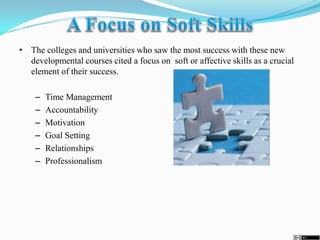
• The colleges and universities who saw the most success with these new
developmental courses cited a focus on soft or affective skills as a crucial
element of their success.
– Time Management
– Accountability
– Motivation
– Goal Setting
– Relationships
– Professionalism
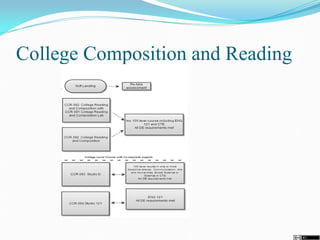
CCR 091
•1 credit
•Co-requisite w/CCR092
•Lab Support
CCR 092
•5 credits
•Integrated reading
and writing
•College ready
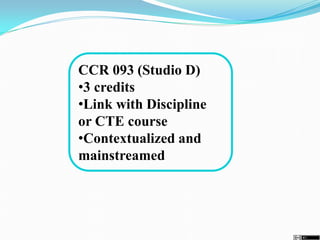
CCR 093 (Studio D)
•3 credits
•Link with Discipline
or CTE course
•Contextualized and
mainstreamed
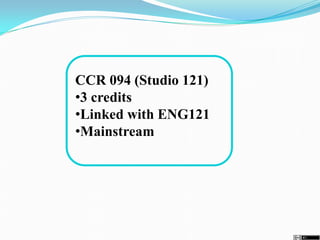
CCR 094 (Studio 121)
•3 credits
•Linked with ENG121
•Mainstream
College Composition and Reading
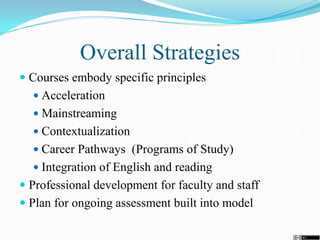
Overall Strategies
 Courses embody specific principles
 Acceleration
 Mainstreaming
 Contextualization
 Career Pathways (Programs of Study)
 Integration of English and reading
 Professional development for faculty and staff
 Plan for ongoing assessment built into model
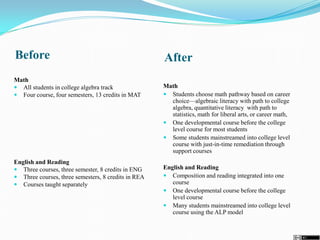
Math
 All students in college algebra track
 Four course, four semesters, 13 credits in MAT
English and Reading
 Three courses, three semester, 8 credits in ENG
 Three courses, three semesters, 8 credits in REA
 Courses taught separately
Math
 Students choose math pathway based on career
choice—algebraic literacy with path to college
algebra, quantitative literacy with path to
statistics, math for liberal arts, or career math,
 One developmental course before the college
level course for most students
 Some students mainstreamed into college level
course with just-in-time remediation through
support courses
English and Reading
 Composition and reading integrated into one
course
 One developmental course before the college
level course
 Many students mainstreamed into college level
course using the ALP model
Before After
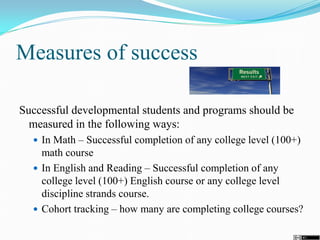
Measures of success
Successful developmental students and programs should be
measured in the following ways:
 In Math – Successful completion of any college level (100+)
math course
 In English and Reading – Successful completion of any
college level (100+) English course or any college level
discipline strands course.
 Cohort tracking – how many are completing college courses?
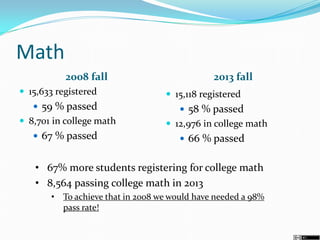
Math
2008 fall
 15,633 registered
 59 % passed
 8,701 in college math
 67 % passed
2013 fall
 15,118 registered
 58 % passed
 12,976 in college math
 66 % passed
• 67% more students registering for college math
• 8,564 passing college math in 2013
• To achieve that in 2008 we would have needed a 98%
pass rate!
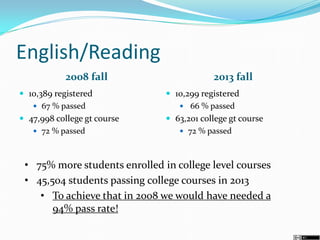
English/Reading
2008 fall
 10,389 registered
 67 % passed
 47,998 college gt course
 72 % passed
2013 fall
 10,299 registered
 66 % passed
 63,201 college gt course
 72 % passed
• 75% more students enrolled in college level courses
• 45,504 students passing college courses in 2013
• To achieve that in 2008 we would have needed a
94% pass rate!
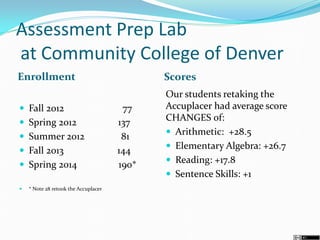
Assessment Prep Lab
at Community College of Denver
Enrollment
 Fall 2012 77
 Spring 2012 137
 Summer 2012 81
 Fall 2013 144
 Spring 2014 190*
 * Note 28 retook the Accuplacer
Scores
Our students retaking the
Accuplacer had average score
CHANGES of:
 Arithmetic: +28.5
 Elementary Algebra: +26.7
 Reading: +17.8
 Sentence Skills: +1
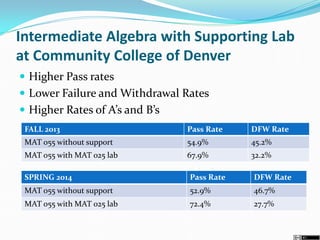
Intermediate Algebra with Supporting Lab
at Community College of Denver
 Higher Pass rates
 Lower Failure and Withdrawal Rates
 Higher Rates of A’s and B’s
FALL 2013 Pass Rate DFW Rate
MAT 055 without support 54.9% 45.2%
MAT 055 with MAT 025 lab 67.9% 32.2%
SPRING 2014 Pass Rate DFW Rate
MAT 055 without support 52.9% 46.7%
MAT 055 with MAT 025 lab 72.4% 27.7%
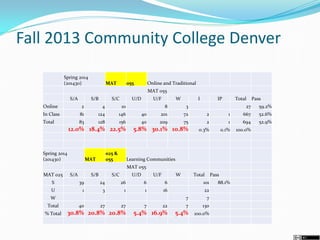
Spring 2014
(201430) MAT 055 Online and Traditional
MAT 055
S/A S/B S/C U/D U/F W I IP Total Pass
Online 2 4 10 8 3 27 59.2%
In Class 81 124 146 40 201 72 2 1 667 52.6%
Total 83 128 156 40 209 75 2 1 694 52.9%
12.0% 18.4% 22.5% 5.8% 30.1% 10.8% 0.3% 0.1% 100.0%
Spring 2014
(201430) MAT
025 &
055 Learning Communities
MAT 055
MAT 025 S/A S/B S/C U/D U/F W Total Pass
S 39 24 26 6 6 101 88.1%
U 1 3 1 1 16 22
W 7 7
Total 40 27 27 7 22 7 130
% Total 30.8% 20.8% 20.8% 5.4% 16.9% 5.4% 100.0%
Fall 2013 Community College Denver
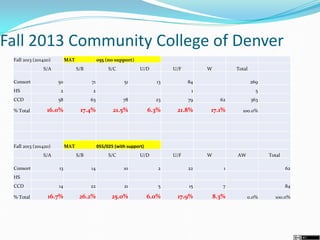
Fall 2013 Community College of Denver
Fall 2013 (201420) MAT 055 (no support)
S/A S/B S/C U/D U/F W Total
Consort 50 71 51 13 84 269
HS 2 2 1 5
CCD 58 63 78 23 79 62 363
% Total 16.0% 17.4% 21.5% 6.3% 21.8% 17.1% 100.0%
Fall 2013 (201420) MAT 055/025 (with support)
S/A S/B S/C U/D U/F W AW Total
Consort 13 14 10 2 22 1 62
HS
CCD 14 22 21 5 15 7 84
% Total 16.7% 26.2% 25.0% 6.0% 17.9% 8.3% 0.0% 100.0%
What faculty are saying…
Just as important as the data are the responses of the faculty and staff who
work with these students. A faculty member teaching a CCR 094 course
commented:
What has been fascinating to watch is how seamlessly this has played out in
the classroom. On the first day, and often for the rest of the semester, no one
in the 121 classroom knows who is "ready" for it and who isn't. There is no
great divide, either socially or academically. If one were to look at our 121
grade books or an average day in class, it would be hard to tell which students
are also in the Studio class because they are rising to the challenge. They are
performing as well as their 121 peers, and often are even outperforming them,
both in classroom participation and assignment quality. They are often
leaders in class discussions, do the most valuable process work, and show the
most awareness of the course's goals. More often than not, the Studio
students are the first in English 121 to volunteer to share their essay drafts with
the class and to ask productive questions.
What faculty are saying…
So it is interesting to see that although a lot of the 146
students were required to take the MAT 025 class, due to
lower accuplacer scores, as a group they performed
better than the overall group. Some of the 146 students
self-enrolled in MAT 025 and were not required, so there
may be some extra motivation for those students. It is
also worth noting that the dropout rate was lower for the
MAT 025 group versus the overall group.
Places to go and people to see for
more information
 DE site https://resources.cccs.edu/education-
services/developmental-education-task-force/developmental-
education-redesign//
 Weebly http://cccscoetc.weebly.com/
 D2L shells
 For Math go to https://ccd.desire2learn.com/ The username is “math” and the
password is “31415161” to access the course. Once there, use the drop down at
the top of the screen to choose the CCCS Developmental Math Resources.
 For College Reading and Composition (CCR) go to
https://ccd.desire2learn.com/ The username is “english” and the password is
“31415161” to access the course.
 College Departments
 CCCS Contacts
Contact us…
Brandon Feres
brandon.feres@ccaurora.edu
303.340.7563
Linda Sue Hoops
Linda.hoops@ccd.edu
303.556.3581 1
Marilyn Smith
marilyn.smith@cccs.edu
720.858.2328
This Workforce Solution and Open Educational Resource by Colorado
Online Energy Training Consortium is licensed under a Creative
Commons Attribution 3.0 Unported License. Permissions beyond the
scope of this license may be available at www.cccs.edu.

Colorado Community College Systems COETC presentation at Accelerated Learning Program Conference June 2014

  • 1.
    Developmental Education Redesign inColorado Community Colleges ALP at BCCC 2014
  • 2.
    The problem “The morelevels of developmental courses a student needs to go through, the less likely that student is to ever complete college English or math.” - Thomas Bailey (2009) CCRC Brief.
  • 3.
    Traditional Colorado CourseSequence MAT 030 MAT 060 MAT 090 MAT 099 ENG 030 ENG 060 ENG 090 REA 030 REA 060 REA 090
  • 4.
    A Colorado Example ENGCohort Fall2010 Number of students enrolled in ENG 030 fall 2010 Enrolled in ENG030 Fall 2010 Complete d ENG030 Fall 2010 Enrolled in ENG060 Complete d ENG060 Enrolled in ENG090 Complete d ENG090 Enrolled in ENG121 Complete d ENG121 537 308 274 176 145 106 83 53 537 57% 51% 38% 27% 20% 15% 10%
  • 5.
    A Colorado Example MATCohort Fall 2010 Number of students enrolled in MAT 030 fall 2010 Complete MAT 030 Enroll in MAT 0600 Complete MAT 060 Enroll in MAT 090 Complete MAT 090 Enroll in MAT 099 Complete MAT 099 Enroll in College Level math course Complete College level math course 3926 2245 1896 1521 1113 827 476 319 194 182 57% 48% 39% 28% 21% 12% 8% 5% 4.6%
  • 6.
    Creation of atask force  College representation  Faculty + others (student services, administration, testing, advising…)  Charged with creating policy for the system
  • 7.
    The goal ofthe redesign . A developmental education redesign that will move students quickly and effectively (and successfully) through their first college level course.
  • 8.
    National models considered Washington State - iBest  Tennessee – emporium  Los Medinos - acceleration in math  Community College Baltimore County - ALP  Chabot College – Integrated reading and English  University of Texas - new mathways  Austin Peay State - mainstreaming
  • 9.
    February 2013 CCCS Boardapproves the Task Force recommendations To accelerate students by reducing the amount of time, number of developmental credits, and number of courses in the developmental sequence so students can have access to and be supported for success in a college level course.
  • 10.
    Timeline  Spring/summer 2013:discipline team developed curriculum and created professional development training for faculty and staff  Fall of 2013: schools who were already working on redesign ramped up projects  Spring 2014: all colleges transition to the new models  PCC, TSJC, NJC, CNCC, LCC, and OJC are in full implementation for spring 2014  Fall of 2014: all colleges will be operating with the new models in place
  • 11.
    What “Redesign” lookslike  Math – pathways at the developmental level  Algebra  Non-Algebra (statistics and math for liberal arts)  Non-transfer (career math, clinical calculations)  Mainstreaming with supplemental instruction when possible  College Composition and Reading (formerly reading and English)  Integrated disciplines  Options for delivery (CCR 092 0r CCR 093 or CCR 094)  Mainstreaming when possible  Tiers of student support in classrooms
  • 12.
    Implementation teams  Coreimplementation team  Faculty  Focused on curriculum, content, training, and professional development  Redesign advisory process  Administrative (Banner, fiscal, advising, financial aid)  Testing – faculty for content. Testing center directors when we have a platform to experiment with.
  • 13.
    The Math PathwayModel MAT 050 Quantitative Literacy MAT 103 MAT 108 MAT 109 MAT 112 MAT 055 Algebraic Literacy MAT 121 MAT 123 MAT 025 Algebraic Literacy Lab MAT 120 MAT 135 MAT 155 MAT 156 MAT 093 Algebra Lab MAT 091 Applied Quant Lab MAT 092 Quant Lab
  • 14.
    Why Two Pathways? Studentspursuing Non-STEM majors need different math skills than students pursuing STEM majors Examples of Career and Technical: Medical Office Technology, Automotive Tech, Radiology Examples of Non-STEM: Journalism, Communications, Education Examples of STEM: Engineering and the Sciences As a result of these different needs, the learning objectives for the new courses were created using reverse design and overlap was removed
  • 15.
    Assessment Prep  Non-credit,low-cost to the student, not Financial Aid eligible  Expected outcomes:  Students re-test to place into chosen pathway  Refresh to raise placement  Suggested topics  Institutional choices
  • 16.
    MAT050 Quantitative Literacy EA>30-84 or AR >40  4 credit course  Expected Outcome: Students are prepared to succeed in the college- level non-STEM or career and technical math course that is part of their career pathway  Institutional choices
  • 17.
    MAT 055 AlgebraicLiteracy EA 60-84  4 credits  Expected Outcome: Students are prepared to succeed in MAT 121 or MAT 123  Institutional choices
  • 18.
    Co-Requisite Labs MAT 025Algebraic Literacy Lab  EA 45 - 59 Supports MAT 055 Algebraic Literacy MAT 091 Applied Quant Lab  EA 30 - 84 or AR >40 Supports MAT 103, 107, 108, 109, 112 MAT 092 Quant Lab  EA 80 - 84 Support MAT 120, 135, 155, 156 MAT 093 Algebra Lab  EA 80 - 84 Supports MAT 121, 123
  • 19.
    New English andReading Courses New Developmental Education Courses  CCR091  CCR 092  CCR 093  CCR 094 CCR = College Composition and Reading All courses integrate reading and writing
  • 20.
    • CCR 092,CCR 093, and CCR 094 are NEW paths to help students become confident readers and writers. • CCR courses are not an attempt to condense several classes into one; each CCR course serves a unique purpose.
  • 21.
    • The collegesand universities who saw the most success with these new developmental courses cited a focus on soft or affective skills as a crucial element of their success. – Time Management – Accountability – Motivation – Goal Setting – Relationships – Professionalism
  • 22.
    CCR 091 •1 credit •Co-requisitew/CCR092 •Lab Support
  • 23.
    CCR 092 •5 credits •Integratedreading and writing •College ready
  • 24.
    CCR 093 (StudioD) •3 credits •Link with Discipline or CTE course •Contextualized and mainstreamed
  • 25.
    CCR 094 (Studio121) •3 credits •Linked with ENG121 •Mainstream
  • 26.
  • 27.
    Overall Strategies  Coursesembody specific principles  Acceleration  Mainstreaming  Contextualization  Career Pathways (Programs of Study)  Integration of English and reading  Professional development for faculty and staff  Plan for ongoing assessment built into model
  • 28.
    Math  All studentsin college algebra track  Four course, four semesters, 13 credits in MAT English and Reading  Three courses, three semester, 8 credits in ENG  Three courses, three semesters, 8 credits in REA  Courses taught separately Math  Students choose math pathway based on career choice—algebraic literacy with path to college algebra, quantitative literacy with path to statistics, math for liberal arts, or career math,  One developmental course before the college level course for most students  Some students mainstreamed into college level course with just-in-time remediation through support courses English and Reading  Composition and reading integrated into one course  One developmental course before the college level course  Many students mainstreamed into college level course using the ALP model Before After
  • 29.
    Measures of success Successfuldevelopmental students and programs should be measured in the following ways:  In Math – Successful completion of any college level (100+) math course  In English and Reading – Successful completion of any college level (100+) English course or any college level discipline strands course.  Cohort tracking – how many are completing college courses?
  • 31.
    Math 2008 fall  15,633registered  59 % passed  8,701 in college math  67 % passed 2013 fall  15,118 registered  58 % passed  12,976 in college math  66 % passed • 67% more students registering for college math • 8,564 passing college math in 2013 • To achieve that in 2008 we would have needed a 98% pass rate!
  • 32.
    English/Reading 2008 fall  10,389registered  67 % passed  47,998 college gt course  72 % passed 2013 fall  10,299 registered  66 % passed  63,201 college gt course  72 % passed • 75% more students enrolled in college level courses • 45,504 students passing college courses in 2013 • To achieve that in 2008 we would have needed a 94% pass rate!
  • 33.
    Assessment Prep Lab atCommunity College of Denver Enrollment  Fall 2012 77  Spring 2012 137  Summer 2012 81  Fall 2013 144  Spring 2014 190*  * Note 28 retook the Accuplacer Scores Our students retaking the Accuplacer had average score CHANGES of:  Arithmetic: +28.5  Elementary Algebra: +26.7  Reading: +17.8  Sentence Skills: +1
  • 34.
    Intermediate Algebra withSupporting Lab at Community College of Denver  Higher Pass rates  Lower Failure and Withdrawal Rates  Higher Rates of A’s and B’s FALL 2013 Pass Rate DFW Rate MAT 055 without support 54.9% 45.2% MAT 055 with MAT 025 lab 67.9% 32.2% SPRING 2014 Pass Rate DFW Rate MAT 055 without support 52.9% 46.7% MAT 055 with MAT 025 lab 72.4% 27.7%
  • 35.
    Spring 2014 (201430) MAT055 Online and Traditional MAT 055 S/A S/B S/C U/D U/F W I IP Total Pass Online 2 4 10 8 3 27 59.2% In Class 81 124 146 40 201 72 2 1 667 52.6% Total 83 128 156 40 209 75 2 1 694 52.9% 12.0% 18.4% 22.5% 5.8% 30.1% 10.8% 0.3% 0.1% 100.0% Spring 2014 (201430) MAT 025 & 055 Learning Communities MAT 055 MAT 025 S/A S/B S/C U/D U/F W Total Pass S 39 24 26 6 6 101 88.1% U 1 3 1 1 16 22 W 7 7 Total 40 27 27 7 22 7 130 % Total 30.8% 20.8% 20.8% 5.4% 16.9% 5.4% 100.0% Fall 2013 Community College Denver
  • 36.
    Fall 2013 CommunityCollege of Denver Fall 2013 (201420) MAT 055 (no support) S/A S/B S/C U/D U/F W Total Consort 50 71 51 13 84 269 HS 2 2 1 5 CCD 58 63 78 23 79 62 363 % Total 16.0% 17.4% 21.5% 6.3% 21.8% 17.1% 100.0% Fall 2013 (201420) MAT 055/025 (with support) S/A S/B S/C U/D U/F W AW Total Consort 13 14 10 2 22 1 62 HS CCD 14 22 21 5 15 7 84 % Total 16.7% 26.2% 25.0% 6.0% 17.9% 8.3% 0.0% 100.0%
  • 37.
    What faculty aresaying… Just as important as the data are the responses of the faculty and staff who work with these students. A faculty member teaching a CCR 094 course commented: What has been fascinating to watch is how seamlessly this has played out in the classroom. On the first day, and often for the rest of the semester, no one in the 121 classroom knows who is "ready" for it and who isn't. There is no great divide, either socially or academically. If one were to look at our 121 grade books or an average day in class, it would be hard to tell which students are also in the Studio class because they are rising to the challenge. They are performing as well as their 121 peers, and often are even outperforming them, both in classroom participation and assignment quality. They are often leaders in class discussions, do the most valuable process work, and show the most awareness of the course's goals. More often than not, the Studio students are the first in English 121 to volunteer to share their essay drafts with the class and to ask productive questions.
  • 38.
    What faculty aresaying… So it is interesting to see that although a lot of the 146 students were required to take the MAT 025 class, due to lower accuplacer scores, as a group they performed better than the overall group. Some of the 146 students self-enrolled in MAT 025 and were not required, so there may be some extra motivation for those students. It is also worth noting that the dropout rate was lower for the MAT 025 group versus the overall group.
  • 39.
    Places to goand people to see for more information  DE site https://resources.cccs.edu/education- services/developmental-education-task-force/developmental- education-redesign//  Weebly http://cccscoetc.weebly.com/  D2L shells  For Math go to https://ccd.desire2learn.com/ The username is “math” and the password is “31415161” to access the course. Once there, use the drop down at the top of the screen to choose the CCCS Developmental Math Resources.  For College Reading and Composition (CCR) go to https://ccd.desire2learn.com/ The username is “english” and the password is “31415161” to access the course.  College Departments  CCCS Contacts
  • 40.
    Contact us… Brandon Feres brandon.feres@ccaurora.edu 303.340.7563 LindaSue Hoops Linda.hoops@ccd.edu 303.556.3581 1 Marilyn Smith marilyn.smith@cccs.edu 720.858.2328
  • 41.
    This Workforce Solutionand Open Educational Resource by Colorado Online Energy Training Consortium is licensed under a Creative Commons Attribution 3.0 Unported License. Permissions beyond the scope of this license may be available at www.cccs.edu.