Agile Mindset & Culture
by Hithem Ahmed
Agenda
• Mindset Big picture
• Our mindset
• Explore your mindset
• Agile mindset
• Products with and without agile mindset
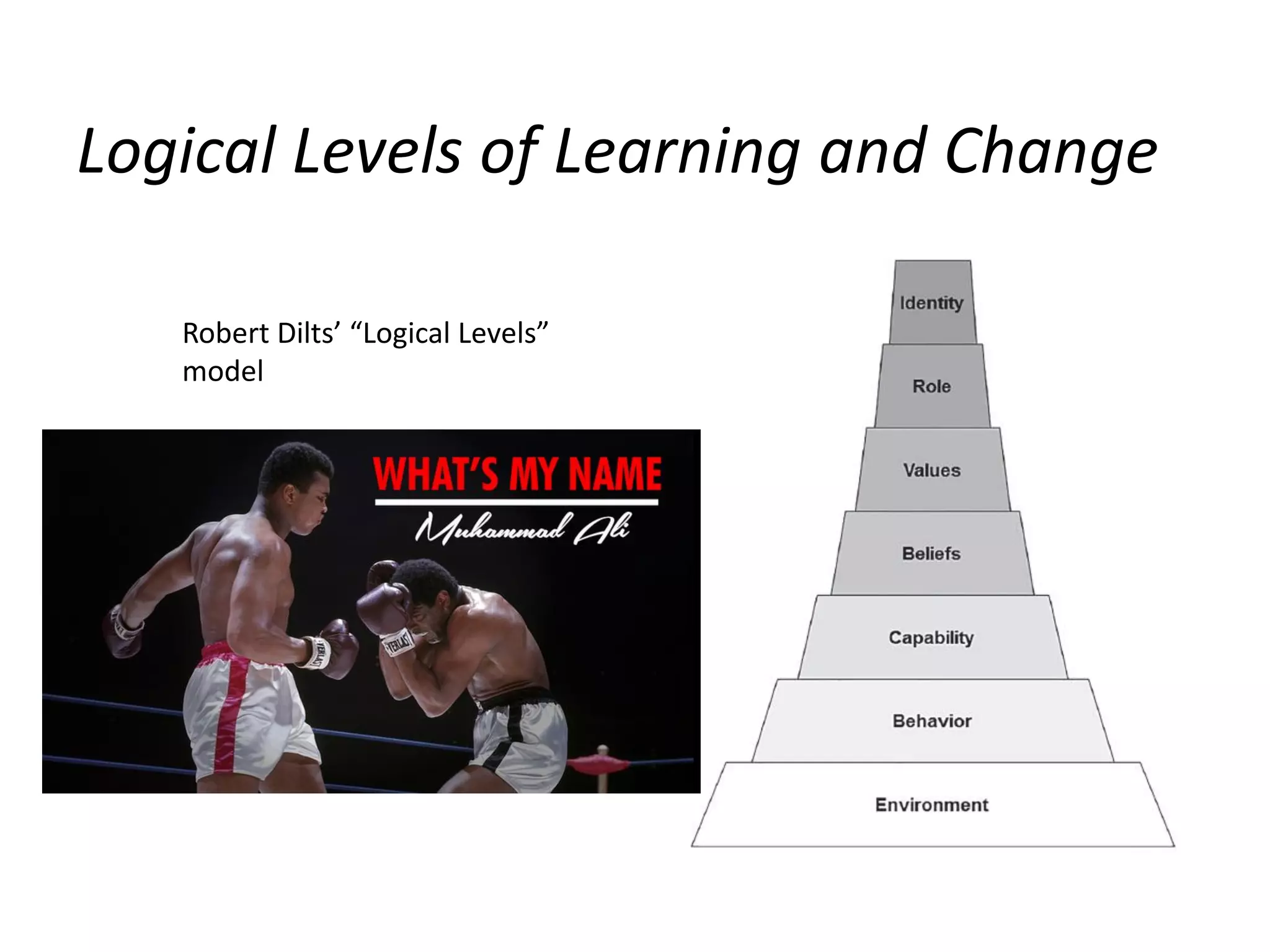
• Logical Levels of Learning and Change
• True agility
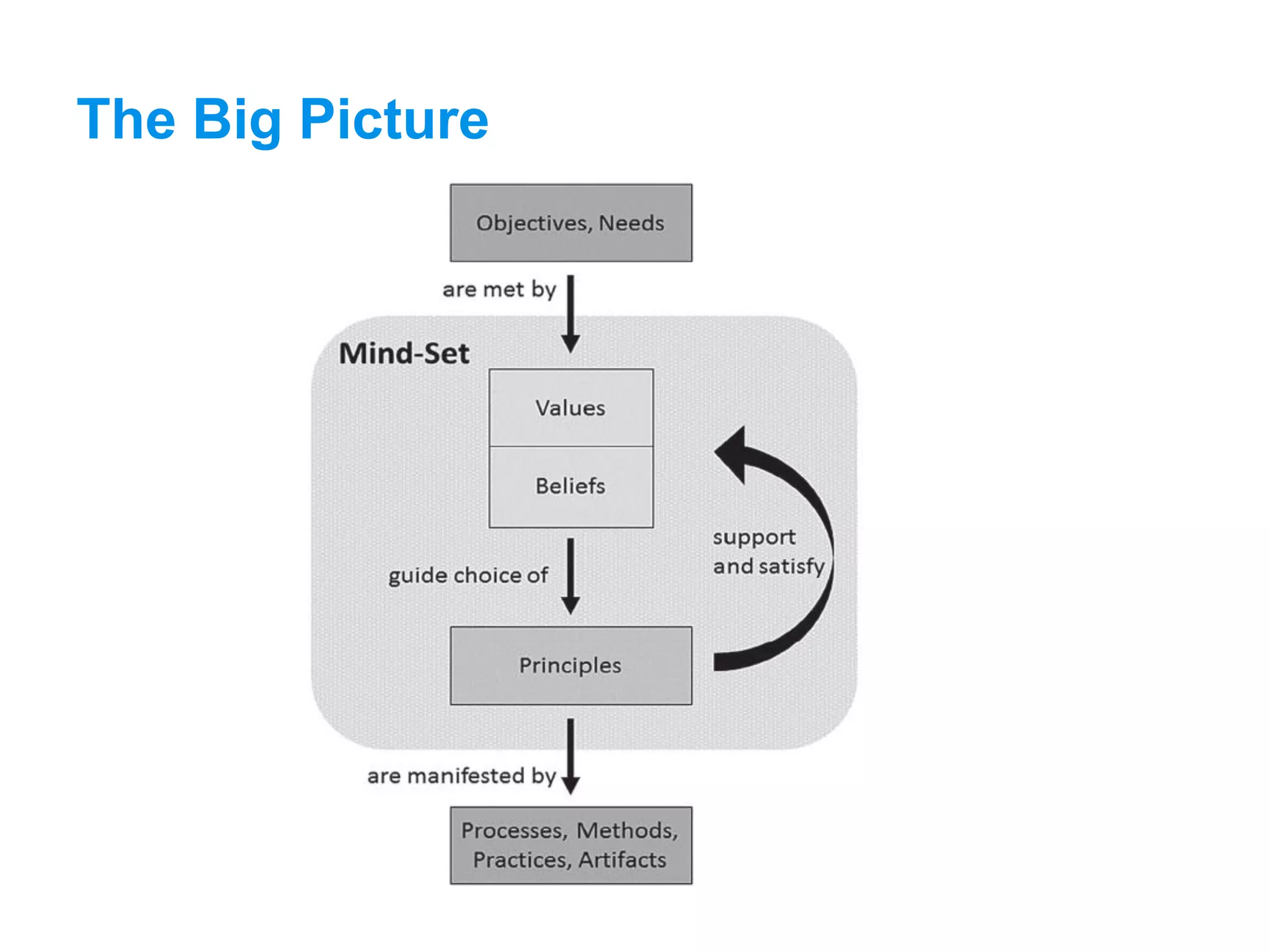
The Big Picture
Our Mindset
• Elements of a Mind-Set
– Values: Most Important
– Beliefs: Contextual Beliefs
– Principles: standards, choices, actions and
decisions
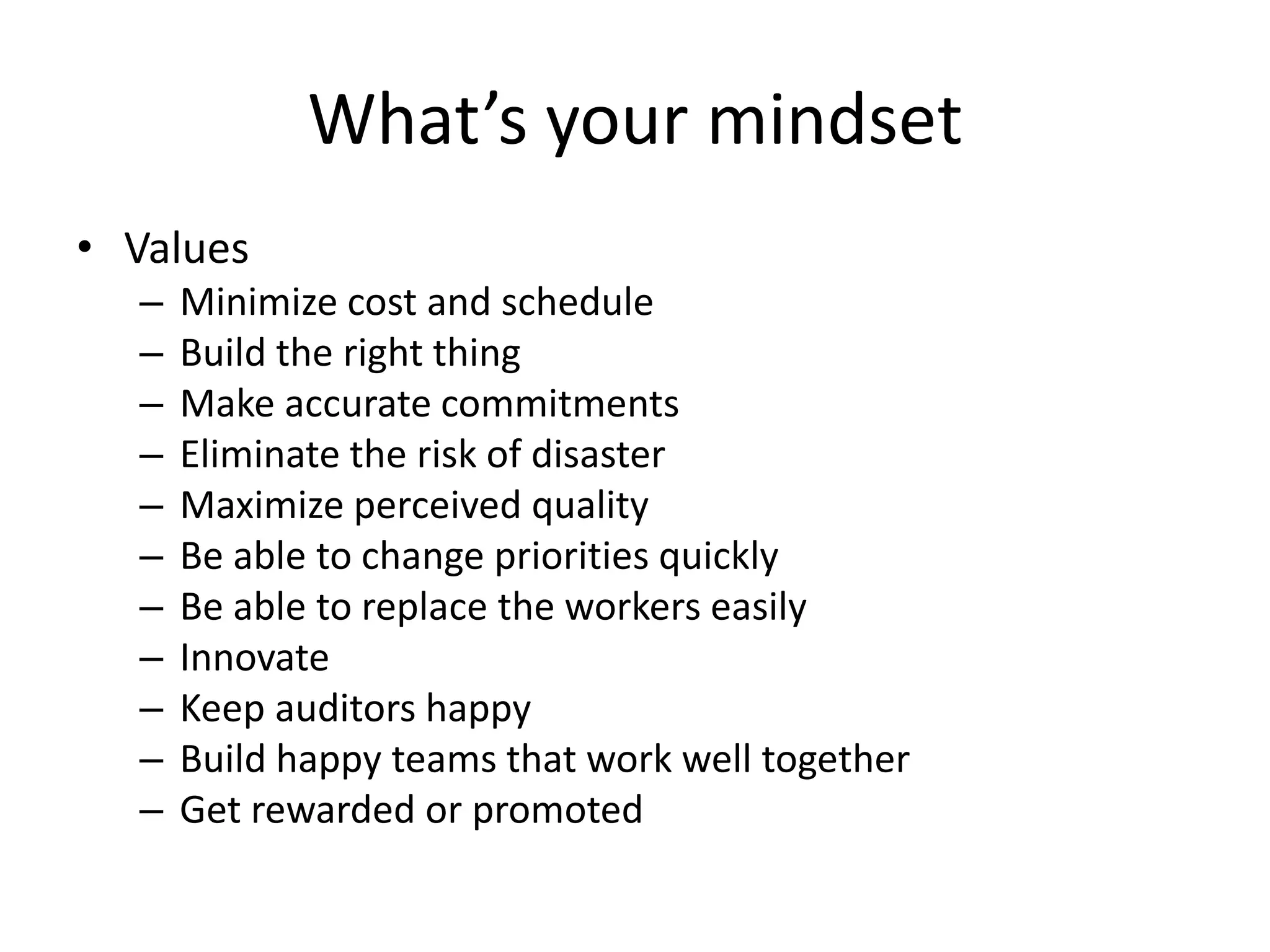
What’s your mindset
• Values
– Minimize cost and schedule
– Build the right thing
– Make accurate commitments
– Eliminate the risk of disaster
– Maximize perceived quality
– Be able to change priorities quickly
– Be able to replace the workers easily
– Innovate
– Keep auditors happy
– Build happy teams that work well together
– Get rewarded or promoted
What’s your mindset
• Beliefs
– If we sign off on requirements now and the team will finish
developing them six months from now, the requirements will
still be valuable and relevant.
– Customer is engaged frequently.
– Placing workers where their skills are most needed is a good
way to finish projects.
– People really care only for themselves.
– If we do all the design before starting implementation, we
reduce risk and avoid rework.
– The documentation of how a piece is constructed will be
useful to the next team member on the job.
– If we invite certain senior managers to our meetings, we
won’t get in trouble later.
– If we hire great people, we’ll have great performance.
– If we propose a compelling, sensible improvement, people
will naturally want to implement it, and proceed to do that.
– Clear processes and roles should be defined
Mindset
• Value (Collaborating with customers,
environment that people thrive together)
– Agile Mindset
• Value (Manfacturing many copies -- Repeatively)
– Lean Mindset
• Value (prove that you are solving the right
problem)
– Lean startup Mindset
• Value (getting the solution right from the first
time)
– WaterFall Mindset
Agile Mindset
Values
• People come first, before product and before
process
• Adaptation.
• Early and frequent value delivery.
• Customer collaboration.
• Control my cost ?
Beliefs
• People: competent, motivated, trusted, and
supported people will do well (self-organizing,
collaborative team)
• The customer. He Can’t pinpoint future needs
and wants, but they have a good handle on
what’s needed now
• The work. emergence, or evolution of plans
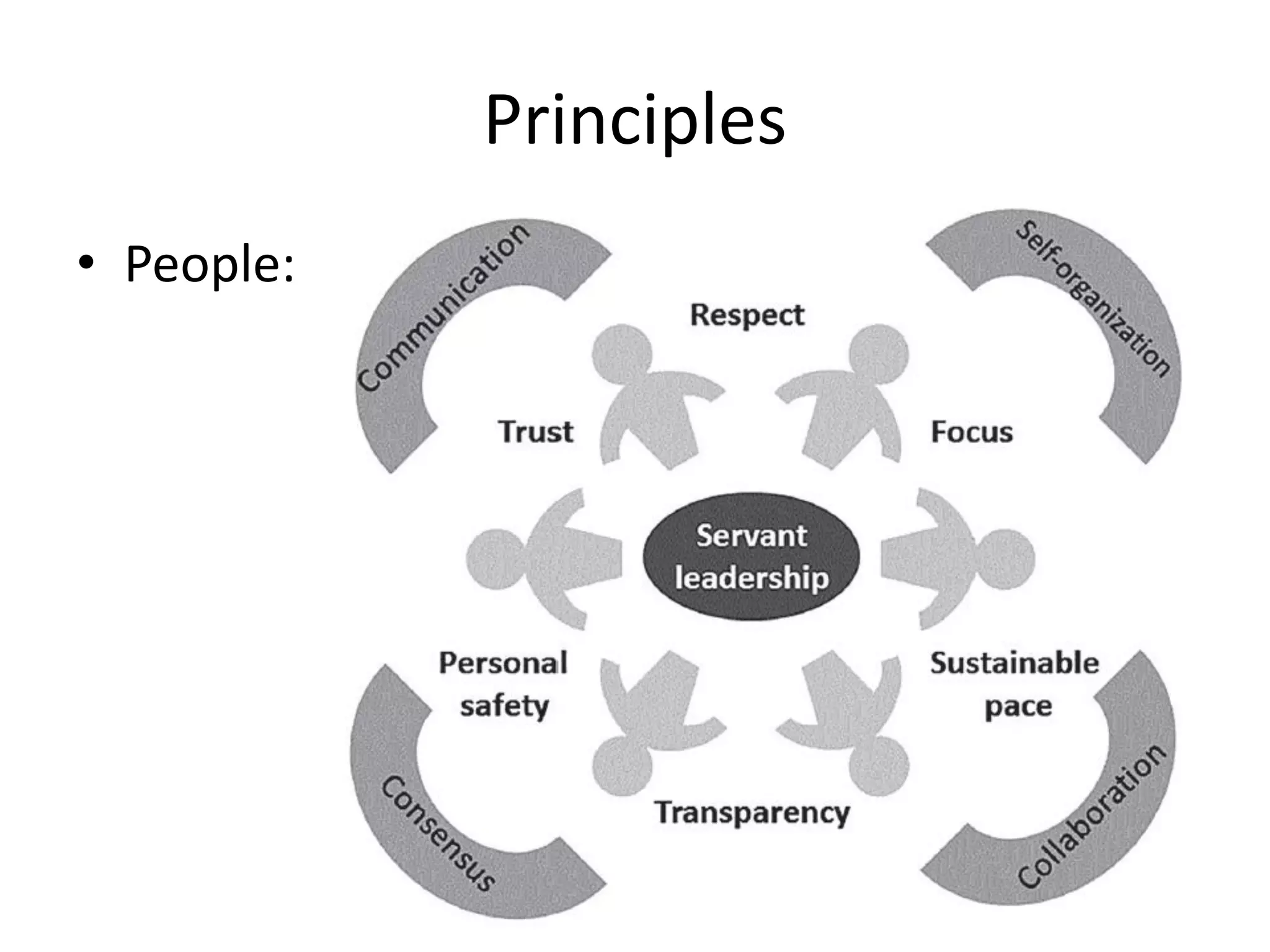
Principles
• People:
Principles
• Work:
Agile ?
• Software Development
• Project management
• Processes & methods
• Methodology or framework
• Paradigm, Mindset
Agile (Paradigm) Mindset
• Transcends Processes (People, Product,
Customer)
• the thinking that drives your actions
• Agile is a whole package to get its benefits for
people, product and customer.
Product With Agile Mindset
• Early and Frequent Delivery
• Value changes over time and context
• People should come first
• Collaborate with customer in trusting
relationship
• Technical Excellence, defer decisions (TDD)
minimize feedback loop by automated (Build,
test, deploy).
Product Without Agile Mindset
• Backlogs with detailed difficult specification
• People work in tasks, no collaboration
• Instead of getting feedback, prescribed
meetings
• Instead of servant leadership, task
management
Beyond Process (Ingredients)
• Beyond Best Practices (Recipes)
• You should be an Agile Chef
Logical Levels of Learning and Change
Robert Dilts’ “Logical Levels”
model
(according to the situation and
context)
Shu Ha Ri
Q & A
????????

Agile Mindset and Culture by Hithem Ahmed

  • 1.
    Agile Mindset &Culture by Hithem Ahmed
  • 2.
    Agenda • Mindset Bigpicture • Our mindset • Explore your mindset • Agile mindset • Products with and without agile mindset • Logical Levels of Learning and Change • True agility
  • 3.
  • 4.
    Our Mindset • Elementsof a Mind-Set – Values: Most Important – Beliefs: Contextual Beliefs – Principles: standards, choices, actions and decisions
  • 5.
    What’s your mindset •Values – Minimize cost and schedule – Build the right thing – Make accurate commitments – Eliminate the risk of disaster – Maximize perceived quality – Be able to change priorities quickly – Be able to replace the workers easily – Innovate – Keep auditors happy – Build happy teams that work well together – Get rewarded or promoted
  • 6.
    What’s your mindset •Beliefs – If we sign off on requirements now and the team will finish developing them six months from now, the requirements will still be valuable and relevant. – Customer is engaged frequently. – Placing workers where their skills are most needed is a good way to finish projects. – People really care only for themselves. – If we do all the design before starting implementation, we reduce risk and avoid rework. – The documentation of how a piece is constructed will be useful to the next team member on the job. – If we invite certain senior managers to our meetings, we won’t get in trouble later. – If we hire great people, we’ll have great performance. – If we propose a compelling, sensible improvement, people will naturally want to implement it, and proceed to do that. – Clear processes and roles should be defined
  • 7.
    Mindset • Value (Collaboratingwith customers, environment that people thrive together) – Agile Mindset • Value (Manfacturing many copies -- Repeatively) – Lean Mindset • Value (prove that you are solving the right problem) – Lean startup Mindset • Value (getting the solution right from the first time) – WaterFall Mindset
  • 8.
  • 9.
    Values • People comefirst, before product and before process • Adaptation. • Early and frequent value delivery. • Customer collaboration. • Control my cost ?
  • 10.
    Beliefs • People: competent,motivated, trusted, and supported people will do well (self-organizing, collaborative team) • The customer. He Can’t pinpoint future needs and wants, but they have a good handle on what’s needed now • The work. emergence, or evolution of plans
  • 11.
  • 12.
  • 13.
    Agile ? • SoftwareDevelopment • Project management • Processes & methods • Methodology or framework • Paradigm, Mindset
  • 14.
    Agile (Paradigm) Mindset •Transcends Processes (People, Product, Customer) • the thinking that drives your actions • Agile is a whole package to get its benefits for people, product and customer.
  • 15.
    Product With AgileMindset • Early and Frequent Delivery • Value changes over time and context • People should come first • Collaborate with customer in trusting relationship • Technical Excellence, defer decisions (TDD) minimize feedback loop by automated (Build, test, deploy).
  • 16.
    Product Without AgileMindset • Backlogs with detailed difficult specification • People work in tasks, no collaboration • Instead of getting feedback, prescribed meetings • Instead of servant leadership, task management
  • 17.
    Beyond Process (Ingredients) •Beyond Best Practices (Recipes) • You should be an Agile Chef
  • 18.
    Logical Levels ofLearning and Change Robert Dilts’ “Logical Levels” model
  • 19.
    (according to thesituation and context) Shu Ha Ri
  • 20.