Agile Transformation
Tathagat Varma
Head Strategy & Operations, Walmart Labs
Doctoral Candidate (EFPM 2019), ISB
Hyderabad
•What?
•Why?
•How?
•How not!
What is
Agile?
• Significant change in nature of work!
• Fundamentally impacts how we work.
• Directed towards continuously re-adapting and
constantly re-aligning:
• Internal processes with external problems
• Internal execution with external changes
• Internal solution expertise with external domain
complexity
• Internal success drivers with external value
measures
• Tip: it’s just plain common sense applied to solving
problems in business context, or simply the business
sense J!
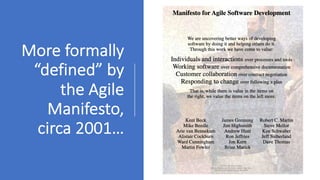
More formally
“defined” by
the Agile
Manifesto,
circa 2001…
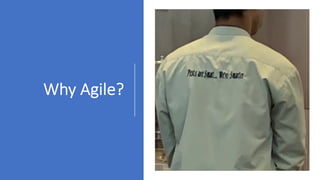
Why Agile?
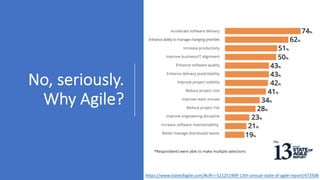
No, seriously.
Why Agile?
https://www.stateofagile.com/#ufh-i-521251909-13th-annual-state-of-agile-report/473508
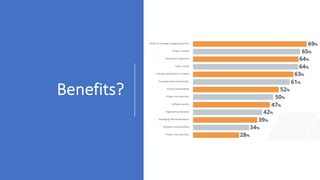
Benefits?
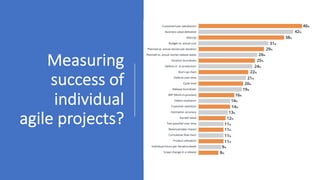
Measuring
success of
individual
agile projects?
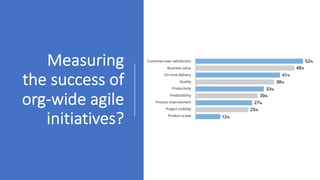
Measuring
the success of
org-wide agile
initiatives?
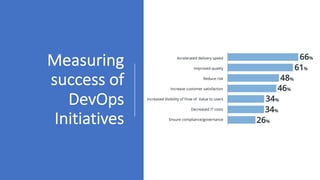
Measuring
success of
DevOps
Initiatives
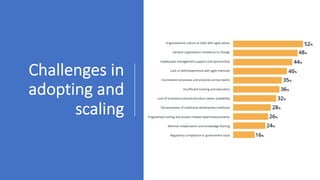
Challenges in
adopting and
scaling
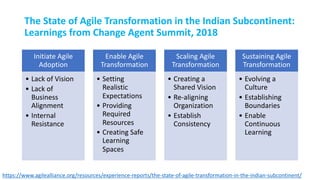
The State of Agile Transformation in the Indian Subcontinent:
Learnings from Change Agent Summit, 2018
Initiate Agile
Adoption
• Lack of Vision
• Lack of
Business
Alignment
• Internal
Resistance
Enable Agile
Transformation
• Setting
Realistic
Expectations
• Providing
Required
Resources
• Creating Safe
Learning
Spaces
Scaling Agile
Transformation
• Creating a
Shared Vision
• Re-aligning
Organization
• Establish
Consistency
Sustaining Agile
Transformation
• Evolving a
Culture
• Establishing
Boundaries
• Enable
Continuous
Learning
https://www.agilealliance.org/resources/experience-reports/the-state-of-agile-transformation-in-the-indian-subcontinent/
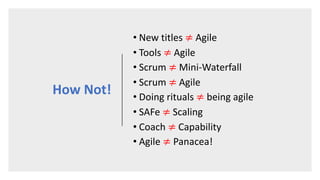
How Not!
• New titles ≠ Agile
• Tools ≠ Agile
• Scrum ≠ Mini-Waterfall
• Scrum ≠ Agile
• Doing rituals ≠ being agile
• SAFe ≠ Scaling
• Coach ≠ Capability
• Agile ≠ Panacea!
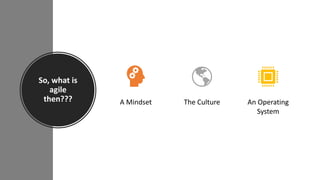
So, what is
agile
then??? A Mindset The Culture An Operating
System
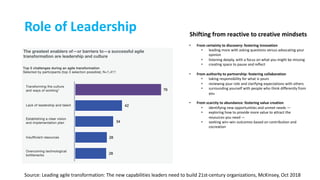
Role of Leadership Shifting from reactive to creative mindsets
• From certainty to discovery: fostering innovation
• leading more with asking questions versus advocating your
opinion
• listening deeply, with a focus on what you might be missing
• creating space to pause and reflect
• From authority to partnership: fostering collaboration
• taking responsibility for what is yours
• reviewing your role and clarifying expectations with others
• surrounding yourself with people who think differently from
you
• From scarcity to abundance: fostering value creation
• identifying new opportunities and unmet needs —
• exploring how to provide more value to attract the
resources you need —
• seeking win–win outcomes based on contribution and
cocreation
Source: Leading agile transformation: The new capabilities leaders need to build 21st-century organizations, McKinsey, Oct 2018
The journey is
the reward…
Agile is not a
destination!

Agile Transformation

  • 1.
    Agile Transformation Tathagat Varma HeadStrategy & Operations, Walmart Labs Doctoral Candidate (EFPM 2019), ISB Hyderabad
  • 2.
  • 3.
    What is Agile? • Significantchange in nature of work! • Fundamentally impacts how we work. • Directed towards continuously re-adapting and constantly re-aligning: • Internal processes with external problems • Internal execution with external changes • Internal solution expertise with external domain complexity • Internal success drivers with external value measures • Tip: it’s just plain common sense applied to solving problems in business context, or simply the business sense J!
  • 4.
    More formally “defined” by theAgile Manifesto, circa 2001…
  • 5.
  • 6.
  • 7.
  • 8.
  • 9.
  • 10.
  • 11.
  • 12.
    The State ofAgile Transformation in the Indian Subcontinent: Learnings from Change Agent Summit, 2018 Initiate Agile Adoption • Lack of Vision • Lack of Business Alignment • Internal Resistance Enable Agile Transformation • Setting Realistic Expectations • Providing Required Resources • Creating Safe Learning Spaces Scaling Agile Transformation • Creating a Shared Vision • Re-aligning Organization • Establish Consistency Sustaining Agile Transformation • Evolving a Culture • Establishing Boundaries • Enable Continuous Learning https://www.agilealliance.org/resources/experience-reports/the-state-of-agile-transformation-in-the-indian-subcontinent/
  • 13.
    How Not! • Newtitles ≠ Agile • Tools ≠ Agile • Scrum ≠ Mini-Waterfall • Scrum ≠ Agile • Doing rituals ≠ being agile • SAFe ≠ Scaling • Coach ≠ Capability • Agile ≠ Panacea!
  • 14.
    So, what is agile then???A Mindset The Culture An Operating System
  • 15.
    Role of LeadershipShifting from reactive to creative mindsets • From certainty to discovery: fostering innovation • leading more with asking questions versus advocating your opinion • listening deeply, with a focus on what you might be missing • creating space to pause and reflect • From authority to partnership: fostering collaboration • taking responsibility for what is yours • reviewing your role and clarifying expectations with others • surrounding yourself with people who think differently from you • From scarcity to abundance: fostering value creation • identifying new opportunities and unmet needs — • exploring how to provide more value to attract the resources you need — • seeking win–win outcomes based on contribution and cocreation Source: Leading agile transformation: The new capabilities leaders need to build 21st-century organizations, McKinsey, Oct 2018
  • 16.
    The journey is thereward… Agile is not a destination!