Joy – The surrender to the body and to life
Homayoun Shahri, Ph.D., M.A., LMFT
Homayoun.shahri@ravonkavi.com
http://www.ravonkavi.com
Joy
● Young children and animals are open to feelings of joy,
and are known to literally jump for joy, but it is rare to see a
mature or older person feel and act that way. In this
presentation, I explore how we can regain our natural
ability to feel joy and be joyful, as well as what are the
impediments to feeling of joy.
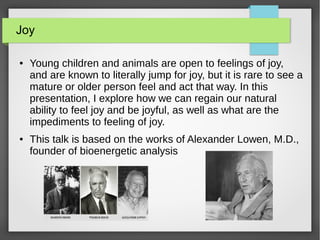
● This talk is based on the works of Alexander Lowen, M.D.,
founder of bioenergetic analysis
Joy
Joy
What is Joy?
● Joy is a feeling (emotion) of great pleasure and happiness
● Joy is one of four primary emotions (Joy, Fear, Sadness, and anger)
● Dancing may be the closest activity to being joyful, which is the
reason why it is the natural activity at joyful occasions.
● Children do not need special occasions to be joyful
● Allow them to be free in company of other children and joyful activity
will soon appear
● When the pleasurable excitement mounts from the baseline of good
feeling, one knows joy
● Should joy overflow, it becomes ecstasy
Joy and its relationship to freedom
● Our behavior and expressions are controlled by a superego, with its lists
of Do's and Don'ts and the power to punish if one violates its
commandments
● The superego is the internalization of the “dictatorial” parent
● It functions below the level of consciousness so that we are unaware of
the limitations it imposes upon our feelings and consequently our actions
are not the result of our free will
● To feel joy and to be joyful requires one to be free – to expand and to
move
● One cannot feel joy in a contracted state
● Many adults are still afraid of their parents, even afraid to speak openly
to them (due to earlier traumatic experience)
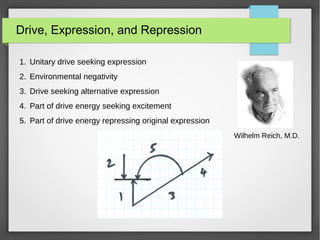
Drive, Expression, and Repression
1. Unitary drive seeking expression
2. Environmental negativity
3. Drive seeking alternative expression
4. Part of drive energy seeking excitement
5. Part of drive energy repressing original expression
Wilhelm Reich, M.D.
Drive, Expression, Repression, and Acting Out
Joy and chronic muscular tensions in the body
● Chronic muscular tension in different parts of the body constitutes the
prison that prevents the free expression of an individual's spirit
● These tensions can be found in the jaw, the neck, the shoulders, the
chest, the upper back and lower back, the legs, and pelvis
● They manifest the inhibition of impulses which the person dares not
express for fear of punishment, verbal or physical
● The child who lives in this fear is tense, anxious and contracted
● It is a painful state and the child will deaden himself to not feel the pain of
the fear
● Deadening the body eliminates the pain and the fear the “dangerous”
impulses are effectively imprisoned – survival is thus assured but
repression becomes the mode of life
Postures – chronic muscular tensions
Postures – chronic muscular tensions (Cont)
The guest house - Rumi
This being human is a guest house.
Every morning a new arrival.
A joy, a depression, a meanness,
some momentary awareness comes
as an unexpected visitor.
Welcome and entertain them all!
Even if they are a crowd of sorrows,
who violently sweep your house empty
of its furniture, still, treat each guest
honorably.
He may be clearing you out
for some new delight.
The dark thought, the shame, the
malice.
meet them at the door laughing and
invite them in.
Be grateful for whatever comes.
because each has been sent
as a guide from beyond.
Joy and its relationship to fear
● Every chronically tense muscle in the body is a frightened muscle, or it would
not be held so tightly against the flow feelings and life
● Looking at the body, one can evaluate the fear – if the body is very rigid, one
can describe the person as being “scared stiff”
● The fear has two aspects – a fear of letting go and surrendering to the body,
to the self, and to life; and the other is the fear of death
● Fear of letting go is also related to fear of insanity in that too much feelings
may overwhelm the ego and result in madness
● Fear of death is connected with a very early experience in which the child
senses that it faces death, that it could die – death does not occur, the child
recovers, but the bodily memory cannot be erased
●
The body memory persists in the form of tension, alarm and fear in the
tissues and organs of the body, especially in the musculature
Joy and its relationship to anger
● Every chronically contracted muscle is an angry muscle,
since anger is the natural reaction to forced restraint and
the denial of freedom
● If an individual is unable to get angry, he becomes locked in
a position of fear – the two emotions are antithetical; when
one is angry, one is not frightened, and vice versa
● When a person is frightened, one can assume that he has
an equal amount of (suppressed) anger in his personality
● Expressing anger releases fear, just as crying releases
sadness
Joy and its relationship to anger (Cont)
● Reich in a seminar in his home (in 1945) stated that the
neurotic personality only develops when a child's ability to
express anger at an insult to his personality is blocked
● He pointed out that when the act of reaching out for
pleasure is frustrated, a withdrawal of the impulse takes
place, creating a loss of integrity in the body
● That integrity can be restored only through the mobilization
of aggressive energy and its expression as anger
● This would reestablish the organism's natural boundaries
and its ability to reach out again
Joy and its relationship to sadness and crying
● Every chronically tense muscle is related to sadness
● There is also sadness at losing the potential for a state of pleasurable
excitation
● Crying is an acceptance of the reality of both the present and the past
● When we cry we feel or sense our sadness and we realize how much
we hurt and how badly we have been hurt
● Crying can be blocked by chronic throat tensions and breathing
● If crying is choked off, one can't breathe
● One has choked off the flow of air by constricting the throat
Joy and its relationship to sadness and crying (Cont)
● If one's throat is constricted, one has no voice
● The regulation of our voice is exercised largely through the control of respiration
● If we breathe freely and fully, our voice will naturally reflect our feelings
● The ability to cry out and to speak out is the basis for an individual's sense that he
has a voice in his own affairs
● Prisoners and slaves have no voice in their affairs and are not free people
● Children can also fall into this category if they have been so frightened that they
cannot make a loud sound
● Sound and feeling are closely connected, and we have learned how to control our
voice so as not to reveal our feelings
● We can speak in a flat and unemotional tone to deny feelings, a high pitch voice to
hide the fact that feel down, etc
Joy and its relationship to love
● Love has been described as the greatest and sweetest feeling, as the
mystery which gives life its richest meaning
● Love is a vital connection to a source of life and joy, whether that
source is an individual, a community, nature, or the universe
● (Healthy adult) Love is an opening up and expansion of the self to
include the world – and thus is related to joy
● Many people are fearful of surrendering to love
● This fear stems from conflict between the ego and the heart
● We love with our heart but we question doubt and control with our ego
● Heart may say “surrender” but ego says “be careful; don't let go; you
will be abandoned and hurt”
Joy and its relationship to love (Cont)
● The surrender to love involves the ability to share one's self fully
with one's partner
● Love is not a matter of giving but of being open
● Openness has to be first with one's self, then with another
● Longing for love is not the same as ability to love
● A person who longs for love, when meets one who responds to
his longing gets hooked on this person like an addict
● The longing for love represents the unloved and unfulfilled child
buried within
Exercise I
● Put your feet on the floor
● Sit in a relaxed position
● Pay attention to your breathing (2 minutes)
● Now try to let your breathing happen by itself – do not
force it
● Be aware of your breathing, and try not to think of anything
else, if a thought comes to your mind focus back on your
breathing (2 minutes)
● What did you experience?
Natural (open) Breathing
Exercise II
● Progressive muscle relaxation
● Follow presenter's instructions
Mindful – Mary Oliver
Every Day
I see or hear
something
that more or less
kills me
with delight,
that leaves me
like a needle
in the haystack
of light.
It is what I was born for—
to look, to listen,
to lose myself
inside this soft world—
to instruct myself
over and over
in joy,
and acclamation.
Nor am I talking
about the exceptional,
the fearful, the dreadful,
the very extravagant—
but of the ordinary,
the common, the very drab
the daily presentations.
Oh, good scholar,
I say to myself,
how can you help
but grow wise
with such teachings
as these—
the untrimmable light
of the world,
the ocean's shine,
the prayers that are made
out of grass?
Surrender to the body
● Surrender to the body is the surrender of the ego in favor of identification with
the body and its feelings
● We live in a narcissistic culture in which success seems to be the meaning of
life
● One's identity is often tied to one's activity rather than one's being
● In our narcissistic culture “surrender” is equated with being defeated, but it is
really the defeat of the narcissistic ego
● Without surrender of the narcissistic ego, one cannot surrender to love
● Without such a surrender joy is impossible
●
Surrender does not mean the abandonment or sacrifice of the ego
● It means that ego recognizes its role as subservient to the self – as the organ
of consciousness, not the master of the body.
Surrender to the body (Cont)
● Surrender means letting the body become fully alive and free
● It means allowing the involuntary processes of the body, like
respiration, and full freedom of action
● It means surrendering to the illusion of the power of the mind
● Surrendering to the body is not something one can do
● Doing is the opposite of surrendering
● Doing is an ego function whereas surrendering to the body
requires abandonment of the ego
Being vs Doing
Being Doing
Unitary Process
Surrendering to the body and grounding
● The surrender to the body is associated with the giving up
of illusions and coming down to ground and to reality
● The individual who is strongly connected to reality is said
to “have his feet on the ground”
● To be grounded means to feel one's feet on the ground
● Grounding is an energetic process in which there is a flow
of excitation through the body from head to feet
● When a person is grounded, he is connected to reality
Grounding in Bioenergetic Analysis
Grounding in Bioenergetic Analysis (Dr Lowen)
Opening the Breathing in Bioenergetic Analysis
Surrendering to the body – journey in self discovery
● Self awareness
– To sense every part of one's body and the feelings that
can arise in it
● Self expression
– If feelings are not expressed they become suppressed
● Self possession
– Individual knows what he feels and he is in touch with
himself
– He has the ability to express himself appropriately
Surrendering to life
● Culture developed as man moved out from a purely animal state and became self-
conscious
● This move, from 4 legged stance to an upright posture, lifted man above other
animals and also in his mind above nature
● He, thus gained control over nature, and by extension over his own nature, and
has thus alienated himself from nature and his activities have become destructive
to himself and to nature
● Man has gained power and is hung up on it, and our culture is driven by it
● As we gain more power, our pace of life increases to a point where our bodies
cannot keep up – if we relax for a few minutes it is only so we can run faster
● This situation cannot be sustained, and our bodies cannot tolerate it for long
Surrendering to life (Cont)
● Man needs to Identify and harmonize with nature, with one's environment and
with members of one's community
● Man needs to surrender to and identify with nature, which is the surrender to life
process in the body, to feelings, and to sexuality
● Flow of excitation in the body creates sexual feelings when it flows downward
and spiritual feelings when it flows upward
● This action is pulsatory and cannot be any stronger in one direction than the
other
● Sexuality does not mean sex any more than spirituality means going to places of
worship
● Sexuality is the feeling of excitement in relation to a person of opposite sex
● Spirituality refers to feelings or excitement in relation to nature, to life, and to the
universe
Surrendering to life (Cont)
● The key to transcendence of the self is the surrender of the ego
● The surrender of the ego allows the person to turn inward, to hear the voice
of nature (God)
● To surrender the ego and to close out the noise of the external world, one
needs to shut off the flow of thoughts, which is called the stream of
consciousness
● The stream of consciousness ceases when one goes into a state of deep
body relaxation in which breathing is full and deep
● When this is done a sense of peace takes over the body – consciousness
is not dimmed
● One is fully aware but the awareness is not focused – one is not
unconsciously poised to meet a danger
Energetic view of different emotions
Freud – Reich – Lowen

Joy

  • 1.
    Joy – Thesurrender to the body and to life Homayoun Shahri, Ph.D., M.A., LMFT Homayoun.shahri@ravonkavi.com http://www.ravonkavi.com
  • 2.
    Joy ● Young childrenand animals are open to feelings of joy, and are known to literally jump for joy, but it is rare to see a mature or older person feel and act that way. In this presentation, I explore how we can regain our natural ability to feel joy and be joyful, as well as what are the impediments to feeling of joy. ● This talk is based on the works of Alexander Lowen, M.D., founder of bioenergetic analysis
  • 3.
  • 5.
  • 6.
    What is Joy? ●Joy is a feeling (emotion) of great pleasure and happiness ● Joy is one of four primary emotions (Joy, Fear, Sadness, and anger) ● Dancing may be the closest activity to being joyful, which is the reason why it is the natural activity at joyful occasions. ● Children do not need special occasions to be joyful ● Allow them to be free in company of other children and joyful activity will soon appear ● When the pleasurable excitement mounts from the baseline of good feeling, one knows joy ● Should joy overflow, it becomes ecstasy
  • 7.
    Joy and itsrelationship to freedom ● Our behavior and expressions are controlled by a superego, with its lists of Do's and Don'ts and the power to punish if one violates its commandments ● The superego is the internalization of the “dictatorial” parent ● It functions below the level of consciousness so that we are unaware of the limitations it imposes upon our feelings and consequently our actions are not the result of our free will ● To feel joy and to be joyful requires one to be free – to expand and to move ● One cannot feel joy in a contracted state ● Many adults are still afraid of their parents, even afraid to speak openly to them (due to earlier traumatic experience)
  • 8.
    Drive, Expression, andRepression 1. Unitary drive seeking expression 2. Environmental negativity 3. Drive seeking alternative expression 4. Part of drive energy seeking excitement 5. Part of drive energy repressing original expression Wilhelm Reich, M.D.
  • 9.
  • 10.
    Joy and chronicmuscular tensions in the body ● Chronic muscular tension in different parts of the body constitutes the prison that prevents the free expression of an individual's spirit ● These tensions can be found in the jaw, the neck, the shoulders, the chest, the upper back and lower back, the legs, and pelvis ● They manifest the inhibition of impulses which the person dares not express for fear of punishment, verbal or physical ● The child who lives in this fear is tense, anxious and contracted ● It is a painful state and the child will deaden himself to not feel the pain of the fear ● Deadening the body eliminates the pain and the fear the “dangerous” impulses are effectively imprisoned – survival is thus assured but repression becomes the mode of life
  • 11.
    Postures – chronicmuscular tensions
  • 12.
    Postures – chronicmuscular tensions (Cont)
  • 13.
    The guest house- Rumi This being human is a guest house. Every morning a new arrival. A joy, a depression, a meanness, some momentary awareness comes as an unexpected visitor. Welcome and entertain them all! Even if they are a crowd of sorrows, who violently sweep your house empty of its furniture, still, treat each guest honorably. He may be clearing you out for some new delight. The dark thought, the shame, the malice. meet them at the door laughing and invite them in. Be grateful for whatever comes. because each has been sent as a guide from beyond.
  • 14.
    Joy and itsrelationship to fear ● Every chronically tense muscle in the body is a frightened muscle, or it would not be held so tightly against the flow feelings and life ● Looking at the body, one can evaluate the fear – if the body is very rigid, one can describe the person as being “scared stiff” ● The fear has two aspects – a fear of letting go and surrendering to the body, to the self, and to life; and the other is the fear of death ● Fear of letting go is also related to fear of insanity in that too much feelings may overwhelm the ego and result in madness ● Fear of death is connected with a very early experience in which the child senses that it faces death, that it could die – death does not occur, the child recovers, but the bodily memory cannot be erased ● The body memory persists in the form of tension, alarm and fear in the tissues and organs of the body, especially in the musculature
  • 15.
    Joy and itsrelationship to anger ● Every chronically contracted muscle is an angry muscle, since anger is the natural reaction to forced restraint and the denial of freedom ● If an individual is unable to get angry, he becomes locked in a position of fear – the two emotions are antithetical; when one is angry, one is not frightened, and vice versa ● When a person is frightened, one can assume that he has an equal amount of (suppressed) anger in his personality ● Expressing anger releases fear, just as crying releases sadness
  • 16.
    Joy and itsrelationship to anger (Cont) ● Reich in a seminar in his home (in 1945) stated that the neurotic personality only develops when a child's ability to express anger at an insult to his personality is blocked ● He pointed out that when the act of reaching out for pleasure is frustrated, a withdrawal of the impulse takes place, creating a loss of integrity in the body ● That integrity can be restored only through the mobilization of aggressive energy and its expression as anger ● This would reestablish the organism's natural boundaries and its ability to reach out again
  • 17.
    Joy and itsrelationship to sadness and crying ● Every chronically tense muscle is related to sadness ● There is also sadness at losing the potential for a state of pleasurable excitation ● Crying is an acceptance of the reality of both the present and the past ● When we cry we feel or sense our sadness and we realize how much we hurt and how badly we have been hurt ● Crying can be blocked by chronic throat tensions and breathing ● If crying is choked off, one can't breathe ● One has choked off the flow of air by constricting the throat
  • 18.
    Joy and itsrelationship to sadness and crying (Cont) ● If one's throat is constricted, one has no voice ● The regulation of our voice is exercised largely through the control of respiration ● If we breathe freely and fully, our voice will naturally reflect our feelings ● The ability to cry out and to speak out is the basis for an individual's sense that he has a voice in his own affairs ● Prisoners and slaves have no voice in their affairs and are not free people ● Children can also fall into this category if they have been so frightened that they cannot make a loud sound ● Sound and feeling are closely connected, and we have learned how to control our voice so as not to reveal our feelings ● We can speak in a flat and unemotional tone to deny feelings, a high pitch voice to hide the fact that feel down, etc
  • 19.
    Joy and itsrelationship to love ● Love has been described as the greatest and sweetest feeling, as the mystery which gives life its richest meaning ● Love is a vital connection to a source of life and joy, whether that source is an individual, a community, nature, or the universe ● (Healthy adult) Love is an opening up and expansion of the self to include the world – and thus is related to joy ● Many people are fearful of surrendering to love ● This fear stems from conflict between the ego and the heart ● We love with our heart but we question doubt and control with our ego ● Heart may say “surrender” but ego says “be careful; don't let go; you will be abandoned and hurt”
  • 20.
    Joy and itsrelationship to love (Cont) ● The surrender to love involves the ability to share one's self fully with one's partner ● Love is not a matter of giving but of being open ● Openness has to be first with one's self, then with another ● Longing for love is not the same as ability to love ● A person who longs for love, when meets one who responds to his longing gets hooked on this person like an addict ● The longing for love represents the unloved and unfulfilled child buried within
  • 21.
    Exercise I ● Putyour feet on the floor ● Sit in a relaxed position ● Pay attention to your breathing (2 minutes) ● Now try to let your breathing happen by itself – do not force it ● Be aware of your breathing, and try not to think of anything else, if a thought comes to your mind focus back on your breathing (2 minutes) ● What did you experience?
  • 22.
  • 23.
    Exercise II ● Progressivemuscle relaxation ● Follow presenter's instructions
  • 24.
    Mindful – MaryOliver Every Day I see or hear something that more or less kills me with delight, that leaves me like a needle in the haystack of light. It is what I was born for— to look, to listen, to lose myself inside this soft world— to instruct myself over and over in joy, and acclamation. Nor am I talking about the exceptional, the fearful, the dreadful, the very extravagant— but of the ordinary, the common, the very drab the daily presentations. Oh, good scholar, I say to myself, how can you help but grow wise with such teachings as these— the untrimmable light of the world, the ocean's shine, the prayers that are made out of grass?
  • 25.
    Surrender to thebody ● Surrender to the body is the surrender of the ego in favor of identification with the body and its feelings ● We live in a narcissistic culture in which success seems to be the meaning of life ● One's identity is often tied to one's activity rather than one's being ● In our narcissistic culture “surrender” is equated with being defeated, but it is really the defeat of the narcissistic ego ● Without surrender of the narcissistic ego, one cannot surrender to love ● Without such a surrender joy is impossible ● Surrender does not mean the abandonment or sacrifice of the ego ● It means that ego recognizes its role as subservient to the self – as the organ of consciousness, not the master of the body.
  • 26.
    Surrender to thebody (Cont) ● Surrender means letting the body become fully alive and free ● It means allowing the involuntary processes of the body, like respiration, and full freedom of action ● It means surrendering to the illusion of the power of the mind ● Surrendering to the body is not something one can do ● Doing is the opposite of surrendering ● Doing is an ego function whereas surrendering to the body requires abandonment of the ego
  • 27.
    Being vs Doing BeingDoing Unitary Process
  • 28.
    Surrendering to thebody and grounding ● The surrender to the body is associated with the giving up of illusions and coming down to ground and to reality ● The individual who is strongly connected to reality is said to “have his feet on the ground” ● To be grounded means to feel one's feet on the ground ● Grounding is an energetic process in which there is a flow of excitation through the body from head to feet ● When a person is grounded, he is connected to reality
  • 29.
  • 30.
    Grounding in BioenergeticAnalysis (Dr Lowen)
  • 31.
    Opening the Breathingin Bioenergetic Analysis
  • 32.
    Surrendering to thebody – journey in self discovery ● Self awareness – To sense every part of one's body and the feelings that can arise in it ● Self expression – If feelings are not expressed they become suppressed ● Self possession – Individual knows what he feels and he is in touch with himself – He has the ability to express himself appropriately
  • 33.
    Surrendering to life ●Culture developed as man moved out from a purely animal state and became self- conscious ● This move, from 4 legged stance to an upright posture, lifted man above other animals and also in his mind above nature ● He, thus gained control over nature, and by extension over his own nature, and has thus alienated himself from nature and his activities have become destructive to himself and to nature ● Man has gained power and is hung up on it, and our culture is driven by it ● As we gain more power, our pace of life increases to a point where our bodies cannot keep up – if we relax for a few minutes it is only so we can run faster ● This situation cannot be sustained, and our bodies cannot tolerate it for long
  • 34.
    Surrendering to life(Cont) ● Man needs to Identify and harmonize with nature, with one's environment and with members of one's community ● Man needs to surrender to and identify with nature, which is the surrender to life process in the body, to feelings, and to sexuality ● Flow of excitation in the body creates sexual feelings when it flows downward and spiritual feelings when it flows upward ● This action is pulsatory and cannot be any stronger in one direction than the other ● Sexuality does not mean sex any more than spirituality means going to places of worship ● Sexuality is the feeling of excitement in relation to a person of opposite sex ● Spirituality refers to feelings or excitement in relation to nature, to life, and to the universe
  • 35.
    Surrendering to life(Cont) ● The key to transcendence of the self is the surrender of the ego ● The surrender of the ego allows the person to turn inward, to hear the voice of nature (God) ● To surrender the ego and to close out the noise of the external world, one needs to shut off the flow of thoughts, which is called the stream of consciousness ● The stream of consciousness ceases when one goes into a state of deep body relaxation in which breathing is full and deep ● When this is done a sense of peace takes over the body – consciousness is not dimmed ● One is fully aware but the awareness is not focused – one is not unconsciously poised to meet a danger
  • 36.
    Energetic view ofdifferent emotions
  • 37.
    Freud – Reich– Lowen