Narcissism – Denial of True Self
Homayoun Shahri, PhD, MA, LMFT
http://www.ravonkavi.com
Homayoun.shahri@ravonkavi.com
Myth of Narcissus
● Narcissus was a handsome Thespian with whom Nymph Echo fell in love
● Echo had been deprived of speech by Hera – wife of Zeus
● Echo could only repeat what she heard
● Narcissus rejected Echo's love as she could not speak but only repeat what she
heard – Echo died of heartbreak but her spirit lives in caves
● Gods punished Narcissus by making him fall in love with his own image
● Narcissus saw his own image in a spring and passionately fell in love with his
own image, refusing to leave the site
● He died and turned into the Narcissus flower which grows on the edges of
springs
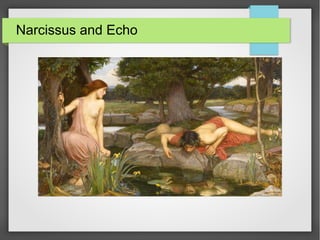
Narcissus and Echo
Narcissus Flower
Myth and Reality of Narcissism
● Falling in love by one's image in the myth of Narcissus is seen to
be a form of punishment for being incapable of loving
● If Narcissus could say: “I love you”, Echo would repeat these
words, and Narcissus would feel loved
● The inability to say these words identifies the Narcissist
● It is not true that Narcissists fall in love with themselves but with
their image which takes on an independent reality
● Narcissism denotes investment in one's image as opposed to
one's self
● Narcissists love their image, not their real self
Narcissism - Definition
● A psychological disturbance and cultural condition
●
On individual level it denotes a personality disturbance characterized by an
exaggerated investment in one's image at the expense of the self.
●
Narcissists are more concerned with how they appear than what they feel
● They deny feelings that contradict the image they seek
● Acting without feelings results in tendency to be seductive and manipulative,
and striving for power and control
●
They are egotists, focused on their own interests but lacking true values of
self – self expression, self possession, dignity, and integrity
●
Narcissists lack a sense of self derived from body feelings
● They experience life as empty and meaningless – a desolate state
Narcissism – Definition (Cont)
● Culturally Narcissism can be seen as loss of human values, a lack of
concern for the environment, for the quality of life, and for one's fellow
human beings
● A society that sacrifices natural environment for profit and power betrays
human needs
● When success is more important that self respect, the culture itself
overvalues image and is considered narcissistic
● Narcissists can be identified by their lack of humanness
● They don't feel the tragedy of a world threatened by global warming,
endless wars, poverty, genocide, etc
● They don't feel the tragedy of a life spent trying to prove their worth to an
uncaring world
Narcissism – A Tragedy
● When the facade of narcissistic superiority and specialness
breaks down, allowing a sense of sadness and loss to become
conscious, it is often too late!
● A CEO was told he has terminal cancer – faced with loss of his
life he discovered what life was:
– “I never saw flowers before, nor the sunshine in the fields”
– “I spent my life trying to prove to my father that I was a
success, and love had no place in my life”
– For the first time in his life this man was able to cry and to
reach out to his wife and children for help
Narcissism – A Tragedy (Cont)
● When asked what he felt, a narcissist replied:
– I don't have any feelings – I don't know what you mean
– I program my behavior so that it is effective in the world
● When asked about his romantic partner he replied:
– We make a good breeding team and form a workable partnership
– I am a very good sexual partner capable of giving a woman much
pleasure
– His partner's response was: We have good sex, but we don't make love
● Narcissist's sexual satisfaction stems from his partner's response and not
his own bodily feelings
More on Narcissistic Disturbance
● There is a sense of unreality about narcissists
● Not being connected with reality results in fear – fear of going crazy!
● Narcissist denies his feelings, and in doing so his ego from his body – the foundation of
one's aliveness
● Self is equated with the living body which includes the mind (we do not exist apart from
our body)
● If the body is the self, then the actual self image must be a bodily image
● One can only discard the actual self image by denying the reality of embodied self
● Narcissists do not deny they have bodies, but see body as an instrument of the mind
● Basic disturbance in the narcissist is denial of feelings
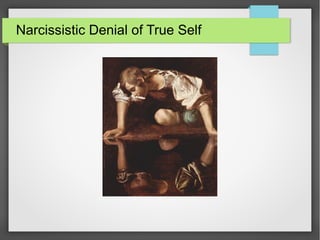
Narcissistic Denial of True Self
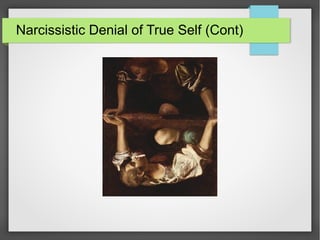
Narcissistic Denial of True Self (Cont)
Narcissism – A Statement (Alexander Lowen, MD)
“In the forty hears I have worked as a therapist, I have seen a marked change
in the personality problems of the people consulting me. The neuroses of
earlier times represented by incapacitating guilts, anxieties, … , are not
commonly seen today. Instead, I see more people who complain of
depression – they describe a lack of feelings, an inner emptiness, a deep
sense of frustration and unfulfillment. Many are quite successful in their work.
… What seems rather strange is a relative absence of anxiety and guilt
despite the severity of the disturbance. This absence of guilt and anxiety,
coupled with an absence of feelings, gives one an impression of unreality
about these people. Their performance – socially, sexually, and in the world –
seems too efficient, too mechanical, too perfect to be human. They function
more like machines than people.”
Narcissism – Developmental Trauma
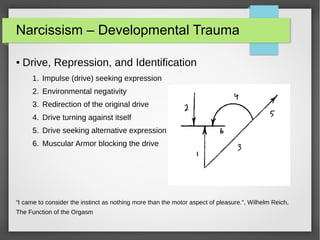
● Drive, Repression, and Identification
1. Impulse (drive) seeking expression
2. Environmental negativity
3. Redirection of the original drive
4. Drive turning against itself
5. Drive seeking alternative expression
6. Muscular Armor blocking the drive
“I came to consider the instinct as nothing more than the motor aspect of pleasure.", Wilhelm Reich,
The Function of the Orgasm
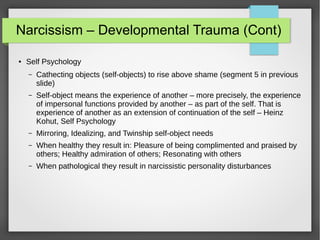
Narcissism – Developmental Trauma (Cont)
● Self Psychology
– Cathecting objects (self-objects) to rise above shame (segment 5 in previous
slide)
– Self-object means the experience of another – more precisely, the experience
of impersonal functions provided by another – as part of the self. That is
experience of another as an extension of continuation of the self – Heinz
Kohut, Self Psychology
– Mirroring, Idealizing, and Twinship self-object needs
– When healthy they result in: Pleasure of being complimented and praised by
others; Healthy admiration of others; Resonating with others
– When pathological they result in narcissistic personality disturbances
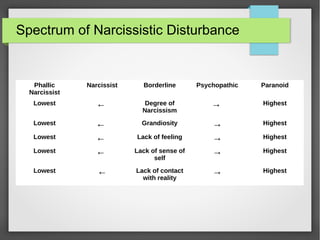
Spectrum of Narcissistic Disturbance
Phallic
Narcissist
Narcissist Borderline Psychopathic Paranoid
Lowest ← Degree of
Narcissism
→ Highest
Lowest ← Grandiosity → Highest
Lowest ← Lack of feeling → Highest
Lowest ← Lack of sense of
self
→ Highest
Lowest ← Lack of contact
with reality
→ Highest
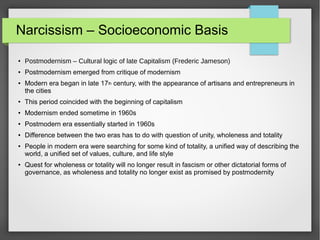
Narcissism – Socioeconomic Basis
● Postmodernism – Cultural logic of late Capitalism (Frederic Jameson)
● Postmodernism emerged from critique of modernism
● Modern era began in late 17th century, with the appearance of artisans and entrepreneurs in
the cities
●
This period coincided with the beginning of capitalism
● Modernism ended sometime in 1960s
●
Postmodern era essentially started in 1960s
● Difference between the two eras has to do with question of unity, wholeness and totality
● People in modern era were searching for some kind of totality, a unified way of describing the
world, a unified set of values, culture, and life style
● Quest for wholeness or totality will no longer result in fascism or other dictatorial forms of
governance, as wholeness and totality no longer exist as promised by postmodernity
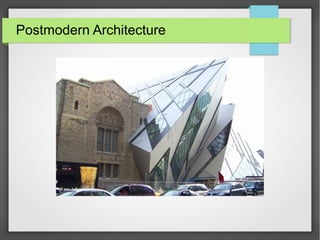
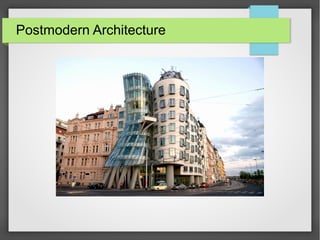
Postmodern Architecture
Critique of Postmodernity
● During the modern era production lagged behind consumption
● Factories struggled hard to produce what consumers demanded
● There was a need for more educated people to streamline production, and
make factories more efficient
● Modern culture had respect for universities, science, and scientists
● There was a relentless search for totality in modern times, a totality that could
solve modern problems, and can make sense of the world
● Modern art also reflected this search for meaning and totality
Critique of Postmodernity (Cont)
● Starting in 1960s, due to tremendous advances in forces of production (more
modern factories, better tools, etc), consumption began to lag production
● Thanks to advances in the forces of production there was an increase in surplus
value, or simply profit
● This increase in profit then was partially spent in advertisements to increase
consumption to further increase profit
● The culture of postmodern capitalism transformed from valuing scientific
research and endeavors to a culture of consumption
● Madison Avenue turned into a force that shaped our lives while it encouraged
consumption
● Thus was created a culture around consumption (postmodern culture), which
now shapes our lives and behavior to a great extent
Critique of Postmodernity (Cont)
● Jameson (1991) contends that modernity believed that it
could represent reality in simple literal signs (ways of
describing real world objects, in which signifier is the form
of the sign and signified is the content of the sign.) and
was troubled by the possibility that these signs might not
have actually represented any reality beyond themselves.
Postmodernity no longer worries about this, as it assumes
that signs exist by themselves, detached from any external
reality.
Critique of Postmodernity (Cont)
● In modernity signifier and signified were directly related.
Postmodernism does not see a relationship between signifier
and signified. For example when reading the word "water", we
might think of water drops, a lake, the chemical symbol H2O,
and so on. We don't necessarily think of a set image of water, a
universal mental representation of it. And then, each concept
(signifier) to which "water" might refer can trigger another
signifier. This infinite chain from signifier to signifier results in a
never-ending game and opens the text, displaces it, sets it in
motion (Derrida, 1980). To a modern man however, the word
water might mean the water that he drinks, water in oceans, rain,
all at once. He is never confused about the meaning of the word
water.
Critique of Postmodernity (Cont)
● Today’s most images and objects are “simulacra” or copies
of the past originals. Thus we observe cars that look like
those of 50’s, but totally unrelated, clothes that look like
those of several decades ago, but unrelated. Within each
postmodern cultural artifact (buildings, songs, films, etc),
signs are thrown together in random ways. They come and
go for no apparent reason. The best way to understand
these ideas is to turn the TV on, and the cutting edge of
postmodernism can be clearly seen in “infotainment”, and
“infomercials” in that we are not sure if we are watching
news or an entertainment show or a commercial.
Critique of Postmodernity (Cont)
● Postmodern images, as exemplified by TV images, have a
paradoxical double meaning. They are the best clue to the
historical meaning of our era. In our world as on TV
everything changes so fast that it seems that all things are
new everyday (Chernus). The concept of “newness”
disappears, since there is nothing old to contrast it with. So
we no longer care about the difference between the old and
the new. This difference is the essence of history. Since we
no longer see this difference, we stop thinking about history,
and the past is only represented through simulacra, and we
may enjoy the past (again) through nostalgia!
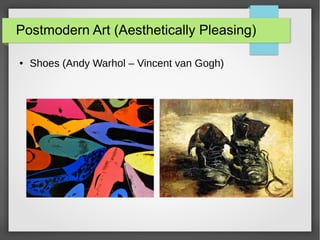
Postmodern Art (Aesthetically Pleasing)
● Shoes (Andy Warhol – Vincent van Gogh)
Critique of Postmodernity (Cont)
● Modern people felt “feelings”. Their experiences were
connected to their inner states, even if their inner states
were confused and problematic. They struggled to connect
their experiences to each other. Postmodern people are
not concerned or disturbed by such issues. Rather than
having “feelings”, they merely register disconnected
“intensities”. Everyday life itself has its own psychedelic
intensity. The more intense the rush, the more “cool” it is.
Critique of Postmodernity (Cont)
● There is something erotically satisfying about the images that play around
us. The intense rushes climax quickly, yet the process seems to be eternal.
We crave for more, like addicts. It is my belief that the postmodern man
who, for the most part instead of having feelings and emotions, has
sensations of various intensities and through commodity fetishism,
increases these sensations is the narcissist. He is the agent of reproduction
of this stage of capitalism. Postmodern man is a perfect consumer of ideas
and commodities in the vast and ever changing spatial postmodern plane,
in which past, present, and future all coexist together (This is how late
capitalism reproduces itself (cycle of capital through consumption). We live
in a depthless two dimensional spatial plane in which history is lost!
Every Era Has Its Own Psychological Disturbance
● Alexander Lowen, MD believed that pattern of neurotic behavior at
any particular time reflects that of the culture, and cultural forces
● In the Victorian period the typical neurosis was hysteria
● Hysterical reaction resulted from damming up of sexual excitement
● Victorian culture was characterized by a rigid class structure
● Sexual morality was the dominant cultural value
● Manners of speech and dress were carefully controlled especially in
bourgeois or aristocratic societies
● The effect was for people to develop rigid and strict superegos, which
limited sexual expression and created intense guilt and anxiety about
sexual feelings (Lowen 1985)
Relationship Between Mode of Production and
psychological Disturbances
● It can be easily seen that in order for Feudalism (Victorian era) to reproduce itself, strict separation between aristocracy and
peasantry (serfs) must be maintained. In order to accomplish this, wealth must be maintained within the aristocracy. Aristocracy
reproduced itself by passing the wealth along blood lines – from father to son. Thus, by controlling sexuality, especially that of
women, the Feudal culture (Victorian era) managed to preserve the separation between the two classes, therefore the Feudal
mode of production. It was important that no member of the serf class should be born into aristocracy to insure the aristocratic
blood line. Repression of female sexuality accomplished this, resulting in hysterical symptoms. Men were allowed to have sex
with members of the serf class but not to marry them, thus preserving the separation. Of course as Lowen (1985) mentions
aristocrats had their own culture, enforced by dress codes, manner of speech, manner of behavior, etc. Once again we see that
the mode of production reproduces culture, which in turn reproduces the type of individual that is necessary for reproduction of
the mode of production. It is worthwhile reiterating that mode of production has its own culture with the essential function of
preserving itself by shaping the lives of individuals who then objectively (in a material sense) reproduce the mode of production.
Relationship Between Mode of Production and
psychological Disturbances
●
In late capitalism, in which production has surpassed consumption, and where there is excess capacity in essentially all
sectors of economy, marketing and sales find pivotal roles. In order for capital to reproduce itself, individuals must be
encouraged to consume at an ever increasing rate. This is the role that marketing plays through the advertisements
that exploit all aspects of peoples’ psyche. Furthermore, people must not remember the past (except through nostalgia,
and experience it through simulacra, which itself results in more consumption!). Thus the postmodern man essentially
lives on a flat (spatial) ever changing plane. Recall that in postmodern era signifier is no longer seen to be related to
signified. Thus the postmodern man must not remember that what is the fashion today, was the fashion 10 years ago,
and perhaps will become the fashion in another 15 years. Postmodern man rejects history. Postmodern man must
become empty internally needing constant excitement to feel some aliveness. This excitement may come through
consumption of aesthetically pleasing objects. But the excitement wears out and emptiness sets in again, requiring
more excitement, and the process repeats.
Relationship Between Mode of Production and
psychological Disturbances
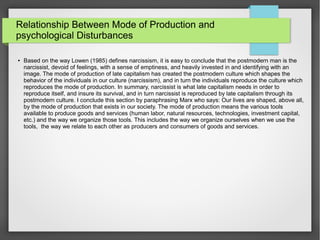
● Based on the way Lowen (1985) defines narcissism, it is easy to conclude that the postmodern man is the
narcissist, devoid of feelings, with a sense of emptiness, and heavily invested in and identifying with an
image. The mode of production of late capitalism has created the postmodern culture which shapes the
behavior of the individuals in our culture (narcissism), and in turn the individuals reproduce the culture which
reproduces the mode of production. In summary, narcissist is what late capitalism needs in order to
reproduce itself, and insure its survival, and in turn narcissist is reproduced by late capitalism through its
postmodern culture. I conclude this section by paraphrasing Marx who says: Our lives are shaped, above all,
by the mode of production that exists in our society. The mode of production means the various tools
available to produce goods and services (human labor, natural resources, technologies, investment capital,
etc.) and the way we organize those tools. This includes the way we organize ourselves when we use the
tools, the way we relate to each other as producers and consumers of goods and services.
What is next?
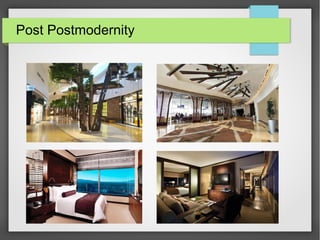
● Post Postmodernity
– Autistic period
– Self alienation
– Disconnection
– Atomic existence
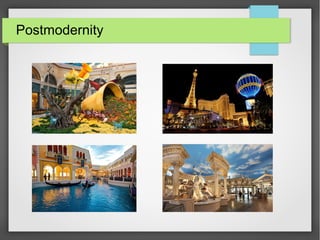
Postmodernity
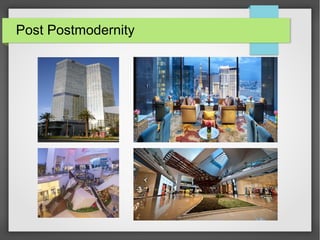
Post Postmodernity
Post Postmodernity

Narcissism

  • 1.
    Narcissism – Denialof True Self Homayoun Shahri, PhD, MA, LMFT http://www.ravonkavi.com Homayoun.shahri@ravonkavi.com
  • 2.
    Myth of Narcissus ●Narcissus was a handsome Thespian with whom Nymph Echo fell in love ● Echo had been deprived of speech by Hera – wife of Zeus ● Echo could only repeat what she heard ● Narcissus rejected Echo's love as she could not speak but only repeat what she heard – Echo died of heartbreak but her spirit lives in caves ● Gods punished Narcissus by making him fall in love with his own image ● Narcissus saw his own image in a spring and passionately fell in love with his own image, refusing to leave the site ● He died and turned into the Narcissus flower which grows on the edges of springs
  • 3.
  • 4.
  • 5.
    Myth and Realityof Narcissism ● Falling in love by one's image in the myth of Narcissus is seen to be a form of punishment for being incapable of loving ● If Narcissus could say: “I love you”, Echo would repeat these words, and Narcissus would feel loved ● The inability to say these words identifies the Narcissist ● It is not true that Narcissists fall in love with themselves but with their image which takes on an independent reality ● Narcissism denotes investment in one's image as opposed to one's self ● Narcissists love their image, not their real self
  • 6.
    Narcissism - Definition ●A psychological disturbance and cultural condition ● On individual level it denotes a personality disturbance characterized by an exaggerated investment in one's image at the expense of the self. ● Narcissists are more concerned with how they appear than what they feel ● They deny feelings that contradict the image they seek ● Acting without feelings results in tendency to be seductive and manipulative, and striving for power and control ● They are egotists, focused on their own interests but lacking true values of self – self expression, self possession, dignity, and integrity ● Narcissists lack a sense of self derived from body feelings ● They experience life as empty and meaningless – a desolate state
  • 7.
    Narcissism – Definition(Cont) ● Culturally Narcissism can be seen as loss of human values, a lack of concern for the environment, for the quality of life, and for one's fellow human beings ● A society that sacrifices natural environment for profit and power betrays human needs ● When success is more important that self respect, the culture itself overvalues image and is considered narcissistic ● Narcissists can be identified by their lack of humanness ● They don't feel the tragedy of a world threatened by global warming, endless wars, poverty, genocide, etc ● They don't feel the tragedy of a life spent trying to prove their worth to an uncaring world
  • 8.
    Narcissism – ATragedy ● When the facade of narcissistic superiority and specialness breaks down, allowing a sense of sadness and loss to become conscious, it is often too late! ● A CEO was told he has terminal cancer – faced with loss of his life he discovered what life was: – “I never saw flowers before, nor the sunshine in the fields” – “I spent my life trying to prove to my father that I was a success, and love had no place in my life” – For the first time in his life this man was able to cry and to reach out to his wife and children for help
  • 9.
    Narcissism – ATragedy (Cont) ● When asked what he felt, a narcissist replied: – I don't have any feelings – I don't know what you mean – I program my behavior so that it is effective in the world ● When asked about his romantic partner he replied: – We make a good breeding team and form a workable partnership – I am a very good sexual partner capable of giving a woman much pleasure – His partner's response was: We have good sex, but we don't make love ● Narcissist's sexual satisfaction stems from his partner's response and not his own bodily feelings
  • 10.
    More on NarcissisticDisturbance ● There is a sense of unreality about narcissists ● Not being connected with reality results in fear – fear of going crazy! ● Narcissist denies his feelings, and in doing so his ego from his body – the foundation of one's aliveness ● Self is equated with the living body which includes the mind (we do not exist apart from our body) ● If the body is the self, then the actual self image must be a bodily image ● One can only discard the actual self image by denying the reality of embodied self ● Narcissists do not deny they have bodies, but see body as an instrument of the mind ● Basic disturbance in the narcissist is denial of feelings
  • 11.
  • 12.
    Narcissistic Denial ofTrue Self (Cont)
  • 13.
    Narcissism – AStatement (Alexander Lowen, MD) “In the forty hears I have worked as a therapist, I have seen a marked change in the personality problems of the people consulting me. The neuroses of earlier times represented by incapacitating guilts, anxieties, … , are not commonly seen today. Instead, I see more people who complain of depression – they describe a lack of feelings, an inner emptiness, a deep sense of frustration and unfulfillment. Many are quite successful in their work. … What seems rather strange is a relative absence of anxiety and guilt despite the severity of the disturbance. This absence of guilt and anxiety, coupled with an absence of feelings, gives one an impression of unreality about these people. Their performance – socially, sexually, and in the world – seems too efficient, too mechanical, too perfect to be human. They function more like machines than people.”
  • 14.
    Narcissism – DevelopmentalTrauma ● Drive, Repression, and Identification 1. Impulse (drive) seeking expression 2. Environmental negativity 3. Redirection of the original drive 4. Drive turning against itself 5. Drive seeking alternative expression 6. Muscular Armor blocking the drive “I came to consider the instinct as nothing more than the motor aspect of pleasure.", Wilhelm Reich, The Function of the Orgasm
  • 15.
    Narcissism – DevelopmentalTrauma (Cont) ● Self Psychology – Cathecting objects (self-objects) to rise above shame (segment 5 in previous slide) – Self-object means the experience of another – more precisely, the experience of impersonal functions provided by another – as part of the self. That is experience of another as an extension of continuation of the self – Heinz Kohut, Self Psychology – Mirroring, Idealizing, and Twinship self-object needs – When healthy they result in: Pleasure of being complimented and praised by others; Healthy admiration of others; Resonating with others – When pathological they result in narcissistic personality disturbances
  • 16.
    Spectrum of NarcissisticDisturbance Phallic Narcissist Narcissist Borderline Psychopathic Paranoid Lowest ← Degree of Narcissism → Highest Lowest ← Grandiosity → Highest Lowest ← Lack of feeling → Highest Lowest ← Lack of sense of self → Highest Lowest ← Lack of contact with reality → Highest
  • 17.
    Narcissism – SocioeconomicBasis ● Postmodernism – Cultural logic of late Capitalism (Frederic Jameson) ● Postmodernism emerged from critique of modernism ● Modern era began in late 17th century, with the appearance of artisans and entrepreneurs in the cities ● This period coincided with the beginning of capitalism ● Modernism ended sometime in 1960s ● Postmodern era essentially started in 1960s ● Difference between the two eras has to do with question of unity, wholeness and totality ● People in modern era were searching for some kind of totality, a unified way of describing the world, a unified set of values, culture, and life style ● Quest for wholeness or totality will no longer result in fascism or other dictatorial forms of governance, as wholeness and totality no longer exist as promised by postmodernity
  • 18.
  • 19.
  • 20.
    Critique of Postmodernity ●During the modern era production lagged behind consumption ● Factories struggled hard to produce what consumers demanded ● There was a need for more educated people to streamline production, and make factories more efficient ● Modern culture had respect for universities, science, and scientists ● There was a relentless search for totality in modern times, a totality that could solve modern problems, and can make sense of the world ● Modern art also reflected this search for meaning and totality
  • 21.
    Critique of Postmodernity(Cont) ● Starting in 1960s, due to tremendous advances in forces of production (more modern factories, better tools, etc), consumption began to lag production ● Thanks to advances in the forces of production there was an increase in surplus value, or simply profit ● This increase in profit then was partially spent in advertisements to increase consumption to further increase profit ● The culture of postmodern capitalism transformed from valuing scientific research and endeavors to a culture of consumption ● Madison Avenue turned into a force that shaped our lives while it encouraged consumption ● Thus was created a culture around consumption (postmodern culture), which now shapes our lives and behavior to a great extent
  • 22.
    Critique of Postmodernity(Cont) ● Jameson (1991) contends that modernity believed that it could represent reality in simple literal signs (ways of describing real world objects, in which signifier is the form of the sign and signified is the content of the sign.) and was troubled by the possibility that these signs might not have actually represented any reality beyond themselves. Postmodernity no longer worries about this, as it assumes that signs exist by themselves, detached from any external reality.
  • 23.
    Critique of Postmodernity(Cont) ● In modernity signifier and signified were directly related. Postmodernism does not see a relationship between signifier and signified. For example when reading the word "water", we might think of water drops, a lake, the chemical symbol H2O, and so on. We don't necessarily think of a set image of water, a universal mental representation of it. And then, each concept (signifier) to which "water" might refer can trigger another signifier. This infinite chain from signifier to signifier results in a never-ending game and opens the text, displaces it, sets it in motion (Derrida, 1980). To a modern man however, the word water might mean the water that he drinks, water in oceans, rain, all at once. He is never confused about the meaning of the word water.
  • 24.
    Critique of Postmodernity(Cont) ● Today’s most images and objects are “simulacra” or copies of the past originals. Thus we observe cars that look like those of 50’s, but totally unrelated, clothes that look like those of several decades ago, but unrelated. Within each postmodern cultural artifact (buildings, songs, films, etc), signs are thrown together in random ways. They come and go for no apparent reason. The best way to understand these ideas is to turn the TV on, and the cutting edge of postmodernism can be clearly seen in “infotainment”, and “infomercials” in that we are not sure if we are watching news or an entertainment show or a commercial.
  • 25.
    Critique of Postmodernity(Cont) ● Postmodern images, as exemplified by TV images, have a paradoxical double meaning. They are the best clue to the historical meaning of our era. In our world as on TV everything changes so fast that it seems that all things are new everyday (Chernus). The concept of “newness” disappears, since there is nothing old to contrast it with. So we no longer care about the difference between the old and the new. This difference is the essence of history. Since we no longer see this difference, we stop thinking about history, and the past is only represented through simulacra, and we may enjoy the past (again) through nostalgia!
  • 26.
    Postmodern Art (AestheticallyPleasing) ● Shoes (Andy Warhol – Vincent van Gogh)
  • 27.
    Critique of Postmodernity(Cont) ● Modern people felt “feelings”. Their experiences were connected to their inner states, even if their inner states were confused and problematic. They struggled to connect their experiences to each other. Postmodern people are not concerned or disturbed by such issues. Rather than having “feelings”, they merely register disconnected “intensities”. Everyday life itself has its own psychedelic intensity. The more intense the rush, the more “cool” it is.
  • 28.
    Critique of Postmodernity(Cont) ● There is something erotically satisfying about the images that play around us. The intense rushes climax quickly, yet the process seems to be eternal. We crave for more, like addicts. It is my belief that the postmodern man who, for the most part instead of having feelings and emotions, has sensations of various intensities and through commodity fetishism, increases these sensations is the narcissist. He is the agent of reproduction of this stage of capitalism. Postmodern man is a perfect consumer of ideas and commodities in the vast and ever changing spatial postmodern plane, in which past, present, and future all coexist together (This is how late capitalism reproduces itself (cycle of capital through consumption). We live in a depthless two dimensional spatial plane in which history is lost!
  • 29.
    Every Era HasIts Own Psychological Disturbance ● Alexander Lowen, MD believed that pattern of neurotic behavior at any particular time reflects that of the culture, and cultural forces ● In the Victorian period the typical neurosis was hysteria ● Hysterical reaction resulted from damming up of sexual excitement ● Victorian culture was characterized by a rigid class structure ● Sexual morality was the dominant cultural value ● Manners of speech and dress were carefully controlled especially in bourgeois or aristocratic societies ● The effect was for people to develop rigid and strict superegos, which limited sexual expression and created intense guilt and anxiety about sexual feelings (Lowen 1985)
  • 30.
    Relationship Between Modeof Production and psychological Disturbances ● It can be easily seen that in order for Feudalism (Victorian era) to reproduce itself, strict separation between aristocracy and peasantry (serfs) must be maintained. In order to accomplish this, wealth must be maintained within the aristocracy. Aristocracy reproduced itself by passing the wealth along blood lines – from father to son. Thus, by controlling sexuality, especially that of women, the Feudal culture (Victorian era) managed to preserve the separation between the two classes, therefore the Feudal mode of production. It was important that no member of the serf class should be born into aristocracy to insure the aristocratic blood line. Repression of female sexuality accomplished this, resulting in hysterical symptoms. Men were allowed to have sex with members of the serf class but not to marry them, thus preserving the separation. Of course as Lowen (1985) mentions aristocrats had their own culture, enforced by dress codes, manner of speech, manner of behavior, etc. Once again we see that the mode of production reproduces culture, which in turn reproduces the type of individual that is necessary for reproduction of the mode of production. It is worthwhile reiterating that mode of production has its own culture with the essential function of preserving itself by shaping the lives of individuals who then objectively (in a material sense) reproduce the mode of production.
  • 31.
    Relationship Between Modeof Production and psychological Disturbances ● In late capitalism, in which production has surpassed consumption, and where there is excess capacity in essentially all sectors of economy, marketing and sales find pivotal roles. In order for capital to reproduce itself, individuals must be encouraged to consume at an ever increasing rate. This is the role that marketing plays through the advertisements that exploit all aspects of peoples’ psyche. Furthermore, people must not remember the past (except through nostalgia, and experience it through simulacra, which itself results in more consumption!). Thus the postmodern man essentially lives on a flat (spatial) ever changing plane. Recall that in postmodern era signifier is no longer seen to be related to signified. Thus the postmodern man must not remember that what is the fashion today, was the fashion 10 years ago, and perhaps will become the fashion in another 15 years. Postmodern man rejects history. Postmodern man must become empty internally needing constant excitement to feel some aliveness. This excitement may come through consumption of aesthetically pleasing objects. But the excitement wears out and emptiness sets in again, requiring more excitement, and the process repeats.
  • 32.
    Relationship Between Modeof Production and psychological Disturbances ● Based on the way Lowen (1985) defines narcissism, it is easy to conclude that the postmodern man is the narcissist, devoid of feelings, with a sense of emptiness, and heavily invested in and identifying with an image. The mode of production of late capitalism has created the postmodern culture which shapes the behavior of the individuals in our culture (narcissism), and in turn the individuals reproduce the culture which reproduces the mode of production. In summary, narcissist is what late capitalism needs in order to reproduce itself, and insure its survival, and in turn narcissist is reproduced by late capitalism through its postmodern culture. I conclude this section by paraphrasing Marx who says: Our lives are shaped, above all, by the mode of production that exists in our society. The mode of production means the various tools available to produce goods and services (human labor, natural resources, technologies, investment capital, etc.) and the way we organize those tools. This includes the way we organize ourselves when we use the tools, the way we relate to each other as producers and consumers of goods and services.
  • 33.
    What is next? ●Post Postmodernity – Autistic period – Self alienation – Disconnection – Atomic existence
  • 34.
  • 35.
  • 36.