WEST BENGAL STATE UNIVERSITY
Department of Journalism & Mass Communication
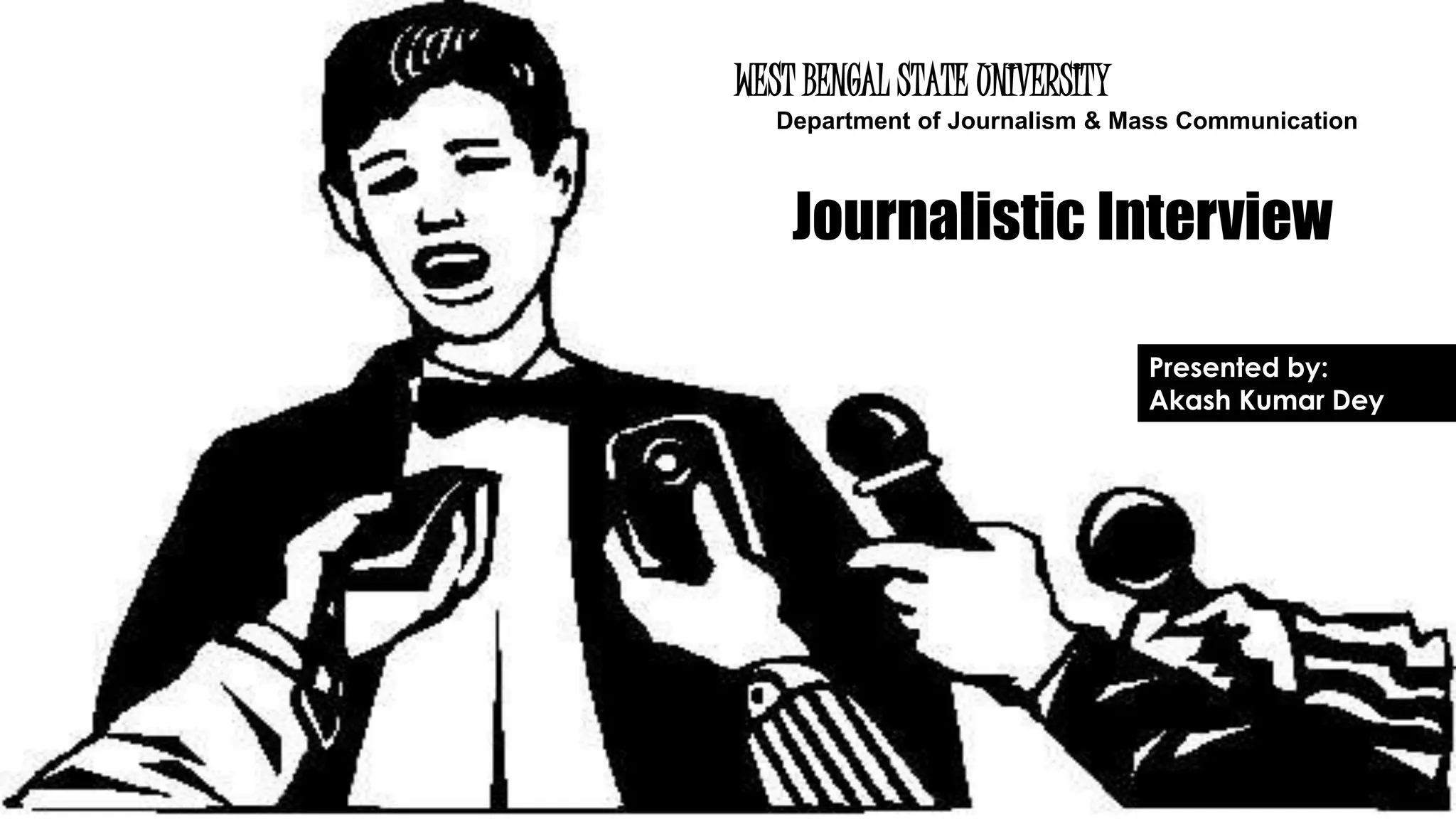
Journalistic Interview
Presented by:
Akash Kumar Dey
Why is Interviewing regarded as an integral
part of journalism?
Interviews provide more than just additional voices; they provide facts,
expertise, balance, depth and credibility.
“You couldn’t work as a journalist, if you were not able to do an
interview.” - Nils Mulvad, Editor at Kaas & Mulvad and associate
professor at The Danish School of Media and Journalism.
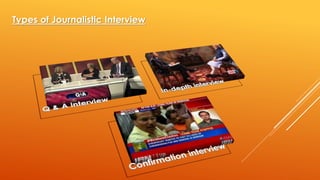
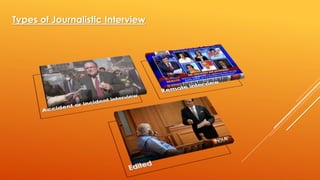
Types of Journalistic Interview
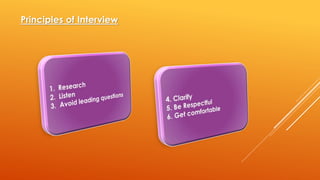
Principles of Interview
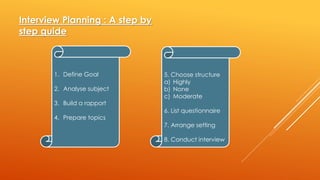
Interview Planning : A step by
step guide
1. Define Goal
2. Analyse subject
3. Build a rapport
4. Prepare topics
5. Choose structure
a) Highly
b) None
c) Moderate
6. List questionnaire
7. Arrange setting
8. Conduct interview
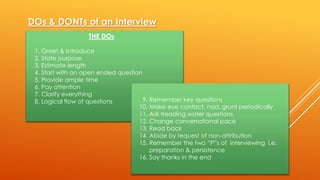
DOs & DONTs of an Interview
THE DOs
1. Greet & Introduce
2. State purpose
3. Estimate length
4. Start with an open ended question
5. Provide ample time
6. Pay attention
7. Clarify everything
8. Logical flow of questions 9. Remember key questions
10. Make eye contact, nod, grunt periodically
11. Ask treading water questions
12. Change conversational pace
13. Read back
14. Abide by request of non-attribution
15. Remember the two “P”s of interviewing i.e.
preparation & persistence
16. Say thanks in the end
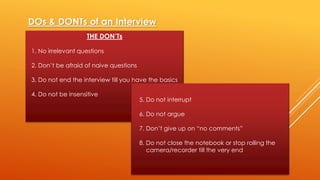
DOs & DONTs of an Interview
THE DON’Ts
1. No irrelevant questions
2. Don’t be afraid of naive questions
3. Do not end the interview till you have the basics
4. Do not be insensitive
5. Do not interrupt
6. Do not argue
7. Don’t give up on “no comments”
8. Do not close the notebook or stop rolling the
camera/recorder till the very end
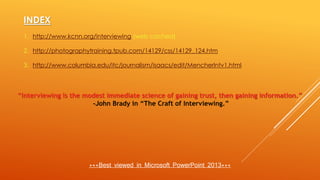
INDEX
1. http://www.kcnn.org/interviewing (web cached)
2. http://photographytraining.tpub.com/14129/css/14129_124.htm
3. http://www.columbia.edu/itc/journalism/isaacs/edit/MencherIntv1.html
“Interviewing is the modest immediate science of gaining trust, then gaining information.”
-John Brady in “The Craft of Interviewing.”
***Best viewed in Microsoft PowerPoint 2013***

Journalistic interview

  • 1.
    WEST BENGAL STATEUNIVERSITY Department of Journalism & Mass Communication Journalistic Interview Presented by: Akash Kumar Dey
  • 2.
    Why is Interviewingregarded as an integral part of journalism? Interviews provide more than just additional voices; they provide facts, expertise, balance, depth and credibility. “You couldn’t work as a journalist, if you were not able to do an interview.” - Nils Mulvad, Editor at Kaas & Mulvad and associate professor at The Danish School of Media and Journalism.
  • 3.
  • 4.
  • 5.
  • 6.
  • 7.
  • 8.
    Interview Planning :A step by step guide 1. Define Goal 2. Analyse subject 3. Build a rapport 4. Prepare topics 5. Choose structure a) Highly b) None c) Moderate 6. List questionnaire 7. Arrange setting 8. Conduct interview
  • 9.
    DOs & DONTsof an Interview THE DOs 1. Greet & Introduce 2. State purpose 3. Estimate length 4. Start with an open ended question 5. Provide ample time 6. Pay attention 7. Clarify everything 8. Logical flow of questions 9. Remember key questions 10. Make eye contact, nod, grunt periodically 11. Ask treading water questions 12. Change conversational pace 13. Read back 14. Abide by request of non-attribution 15. Remember the two “P”s of interviewing i.e. preparation & persistence 16. Say thanks in the end
  • 10.
    DOs & DONTsof an Interview THE DON’Ts 1. No irrelevant questions 2. Don’t be afraid of naive questions 3. Do not end the interview till you have the basics 4. Do not be insensitive 5. Do not interrupt 6. Do not argue 7. Don’t give up on “no comments” 8. Do not close the notebook or stop rolling the camera/recorder till the very end
  • 11.
    INDEX 1. http://www.kcnn.org/interviewing (webcached) 2. http://photographytraining.tpub.com/14129/css/14129_124.htm 3. http://www.columbia.edu/itc/journalism/isaacs/edit/MencherIntv1.html “Interviewing is the modest immediate science of gaining trust, then gaining information.” -John Brady in “The Craft of Interviewing.” ***Best viewed in Microsoft PowerPoint 2013***