Interviewing that Works
John Couper
Business Resource
March, 2012
Why do we interview?
 To
 Gather important facts and ideas
 Learn another perspective
 Learn as your readers would like to
 Collect supporting and alternative details
 Get additional contacts
 Add a personal view to the story
 Add credibility and authority
 Deepen the story with experiences
1. Principles a)
 Be as specific as your goals and knowledge allow
 Know when to give up control
 Give them some freedom… but don’t lose your way
 Learn all you can
 but don’t pretend to know more than you do
 During the interview, write down one-word reminders
of questions to ask later
 If the interviewee tends to talk in generalities, ask for
specifics, and vice-versa;
 get examples to
 Clarify
 Add depth to the story
Principles b)
 Keep questions simple but provocative
 Put readers’ priorities first, yours second
 Connect interviewee goals to the first two
 Know your goals, but be ready to change them
 Avoid obvious questions (“was that painful?”)
 Be skeptical
 not adversarial or completely accepting
 Ask only for what they really know about
 For specific information, ask “when” questions:
 "When did you realize you would need open-
heart surgery?"
Principles c)
 Repeat questions
 Put yourself in your readers’ shoes
 Get clarification and definition
 Use the Silent Treatment
 Be tactful with their emotions
 Be courteous
 Be brief
 Treat the source as a person
Principles d)
 Focus on what is being said, not on your next
question
 Try to make it a conversation
 Use critical listening skills; be curious
 Talk as little as possible
 Listen for what isn’t said
 Never act embarrassed or judgmental
An interview as “Social space”
 A social opening we offer
 Ex: questions, silence, inquiring expression,
respect
 Present the article as social space for them
 Will allow them to reach out to readers
 Listen very hard, respond well
 Respectful but with self-respect
 Show how helping you will also help them
2. The angle: your initial focus
 Why is an angle important for an interview?
 To narrow the range of questions
 To make the interviewee more comfortable
 To help “pre-write” the story
 To increase your confidence
 Sources of good angles
 Start with what readers and subgroups want
 A variation of what you saw in another paper
 What another source suggested
 Find a new perspective on the topic
 Something you’ve wondered
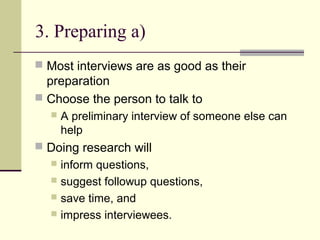
3. Preparing a)
 Most interviews are as good as their
preparation
 Choose the person to talk to
 A preliminary interview of someone else can
help
 Doing research will
 inform questions,
 suggest followup questions,
 save time, and
 impress interviewees.
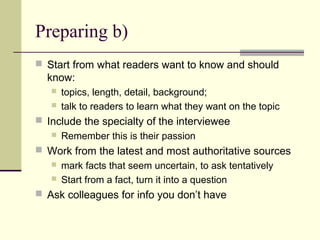
Preparing b)
 Start from what readers want to know and should
know:
 topics, length, detail, background;
 talk to readers to learn what they want on the topic
 Include the specialty of the interviewee
 Remember this is their passion
 Work from the latest and most authoritative sources
 mark facts that seem uncertain, to ask tentatively
 Start from a fact, turn it into a question
 Ask colleagues for info you don’t have
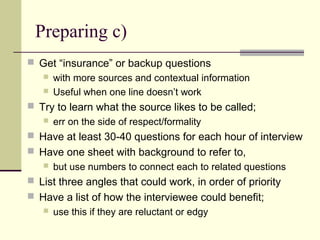
Preparing c)
 Get “insurance” or backup questions
 with more sources and contextual information
 Useful when one line doesn’t work
 Try to learn what the source likes to be called;
 err on the side of respect/formality
 Have at least 30-40 questions for each hour of interview
 Have one sheet with background to refer to,
 but use numbers to connect each to related questions
 List three angles that could work, in order of priority
 Have a list of how the interviewee could benefit;
 use this if they are reluctant or edgy
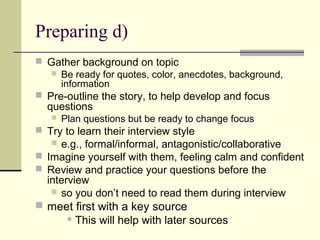
Preparing d)
 Gather background on topic
 Be ready for quotes, color, anecdotes, background,
information
 Pre-outline the story, to help develop and focus
questions
 Plan questions but be ready to change focus
 Try to learn their interview style
 e.g., formal/informal, antagonistic/collaborative
 Imagine yourself with them, feeling calm and confident
 Review and practice your questions before the
interview
 so you don’t need to read them during interview
 meet first with a key source
 This will help with later sources
Preparing e)
 Try to create a “shape” to the
questions/session
 Start with a set of related questions, logical
progression
 Consider the story’s implications: future
impact, side concerns
 look for what is missing/absent/unknown
 this usually impresses interviewees
 Always be ready to change/adapt your angle
4. Creating Rapport a)
 First impressions
 Smile when you meet, breathe deeply
 Plan and practice your first lines
 Keep up eye contact
 Wait to be asked to sit,
 but know where you will sit if you can choose;
 don’t sit directly opposite or too close, beside them
 An angle of about 90 degrees works well
 can say “If it's OK with you, I'd prefer to sit…”
(and indicate where)
Creating Rapport b)
 Copy their body language (crossing legs,
leaning, etc.)
 even their speaking pace and tone of voice
 Try to meet at a place where they can relax
 But away from their distractions and duties
 Explain your angle and what you want to know
 Listen well and respond to what they say
 Use the word “we” as often as possible
 Don’t be afraid of showing ignorance
 But always show curiosity
Creating Rapport c)
 Be sympathetic
 but never suggest you are on their side
 they will feel betrayed
 Find personal connections: from same area,
similar interests, etc. (but not too
personal/presumptuous)
 Let them feel occasional control
 e.g. “what would you like to tell me?”
 Relax but be professional
 Put yourself in their place, seeing you
Creating Rapport d)
 Be ready with an opener to make a connection,
 related to what you learned about their success
 Allow your own personality to come through
 Wear clothes similar to theirs to show respect
 if in doubt, dress slightly up
 Learn the names of their family if appropriate
 Develop and show genuine interest in the topic
 if you aren’t, why should they or readers be?
 Make sure you have a place to put your things
Creating Rapport e)
 Understand and address their priorities
 Don’t respond defensively to complaints or
worries
 be neutral but open to their points
 Putting the onus on yourself
 "I'm sorry, but I don't understand";
 "That's not quite clear to me. Do you have an
example?“
 Mildly humorous self-deprecation is powerful
5. Organizing questions
 Why organize?
 Helps confidence,
 makes sure to remember,
 keep you on track,
 reassures the interviewee,
 shows authority, respect and preparation,
 gives you a reason to look away
 Group questions by topic
 Write a 1-word index on the left to find quickly
 Start with easy questions
 but quickly shift to substantive
6. Kinds of question a)
 Funnels and tunnel questions
 Narrowing funnel: generalities to specifics
 use when you know less, to relax interviewee
 Gives more control to interviewee
 Broadening funnel: specifics to generalities
 use when know more, to engage interviewee
 Gives more control to you
 Tunnel: one informative level (use when know
exactly what you need to know on topic)
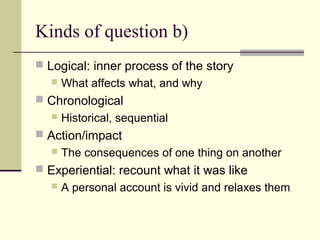
Kinds of question b)
 Logical: inner process of the story
 What affects what, and why
 Chronological
 Historical, sequential
 Action/impact
 The consequences of one thing on another
 Experiential: recount what it was like
 A personal account is vivid and relaxes them
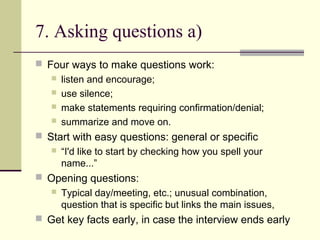
7. Asking questions a)
 Four ways to make questions work:
 listen and encourage;
 use silence;
 make statements requiring confirmation/denial;
 summarize and move on.
 Start with easy questions: general or specific
 “I'd like to start by checking how you spell your
name...”
 Opening questions:
 Typical day/meeting, etc.; unusual combination,
question that is specific but links the main issues,
 Get key facts early, in case the interview ends early
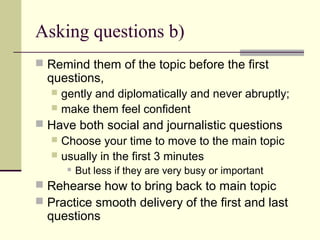
Asking questions b)
 Remind them of the topic before the first
questions,
 gently and diplomatically and never abruptly;
 make them feel confident
 Have both social and journalistic questions
 Choose your time to move to the main topic
 usually in the first 3 minutes
 But less if they are very busy or important
 Rehearse how to bring back to main topic
 Practice smooth delivery of the first and last
questions
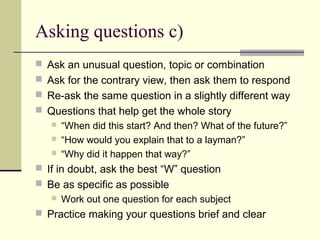
Asking questions c)
 Ask an unusual question, topic or combination
 Ask for the contrary view, then ask them to respond
 Re-ask the same question in a slightly different way
 Questions that help get the whole story
 “When did this start? And then? What of the future?”
 “How would you explain that to a layman?”
 “Why did it happen that way?”
 If in doubt, ask the best “W” question
 Be as specific as possible
 Work out one question for each subject
 Practice making your questions brief and clear
Asking questions d)
 Have both general and specific questions
 Use the one that relaxes the interviewee
 Always ask questions that lead to elaboration,
 not “if” or yes/no
 Save tough questions for near the end
 open-door questions at the end
 Ask for documentation and further leads
 to show you are curious and engaged
 Avoid leading questions as much as possible
 Note the setting and their style if appropriate
 Pick an angle, then be neutral and unpredictive
Asking questions e)
 Plan the wording of key questions carefully
 consider the implications of words
 Leading questions are useful when rapport is good
 2-part questions:
 If they are relaxed, they answer the part they want
 “Echoing”: repeat their statement to get more detail
 Make your questions suit your interviewee
 People resist hypothetical questions when they
 like facts and figures
 are defensive/pompous/tentative/afraid,
 Creative people welcome a “what would you do if…?”
approach and will freewheel away into fantasy, which
can make for good copy
Asking questions f)
 Open vs. closed questions
 Open: encourage elaboration and explanation
 Closed: get clear, declarative information
 Show that it matters to you, and make sure it is
sincere
 find a way to care
 Be ready to ask important questions when a related
topic comes up so it isn’t artificial
 Try specific questions
 then move on to summary or category issues
 End with “anything else?” questions
8. Followup questions a)
 Get details with process related questions (“how”)
 Pose an explanation and have them correct it
 Sympathetic Noise…
 "You feel very strongly about that, don't you?"
 Questions that ask for their approval or interest can
be better than direct
 Ask not only about that topic, but if know of other
story that might be good
 Followups that work:
 “…don’t you think?”
 “what evidence do you have for that?'
 “I take it that means ‘yes’”
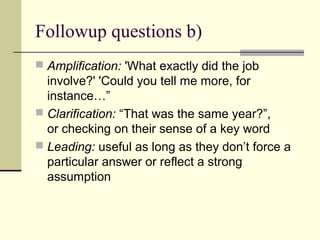
Followup questions b)
 Amplification: 'What exactly did the job
involve?' 'Could you tell me more, for
instance…”
 Clarification: “That was the same year?”,
or checking on their sense of a key word
 Leading: useful as long as they don’t force a
particular answer or reflect a strong
assumption
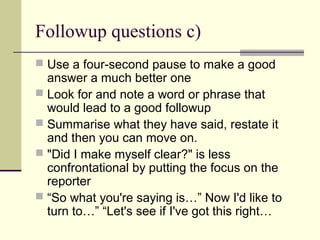
Followup questions c)
 Use a four-second pause to make a good
answer a much better one
 Look for and note a word or phrase that
would lead to a good followup
 Summarise what they have said, restate it
and then you can move on.
 "Did I make myself clear?" is less
confrontational by putting the focus on the
reporter
 “So what you're saying is…” Now I'd like to
turn to…” “Let's see if I've got this right…
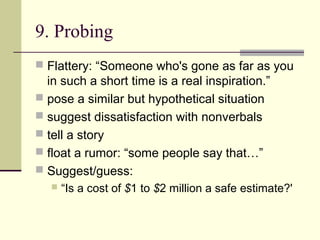
9. Probing
 Flattery: “Someone who's gone as far as you
in such a short time is a real inspiration.”
 pose a similar but hypothetical situation
 suggest dissatisfaction with nonverbals
 tell a story
 float a rumor: “some people say that…”
 Suggest/guess:
 “Is a cost of $1 to $2 million a safe estimate?'
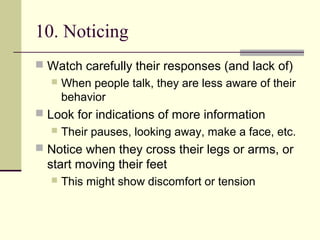
10. Noticing
 Watch carefully their responses (and lack of)
 When people talk, they are less aware of their
behavior
 Look for indications of more information
 Their pauses, looking away, make a face, etc.
 Notice when they cross their legs or arms, or
start moving their feet
 This might show discomfort or tension
11. Listening a)
 Listening is active
 hearing, imagining and understanding
 during an interview, listen intently
 Pick up nonverbals in voice, pauses, change of tone
 Listening
 increases rapport and
 prepares you to get the answers you want
 Use “listening’ body language
 use nods, head tilts, leaning forward, smiling, raise
eyebrows for a question
 Practice nodding to make sure it is “natural”
 avoid nodding more than twice;
 notice and use the body language they respond best to
Listening b)
 Use silence to look thoughtful, attentive,
 encourage elaboration
 Listen carefully to exact words the interviewee, e.g.
 their eagerness or reluctance to answer particular
questions,
 tone or strength of voice,
 pauses, omissions,
 what makes them animated,
 signs of reluctance
 When their voice drop or slows, the topic may be
significant or the interviewee has reservations
 Don’t just ask questions, but seek confirmation:
 “I understand you have a house in Boise”
12. Be responsive
 Show you are listening and change
expression to encourage more information
 Use a variety of nonverbal prompts, like “uh-
huh,” “I see”, small looks of surprise and
interest
 Be ready to be honest if it helps them
loosen/open up
 When they talk too much, “punish” them
 cut back on the nods, lean back, look away,
sigh softly, adopt a posture opposite to theirs
13. Difficult interviewees a)
 Go in with idea of goals and that you belong there and readers
deserve to know
 If they put up a barrier
 Go a different way
 Say something like “you mean to say that…?”
 Spark their curiosity with what you have heard
 Say “you’ve heard” that something happened; this often
inspires them to correct the facts
 Invoke authority of someone they want to please
 Know and mention how the story would help them
 Strategic flexibility; offer to do the interview several ways
 gives them sense of choice when really you are getting what
you want, and have choice of changing to your preferred
style (make a show of turning off the recorder)
Difficult interviewees b)
 Make questions simple for defensive, skilled and tricky
interviewees.
 “People make these allegations so maybe you should put the
record straight”
 “How do you answer what…is saying?”
 “It looks bad if you don't comment; we'd like to print your side.”
 “Fascinating, but what I really want to know is…”
 “Wow, really… but first can we get back to…”
 “That's a great story. I'd like to know much more-but first I'd
like to clear up…”
 “Will you explain why you are not implementing your planned
factory expansion?”
 Ascribe contradiction to someone else
 Preface an attack with praise
 Treat it lightly by implying the question is not that serious
 Practice mentally by vivdly imagining strong resistance
 with a strong, cool response from you
Difficult interviewees c)
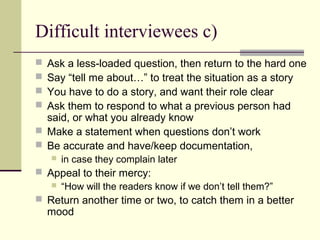
 Ask a less-loaded question, then return to the hard one
 Say “tell me about…” to treat the situation as a story
 You have to do a story, and want their role clear
 Ask them to respond to what a previous person had
said, or what you already know
 Make a statement when questions don’t work
 Be accurate and have/keep documentation,
 in case they complain later
 Appeal to their mercy:
 “How will the readers know if we don’t tell them?”
 Return another time or two, to catch them in a better
mood
Difficult interviewees d)
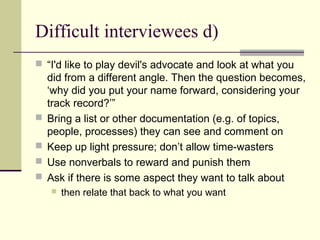
 “I'd like to play devil's advocate and look at what you
did from a different angle. Then the question becomes,
‘why did you put your name forward, considering your
track record?’”
 Bring a list or other documentation (e.g. of topics,
people, processes) they can see and comment on
 Keep up light pressure; don’t allow time-wasters
 Use nonverbals to reward and punish them
 Ask if there is some aspect they want to talk about
 then relate that back to what you want
14. After the interview
 Be prepared to re-interview if needed
 “Leave the door open” at the end, in case you
need to go back
 Go over your notes immediately afterwards to
fill in gaps and details
 Ideally, use a recorder and indexing notes
 Listen back to tape of your interview just to
learn how to improve your techniques
 After the story runs, maybe contact them for
their response
 If you offer to send a copy, make sure you do
15. Practicalities a)
 Make sure it is the right person!
 Confirm all details
 day, date, time, location, phone for changes
 Create a relationship with office manager, assistant
 Before the interview, give yourself an extra minute or
two
 to collect yourself
 check what you have and where
 But never in the interview area
 Make sure to have all materials needed ahead of
time, and check just before the interview
Practicalities b)
 Have a business card, extra batteries for
recorder
 Practice talking to and watching people to
learn to read interviewees,
 understand body language, subtleties of
voice tone etc.
 Offer strong, sincere thanks

Interviewing for kimep

  • 1.
    Interviewing that Works JohnCouper Business Resource March, 2012
  • 2.
    Why do weinterview?  To  Gather important facts and ideas  Learn another perspective  Learn as your readers would like to  Collect supporting and alternative details  Get additional contacts  Add a personal view to the story  Add credibility and authority  Deepen the story with experiences
  • 3.
    1. Principles a) Be as specific as your goals and knowledge allow  Know when to give up control  Give them some freedom… but don’t lose your way  Learn all you can  but don’t pretend to know more than you do  During the interview, write down one-word reminders of questions to ask later  If the interviewee tends to talk in generalities, ask for specifics, and vice-versa;  get examples to  Clarify  Add depth to the story
  • 4.
    Principles b)  Keepquestions simple but provocative  Put readers’ priorities first, yours second  Connect interviewee goals to the first two  Know your goals, but be ready to change them  Avoid obvious questions (“was that painful?”)  Be skeptical  not adversarial or completely accepting  Ask only for what they really know about  For specific information, ask “when” questions:  "When did you realize you would need open- heart surgery?"
  • 5.
    Principles c)  Repeatquestions  Put yourself in your readers’ shoes  Get clarification and definition  Use the Silent Treatment  Be tactful with their emotions  Be courteous  Be brief  Treat the source as a person
  • 6.
    Principles d)  Focuson what is being said, not on your next question  Try to make it a conversation  Use critical listening skills; be curious  Talk as little as possible  Listen for what isn’t said  Never act embarrassed or judgmental
  • 7.
    An interview as“Social space”  A social opening we offer  Ex: questions, silence, inquiring expression, respect  Present the article as social space for them  Will allow them to reach out to readers  Listen very hard, respond well  Respectful but with self-respect  Show how helping you will also help them
  • 8.
    2. The angle:your initial focus  Why is an angle important for an interview?  To narrow the range of questions  To make the interviewee more comfortable  To help “pre-write” the story  To increase your confidence  Sources of good angles  Start with what readers and subgroups want  A variation of what you saw in another paper  What another source suggested  Find a new perspective on the topic  Something you’ve wondered
  • 9.
    3. Preparing a) Most interviews are as good as their preparation  Choose the person to talk to  A preliminary interview of someone else can help  Doing research will  inform questions,  suggest followup questions,  save time, and  impress interviewees.
  • 10.
    Preparing b)  Startfrom what readers want to know and should know:  topics, length, detail, background;  talk to readers to learn what they want on the topic  Include the specialty of the interviewee  Remember this is their passion  Work from the latest and most authoritative sources  mark facts that seem uncertain, to ask tentatively  Start from a fact, turn it into a question  Ask colleagues for info you don’t have
  • 11.
    Preparing c)  Get“insurance” or backup questions  with more sources and contextual information  Useful when one line doesn’t work  Try to learn what the source likes to be called;  err on the side of respect/formality  Have at least 30-40 questions for each hour of interview  Have one sheet with background to refer to,  but use numbers to connect each to related questions  List three angles that could work, in order of priority  Have a list of how the interviewee could benefit;  use this if they are reluctant or edgy
  • 12.
    Preparing d)  Gatherbackground on topic  Be ready for quotes, color, anecdotes, background, information  Pre-outline the story, to help develop and focus questions  Plan questions but be ready to change focus  Try to learn their interview style  e.g., formal/informal, antagonistic/collaborative  Imagine yourself with them, feeling calm and confident  Review and practice your questions before the interview  so you don’t need to read them during interview  meet first with a key source  This will help with later sources
  • 13.
    Preparing e)  Tryto create a “shape” to the questions/session  Start with a set of related questions, logical progression  Consider the story’s implications: future impact, side concerns  look for what is missing/absent/unknown  this usually impresses interviewees  Always be ready to change/adapt your angle
  • 14.
    4. Creating Rapporta)  First impressions  Smile when you meet, breathe deeply  Plan and practice your first lines  Keep up eye contact  Wait to be asked to sit,  but know where you will sit if you can choose;  don’t sit directly opposite or too close, beside them  An angle of about 90 degrees works well  can say “If it's OK with you, I'd prefer to sit…” (and indicate where)
  • 15.
    Creating Rapport b) Copy their body language (crossing legs, leaning, etc.)  even their speaking pace and tone of voice  Try to meet at a place where they can relax  But away from their distractions and duties  Explain your angle and what you want to know  Listen well and respond to what they say  Use the word “we” as often as possible  Don’t be afraid of showing ignorance  But always show curiosity
  • 16.
    Creating Rapport c) Be sympathetic  but never suggest you are on their side  they will feel betrayed  Find personal connections: from same area, similar interests, etc. (but not too personal/presumptuous)  Let them feel occasional control  e.g. “what would you like to tell me?”  Relax but be professional  Put yourself in their place, seeing you
  • 17.
    Creating Rapport d) Be ready with an opener to make a connection,  related to what you learned about their success  Allow your own personality to come through  Wear clothes similar to theirs to show respect  if in doubt, dress slightly up  Learn the names of their family if appropriate  Develop and show genuine interest in the topic  if you aren’t, why should they or readers be?  Make sure you have a place to put your things
  • 18.
    Creating Rapport e) Understand and address their priorities  Don’t respond defensively to complaints or worries  be neutral but open to their points  Putting the onus on yourself  "I'm sorry, but I don't understand";  "That's not quite clear to me. Do you have an example?“  Mildly humorous self-deprecation is powerful
  • 19.
    5. Organizing questions Why organize?  Helps confidence,  makes sure to remember,  keep you on track,  reassures the interviewee,  shows authority, respect and preparation,  gives you a reason to look away  Group questions by topic  Write a 1-word index on the left to find quickly  Start with easy questions  but quickly shift to substantive
  • 20.
    6. Kinds ofquestion a)  Funnels and tunnel questions  Narrowing funnel: generalities to specifics  use when you know less, to relax interviewee  Gives more control to interviewee  Broadening funnel: specifics to generalities  use when know more, to engage interviewee  Gives more control to you  Tunnel: one informative level (use when know exactly what you need to know on topic)
  • 21.
    Kinds of questionb)  Logical: inner process of the story  What affects what, and why  Chronological  Historical, sequential  Action/impact  The consequences of one thing on another  Experiential: recount what it was like  A personal account is vivid and relaxes them
  • 22.
    7. Asking questionsa)  Four ways to make questions work:  listen and encourage;  use silence;  make statements requiring confirmation/denial;  summarize and move on.  Start with easy questions: general or specific  “I'd like to start by checking how you spell your name...”  Opening questions:  Typical day/meeting, etc.; unusual combination, question that is specific but links the main issues,  Get key facts early, in case the interview ends early
  • 23.
    Asking questions b) Remind them of the topic before the first questions,  gently and diplomatically and never abruptly;  make them feel confident  Have both social and journalistic questions  Choose your time to move to the main topic  usually in the first 3 minutes  But less if they are very busy or important  Rehearse how to bring back to main topic  Practice smooth delivery of the first and last questions
  • 24.
    Asking questions c) Ask an unusual question, topic or combination  Ask for the contrary view, then ask them to respond  Re-ask the same question in a slightly different way  Questions that help get the whole story  “When did this start? And then? What of the future?”  “How would you explain that to a layman?”  “Why did it happen that way?”  If in doubt, ask the best “W” question  Be as specific as possible  Work out one question for each subject  Practice making your questions brief and clear
  • 25.
    Asking questions d) Have both general and specific questions  Use the one that relaxes the interviewee  Always ask questions that lead to elaboration,  not “if” or yes/no  Save tough questions for near the end  open-door questions at the end  Ask for documentation and further leads  to show you are curious and engaged  Avoid leading questions as much as possible  Note the setting and their style if appropriate  Pick an angle, then be neutral and unpredictive
  • 26.
    Asking questions e) Plan the wording of key questions carefully  consider the implications of words  Leading questions are useful when rapport is good  2-part questions:  If they are relaxed, they answer the part they want  “Echoing”: repeat their statement to get more detail  Make your questions suit your interviewee  People resist hypothetical questions when they  like facts and figures  are defensive/pompous/tentative/afraid,  Creative people welcome a “what would you do if…?” approach and will freewheel away into fantasy, which can make for good copy
  • 27.
    Asking questions f) Open vs. closed questions  Open: encourage elaboration and explanation  Closed: get clear, declarative information  Show that it matters to you, and make sure it is sincere  find a way to care  Be ready to ask important questions when a related topic comes up so it isn’t artificial  Try specific questions  then move on to summary or category issues  End with “anything else?” questions
  • 28.
    8. Followup questionsa)  Get details with process related questions (“how”)  Pose an explanation and have them correct it  Sympathetic Noise…  "You feel very strongly about that, don't you?"  Questions that ask for their approval or interest can be better than direct  Ask not only about that topic, but if know of other story that might be good  Followups that work:  “…don’t you think?”  “what evidence do you have for that?'  “I take it that means ‘yes’”
  • 29.
    Followup questions b) Amplification: 'What exactly did the job involve?' 'Could you tell me more, for instance…”  Clarification: “That was the same year?”, or checking on their sense of a key word  Leading: useful as long as they don’t force a particular answer or reflect a strong assumption
  • 30.
    Followup questions c) Use a four-second pause to make a good answer a much better one  Look for and note a word or phrase that would lead to a good followup  Summarise what they have said, restate it and then you can move on.  "Did I make myself clear?" is less confrontational by putting the focus on the reporter  “So what you're saying is…” Now I'd like to turn to…” “Let's see if I've got this right…
  • 31.
    9. Probing  Flattery:“Someone who's gone as far as you in such a short time is a real inspiration.”  pose a similar but hypothetical situation  suggest dissatisfaction with nonverbals  tell a story  float a rumor: “some people say that…”  Suggest/guess:  “Is a cost of $1 to $2 million a safe estimate?'
  • 32.
    10. Noticing  Watchcarefully their responses (and lack of)  When people talk, they are less aware of their behavior  Look for indications of more information  Their pauses, looking away, make a face, etc.  Notice when they cross their legs or arms, or start moving their feet  This might show discomfort or tension
  • 33.
    11. Listening a) Listening is active  hearing, imagining and understanding  during an interview, listen intently  Pick up nonverbals in voice, pauses, change of tone  Listening  increases rapport and  prepares you to get the answers you want  Use “listening’ body language  use nods, head tilts, leaning forward, smiling, raise eyebrows for a question  Practice nodding to make sure it is “natural”  avoid nodding more than twice;  notice and use the body language they respond best to
  • 34.
    Listening b)  Usesilence to look thoughtful, attentive,  encourage elaboration  Listen carefully to exact words the interviewee, e.g.  their eagerness or reluctance to answer particular questions,  tone or strength of voice,  pauses, omissions,  what makes them animated,  signs of reluctance  When their voice drop or slows, the topic may be significant or the interviewee has reservations  Don’t just ask questions, but seek confirmation:  “I understand you have a house in Boise”
  • 35.
    12. Be responsive Show you are listening and change expression to encourage more information  Use a variety of nonverbal prompts, like “uh- huh,” “I see”, small looks of surprise and interest  Be ready to be honest if it helps them loosen/open up  When they talk too much, “punish” them  cut back on the nods, lean back, look away, sigh softly, adopt a posture opposite to theirs
  • 36.
    13. Difficult intervieweesa)  Go in with idea of goals and that you belong there and readers deserve to know  If they put up a barrier  Go a different way  Say something like “you mean to say that…?”  Spark their curiosity with what you have heard  Say “you’ve heard” that something happened; this often inspires them to correct the facts  Invoke authority of someone they want to please  Know and mention how the story would help them  Strategic flexibility; offer to do the interview several ways  gives them sense of choice when really you are getting what you want, and have choice of changing to your preferred style (make a show of turning off the recorder)
  • 37.
    Difficult interviewees b) Make questions simple for defensive, skilled and tricky interviewees.  “People make these allegations so maybe you should put the record straight”  “How do you answer what…is saying?”  “It looks bad if you don't comment; we'd like to print your side.”  “Fascinating, but what I really want to know is…”  “Wow, really… but first can we get back to…”  “That's a great story. I'd like to know much more-but first I'd like to clear up…”  “Will you explain why you are not implementing your planned factory expansion?”  Ascribe contradiction to someone else  Preface an attack with praise  Treat it lightly by implying the question is not that serious  Practice mentally by vivdly imagining strong resistance  with a strong, cool response from you
  • 38.
    Difficult interviewees c) Ask a less-loaded question, then return to the hard one  Say “tell me about…” to treat the situation as a story  You have to do a story, and want their role clear  Ask them to respond to what a previous person had said, or what you already know  Make a statement when questions don’t work  Be accurate and have/keep documentation,  in case they complain later  Appeal to their mercy:  “How will the readers know if we don’t tell them?”  Return another time or two, to catch them in a better mood
  • 39.
    Difficult interviewees d) “I'd like to play devil's advocate and look at what you did from a different angle. Then the question becomes, ‘why did you put your name forward, considering your track record?’”  Bring a list or other documentation (e.g. of topics, people, processes) they can see and comment on  Keep up light pressure; don’t allow time-wasters  Use nonverbals to reward and punish them  Ask if there is some aspect they want to talk about  then relate that back to what you want
  • 40.
    14. After theinterview  Be prepared to re-interview if needed  “Leave the door open” at the end, in case you need to go back  Go over your notes immediately afterwards to fill in gaps and details  Ideally, use a recorder and indexing notes  Listen back to tape of your interview just to learn how to improve your techniques  After the story runs, maybe contact them for their response  If you offer to send a copy, make sure you do
  • 41.
    15. Practicalities a) Make sure it is the right person!  Confirm all details  day, date, time, location, phone for changes  Create a relationship with office manager, assistant  Before the interview, give yourself an extra minute or two  to collect yourself  check what you have and where  But never in the interview area  Make sure to have all materials needed ahead of time, and check just before the interview
  • 42.
    Practicalities b)  Havea business card, extra batteries for recorder  Practice talking to and watching people to learn to read interviewees,  understand body language, subtleties of voice tone etc.  Offer strong, sincere thanks