Joshua S. White Academic & Technical Advisor: Dr. John Marsh Presented To:  Information Systems Security Association Central New York Chapter   Presentation Derived From: SUNYIT M.S. Telecommunications Thesis The Missing Pieces: Physical Layer Optical Network Security
>   Outline What is PLONS? Reasoning What's Known Understanding The Void The Big Picture PDR Closings
Physical Layer Optical Network Security
>   Why Bother? Fiber to the X 90 million+ Miles Of Fiber In 10 Years 1 Sec. Compromise is Upwards of 40 Gb Loss Networks Not Build With Security In Mind Most Traffic Eventually Travels a Fiber Link  Less Research on PDR More on Attacks Recent Events  Mediterranean, Persian Gulf U.S.S. Jimmy Carter
>   What's Known: PLON Attacks Tapping Bend  Rayleigh Scatter Crosstalk Legitimate  Gain Competition Single Point Multi-Point Due to Bend Jamming EDFA Multi-Point Crosstalk Correlative Out of Band  In Band
>   Categorization
>   Understanding The Void
>   The Big Picture
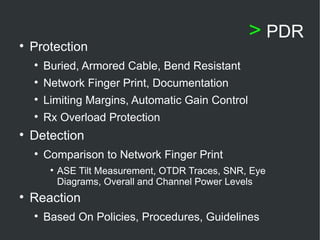
>   PDR Protection Buried, Armored Cable, Bend Resistant Network Finger Print, Documentation Limiting Margins, Automatic Gain Control Rx Overload Protection Detection Comparison to Network Finger Print ASE Tilt Measurement, OTDR Traces, SNR, Eye Diagrams, Overall and Channel Power Levels Reaction Based On Policies, Procedures, Guidelines
>   Closing What's Needed: More Awareness Dispel The Myths  QoS is Not Security More Research What's Now Provided: Taxonomy For PLONS A Better Understanding of Specific Attacks The Beginnings of a Standardized PDR Schema
>   Citations [1]  Harry Dutton, Understanding Optical Communications, IBM  RedBooks, SGA24-5230-00, Sep. 1998 [2]  Luca Faustini and Giuseppe Martini. Bend loss in single-mode  fibers.  IEEE  -  Journal of Lightwave Technology , 15(4): 671–679, April 1997. [3]   Alun J. Harris and Peter F. Castle. Bend loss measurements on  high numerical aperture single-mode fibers as a function  of wavelength and bend radius.  IEEE  -  Journal of  Lightwave Technology , 4(1):34–40, January 1986. [4]   Muriel Medard, Douglas Marquis, Richard A. Barry, and Steven  G. Finn: Security Issues in All-Optical Networks,  IEEE  Network Magazine  11(3), 42–8, May/June 1997. [5]  Alun J. Harris, Peter F. Castle, and Paul A. Shrubshall:  Wavelength Demultiplexing Using Bends in a Single- Mode Optical Fiber,  IEEE - Journal of Lightwave  Technology  6(1):80-86, January 1988. [6]  T. H. Shake, B. Hazzard, and D. Marquis: Assessing Network  Infrastucture Vulnerabilities to Physical Layer Attacks  Distributed Systems Group, Advanced Networks Group,  Lincoln Laboratory MIT, Sponsored By the DARPA  under contract F19628-95-C-002 [7]   Muriel Medard, Douglas Marquis, and Stephen R. Chinn: Attack  Detection Methods for All-Optical Networks,  Network  and Distributed System Security Symposium , sponsored  by the Internet Society Session 3(Paper 1), 1–15, 1998 [8] M.Y. Loke, and James N. McMullin: Simulation and    Measurement of Radiation Loss at Multimode Fiber  Macrobends,  IEEE - Journal of Lightwave Technology   8(8), 1250–56, August 1990 [9]  R. Morgan, J.D.C. Jones, P.G. Harper, and J.S. Barton:  Observation of secondary bend loss oscillations  arising from propagation of cladding modes in  buffered  monomode optical fibres ,  Optics  Communications  85(1),17–20, August 1991 [10]  Technical Staff of CSELT:  Fiber Optic Communications    Handbook , TAB Profession and Reference Books, 1990 [11]   Robert S. Elliott, “Electromagnetics – History, Theory, and  Applications”, IEEE Press Series on Electromagnetic  Waves, IEEE Press, 1993 [12]   Muriel Medard, Douglas Marquis, and Stephen R. Chinn: Attack  Detection Methods for All-Optical Networks, Network  and Distributed System Security Symposium, sponsored  by the Internet Society Session 3(Paper 1), 1–15, 1998 [13]   Cancellieri, G. single-Mode Optical Fibers, Pergamon Press,  Toronto, 1991 [14]   Keiser, G., Optical Fiber Communications 2 nd  Edition, McGraw  Hill, Inc., Toronto, 1991 [15]  Walter, H., Method and Device For Extracting Signals Out of a  Glass Fiber, US Patent No.: 6,265,710 B1, July 2001
[16]  Stoneburner, G., Goguen, A., Feringa, A., Risk Management  Guide for Information Technology Systems, Special  Publication 800-30 [17] Bruce Potter, Trends in wireless security – the big picture,  Network Security Volume 2003, Issue 12, December  2003, Pages 4-5.  [18]  Opterna, State of Optical Network Security, Black Hat Federal  Briefing Presentation, October 2003 [19]  ISO/IEC 15408:1999(E): Information Technology – Security  Techniques – Evaluation Criteria for IT Security,  International Organization for Standardization, Geneva,  Switzerland.  [20]  Schneier, Bruce. “Attack Trees.” 21-29. Dr. Dobb’s Journal of  software Tools 24, 12 (December 1999): 21-29 [21]  Schneier, Bruce. Secrets and Lies: Digital Security in a  Networked World. New York, NY: John Wiley & Sons,  2000. >   Citations

Physical Layer Optical Network Security Thesis Presentation To The CNY ISSA Chapter

  • 1.
    Joshua S. WhiteAcademic & Technical Advisor: Dr. John Marsh Presented To: Information Systems Security Association Central New York Chapter Presentation Derived From: SUNYIT M.S. Telecommunications Thesis The Missing Pieces: Physical Layer Optical Network Security
  • 2.
    > Outline What is PLONS? Reasoning What's Known Understanding The Void The Big Picture PDR Closings
  • 3.
    Physical Layer OpticalNetwork Security
  • 4.
    > Why Bother? Fiber to the X 90 million+ Miles Of Fiber In 10 Years 1 Sec. Compromise is Upwards of 40 Gb Loss Networks Not Build With Security In Mind Most Traffic Eventually Travels a Fiber Link Less Research on PDR More on Attacks Recent Events Mediterranean, Persian Gulf U.S.S. Jimmy Carter
  • 5.
    > What's Known: PLON Attacks Tapping Bend Rayleigh Scatter Crosstalk Legitimate Gain Competition Single Point Multi-Point Due to Bend Jamming EDFA Multi-Point Crosstalk Correlative Out of Band In Band
  • 6.
    > Categorization
  • 7.
    > Understanding The Void
  • 8.
    > The Big Picture
  • 9.
    > PDR Protection Buried, Armored Cable, Bend Resistant Network Finger Print, Documentation Limiting Margins, Automatic Gain Control Rx Overload Protection Detection Comparison to Network Finger Print ASE Tilt Measurement, OTDR Traces, SNR, Eye Diagrams, Overall and Channel Power Levels Reaction Based On Policies, Procedures, Guidelines
  • 10.
    > Closing What's Needed: More Awareness Dispel The Myths QoS is Not Security More Research What's Now Provided: Taxonomy For PLONS A Better Understanding of Specific Attacks The Beginnings of a Standardized PDR Schema
  • 11.
    > Citations [1] Harry Dutton, Understanding Optical Communications, IBM RedBooks, SGA24-5230-00, Sep. 1998 [2] Luca Faustini and Giuseppe Martini. Bend loss in single-mode fibers. IEEE - Journal of Lightwave Technology , 15(4): 671–679, April 1997. [3] Alun J. Harris and Peter F. Castle. Bend loss measurements on high numerical aperture single-mode fibers as a function of wavelength and bend radius. IEEE - Journal of Lightwave Technology , 4(1):34–40, January 1986. [4] Muriel Medard, Douglas Marquis, Richard A. Barry, and Steven G. Finn: Security Issues in All-Optical Networks, IEEE Network Magazine 11(3), 42–8, May/June 1997. [5] Alun J. Harris, Peter F. Castle, and Paul A. Shrubshall: Wavelength Demultiplexing Using Bends in a Single- Mode Optical Fiber, IEEE - Journal of Lightwave Technology 6(1):80-86, January 1988. [6] T. H. Shake, B. Hazzard, and D. Marquis: Assessing Network Infrastucture Vulnerabilities to Physical Layer Attacks Distributed Systems Group, Advanced Networks Group, Lincoln Laboratory MIT, Sponsored By the DARPA under contract F19628-95-C-002 [7] Muriel Medard, Douglas Marquis, and Stephen R. Chinn: Attack Detection Methods for All-Optical Networks, Network and Distributed System Security Symposium , sponsored by the Internet Society Session 3(Paper 1), 1–15, 1998 [8] M.Y. Loke, and James N. McMullin: Simulation and Measurement of Radiation Loss at Multimode Fiber Macrobends, IEEE - Journal of Lightwave Technology 8(8), 1250–56, August 1990 [9] R. Morgan, J.D.C. Jones, P.G. Harper, and J.S. Barton: Observation of secondary bend loss oscillations arising from propagation of cladding modes in buffered monomode optical fibres , Optics Communications 85(1),17–20, August 1991 [10] Technical Staff of CSELT: Fiber Optic Communications Handbook , TAB Profession and Reference Books, 1990 [11] Robert S. Elliott, “Electromagnetics – History, Theory, and Applications”, IEEE Press Series on Electromagnetic Waves, IEEE Press, 1993 [12] Muriel Medard, Douglas Marquis, and Stephen R. Chinn: Attack Detection Methods for All-Optical Networks, Network and Distributed System Security Symposium, sponsored by the Internet Society Session 3(Paper 1), 1–15, 1998 [13] Cancellieri, G. single-Mode Optical Fibers, Pergamon Press, Toronto, 1991 [14] Keiser, G., Optical Fiber Communications 2 nd Edition, McGraw Hill, Inc., Toronto, 1991 [15] Walter, H., Method and Device For Extracting Signals Out of a Glass Fiber, US Patent No.: 6,265,710 B1, July 2001
  • 12.
    [16] Stoneburner,G., Goguen, A., Feringa, A., Risk Management Guide for Information Technology Systems, Special Publication 800-30 [17] Bruce Potter, Trends in wireless security – the big picture, Network Security Volume 2003, Issue 12, December 2003, Pages 4-5. [18] Opterna, State of Optical Network Security, Black Hat Federal Briefing Presentation, October 2003 [19] ISO/IEC 15408:1999(E): Information Technology – Security Techniques – Evaluation Criteria for IT Security, International Organization for Standardization, Geneva, Switzerland. [20] Schneier, Bruce. “Attack Trees.” 21-29. Dr. Dobb’s Journal of software Tools 24, 12 (December 1999): 21-29 [21] Schneier, Bruce. Secrets and Lies: Digital Security in a Networked World. New York, NY: John Wiley & Sons, 2000. > Citations

Editor's Notes

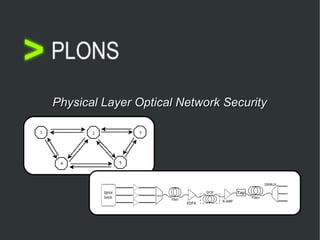
  • #4 - PLONS, Physical Layer Optical Network Security is what I've found to be an Under Researched Area of Information Security... and as we know, we “ Must ” Better Understand security at every level of the OSI reference Model if we are to Ensure Trusted Path. - So Lets stop for a second and define exactly what we mean by “Trusted Path”... We're talking about the tenets that make up Assured Communications; these are of course Confidentiality, Integrity, and Availability. - For those of you who are unfamiliar with the CIA Triad: As it applies to networking, Confidentiality is the assurance that only the intended recipient can view a communication. Integrity is the concept that the received information has not been tampered with, and finally Availability is the notion that the information will be there when you need/want it without interruption. - So lets define what we're talking about when we say the physical layer as it applies to optical networks... “load pictures” Communications on a typical long haul optical network takes place between larger OEO Nodes as shown here, but what really happens between those nodes... it's not just fiber connecting them, it's in fact a number of components including the fiber. These are needed to counteract the effects of Dispersion and power loss.