SASITHARAN BALASUBRAMANIAM
DIRECTOR OF RESEARCH, TSSG
VistaMilk
Communication
Technologies
Research
20-05-2019
2
TSSG
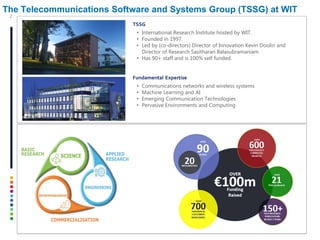
• International Research Institute hosted by WIT.
• Founded in 1997.
• Led by (co-directors) Director of Innovation Kevin Doolin and
Director of Research Sasitharan Balasubramaniam
• Has 90+ staff and is 100% self funded.
• Communications networks and wireless systems
• Machine Learning and AI
• Emerging Communication Technologies
• Pervasive Environments and Computing
The Telecommunications Software and Systems Group (TSSG) at WIT
Fundamental Expertise
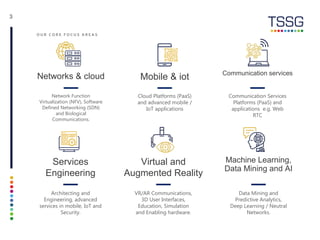
Networks & cloud
Network Function
Virtualization (NFV), Software
Defined Networking (SDN)
and Biological
Communications.
Communication services
3
Mobile & iot
Cloud Platforms (PaaS)
and advanced mobile /
IoT applications
Communication Services
Platforms (PaaS) and
applications e.g. Web
RTC
O U R C O R E F O C U S A R E A S
Architecting and
Engineering, advanced
services in mobile, IoT and
Security.
Virtual and
Augmented Reality
VR/AR Communications,
3D User Interfaces,
Education, Simulation
and Enabling hardware.
Data Mining and
Predictive Analytics,
Deep Learning / Neutral
Networks.
Machine Learning,
Data Mining and AI
Services
Engineering
VistaMilk
Wireless Communications in
Agri. Tech.
www.tssg.org 6
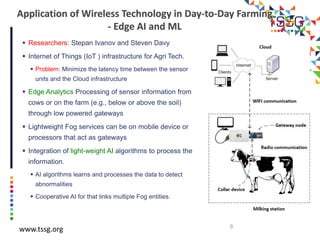
Application of Wireless Technology in Day-to-Day Farming
- Edge AI and ML
 Researchers: Stepan Ivanov and Steven Davy
 Internet of Things (IoT ) infrastructure for Agri Tech.
 Problem: Minimize the latency time between the sensor
units and the Cloud infrastructure
 Edge Analytics Processing of sensor information from
cows or on the farm (e.g., below or above the soil)
through low powered gateways
 Lightweight Fog services can be on mobile device or
processors that act as gateways
 Integration of light-weight AI algorithms to process the
information.
 AI algorithms learns and processes the data to detect
abnormalities
 Cooperative AI for that links multiple Fog entities.
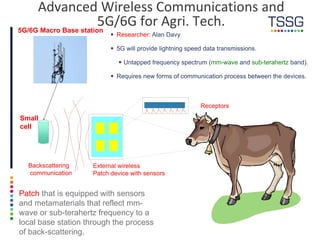
External wireless
Patch device with sensors
Patch that is equipped with sensors
and metamaterials that reflect mm-
wave or sub-terahertz frequency to a
local base station through the process
of back-scattering.
5G/6G Macro Base station
Advanced Wireless Communications and
5G/6G for Agri. Tech.
Backscattering
communication
 Researcher: Alan Davy
 5G will provide lightning speed data transmissions.
 Untapped frequency spectrum (mm-wave and sub-terahertz band).
 Requires new forms of communication process between the devices.
Receptors
Small
cell
Internet of Bio-Nano Things
(IoBNT) for Smart Agri.
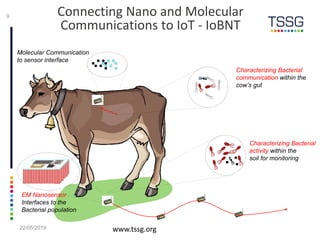
Connecting Nano and Molecular
Communications to IoT - IoBNT
22/05/2019 www.tssg.org
9
Characterizing Bacterial
communication within the
cow’s gut
Characterizing Bacterial
activity within the
soil for monitoring
Molecular Communication
to sensor interface
EM Nanosensor
Interfaces to the
Bacterial population
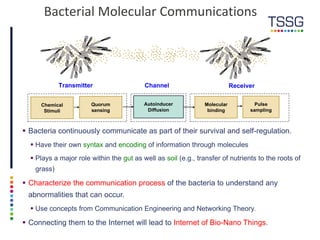
Chemical
Stimuli
Autoinducer
Diffusion
Pulse
sampling
Channel
Quorum
sensing
Molecular
binding
Transmitter Receiver
Bacterial Molecular Communications
 Bacteria continuously communicate as part of their survival and self-regulation.
 Have their own syntax and encoding of information through molecules
 Plays a major role within the gut as well as soil (e.g., transfer of nutrients to the roots of
grass)
 Characterize the communication process of the bacteria to understand any
abnormalities that can occur.
 Use concepts from Communication Engineering and Networking Theory.
 Connecting them to the Internet will lead to Internet of Bio-Nano Things.
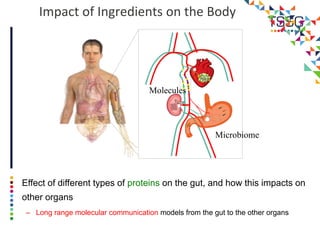
Microbiome
Molecules
• Effect of different types of proteins on the gut, and how this impacts on
other organs
– Long range molecular communication models from the gut to the other organs
Impact of Ingredients on the Body
Gut-Brain Communication
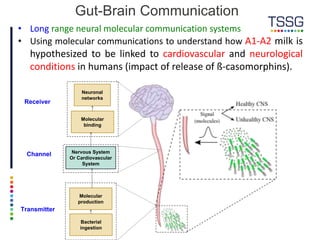
• Long range neural molecular communication systems
• Using molecular communications to understand how A1-A2 milk is
hypothesized to be linked to cardiovascular and neurological
conditions in humans (impact of release of ß-casomorphins).
Bacterial
ingestion
Nervous System
Or Cardiovascular
System
Neuronal
networks
Channel
Molecular
production
Molecular
binding
Transmitter
Receiver
1 3
( 0 5 1 ) 3 0 2 9 1 2
s a s i b @ T S S G . O R G T S S G _ W I T
@ T S S G _ W I T
0 8 7 0 9 7 5 1 8 6
SASITHARAN
BALASUBRAMANIAM
DIR E CTOR OF R E SE AR CH , TSSG

VistaMilk Communication Technologies Research

  • 1.
    SASITHARAN BALASUBRAMANIAM DIRECTOR OFRESEARCH, TSSG VistaMilk Communication Technologies Research 20-05-2019
  • 2.
    2 TSSG • International ResearchInstitute hosted by WIT. • Founded in 1997. • Led by (co-directors) Director of Innovation Kevin Doolin and Director of Research Sasitharan Balasubramaniam • Has 90+ staff and is 100% self funded. • Communications networks and wireless systems • Machine Learning and AI • Emerging Communication Technologies • Pervasive Environments and Computing The Telecommunications Software and Systems Group (TSSG) at WIT Fundamental Expertise
  • 3.
    Networks & cloud NetworkFunction Virtualization (NFV), Software Defined Networking (SDN) and Biological Communications. Communication services 3 Mobile & iot Cloud Platforms (PaaS) and advanced mobile / IoT applications Communication Services Platforms (PaaS) and applications e.g. Web RTC O U R C O R E F O C U S A R E A S Architecting and Engineering, advanced services in mobile, IoT and Security. Virtual and Augmented Reality VR/AR Communications, 3D User Interfaces, Education, Simulation and Enabling hardware. Data Mining and Predictive Analytics, Deep Learning / Neutral Networks. Machine Learning, Data Mining and AI Services Engineering
  • 4.
  • 5.
  • 6.
    www.tssg.org 6 Application ofWireless Technology in Day-to-Day Farming - Edge AI and ML  Researchers: Stepan Ivanov and Steven Davy  Internet of Things (IoT ) infrastructure for Agri Tech.  Problem: Minimize the latency time between the sensor units and the Cloud infrastructure  Edge Analytics Processing of sensor information from cows or on the farm (e.g., below or above the soil) through low powered gateways  Lightweight Fog services can be on mobile device or processors that act as gateways  Integration of light-weight AI algorithms to process the information.  AI algorithms learns and processes the data to detect abnormalities  Cooperative AI for that links multiple Fog entities.
  • 7.
    External wireless Patch devicewith sensors Patch that is equipped with sensors and metamaterials that reflect mm- wave or sub-terahertz frequency to a local base station through the process of back-scattering. 5G/6G Macro Base station Advanced Wireless Communications and 5G/6G for Agri. Tech. Backscattering communication  Researcher: Alan Davy  5G will provide lightning speed data transmissions.  Untapped frequency spectrum (mm-wave and sub-terahertz band).  Requires new forms of communication process between the devices. Receptors Small cell
  • 8.
    Internet of Bio-NanoThings (IoBNT) for Smart Agri.
  • 9.
    Connecting Nano andMolecular Communications to IoT - IoBNT 22/05/2019 www.tssg.org 9 Characterizing Bacterial communication within the cow’s gut Characterizing Bacterial activity within the soil for monitoring Molecular Communication to sensor interface EM Nanosensor Interfaces to the Bacterial population
  • 10.
    Chemical Stimuli Autoinducer Diffusion Pulse sampling Channel Quorum sensing Molecular binding Transmitter Receiver Bacterial MolecularCommunications  Bacteria continuously communicate as part of their survival and self-regulation.  Have their own syntax and encoding of information through molecules  Plays a major role within the gut as well as soil (e.g., transfer of nutrients to the roots of grass)  Characterize the communication process of the bacteria to understand any abnormalities that can occur.  Use concepts from Communication Engineering and Networking Theory.  Connecting them to the Internet will lead to Internet of Bio-Nano Things.
  • 11.
    Microbiome Molecules • Effect ofdifferent types of proteins on the gut, and how this impacts on other organs – Long range molecular communication models from the gut to the other organs Impact of Ingredients on the Body
  • 12.
    Gut-Brain Communication • Longrange neural molecular communication systems • Using molecular communications to understand how A1-A2 milk is hypothesized to be linked to cardiovascular and neurological conditions in humans (impact of release of ß-casomorphins). Bacterial ingestion Nervous System Or Cardiovascular System Neuronal networks Channel Molecular production Molecular binding Transmitter Receiver
  • 13.
    1 3 ( 05 1 ) 3 0 2 9 1 2 s a s i b @ T S S G . O R G T S S G _ W I T @ T S S G _ W I T 0 8 7 0 9 7 5 1 8 6 SASITHARAN BALASUBRAMANIAM DIR E CTOR OF R E SE AR CH , TSSG

Editor's Notes

  • #4 Focus areas with company logos
  • #7 Sensors are being placed everywhere (on farms and animals) Fog and edge analytics processes information close to the source before sending to the cloud The processing is done through light-weight AI that sits on each sensor
  • #8 Smart agriculture needs to be ready for 5G and even 6G New forms of communication needs to be investigated for new types of materials This will investigate if new miniature patches can emit high frequency signals to 5G/6G small cells
  • #10 Molecular communications is a new form of communication using molecules (found in all biological systems at cellular scale) This occurs within the animal as well as within the soil The aim is to connect these molecular communication system to the internet – we term as “Internet of Bio-Nano Things”
  • #11 One form of molecular communication using bacteria They communicate naturally through molecule messaging Our aim is to characterize this for bacteria communication in animal’s gut as well as the soil to know when optimum condition occurs
  • #12 The aim of this research is to look at how ingredients impacts on different organs of the body From the ingestion in the gut, the enzymes will travel to different organs and impact different for people with different condition This will use concept of long-range molecular communications, where molecules travel in the blood stream Simulations will be conducted on a supercomputer
  • #13 - This system can be used to also understand the impact that A1-A2 milk and how this impacts on neurological conditions The long range molecular communication will investigate how the food ingested will travel to the brain and interact with the neurons