ENGINEERING PHYSICS
B.TECH :I YEAR SEM-I
MECHANICAL & CIVIL
BY SAMERA MOUSIN
DEPT. OF H& BS
Introduction to Fiber
Optics
What are optical fibers
 Thin strands of pure glass
 Carry data over long distances
 At very high speeds
 Fiber can be bent or twisted
Fiber optic technology
 Sources
 Transmission medium
 Detectors
Fig: The fiber optic communication system
Sources of light
 Light emitting diodes
 Lasers
Sources
 Modulate electrical signals into
optical signals
 Mostly modulate at 850nm, 1300nm
and 1550 nm
 Lasers give high intensity, high
frequency light
 LEDs are economical
Transmission medium
 Optical fiber is replacing copper
 Light is used as the carrier of
information
 Much higher data rate
The optical fiber
Physics of optical fibers
 Index of refraction of material : ratio
of speed of light in vacuum to speed
of light in medium
 Refraction of light : bending of
light as it travels from one
media to another
Refraction of light
 Speed of light
changes as it
across the
boundary of
two media
 Angles w.r.t
normal
Refraction Indices
 Vacuum…….1.00000 (exactly)
 Air ……1.00029
 Alcohol ......1.329
 Diamond ...... 2.417
 Glass ........ 1.5
 Ice ....... 1.309
 Sodium Chloride (Salt) .... 1.544
 Sugar Solution (80%) ........ 1.49
 Water (20 C) ................ 1.333
Snell’s Law
 Critical angle: Angle of incidence at which
angle of refraction = 900
Total internal reflection
 Trapping light in the fiber
Numerical Aperture
The numerical aperture of the
fiber is closely related to the
critical angle and is often used in
the specification for optical fiber
and the components that work
with it
The numerical aperture is given by
the formula:
The angle of acceptance is twice
that given by the numerical
2
2
2
1
.
. n
n
A
N 

Fibers can be bent!!
Fig: Illustration of total internal reflection
Types of optical fibers
 Single mode
 only one signal can be transmitted
 use of single frequency
 Multi mode
 Several signals can be transmitted
 Several frequencies used to modulate
the signal
Types of Fiber
•Both types of fiber described earlier are known as
step-index fibers because the index of refraction
changes radically between the core and the cladding
•Graded-index fiber is a compromise multimode
fiber, but the index of refraction gradually decreases
away from the center of the core
•Graded-index fiber has less dispersion than a
multimode step-index fiber
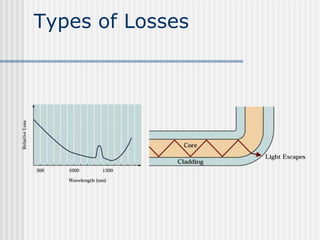
Losses in optical fibers
 Attenuation loss
 Dispersion loss
 Waveguide loss
Types of Losses
Splices and Connectors
 To connect to fibers mechanically or
by fusion
 Lot of signal loss possible
 Very accurate alignment necessary
 Most important cost factor
 Now being replaced by optical
amplifiers
Optical Receivers
 Must be very sensitive
 Capable of picking up and amplifying
signals of nanowatts
 Photodiodes and phototransistors
 These devices get ‘turned ON’ by
light
 Produce photocurrent
Advantages of optical fibers
 Can carry much more information
 Much higher data rates
 Much longer distances than co-axial
cables
 Immune to electromagnetic noise
 Light in weight
 Unaffected by atmospheric agents
THANK
YOU

15848591.ppt

  • 1.
    ENGINEERING PHYSICS B.TECH :IYEAR SEM-I MECHANICAL & CIVIL
  • 2.
  • 3.
  • 4.
    What are opticalfibers  Thin strands of pure glass  Carry data over long distances  At very high speeds  Fiber can be bent or twisted
  • 5.
    Fiber optic technology Sources  Transmission medium  Detectors Fig: The fiber optic communication system
  • 6.
    Sources of light Light emitting diodes  Lasers
  • 7.
    Sources  Modulate electricalsignals into optical signals  Mostly modulate at 850nm, 1300nm and 1550 nm  Lasers give high intensity, high frequency light  LEDs are economical
  • 8.
    Transmission medium  Opticalfiber is replacing copper  Light is used as the carrier of information  Much higher data rate The optical fiber
  • 9.
    Physics of opticalfibers  Index of refraction of material : ratio of speed of light in vacuum to speed of light in medium  Refraction of light : bending of light as it travels from one media to another
  • 10.
    Refraction of light Speed of light changes as it across the boundary of two media  Angles w.r.t normal
  • 11.
    Refraction Indices  Vacuum…….1.00000(exactly)  Air ……1.00029  Alcohol ......1.329  Diamond ...... 2.417  Glass ........ 1.5  Ice ....... 1.309  Sodium Chloride (Salt) .... 1.544  Sugar Solution (80%) ........ 1.49  Water (20 C) ................ 1.333
  • 12.
    Snell’s Law  Criticalangle: Angle of incidence at which angle of refraction = 900
  • 13.
    Total internal reflection Trapping light in the fiber
  • 14.
    Numerical Aperture The numericalaperture of the fiber is closely related to the critical angle and is often used in the specification for optical fiber and the components that work with it The numerical aperture is given by the formula: The angle of acceptance is twice that given by the numerical 2 2 2 1 . . n n A N  
  • 15.
    Fibers can bebent!! Fig: Illustration of total internal reflection
  • 16.
    Types of opticalfibers  Single mode  only one signal can be transmitted  use of single frequency  Multi mode  Several signals can be transmitted  Several frequencies used to modulate the signal
  • 17.
    Types of Fiber •Bothtypes of fiber described earlier are known as step-index fibers because the index of refraction changes radically between the core and the cladding •Graded-index fiber is a compromise multimode fiber, but the index of refraction gradually decreases away from the center of the core •Graded-index fiber has less dispersion than a multimode step-index fiber
  • 20.
    Losses in opticalfibers  Attenuation loss  Dispersion loss  Waveguide loss
  • 21.
  • 22.
    Splices and Connectors To connect to fibers mechanically or by fusion  Lot of signal loss possible  Very accurate alignment necessary  Most important cost factor  Now being replaced by optical amplifiers
  • 23.
    Optical Receivers  Mustbe very sensitive  Capable of picking up and amplifying signals of nanowatts  Photodiodes and phototransistors  These devices get ‘turned ON’ by light  Produce photocurrent
  • 24.
    Advantages of opticalfibers  Can carry much more information  Much higher data rates  Much longer distances than co-axial cables  Immune to electromagnetic noise  Light in weight  Unaffected by atmospheric agents
  • 26.