PLATO’S THEORY OF EDUCATION
Dr. Kabita Das
Department of Philosophy
 Plato born and brought up in an wealthy family and begins his career as a student of
Socrates.
 He established his own school known as Academy.
 Plato believes that most of the evils in the society could be removedby providing
proper education.
 Every person should do the best thing through out life.
 Idea of education connected to his ideal state.
 In his dialogue of Republic the concept of education was elaborated.
 Education is tool for state.
 He pounces that there are three classes in the state must be well trained and
educated in order to do their duties with efficiency.
 He thinks that that education is a kind of positive measure by which a ruler can
mold the characters of the individual.
 He doesn’t support private education rather he stresses the need of keeping
education with a state only.
 Through education a state could get the best philosopher king.
 Education is the most important scheme to have a just society.
INTRODUCTION
EDUCATION
 Plato says that education is related to individual beings and social
characteristics. So he gives important individual to understand knowledge which
is equivalent to virtue.
 He stated that education for all the citizens (man and women) of the state.
 Through education individual can develop their mental abilities and can become
respected units of state.
 According to him education should be provided for moral and physical
improvement of the child.
 Significance aspect of his education is to prepare the philosopher king.
 In Republic he talks about early education.
 In Laws he talks about the end of life.
 Plato believes that the highest goal of educational curriculum is the knowledge
of good.
METHOD OF TEACHING
• Plato gives important to a place where children love to go and thereby
learn many things from learning.
• He gave much more importance to nursery or primary education.
• In the elementary level he focuses on play method.
• He believe in the concept of learning by doing.
• He was against the concept of force education. And wants student
interest in education.
• Education should be both physical and mental growth.
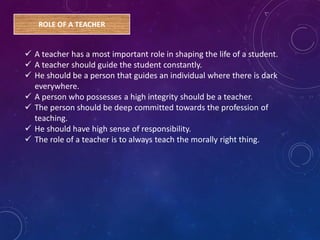
ROLE OF A TEACHER
 A teacher has a most important role in shaping the life of a student.
 A teacher should guide the student constantly.
 He should be a person that guides an individual where there is dark
everywhere.
 A person who possesses a high integrity should be a teacher.
 The person should be deep committed towards the profession of
teaching.
 He should have high sense of responsibility.
 The role of a teacher is to always teach the morally right thing.
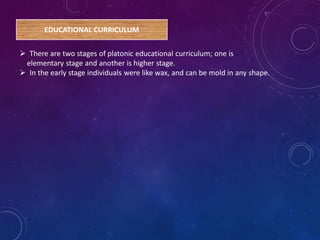
EDUCATIONAL CURRICULUM
 There are two stages of platonic educational curriculum; one is
elementary stage and another is higher stage.
 In the early stage individuals were like wax, and can be mold in any shape.
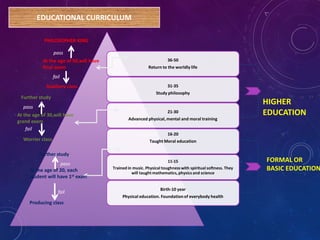
EDUCATIONAL CURRICULUM
36-50
Return to the worldly life
31-35
Study philosophy
21-30
Advanced physical, mental and moral training
16-20
Taught Moral education
11-15
Trained in music. Physical toughnesswith spiritual softness. They
will taught mathematics,physics and science
Birth-10 year
Physical education. Foundationof everybody health
FORMAL OR
BASIC EDUCATION
HIGHER
EDUCATION
At the age of 20, each
student will have 1st exam
Producing class
fail
pass
Further study
At the age of 30,will have
grand exam
fail
Worrier class
Further study
At the age of 50,will have
final exam
fail
pass
pass
Auxiliary class
PHILOSOPHER KING
References:
Plato, The Republic. Oxford University Press
K Marx &F Engels, German Ideology, K Marx & F Engels, Collected
Works, (CW, hence forth) Vol. 5, Progress, Moscow,
1978 pp.59-62
Lodge, R.C. 2000, first published in 1947. Plato's Theory of Education. Edited by
T. I. L. o. Philosophy. Vol. Vol VIII, Ancient Philosophy. London:
Routledge.
Smith, L. Glenn, and Joan K. Smith. 1994. Lives in Education: A Narrative of
People and Ideas. 2nd ed. New York: St. Martin's Press.
Hare, T.M. 1999. Plato. In Greek Philosophers, edited by K. Thomas. Oxford:
Oxford University Press.

Theory-of-education-Plato.pdf

  • 1.
    PLATO’S THEORY OFEDUCATION Dr. Kabita Das Department of Philosophy
  • 2.
     Plato bornand brought up in an wealthy family and begins his career as a student of Socrates.  He established his own school known as Academy.  Plato believes that most of the evils in the society could be removedby providing proper education.  Every person should do the best thing through out life.  Idea of education connected to his ideal state.  In his dialogue of Republic the concept of education was elaborated.  Education is tool for state.  He pounces that there are three classes in the state must be well trained and educated in order to do their duties with efficiency.  He thinks that that education is a kind of positive measure by which a ruler can mold the characters of the individual.  He doesn’t support private education rather he stresses the need of keeping education with a state only.  Through education a state could get the best philosopher king.  Education is the most important scheme to have a just society. INTRODUCTION
  • 3.
    EDUCATION  Plato saysthat education is related to individual beings and social characteristics. So he gives important individual to understand knowledge which is equivalent to virtue.  He stated that education for all the citizens (man and women) of the state.  Through education individual can develop their mental abilities and can become respected units of state.  According to him education should be provided for moral and physical improvement of the child.  Significance aspect of his education is to prepare the philosopher king.  In Republic he talks about early education.  In Laws he talks about the end of life.  Plato believes that the highest goal of educational curriculum is the knowledge of good.
  • 4.
    METHOD OF TEACHING •Plato gives important to a place where children love to go and thereby learn many things from learning. • He gave much more importance to nursery or primary education. • In the elementary level he focuses on play method. • He believe in the concept of learning by doing. • He was against the concept of force education. And wants student interest in education. • Education should be both physical and mental growth.
  • 5.
    ROLE OF ATEACHER  A teacher has a most important role in shaping the life of a student.  A teacher should guide the student constantly.  He should be a person that guides an individual where there is dark everywhere.  A person who possesses a high integrity should be a teacher.  The person should be deep committed towards the profession of teaching.  He should have high sense of responsibility.  The role of a teacher is to always teach the morally right thing.
  • 6.
    EDUCATIONAL CURRICULUM  Thereare two stages of platonic educational curriculum; one is elementary stage and another is higher stage.  In the early stage individuals were like wax, and can be mold in any shape.
  • 7.
    EDUCATIONAL CURRICULUM 36-50 Return tothe worldly life 31-35 Study philosophy 21-30 Advanced physical, mental and moral training 16-20 Taught Moral education 11-15 Trained in music. Physical toughnesswith spiritual softness. They will taught mathematics,physics and science Birth-10 year Physical education. Foundationof everybody health FORMAL OR BASIC EDUCATION HIGHER EDUCATION At the age of 20, each student will have 1st exam Producing class fail pass Further study At the age of 30,will have grand exam fail Worrier class Further study At the age of 50,will have final exam fail pass pass Auxiliary class PHILOSOPHER KING
  • 8.
    References: Plato, The Republic.Oxford University Press K Marx &F Engels, German Ideology, K Marx & F Engels, Collected Works, (CW, hence forth) Vol. 5, Progress, Moscow, 1978 pp.59-62 Lodge, R.C. 2000, first published in 1947. Plato's Theory of Education. Edited by T. I. L. o. Philosophy. Vol. Vol VIII, Ancient Philosophy. London: Routledge. Smith, L. Glenn, and Joan K. Smith. 1994. Lives in Education: A Narrative of People and Ideas. 2nd ed. New York: St. Martin's Press. Hare, T.M. 1999. Plato. In Greek Philosophers, edited by K. Thomas. Oxford: Oxford University Press.