Constructive Alignment in Learning, Teaching and Assessment     John Biggs Catherine Tang ATN Assessment Conference: “Engaging Students in Assessment”  U of SA, 20-21 November, 2008
Activity 1 As a teacher, what do you want to achieve in  teaching? Share your views with your colleagues.
The focus in teaching is not what we teach but  what we would like our students to learn and  how we can help them achieve that. The first step therefore is to define the intended  learning outcomes for our students. Teaching and assessment are then designed and  implemented to align to these outcomes.
The Intended Outcomes of This Session 1. Explain constructive alignment. 2. Identify intended learning outcomes for one  of your teaching units. 3. Design teaching/learning activities to best      achieve one of your intended learning      outcomes. 4. Design tasks to assess how well the intended  learning outcome has been achieved.   5. Reflect on the impact of this session on your  teaching and assessment.
Why “Constructive Alignment”? ‘ constructive’ refers to the idea that students  construct meaning  through relevant learning activities.  ‘ alignment’ refers to a learning environment where teaching and learning activities, and assessment tasks, are  aligned  to the intended learning outcomes of a subject.
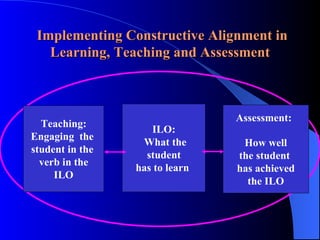
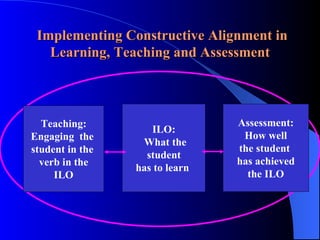
Implementing Constructive Alignment in Learning, Teaching and Assessment ILO: What the student has to learn   Teaching: Engaging  the  student in the  verb in the ILO Assessment:  How well the student  has achieved the ILO
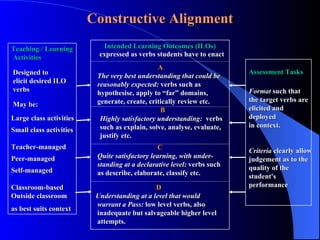
Constructive Alignment Intended Learning Outcomes (ILOs)‏ expressed as verbs students have to enact A The very best understanding that could be reasonably expected:   verbs such as  hypothesise, apply to “far” domains,  generate, create, critically review etc. B Highly satisfactory understanding:  verbs such as explain, solve, analyse, evaluate, justify etc. C Quite satisfactory learning, with under- standing at a declarative level:  verbs such  as describe, elaborate, classify etc. D Understanding at a level that would  warrant a Pass:   low level verbs, also inadequate but salvageable higher level  attempts. Teaching / Learning Activities Designed to elicit desired ILO verbs May be: Large class activities Small class activities Teacher-managed Peer-managed Self-managed Classroom-based Outside classroom as best suits context Assessment Tasks Format  such that  the target verbs are elicited and  deployed in context. Criteria  clearly allow judgement as to the quality of the  student's performance
Designing Constructively Aligned   Teaching and Assessment There are four steps in designing such teaching and assessment: 1. describe  intended outcomes  in the form of  standards     students are to attain using appropriate learning verbs. 2. create a  learning environment  likely to bring about the  intended outcomes.  3. use  assessment tasks  enabling you to judge if and how well  students’ performances meet the outcomes. 4. develop  grading criteria  ( rubrics ) for judging the quality of    student performance.
Intended Learning Outcomes (ILOs)  University  level What are the attributes of an ideal graduate of the University?  Programme  level What are the intended learning outcomes for students enrolled  in the programme?   Subject/Unit  level What are the intended learning outcomes for students taking a  particular subject/unit at a particular level within the  programme?
Intended Learning Outcomes (ILOs)  .  Statements of what students are expected to be    able to do as a result of engaging in the learning        process (studying a subject/programme). .  ILOs should reflect the level of the programme /      subject.   .  Expressed from the students' perspective. .  Expressed in the form of action verbs leading to        observable and assessable outcomes. .  Related to criteria for assessing student      performance.
The Verbs   in the ILOs .  It is useful to express ILOs by using appropriate  verbs . .  Teaching is specifically aimed at  activating  those verbs. .  Students should be unable to complete the assessment tasks unless they enact the same verbs that are in the ILOs (criterion-referenced).  .  Generic high level verbs include:  apply,   conceptualise ,  reflect ,  create original insights ,  solve unseen problems ,  generate new alternatives, critically review . Such verbs might typically be used to define an HD or D grade in meeting the ILOs, depending on the subject/unit. Low level verbs such as  describe ,  identify , would be more frequent in defining P.
Procedures in Designing Subject ILOs 1. Select the topics to be taught. 2. Decide the levels of understanding/performance the      students are expected to achieve for the different      topics. 3. Consider if all the ILOs are of equal importance. 4.  Ensure a clear understanding and agreement of the      ILOs within the teaching team and other relevant    parties e.g. External Reviewer. 5.  Communicate the ILOs to students.
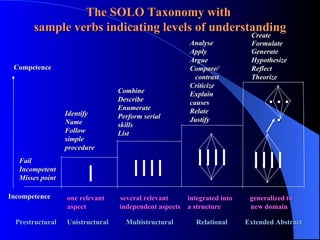
The SOLO Taxonomy with  sample verbs indicating levels of understanding Competence Prestructural  Unistructural  Multistructural  Relational  Extended Abstract one relevant  several relevant  integrated into  generalized to  aspect  independent aspects  a structure  new domain Incompetence Fail Incompetent Misses point Identify Name Follow simple   procedure Combine Describe Enumerate Perform serial skills List Analyse Apply Argue Compare/ contrast Criticize Explain causes Relate Justify Create Formulate Generate Hypothesize Reflect Theorize . . . .
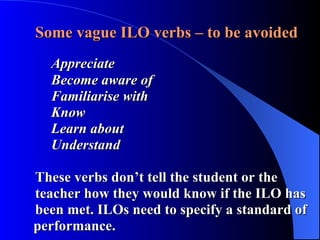
Some vague ILO verbs – to be avoided Appreciate Become aware of  Familiarise with Know Learn about Understand These verbs don’t tell the student or the      teacher how they would know if the ILO has    been met. ILOs need to specify a standard of    performance.
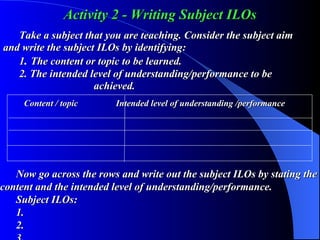
Activity 2 - Writing Subject ILOs Take a subject that you are teaching. Consider the subject aim  and write the subject ILOs by identifying: 1 .  The content or topic to be learned. 2. The intended level of understanding/performance to be      achieved. Now go across the rows and write out the subject ILOs by stating the  content and the intended level of understanding/performance. Subject ILOs: 1. 2. 3.   Content / topic  Intended level of understanding /performance
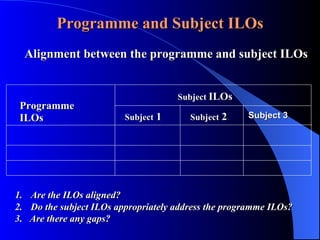
Programme and Subject ILOs Alignment between the programme and subject ILOs 1. Are the ILOs aligned? 2. Do the subject ILOs appropriately address the programme ILOs? 3.  Are there any gaps?   Programme ILOs Subject   ILOs Subject  1 Subject  2 Subject 3
Designing Teaching/Learning Activities to Align to Intended Learning Outcomes Having designed subject ILOs, we now need to activate the verbs or learning activities embedded in the ILOs by designing suitable    Teaching/Learning Activities that will      facilitate  students achieving the ILOs. Remember:  There are many alternatives to  lectures and  tutorials, even in large classes.
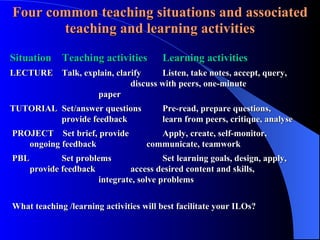
Four common teaching situations and associated teaching and learning activities Situation   Teaching activities Learning activities LECTURE  Talk, explain, clarify  Listen, take notes, accept, query,  discuss with peers, one-minute  paper TUTORIAL  Set/answer questions  Pre-read, prepare questions,      provide feedback  learn from peers, critique, analyse PROJECT  Set brief, provide  Apply, create, self-monitor,     ongoing feedback  communicate, teamwork  PBL    Set problems Set learning goals, design, apply,    provide feedback   access desired content and skills,  integrate, solve problems  What teaching /learning activities will best facilitate your ILOs?
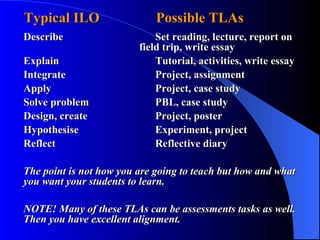
  Typical ILO   Possible TLAs Describe Set reading, lecture, report on  field trip, write essay Explain Tutorial, activities, write essay Integrate Project, assignment Apply Project, case study Solve problem PBL, case study Design, create Project, poster  Hypothesise Experiment, project Reflect Reflective diary The point is not how you are going to teach but how and what you want your students to   learn. NOTE! Many of these TLAs can be assessments tasks as well. Then you have excellent alignment.
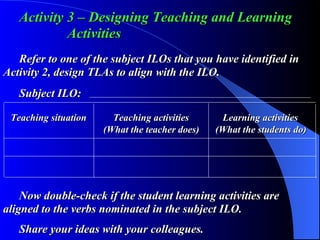
Activity 3 – Designing Teaching and Learning  Activities Refer to one of the subject ILOs that you have identified in  Activity 2, design TLAs to align with the ILO. Subject ILO:     Now double-check if the student learning activities are  aligned to the verbs nominated in the subject ILO. Share your ideas with your colleagues.   Teaching situation   Teaching activities   Learning activities   (What the teacher does)   (What the students do)
Assessment Tasks (ATs) . Provide students the opportunity to demonstrate whether or  not they have achieved the ILOs and what level their      performance is in those ILOs.  . Should be appropriately designed or selected to address the  ILOs that we want to assess. . Different assessment methods (tasks) address different ILOs There should therefore be several kinds of task. . Provide the evidence allowing teachers to make a judgment  about the level of a student’s performance against the ILOs  and to award a final grade.
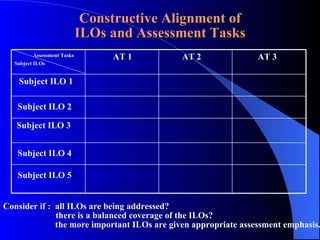
Constructive Alignment of ILOs and Assessment Tasks Subject ILO 5 Subject ILO 4 Subject ILO 3 Subject ILO 2 Subject ILO 1 AT 3 AT 2 AT 1  Assessment Tasks Subject ILOs Consider if :  all ILOs are being addressed?     there is a balanced coverage of the ILOs?    the more important ILOs are given appropriate assessment emphasis.
Designing Assessment Tasks (ATs) Steps: 1. Select a practicable task that embodies the target  ILO verb. (Try using the TLA as an AT first). 2. Make a judgment on how well the ILO has been  met by the students' performance in the ATs –    developing grading criteria (rubrics).
A range of different assessment tasks may be required to  address the range of ILOs of a subject. Questions to be asked in selecting assessment tasks: 1 .  Are the assessment tasks aligned to their appropriate    ILOs? Are the students required to engage in the verbs    identified in the ILOs? 2.  Are the assessment tasks practicable with respect to    available time and resources? 3.  Do the assessment tasks reflect the relative importance    of the subject ILOs? 4.  Is the assessment workload realistic for teachers and    students?  Selecting Assessment Tasks
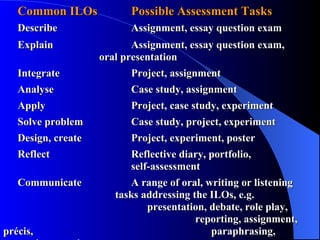
Common ILOs  Possible Assessment Tasks Describe Assignment, essay question exam Explain Assignment, essay question exam,  oral presentation Integrate Project, assignment Analyse Case study, assignment Apply Project, case study, experiment Solve problem Case study, project, experiment Design, create Project, experiment, poster Reflect Reflective diary, portfolio, self-assessment Communicate A range of oral, writing or listening  tasks addressing the ILOs, e.g.  presentation, debate, role play,  reporting, assignment, précis,  paraphrasing, answering questions etc.
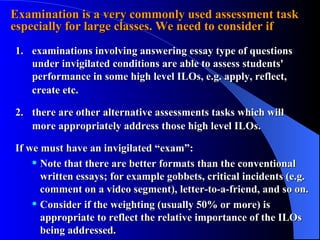
Examination is a very commonly used assessment task especially for large classes. We need to consider if 1. examinations involving answering essay type of questions under invigilated conditions are able to assess students' performance in some high level ILOs, e.g. apply, reflect,  create etc. 2. there are other alternative assessments tasks which will  more appropriately address those high level ILOs. If we must have an invigilated “exam”: Note that there are better formats than the conventional written essays; for example gobbets, critical incidents (e.g. comment on a video segment), letter-to-a-friend, and so on. Consider if the weighting (usually 50% or more) is appropriate to reflect the relative importance of the ILOs being addressed.
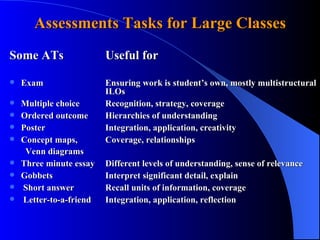
Assessments Tasks for Large Classes Some ATs Useful for Exam Ensuring work is student’s own, mostly multistructural  ILOs  Multiple choice Recognition, strategy, coverage Ordered outcome Hierarchies of understanding Poster Integration, application, creativity Concept maps,  Coverage, relationships Venn diagrams Three minute essay Different levels of understanding, sense of relevance Gobbets Interpret significant detail, explain Short answer Recall units of information, coverage Letter-to-a-friend Integration, application, reflection
Implementing Constructive Alignment in Learning, Teaching and Assessment ILO: What the student has to learn   Teaching: Engaging  the  student in the  verb in the ILO Assessment: How well the student  has achieved the ILO
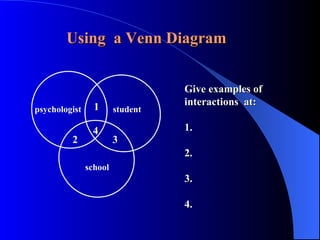
Using  a Venn Diagram   1 2 4 3 psychologist student   school Give examples of interactions  at: 1. 2. 3. 4.
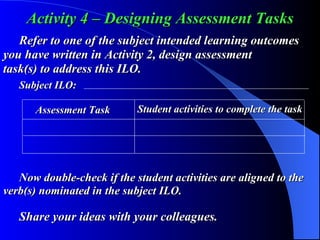
Activity 4 – Designing Assessment Tasks Refer to one of the subject intended learning outcomes  you have written in Activity 2, design assessment  task(s) to address this ILO.  Subject ILO:        Now double-check if the student activities are aligned to the  verb(s) nominated in the subject ILO. Share your ideas with your colleagues.   Assessment Task Student activities to complete the task
Assessing by marks or grades?
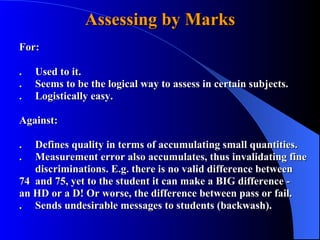
Assessing by Marks For: . Used to it. . Seems to be the logical way to assess in certain subjects. . Logistically easy. Against: . Defines quality in terms of accumulating small quantities. .  Measurement error also accumulates, thus invalidating fine  discriminations. E.g. there is no valid difference between  74 and 75, yet to the student it can make a BIG difference -  an HD or a D! Or worse, the difference between pass or fail. . Sends undesirable messages to students (backwash).
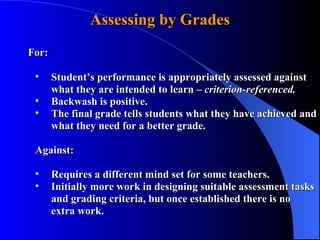
Assessing by Grades For: Student’s performance is appropriately assessed against what they are intended to learn –  criterion-referenced. Backwash is positive. The final grade tells students what they have achieved and what they need for a better grade. Against: Requires a different mind set for some teachers. Initially more work in designing suitable assessment tasks and grading criteria, but once established there is no extra work.
Qualitative assessment involves making  judgment against criteria  ( rubrics ), not  by counting ‘marks ’ If ILOs are to reflect workplace or ‘real world’ standards it is not appropriate to state and assess them in terms of marks obtained.  Assessment tasks should likewise reflect the ‘real world’ ILOs.
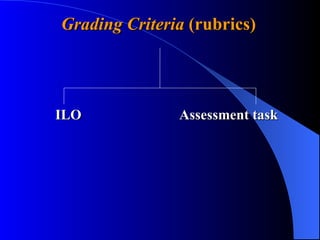
  Grading Criteria  (rubrics)   ILO Assessment task
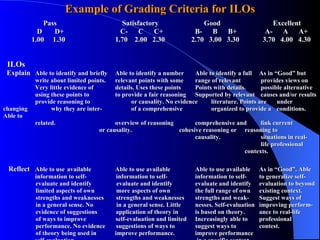
Example of Grading Criteria for ILOs   Pass       Satisfactory   Good    Excellent   D   D+       C-  C  C+   B-  B  B+  A-  A  A+   1.00  1.30 1.70  2.00  2.30  2.70  3.00  3.30   3.70  4.00  4.30 ILOs Explain Able to identify and briefly Able to identify a number Able to identify a full As in “Good” but  write about limited points. relevant points with some  range of relevant   provides views on Very little evidence of  details. Uses these points  Points with details.   possible alternative using these points to  to provide a fair reasoning  Supported by relevant   causes and/or results provide reasoning to  or causality. No evidence  literature. Points are   under changing  why they are inter-  of a comprehensive  organized to provide a   conditions. Able to  related.    overview of reasoning  comprehensive and   link current  or causality.   cohesive reasoning or   reasoning to    causality.   situations in real-   life professional   contexts. Reflect Able to use  available Able to use available    Able to use available  As in “Good”. Able  information to self-  information to self-  information to self-  to generalize self- evaluate and identify  evaluate and identify  evaluate and identify  evaluation to beyond  limited aspects of own  more aspects of own  the full range of own  existing context.  strengths and weaknesses  strengths and weaknesses  strengths and weak-  Suggest ways of  in a general sense. No  in a general sense. Little  nesses. Self-evaluation  improving perform- evidence of suggestions  application of theory in  is based on theory.  ance to real-life  of ways to improve  self-evaluation and limited  Increasingly able to  professional  performance. No evidence  suggestions of ways to  suggest ways to contest.  of theory being used in  improve performance.  improve performance  self-evaluation.     in a specific context.
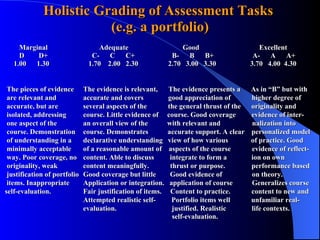
Holistic Grading of Assessment Tasks  (e.g. a portfolio) Marginal   Adequate     Good    Excellent D   D+       C-  C  C+     B-  B  B+  A-  A  A+ 1.00  1.30   1.70  2.00  2.30  2.70  3.00  3.30   3.70  4.00  4.30    The pieces of evidence The evidence is relevant,   The evidence presents a  As in “B” but with are relevant and  accurate and covers  good appreciation of  higher degree of  accurate, but are  several aspects of the  the general thrust of the  originality and isolated, addressing  course. Little evidence of  course. Good coverage  evidence of inter- one aspect of the  an overall view of the  with relevant and  nalization into course. Demonstration  course. Demonstrates  accurate support. A clear  personalized model  of understanding in a  declarative understanding  view of how various  of practice. Good minimally acceptable  of a reasonable amount of  aspects of the course  evidence of reflect- way. Poor coverage, no  content. Able to discuss  integrate to form a  ion on own  originality, weak  content meaningfully.  thrust or purpose.  performance based justification of portfolio  Good coverage but little  Good evidence of  on theory. items. Inappropriate  Application or integration.  application of course  Generalizes course self-evaluation. Fair justification of items.  Content to practice.  content to new and  Attempted realistic self-  Portfolio items well  unfamiliar real-   evaluation.   justified. Realistic   life contexts.   self-evaluation.
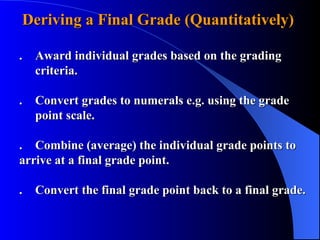
Deriving a Final Grade (Quantitatively)  . Award individual grades based on the grading    criteria. . Convert grades to numerals e.g. using the grade    point scale.  . Combine (average) the individual grade points to  arrive at a final grade point. . Convert the final grade point back to a final grade.
Deriving a Final Grade (Holistically)  Curriculum and Instruction: A subject in a course for Ed. Psychlsts.  Grading will be   based on your attaining the following ILOs 1.  Apply the principles of good teaching and assessment to chosen contexts. 2.  Relate selected aspects of curriculum design and management to the educational  system in Hong Kong. 3.  Apply the content and experiences in this subject to enhance your effectiveness as  an educational psychologist. 4.  Show examples of your reflective decision-making as an educational psychologist. Final grades will depend on how well you can demonstrate that you have met all the ILOs: A  Awarded if you have clearly met all the ILOs, provide evidence of original and  creative thinking, perhaps going beyond established practice. B  Awarded when all ILOs have been met very well and effectively. C  Awarded when the ILOs have been addressed satisfactorily, or where the evidence  is strong in some ILOs, weaker but acceptable in others. F  Less than C, work plagiarised, not submitted.
Activity 5 Take a few minutes to reflect on the following: 1. One important point that you have gained from this  session. 2.  One question you still have on designing      constructively aligned learning, teaching and    assessment. 3. One action you will take in your future teaching and    assessment based on the discussion of this session. Please share with us your reflection on the above issues.
References  Biggs, J. & Tang, C. (3rd Ed) (2007) .  Teaching for  Quality Learning at University . Maidenhead: Open  University Press/McGraw Hill.

John Biggs And Catherine Tang 2008

  • 1.
    Constructive Alignment inLearning, Teaching and Assessment   John Biggs Catherine Tang ATN Assessment Conference: “Engaging Students in Assessment” U of SA, 20-21 November, 2008
  • 2.
    Activity 1 Asa teacher, what do you want to achieve in teaching? Share your views with your colleagues.
  • 3.
    The focus inteaching is not what we teach but what we would like our students to learn and how we can help them achieve that. The first step therefore is to define the intended learning outcomes for our students. Teaching and assessment are then designed and implemented to align to these outcomes.
  • 4.
    The Intended Outcomesof This Session 1. Explain constructive alignment. 2. Identify intended learning outcomes for one of your teaching units. 3. Design teaching/learning activities to best achieve one of your intended learning outcomes. 4. Design tasks to assess how well the intended learning outcome has been achieved. 5. Reflect on the impact of this session on your teaching and assessment.
  • 5.
    Why “Constructive Alignment”?‘ constructive’ refers to the idea that students construct meaning through relevant learning activities. ‘ alignment’ refers to a learning environment where teaching and learning activities, and assessment tasks, are aligned to the intended learning outcomes of a subject.
  • 6.
    Implementing Constructive Alignmentin Learning, Teaching and Assessment ILO: What the student has to learn Teaching: Engaging the student in the verb in the ILO Assessment: How well the student has achieved the ILO
  • 7.
    Constructive Alignment IntendedLearning Outcomes (ILOs)‏ expressed as verbs students have to enact A The very best understanding that could be reasonably expected: verbs such as hypothesise, apply to “far” domains, generate, create, critically review etc. B Highly satisfactory understanding: verbs such as explain, solve, analyse, evaluate, justify etc. C Quite satisfactory learning, with under- standing at a declarative level: verbs such as describe, elaborate, classify etc. D Understanding at a level that would warrant a Pass: low level verbs, also inadequate but salvageable higher level attempts. Teaching / Learning Activities Designed to elicit desired ILO verbs May be: Large class activities Small class activities Teacher-managed Peer-managed Self-managed Classroom-based Outside classroom as best suits context Assessment Tasks Format such that the target verbs are elicited and deployed in context. Criteria clearly allow judgement as to the quality of the student's performance
  • 8.
    Designing Constructively Aligned Teaching and Assessment There are four steps in designing such teaching and assessment: 1. describe intended outcomes in the form of standards students are to attain using appropriate learning verbs. 2. create a learning environment likely to bring about the intended outcomes. 3. use assessment tasks enabling you to judge if and how well students’ performances meet the outcomes. 4. develop grading criteria ( rubrics ) for judging the quality of student performance.
  • 9.
    Intended Learning Outcomes(ILOs) University level What are the attributes of an ideal graduate of the University? Programme level What are the intended learning outcomes for students enrolled in the programme? Subject/Unit level What are the intended learning outcomes for students taking a particular subject/unit at a particular level within the programme?
  • 10.
    Intended Learning Outcomes(ILOs) . Statements of what students are expected to be able to do as a result of engaging in the learning process (studying a subject/programme). . ILOs should reflect the level of the programme / subject. . Expressed from the students' perspective. . Expressed in the form of action verbs leading to observable and assessable outcomes. . Related to criteria for assessing student performance.
  • 11.
    The Verbs in the ILOs . It is useful to express ILOs by using appropriate verbs . . Teaching is specifically aimed at activating those verbs. . Students should be unable to complete the assessment tasks unless they enact the same verbs that are in the ILOs (criterion-referenced). . Generic high level verbs include: apply, conceptualise , reflect , create original insights , solve unseen problems , generate new alternatives, critically review . Such verbs might typically be used to define an HD or D grade in meeting the ILOs, depending on the subject/unit. Low level verbs such as describe , identify , would be more frequent in defining P.
  • 12.
    Procedures in DesigningSubject ILOs 1. Select the topics to be taught. 2. Decide the levels of understanding/performance the students are expected to achieve for the different topics. 3. Consider if all the ILOs are of equal importance. 4. Ensure a clear understanding and agreement of the ILOs within the teaching team and other relevant parties e.g. External Reviewer. 5. Communicate the ILOs to students.
  • 13.
    The SOLO Taxonomywith sample verbs indicating levels of understanding Competence Prestructural Unistructural Multistructural Relational Extended Abstract one relevant several relevant integrated into generalized to aspect independent aspects a structure new domain Incompetence Fail Incompetent Misses point Identify Name Follow simple procedure Combine Describe Enumerate Perform serial skills List Analyse Apply Argue Compare/ contrast Criticize Explain causes Relate Justify Create Formulate Generate Hypothesize Reflect Theorize . . . .
  • 14.
    Some vague ILOverbs – to be avoided Appreciate Become aware of Familiarise with Know Learn about Understand These verbs don’t tell the student or the teacher how they would know if the ILO has been met. ILOs need to specify a standard of performance.
  • 15.
    Activity 2 -Writing Subject ILOs Take a subject that you are teaching. Consider the subject aim and write the subject ILOs by identifying: 1 . The content or topic to be learned. 2. The intended level of understanding/performance to be achieved. Now go across the rows and write out the subject ILOs by stating the content and the intended level of understanding/performance. Subject ILOs: 1. 2. 3. Content / topic Intended level of understanding /performance
  • 16.
    Programme and SubjectILOs Alignment between the programme and subject ILOs 1. Are the ILOs aligned? 2. Do the subject ILOs appropriately address the programme ILOs? 3. Are there any gaps? Programme ILOs Subject ILOs Subject 1 Subject 2 Subject 3
  • 17.
    Designing Teaching/Learning Activitiesto Align to Intended Learning Outcomes Having designed subject ILOs, we now need to activate the verbs or learning activities embedded in the ILOs by designing suitable Teaching/Learning Activities that will facilitate students achieving the ILOs. Remember: There are many alternatives to lectures and tutorials, even in large classes.
  • 18.
    Four common teachingsituations and associated teaching and learning activities Situation Teaching activities Learning activities LECTURE Talk, explain, clarify Listen, take notes, accept, query, discuss with peers, one-minute paper TUTORIAL Set/answer questions Pre-read, prepare questions, provide feedback learn from peers, critique, analyse PROJECT Set brief, provide Apply, create, self-monitor, ongoing feedback communicate, teamwork PBL Set problems Set learning goals, design, apply, provide feedback access desired content and skills, integrate, solve problems What teaching /learning activities will best facilitate your ILOs?
  • 19.
    TypicalILO Possible TLAs Describe Set reading, lecture, report on field trip, write essay Explain Tutorial, activities, write essay Integrate Project, assignment Apply Project, case study Solve problem PBL, case study Design, create Project, poster Hypothesise Experiment, project Reflect Reflective diary The point is not how you are going to teach but how and what you want your students to learn. NOTE! Many of these TLAs can be assessments tasks as well. Then you have excellent alignment.
  • 20.
    Activity 3 –Designing Teaching and Learning Activities Refer to one of the subject ILOs that you have identified in Activity 2, design TLAs to align with the ILO. Subject ILO: Now double-check if the student learning activities are aligned to the verbs nominated in the subject ILO. Share your ideas with your colleagues. Teaching situation Teaching activities Learning activities (What the teacher does) (What the students do)
  • 21.
    Assessment Tasks (ATs). Provide students the opportunity to demonstrate whether or not they have achieved the ILOs and what level their performance is in those ILOs. . Should be appropriately designed or selected to address the ILOs that we want to assess. . Different assessment methods (tasks) address different ILOs There should therefore be several kinds of task. . Provide the evidence allowing teachers to make a judgment about the level of a student’s performance against the ILOs and to award a final grade.
  • 22.
    Constructive Alignment ofILOs and Assessment Tasks Subject ILO 5 Subject ILO 4 Subject ILO 3 Subject ILO 2 Subject ILO 1 AT 3 AT 2 AT 1 Assessment Tasks Subject ILOs Consider if : all ILOs are being addressed? there is a balanced coverage of the ILOs? the more important ILOs are given appropriate assessment emphasis.
  • 23.
    Designing Assessment Tasks(ATs) Steps: 1. Select a practicable task that embodies the target ILO verb. (Try using the TLA as an AT first). 2. Make a judgment on how well the ILO has been met by the students' performance in the ATs – developing grading criteria (rubrics).
  • 24.
    A range ofdifferent assessment tasks may be required to address the range of ILOs of a subject. Questions to be asked in selecting assessment tasks: 1 . Are the assessment tasks aligned to their appropriate ILOs? Are the students required to engage in the verbs identified in the ILOs? 2. Are the assessment tasks practicable with respect to available time and resources? 3. Do the assessment tasks reflect the relative importance of the subject ILOs? 4. Is the assessment workload realistic for teachers and students? Selecting Assessment Tasks
  • 25.
    Common ILOs Possible Assessment Tasks Describe Assignment, essay question exam Explain Assignment, essay question exam, oral presentation Integrate Project, assignment Analyse Case study, assignment Apply Project, case study, experiment Solve problem Case study, project, experiment Design, create Project, experiment, poster Reflect Reflective diary, portfolio, self-assessment Communicate A range of oral, writing or listening tasks addressing the ILOs, e.g. presentation, debate, role play, reporting, assignment, précis, paraphrasing, answering questions etc.
  • 26.
    Examination is avery commonly used assessment task especially for large classes. We need to consider if 1. examinations involving answering essay type of questions under invigilated conditions are able to assess students' performance in some high level ILOs, e.g. apply, reflect, create etc. 2. there are other alternative assessments tasks which will more appropriately address those high level ILOs. If we must have an invigilated “exam”: Note that there are better formats than the conventional written essays; for example gobbets, critical incidents (e.g. comment on a video segment), letter-to-a-friend, and so on. Consider if the weighting (usually 50% or more) is appropriate to reflect the relative importance of the ILOs being addressed.
  • 27.
    Assessments Tasks forLarge Classes Some ATs Useful for Exam Ensuring work is student’s own, mostly multistructural ILOs Multiple choice Recognition, strategy, coverage Ordered outcome Hierarchies of understanding Poster Integration, application, creativity Concept maps, Coverage, relationships Venn diagrams Three minute essay Different levels of understanding, sense of relevance Gobbets Interpret significant detail, explain Short answer Recall units of information, coverage Letter-to-a-friend Integration, application, reflection
  • 28.
    Implementing Constructive Alignmentin Learning, Teaching and Assessment ILO: What the student has to learn Teaching: Engaging the student in the verb in the ILO Assessment: How well the student has achieved the ILO
  • 29.
    Using aVenn Diagram 1 2 4 3 psychologist student school Give examples of interactions at: 1. 2. 3. 4.
  • 30.
    Activity 4 –Designing Assessment Tasks Refer to one of the subject intended learning outcomes you have written in Activity 2, design assessment task(s) to address this ILO. Subject ILO: Now double-check if the student activities are aligned to the verb(s) nominated in the subject ILO. Share your ideas with your colleagues. Assessment Task Student activities to complete the task
  • 31.
  • 32.
    Assessing by MarksFor: . Used to it. . Seems to be the logical way to assess in certain subjects. . Logistically easy. Against: . Defines quality in terms of accumulating small quantities. . Measurement error also accumulates, thus invalidating fine discriminations. E.g. there is no valid difference between 74 and 75, yet to the student it can make a BIG difference - an HD or a D! Or worse, the difference between pass or fail. . Sends undesirable messages to students (backwash).
  • 33.
    Assessing by GradesFor: Student’s performance is appropriately assessed against what they are intended to learn – criterion-referenced. Backwash is positive. The final grade tells students what they have achieved and what they need for a better grade. Against: Requires a different mind set for some teachers. Initially more work in designing suitable assessment tasks and grading criteria, but once established there is no extra work.
  • 34.
    Qualitative assessment involvesmaking judgment against criteria ( rubrics ), not by counting ‘marks ’ If ILOs are to reflect workplace or ‘real world’ standards it is not appropriate to state and assess them in terms of marks obtained. Assessment tasks should likewise reflect the ‘real world’ ILOs.
  • 35.
    GradingCriteria (rubrics) ILO Assessment task
  • 36.
    Example of GradingCriteria for ILOs Pass Satisfactory Good Excellent D D+ C- C C+ B- B B+ A- A A+ 1.00 1.30 1.70 2.00 2.30 2.70 3.00 3.30 3.70 4.00 4.30 ILOs Explain Able to identify and briefly Able to identify a number Able to identify a full As in “Good” but write about limited points. relevant points with some range of relevant provides views on Very little evidence of details. Uses these points Points with details. possible alternative using these points to to provide a fair reasoning Supported by relevant causes and/or results provide reasoning to or causality. No evidence literature. Points are under changing why they are inter- of a comprehensive organized to provide a conditions. Able to related. overview of reasoning comprehensive and link current or causality. cohesive reasoning or reasoning to causality. situations in real- life professional contexts. Reflect Able to use available Able to use available Able to use available As in “Good”. Able information to self- information to self- information to self- to generalize self- evaluate and identify evaluate and identify evaluate and identify evaluation to beyond limited aspects of own more aspects of own the full range of own existing context. strengths and weaknesses strengths and weaknesses strengths and weak- Suggest ways of in a general sense. No in a general sense. Little nesses. Self-evaluation improving perform- evidence of suggestions application of theory in is based on theory. ance to real-life of ways to improve self-evaluation and limited Increasingly able to professional performance. No evidence suggestions of ways to suggest ways to contest. of theory being used in improve performance. improve performance self-evaluation. in a specific context.
  • 37.
    Holistic Grading ofAssessment Tasks (e.g. a portfolio) Marginal Adequate Good Excellent D D+ C- C C+ B- B B+ A- A A+ 1.00 1.30 1.70 2.00 2.30 2.70 3.00 3.30 3.70 4.00 4.30 The pieces of evidence The evidence is relevant, The evidence presents a As in “B” but with are relevant and accurate and covers good appreciation of higher degree of accurate, but are several aspects of the the general thrust of the originality and isolated, addressing course. Little evidence of course. Good coverage evidence of inter- one aspect of the an overall view of the with relevant and nalization into course. Demonstration course. Demonstrates accurate support. A clear personalized model of understanding in a declarative understanding view of how various of practice. Good minimally acceptable of a reasonable amount of aspects of the course evidence of reflect- way. Poor coverage, no content. Able to discuss integrate to form a ion on own originality, weak content meaningfully. thrust or purpose. performance based justification of portfolio Good coverage but little Good evidence of on theory. items. Inappropriate Application or integration. application of course Generalizes course self-evaluation. Fair justification of items. Content to practice. content to new and Attempted realistic self- Portfolio items well unfamiliar real- evaluation. justified. Realistic life contexts. self-evaluation.
  • 38.
    Deriving a FinalGrade (Quantitatively) . Award individual grades based on the grading criteria. . Convert grades to numerals e.g. using the grade point scale. . Combine (average) the individual grade points to arrive at a final grade point. . Convert the final grade point back to a final grade.
  • 39.
    Deriving a FinalGrade (Holistically) Curriculum and Instruction: A subject in a course for Ed. Psychlsts. Grading will be based on your attaining the following ILOs 1. Apply the principles of good teaching and assessment to chosen contexts. 2. Relate selected aspects of curriculum design and management to the educational system in Hong Kong. 3. Apply the content and experiences in this subject to enhance your effectiveness as an educational psychologist. 4. Show examples of your reflective decision-making as an educational psychologist. Final grades will depend on how well you can demonstrate that you have met all the ILOs: A Awarded if you have clearly met all the ILOs, provide evidence of original and creative thinking, perhaps going beyond established practice. B Awarded when all ILOs have been met very well and effectively. C Awarded when the ILOs have been addressed satisfactorily, or where the evidence is strong in some ILOs, weaker but acceptable in others. F Less than C, work plagiarised, not submitted.
  • 40.
    Activity 5 Takea few minutes to reflect on the following: 1. One important point that you have gained from this session. 2. One question you still have on designing constructively aligned learning, teaching and assessment. 3. One action you will take in your future teaching and assessment based on the discussion of this session. Please share with us your reflection on the above issues.
  • 41.
    References Biggs,J. & Tang, C. (3rd Ed) (2007) . Teaching for Quality Learning at University . Maidenhead: Open University Press/McGraw Hill.