Engaging students: encouraging success Helen Johnston,  Syed Mahfuzul Aziz, C. Yalçın Kaya & Diana Quinn
New start in Engineering: 2008 at Mawson Lakes A new common first year program  for Civil, Mechanical and Electrical Engineering students broadened access : Associate degree and non-traditional students new courses  and increased focus on experiential and project –based learning new Teaching Team  including a first year academic director all course coordinators Learning and Teaching Unit staff: learning advisers, academic developer, online adviser Library staff
Students’ first 6 weeks at uni no bells, no rules parents in the dark: what they don’t know about they can’t worry about new friends, new loves a job -  luvly money Another shift? sure, more luvly money a class: not today thanks! the Maths quiz? I’ll do next week’s Census date: OOPS!
While it’s a given that programs need to offer engaging curriculum good teaching early assessment multiple opportunities to succeed Students who don’t attend class and/or complete early assessment tasks are unlikely to hear their lecturers’ and tutors’ advice.
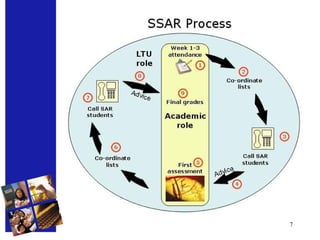
So there’s a communication and support dilemma: how do we reach students? The ‘Supporting students at risk’ strategy is  an academically focussed intervention  clearly linked assessment  SSAR offers  early & explicit advice to students to join the main game i.e. their academic program .  SSAR involves the Engineering First Year Teaching Team course coordinators in target courses Learning Advisers in the Learning and Teaching Unit
Academic success is a powerful  means of ensuring  student engagement  student persistence
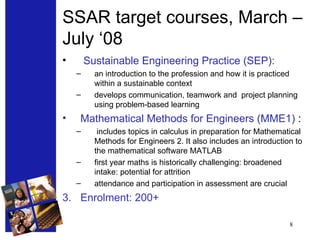
SSAR target courses, March – July ‘08 Sustainable Engineering Practice (SEP):  an introduction to the profession and how it is practiced within a sustainable context develops communication, teamwork and  project planning using problem-based learning Mathematical Methods for Engineers (MME1)  : includes topics in calculus in preparation for Mathematical Methods for Engineers 2. It also includes an introduction to the mathematical software MATLAB first year maths is historically challenging: broadened intake: potential for attrition  attendance and participation in assessment are crucial Enrolment: 200+
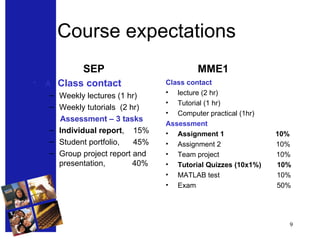
Course expectations SEP A  Class contact Weekly lectures (1 hr)  Weekly tutorials  (2 hr) Assessment – 3 tasks Individual report ,  15% Student portfolio,  45% Group project report and presentation,  40%  MME1 Class contact lecture (2 hr) Tutorial (1 hr) Computer practical (1hr)  Assessment  Assignment 1                          10% Assignment 2                            10% Team project                             10% Tutorial Quizzes (10x1%)        10% MATLAB test                             10% Exam                                         50%
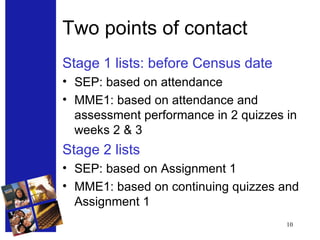
Two points of contact Stage 1 lists: before Census date SEP: based on attendance MME1: based on attendance and assessment performance in 2 quizzes in weeks 2 & 3 Stage 2 lists SEP: based on Assignment 1 MME1: based on continuing quizzes and Assignment 1
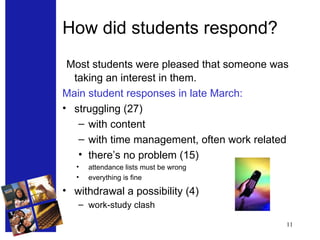
How did students respond? Most students were pleased that someone was taking an interest in them. Main student responses in late March: struggling (27)  with content with time management, often work related there’s no problem (15) attendance lists must be wrong everything is fine withdrawal a possibility (4) work-study clash
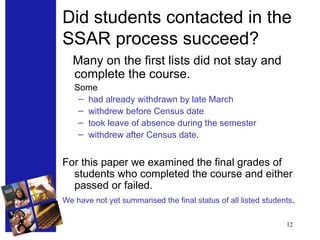
Did students contacted in the SSAR process succeed? Many on the first lists did not stay and complete the course.  Some had already withdrawn by late March withdrew before Census date took leave of absence during the semester withdrew after Census date. For this paper we examined the final grades of students who completed the course and either passed or failed. We have not yet summarised the final status of all listed students .
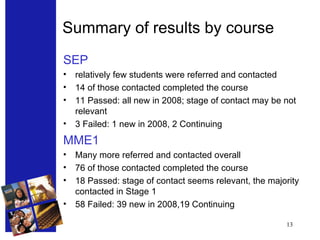
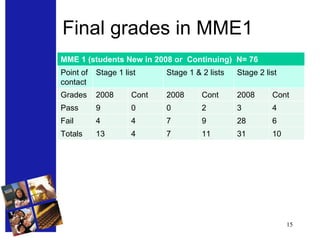
Summary of results by course SEP relatively few students were referred and contacted 14 of those contacted completed the course 11 Passed: all new in 2008; stage of contact may be not relevant  3 Failed: 1 new in 2008, 2 Continuing MME1 Many more referred and contacted overall 76 of those contacted completed the course 18 Passed: stage of contact seems relevant, the majority contacted in Stage 1 58 Failed: 39 new in 2008,19 Continuing
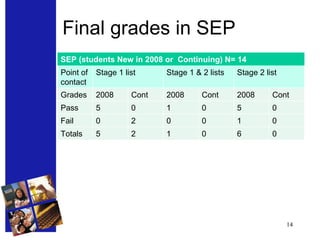
Final grades in SEP SEP (students New in 2008 or  Continuing) N= 14 Point of contact Stage 1 list Stage 1 & 2 lists Stage 2 list  Grades  2008 Cont  2008 Cont 2008 Cont Pass 5 0 1 0 5 0 Fail  0 2 0 0 1 0 Totals  5 2 1 0 6 0
Final grades in MME1 MME 1 (students New in 2008 or  Continuing)  N= 76 Point of contact Stage 1 list Stage 1 & 2 lists Stage 2 list  Grades  2008 Cont  2008 Cont 2008 Cont Pass 9 0 0 2 3 4 Fail  4 4 7 9 28 6 Totals  13 4 7 11 31 10
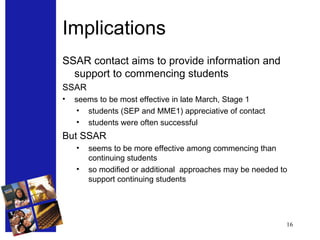
Implications SSAR contact aims to provide information and support to commencing students SSAR  seems to be most effective in late March, Stage 1 students (SEP and MME1) appreciative of contact students were often successful But SSAR  seems to be more effective among commencing than continuing students so modified or additional  approaches may be needed to support continuing students
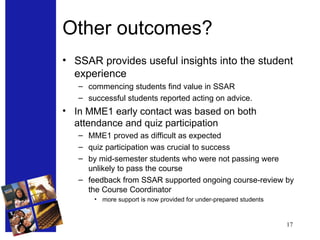
Other outcomes? SSAR provides useful insights into the student experience commencing students find value in SSAR successful students reported acting on advice. In MME1 early contact was based on both attendance and quiz participation MME1 proved as difficult as expected  quiz participation was crucial to success by mid-semester students who were not passing were unlikely to pass the course feedback from SSAR supported ongoing course-review by the Course Coordinator more support is now provided for under-prepared students
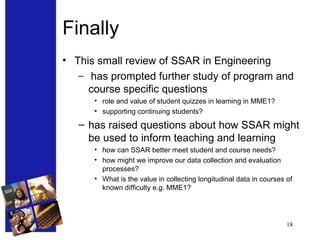
Finally This small review of SSAR in Engineering has prompted further study of program and course specific questions role and value of student quizzes in learning in MME1? supporting continuing students? has raised questions about how SSAR might be used to inform teaching and learning how can SSAR better meet student and course needs? how might we improve our data collection and evaluation processes? What is the value in collecting longitudinal data in courses of known difficulty e.g. MME1?

Helen Johnston et al 2008

  • 1.
    Engaging students: encouragingsuccess Helen Johnston, Syed Mahfuzul Aziz, C. Yalçın Kaya & Diana Quinn
  • 2.
    New start inEngineering: 2008 at Mawson Lakes A new common first year program for Civil, Mechanical and Electrical Engineering students broadened access : Associate degree and non-traditional students new courses and increased focus on experiential and project –based learning new Teaching Team including a first year academic director all course coordinators Learning and Teaching Unit staff: learning advisers, academic developer, online adviser Library staff
  • 3.
    Students’ first 6weeks at uni no bells, no rules parents in the dark: what they don’t know about they can’t worry about new friends, new loves a job - luvly money Another shift? sure, more luvly money a class: not today thanks! the Maths quiz? I’ll do next week’s Census date: OOPS!
  • 4.
    While it’s agiven that programs need to offer engaging curriculum good teaching early assessment multiple opportunities to succeed Students who don’t attend class and/or complete early assessment tasks are unlikely to hear their lecturers’ and tutors’ advice.
  • 5.
    So there’s acommunication and support dilemma: how do we reach students? The ‘Supporting students at risk’ strategy is an academically focussed intervention clearly linked assessment SSAR offers early & explicit advice to students to join the main game i.e. their academic program . SSAR involves the Engineering First Year Teaching Team course coordinators in target courses Learning Advisers in the Learning and Teaching Unit
  • 6.
    Academic success isa powerful means of ensuring student engagement student persistence
  • 8.
    SSAR target courses,March – July ‘08 Sustainable Engineering Practice (SEP): an introduction to the profession and how it is practiced within a sustainable context develops communication, teamwork and project planning using problem-based learning Mathematical Methods for Engineers (MME1)  : includes topics in calculus in preparation for Mathematical Methods for Engineers 2. It also includes an introduction to the mathematical software MATLAB first year maths is historically challenging: broadened intake: potential for attrition attendance and participation in assessment are crucial Enrolment: 200+
  • 9.
    Course expectations SEPA Class contact Weekly lectures (1 hr) Weekly tutorials (2 hr) Assessment – 3 tasks Individual report , 15% Student portfolio, 45% Group project report and presentation, 40% MME1 Class contact lecture (2 hr) Tutorial (1 hr) Computer practical (1hr) Assessment Assignment 1                          10% Assignment 2                            10% Team project                             10% Tutorial Quizzes (10x1%)        10% MATLAB test                            10% Exam                                        50%
  • 10.
    Two points ofcontact Stage 1 lists: before Census date SEP: based on attendance MME1: based on attendance and assessment performance in 2 quizzes in weeks 2 & 3 Stage 2 lists SEP: based on Assignment 1 MME1: based on continuing quizzes and Assignment 1
  • 11.
    How did studentsrespond? Most students were pleased that someone was taking an interest in them. Main student responses in late March: struggling (27) with content with time management, often work related there’s no problem (15) attendance lists must be wrong everything is fine withdrawal a possibility (4) work-study clash
  • 12.
    Did students contactedin the SSAR process succeed? Many on the first lists did not stay and complete the course. Some had already withdrawn by late March withdrew before Census date took leave of absence during the semester withdrew after Census date. For this paper we examined the final grades of students who completed the course and either passed or failed. We have not yet summarised the final status of all listed students .
  • 13.
    Summary of resultsby course SEP relatively few students were referred and contacted 14 of those contacted completed the course 11 Passed: all new in 2008; stage of contact may be not relevant 3 Failed: 1 new in 2008, 2 Continuing MME1 Many more referred and contacted overall 76 of those contacted completed the course 18 Passed: stage of contact seems relevant, the majority contacted in Stage 1 58 Failed: 39 new in 2008,19 Continuing
  • 14.
    Final grades inSEP SEP (students New in 2008 or Continuing) N= 14 Point of contact Stage 1 list Stage 1 & 2 lists Stage 2 list Grades 2008 Cont 2008 Cont 2008 Cont Pass 5 0 1 0 5 0 Fail 0 2 0 0 1 0 Totals 5 2 1 0 6 0
  • 15.
    Final grades inMME1 MME 1 (students New in 2008 or Continuing) N= 76 Point of contact Stage 1 list Stage 1 & 2 lists Stage 2 list Grades 2008 Cont 2008 Cont 2008 Cont Pass 9 0 0 2 3 4 Fail 4 4 7 9 28 6 Totals 13 4 7 11 31 10
  • 16.
    Implications SSAR contactaims to provide information and support to commencing students SSAR seems to be most effective in late March, Stage 1 students (SEP and MME1) appreciative of contact students were often successful But SSAR seems to be more effective among commencing than continuing students so modified or additional approaches may be needed to support continuing students
  • 17.
    Other outcomes? SSARprovides useful insights into the student experience commencing students find value in SSAR successful students reported acting on advice. In MME1 early contact was based on both attendance and quiz participation MME1 proved as difficult as expected quiz participation was crucial to success by mid-semester students who were not passing were unlikely to pass the course feedback from SSAR supported ongoing course-review by the Course Coordinator more support is now provided for under-prepared students
  • 18.
    Finally This smallreview of SSAR in Engineering has prompted further study of program and course specific questions role and value of student quizzes in learning in MME1? supporting continuing students? has raised questions about how SSAR might be used to inform teaching and learning how can SSAR better meet student and course needs? how might we improve our data collection and evaluation processes? What is the value in collecting longitudinal data in courses of known difficulty e.g. MME1?