JNC 8 2014 V/S ESC 2013
HYPERTENSION GUIDELINESOVERVIEW
DR SUHAIL, KIMS,TRIVANDRUM
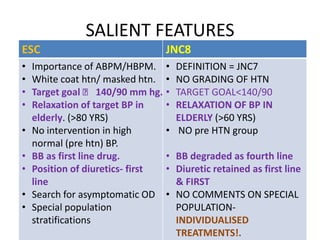
SALIENT FEATURES
ESC
•
•
•
•
•
•
•

•
•

JNC8

Importance of ABPM/HBPM. •
White coat htn/ masked htn. •
Target goal ˂ 140/90 mm hg. •
Relaxation of target BP in
•
elderly. (>80 YRS)
No intervention in high
•
normal (pre htn) BP.
BB as first line drug.
•
Position of diuretics- first
•
line
Search for asymptomatic OD •
Special population
stratifications

DEFINITION = JNC7
NO GRADING OF HTN
TARGET GOAL<140/90
RELAXATION OF BP IN
ELDERLY (>60 YRS)
NO pre HTN group
BB degraded as fourth line
Diuretic retained as first line
& FIRST
NO COMMENTS ON SPECIAL
POPULATIONINDIVIDUALISED
TREATMENTS!.
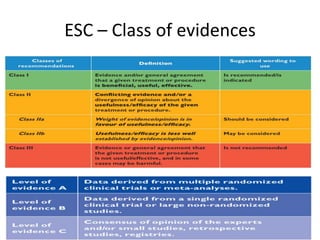
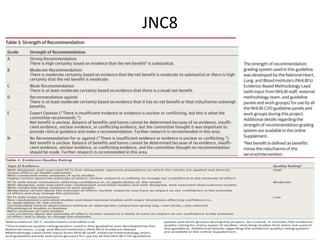
ESC – Class of evidences
JNC8
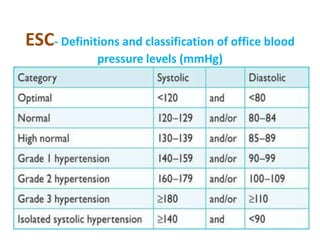
ESC- Definitions and classification of office blood
pressure levels (mmHg)
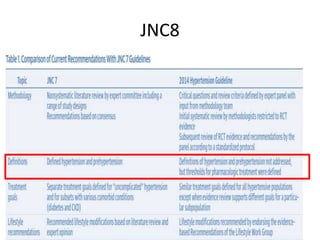
JNC8
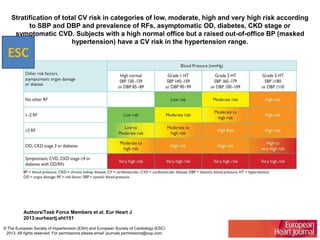
Stratification of total CV risk in categories of low, moderate, high and very high risk according
to SBP and DBP and prevalence of RFs, asymptomatic OD, diabetes, CKD stage or
symptomatic CVD. Subjects with a high normal office but a raised out-of-office BP (masked
hypertension) have a CV risk in the hypertension range.

ESC

Authors/Task Force Members et al. Eur Heart J
2013;eurheartj.eht151
© The European Society of Hypertension (ESH) and European Society of Cardiology (ESC)
2013. All rights reserved. For permissions please email: journals.permissions@oup.com.
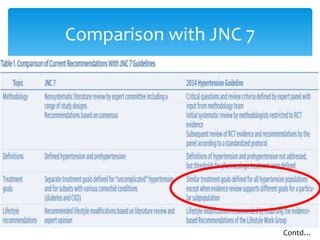
Comparison with JNC 7

Contd…
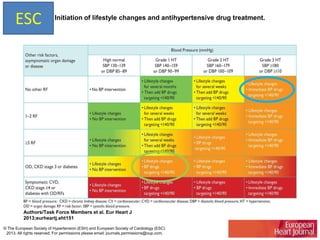
ESC

Initiation of lifestyle changes and antihypertensive drug treatment.

Authors/Task Force Members et al. Eur Heart J
2013;eurheartj.eht151
© The European Society of Hypertension (ESH) and European Society of Cardiology (ESC)
2013. All rights reserved. For permissions please email: journals.permissions@oup.com.
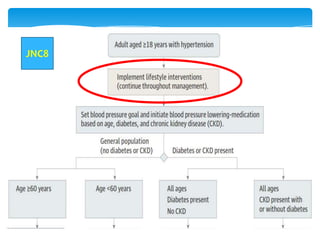
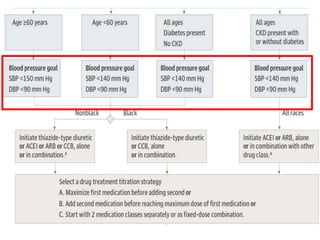
JNC8
ESC

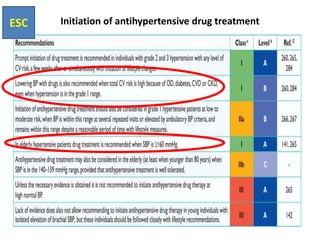
Initiation of antihypertensive drug treatment
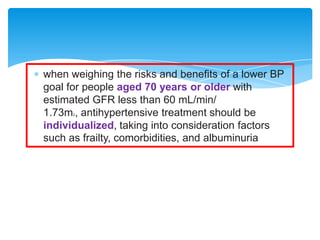
when weighing the risks and benefits of a lower BP
goal for people aged 70 years or older with
estimated GFR less than 60 mL/min/
1.73m , antihypertensive treatment should be
individualized, taking into consideration factors
such as frailty, comorbidities, and albuminuria
2
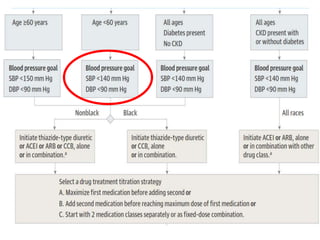
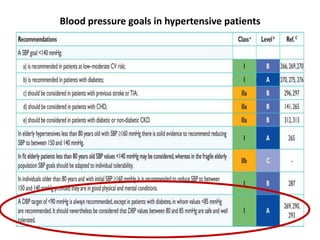
Blood pressure goals in hypertensive patients
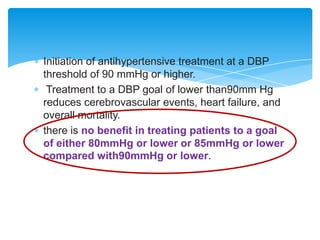
Initiation of antihypertensive treatment at a DBP
threshold of 90 mmHg or higher.
Treatment to a DBP goal of lower than90mm Hg
reduces cerebrovascular events, heart failure, and
overall mortality.
there is no benefit in treating patients to a goal
of either 80mmHg or lower or 85mmHg or lower
compared with90mmHg or lower.
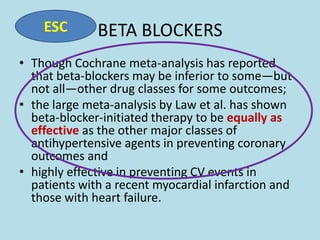
ESC

BETA BLOCKERS

• Though Cochrane meta-analysis has reported
that beta-blockers may be inferior to some—but
not all—other drug classes for some outcomes;
• the large meta-analysis by Law et al. has shown
beta-blocker-initiated therapy to be equally as
effective as the other major classes of
antihypertensive agents in preventing coronary
outcomes and
• highly effective in preventing CV events in
patients with a recent myocardial infarction and
those with heart failure.
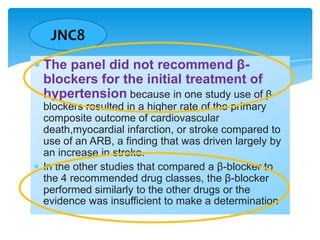
JNC8
The panel did not recommend βblockers for the initial treatment of
hypertension because in one study use of βblockers resulted in a higher rate of the primary
composite outcome of cardiovascular
death,myocardial infarction, or stroke compared to
use of an ARB, a finding that was driven largely by
an increase in stroke.
In the other studies that compared a β-blocker to
the 4 recommended drug classes, the β-blocker
performed similarly to the other drugs or the
evidence was insufficient to make a determination
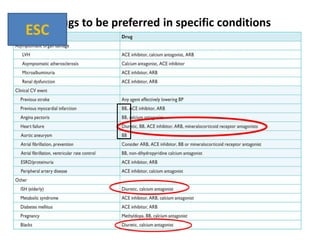
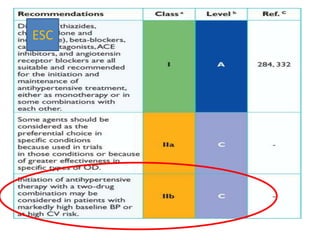
ESC

Drugs to be preferred in specific conditions
JNC8
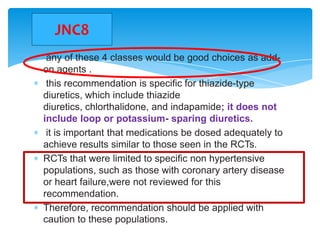
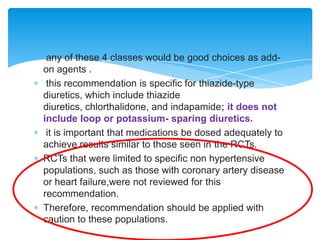
any of these 4 classes would be good choices as addon agents .
this recommendation is specific for thiazide-type
diuretics, which include thiazide
diuretics, chlorthalidone, and indapamide; it does not
include loop or potassium- sparing diuretics.
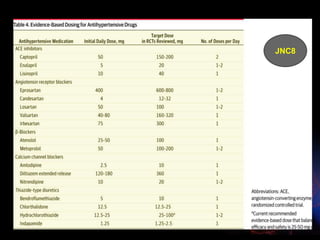
it is important that medications be dosed adequately to
achieve results similar to those seen in the RCTs.
RCTs that were limited to specific non hypertensive
populations, such as those with coronary artery disease
or heart failure,were not reviewed for this
recommendation.
Therefore, recommendation should be applied with
caution to these populations.
ESC
JN
C8

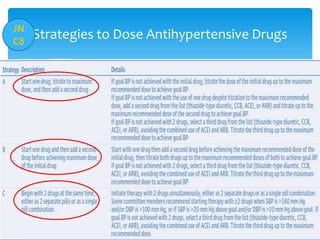
Strategies to Dose Antihypertensive Drugs
JNC8
SPECIAL POPULATIONS
any of these 4 classes would be good choices as addon agents .
this recommendation is specific for thiazide-type
diuretics, which include thiazide
diuretics, chlorthalidone, and indapamide; it does not
include loop or potassium- sparing diuretics.
it is important that medications be dosed adequately to
achieve results similar to those seen in the RCTs.
RCTs that were limited to specific non hypertensive
populations, such as those with coronary artery disease
or heart failure,were not reviewed for this
recommendation.
Therefore, recommendation should be applied with
caution to these populations.
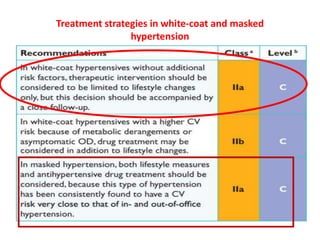
Treatment strategies in white-coat and masked
hypertension
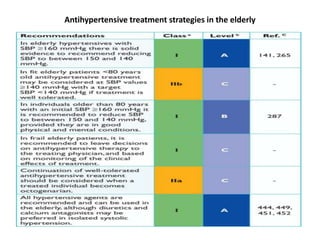
Antihypertensive treatment strategies in the elderly
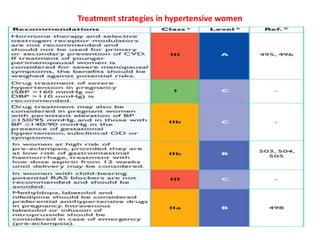
Treatment strategies in hypertensive women
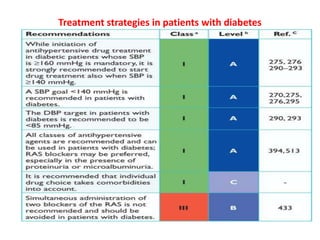
Treatment strategies in patients with diabetes
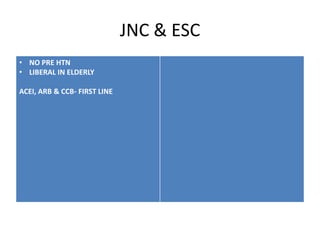
JNC & ESC
• NO PRE HTN
• LIBERAL IN ELDERLY
ACEI, ARB & CCB- FIRST LINE
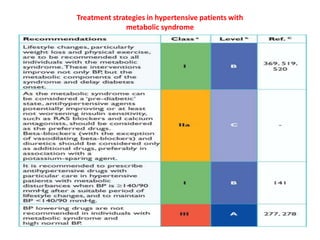
Treatment strategies in hypertensive patients with
metabolic syndrome
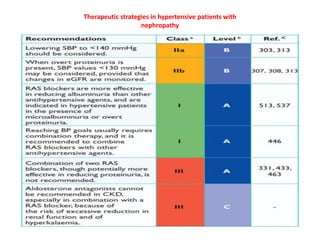
Therapeutic strategies in hypertensive patients with
nephropathy
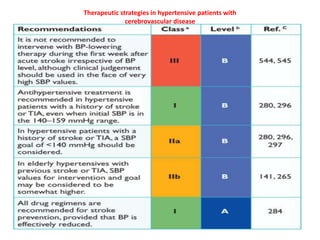
Therapeutic strategies in hypertensive patients with
cerebrovascular disease
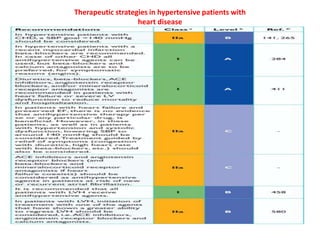
Therapeutic strategies in hypertensive patients with
heart disease
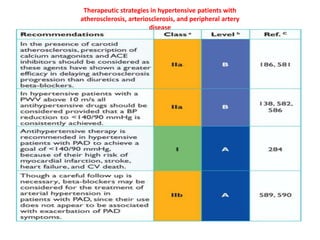
Therapeutic strategies in hypertensive patients with
atherosclerosis, arteriosclerosis, and peripheral artery
disease
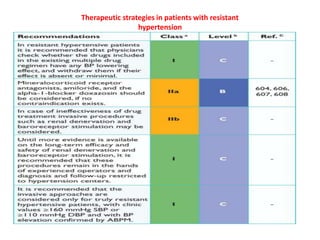
Therapeutic strategies in patients with resistant
hypertension
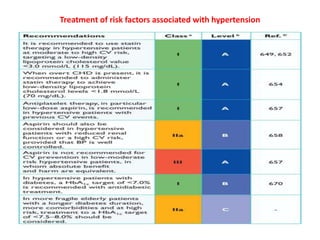
Treatment of risk factors associated with hypertension

Jnc 8 2014 v

  • 1.
    JNC 8 2014V/S ESC 2013 HYPERTENSION GUIDELINESOVERVIEW DR SUHAIL, KIMS,TRIVANDRUM
  • 2.
    SALIENT FEATURES ESC • • • • • • • • • JNC8 Importance ofABPM/HBPM. • White coat htn/ masked htn. • Target goal ˂ 140/90 mm hg. • Relaxation of target BP in • elderly. (>80 YRS) No intervention in high • normal (pre htn) BP. BB as first line drug. • Position of diuretics- first • line Search for asymptomatic OD • Special population stratifications DEFINITION = JNC7 NO GRADING OF HTN TARGET GOAL<140/90 RELAXATION OF BP IN ELDERLY (>60 YRS) NO pre HTN group BB degraded as fourth line Diuretic retained as first line & FIRST NO COMMENTS ON SPECIAL POPULATIONINDIVIDUALISED TREATMENTS!.
  • 3.
    ESC – Classof evidences
  • 4.
  • 5.
    ESC- Definitions andclassification of office blood pressure levels (mmHg)
  • 6.
  • 7.
    Stratification of totalCV risk in categories of low, moderate, high and very high risk according to SBP and DBP and prevalence of RFs, asymptomatic OD, diabetes, CKD stage or symptomatic CVD. Subjects with a high normal office but a raised out-of-office BP (masked hypertension) have a CV risk in the hypertension range. ESC Authors/Task Force Members et al. Eur Heart J 2013;eurheartj.eht151 © The European Society of Hypertension (ESH) and European Society of Cardiology (ESC) 2013. All rights reserved. For permissions please email: journals.permissions@oup.com.
  • 8.
  • 9.
    ESC Initiation of lifestylechanges and antihypertensive drug treatment. Authors/Task Force Members et al. Eur Heart J 2013;eurheartj.eht151 © The European Society of Hypertension (ESH) and European Society of Cardiology (ESC) 2013. All rights reserved. For permissions please email: journals.permissions@oup.com.
  • 10.
  • 12.
  • 14.
    when weighing therisks and benefits of a lower BP goal for people aged 70 years or older with estimated GFR less than 60 mL/min/ 1.73m , antihypertensive treatment should be individualized, taking into consideration factors such as frailty, comorbidities, and albuminuria 2
  • 15.
    Blood pressure goalsin hypertensive patients
  • 16.
    Initiation of antihypertensivetreatment at a DBP threshold of 90 mmHg or higher. Treatment to a DBP goal of lower than90mm Hg reduces cerebrovascular events, heart failure, and overall mortality. there is no benefit in treating patients to a goal of either 80mmHg or lower or 85mmHg or lower compared with90mmHg or lower.
  • 17.
    ESC BETA BLOCKERS • ThoughCochrane meta-analysis has reported that beta-blockers may be inferior to some—but not all—other drug classes for some outcomes; • the large meta-analysis by Law et al. has shown beta-blocker-initiated therapy to be equally as effective as the other major classes of antihypertensive agents in preventing coronary outcomes and • highly effective in preventing CV events in patients with a recent myocardial infarction and those with heart failure.
  • 18.
    JNC8 The panel didnot recommend βblockers for the initial treatment of hypertension because in one study use of βblockers resulted in a higher rate of the primary composite outcome of cardiovascular death,myocardial infarction, or stroke compared to use of an ARB, a finding that was driven largely by an increase in stroke. In the other studies that compared a β-blocker to the 4 recommended drug classes, the β-blocker performed similarly to the other drugs or the evidence was insufficient to make a determination
  • 19.
    ESC Drugs to bepreferred in specific conditions
  • 20.
    JNC8 any of these4 classes would be good choices as addon agents . this recommendation is specific for thiazide-type diuretics, which include thiazide diuretics, chlorthalidone, and indapamide; it does not include loop or potassium- sparing diuretics. it is important that medications be dosed adequately to achieve results similar to those seen in the RCTs. RCTs that were limited to specific non hypertensive populations, such as those with coronary artery disease or heart failure,were not reviewed for this recommendation. Therefore, recommendation should be applied with caution to these populations.
  • 21.
  • 22.
    JN C8 Strategies to DoseAntihypertensive Drugs
  • 23.
  • 24.
  • 25.
    any of these4 classes would be good choices as addon agents . this recommendation is specific for thiazide-type diuretics, which include thiazide diuretics, chlorthalidone, and indapamide; it does not include loop or potassium- sparing diuretics. it is important that medications be dosed adequately to achieve results similar to those seen in the RCTs. RCTs that were limited to specific non hypertensive populations, such as those with coronary artery disease or heart failure,were not reviewed for this recommendation. Therefore, recommendation should be applied with caution to these populations.
  • 26.
    Treatment strategies inwhite-coat and masked hypertension
  • 27.
  • 28.
    Treatment strategies inhypertensive women
  • 29.
    Treatment strategies inpatients with diabetes
  • 30.
    JNC & ESC •NO PRE HTN • LIBERAL IN ELDERLY ACEI, ARB & CCB- FIRST LINE
  • 31.
    Treatment strategies inhypertensive patients with metabolic syndrome
  • 32.
    Therapeutic strategies inhypertensive patients with nephropathy
  • 33.
    Therapeutic strategies inhypertensive patients with cerebrovascular disease
  • 34.
    Therapeutic strategies inhypertensive patients with heart disease
  • 35.
    Therapeutic strategies inhypertensive patients with atherosclerosis, arteriosclerosis, and peripheral artery disease
  • 36.
    Therapeutic strategies inpatients with resistant hypertension
  • 37.
    Treatment of riskfactors associated with hypertension