WELCOME
Problem Magnitude
 35 million office visits are as the primary
diagnosis of HTN.
 Worldwide prevalence estimates for HTN may
be as much as 1 billion.
 7.1 million deaths per year may be attributable
to hypertension.
Definition
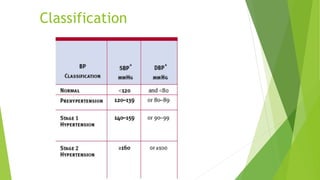
 A systolic blood pressure ( SBP) >139 mmHg
and/or
 A diastolic (DBP) >89 mmHg.
 Based on the average of two or more properly
measured, seated BP readings.
 On each of two or more office visits.
Classification
Hypertensive Crises
 Hypertensive Urgencies: No progressive target-
organ dysfunction. (Accelerated Hypertension)
 Hypertensive Emergencies: Progressive end-
organ dysfunction. (Malignant Hypertension)
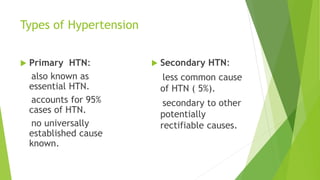
Types of Hypertension
 Primary HTN:
also known as
essential HTN.
accounts for 95%
cases of HTN.
no universally
established cause
known.
 Secondary HTN:
less common cause
of HTN ( 5%).
secondary to other
potentially
rectifiable causes.
Causes of Secondary HTN
 Common
 Intrinsic renal disease
 Renovascular disease
 Mineralocorticoid
excess
 Sleep Breathing
disorder
 Uncommon
 Pheochromocytoma
 Glucocorticoid excess
 Coarctation of Aorta
 Hyper/hypothyroidism
Indian Guidelines on Hypertension - III
 Wean off use of mercury sphygmomanometers use aneroid
instead.
 Home monitoring of BP
 Beta blockers recommended only in young hypertesives with
specific indications.
 BP> 200/100mmHg start with drug combination rather than
monotherapy
 ACEI/ARB and CCB form a good combination
 CKD recognized as a comorbidity
Indian Guidelines on Hypertension - III
 HFnEF Heart Failure with noramal ejection fraction needs to be
recognized
 Dyspnoea
 Raised BNP
 Diastolic dysfunction with normal ejection fraction.
 Interventional sympathetic denervation being evaluated.
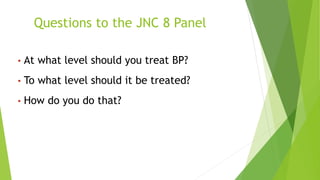
Questions to the JNC 8 Panel
• At what level should you treat BP?
• To what level should it be treated?
• How do you do that?
“Statements and recommendations for [BP]
treatment based on a systematic review of
the literature to meet user needs, especially
the needs of the primary care clinician.”
Focus of the Recommendations
Age
Black/nonblack
Diabetic
Chronic kidney disease (CKD)
Age Recommendations, JNC 2014
• 18 years old and younger: Not considered
• 30 years old and younger: We have little to no data
• 30 to 59 years old: In the general population younger than 60 years, initiate
pharmacologic treatment to lower BP at a DBP of 90 mm Hg and treat to a
goal DBP lower than 90 mm Hg. Strong Recommendation: Grade A
• 60 years old: In the general population aged 60 years or older, initiate
pharmacologic treatment to lower BP at an SBP of 150 mm Hg or higher or a
DBP of 90 mm Hg or higher and treat to a goal SBP lower than 150 mm Hg
and goal DBP lower than 90 mm Hg. Strong Recommendation: Grade A
• 80 years old: Based on HYVET*
*Hypertensions in very elderly Trial
James PA, et al. JAMA. 2014;311:507-520.[1]
JNC Panel Recommendation for Patients With
Diabetes and Hypertension
• In the population aged 18 years and older with
diabetes, initiate pharmacologic treatment to
lower BP at an SBP of 140 mm Hg or a DBP of 90
mm Hg and treat to a goal of SBP lower than 140
mm Hg and goal DBP lower than 90 mm Hg. Expert
Opinion: Grade E
James PA, et al. JAMA. 2014;311:507-520.[1]
JNC Panel Recommendation for Patients With
CKD
• In the population aged 18 years with CKD,
initiate pharmacologic treatment to lower BP
at an SBP of 140 mm Hg or a DBP of 90 mm
Hg and treat to goal of an SBP lower than 140
mm Hg and a goal DBP lower than 90 mm Hg.
Expert Opinion: Grade E
James PA, et al. JAMA. 2014;311:507-520.[1]
JNC Recommendation for Nonblack Patients
• In the general nonblack population, including
those with diabetes, initial antihypertensive
treatment should include
– Thiazide-type diuretic
– Calcium channel blocker (CCB)
– Angiotensin-converting enzyme (ACE) inhibitor
– Angiotensin receptor blocker (ARB)
– Moderate Recommendation: Grade B
James PA, et al. JAMA. 2014;311:507-520.[1]
JNC Recommendation for Black Patients
• In the general black population, including
those with diabetes, initial antihypertensive
treatment should include
– Thiazide-type diuretic
– CCB
• For the general black population:
– Moderate Recommendation: Grade B
• For black patients with diabetes:
– Weak Recommendation: Grade C
James PA, et al. JAMA. 2014;311:507-520.[1]
Recommendations for Hypertension
Management
Recommendation 1: In the general population aged 60 years,
initiate pharmacologic treatment to lower BP at systolic BP
(SBP)150 mm Hg or diastolic BP (DBP) 90 mm Hg and treat to a
goal SBP lower than 150 mm Hg and goal DBP lower than 90 mm
Hg. (Strong Recommendation : Grade A)
 Corollary Recommendation: In the general population aged 60
years, if pharmacologic treatment for high BP results in lower
achieved SBP (eg, <140 mm Hg) and treatment is well tolerated
and without adverse effects on health or quality of life, treatment
does not need to be adjusted. (Expert Opinion : Grade E)
 Recommendation 2: In the general population younger than 60
years, initiate pharmacologic treatment to lower BP at DBP 90
mm Hg and treat to a goal DBP lower than 90 mm Hg. (For ages
30 to 59 years, Strong Recommendation : Grade A; for ages 18
to 29 years, Expert Opinion: Grade E)
Recommendations for Hypertension Management
 Recommendation 3: In the general population younger than 60
years, initiate pharmacologic treatment to lower BP at SBP to
140 mm Hg and treat to a goal SBP lower than 140 mm Hg.
(Expert Opinion : Grade E)
Recommendations for Hypertension Management
 Recommendation 4: In the population aged 18 years with CKD,
initiate pharmacologic treatment to lower BP at SBP 140 mm Hg
or DBP 90 mm Hg and treat to goal SBP lower than 140 mm Hg
and goal DBP lower than 90 mm Hg. (Expert Opinion: Grade E)
Recommendations for Hypertension Management
 Recommendation 5: In the population aged 18 years with
diabetes, initiate pharmacologic treatment to lower BP at SBP
140 mm Hg or DBP 90 mm Hg and treat to a goal SBP lower
than 140 mm Hg and goal DBP lower than 90 mm Hg. (Expert
Opinion: Grade E)
Recommendations for Hypertension Management
James PA, et al. JAMA. 2014;311:507-520.[1]
Recommendation 6: In the general nonblack population, including
those with diabetes, initial antihypertensive treatment should
include a thiazide-type diuretic, CCB, angiotensin-converting
enzyme inhibitor (ACEI), or angiotensin receptor blocker (ARB).
(Moderate Recommendation: Grade B)
Recommendations for Hypertension
Management
 Recommendation 8: In the population aged 18 years with CKD,
initial (or add-on) antihypertensive treatment should include an
ACEI or ARB to improve kidney outcomes. This applies to all
patients with CKD with hypertension regardless of race or
diabetes status. (Moderate Recommendation: Grade B)
Recommendations for Hypertension Management
 Recommendation 9:Attain and maintain goal BP within 1 month.
 If not attained increase dose or add another drug from
Recommendation 6
 Do not use ACEI and ARB in the same patient.
 Referral to hypertension specialist in patients whom goal BP cannot be
attained or management of complicated patients.
Recommendations for Hypertension Management
Strategies for Reaching BP Goal
James PA, et al. JAMA. 2014;311:507-520.[1]
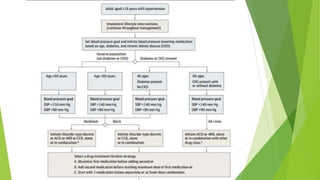
Start 1 drug, titrate to maximum dose, and
then add a second drug
Start 1 drug and then add a second drug before
achieving maximum dose of the initial drug
Begin with 2 drugs at the same time either as
2 separate pills or as a single pill combination
AbbreviationsACCORD = Action to Control Cardiovascular Risk in Diabetes
ACE = angiotensin-converting enzyme
ALLHAT = Antihypertensive and Lipid-Lowering Treatment to Prevent Heart
Attack Trial
ARB = angiotensin receptor blockers
ASCOT = Anglo-Scandinavian Cardiac Outcomes Trial
BP = blood pressure
CCB = calcium channel blocker
CHADS = congestive heart failure, hypertension, age, diabetes mellitus, and
stroke
CHD = coronary heart disease
CI = confidence interval
CKD = chronic kidney disease
DBP = diastolic blood pressure
HYVET = Hypertension in the Very Elderly Trial
JNC 8 = Eighth Joint National Committee
MI = myocardial infarction
SBP = systolic blood pressure
References
1. James PA, Oparil S, Carter BL, et al. 2014 evidence-based guideline for the
management of high blood pressure in adults: report from the panel members
appointed to the Eighth Joint National Committee (JNC 8). JAMA. 2014;311:507-520.
2. Chobanian AV, Bakris GL, Black HR, et al; National Heart, Lung, and Blood Institute
Joint National Committee on Prevention, Detection, Evaluation, and Treatment of High
Blood Pressure; National High Blood Pressure Education Program Coordinating
Committee. The Seventh Report of the Joint National Committee on Prevention,
Detection, Evaluation, and Treatment of High Blood Pressure: the JNC 7 report. JAMA.
2003;289:2560-2572.
3. Beckett NS, Peters R, Fletcher AE, et al; HYVET Study Group. Treatment of
hypertension in patients 80 years of age or older. N Engl J Med. 2008;358:1887-1898.
4. Mancia G, Fagard R, Narkiewicz K, et al. 2013 ESH/ESC guidelines for the
management of arterial hypertension: the Task Force for the Management of Arterial
Hypertension of the European Society of Hypertension (ESH) and of the European
Society of Cardiology (ESC). Eur Heart J. 2013;34:2159-2219.
5. Tight blood pressure control and risk of macrovascular and microvascular
complications in type 2 diabetes: UKPDS 38. UK Prospective Diabetes Study Group. BMJ.
1998;317:703-713.
References (cont)
6. ACCORD Study Group, Cushman WC, Evans GW, Byington RP, et al. Effects of
intensive blood-pressure control in type 2 diabetes mellitus. N Engl J Med.
2010;362:1575-1585.
7. Hebert LA, Kusek JW, Greene T, et al. Effects of blood pressure control on
progressive renal disease in blacks and whites. Modification of Diet in Renal Disease
Study Group. Hypertension. 1997;30(3 Pt 1):428-435.
8. Wright JT Jr, Bakris G, Greene T, et al; African American Study of Kidney Disease
and Hypertension Study Group. Effect of blood pressure lowering and antihypertensive
drug class on progression of hypertensive kidney disease: results from the AASK trial.
JAMA. 2002;288:2421-2431.
9. Ruggenenti P, Perna A, Loriga G, et al; REIN-2 Study Group. Blood-pressure control
for renoprotection in patients with non-diabetic chronic renal disease (REIN-2):
multicentre, randomised controlled trial. Lancet. 2005;365:939-946.
10. ClinicalTrials.gov. Systolic Blood Pressure Intervention Trial (SPRINT).
NCT01206062. http://clinicaltrials.gov/ct2/show/NCT01206062?term=SPRINT&rank=3
Accessed March 14, 2014.
References (cont)
11. Wright JT Jr, Harris-Haywood S, Pressel S, et al. Clinical outcomes by race in
hypertensive patients with and without the metabolic syndrome: Antihypertensive
and Lipid-Lowering Treatment to Prevent Heart Attack Trial (ALLHAT). Arch Intern
Med. 2008;168:207-217.
12. Wright Jr JT, Fine LJ, Lackland DT, Ogedegbe G, Dennison Himmelfarb CR.
Evidence Supporting a Systolic Blood Pressure Goal of Less Than 150 mm Hg in
Patients Aged 60 Years or Older: The Minority View. Ann Intern Med. 2014. [Epub
ahead of print]
13. Dahlöf B, Devereux RB, Kjeldsen SE, et al; LIFE Study Group. Cardiovascular
morbidity and mortality in the Losartan Intervention For Endpoint reduction in
hypertension study (LIFE): a randomised trial against atenolol. Lancet. 2002;359:995-
1003.
14. Poulter NR, Wedel H, Dahlöf B, et al; ASCOT Investigators. Role of blood
pressure and other variables in the differential cardiovascular event rates noted in
the Anglo-Scandinavian Cardiac Outcomes Trial-Blood Pressure Lowering Arm (ASCOT-
BPLA). Lancet. 2005;366:907-913.
References (cont)
15. Law MR, Morris JK, Wald NJ. Use of blood pressure lowering drugs in the prevention of
cardiovascular disease: meta-analysis of 147 randomised trials in the context of
expectations from prospective epidemiological studies. BMJ. 2009;338:b1665.
16. Antihypertensive and Lipid-Lowering Treatment to Prevent Heart Attack Trial
Collaborative Research Group. Diuretic versus alpha-blocker as first-step antihypertensive
therapy: final results from the Antihypertensive and Lipid-Lowering Treatment to Prevent
Heart Attack Trial (ALLHAT). Hypertension. 2003;42:239-246.
17. Wright JT Jr, Dunn JK, Cutler JA, et al; ALLHAT Collaborative Research Group.
Outcomes in hypertensive black and nonblack patients treated with chlorthalidone,
amlodipine, and lisinopril. JAMA. 2005;293:1595-1608.
18. Dahlöf B, Sever PS, Poulter NR, et al; ASCOT Investigators. Prevention of
cardiovascular events with an antihypertensive regimen of amlodipine adding perindopril as
required versus atenolol adding bendroflumethiazide as required, in the Anglo-Scandinavian
Cardiac Outcomes Trial-Blood Pressure Lowering Arm (ASCOT-BPLA): a multicentre
randomised controlled trial. Lancet. 2005;366:895-906.
Hypertension Guidelines JNC 8

Hypertension Guidelines JNC 8

  • 1.
  • 3.
    Problem Magnitude  35million office visits are as the primary diagnosis of HTN.  Worldwide prevalence estimates for HTN may be as much as 1 billion.  7.1 million deaths per year may be attributable to hypertension.
  • 4.
    Definition  A systolicblood pressure ( SBP) >139 mmHg and/or  A diastolic (DBP) >89 mmHg.  Based on the average of two or more properly measured, seated BP readings.  On each of two or more office visits.
  • 5.
  • 6.
    Hypertensive Crises  HypertensiveUrgencies: No progressive target- organ dysfunction. (Accelerated Hypertension)  Hypertensive Emergencies: Progressive end- organ dysfunction. (Malignant Hypertension)
  • 7.
    Types of Hypertension Primary HTN: also known as essential HTN. accounts for 95% cases of HTN. no universally established cause known.  Secondary HTN: less common cause of HTN ( 5%). secondary to other potentially rectifiable causes.
  • 8.
    Causes of SecondaryHTN  Common  Intrinsic renal disease  Renovascular disease  Mineralocorticoid excess  Sleep Breathing disorder  Uncommon  Pheochromocytoma  Glucocorticoid excess  Coarctation of Aorta  Hyper/hypothyroidism
  • 9.
    Indian Guidelines onHypertension - III  Wean off use of mercury sphygmomanometers use aneroid instead.  Home monitoring of BP  Beta blockers recommended only in young hypertesives with specific indications.  BP> 200/100mmHg start with drug combination rather than monotherapy  ACEI/ARB and CCB form a good combination  CKD recognized as a comorbidity
  • 10.
    Indian Guidelines onHypertension - III  HFnEF Heart Failure with noramal ejection fraction needs to be recognized  Dyspnoea  Raised BNP  Diastolic dysfunction with normal ejection fraction.  Interventional sympathetic denervation being evaluated.
  • 11.
    Questions to theJNC 8 Panel • At what level should you treat BP? • To what level should it be treated? • How do you do that?
  • 12.
    “Statements and recommendationsfor [BP] treatment based on a systematic review of the literature to meet user needs, especially the needs of the primary care clinician.”
  • 13.
    Focus of theRecommendations Age Black/nonblack Diabetic Chronic kidney disease (CKD)
  • 14.
    Age Recommendations, JNC2014 • 18 years old and younger: Not considered • 30 years old and younger: We have little to no data • 30 to 59 years old: In the general population younger than 60 years, initiate pharmacologic treatment to lower BP at a DBP of 90 mm Hg and treat to a goal DBP lower than 90 mm Hg. Strong Recommendation: Grade A • 60 years old: In the general population aged 60 years or older, initiate pharmacologic treatment to lower BP at an SBP of 150 mm Hg or higher or a DBP of 90 mm Hg or higher and treat to a goal SBP lower than 150 mm Hg and goal DBP lower than 90 mm Hg. Strong Recommendation: Grade A • 80 years old: Based on HYVET* *Hypertensions in very elderly Trial James PA, et al. JAMA. 2014;311:507-520.[1]
  • 15.
    JNC Panel Recommendationfor Patients With Diabetes and Hypertension • In the population aged 18 years and older with diabetes, initiate pharmacologic treatment to lower BP at an SBP of 140 mm Hg or a DBP of 90 mm Hg and treat to a goal of SBP lower than 140 mm Hg and goal DBP lower than 90 mm Hg. Expert Opinion: Grade E James PA, et al. JAMA. 2014;311:507-520.[1]
  • 16.
    JNC Panel Recommendationfor Patients With CKD • In the population aged 18 years with CKD, initiate pharmacologic treatment to lower BP at an SBP of 140 mm Hg or a DBP of 90 mm Hg and treat to goal of an SBP lower than 140 mm Hg and a goal DBP lower than 90 mm Hg. Expert Opinion: Grade E James PA, et al. JAMA. 2014;311:507-520.[1]
  • 17.
    JNC Recommendation forNonblack Patients • In the general nonblack population, including those with diabetes, initial antihypertensive treatment should include – Thiazide-type diuretic – Calcium channel blocker (CCB) – Angiotensin-converting enzyme (ACE) inhibitor – Angiotensin receptor blocker (ARB) – Moderate Recommendation: Grade B James PA, et al. JAMA. 2014;311:507-520.[1]
  • 18.
    JNC Recommendation forBlack Patients • In the general black population, including those with diabetes, initial antihypertensive treatment should include – Thiazide-type diuretic – CCB • For the general black population: – Moderate Recommendation: Grade B • For black patients with diabetes: – Weak Recommendation: Grade C James PA, et al. JAMA. 2014;311:507-520.[1]
  • 19.
    James PA, etal. JAMA. 2014;311:507-520.[1] Recommendations for Hypertension Management Recommendation 1: In the general population aged 60 years, initiate pharmacologic treatment to lower BP at systolic BP (SBP)150 mm Hg or diastolic BP (DBP) 90 mm Hg and treat to a goal SBP lower than 150 mm Hg and goal DBP lower than 90 mm Hg. (Strong Recommendation : Grade A)  Corollary Recommendation: In the general population aged 60 years, if pharmacologic treatment for high BP results in lower achieved SBP (eg, <140 mm Hg) and treatment is well tolerated and without adverse effects on health or quality of life, treatment does not need to be adjusted. (Expert Opinion : Grade E)
  • 20.
     Recommendation 2:In the general population younger than 60 years, initiate pharmacologic treatment to lower BP at DBP 90 mm Hg and treat to a goal DBP lower than 90 mm Hg. (For ages 30 to 59 years, Strong Recommendation : Grade A; for ages 18 to 29 years, Expert Opinion: Grade E) Recommendations for Hypertension Management
  • 21.
     Recommendation 3:In the general population younger than 60 years, initiate pharmacologic treatment to lower BP at SBP to 140 mm Hg and treat to a goal SBP lower than 140 mm Hg. (Expert Opinion : Grade E) Recommendations for Hypertension Management
  • 22.
     Recommendation 4:In the population aged 18 years with CKD, initiate pharmacologic treatment to lower BP at SBP 140 mm Hg or DBP 90 mm Hg and treat to goal SBP lower than 140 mm Hg and goal DBP lower than 90 mm Hg. (Expert Opinion: Grade E) Recommendations for Hypertension Management
  • 23.
     Recommendation 5:In the population aged 18 years with diabetes, initiate pharmacologic treatment to lower BP at SBP 140 mm Hg or DBP 90 mm Hg and treat to a goal SBP lower than 140 mm Hg and goal DBP lower than 90 mm Hg. (Expert Opinion: Grade E) Recommendations for Hypertension Management
  • 24.
    James PA, etal. JAMA. 2014;311:507-520.[1] Recommendation 6: In the general nonblack population, including those with diabetes, initial antihypertensive treatment should include a thiazide-type diuretic, CCB, angiotensin-converting enzyme inhibitor (ACEI), or angiotensin receptor blocker (ARB). (Moderate Recommendation: Grade B) Recommendations for Hypertension Management
  • 25.
     Recommendation 8:In the population aged 18 years with CKD, initial (or add-on) antihypertensive treatment should include an ACEI or ARB to improve kidney outcomes. This applies to all patients with CKD with hypertension regardless of race or diabetes status. (Moderate Recommendation: Grade B) Recommendations for Hypertension Management
  • 26.
     Recommendation 9:Attainand maintain goal BP within 1 month.  If not attained increase dose or add another drug from Recommendation 6  Do not use ACEI and ARB in the same patient.  Referral to hypertension specialist in patients whom goal BP cannot be attained or management of complicated patients. Recommendations for Hypertension Management
  • 27.
    Strategies for ReachingBP Goal James PA, et al. JAMA. 2014;311:507-520.[1] Start 1 drug, titrate to maximum dose, and then add a second drug Start 1 drug and then add a second drug before achieving maximum dose of the initial drug Begin with 2 drugs at the same time either as 2 separate pills or as a single pill combination
  • 30.
    AbbreviationsACCORD = Actionto Control Cardiovascular Risk in Diabetes ACE = angiotensin-converting enzyme ALLHAT = Antihypertensive and Lipid-Lowering Treatment to Prevent Heart Attack Trial ARB = angiotensin receptor blockers ASCOT = Anglo-Scandinavian Cardiac Outcomes Trial BP = blood pressure CCB = calcium channel blocker CHADS = congestive heart failure, hypertension, age, diabetes mellitus, and stroke CHD = coronary heart disease CI = confidence interval CKD = chronic kidney disease DBP = diastolic blood pressure HYVET = Hypertension in the Very Elderly Trial JNC 8 = Eighth Joint National Committee MI = myocardial infarction SBP = systolic blood pressure
  • 31.
    References 1. James PA,Oparil S, Carter BL, et al. 2014 evidence-based guideline for the management of high blood pressure in adults: report from the panel members appointed to the Eighth Joint National Committee (JNC 8). JAMA. 2014;311:507-520. 2. Chobanian AV, Bakris GL, Black HR, et al; National Heart, Lung, and Blood Institute Joint National Committee on Prevention, Detection, Evaluation, and Treatment of High Blood Pressure; National High Blood Pressure Education Program Coordinating Committee. The Seventh Report of the Joint National Committee on Prevention, Detection, Evaluation, and Treatment of High Blood Pressure: the JNC 7 report. JAMA. 2003;289:2560-2572. 3. Beckett NS, Peters R, Fletcher AE, et al; HYVET Study Group. Treatment of hypertension in patients 80 years of age or older. N Engl J Med. 2008;358:1887-1898. 4. Mancia G, Fagard R, Narkiewicz K, et al. 2013 ESH/ESC guidelines for the management of arterial hypertension: the Task Force for the Management of Arterial Hypertension of the European Society of Hypertension (ESH) and of the European Society of Cardiology (ESC). Eur Heart J. 2013;34:2159-2219. 5. Tight blood pressure control and risk of macrovascular and microvascular complications in type 2 diabetes: UKPDS 38. UK Prospective Diabetes Study Group. BMJ. 1998;317:703-713.
  • 32.
    References (cont) 6. ACCORDStudy Group, Cushman WC, Evans GW, Byington RP, et al. Effects of intensive blood-pressure control in type 2 diabetes mellitus. N Engl J Med. 2010;362:1575-1585. 7. Hebert LA, Kusek JW, Greene T, et al. Effects of blood pressure control on progressive renal disease in blacks and whites. Modification of Diet in Renal Disease Study Group. Hypertension. 1997;30(3 Pt 1):428-435. 8. Wright JT Jr, Bakris G, Greene T, et al; African American Study of Kidney Disease and Hypertension Study Group. Effect of blood pressure lowering and antihypertensive drug class on progression of hypertensive kidney disease: results from the AASK trial. JAMA. 2002;288:2421-2431. 9. Ruggenenti P, Perna A, Loriga G, et al; REIN-2 Study Group. Blood-pressure control for renoprotection in patients with non-diabetic chronic renal disease (REIN-2): multicentre, randomised controlled trial. Lancet. 2005;365:939-946. 10. ClinicalTrials.gov. Systolic Blood Pressure Intervention Trial (SPRINT). NCT01206062. http://clinicaltrials.gov/ct2/show/NCT01206062?term=SPRINT&rank=3 Accessed March 14, 2014.
  • 33.
    References (cont) 11. WrightJT Jr, Harris-Haywood S, Pressel S, et al. Clinical outcomes by race in hypertensive patients with and without the metabolic syndrome: Antihypertensive and Lipid-Lowering Treatment to Prevent Heart Attack Trial (ALLHAT). Arch Intern Med. 2008;168:207-217. 12. Wright Jr JT, Fine LJ, Lackland DT, Ogedegbe G, Dennison Himmelfarb CR. Evidence Supporting a Systolic Blood Pressure Goal of Less Than 150 mm Hg in Patients Aged 60 Years or Older: The Minority View. Ann Intern Med. 2014. [Epub ahead of print] 13. Dahlöf B, Devereux RB, Kjeldsen SE, et al; LIFE Study Group. Cardiovascular morbidity and mortality in the Losartan Intervention For Endpoint reduction in hypertension study (LIFE): a randomised trial against atenolol. Lancet. 2002;359:995- 1003. 14. Poulter NR, Wedel H, Dahlöf B, et al; ASCOT Investigators. Role of blood pressure and other variables in the differential cardiovascular event rates noted in the Anglo-Scandinavian Cardiac Outcomes Trial-Blood Pressure Lowering Arm (ASCOT- BPLA). Lancet. 2005;366:907-913.
  • 34.
    References (cont) 15. LawMR, Morris JK, Wald NJ. Use of blood pressure lowering drugs in the prevention of cardiovascular disease: meta-analysis of 147 randomised trials in the context of expectations from prospective epidemiological studies. BMJ. 2009;338:b1665. 16. Antihypertensive and Lipid-Lowering Treatment to Prevent Heart Attack Trial Collaborative Research Group. Diuretic versus alpha-blocker as first-step antihypertensive therapy: final results from the Antihypertensive and Lipid-Lowering Treatment to Prevent Heart Attack Trial (ALLHAT). Hypertension. 2003;42:239-246. 17. Wright JT Jr, Dunn JK, Cutler JA, et al; ALLHAT Collaborative Research Group. Outcomes in hypertensive black and nonblack patients treated with chlorthalidone, amlodipine, and lisinopril. JAMA. 2005;293:1595-1608. 18. Dahlöf B, Sever PS, Poulter NR, et al; ASCOT Investigators. Prevention of cardiovascular events with an antihypertensive regimen of amlodipine adding perindopril as required versus atenolol adding bendroflumethiazide as required, in the Anglo-Scandinavian Cardiac Outcomes Trial-Blood Pressure Lowering Arm (ASCOT-BPLA): a multicentre randomised controlled trial. Lancet. 2005;366:895-906.