Hypertension Medications
Selections based on Race and Co-
Morbid Conditions
Daniel Le
UNMC College of Pharmacy
Overview
• Why important to control hypertension
• Life Style modification
• Medication Classes
• Most patients response
• Goals from JNC 7
• JNC 8 general question prior to treatment &
methods of dosing
• Treatment for different Races and co-morbidity
• Resistant Hypertension
Important to control hypertension
• One of the major risk factors for cardiovascular
disease
• 67 million adults in the US (31%), 1 in 3
Americans
• Associated with developing other co-morbid
disease
• On average the U.S spend about $131 billion per
year
• Untreated can lead to heart failure, heart attack,
damage arteries which can prevent blood from
getting to the vital organs
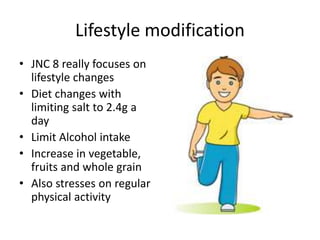
Lifestyle modification
• JNC 8 really focuses on
lifestyle changes
• Diet changes with
limiting salt to 2.4g a
day
• Limit Alcohol intake
• Increase in vegetable,
fruits and whole grain
• Also stresses on regular
physical activity
Life Style Modifications results
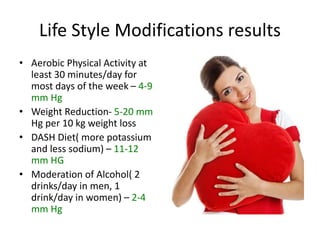
• Aerobic Physical Activity at
least 30 minutes/day for
most days of the week – 4-9
mm Hg
• Weight Reduction- 5-20 mm
Hg per 10 kg weight loss
• DASH Diet( more potassium
and less sodium) – 11-12
mm HG
• Moderation of Alcohol( 2
drinks/day in men, 1
drink/day in women) – 2-4
mm Hg
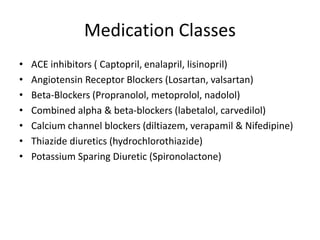
Medication Classes
• ACE inhibitors ( Captopril, enalapril, lisinopril)
• Angiotensin Receptor Blockers (Losartan, valsartan)
• Beta-Blockers (Propranolol, metoprolol, nadolol)
• Combined alpha & beta-blockers (labetalol, carvedilol)
• Calcium channel blockers (diltiazem, verapamil & Nifedipine)
• Thiazide diuretics (hydrochlorothiazide)
• Potassium Sparing Diuretic (Spironolactone)
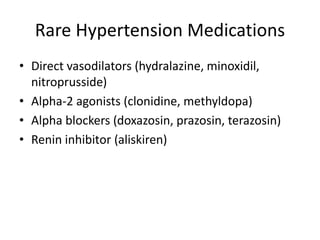
Rare Hypertension Medications
• Direct vasodilators (hydralazine, minoxidil,
nitroprusside)
• Alpha-2 agonists (clonidine, methyldopa)
• Alpha blockers (doxazosin, prazosin, terazosin)
• Renin inhibitor (aliskiren)
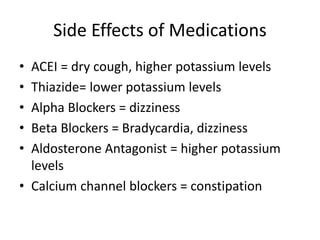
Side Effects of Medications
• ACEI = dry cough, higher potassium levels
• Thiazide= lower potassium levels
• Alpha Blockers = dizziness
• Beta Blockers = Bradycardia, dizziness
• Aldosterone Antagonist = higher potassium
levels
• Calcium channel blockers = constipation
Most Patients
• Most antihypertensive drugs will have the same
cardiovascular protection for the same level of
blood pressure control
• Most patients will require 2 medications to reach
goals, and about 40% will need 3 medications
• Many patients will get hypokalemia
• Many medications will deplete Potassium and
should be counter-balance with potassium
sparing diuretic to increase the low level of
potassium
Goals from JNC 7
• JNC 7 guidelines can still
be useful in setting goals
• <140/90 mmHg Primary
Prevention
• <130/80 mmHg
• - Diabetes
• - Chronic Kidney Disease
• - Coronary Artery Disease
• - CAD Risk Equivalent
• < 120/80 mmHg Left
Ventricular Dysfunction
JNC 8 have 3 general questions
• At what BP should
treatment be initiated to
improve outcomes?
• What should the target
BP be for those
undergoing treatment?
• What medications are
best?
• JNC 8 moved away from
Goals of JNC 7, and
looked at
recommendation based
on the three questions
3 Distinct methods of dosing by JNC 8
1. Start with one
medication at initial
dose, titrate to max dose
and if not effective add
2nd drug
2. Start with one
medication, then add 2nd
medication, titrate both
to max dose
3. Initiate 2 medication
from 2 different classes
Race and health conditions
• Diabetes
• Pregnancy
• African Americans
• Chronic Kidney Disease
• Elderly
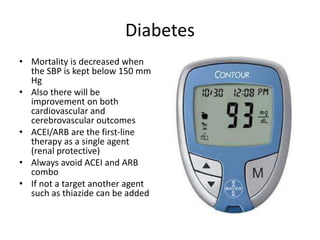
Diabetes
• Mortality is decreased when
the SBP is kept below 150 mm
Hg
• Also there will be
improvement on both
cardiovascular and
cerebrovascular outcomes
• ACEI/ARB are the first-line
therapy as a single agent
(renal protective)
• Always avoid ACEI and ARB
combo
• If not a target another agent
such as thiazide can be added
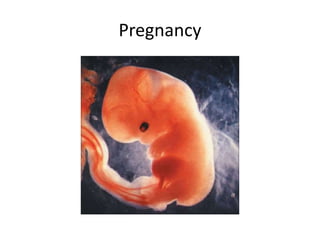
Pregnancy
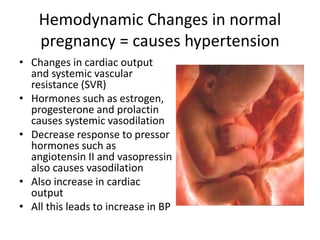
Hemodynamic Changes in normal
pregnancy = causes hypertension
• Changes in cardiac output
and systemic vascular
resistance (SVR)
• Hormones such as estrogen,
progesterone and prolactin
causes systemic vasodilation
• Decrease response to pressor
hormones such as
angiotensin II and vasopressin
also causes vasodilation
• Also increase in cardiac
output
• All this leads to increase in BP
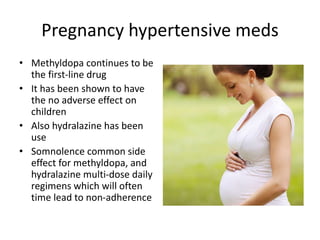
Pregnancy hypertensive meds
• Methyldopa continues to be
the first-line drug
• It has been shown to have
the no adverse effect on
children
• Also hydralazine has been
use
• Somnolence common side
effect for methyldopa, and
hydralazine multi-dose daily
regimens which will often
time lead to non-adherence
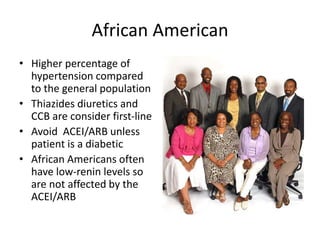
African American
• Higher percentage of
hypertension compared
to the general population
• Thiazides diuretics and
CCB are consider first-line
• Avoid ACEI/ARB unless
patient is a diabetic
• African Americans often
have low-renin levels so
are not affected by the
ACEI/ARB
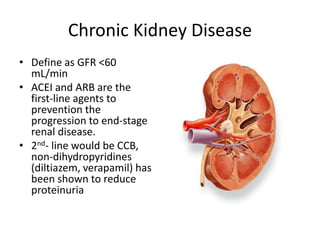
Chronic Kidney Disease
• Define as GFR <60
mL/min
• ACEI and ARB are the
first-line agents to
prevention the
progression to end-stage
renal disease.
• 2nd- line would be CCB,
non-dihydropyridines
(diltiazem, verapamil) has
been shown to reduce
proteinuria
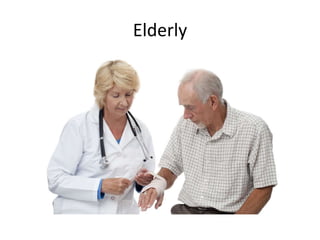
Elderly
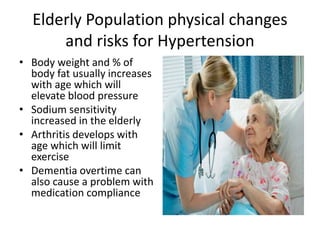
Elderly Population physical changes
and risks for Hypertension
• Body weight and % of
body fat usually increases
with age which will
elevate blood pressure
• Sodium sensitivity
increased in the elderly
• Arthritis develops with
age which will limit
exercise
• Dementia overtime can
also cause a problem with
medication compliance
Elderly Population Medication
• Thiazides are first-line
• Often advise to add
spironolactone to prevent
hypokalemia
• ACEI would be a good
alternative to thiazides
• Beta-Blockers should be use
with caution because it can
drop heart heart
• Short-acting CCB like
Nifedipine has shown to
increase mortality and
should be avoided
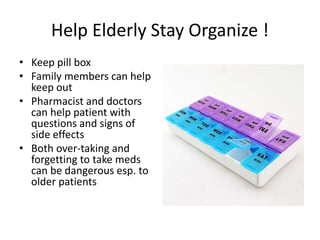
Help Elderly Stay Organize !
• Keep pill box
• Family members can help
keep out
• Pharmacist and doctors
can help patient with
questions and signs of
side effects
• Both over-taking and
forgetting to take meds
can be dangerous esp. to
older patients
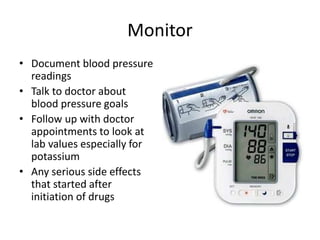
Monitor
• Document blood pressure
readings
• Talk to doctor about
blood pressure goals
• Follow up with doctor
appointments to look at
lab values especially for
potassium
• Any serious side effects
that started after
initiation of drugs
Treatment-Resistant Hypertension
• Elevated BP that cannot
be controlled with 3 drug
regiment at max doses
• Ask patient about
compliance, sometimes
patients get confused and
forget
• Any OTC & herbals that
could have caused
elevation?
• Patient might not be able
to afford the drug cost?
Treatment-resistant hypertension
• IF no such issues are
identified…..
• Refer to specialist
• Further evaluation and
look at other possible
disorders
• Such as CKD, renal
artery stenosis,
hyperaldosteronemia,
and sleep apnea
Conclusion
• It is important in the
selection of hypertensive
meds that we are aware
of what co-morbid as well
as racial background of
patients
• Understanding when a 2nd
medication should be
added
• What side effects are
common in the
medications
References
• Mahvan T.S., Mlodinow S.G(2014). JNC 8: What’s covered, what’s not, and what else to consider. The journal of family
practice, 63(10), 574-584
• Hernandez-Villa E. (2015). A Review of the JNC 8 Blood Pressure Guideline. Texas Heart Institute, 42, 226-228
• Arauz-Pacheco C., Parriott M.A., Raskin, P. Treatment of Hypertension in Adults with Diabetes. Diabetes Care, 26(1) ,80-82
• Sarkar C., Dodhia H., Crompton J., Schofield P., White P., Millet C., Ashworth M. (2015) Hypertension: a cross-sectional study
of the role of multimorbidity in blood pressure control. BMC Family Practice
• Flack J.M., Levy P.D., Nasser S.A. (2011). Therapy of Hypertension in African Americans. American Journal of Cardiovascular
Drugs, 11(2) 83-92
• Scantelbury D.C., Schwartz G.L., Acquah L.A., White, W.M., Moser M., Garovic V.D.,(2013). The Treatment of Hypertension
During Pregnancy: When Should Blood Pressure Medications be Started?National Institutes of Health, 15 (11).
• Stokes G.S. (2009). Management of hypertension in the elderly patient. Clinical Interventions in Aging, 4, 379-389

Hypertension

  • 1.
    Hypertension Medications Selections basedon Race and Co- Morbid Conditions Daniel Le UNMC College of Pharmacy
  • 2.
    Overview • Why importantto control hypertension • Life Style modification • Medication Classes • Most patients response • Goals from JNC 7 • JNC 8 general question prior to treatment & methods of dosing • Treatment for different Races and co-morbidity • Resistant Hypertension
  • 3.
    Important to controlhypertension • One of the major risk factors for cardiovascular disease • 67 million adults in the US (31%), 1 in 3 Americans • Associated with developing other co-morbid disease • On average the U.S spend about $131 billion per year • Untreated can lead to heart failure, heart attack, damage arteries which can prevent blood from getting to the vital organs
  • 4.
    Lifestyle modification • JNC8 really focuses on lifestyle changes • Diet changes with limiting salt to 2.4g a day • Limit Alcohol intake • Increase in vegetable, fruits and whole grain • Also stresses on regular physical activity
  • 5.
    Life Style Modificationsresults • Aerobic Physical Activity at least 30 minutes/day for most days of the week – 4-9 mm Hg • Weight Reduction- 5-20 mm Hg per 10 kg weight loss • DASH Diet( more potassium and less sodium) – 11-12 mm HG • Moderation of Alcohol( 2 drinks/day in men, 1 drink/day in women) – 2-4 mm Hg
  • 6.
    Medication Classes • ACEinhibitors ( Captopril, enalapril, lisinopril) • Angiotensin Receptor Blockers (Losartan, valsartan) • Beta-Blockers (Propranolol, metoprolol, nadolol) • Combined alpha & beta-blockers (labetalol, carvedilol) • Calcium channel blockers (diltiazem, verapamil & Nifedipine) • Thiazide diuretics (hydrochlorothiazide) • Potassium Sparing Diuretic (Spironolactone)
  • 7.
    Rare Hypertension Medications •Direct vasodilators (hydralazine, minoxidil, nitroprusside) • Alpha-2 agonists (clonidine, methyldopa) • Alpha blockers (doxazosin, prazosin, terazosin) • Renin inhibitor (aliskiren)
  • 8.
    Side Effects ofMedications • ACEI = dry cough, higher potassium levels • Thiazide= lower potassium levels • Alpha Blockers = dizziness • Beta Blockers = Bradycardia, dizziness • Aldosterone Antagonist = higher potassium levels • Calcium channel blockers = constipation
  • 9.
    Most Patients • Mostantihypertensive drugs will have the same cardiovascular protection for the same level of blood pressure control • Most patients will require 2 medications to reach goals, and about 40% will need 3 medications • Many patients will get hypokalemia • Many medications will deplete Potassium and should be counter-balance with potassium sparing diuretic to increase the low level of potassium
  • 10.
    Goals from JNC7 • JNC 7 guidelines can still be useful in setting goals • <140/90 mmHg Primary Prevention • <130/80 mmHg • - Diabetes • - Chronic Kidney Disease • - Coronary Artery Disease • - CAD Risk Equivalent • < 120/80 mmHg Left Ventricular Dysfunction
  • 11.
    JNC 8 have3 general questions • At what BP should treatment be initiated to improve outcomes? • What should the target BP be for those undergoing treatment? • What medications are best? • JNC 8 moved away from Goals of JNC 7, and looked at recommendation based on the three questions
  • 12.
    3 Distinct methodsof dosing by JNC 8 1. Start with one medication at initial dose, titrate to max dose and if not effective add 2nd drug 2. Start with one medication, then add 2nd medication, titrate both to max dose 3. Initiate 2 medication from 2 different classes
  • 13.
    Race and healthconditions • Diabetes • Pregnancy • African Americans • Chronic Kidney Disease • Elderly
  • 14.
    Diabetes • Mortality isdecreased when the SBP is kept below 150 mm Hg • Also there will be improvement on both cardiovascular and cerebrovascular outcomes • ACEI/ARB are the first-line therapy as a single agent (renal protective) • Always avoid ACEI and ARB combo • If not a target another agent such as thiazide can be added
  • 15.
  • 16.
    Hemodynamic Changes innormal pregnancy = causes hypertension • Changes in cardiac output and systemic vascular resistance (SVR) • Hormones such as estrogen, progesterone and prolactin causes systemic vasodilation • Decrease response to pressor hormones such as angiotensin II and vasopressin also causes vasodilation • Also increase in cardiac output • All this leads to increase in BP
  • 17.
    Pregnancy hypertensive meds •Methyldopa continues to be the first-line drug • It has been shown to have the no adverse effect on children • Also hydralazine has been use • Somnolence common side effect for methyldopa, and hydralazine multi-dose daily regimens which will often time lead to non-adherence
  • 18.
    African American • Higherpercentage of hypertension compared to the general population • Thiazides diuretics and CCB are consider first-line • Avoid ACEI/ARB unless patient is a diabetic • African Americans often have low-renin levels so are not affected by the ACEI/ARB
  • 19.
    Chronic Kidney Disease •Define as GFR <60 mL/min • ACEI and ARB are the first-line agents to prevention the progression to end-stage renal disease. • 2nd- line would be CCB, non-dihydropyridines (diltiazem, verapamil) has been shown to reduce proteinuria
  • 20.
  • 21.
    Elderly Population physicalchanges and risks for Hypertension • Body weight and % of body fat usually increases with age which will elevate blood pressure • Sodium sensitivity increased in the elderly • Arthritis develops with age which will limit exercise • Dementia overtime can also cause a problem with medication compliance
  • 22.
    Elderly Population Medication •Thiazides are first-line • Often advise to add spironolactone to prevent hypokalemia • ACEI would be a good alternative to thiazides • Beta-Blockers should be use with caution because it can drop heart heart • Short-acting CCB like Nifedipine has shown to increase mortality and should be avoided
  • 23.
    Help Elderly StayOrganize ! • Keep pill box • Family members can help keep out • Pharmacist and doctors can help patient with questions and signs of side effects • Both over-taking and forgetting to take meds can be dangerous esp. to older patients
  • 24.
    Monitor • Document bloodpressure readings • Talk to doctor about blood pressure goals • Follow up with doctor appointments to look at lab values especially for potassium • Any serious side effects that started after initiation of drugs
  • 25.
    Treatment-Resistant Hypertension • ElevatedBP that cannot be controlled with 3 drug regiment at max doses • Ask patient about compliance, sometimes patients get confused and forget • Any OTC & herbals that could have caused elevation? • Patient might not be able to afford the drug cost?
  • 26.
    Treatment-resistant hypertension • IFno such issues are identified….. • Refer to specialist • Further evaluation and look at other possible disorders • Such as CKD, renal artery stenosis, hyperaldosteronemia, and sleep apnea
  • 27.
    Conclusion • It isimportant in the selection of hypertensive meds that we are aware of what co-morbid as well as racial background of patients • Understanding when a 2nd medication should be added • What side effects are common in the medications
  • 28.
    References • Mahvan T.S.,Mlodinow S.G(2014). JNC 8: What’s covered, what’s not, and what else to consider. The journal of family practice, 63(10), 574-584 • Hernandez-Villa E. (2015). A Review of the JNC 8 Blood Pressure Guideline. Texas Heart Institute, 42, 226-228 • Arauz-Pacheco C., Parriott M.A., Raskin, P. Treatment of Hypertension in Adults with Diabetes. Diabetes Care, 26(1) ,80-82 • Sarkar C., Dodhia H., Crompton J., Schofield P., White P., Millet C., Ashworth M. (2015) Hypertension: a cross-sectional study of the role of multimorbidity in blood pressure control. BMC Family Practice • Flack J.M., Levy P.D., Nasser S.A. (2011). Therapy of Hypertension in African Americans. American Journal of Cardiovascular Drugs, 11(2) 83-92 • Scantelbury D.C., Schwartz G.L., Acquah L.A., White, W.M., Moser M., Garovic V.D.,(2013). The Treatment of Hypertension During Pregnancy: When Should Blood Pressure Medications be Started?National Institutes of Health, 15 (11). • Stokes G.S. (2009). Management of hypertension in the elderly patient. Clinical Interventions in Aging, 4, 379-389