Article Discussion
Hypertension treatment and
management
Medscape review article
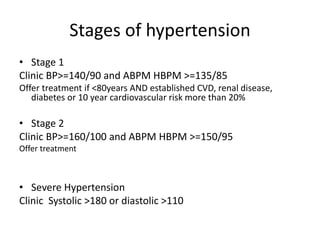
Stages of hypertension
• Stage 1
Clinic BP>=140/90 and ABPM HBPM >=135/85
Offer treatment if <80years AND established CVD, renal disease,
diabetes or 10 year cardiovascular risk more than 20%
• Stage 2
Clinic BP>=160/100 and ABPM HBPM >=150/95
Offer treatment
• Severe Hypertension
Clinic Systolic >180 or diastolic >110
Nonpharmacologic Therapy
• NaCl
• The effect of sodium chloride is particularly important in individuals who
are middle-aged to elderly with a family history of hypertension
• The American Heart Association recommends that the average daily
consumption of sodium chloride not exceed 6 g; this may lower BP by 2-8
mm Hg
• 6mg equals around one tea spoon of salt.
• dark chocolate may lower BP via improved vascular endothelial function
and increased formation of nitric oxide.
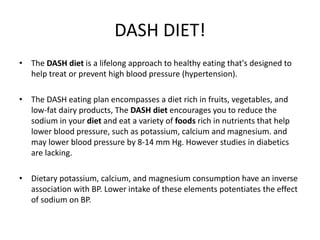
DASH DIET!
• The DASH diet is a lifelong approach to healthy eating that's designed to
help treat or prevent high blood pressure (hypertension).
• The DASH eating plan encompasses a diet rich in fruits, vegetables, and
low-fat dairy products, The DASH diet encourages you to reduce the
sodium in your diet and eat a variety of foods rich in nutrients that help
lower blood pressure, such as potassium, calcium and magnesium. and
may lower blood pressure by 8-14 mm Hg. However studies in diabetics
are lacking.
• Dietary potassium, calcium, and magnesium consumption have an inverse
association with BP. Lower intake of these elements potentiates the effect
of sodium on BP.
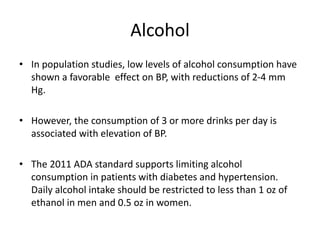
Alcohol
• In population studies, low levels of alcohol consumption have
shown a favorable effect on BP, with reductions of 2-4 mm
Hg.
• However, the consumption of 3 or more drinks per day is
associated with elevation of BP.
• The 2011 ADA standard supports limiting alcohol
consumption in patients with diabetes and hypertension.
Daily alcohol intake should be restricted to less than 1 oz of
ethanol in men and 0.5 oz in women.
Weight loss and exercise
• Up to 60% of all individuals with hypertension are more than 20%
overweight.
• Weight reduction may lower blood pressure by 5-20 mm Hg per 10 kg of
weight loss in a patient whose weight is more than 10% of ideal body
weight.
• Adding exercise and weight loss to the DASH diet resulted in even larger
reductions in BP and cardiovascular biomarkers of risk.
Lifestyle modifications
• A decrease in BP of 2 mm Hg reduces the risk
of stroke by 15% and the risk of coronary
artery disease by 6% in a given population.
• Majority of risk factors modifications have a
larger role in prehypertension and stage 1
hypertension than in stage 2 hypertension
Pharmacologic Therapy
• Standard initiation therapy should be used as per guidelines, but ACE/ARB CCB
Thiazides are equally effective in non black, and CCB and Thiazide are favoured
in black population.
• Multiple clinical trials suggest that most antihypertensive drugs provide the
same degree of cardiovascular protection for the same level of BP control.
• The following are drug class recommendations for compelling indications
based on various clinical trials :
• Heart failure: Diuretic, beta-blocker, ACE inhibitor/ARB, aldosterone antagonist
• Following myocardial infarction: Beta-blocker, ACE inhibitor
• Diabetes: ACE inhibitor/ARB
• Chronic kidney disease: ACE inhibitor/ARB
Single agent versus multiagent
treatment approach
• Over 50% of patients with hypertension will require more than one drug
for blood pressure control.
• In stage 1 hypertension, a single agent is generally sufficient to reduce BP,
whereas in stage 2, a multidrug approach may be needed
• Should also be considered when BP is more than 20 mm Hg above the
systolic goal (or 10 mm Hg above the diastolic goal)
• 2 drugs may be used at lower doses to avoid the adverse effects that may
occur with higher doses of a single agent.
• Diuretics generally potentiate the effects of other antihypertensive drugs
by minimizing volume expansion.
Direct Renin Inhibitors and ACE/ARB
• The ALTITUDE trial was halted because it was shown that aliskiren can
cause adverse events—nonfatal stroke, renal complications, hyperkalemia,
and hypotension—when used in combination with an ACE inhibitor or an
angiotensin receptor blocker (ARB) in patients with type 2 diabetes and
renal impairment who are at high risk of cardiovascular and renal events.
Management of Diabetes and
Hypertension
• Hypertension is not only disproportionately high in diabetic
individuals, but it also increases the risk of diabetes 2.5 times
within 5 years in hypertensive patients
• (JNC 8) recommends initiating treatment at systolic blood
pressure (BP) levels of 140 mm Hg or greater or at diastolic BP
levels of 90 mm Hg or greater, and then treat to a goal BP
below 140/90 mm Hg.
• Most studies, have shown superiority of ACE inhibitors or
ARBs over calcium antagonists in diabetic patients.
• .
• If needed to achieve BP goals, a thiazide diuretic is indicated for those
patients with an estimated GFR of 30 mL/min/1.73 m2 or greater, and a
loop diuretic is indicated for those with an estimated GFR of less than 30
mL/min/1.73 m2. Regardless of which antihypertensive drugs are used,
kidney function and serum potassium levels should be monitored.
• adding spironolactone to existing treatment in patients with resistant
hypertension and diabetes mellitus significantly lowered blood pressure
Management of Hypertensive
Emergencies
• Hypertensive emergencies are characterized by severe elevations in BP
(>180/120 mm Hg) associated with acute end-organ damage
• Examples include hypertensive encephalopathy, intracerebral
hemorrhage, acute myocardial infarction, acute left ventricular failure
with pulmonary edema, aortic dissection, unstable angina pectoris,
eclampsia, [2] or posterior reversible encephalopathy syndrome (PRES) (a
condition characterized by headache, altered mental status, visual
disturbances, and seizures)
• The primary goal of the physician is to determine which
patients with acute hypertension are exhibiting symptoms of
end-organ damage and require immediate intravenous
parenteral antihypertensive therapy
• Initial treatment goals are to reduce the mean arterial BP by
no more than 25% within minutes to 1 hour. If the patient is
stable, reduce the BP to 160/100-110 mm Hg within the next
2-6 hours.
• Agents such as nitroprusside sodium, hydralazine,
nicardipine, fenoldopam, nitroglycerin, or enalaprilat,
labetalol, esmolol, and phentolamine.
• Exceptions to the above recommendation include the following[2] :
• Patients with an ischemic stroke (currently, no clear evidence exists
for immediate antihypertensive treatment)
• Patients with aortic dissection (their systolic BP should be lowered
to < 100 mm Hg, if tolerated)
• Patients in whom BP is lowered to allow thrombolytic therapy (eg,
stroke patients)
• Avoid using short-acting nifedipine in the initial treatment of this
condition because of the risk of rapid, unpredictable hypotension
and the possibility of precipitating ischemic events.
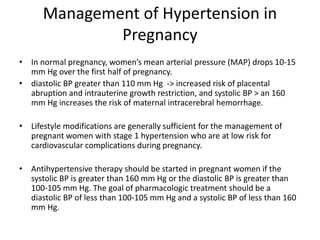
Management of Hypertension in
Pregnancy
• In normal pregnancy, women’s mean arterial pressure (MAP) drops 10-15
mm Hg over the first half of pregnancy.
• diastolic BP greater than 110 mm Hg -> increased risk of placental
abruption and intrauterine growth restriction, and systolic BP > an 160
mm Hg increases the risk of maternal intracerebral hemorrhage.
• Lifestyle modifications are generally sufficient for the management of
pregnant women with stage 1 hypertension who are at low risk for
cardiovascular complications during pregnancy.
• Antihypertensive therapy should be started in pregnant women if the
systolic BP is greater than 160 mm Hg or the diastolic BP is greater than
100-105 mm Hg. The goal of pharmacologic treatment should be a
diastolic BP of less than 100-105 mm Hg and a systolic BP of less than 160
mm Hg.
• Women who have preexisting end-organ damage from chronic
hypertension or who have previously required multidrug therapy
for BP control should have a lower threshold for starting
antihypertensive medication (ie, >139/89 mm Hg) and a lower
target BP (< 140/90 mm Hg).
• Methyldopa is generally the preferred first-line agent because of its
safety profile.
• ]Other drugs labetalol, beta-blockers, and diuretics. Data are limited
regarding the use of clonidine and calcium antagonists in pregnant
women with chronic hypertension;
• however, angiotensin-converting enzyme (ACE) inhibitors and
angiotensin II receptor (ARB) antagonists should be avoided
because of the risk of fetal toxicity and death
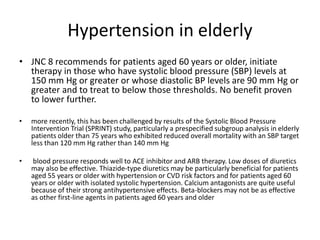
Hypertension in elderly
• JNC 8 recommends for patients aged 60 years or older, initiate
therapy in those who have systolic blood pressure (SBP) levels at
150 mm Hg or greater or whose diastolic BP levels are 90 mm Hg or
greater and to treat to below those thresholds. No benefit proven
to lower further.
• more recently, this has been challenged by results of the Systolic Blood Pressure
Intervention Trial (SPRINT) study, particularly a prespecified subgroup analysis in elderly
patients older than 75 years who exhibited reduced overall mortality with an SBP target
less than 120 mm Hg rather than 140 mm Hg
• blood pressure responds well to ACE inhibitor and ARB therapy. Low doses of diuretics
may also be effective. Thiazide-type diuretics may be particularly beneficial for patients
aged 55 years or older with hypertension or CVD risk factors and for patients aged 60
years or older with isolated systolic hypertension. Calcium antagonists are quite useful
because of their strong antihypertensive effects. Beta-blockers may not be as effective
as other first-line agents in patients aged 60 years and older
In black population
• Beta-blocker, ACE inhibitor, or ARB monotherapy in black
patients may be less effective for BP reduction than in white
patients
• CCBs were more effective than ACE inhibitors in black
patients. However, combination therapy with a diuretic and
agents of the other drug classes eliminated the differences in
BP reduction between racial groups
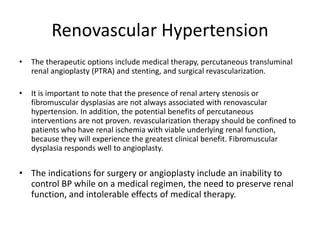
Renovascular Hypertension
• The therapeutic options include medical therapy, percutaneous transluminal
renal angioplasty (PTRA) and stenting, and surgical revascularization.
• It is important to note that the presence of renal artery stenosis or
fibromuscular dysplasias are not always associated with renovascular
hypertension. In addition, the potential benefits of percutaneous
interventions are not proven. revascularization therapy should be confined to
patients who have renal ischemia with viable underlying renal function,
because they will experience the greatest clinical benefit. Fibromuscular
dysplasia responds well to angioplasty.
• The indications for surgery or angioplasty include an inability to
control BP while on a medical regimen, the need to preserve renal
function, and intolerable effects of medical therapy.
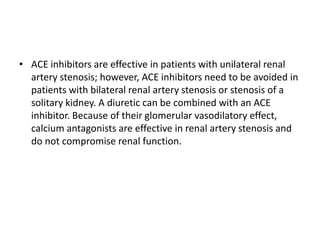
• ACE inhibitors are effective in patients with unilateral renal
artery stenosis; however, ACE inhibitors need to be avoided in
patients with bilateral renal artery stenosis or stenosis of a
solitary kidney. A diuretic can be combined with an ACE
inhibitor. Because of their glomerular vasodilatory effect,
calcium antagonists are effective in renal artery stenosis and
do not compromise renal function.
Management of Resistant
Hypertension
• Resistant hypertension is commonly defined as a blood pressure (BP) level
higher than 140/90 mm Hg despite treatment with antihypertensive
agents of three or more different classes, of which one is a diuretic.
• Causes of resistant hypertension include improper BP measurement, volume
overload, drug-induced or other causes, and associated conditions such as obesity
or excessive alcohol intake.
• Improper BP measurement
• Inadequate treatment and patient noncompliance.
• Extracellular volume expansion
• Vasoactive substances . Salt and alcohol are common examples; others include
cocaine, amphetamines, anabolic steroids, oral contraceptives, cyclosporine,
antidepressants, and nonsteroidal anti-inflammatory drugs.
• renal artery stenosis, primary hyperaldosteronism, obstructive sleep
apnea maybe secondary causes
• Data suggest that the addition of low-dose spironolactone provides
significant additive BP reduction in both black patients and white patients
who have resistant hypertension, with or without primary
hyperaldosteronism.
Pseudohypertension
• Pseudohypertension in an overestimation of
intra-arterial pressure by cuff blood pressure
(BP) measurement. This may be observed in
elderly individuals who have thickened,
calcified arteries
• Direct measurement of intra-arterial pressure
may be required in this setting.
Management of Pheochromocytoma
• Surgical resection is the treatment of choice for pheochromocytoma,
because hypertension is cured by tumor resection. In the preoperative
phase, nonspecific alpha-adrenergic blockade is indicated with
phenoxybenzamine, and following adequate alpha-adrenergic blockade,
beta-adrenergic blockade is added if excess tachycardia is present.
• For adrenal pheochromocytoma, laparoscopic adrenalectomy is becoming
the procedure of choice in suitable patients. Follow-up 24-hour urinary
excretion studies of catecholamines should be performed 2 weeks
following surgery (and periodically thereafter) to detect recurrence,
metastases, or development of second primary lesion.
Management of Primary
Hyperaldosteronism
• A CT scan with dynamic protocol may help localize an adrenal mass,
indicating adrenal adenoma, which may be a nonsecreting incidentaloma
or a hypersecreting adenoma. If the results of the CT scan are
inconclusive, adrenal venous sampling for aldosterone and cortisol levels
should be performed.
• Medical therapy is indicated in patients with adrenal hyperplasia, patients
with adenoma who are poor surgical risks, and patients with bilateral
adenomas. These patients are best treated with sustained salt and water
depletion.
• Adrenal adenomas may be resected via a laparoscopic procedure. Surgical
resection often leads to the control of blood pressure and the reversal of
biochemical abnormalities. These patients may develop
hypoaldosteronism during the postoperative follow-up period and require
supplementation with fludrocortisone.
Interventions for Improving Blood
Pressure Control
• Self-monitoring
• Educational interventions directed to the patient
• Educational interventions directed to the health
professional
• Nurse or pharmacist care
• Organizational interventions that aim to improve
the delivery of care
• Appointment reminder systems
Prevention
• Prevention of hypertension may be achieved
by the following interventions:
• Weight control
• Increased physical activity
• Moderated sodium and alcohol intake
• Increased potassium intake
• A diet rich in fruits and vegetables and low-fat
meat, fish, and dairy products
Blood Pressure Discussion

Blood Pressure Discussion

  • 1.
    Article Discussion Hypertension treatmentand management Medscape review article
  • 2.
    Stages of hypertension •Stage 1 Clinic BP>=140/90 and ABPM HBPM >=135/85 Offer treatment if <80years AND established CVD, renal disease, diabetes or 10 year cardiovascular risk more than 20% • Stage 2 Clinic BP>=160/100 and ABPM HBPM >=150/95 Offer treatment • Severe Hypertension Clinic Systolic >180 or diastolic >110
  • 4.
    Nonpharmacologic Therapy • NaCl •The effect of sodium chloride is particularly important in individuals who are middle-aged to elderly with a family history of hypertension • The American Heart Association recommends that the average daily consumption of sodium chloride not exceed 6 g; this may lower BP by 2-8 mm Hg • 6mg equals around one tea spoon of salt. • dark chocolate may lower BP via improved vascular endothelial function and increased formation of nitric oxide.
  • 5.
    DASH DIET! • TheDASH diet is a lifelong approach to healthy eating that's designed to help treat or prevent high blood pressure (hypertension). • The DASH eating plan encompasses a diet rich in fruits, vegetables, and low-fat dairy products, The DASH diet encourages you to reduce the sodium in your diet and eat a variety of foods rich in nutrients that help lower blood pressure, such as potassium, calcium and magnesium. and may lower blood pressure by 8-14 mm Hg. However studies in diabetics are lacking. • Dietary potassium, calcium, and magnesium consumption have an inverse association with BP. Lower intake of these elements potentiates the effect of sodium on BP.
  • 6.
    Alcohol • In populationstudies, low levels of alcohol consumption have shown a favorable effect on BP, with reductions of 2-4 mm Hg. • However, the consumption of 3 or more drinks per day is associated with elevation of BP. • The 2011 ADA standard supports limiting alcohol consumption in patients with diabetes and hypertension. Daily alcohol intake should be restricted to less than 1 oz of ethanol in men and 0.5 oz in women.
  • 7.
    Weight loss andexercise • Up to 60% of all individuals with hypertension are more than 20% overweight. • Weight reduction may lower blood pressure by 5-20 mm Hg per 10 kg of weight loss in a patient whose weight is more than 10% of ideal body weight. • Adding exercise and weight loss to the DASH diet resulted in even larger reductions in BP and cardiovascular biomarkers of risk.
  • 8.
    Lifestyle modifications • Adecrease in BP of 2 mm Hg reduces the risk of stroke by 15% and the risk of coronary artery disease by 6% in a given population. • Majority of risk factors modifications have a larger role in prehypertension and stage 1 hypertension than in stage 2 hypertension
  • 9.
    Pharmacologic Therapy • Standardinitiation therapy should be used as per guidelines, but ACE/ARB CCB Thiazides are equally effective in non black, and CCB and Thiazide are favoured in black population. • Multiple clinical trials suggest that most antihypertensive drugs provide the same degree of cardiovascular protection for the same level of BP control. • The following are drug class recommendations for compelling indications based on various clinical trials : • Heart failure: Diuretic, beta-blocker, ACE inhibitor/ARB, aldosterone antagonist • Following myocardial infarction: Beta-blocker, ACE inhibitor • Diabetes: ACE inhibitor/ARB • Chronic kidney disease: ACE inhibitor/ARB
  • 10.
    Single agent versusmultiagent treatment approach • Over 50% of patients with hypertension will require more than one drug for blood pressure control. • In stage 1 hypertension, a single agent is generally sufficient to reduce BP, whereas in stage 2, a multidrug approach may be needed • Should also be considered when BP is more than 20 mm Hg above the systolic goal (or 10 mm Hg above the diastolic goal) • 2 drugs may be used at lower doses to avoid the adverse effects that may occur with higher doses of a single agent. • Diuretics generally potentiate the effects of other antihypertensive drugs by minimizing volume expansion.
  • 11.
    Direct Renin Inhibitorsand ACE/ARB • The ALTITUDE trial was halted because it was shown that aliskiren can cause adverse events—nonfatal stroke, renal complications, hyperkalemia, and hypotension—when used in combination with an ACE inhibitor or an angiotensin receptor blocker (ARB) in patients with type 2 diabetes and renal impairment who are at high risk of cardiovascular and renal events.
  • 12.
    Management of Diabetesand Hypertension • Hypertension is not only disproportionately high in diabetic individuals, but it also increases the risk of diabetes 2.5 times within 5 years in hypertensive patients • (JNC 8) recommends initiating treatment at systolic blood pressure (BP) levels of 140 mm Hg or greater or at diastolic BP levels of 90 mm Hg or greater, and then treat to a goal BP below 140/90 mm Hg. • Most studies, have shown superiority of ACE inhibitors or ARBs over calcium antagonists in diabetic patients. • .
  • 13.
    • If neededto achieve BP goals, a thiazide diuretic is indicated for those patients with an estimated GFR of 30 mL/min/1.73 m2 or greater, and a loop diuretic is indicated for those with an estimated GFR of less than 30 mL/min/1.73 m2. Regardless of which antihypertensive drugs are used, kidney function and serum potassium levels should be monitored. • adding spironolactone to existing treatment in patients with resistant hypertension and diabetes mellitus significantly lowered blood pressure
  • 14.
    Management of Hypertensive Emergencies •Hypertensive emergencies are characterized by severe elevations in BP (>180/120 mm Hg) associated with acute end-organ damage • Examples include hypertensive encephalopathy, intracerebral hemorrhage, acute myocardial infarction, acute left ventricular failure with pulmonary edema, aortic dissection, unstable angina pectoris, eclampsia, [2] or posterior reversible encephalopathy syndrome (PRES) (a condition characterized by headache, altered mental status, visual disturbances, and seizures)
  • 15.
    • The primarygoal of the physician is to determine which patients with acute hypertension are exhibiting symptoms of end-organ damage and require immediate intravenous parenteral antihypertensive therapy • Initial treatment goals are to reduce the mean arterial BP by no more than 25% within minutes to 1 hour. If the patient is stable, reduce the BP to 160/100-110 mm Hg within the next 2-6 hours. • Agents such as nitroprusside sodium, hydralazine, nicardipine, fenoldopam, nitroglycerin, or enalaprilat, labetalol, esmolol, and phentolamine.
  • 16.
    • Exceptions tothe above recommendation include the following[2] : • Patients with an ischemic stroke (currently, no clear evidence exists for immediate antihypertensive treatment) • Patients with aortic dissection (their systolic BP should be lowered to < 100 mm Hg, if tolerated) • Patients in whom BP is lowered to allow thrombolytic therapy (eg, stroke patients) • Avoid using short-acting nifedipine in the initial treatment of this condition because of the risk of rapid, unpredictable hypotension and the possibility of precipitating ischemic events.
  • 17.
    Management of Hypertensionin Pregnancy • In normal pregnancy, women’s mean arterial pressure (MAP) drops 10-15 mm Hg over the first half of pregnancy. • diastolic BP greater than 110 mm Hg -> increased risk of placental abruption and intrauterine growth restriction, and systolic BP > an 160 mm Hg increases the risk of maternal intracerebral hemorrhage. • Lifestyle modifications are generally sufficient for the management of pregnant women with stage 1 hypertension who are at low risk for cardiovascular complications during pregnancy. • Antihypertensive therapy should be started in pregnant women if the systolic BP is greater than 160 mm Hg or the diastolic BP is greater than 100-105 mm Hg. The goal of pharmacologic treatment should be a diastolic BP of less than 100-105 mm Hg and a systolic BP of less than 160 mm Hg.
  • 18.
    • Women whohave preexisting end-organ damage from chronic hypertension or who have previously required multidrug therapy for BP control should have a lower threshold for starting antihypertensive medication (ie, >139/89 mm Hg) and a lower target BP (< 140/90 mm Hg). • Methyldopa is generally the preferred first-line agent because of its safety profile. • ]Other drugs labetalol, beta-blockers, and diuretics. Data are limited regarding the use of clonidine and calcium antagonists in pregnant women with chronic hypertension; • however, angiotensin-converting enzyme (ACE) inhibitors and angiotensin II receptor (ARB) antagonists should be avoided because of the risk of fetal toxicity and death
  • 19.
    Hypertension in elderly •JNC 8 recommends for patients aged 60 years or older, initiate therapy in those who have systolic blood pressure (SBP) levels at 150 mm Hg or greater or whose diastolic BP levels are 90 mm Hg or greater and to treat to below those thresholds. No benefit proven to lower further. • more recently, this has been challenged by results of the Systolic Blood Pressure Intervention Trial (SPRINT) study, particularly a prespecified subgroup analysis in elderly patients older than 75 years who exhibited reduced overall mortality with an SBP target less than 120 mm Hg rather than 140 mm Hg • blood pressure responds well to ACE inhibitor and ARB therapy. Low doses of diuretics may also be effective. Thiazide-type diuretics may be particularly beneficial for patients aged 55 years or older with hypertension or CVD risk factors and for patients aged 60 years or older with isolated systolic hypertension. Calcium antagonists are quite useful because of their strong antihypertensive effects. Beta-blockers may not be as effective as other first-line agents in patients aged 60 years and older
  • 20.
    In black population •Beta-blocker, ACE inhibitor, or ARB monotherapy in black patients may be less effective for BP reduction than in white patients • CCBs were more effective than ACE inhibitors in black patients. However, combination therapy with a diuretic and agents of the other drug classes eliminated the differences in BP reduction between racial groups
  • 21.
    Renovascular Hypertension • Thetherapeutic options include medical therapy, percutaneous transluminal renal angioplasty (PTRA) and stenting, and surgical revascularization. • It is important to note that the presence of renal artery stenosis or fibromuscular dysplasias are not always associated with renovascular hypertension. In addition, the potential benefits of percutaneous interventions are not proven. revascularization therapy should be confined to patients who have renal ischemia with viable underlying renal function, because they will experience the greatest clinical benefit. Fibromuscular dysplasia responds well to angioplasty. • The indications for surgery or angioplasty include an inability to control BP while on a medical regimen, the need to preserve renal function, and intolerable effects of medical therapy.
  • 22.
    • ACE inhibitorsare effective in patients with unilateral renal artery stenosis; however, ACE inhibitors need to be avoided in patients with bilateral renal artery stenosis or stenosis of a solitary kidney. A diuretic can be combined with an ACE inhibitor. Because of their glomerular vasodilatory effect, calcium antagonists are effective in renal artery stenosis and do not compromise renal function.
  • 23.
    Management of Resistant Hypertension •Resistant hypertension is commonly defined as a blood pressure (BP) level higher than 140/90 mm Hg despite treatment with antihypertensive agents of three or more different classes, of which one is a diuretic. • Causes of resistant hypertension include improper BP measurement, volume overload, drug-induced or other causes, and associated conditions such as obesity or excessive alcohol intake. • Improper BP measurement • Inadequate treatment and patient noncompliance. • Extracellular volume expansion • Vasoactive substances . Salt and alcohol are common examples; others include cocaine, amphetamines, anabolic steroids, oral contraceptives, cyclosporine, antidepressants, and nonsteroidal anti-inflammatory drugs.
  • 24.
    • renal arterystenosis, primary hyperaldosteronism, obstructive sleep apnea maybe secondary causes • Data suggest that the addition of low-dose spironolactone provides significant additive BP reduction in both black patients and white patients who have resistant hypertension, with or without primary hyperaldosteronism.
  • 25.
    Pseudohypertension • Pseudohypertension inan overestimation of intra-arterial pressure by cuff blood pressure (BP) measurement. This may be observed in elderly individuals who have thickened, calcified arteries • Direct measurement of intra-arterial pressure may be required in this setting.
  • 26.
    Management of Pheochromocytoma •Surgical resection is the treatment of choice for pheochromocytoma, because hypertension is cured by tumor resection. In the preoperative phase, nonspecific alpha-adrenergic blockade is indicated with phenoxybenzamine, and following adequate alpha-adrenergic blockade, beta-adrenergic blockade is added if excess tachycardia is present. • For adrenal pheochromocytoma, laparoscopic adrenalectomy is becoming the procedure of choice in suitable patients. Follow-up 24-hour urinary excretion studies of catecholamines should be performed 2 weeks following surgery (and periodically thereafter) to detect recurrence, metastases, or development of second primary lesion.
  • 27.
    Management of Primary Hyperaldosteronism •A CT scan with dynamic protocol may help localize an adrenal mass, indicating adrenal adenoma, which may be a nonsecreting incidentaloma or a hypersecreting adenoma. If the results of the CT scan are inconclusive, adrenal venous sampling for aldosterone and cortisol levels should be performed. • Medical therapy is indicated in patients with adrenal hyperplasia, patients with adenoma who are poor surgical risks, and patients with bilateral adenomas. These patients are best treated with sustained salt and water depletion. • Adrenal adenomas may be resected via a laparoscopic procedure. Surgical resection often leads to the control of blood pressure and the reversal of biochemical abnormalities. These patients may develop hypoaldosteronism during the postoperative follow-up period and require supplementation with fludrocortisone.
  • 28.
    Interventions for ImprovingBlood Pressure Control • Self-monitoring • Educational interventions directed to the patient • Educational interventions directed to the health professional • Nurse or pharmacist care • Organizational interventions that aim to improve the delivery of care • Appointment reminder systems
  • 29.
    Prevention • Prevention ofhypertension may be achieved by the following interventions: • Weight control • Increased physical activity • Moderated sodium and alcohol intake • Increased potassium intake • A diet rich in fruits and vegetables and low-fat meat, fish, and dairy products