Jenkins
What’s Jenkins?©2010 CloudBees, Inc. All Rights Reserved
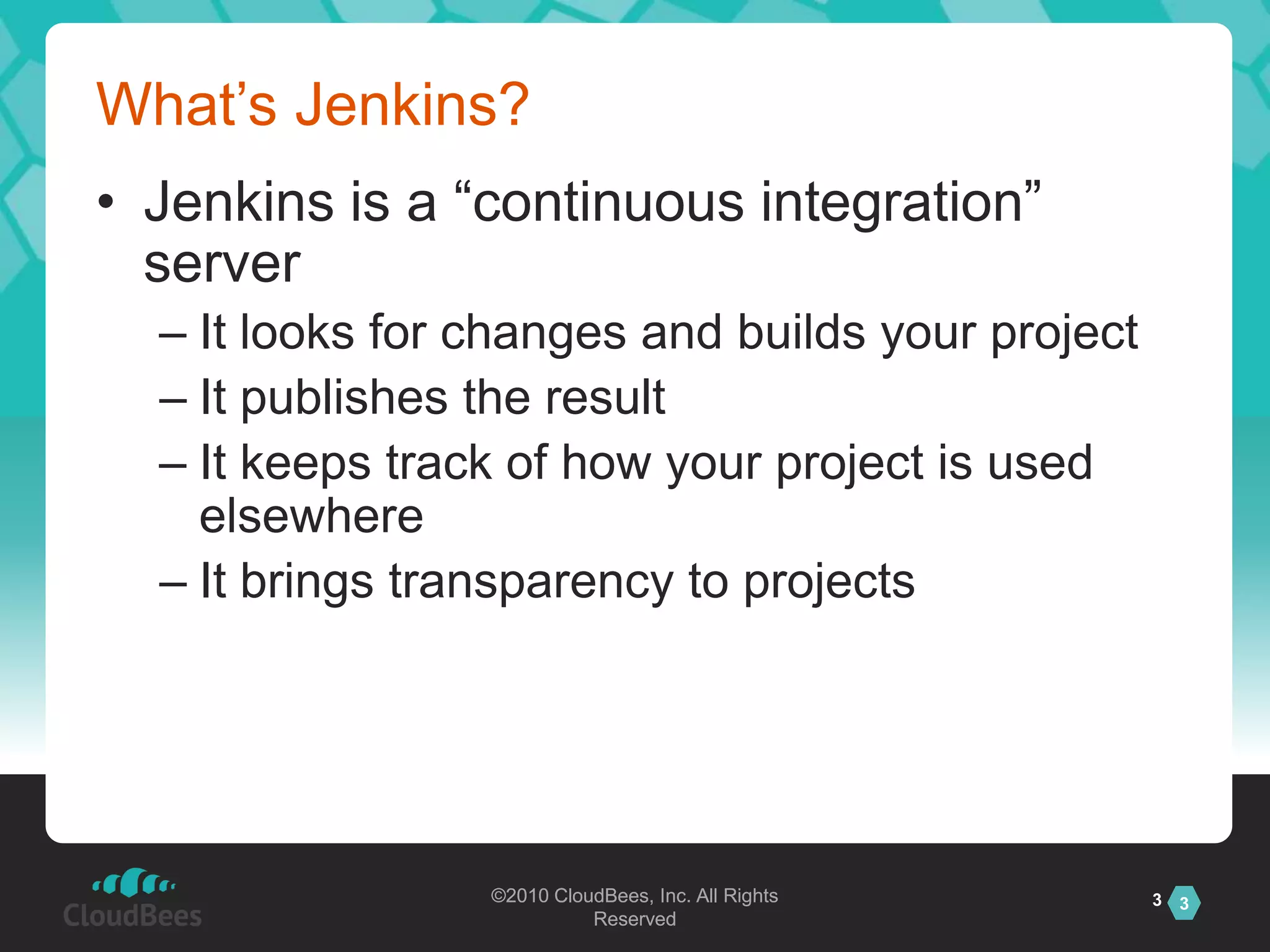
What’s Jenkins?Jenkins is a “continuous integration” serverIt looks for changes and builds your projectIt publishes the resultIt keeps track of how your project is used elsewhereIt brings transparency to projects3
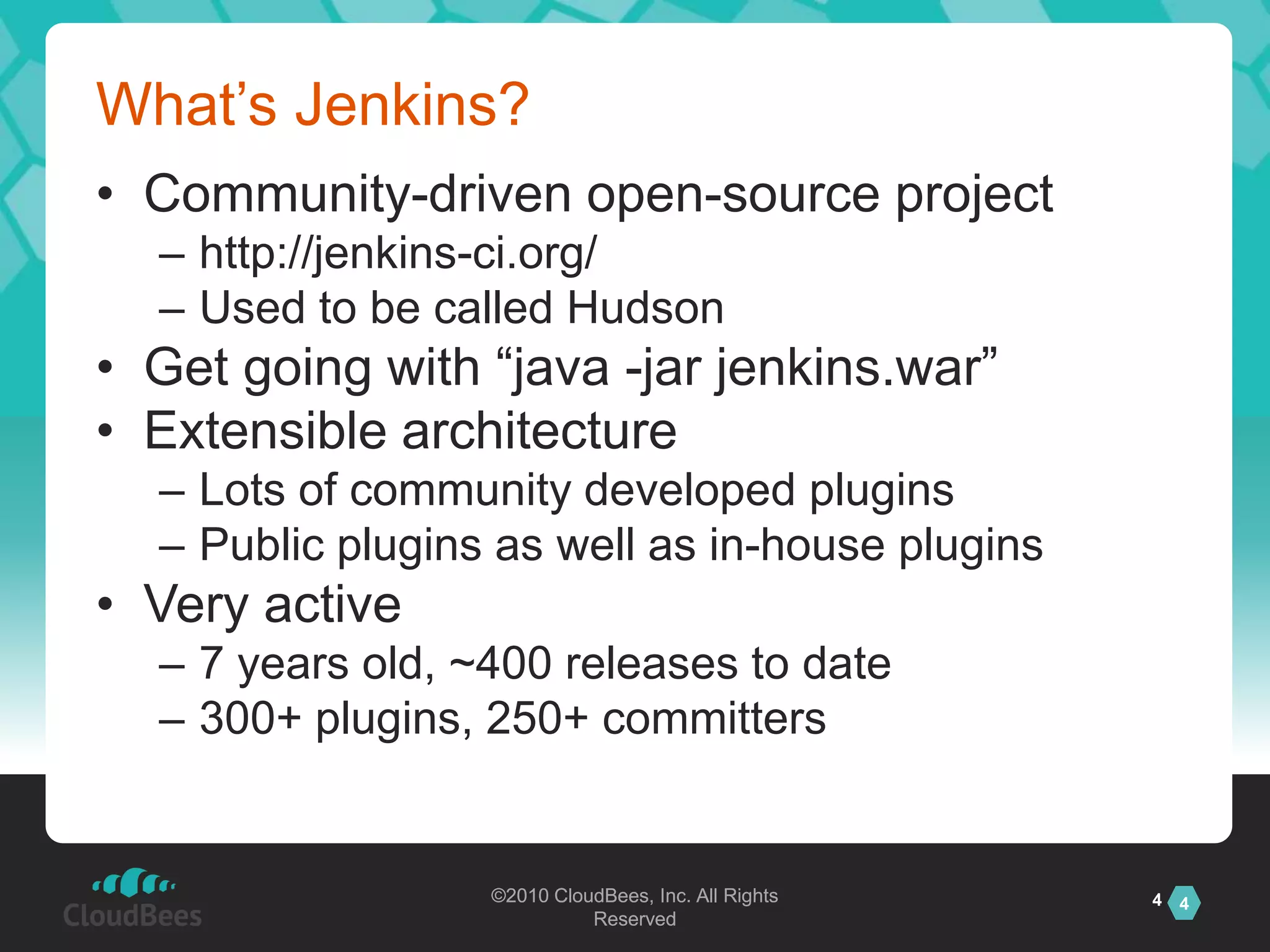
What’s Jenkins?Community-driven open-source projecthttp://jenkins-ci.org/Used to be called HudsonGet going with “java -jar jenkins.war”Extensible architectureLots of community developed pluginsPublic plugins as well as in-house pluginsVery active7 years old, ~400 releases to date300+ plugins, 250+ committers4
Used Everywhere55
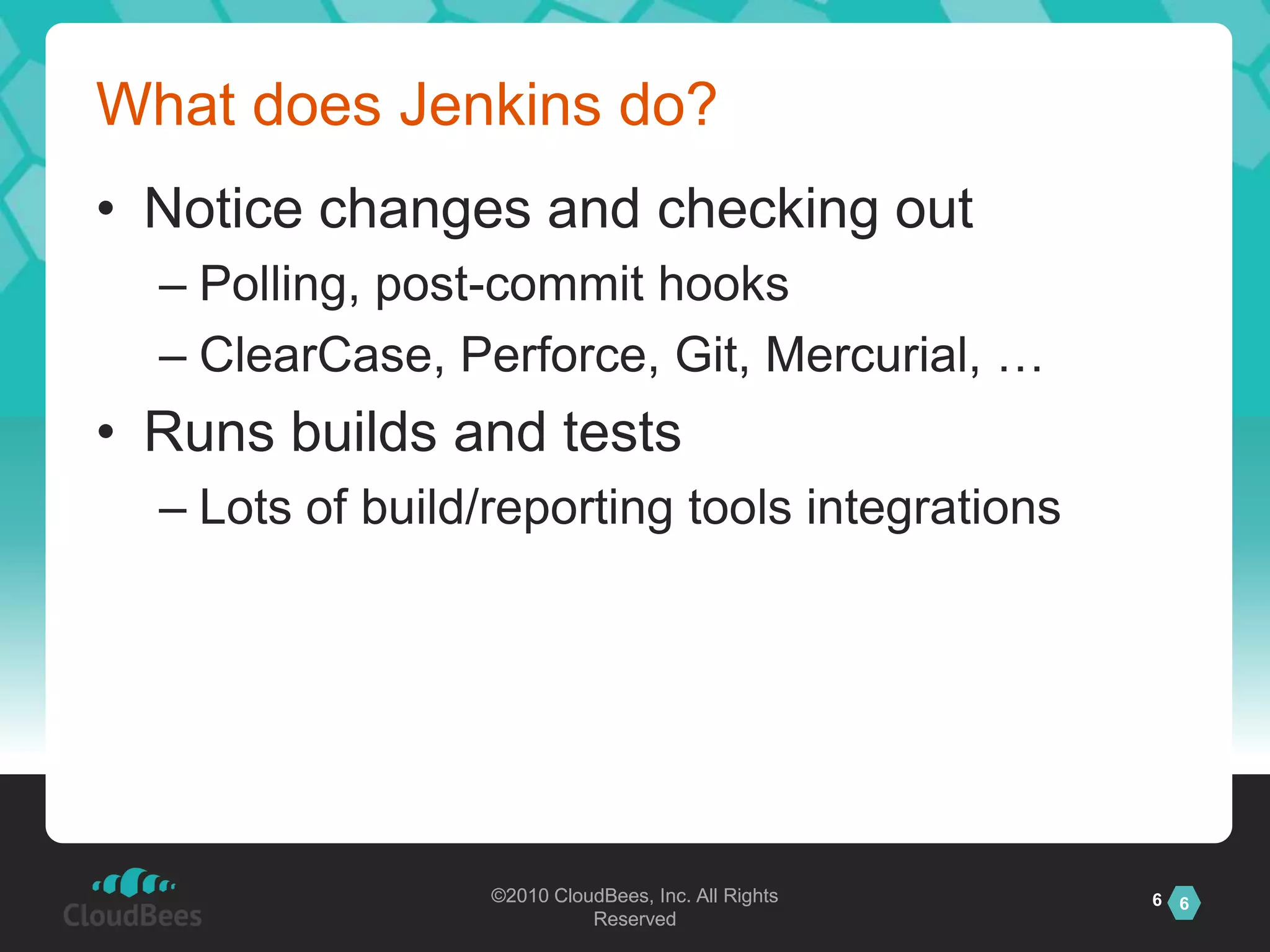
What does Jenkins do?Notice changes and checking outPolling, post-commit hooksClearCase, Perforce, Git, Mercurial, …Runs builds and testsLots of build/reporting tools integrations6
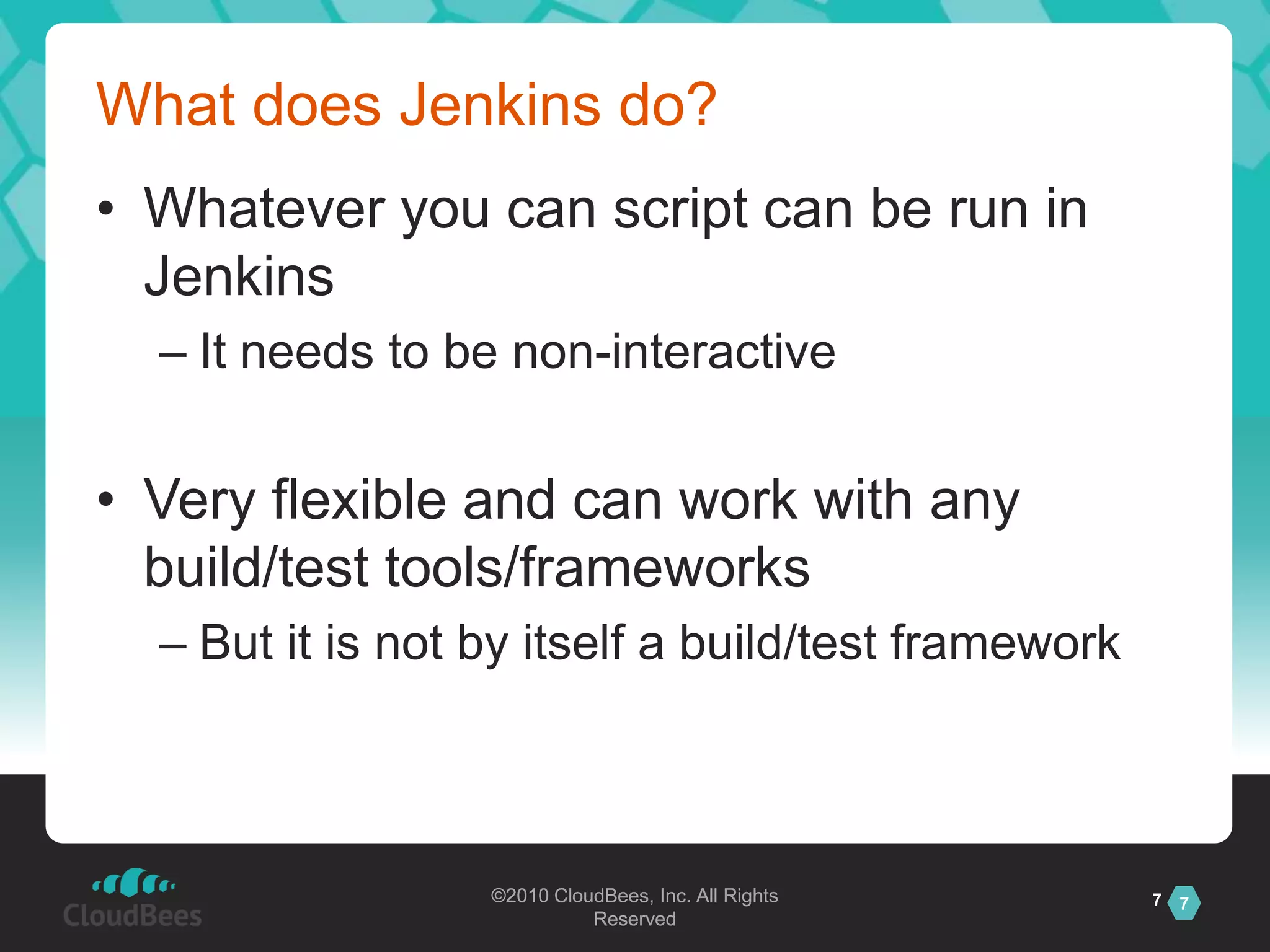
What does Jenkins do?Whatever you can script can be run in JenkinsIt needs to be non-interactiveVery flexible and can work with any build/test tools/frameworksBut it is not by itself a build/test framework7
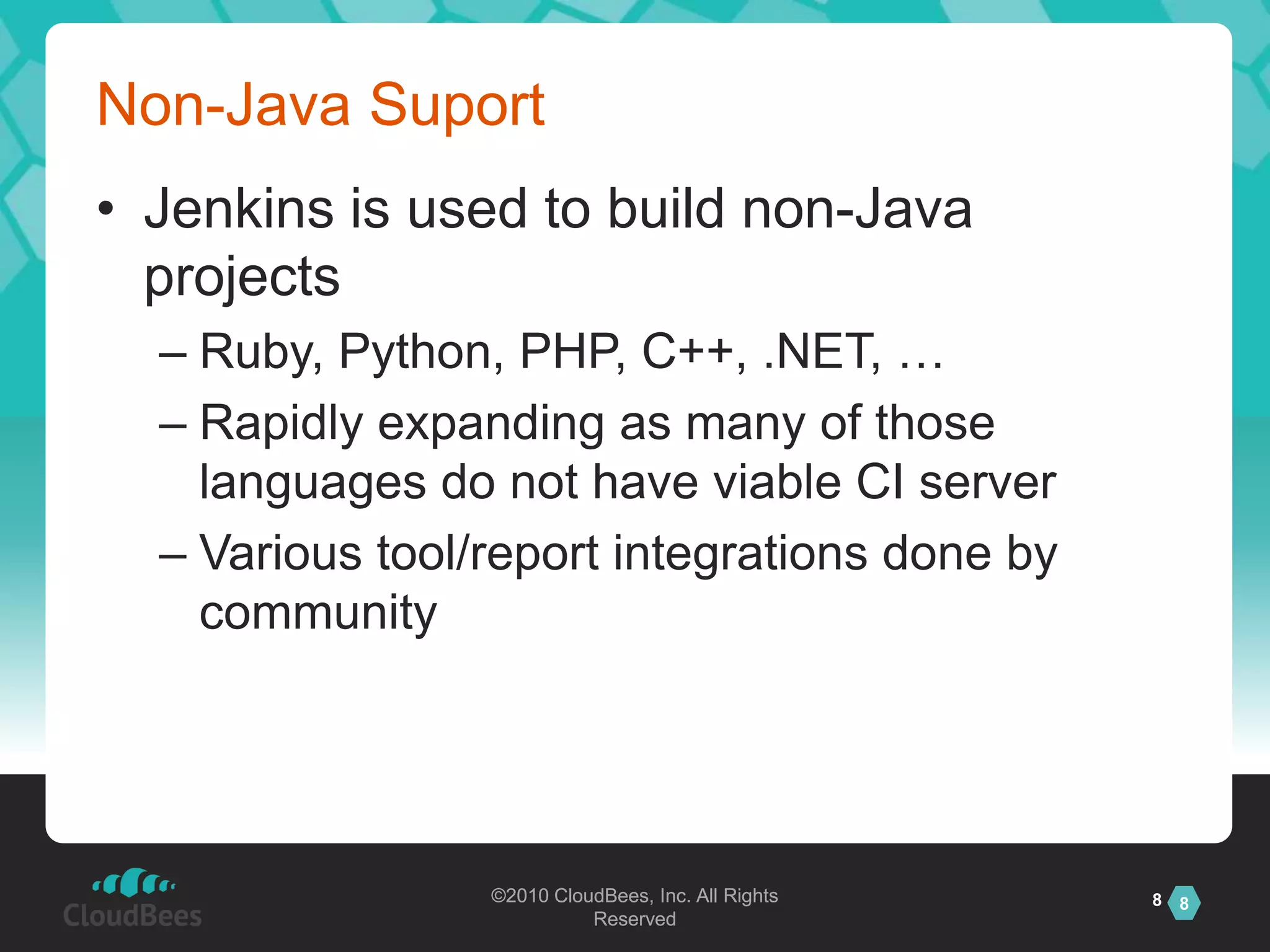
Non-Java SuportJenkins is used to build non-Java projectsRuby, Python, PHP, C++, .NET, …Rapidly expanding as many of those languages do not have viable CI serverVarious tool/report integrations done by community8
Demo©2010 CloudBees, Inc. All Rights Reserved
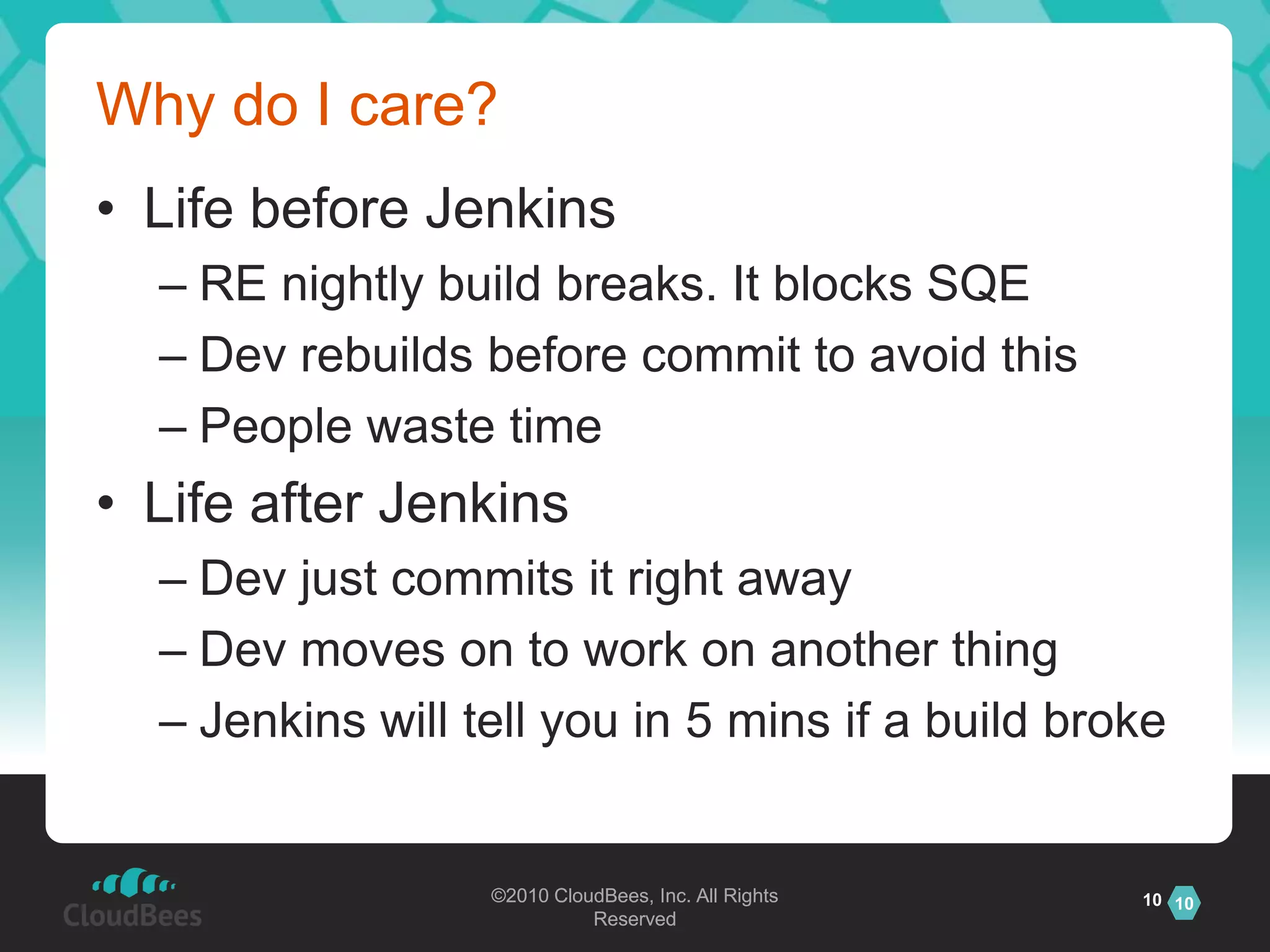
Why do I care?Life before JenkinsRE nightly build breaks. It blocks SQEDev rebuilds before commit to avoid thisPeople waste timeLife after JenkinsDev just commits it right awayDev moves on to work on another thingJenkins will tell you in 5 mins if a build broke10
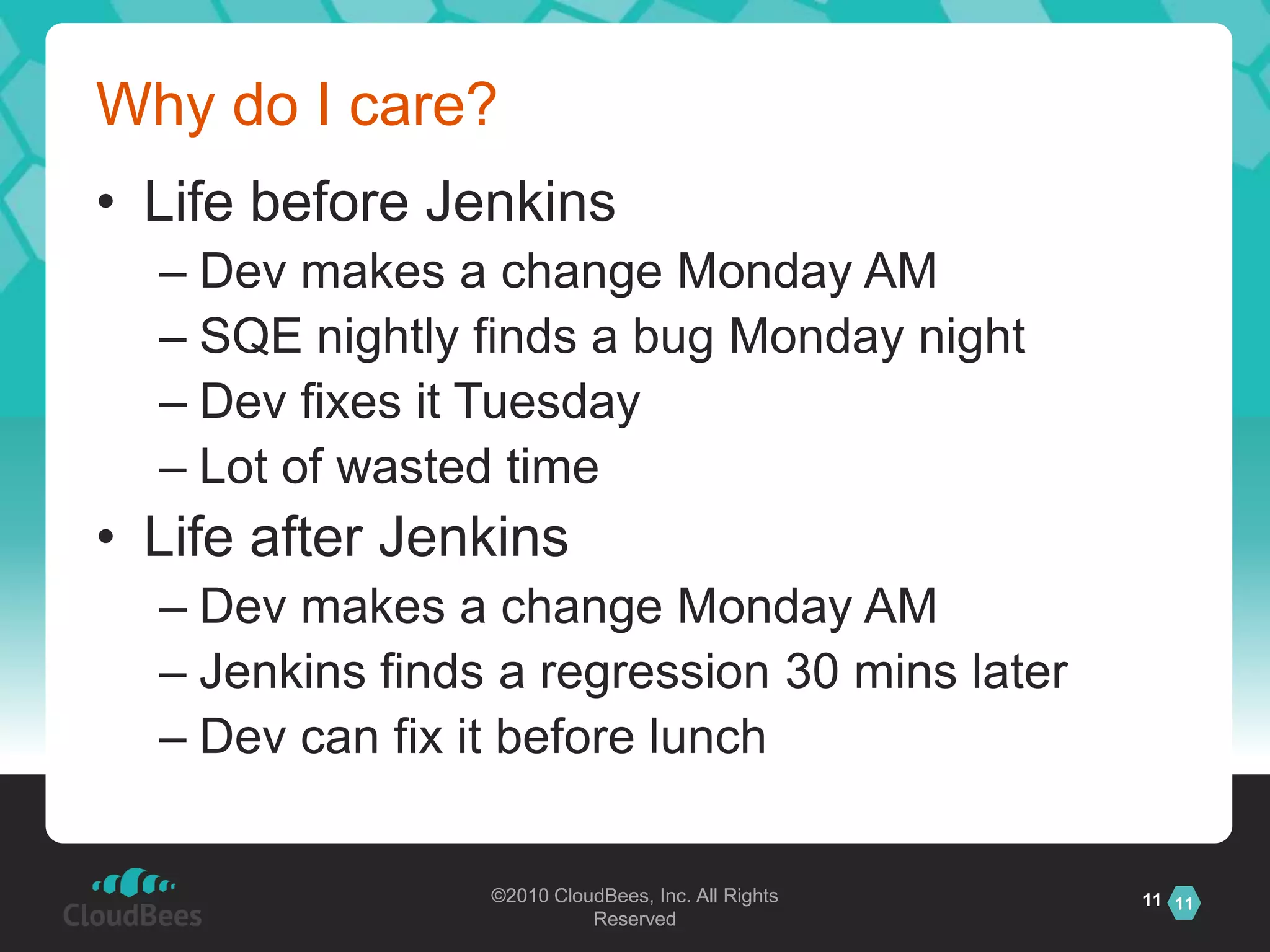
Why do I care?Life before JenkinsDev makes a change Monday AMSQE nightly finds a bug Monday nightDev fixes it TuesdayLot of wasted timeLife after JenkinsDev makes a change Monday AMJenkins finds a regression 30 mins laterDev can fix it before lunch11
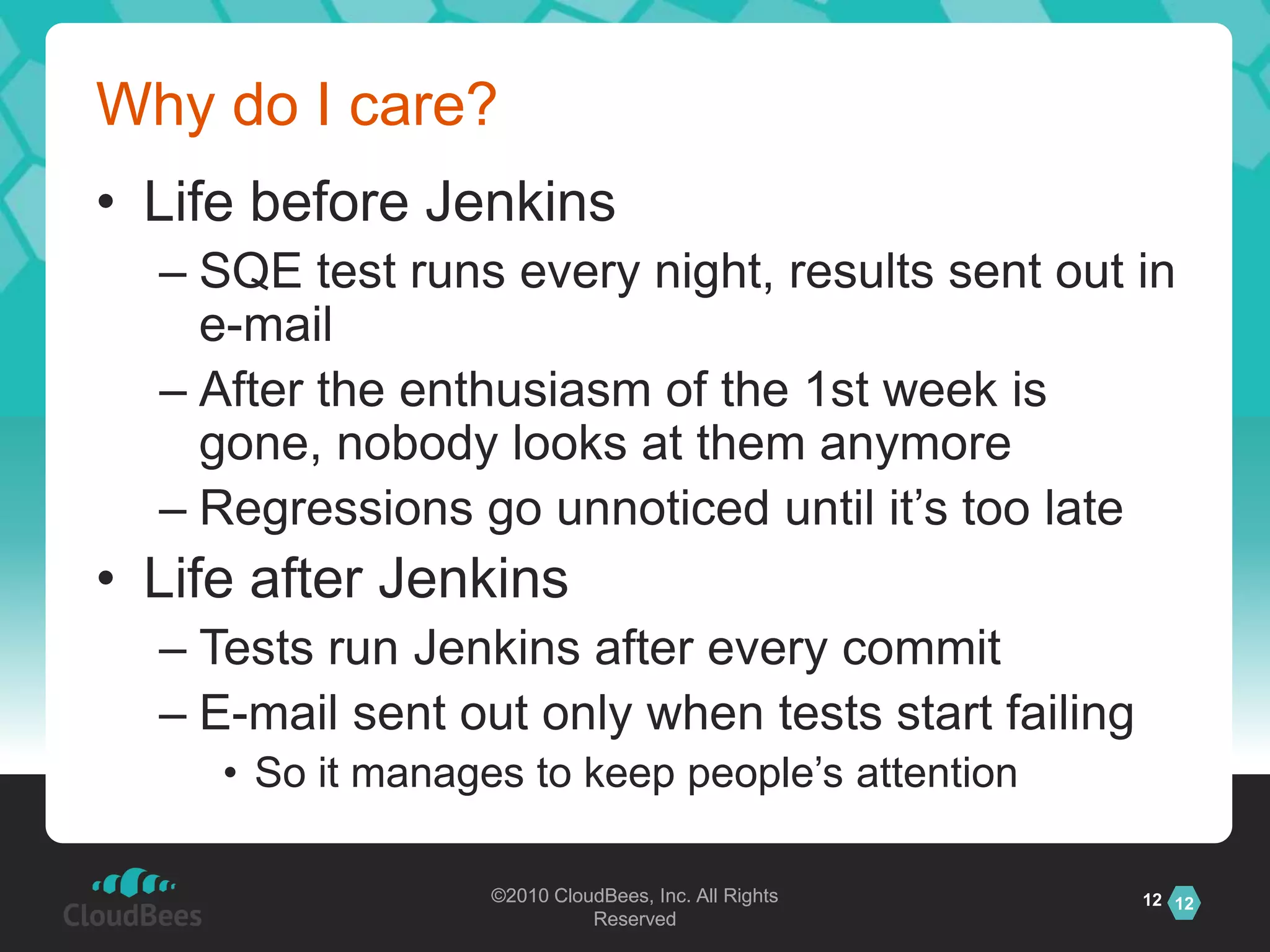
Why do I care?Life before JenkinsSQE test runs every night, results sent out in e-mailAfter the enthusiasm of the 1st week is gone, nobody looks at them anymoreRegressions go unnoticed until it’s too lateLife after JenkinsTests run Jenkins after every commitE-mail sent out only when tests start failingSo it manages to keep people’s attention12
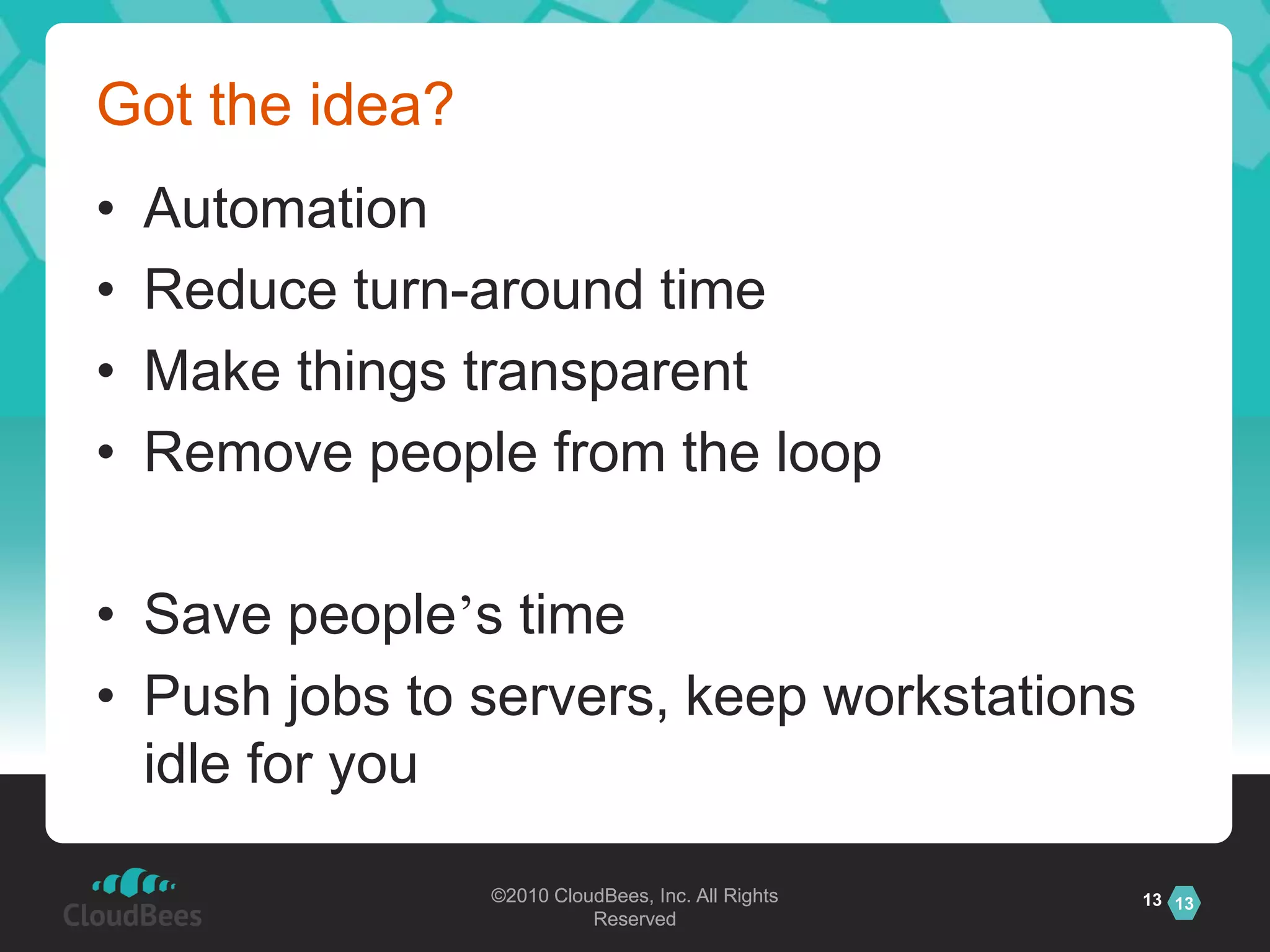
Got the idea?AutomationReduce turn-around timeMake things transparentRemove people from the loopSave people’s timePush jobs to servers, keep workstations idle for you13
Advanced Integration Techniques©2010 CloudBees, Inc. All Rights Reserved
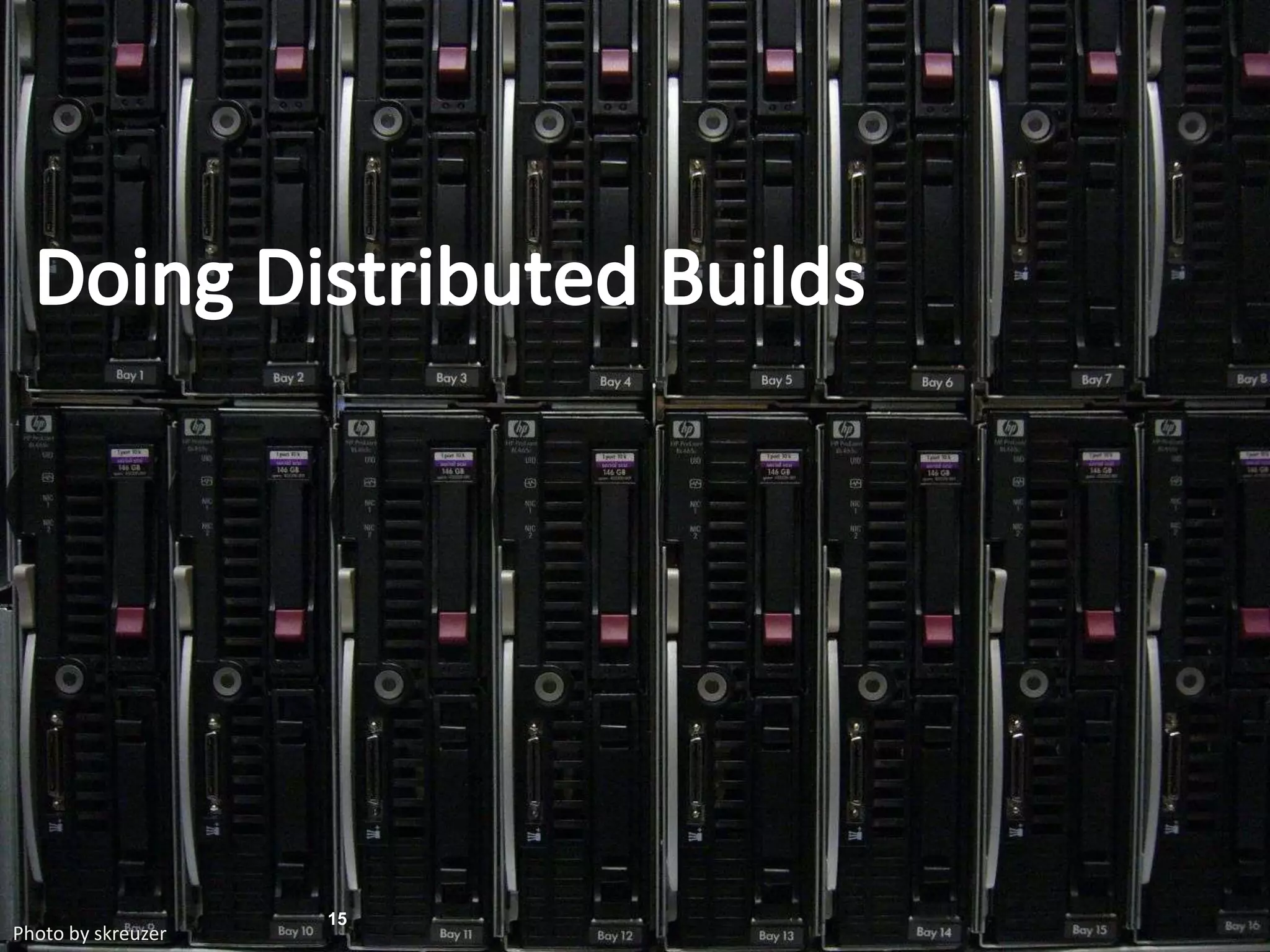
Doing Distributed Builds15Photo by skreuzer
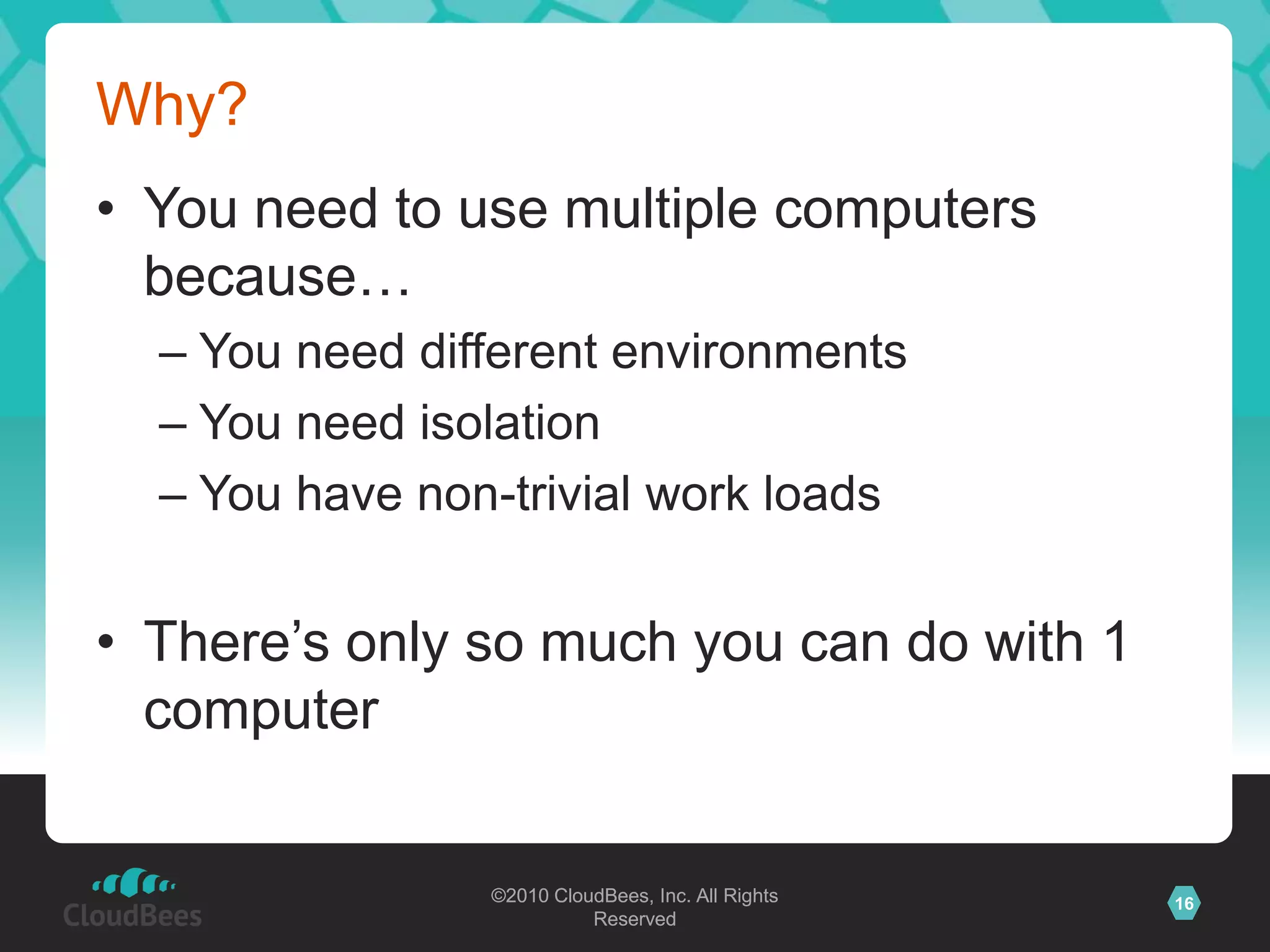
Why?You need to use multiple computers because…You need different environmentsYou need isolationYou have non-trivial work loadsThere’s only so much you can do with 1 computer
Lots of computers = tediousPains grow as your build farm growsSoftware installation problemNode failure problemRemote maintenance problem…What does Jenkins do to help you with these?
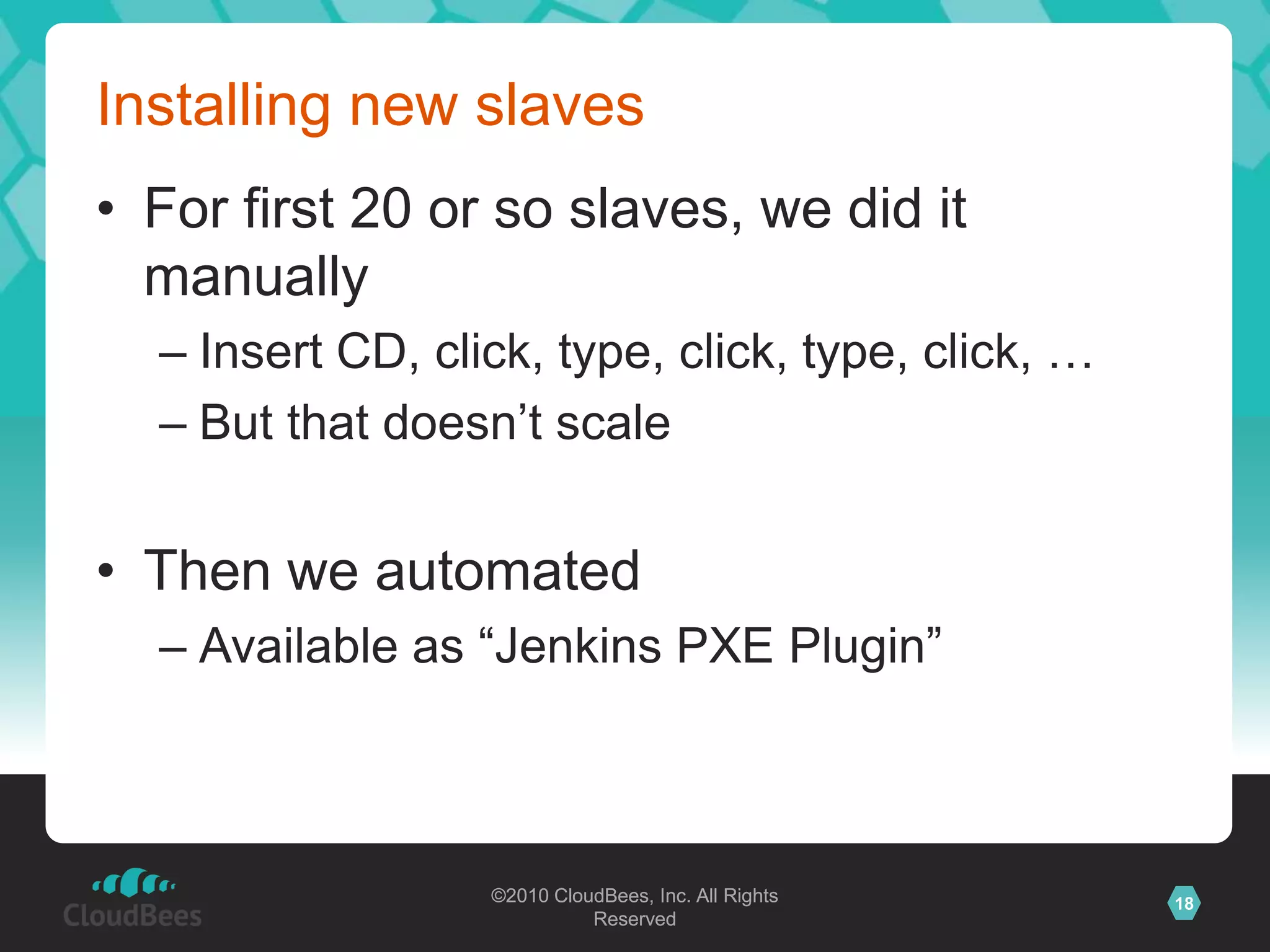
Installing new slavesFor first 20 or so slaves, we did it manuallyInsert CD, click, type, click, type, click, …But that doesn’t scaleThen we automatedAvailable as “Jenkins PXE Plugin”
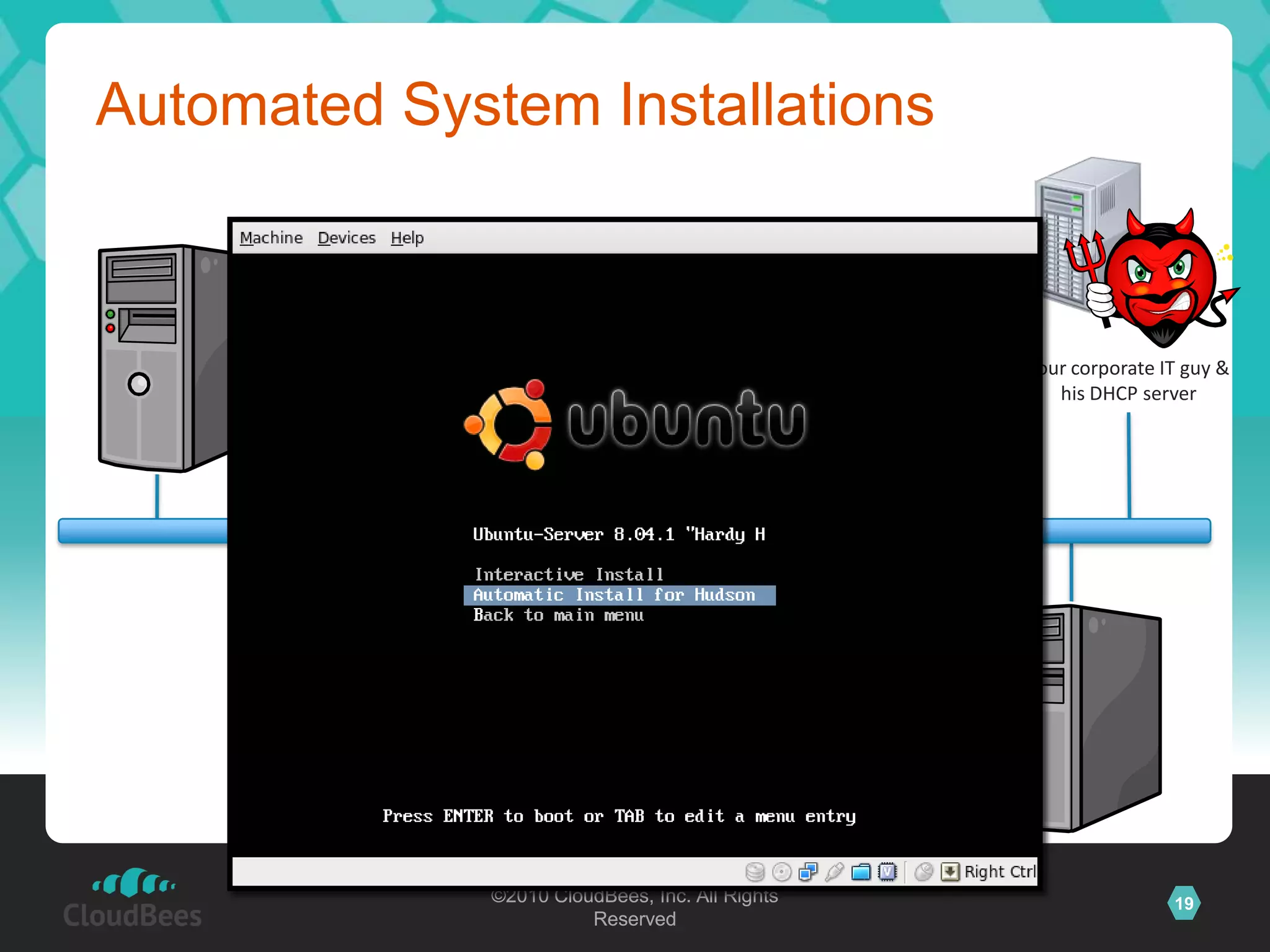
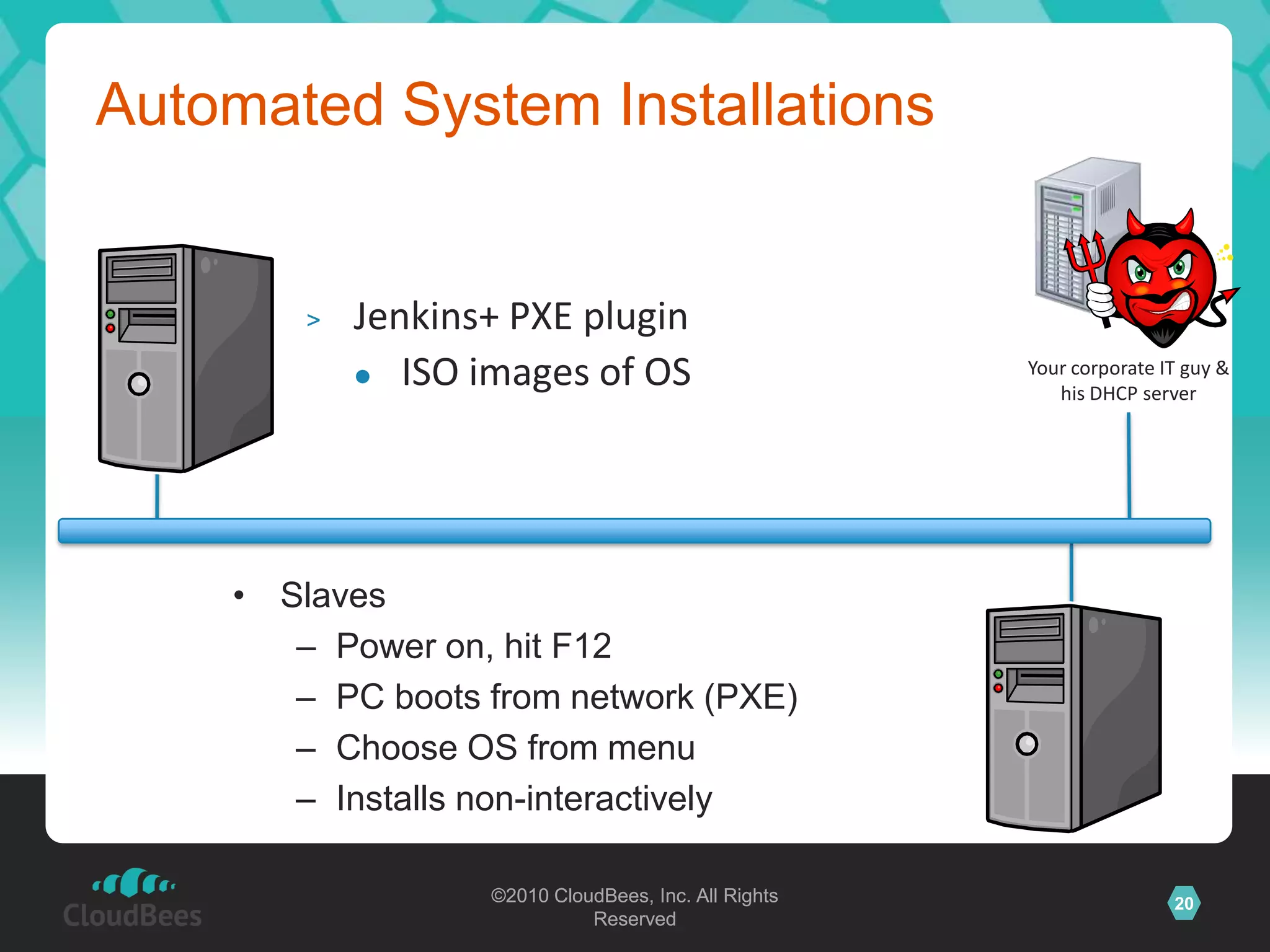
Automated System InstallationsJenkins + PXEplugin
ISO images of OSYour corporate IT guy & his DHCP serverSlavesPower on, hit F12PC boots from network (PXE)
Automated System InstallationsJenkins+ PXEplugin
ISO images of OSYour corporate IT guy & his DHCP serverSlavesPower on, hit F12PC boots from network (PXE)Choose OS from menuInstalls non-interactively
Automated System InstallationsSupports OpenSolaris, Ubuntu, CentOS, FedoraTrivial with most LinuxCooperate with Windows, tooQuite useful outside Jenkins, tooNo more broken CD drivesNo more CD-Rs
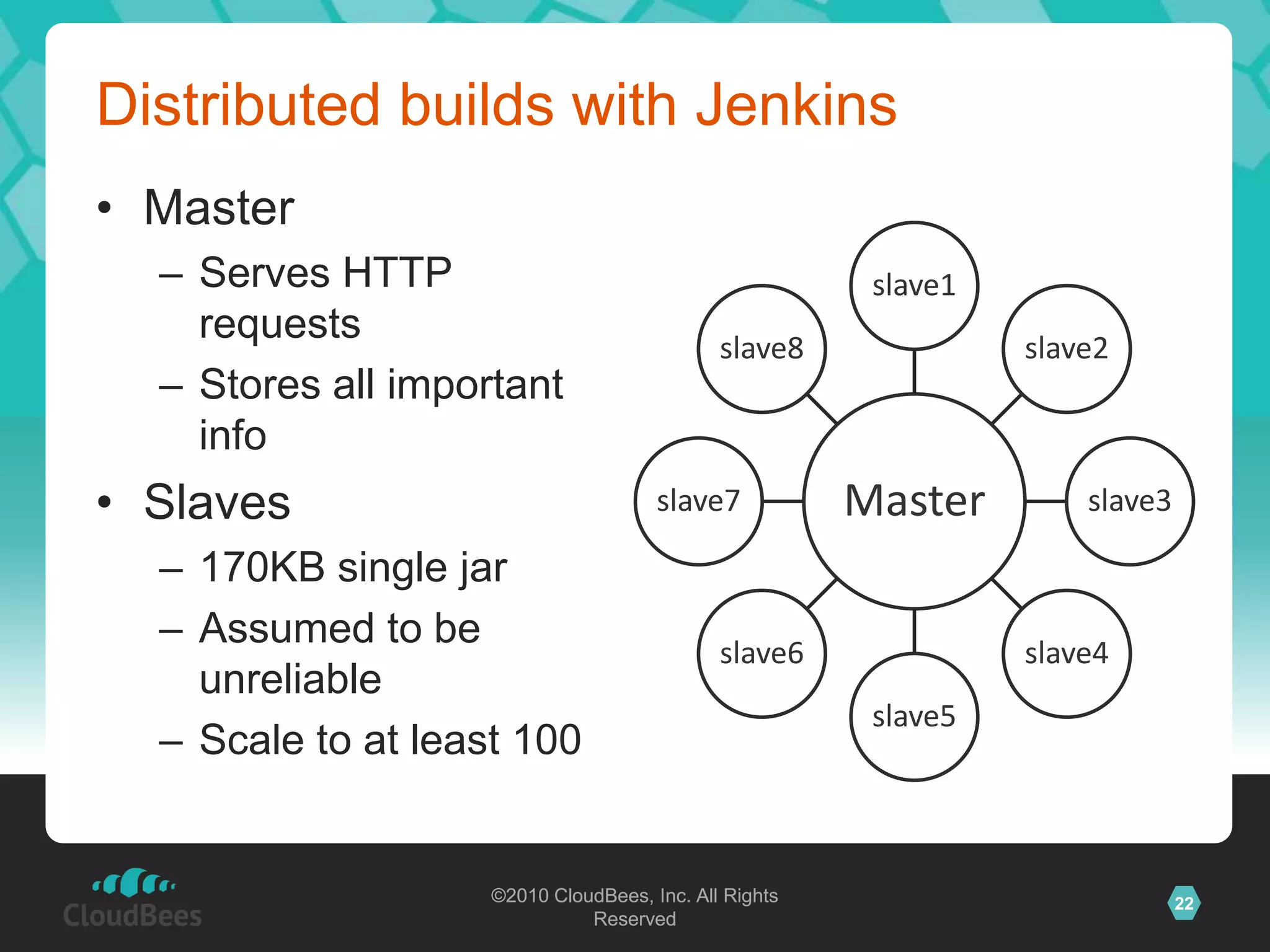
MasterServes HTTP requestsStores all important infoSlaves170KB single jarAssumed to be unreliableScale to at least 100Distributed builds with Jenkins
Building on slavesSlave agent is a little Java programRuns locally on the machine that it controlsAccess files, fork processes, etc., on behalf of masterCommunication with masterNeeds a bi-di byte streamBut very flexible in how this gets set upNo shared file system, no network topology constraints, etc
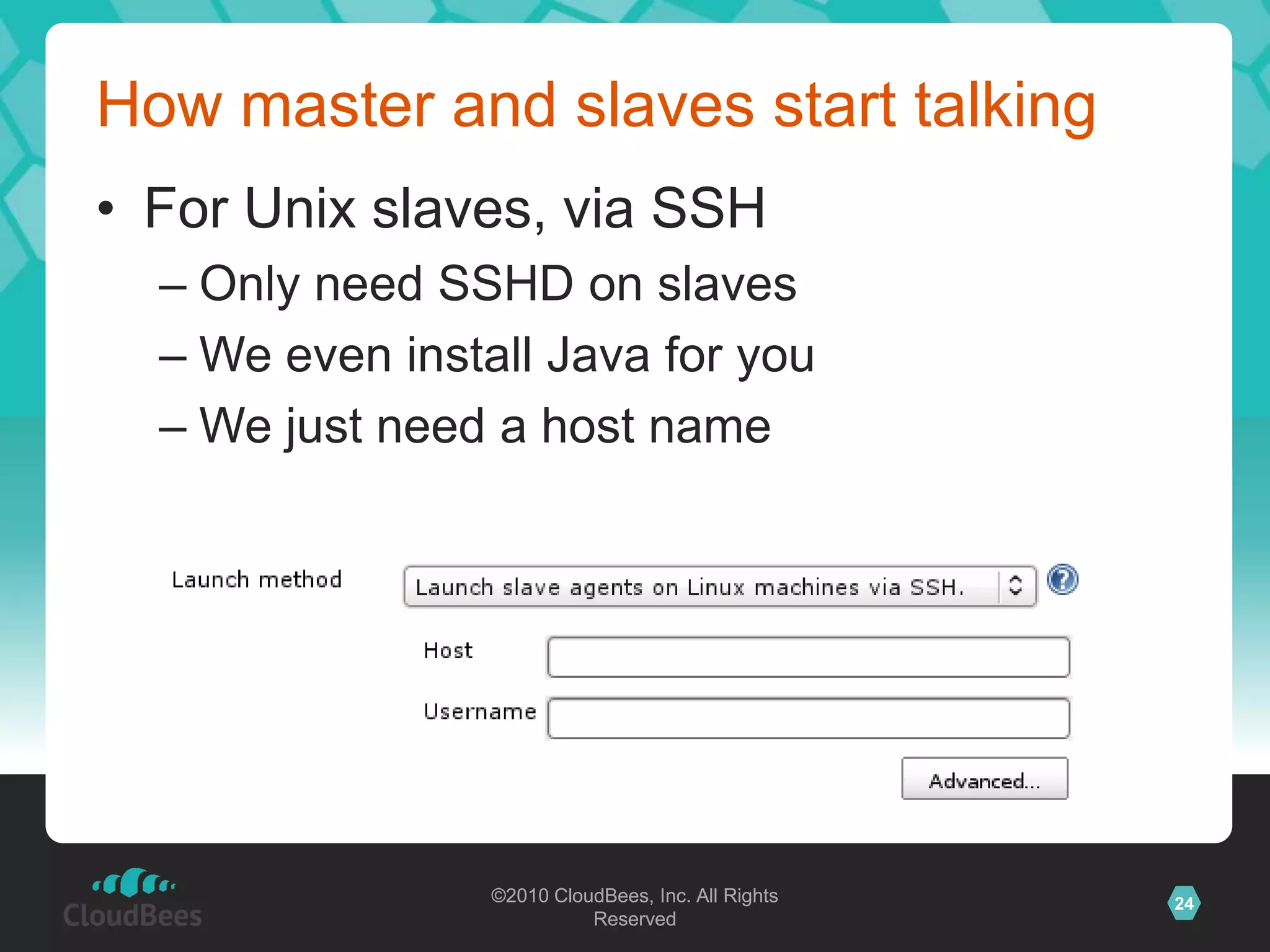
How master and slaves start talkingFor Unix slaves, via SSHOnly need SSHD on slavesWe even install Java for youWe just need a host name
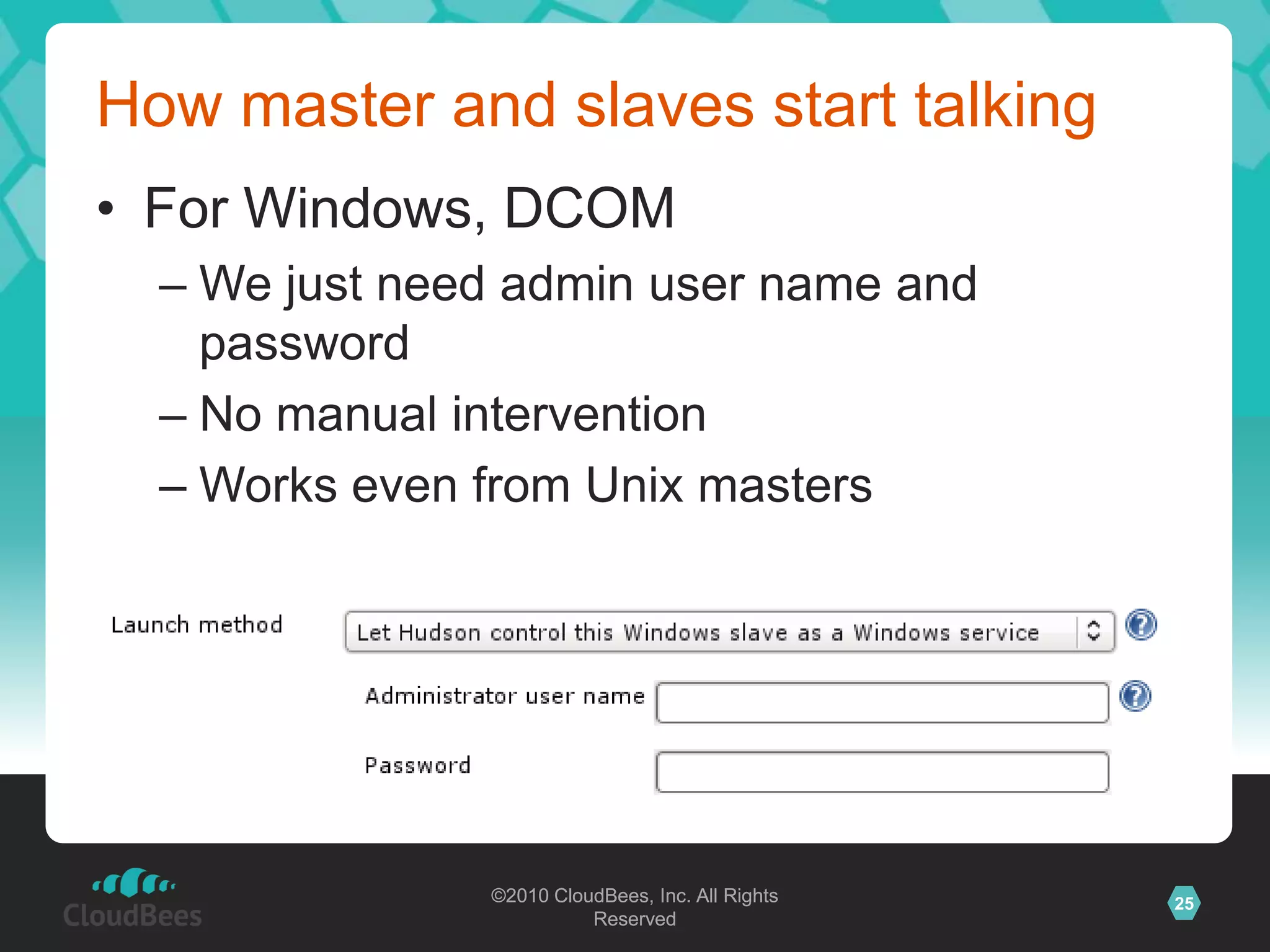
How master and slaves start talkingFor Windows, DCOMWe just need admin user name and passwordNo manual interventionWorks even from Unix masters
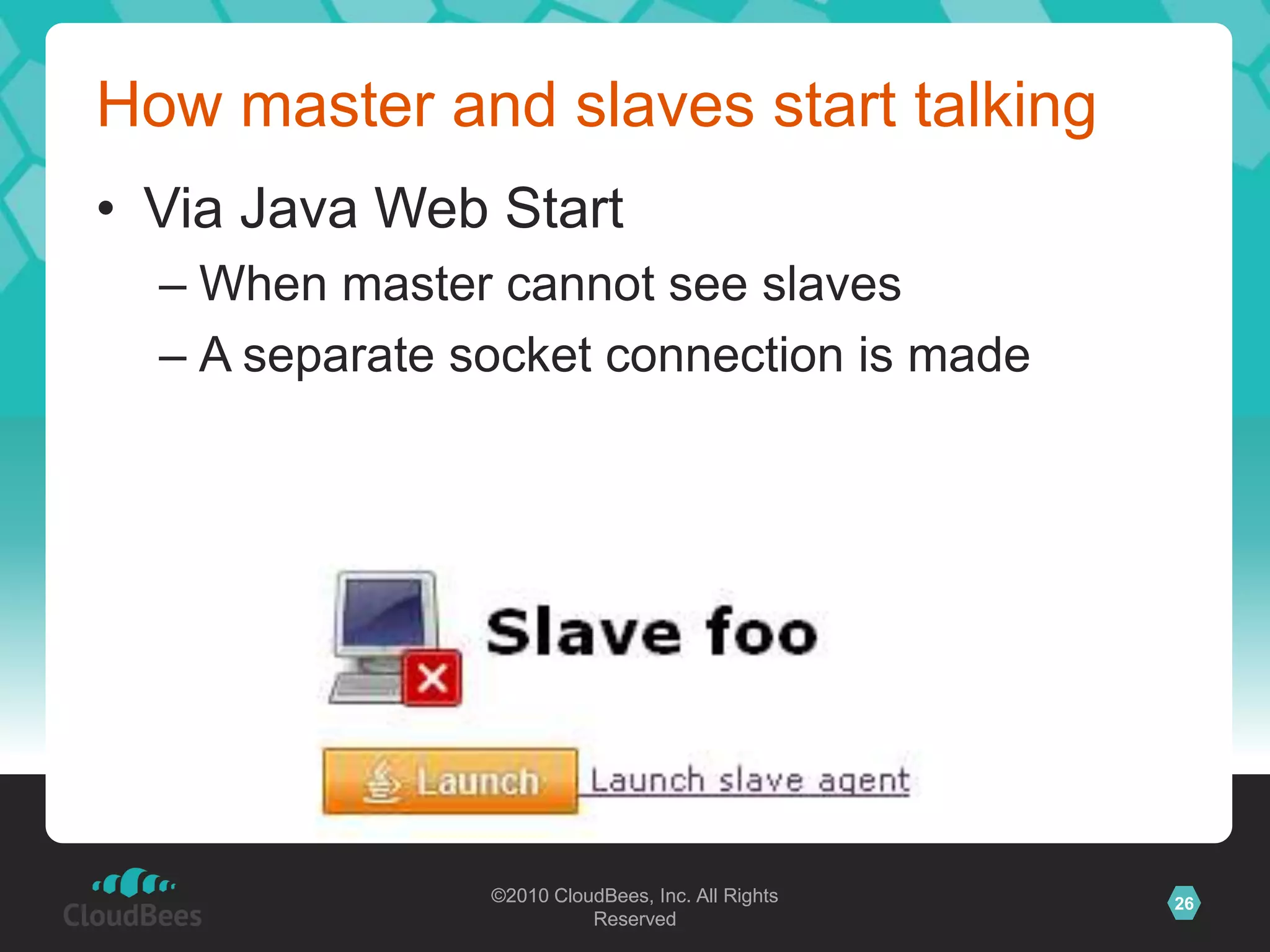
How master and slaves start talkingVia Java Web StartWhen master cannot see slavesA separate socket connection is made
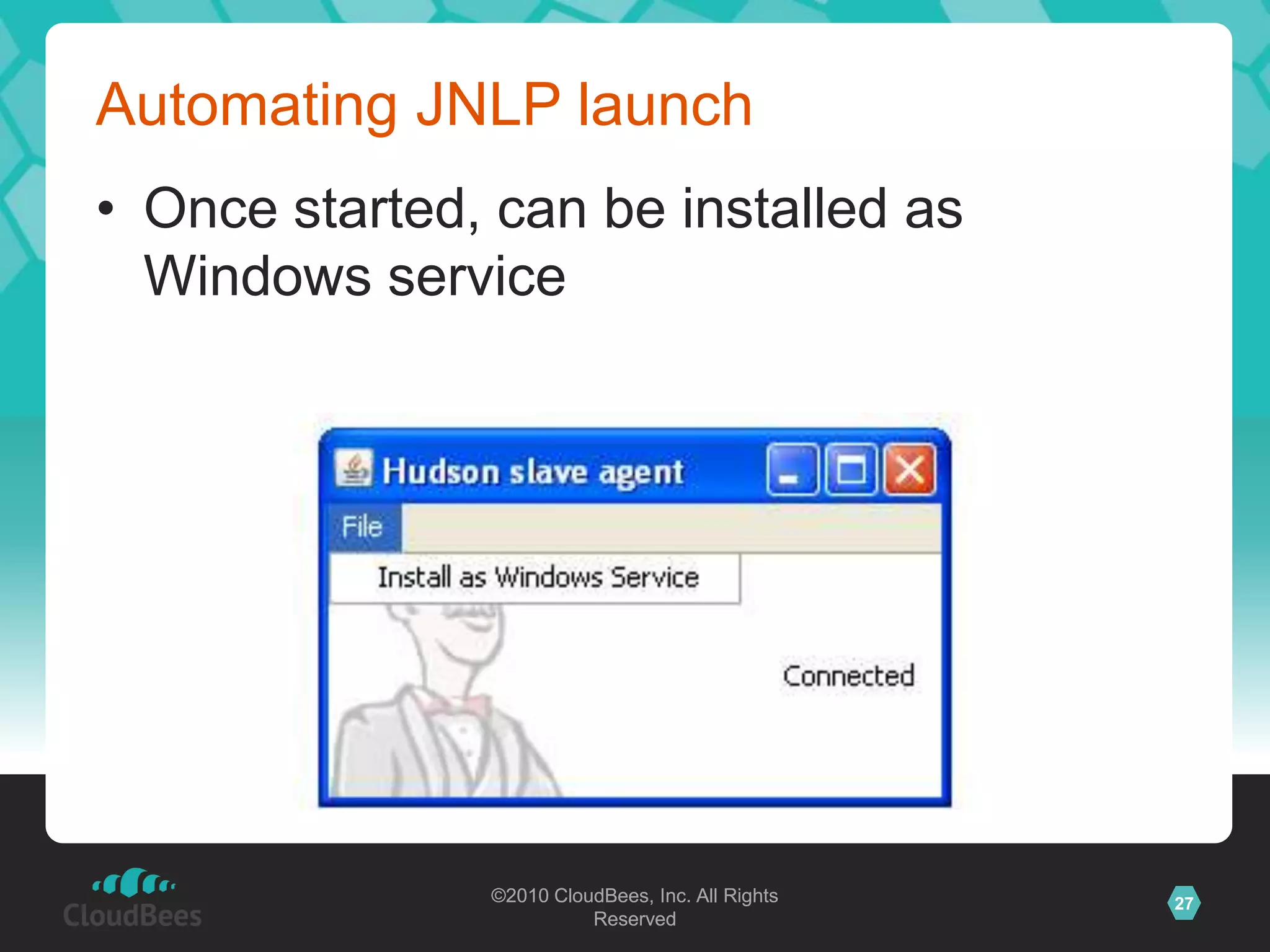
Automating JNLP launchOnce started, can be installed as Windows service
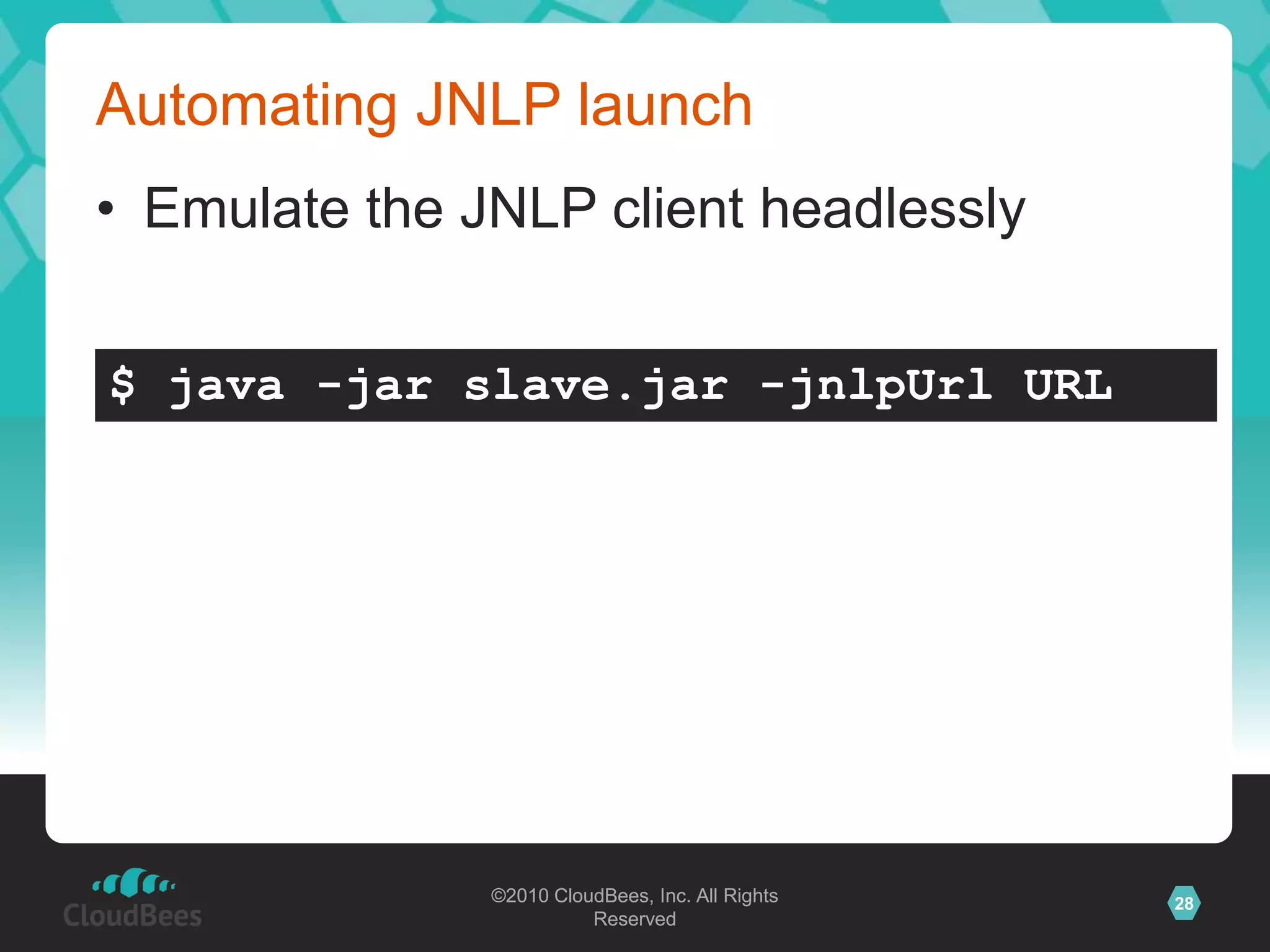
Automating JNLP launchEmulate the JNLP client headlessly$ java -jar slave.jar -jnlpUrl URL
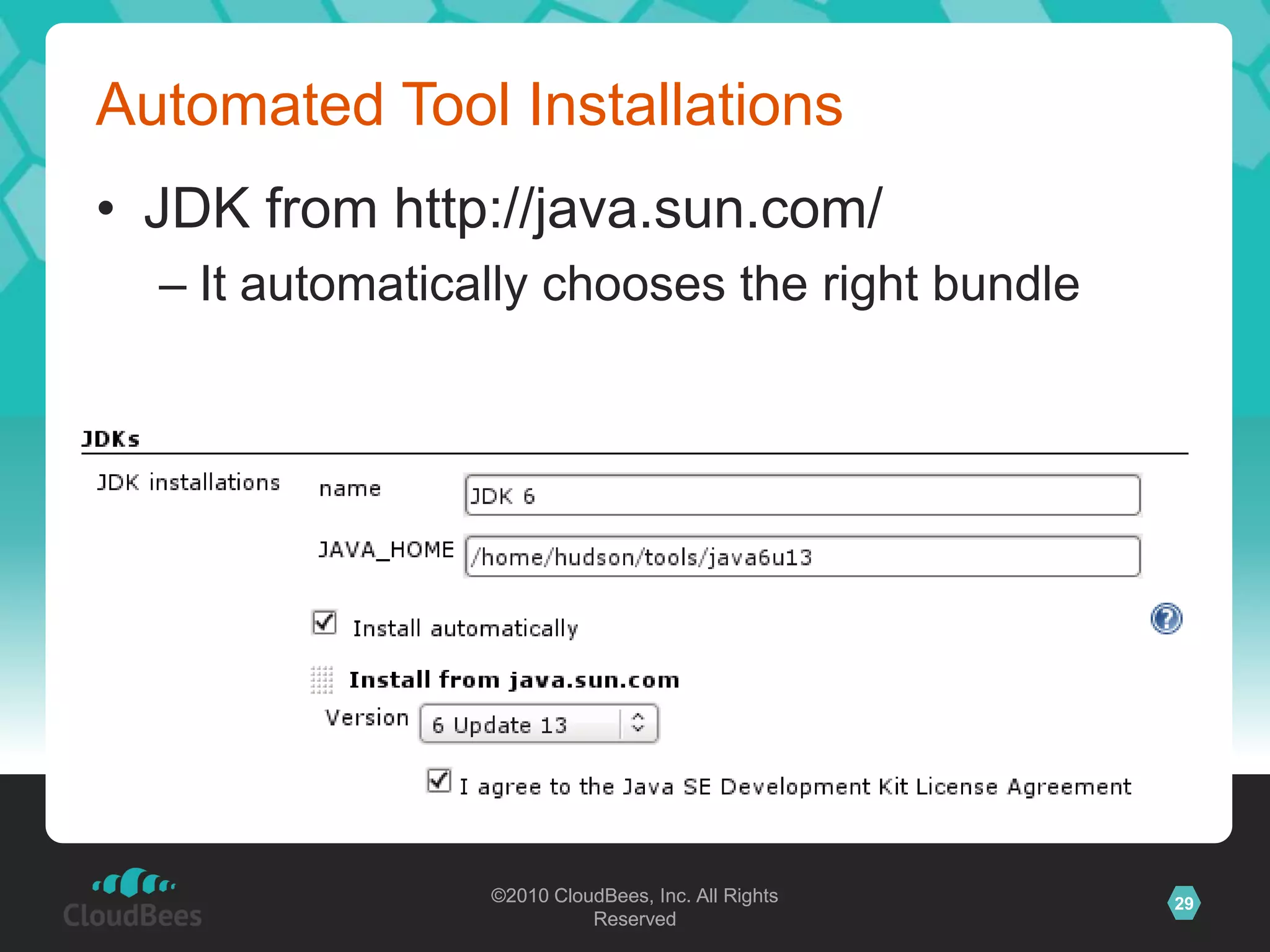
Automated Tool InstallationsJDK from http://java.sun.com/It automatically chooses the right bundle
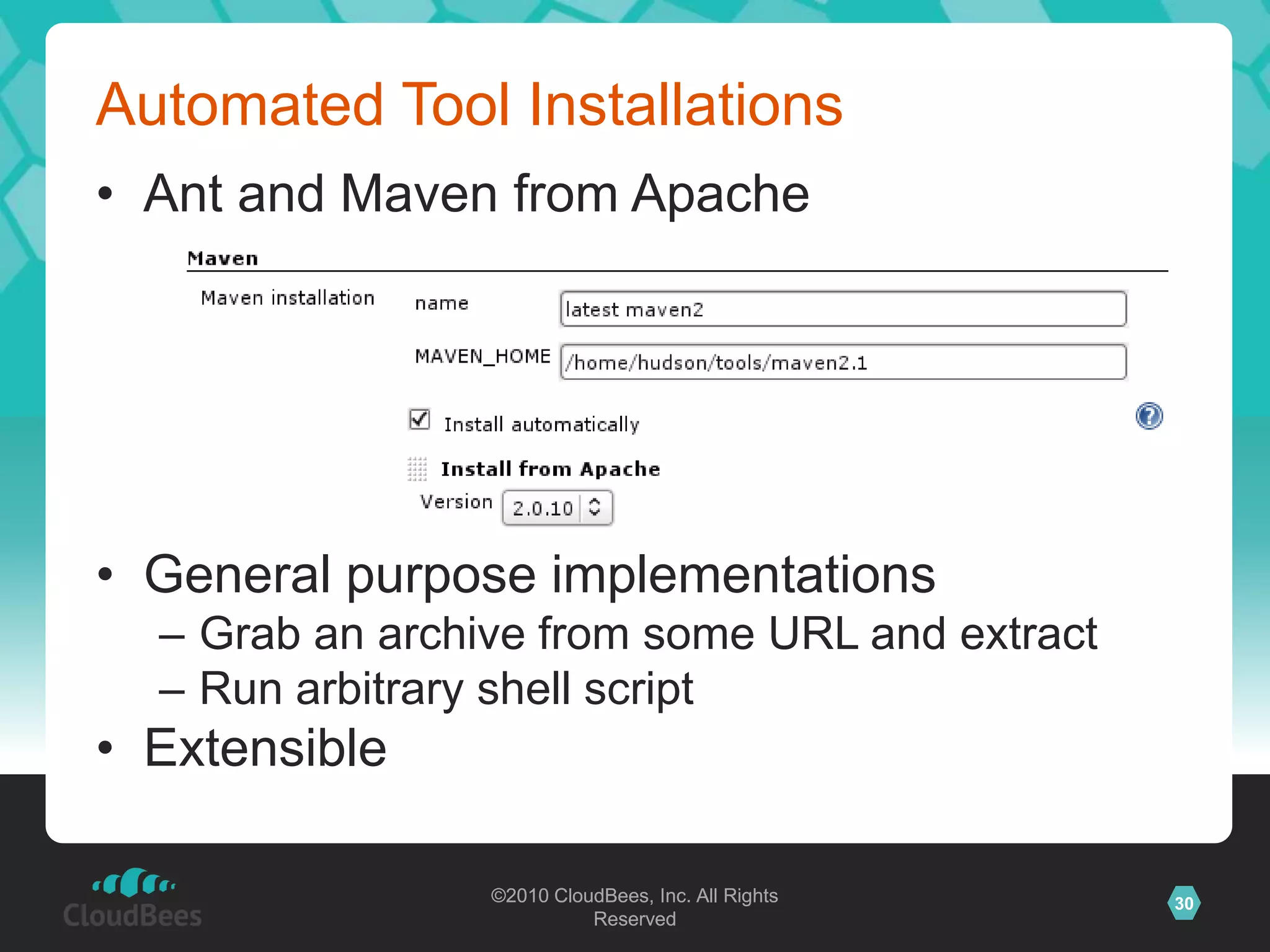
Automated Tool InstallationsAnt and Maven from ApacheGeneral purpose implementationsGrab an archive from some URL and extractRun arbitrary shell scriptExtensible
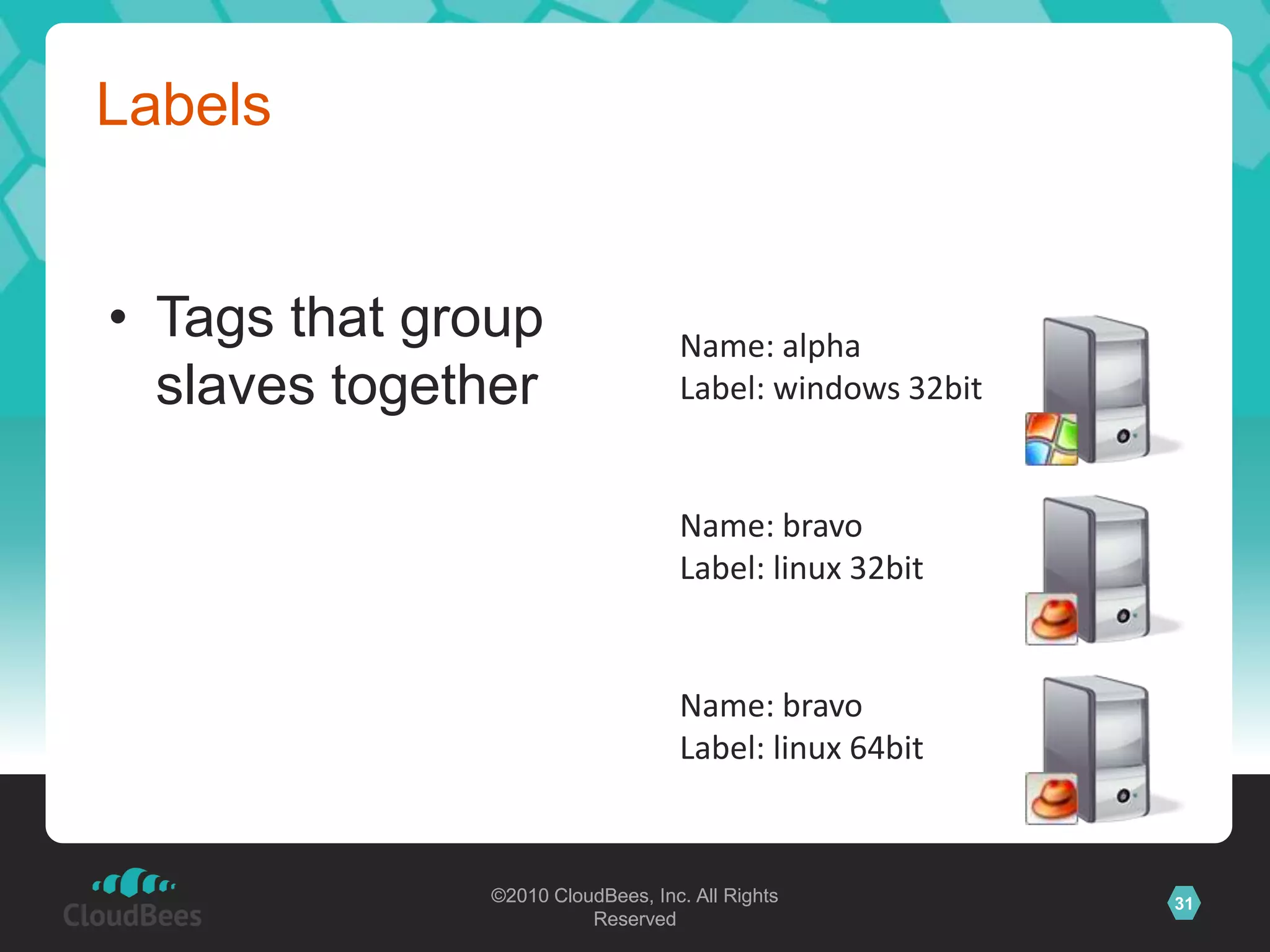
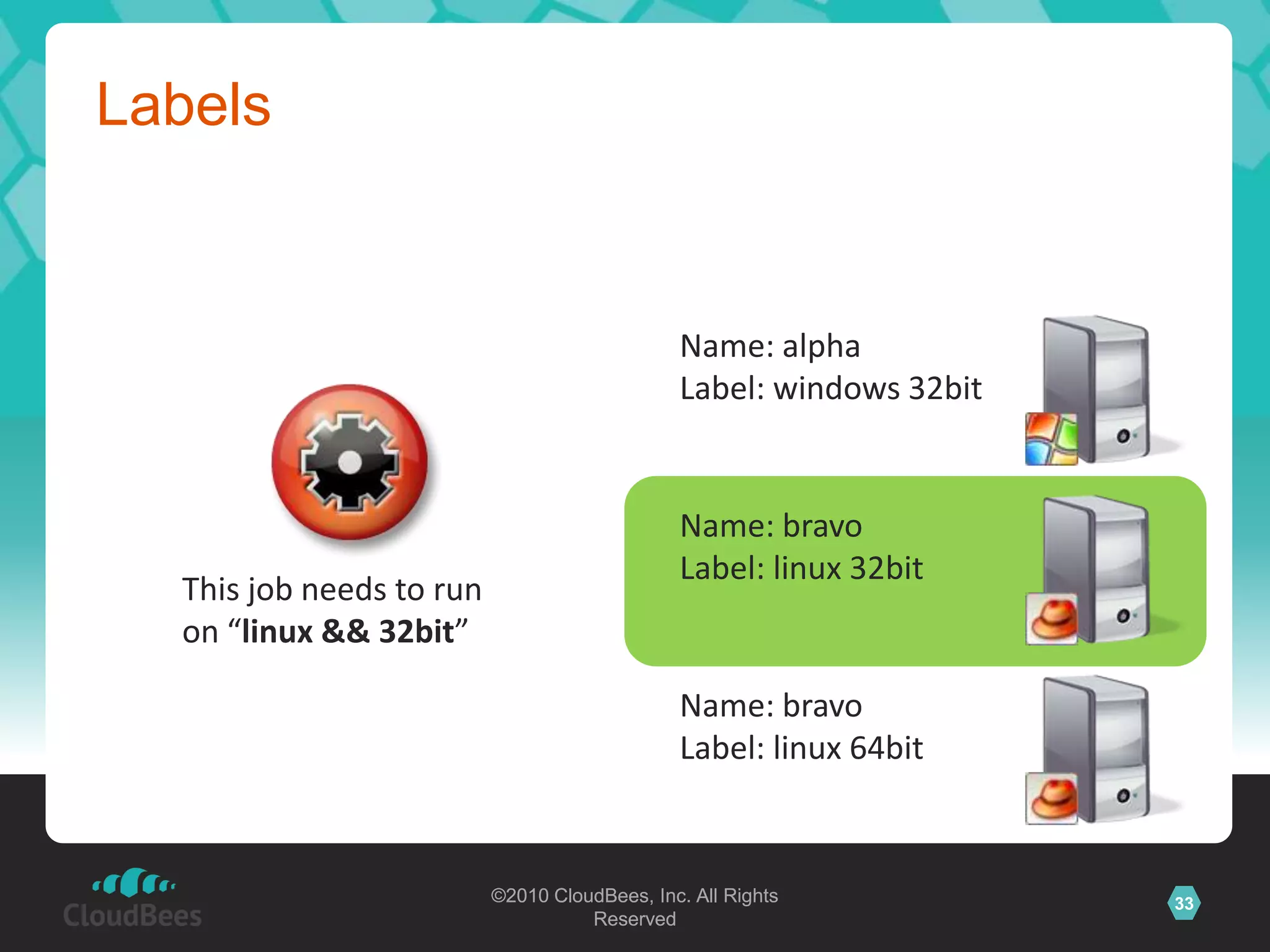
LabelsTags that group slaves togetherName: alphaLabel: windows 32bitName: bravoLabel: linux 32bitName: bravoLabel: linux 64bit
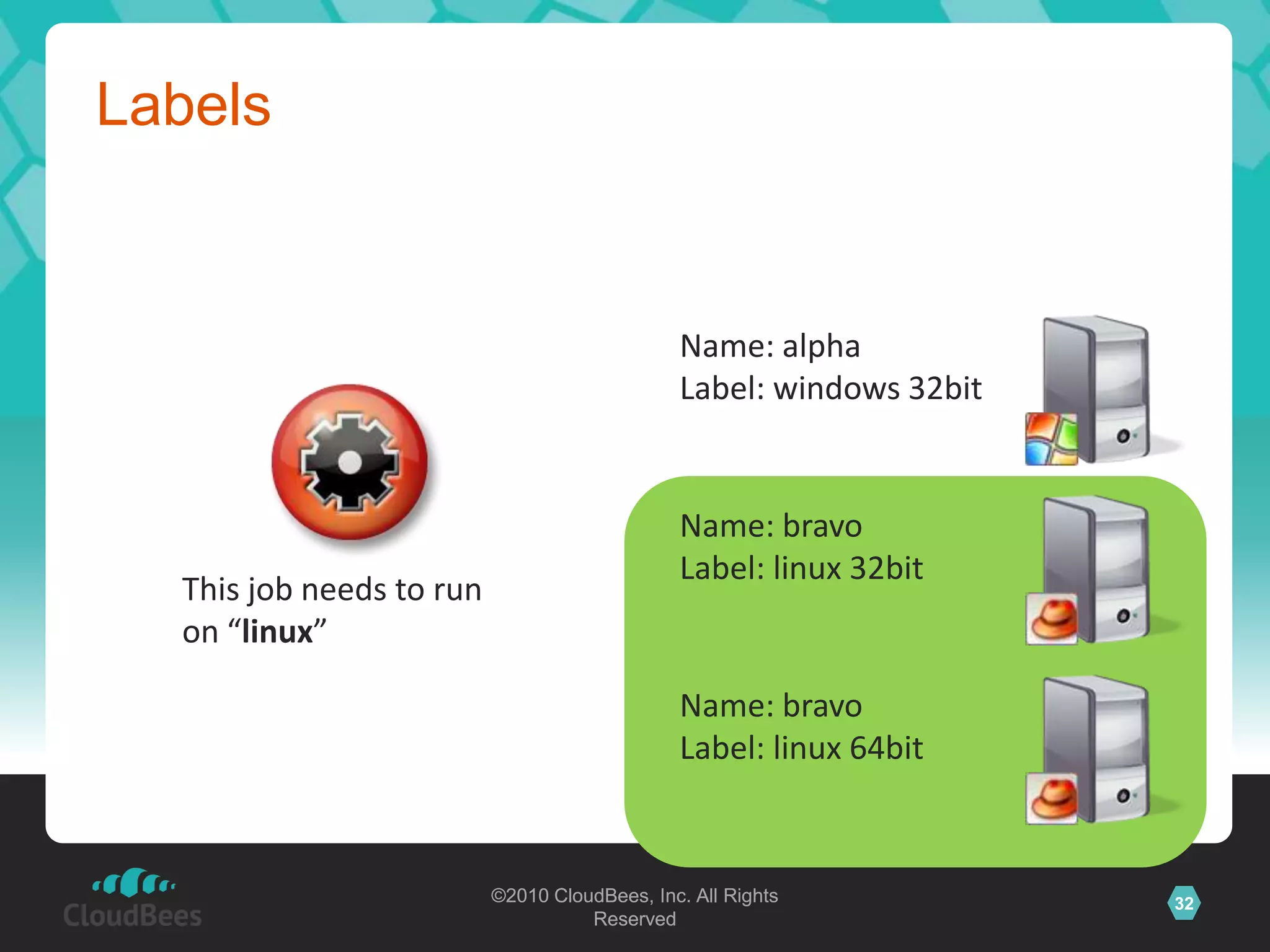
LabelsName: alphaLabel: windows 32bitName: bravoLabel: linux 32bitThis job needs to run on “linux”Name: bravoLabel: linux 64bit
LabelsName: alphaLabel: windows 32bitName: bravoLabel: linux 32bitThis job needs to run on “linux && 32bit”Name: bravoLabel: linux 64bit
More Label BenefitsLabels can be anythingGeographic locationsAvailability of proprietary software installedBetter resource utilizationJenkins have maximum freedomResilient to node addition/removalTreat servers like livestocks, not like pets
Making builds stickyWe want jobs to be mostly on the same slaveFaster check outConsistent resultsMinimizes disk consumptionBut do it softlyJenkins uses consistent hash to achieve thisMore schedule controls become possible:Use faster machines more frequentlySlowly ramp up newly installed slaves* http://en.wikipedia.org/wiki/Consistent_hashing
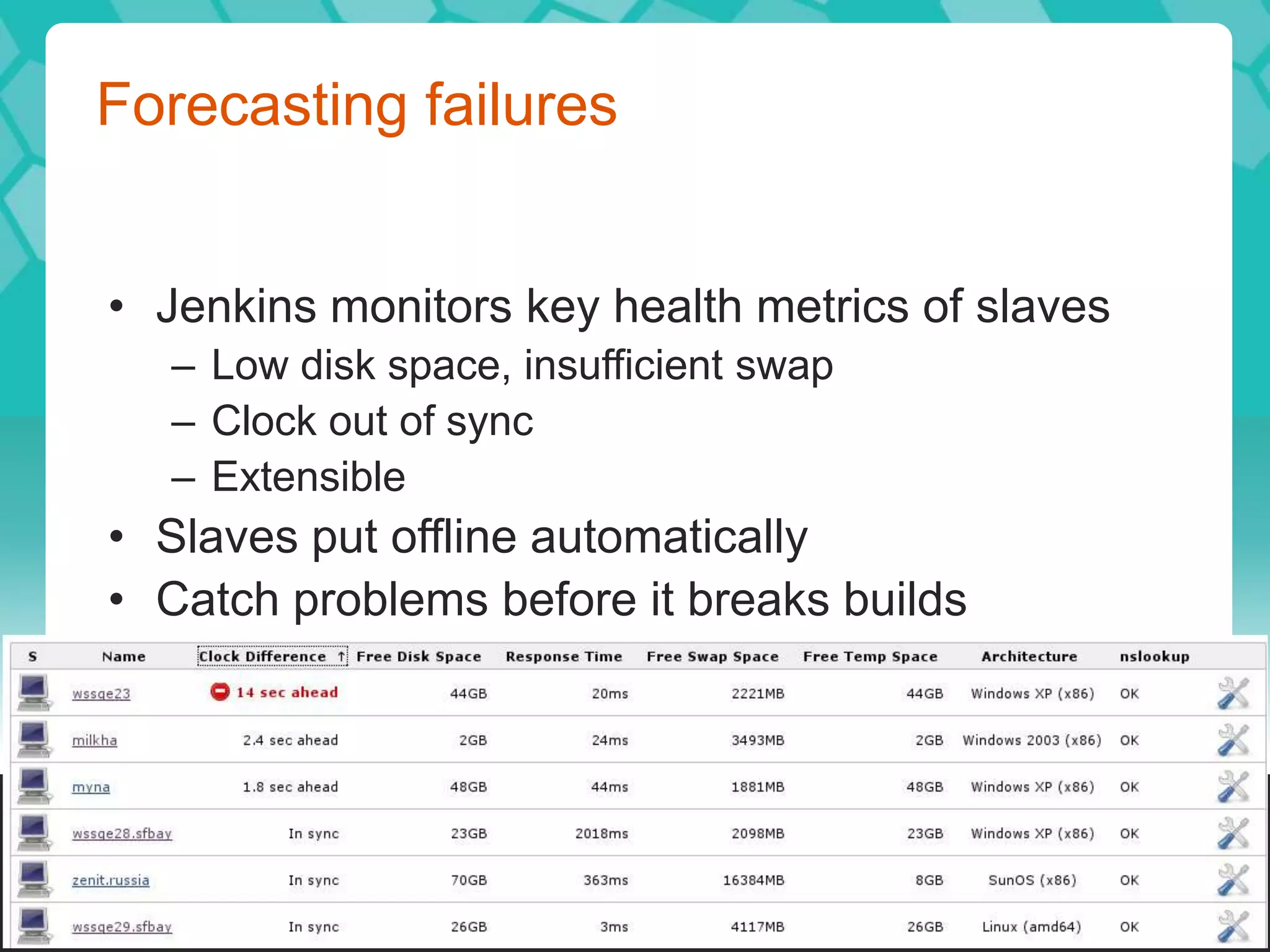
Forecasting failuresJenkins monitors key health metrics of slavesLow disk space, insufficient swapClock out of syncExtensibleSlaves put offline automaticallyCatch problems before it breaks builds36
Clean up mess after buildsKill run-away processesDaemons, background processes left by your buildWorks on Windows, Linux, Mac, and Solaris
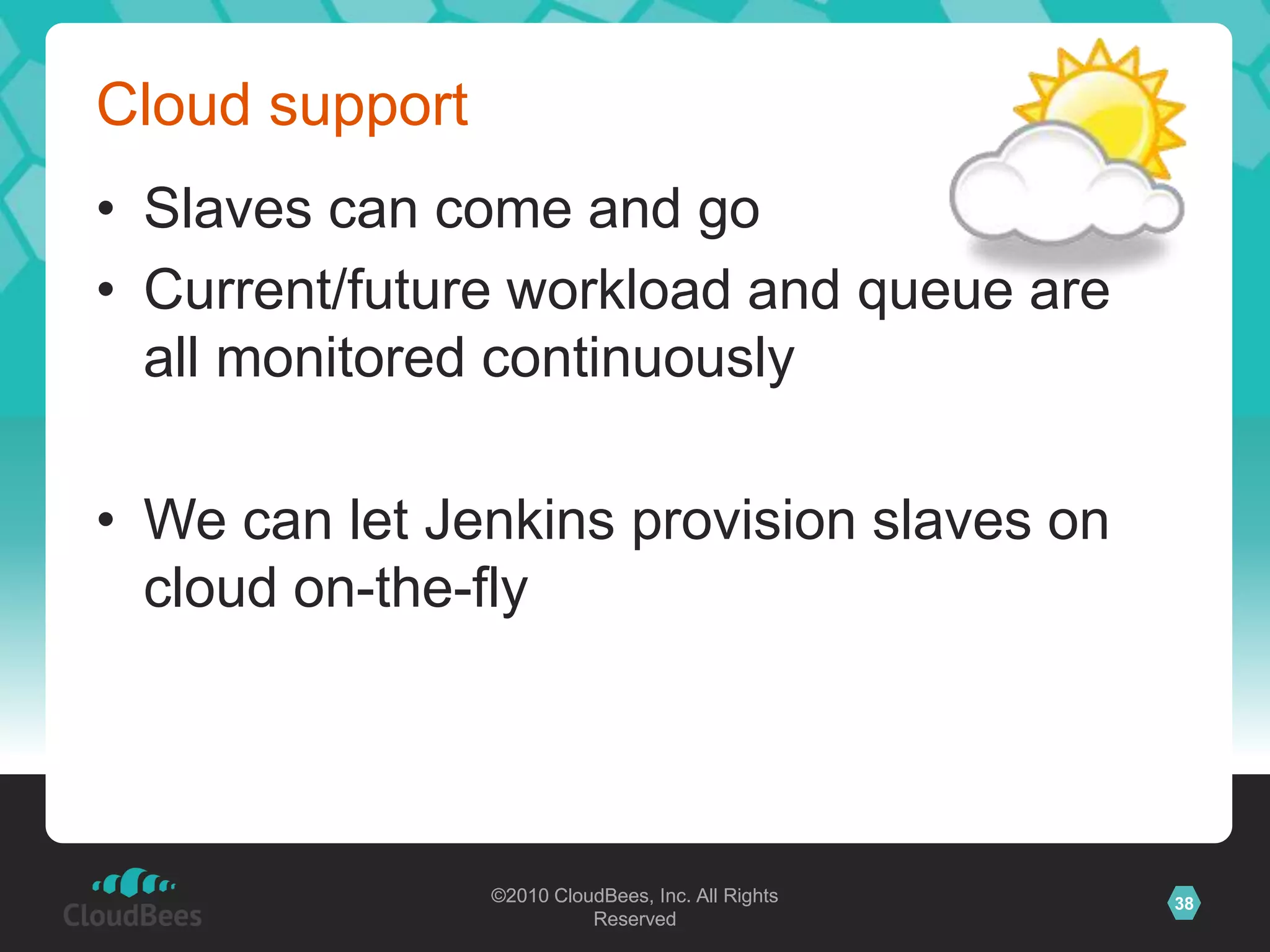
Cloud supportSlaves can come and goCurrent/future workload and queue are all monitored continuouslyWe can let Jenkins provision slaves on cloud on-the-fly
Jenkins EC2 pluginAutomatically provision slaves on EC2 on demandPick the right AMI depending on demandStart slave agentShut down unused instances* http://code.google.com/p/typica/
Integration with VMWareSimilar mechanism exists with VMWareCreate a pool of virtual machines upfrontJenkins powers them up/down based on loadOptionally revert to snapshot at the endAchieves benefits similar to EC2 without going publicNectarFeature
Matrix ProjectPhoto: http://www.flickr.com/photos/amarilloposters/4380080793/41
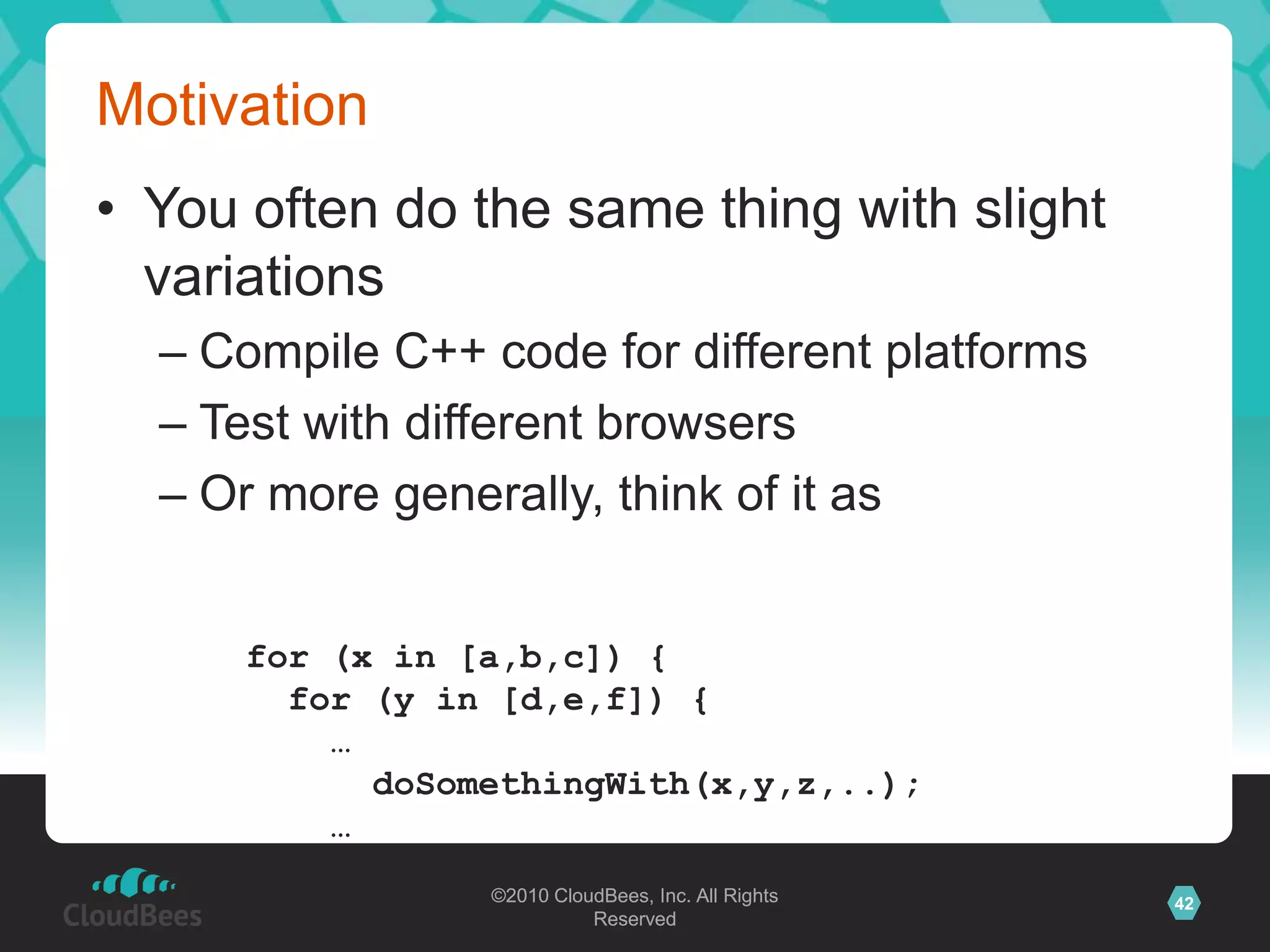
MotivationYou often do the same thing with slight variationsCompile C++ code for different platformsTest with different browsersOr more generally, think of it asfor (x in [a,b,c]) {  for (y in [d,e,f]) {    …doSomethingWith(x,y,z,..);    …  }}
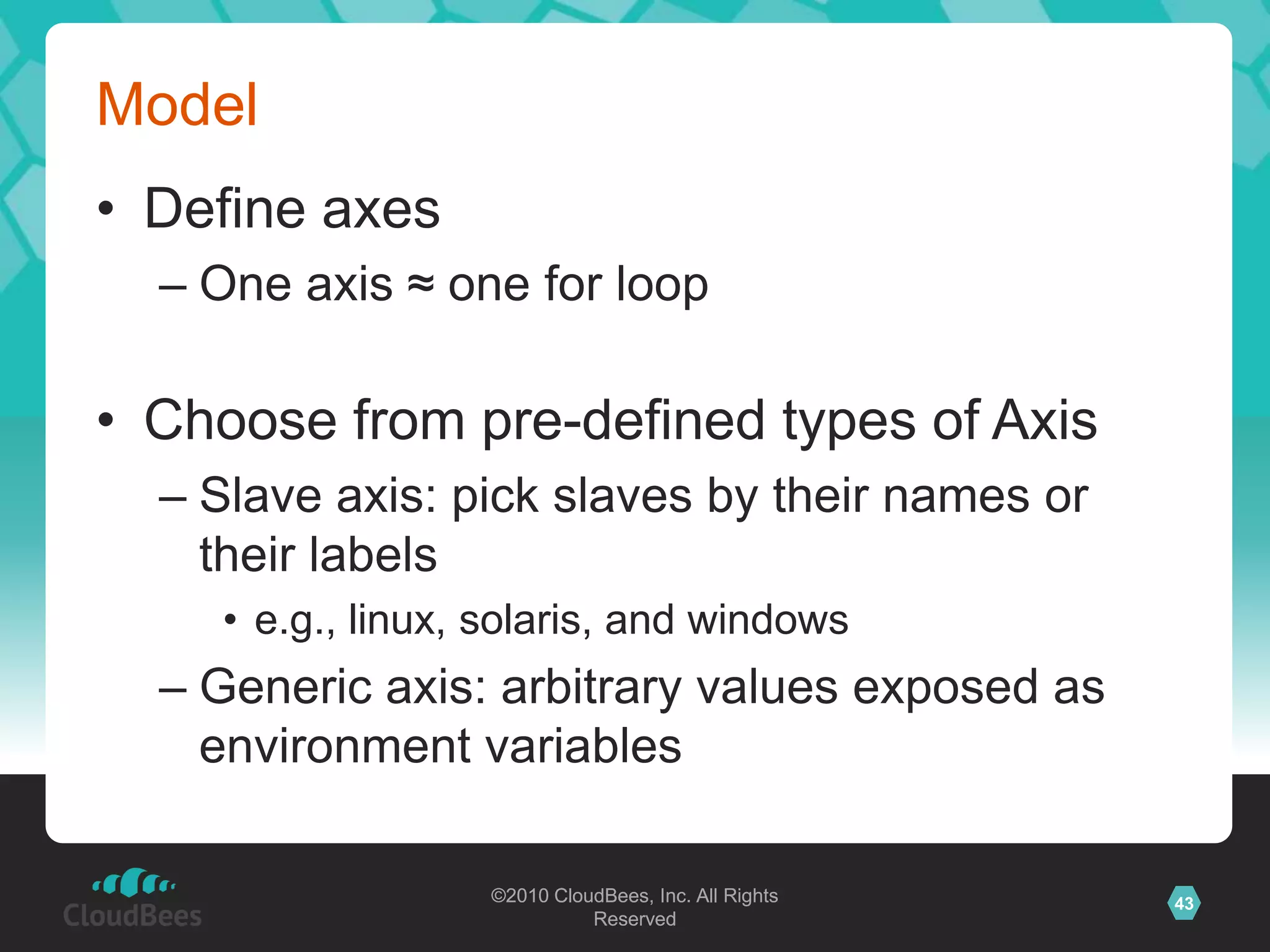
ModelDefine axesOne axis ≈ one for loopChoose from pre-defined types of AxisSlave axis: pick slaves by their names or their labelse.g., linux, solaris, and windowsGeneric axis: arbitrary values exposed as environment variables
Matrix Project GimmicksFilteringOtherwise combinations increase exponentiallyNot all combinations make senseUse boolean expression to trim down the sizeOr tell Jenkins to cut the workload to N%Jenkins will thin out the combinations by itself(label==“windows”).implies(browser==“iexplore”) &&(label==“mac”).implies(browser==“safari”)
Demo
Build Promotion
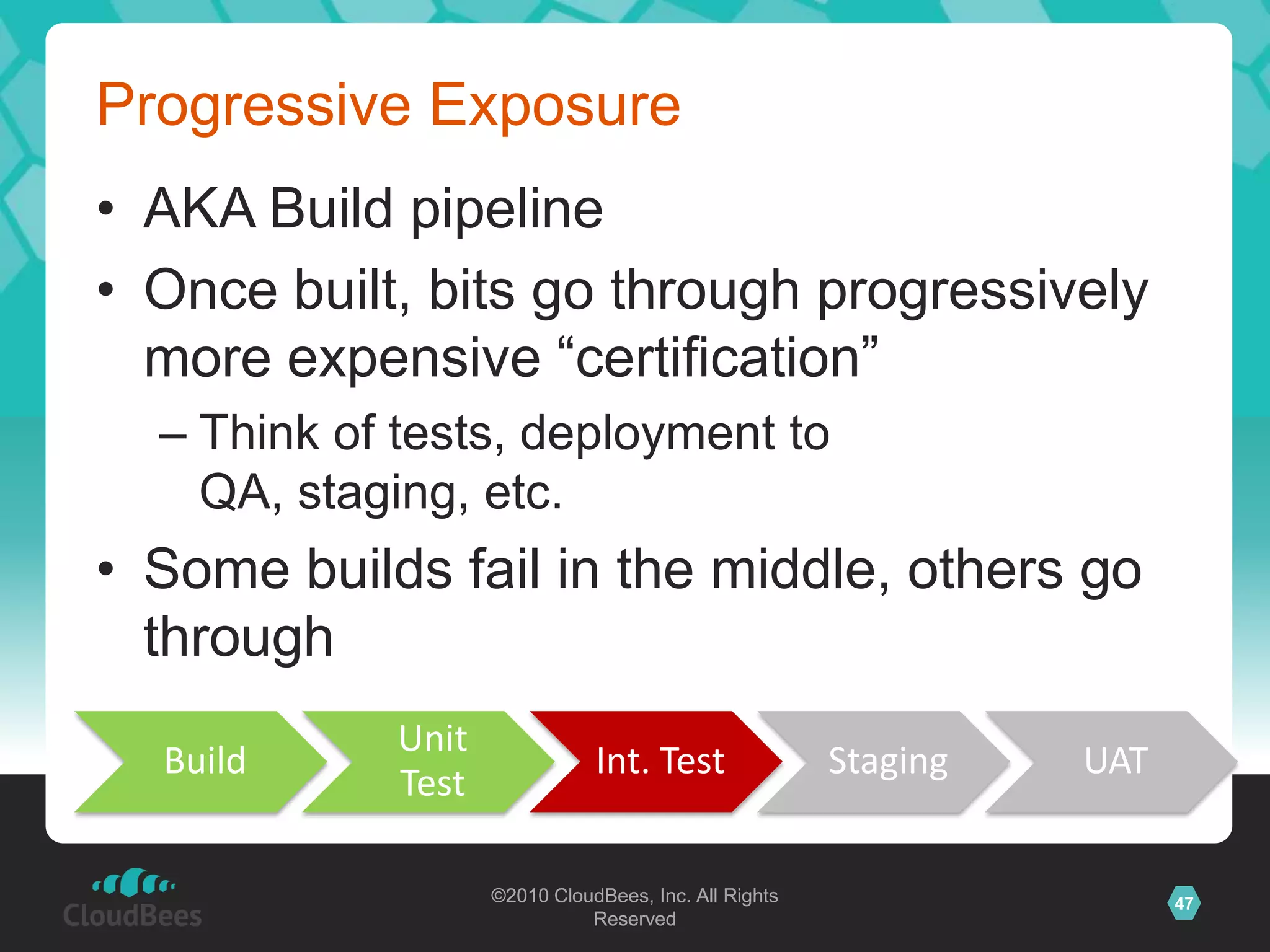
Progressive ExposureAKA Build pipelineOnce built, bits go through progressively more expensive “certification”Think of tests, deployment to QA, staging, etc.Some builds fail in the middle, others go through
Then it gets more complexEach stage can be several parallel jobsNeeds to be retryableYou can’t afford to execute every pipeline until it fails
Hence “build promotion”Configuration“Foo gets promoted if FooTest passes”“When Foo gets promoted, do X, Y, and Z”Sequence of eventsFoo #N successfully completesFooTest #M executes on Foo #NFooTest #M successfully completesFoo #N gets promotedX, Y, and Z happens on Foo #N
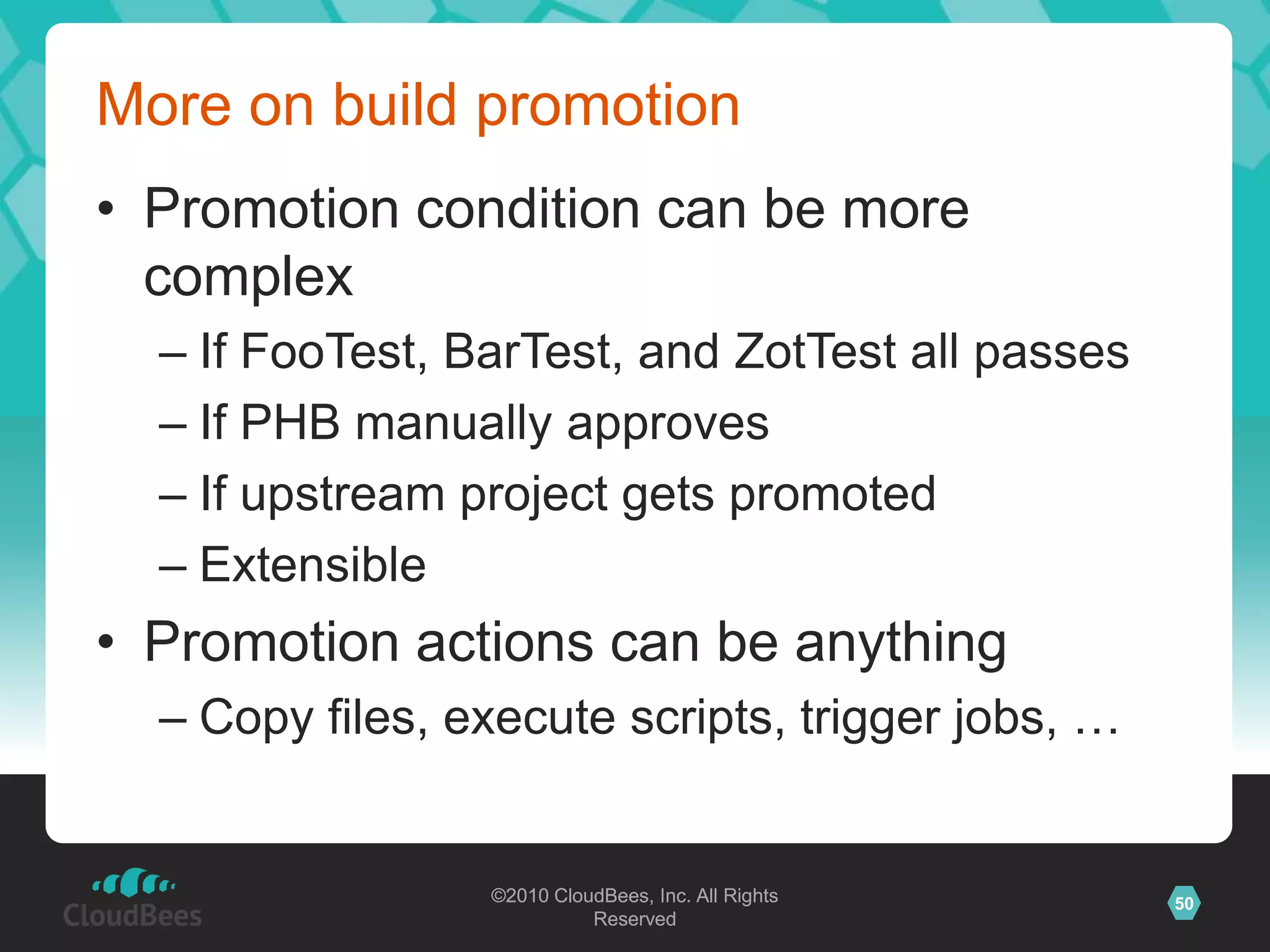
More on build promotionPromotion condition can be more complexIf FooTest, BarTest, and ZotTest all passesIf PHB manually approvesIf upstream project gets promotedExtensiblePromotion actions can be anythingCopy files, execute scripts, trigger jobs, …
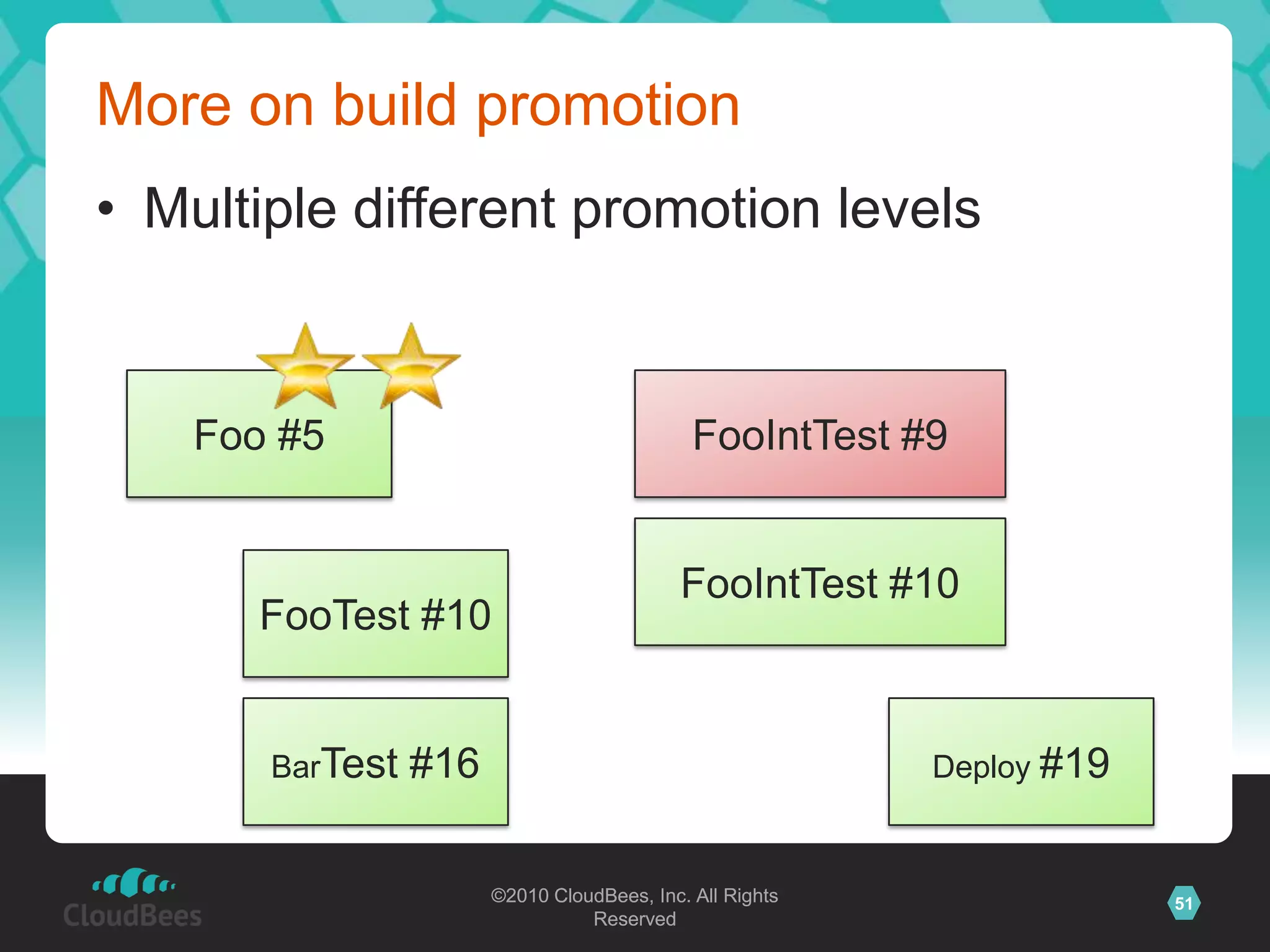
More on build promotionMultiple different promotion levelsFoo #5FooIntTest #9FooIntTest #10FooTest #10BarTest #16Deploy #19
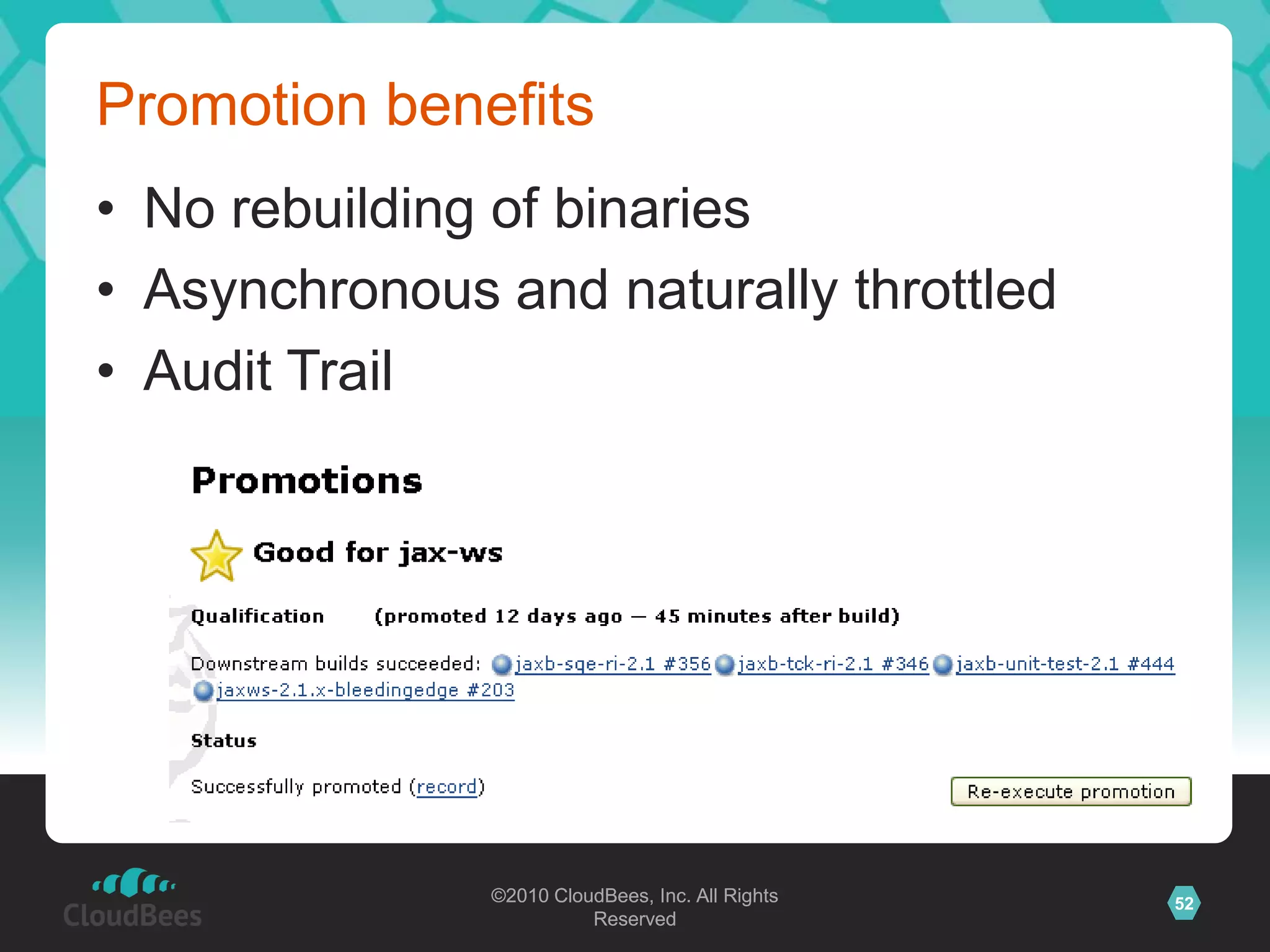
Promotion benefitsNo rebuilding of binariesAsynchronous and naturally throttledAudit Trail

Jenkins talk at Silicon valley DevOps meetup

  • 1.
  • 2.
    What’s Jenkins?©2010 CloudBees,Inc. All Rights Reserved
  • 3.
    What’s Jenkins?Jenkins isa “continuous integration” serverIt looks for changes and builds your projectIt publishes the resultIt keeps track of how your project is used elsewhereIt brings transparency to projects3
  • 4.
    What’s Jenkins?Community-driven open-sourceprojecthttp://jenkins-ci.org/Used to be called HudsonGet going with “java -jar jenkins.war”Extensible architectureLots of community developed pluginsPublic plugins as well as in-house pluginsVery active7 years old, ~400 releases to date300+ plugins, 250+ committers4
  • 5.
  • 6.
    What does Jenkinsdo?Notice changes and checking outPolling, post-commit hooksClearCase, Perforce, Git, Mercurial, …Runs builds and testsLots of build/reporting tools integrations6
  • 7.
    What does Jenkinsdo?Whatever you can script can be run in JenkinsIt needs to be non-interactiveVery flexible and can work with any build/test tools/frameworksBut it is not by itself a build/test framework7
  • 8.
    Non-Java SuportJenkins isused to build non-Java projectsRuby, Python, PHP, C++, .NET, …Rapidly expanding as many of those languages do not have viable CI serverVarious tool/report integrations done by community8
  • 9.
    Demo©2010 CloudBees, Inc.All Rights Reserved
  • 10.
    Why do Icare?Life before JenkinsRE nightly build breaks. It blocks SQEDev rebuilds before commit to avoid thisPeople waste timeLife after JenkinsDev just commits it right awayDev moves on to work on another thingJenkins will tell you in 5 mins if a build broke10
  • 11.
    Why do Icare?Life before JenkinsDev makes a change Monday AMSQE nightly finds a bug Monday nightDev fixes it TuesdayLot of wasted timeLife after JenkinsDev makes a change Monday AMJenkins finds a regression 30 mins laterDev can fix it before lunch11
  • 12.
    Why do Icare?Life before JenkinsSQE test runs every night, results sent out in e-mailAfter the enthusiasm of the 1st week is gone, nobody looks at them anymoreRegressions go unnoticed until it’s too lateLife after JenkinsTests run Jenkins after every commitE-mail sent out only when tests start failingSo it manages to keep people’s attention12
  • 13.
    Got the idea?AutomationReduceturn-around timeMake things transparentRemove people from the loopSave people’s timePush jobs to servers, keep workstations idle for you13
  • 14.
    Advanced Integration Techniques©2010CloudBees, Inc. All Rights Reserved
  • 15.
  • 16.
    Why?You need touse multiple computers because…You need different environmentsYou need isolationYou have non-trivial work loadsThere’s only so much you can do with 1 computer
  • 17.
    Lots of computers= tediousPains grow as your build farm growsSoftware installation problemNode failure problemRemote maintenance problem…What does Jenkins do to help you with these?
  • 18.
    Installing new slavesForfirst 20 or so slaves, we did it manuallyInsert CD, click, type, click, type, click, …But that doesn’t scaleThen we automatedAvailable as “Jenkins PXE Plugin”
  • 19.
  • 20.
    ISO images ofOSYour corporate IT guy & his DHCP serverSlavesPower on, hit F12PC boots from network (PXE)
  • 21.
  • 22.
    ISO images ofOSYour corporate IT guy & his DHCP serverSlavesPower on, hit F12PC boots from network (PXE)Choose OS from menuInstalls non-interactively
  • 23.
    Automated System InstallationsSupportsOpenSolaris, Ubuntu, CentOS, FedoraTrivial with most LinuxCooperate with Windows, tooQuite useful outside Jenkins, tooNo more broken CD drivesNo more CD-Rs
  • 24.
    MasterServes HTTP requestsStoresall important infoSlaves170KB single jarAssumed to be unreliableScale to at least 100Distributed builds with Jenkins
  • 25.
    Building on slavesSlaveagent is a little Java programRuns locally on the machine that it controlsAccess files, fork processes, etc., on behalf of masterCommunication with masterNeeds a bi-di byte streamBut very flexible in how this gets set upNo shared file system, no network topology constraints, etc
  • 26.
    How master andslaves start talkingFor Unix slaves, via SSHOnly need SSHD on slavesWe even install Java for youWe just need a host name
  • 27.
    How master andslaves start talkingFor Windows, DCOMWe just need admin user name and passwordNo manual interventionWorks even from Unix masters
  • 28.
    How master andslaves start talkingVia Java Web StartWhen master cannot see slavesA separate socket connection is made
  • 29.
    Automating JNLP launchOncestarted, can be installed as Windows service
  • 30.
    Automating JNLP launchEmulatethe JNLP client headlessly$ java -jar slave.jar -jnlpUrl URL
  • 31.
    Automated Tool InstallationsJDKfrom http://java.sun.com/It automatically chooses the right bundle
  • 32.
    Automated Tool InstallationsAntand Maven from ApacheGeneral purpose implementationsGrab an archive from some URL and extractRun arbitrary shell scriptExtensible
  • 33.
    LabelsTags that groupslaves togetherName: alphaLabel: windows 32bitName: bravoLabel: linux 32bitName: bravoLabel: linux 64bit
  • 34.
    LabelsName: alphaLabel: windows32bitName: bravoLabel: linux 32bitThis job needs to run on “linux”Name: bravoLabel: linux 64bit
  • 35.
    LabelsName: alphaLabel: windows32bitName: bravoLabel: linux 32bitThis job needs to run on “linux && 32bit”Name: bravoLabel: linux 64bit
  • 36.
    More Label BenefitsLabelscan be anythingGeographic locationsAvailability of proprietary software installedBetter resource utilizationJenkins have maximum freedomResilient to node addition/removalTreat servers like livestocks, not like pets
  • 37.
    Making builds stickyWewant jobs to be mostly on the same slaveFaster check outConsistent resultsMinimizes disk consumptionBut do it softlyJenkins uses consistent hash to achieve thisMore schedule controls become possible:Use faster machines more frequentlySlowly ramp up newly installed slaves* http://en.wikipedia.org/wiki/Consistent_hashing
  • 38.
    Forecasting failuresJenkins monitorskey health metrics of slavesLow disk space, insufficient swapClock out of syncExtensibleSlaves put offline automaticallyCatch problems before it breaks builds36
  • 39.
    Clean up messafter buildsKill run-away processesDaemons, background processes left by your buildWorks on Windows, Linux, Mac, and Solaris
  • 40.
    Cloud supportSlaves cancome and goCurrent/future workload and queue are all monitored continuouslyWe can let Jenkins provision slaves on cloud on-the-fly
  • 41.
    Jenkins EC2 pluginAutomaticallyprovision slaves on EC2 on demandPick the right AMI depending on demandStart slave agentShut down unused instances* http://code.google.com/p/typica/
  • 42.
    Integration with VMWareSimilarmechanism exists with VMWareCreate a pool of virtual machines upfrontJenkins powers them up/down based on loadOptionally revert to snapshot at the endAchieves benefits similar to EC2 without going publicNectarFeature
  • 43.
  • 44.
    MotivationYou often dothe same thing with slight variationsCompile C++ code for different platformsTest with different browsersOr more generally, think of it asfor (x in [a,b,c]) { for (y in [d,e,f]) { …doSomethingWith(x,y,z,..); … }}
  • 45.
    ModelDefine axesOne axis≈ one for loopChoose from pre-defined types of AxisSlave axis: pick slaves by their names or their labelse.g., linux, solaris, and windowsGeneric axis: arbitrary values exposed as environment variables
  • 46.
    Matrix Project GimmicksFilteringOtherwisecombinations increase exponentiallyNot all combinations make senseUse boolean expression to trim down the sizeOr tell Jenkins to cut the workload to N%Jenkins will thin out the combinations by itself(label==“windows”).implies(browser==“iexplore”) &&(label==“mac”).implies(browser==“safari”)
  • 47.
  • 48.
  • 49.
    Progressive ExposureAKA BuildpipelineOnce built, bits go through progressively more expensive “certification”Think of tests, deployment to QA, staging, etc.Some builds fail in the middle, others go through
  • 50.
    Then it getsmore complexEach stage can be several parallel jobsNeeds to be retryableYou can’t afford to execute every pipeline until it fails
  • 51.
    Hence “build promotion”Configuration“Foogets promoted if FooTest passes”“When Foo gets promoted, do X, Y, and Z”Sequence of eventsFoo #N successfully completesFooTest #M executes on Foo #NFooTest #M successfully completesFoo #N gets promotedX, Y, and Z happens on Foo #N
  • 52.
    More on buildpromotionPromotion condition can be more complexIf FooTest, BarTest, and ZotTest all passesIf PHB manually approvesIf upstream project gets promotedExtensiblePromotion actions can be anythingCopy files, execute scripts, trigger jobs, …
  • 53.
    More on buildpromotionMultiple different promotion levelsFoo #5FooIntTest #9FooIntTest #10FooTest #10BarTest #16Deploy #19
  • 54.
    Promotion benefitsNo rebuildingof binariesAsynchronous and naturally throttledAudit Trail
  • 55.