Jean Watson developed her Theory of Caring in nursing to bring dignity and meaning back to the profession. She drew from her experiences and works in philosophy, psychology, and other disciplines. The key elements of her theory are the 10 Carative Factors that represent caring behaviors, developing Transpersonal Caring Relationships with patients, recognizing Caring Occasions during interactions, and using a Caring and Healing Model to promote well-being. Nurses apply the theory through establishing trust, meeting physical and emotional needs, and opening themselves to spiritual elements of care. The theory provides a holistic and humanistic approach but may be difficult to fully implement within modern healthcare systems.
INTRODUCTION
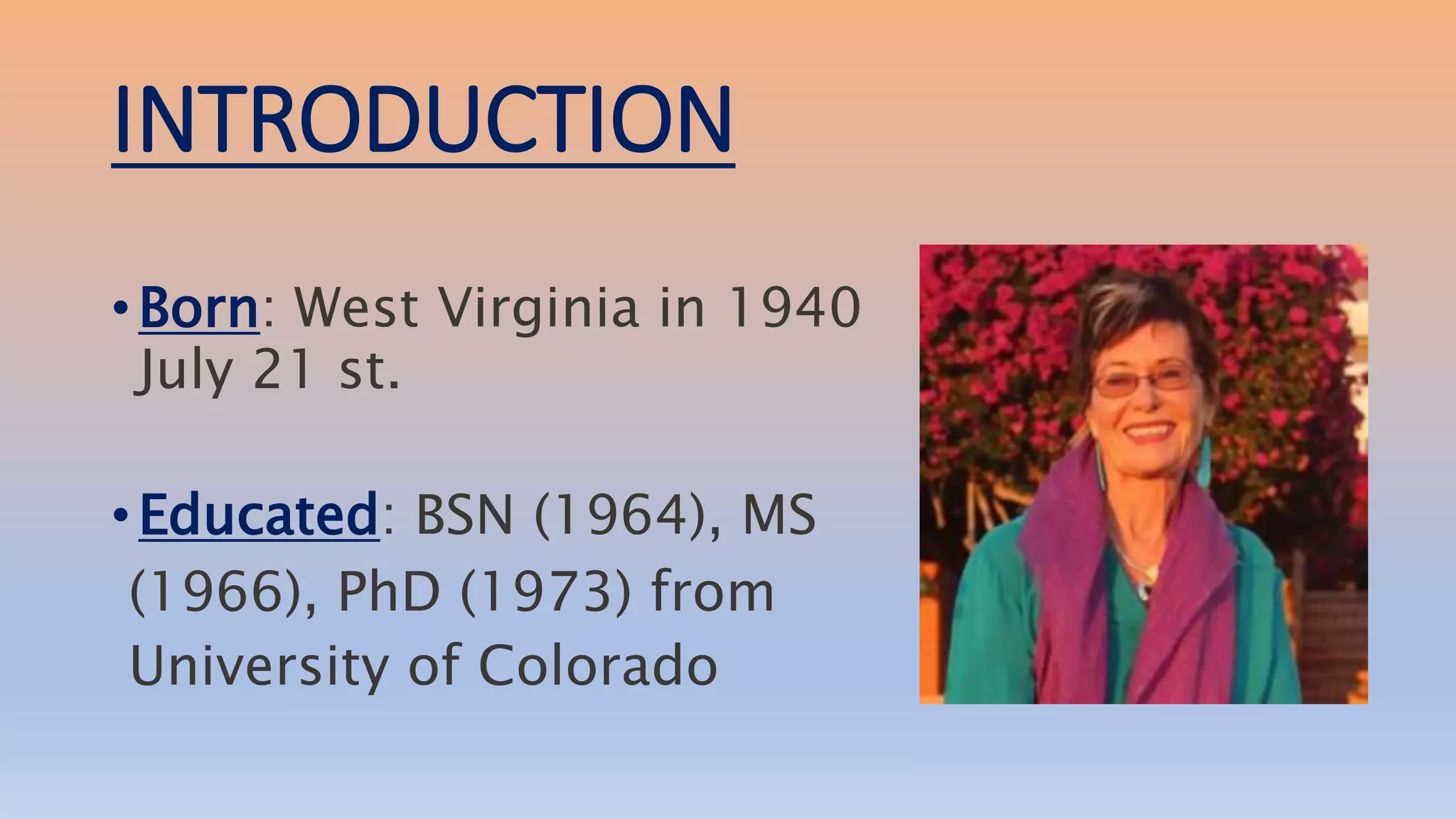
• Born: WestVirginia in 1940
July 21 st.
• Educated: BSN (1964), MS
(1966), PhD (1973) from
University of Colorado
4.
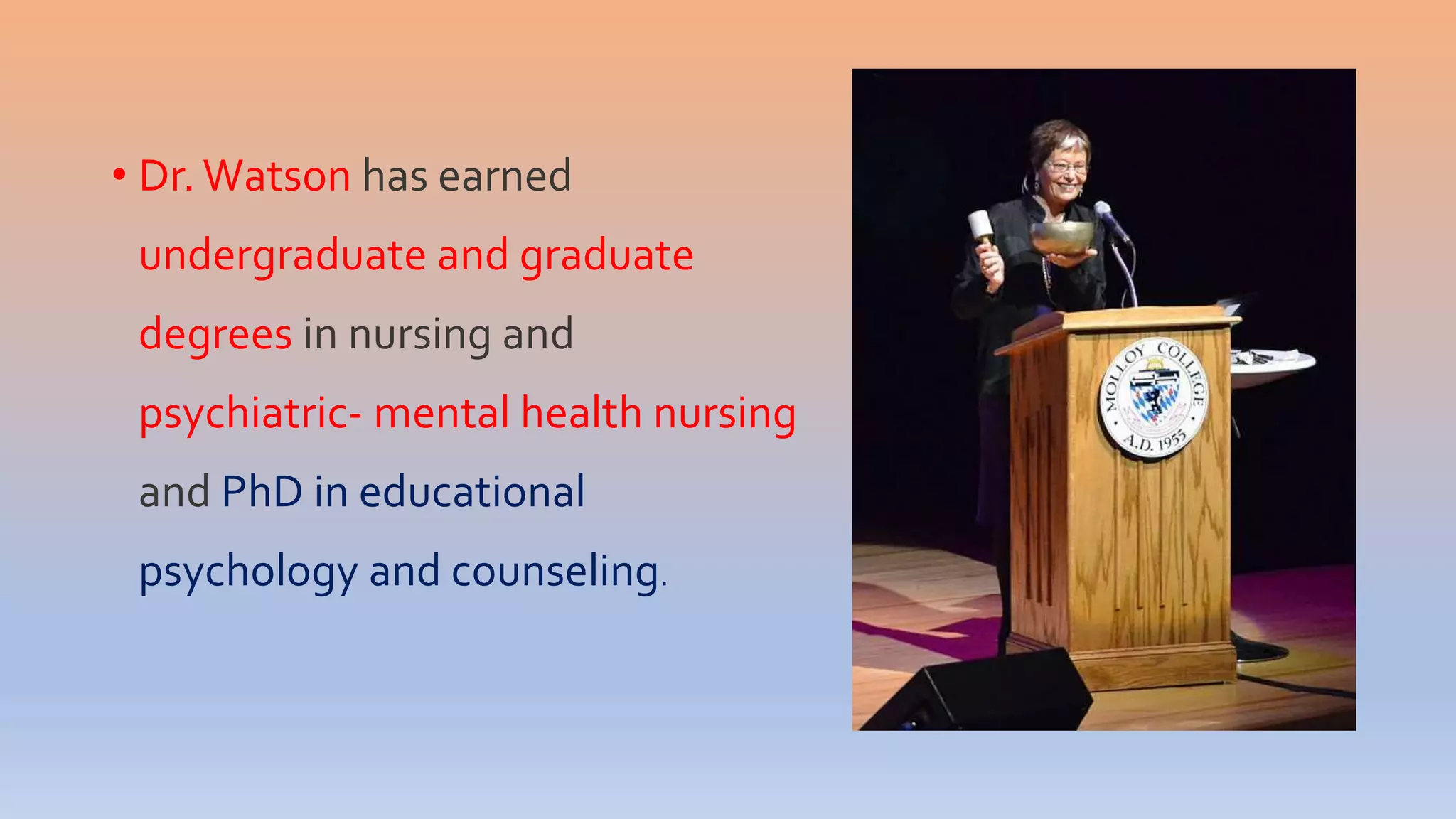
• Dr. Watsonhas earned
undergraduate and graduate
degrees in nursing and
psychiatric- mental health nursing
and PhD in educational
psychology and counseling.
5.
CREATING THE THEORY
(WHY)
Planwas to bring new meaning and dignity to
nursing
Used concepts from personal and professional
experience
Inducted, grounded, and combined with philosophy,
ethical, intellectual, and experimental background.
6.
CREATING THE THEORY(HOW)
• “Dr. Watson drew parts of her theory
from nursing writers like Florence
Nightingale as well as from works of
psychologists and philosophers.”
• “Her theory is one based on the human
interactive process that recognizes the
spiritual and ethical dimensions relevant
to the human care process.”
7.
BASIC ASSUMPTIONS OFTHE
THEORY
Watson proposes even assumption of about the science of
caring these are:
Caring can be effectively demonstrated and practiced only
interpersonally.
Caring consists of curative factors that results in the satisfaction
of certain human needs.
Effective caring promotes health and individual or family growth.
Caring responses accept person not only as he or she is now but
as what he or she may become.
8.
A caring environmentis one that offers the development of
potential while allowing the person to chose the best action
for himself at a given point in time.
Caring is more “health-ogenic” than is curing. A science of
caring is complementary to the science if curing.
The practice of caring is central to nursing.
9.
MAJOR CONCEPTUAL
ELEMENTS
• Theten carative factors (Greek word “caritas”
means to cherish & appreciate, giving special
attention to, loving factors)
• Transpersonal caring relationship
• Caring occasion
• Caring and healing model of theory
(i) 10 CARATIVEFACTORS
1 .Formation of a humanistic–altruistic system of values
2. Instillation of faith–hope
3. Cultivation of sensitivity to one’s self and to others
4. Development of a helping–trusting, human caring relationship
5.Promotion and acceptance of the expression of positive and
negative feelings
12.
6. Systematic useof a creative problem solving caring process
7. Promotion of transpersonal teaching– learning
8. Provision for a supportive, protective, and/or corrective
mental, physical, societal, & spiritual environment
9. Assistance with gratification of human needs
10. Allowance for existential–phenomenological–spiritual forces
13.
(ii)THE TRANSPERSONAL CARING
RELATIONSHIP
•This portion of the theory focuses on “the one caring and the
one cared for.” The nurse and patient can develop a deep divine
relationship that blends together and promotes overall health
and well- being.
• This process requires the use of “Actions, words, behaviours,
cognition, body language, feelings, intuition, thought, senses,
and the energy field”
14.
• The nursehas a professional as well as a personal obligation to not only see
the patient as more than an object but to also protect and assist with improving
the patient’s dignity.
• The nurse and the patient are transformed together in this relationship
•The nurse should be using her professional experience to promote healing and
bonding with the patient.This may include the use of various communication
techniques, both verbal and non-verbal to achieve a healing and gentle
relationship.
15.
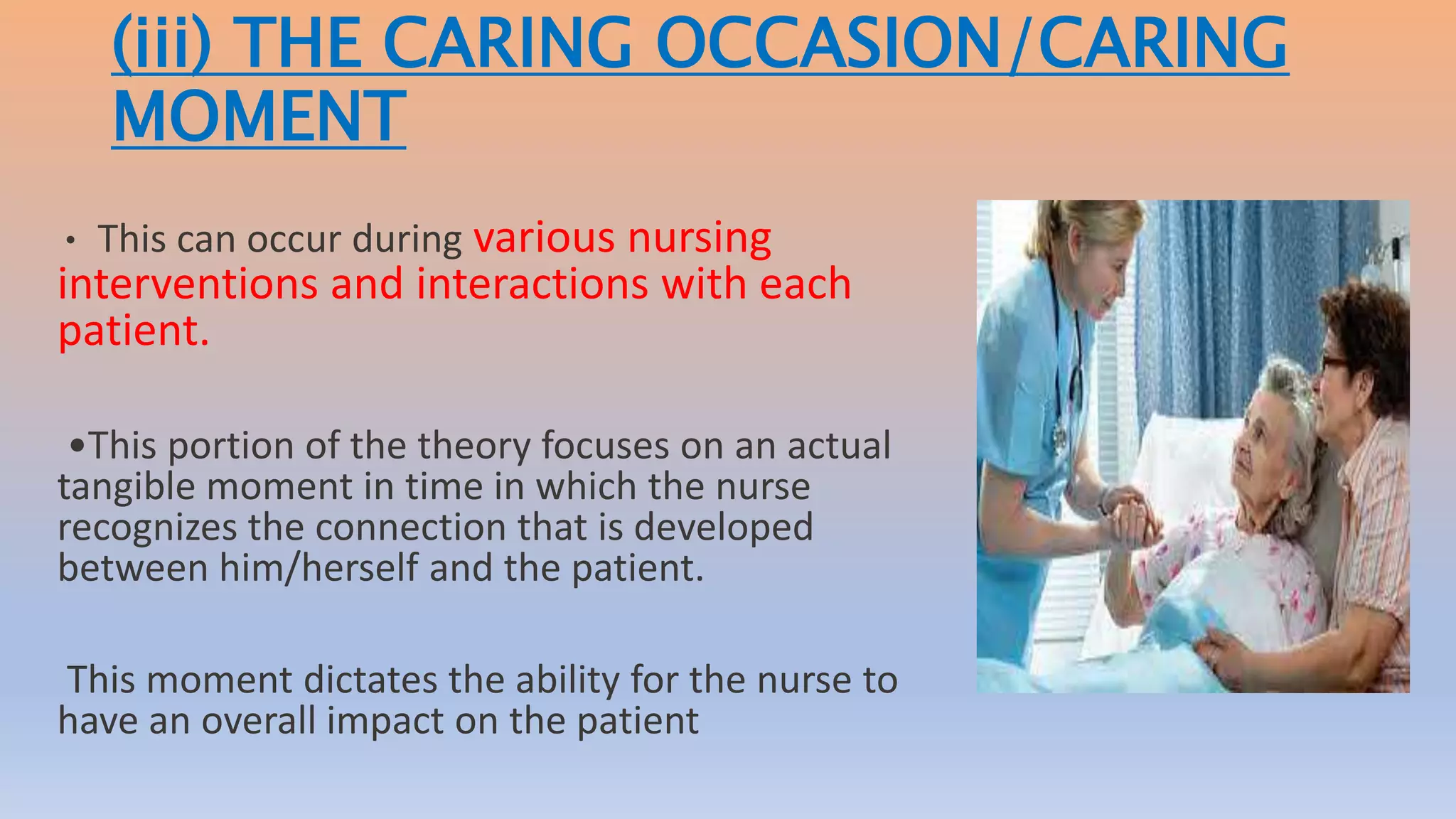
(iii) THE CARINGOCCASION/CARING
MOMENT
• This can occur during various nursing
interventions and interactions with each
patient.
•This portion of the theory focuses on an actual
tangible moment in time in which the nurse
recognizes the connection that is developed
between him/herself and the patient.
This moment dictates the ability for the nurse to
have an overall impact on the patient
16.
• According toCara, The Caring Moment
“Consists of feelings, bodily sensations,
thoughts, spiritual beliefs, goals,
expectations, environmental
considerations, and meanings of one’s
perceptions—all of which are based upon
one’s past life history, one’s present
moment, and one’s imagined future.
17.
(iv) CARING &HEALING MODEL OF THEORY
• The nurse is able to help the patient with overall well-
being by assisting them with the release of
“disharmony and blocked energy”
• The use of this portion of the theory helps the patient
with overall healing and renewal.
• Nurses can impact the patient through “health
promotion, health restoration, and illness prevention”
18.
WATSON’S THEORY ANDTHE FOUR MAJOR
CONCEPTS
PERSON HEALTH
ENVIRON
MENT /
SOCIETY NURSING
FOUR MAJOR
CONCEPTS
19.
(a) person
• Sheadopts a view of the human being as: “….. a valued
person in and of him or herself to be cared for,
respected, nurtured, understood and assisted
• in general a philosophical view of a person as a fully
functional integrated self.
• the, human is viewed as greater than and different
from, the sum of his or her parts”.
20.
(b) health
• Watsonbelieves that there are other factors that are needed to be
included in the WHO definition of health.
She adds the following three elements:
• A high level of overall physical, mental and social functioning
• A general adaptive-maintenance level of daily functioning
• The absence of illness (or the presence of efforts that leads its
absence)
21.
(c) Environment orsociety
• According to Watson caring (and nursing) has
existed in every society.
• A caring attitude is not transmitted from
generation to generation.
• It is transmitted by the culture of the
profession as a unique way of coping with its
environment
22.
(d) nursing
1.According toWatson “nursing is concerned with promoting health,
preventing illness, caring for the sick and restoring health”.
1. It focuses on health promotion and treatment of disease. She believes that holistic
health care is central to the practice of caring in nursing.
She defines nursing as….. “A human science of persons and human health-illness
experiences that are mediated by professional, personal, scientific, aesthetic and ethical
human transactions”.
“May be this one moment, with this one person, is the very reason we’re here on Earth
at this time”s
23.
WATSON’S THEORY ANDNURSING PROCESS
Assessment plan
intervention evaluation
Nursing
process
24.
(a) assessment
• Involvesobservation, identification and
review of the problem; use of applicable
knowledge in literature.
• Also includes conceptual knowledge for the
formulation and conceptualization of
framework.
• Includes the formulation of hypothesis;
defining variables that will be examined in
solving the problem.
25.
(b) plan
• Ithelps to determine how variables would be
examined or measured; includes a
conceptual approach or design for problem
solving.
• It determines what data would be collected
and how on whom.
26.
(c) intervention
•It isthe direct action and
implementation of the
plan.
• It includes the collection of
the data.
27.
(d) evaluation
Analysis ofthe data as well as the examination of
the effects of interventions based on the data.
Includes the interpretation of the results, the degree
to which positive outcome has occurred and whether
the result can be generalized.
It may also generate additional hypothesis or may
even lead to the generation of a nursing theory.
28.
HOW NURSES RELATETO THE THEORY
• Embrace altruistic values and Practice loving kindness
with self and others.
• Instill faith and hope and honor others.
• Be sensitive to self and others by nurturing individual
beliefs and practices.
• Develop helping – trusting- caring relationships
• Promote and accept positive and negative feelings as
you authentically listen to another’s story
29.
• Use creativescientific problem-solving methods for
caring decision making.
• Share teaching and learning that addresses the
individual needs and comprehension styles.
•Create a healing environment for the physical and
spiritual self which respects human dignity.
•Assist with basic physical, emotional, and spiritual
human needs.
•Open to mystery and Allow miracles to enter.
30.
STRENGTHS
• Besides assistingin providing the quality of
care that client ought to receive, it also
provides the soul satisfying care for which
many nurses enter the profession.
•The client is placed in the context of the
family, the community and the culture.
• It places the client as the focus of practice
rather than the technology.
31.
LIMITATIONS
• Given theacuity of illness that leads to hospitalization, the
short length stay, and the increasing complex technology,
such quality of care may be deemed impossible to give in
the hospital.
• While Watson acknowledges the need for biophysical base
to nursing, this area receives little attention in her writings.
• The 10 carative factors primarily delineate the psychosocial
needs of the person.
• While the carative factors have a sound foundation based
on other disciplines , they need further research in nursing to
demonstrate their application to practice.
32.
CONCLUSION
• Watson providesmany usefull concepts for the practice
of nursing.
• She ties together many theories commonly used in
nursing education and does so in a manner to help
practitioner.
• The detailed discriptions of the carative factors can give
guidance to those who wish to employ them in practice
or research .
• Using her theory can add dimensions to practice that is
both satisfying and challenging .

















![Understanding Parkinson’s Disease: Causes, Symptoms, and Treatment [2025]](https://cdn.slidesharecdn.com/ss_thumbnails/understandingparkinson-251208102525-80ba3223-thumbnail.jpg?width=640&height=640&fit=bounds)


