PHILOSOPHIES
OBJECTIVES
1. Identify the proponents of the different theories
2. Determine the assumptions made by the theorist
3. Discuss the theory as applied to the nursing paradigms
4.
Discuss the importance of the nursing theory with emphasis on
nursing practice
5. Appreciate the importance/ relevance of the different theories
After this presentation, students might understand the following:
LET’S RECALL!!
1. Theory
2. Nursing Theory
3. Phylosophy
4. Conceptual Framework/ model
5. Metaparadigm
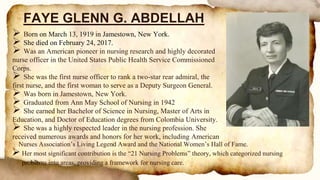
FAYE GLENN G. ABDELLAH
 Born on March 13, 1919 in Jamestown, New York.
 She died on February 24, 2017.
 Was an American pioneer in nursing research and highly decorated
nurse officer in the United States Public Health Service Commissioned
Corps.
 She was the first nurse officer to rank a two-star rear admiral, the
first nurse, and the first woman to serve as a Deputy Surgeon General.
 Was born in Jamestown, New York.
 Graduated from Ann May School of Nursing in 1942
 She earned her Bachelor of Science in Nursing, Master of Arts in
Education, and Doctor of Education degrees from Colombia University.
 She was a highly respected leader in the nursing profession. She
received numerous awards and honors for her work, including American
Nurses Association’s Living Legend Award and the National Women’s Hall of Fame.
Her most significant contribution is the “21 Nursing Problems” theory, which categorized nursing
problems into areas, providing a framework for nursing care.
“Nursing is based on an art and science
that molds the attitudes, intellectual
competencies, and technical skills of the
individual nurse into the desire and
ability to help people, sick or well, cope
with their health needs.”
~Adellah
 This model is characterized by overlapping
concepts of health and nursing as well as
problem solving which, in principle, are
activities with inherent logic.
 The model identifies nursing as a helping
profession.
21 NURSING
PROBLEMS
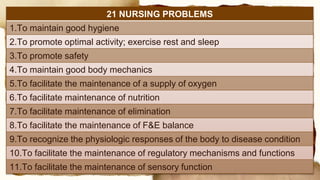
21 NURSING PROBLEMS
1.To maintain good hygiene
2.To promote optimal activity; exercise rest and sleep
3.To promote safety
4.To maintain good body mechanics
5.To facilitate the maintenance of a supply of oxygen
6.To facilitate maintenance of nutrition
7.To facilitate maintenance of elimination
8.To facilitate the maintenance of F&E balance
9.To recognize the physiologic responses of the body to disease condition
10.To facilitate the maintenance of regulatory mechanisms and functions
11.To facilitate the maintenance of sensory function
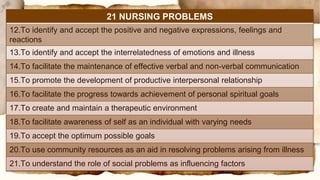
21 NURSING PROBLEMS
12.To identify and accept the positive and negative expressions, feelings and
reactions
13.To identify and accept the interrelatedness of emotions and illness
14.To facilitate the maintenance of effective verbal and non-verbal communication
15.To promote the development of productive interpersonal relationship
16.To facilitate the progress towards achievement of personal spiritual goals
17.To create and maintain a therapeutic environment
18.To facilitate awareness of self as an individual with varying needs
19.To accept the optimum possible goals
20.To use community resources as an aid in resolving problems arising from illness
21.To understand the role of social problems as influencing factors
THREE (3) CATEGORIES OF 21 NURSING
PROBLEMS
1. Physical, sociological, and Emotional needs of
patient.
2. Types of interpersonal relationships between
the patient and nurse; and
3. Common elements of patient care
FOUR (4) CATEGORIES OF NEED OF A
PATIENT
1. Basic to all patients
2. Sustenal care needs
3. Remedial care needs; and
4. Restorative care needs.
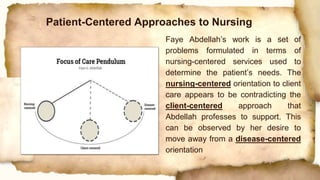
Patient-Centered Approaches to Nursing
Faye Abdellah’s work is a set of
problems formulated in terms of
nursing-centered services used to
determine the patient’s needs. The
nursing-centered orientation to client
care appears to be contradicting the
client-centered approach that
Abdellah professes to support. This
can be observed by her desire to
move away from a disease-centered
orientation
Continue to observe and evaluate the
patient over a period of time to identify any
attitudes and clues affecting this behavior.
Make generalizations about available data
concerning similar nursing problems
presented by other patients.
RELVANCE OF 21 NURSING PROBLEMS
01. 02.
03. 04.
Identify the therapeutic plan. Validate the patient’s conclusions about his
nursing problems.
RELVANCE OF 21 NURSING PROBLEMS
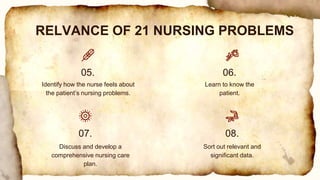
Identify how the nurse feels about
the patient’s nursing problems.
07.
05.
Discuss and develop a
comprehensive nursing care
plan.
Learn to know the
patient.
Sort out relevant and
significant data.
06.
08.
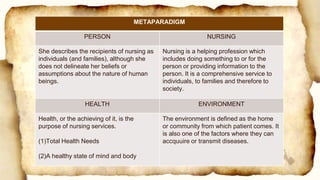
METAPARADIGM
PERSON NURSING
She describes the recipients of nursing as
individuals (and families), although she
does not delineate her beliefs or
assumptions about the nature of human
beings.
Nursing is a helping profession which
includes doing something to or for the
person or providing information to the
person. It is a comprehensive service to
individuals, to families and therefore to
society.
HEALTH ENVIRONMENT
Health, or the achieving of it, is the
purpose of nursing services.
(1)Total Health Needs
(2)A healthy state of mind and body
The environment is defined as the home
or community from which patient comes. It
is also one of the factors where they can
accquuire or transmit diseases.
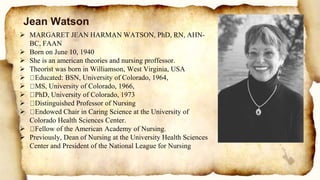
Jean Watson
 MARGARET JEAN HARMAN WATSON, PhD, RN, AHN-
BC, FAAN
 Born on June 10, 1940
 She is an american theories and nursing proffessor.
 Theorist was born in Williamson, West Virginia, USA
 Educated: BSN, University of Colorado, 1964,
 MS, University of Colorado, 1966,
 PhD, University of Colorado, 1973
 Distinguished Professor of Nursing
 Endowed Chair in Caring Science at the University of
Colorado Health Sciences Center.
 Fellow of the American Academy of Nursing.
 Previously, Dean of Nursing at the University Health Sciences
Center and President of the National League for Nursing
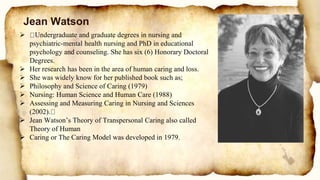
Jean Watson
 Undergraduate and graduate degrees in nursing and
psychiatric-mental health nursing and PhD in educational
psychology and counseling. She has six (6) Honorary Doctoral
Degrees.
 Her research has been in the area of human caring and loss.
 She was widely know for her published book such as;
 Philosophy and Science of Caring (1979)
 Nursing: Human Science and Human Care (1988)
 Assessing and Measuring Caring in Nursing and Sciences
(2002).
 Jean Watson’s Theory of Transpersonal Caring also called
Theory of Human
 Caring or The Caring Model was developed in 1979.
“Too often, we underestimate the power
of touch, a smile, a kind words, a
listening ears, an honest compliment, or
the smallest act of caring, all of which
have the potential to turn a life around.”
~Watson
THEORY OF TRANSPERSONAL CARING
01
Theory of Human
Caring
The Seven
Assumptions
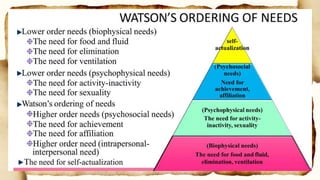
Watson’s Ordering of
Needs
Metaparadigm Relevance of Theory
of Transpersonal Care
02 03
04 05
TRANSPERSONAL?
CARE/CARING?
TRANSPERSONAL
CARING
 It emphasizes the humanistic aspects of nursing in
combination with scientific knowledge
 Watson designed this theory to bring meaning and focus to
nursing as a distinct health profession
 Watson believes that: “Caring” is an endorsement of
professional nurses identity
Theory of Human Caring or The Caring Model
 According to Watson, the nurse’s role is to:
-Establish a caring relationship with patients
-Treat patients as holistic beings (body, mind and spirit)
-Display unconditional acceptance
-Treat patients with a positive regard
-Promote health through knowledge and intervention
-Spend uninterrupted time with patients: “caring moments”
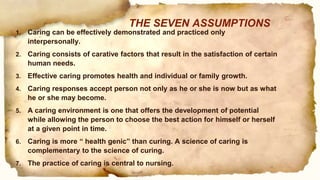
THE SEVEN ASSUMPTIONS
1. Caring can be effectively demonstrated and practiced only
interpersonally.
2. Caring consists of carative factors that result in the satisfaction of certain
human needs.
3. Effective caring promotes health and individual or family growth.
4. Caring responses accept person not only as he or she is now but as what
he or she may become.
5. A caring environment is one that offers the development of potential
while allowing the person to choose the best action for himself or herself
at a given point in time.
6. Caring is more “ health genic” than curing. A science of caring is
complementary to the science of curing.
7. The practice of caring is central to nursing.
Ten Primary Carative
Factors
 Carative- came from the Latin word “Caritas”
meaning “to cherish and appreciate, giving
special attention to, or loving.”
 the goal was to provide a framework for the “core of
nursing” which are the philosophy, science, and art
of caring
 Waston used carative as a replacement to curative.
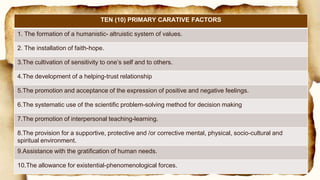
TEN (10) PRIMARY CARATIVE FACTORS
1. The formation of a humanistic- altruistic system of values.
2. The installation of faith-hope.
3.The cultivation of sensitivity to one’s self and to others.
4.The development of a helping-trust relationship
5.The promotion and acceptance of the expression of positive and negative feelings.
6.The systematic use of the scientific problem-solving method for decision making
7.The promotion of interpersonal teaching-learning.
8.The provision for a supportive, protective and /or corrective mental, physical, socio-cultural and
spiritual environment.
9.Assistance with the gratification of human needs.
10.The allowance for existential-phenomenological forces.
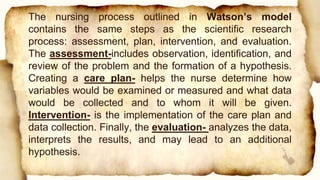
The nursing process outlined in Watson’s model
contains the same steps as the scientific research
process: assessment, plan, intervention, and evaluation.
The assessment-includes observation, identification, and
review of the problem and the formation of a hypothesis.
Creating a care plan- helps the nurse determine how
variables would be examined or measured and what data
would be collected and to whom it will be given.
Intervention- is the implementation of the care plan and
data collection. Finally, the evaluation- analyzes the data,
interprets the results, and may lead to an additional
hypothesis.
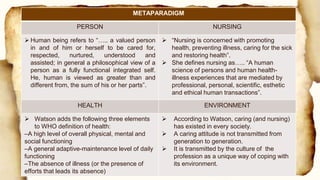
METAPARADIGM
PERSON NURSING
 Human being refers to “….. a valued person
in and of him or herself to be cared for,
respected, nurtured, understood and
assisted; in general a philosophical view of a
person as a fully functional integrated self.
He, human is viewed as greater than and
different from, the sum of his or her parts”.
 “Nursing is concerned with promoting
health, preventing illness, caring for the sick
and restoring health”.
 She defines nursing as….. “A human
science of persons and human health-
illness experiences that are mediated by
professional, personal, scientific, esthetic
and ethical human transactions”.
HEALTH ENVIRONMENT
 Watson adds the following three elements
to WHO definition of health:
–A high level of overall physical, mental and
social functioning
–A general adaptive-maintenance level of daily
functioning
–The absence of illness (or the presence of
efforts that leads its absence)
 According to Watson, caring (and nursing)
has existed in every society.
 A caring attitude is not transmitted from
generation to generation.
 It is transmitted by the culture of the
profession as a unique way of coping with
its environment.
RELVANCE OF 21 NURSING PROBLEMS
building genuine connections with
patients
05.
Help the person achieve
body, mind and soul
harmony
06.
emphasizes that caring is a transpersonal
concept that goes beyond the individual
the theory of human caring represents a
paradigm shift in healthcare that places the
experience of caring at the heart of the
nursing practice.
RELVANCE OF 21 THEORY OF
TRANSPERSONAL CARE
01. 02.
03.
04.
as its core, the theory of human caring for
others- it’s also about caring yourself.
model of caring science helps us to
advance our practice and fulfill our mission
Thank You
for Listening!

Group2-philosophies-Abdella-and-Watson-1.pptx

  • 1.
  • 2.
    OBJECTIVES 1. Identify theproponents of the different theories 2. Determine the assumptions made by the theorist 3. Discuss the theory as applied to the nursing paradigms 4. Discuss the importance of the nursing theory with emphasis on nursing practice 5. Appreciate the importance/ relevance of the different theories After this presentation, students might understand the following:
  • 3.
    LET’S RECALL!! 1. Theory 2.Nursing Theory 3. Phylosophy 4. Conceptual Framework/ model 5. Metaparadigm
  • 4.
    FAYE GLENN G.ABDELLAH  Born on March 13, 1919 in Jamestown, New York.  She died on February 24, 2017.  Was an American pioneer in nursing research and highly decorated nurse officer in the United States Public Health Service Commissioned Corps.  She was the first nurse officer to rank a two-star rear admiral, the first nurse, and the first woman to serve as a Deputy Surgeon General.  Was born in Jamestown, New York.  Graduated from Ann May School of Nursing in 1942  She earned her Bachelor of Science in Nursing, Master of Arts in Education, and Doctor of Education degrees from Colombia University.  She was a highly respected leader in the nursing profession. She received numerous awards and honors for her work, including American Nurses Association’s Living Legend Award and the National Women’s Hall of Fame. Her most significant contribution is the “21 Nursing Problems” theory, which categorized nursing problems into areas, providing a framework for nursing care.
  • 5.
    “Nursing is basedon an art and science that molds the attitudes, intellectual competencies, and technical skills of the individual nurse into the desire and ability to help people, sick or well, cope with their health needs.” ~Adellah
  • 6.
     This modelis characterized by overlapping concepts of health and nursing as well as problem solving which, in principle, are activities with inherent logic.  The model identifies nursing as a helping profession. 21 NURSING PROBLEMS
  • 7.
    21 NURSING PROBLEMS 1.Tomaintain good hygiene 2.To promote optimal activity; exercise rest and sleep 3.To promote safety 4.To maintain good body mechanics 5.To facilitate the maintenance of a supply of oxygen 6.To facilitate maintenance of nutrition 7.To facilitate maintenance of elimination 8.To facilitate the maintenance of F&E balance 9.To recognize the physiologic responses of the body to disease condition 10.To facilitate the maintenance of regulatory mechanisms and functions 11.To facilitate the maintenance of sensory function
  • 8.
    21 NURSING PROBLEMS 12.Toidentify and accept the positive and negative expressions, feelings and reactions 13.To identify and accept the interrelatedness of emotions and illness 14.To facilitate the maintenance of effective verbal and non-verbal communication 15.To promote the development of productive interpersonal relationship 16.To facilitate the progress towards achievement of personal spiritual goals 17.To create and maintain a therapeutic environment 18.To facilitate awareness of self as an individual with varying needs 19.To accept the optimum possible goals 20.To use community resources as an aid in resolving problems arising from illness 21.To understand the role of social problems as influencing factors
  • 9.
    THREE (3) CATEGORIESOF 21 NURSING PROBLEMS 1. Physical, sociological, and Emotional needs of patient. 2. Types of interpersonal relationships between the patient and nurse; and 3. Common elements of patient care
  • 10.
    FOUR (4) CATEGORIESOF NEED OF A PATIENT 1. Basic to all patients 2. Sustenal care needs 3. Remedial care needs; and 4. Restorative care needs.
  • 11.
    Patient-Centered Approaches toNursing Faye Abdellah’s work is a set of problems formulated in terms of nursing-centered services used to determine the patient’s needs. The nursing-centered orientation to client care appears to be contradicting the client-centered approach that Abdellah professes to support. This can be observed by her desire to move away from a disease-centered orientation
  • 12.
    Continue to observeand evaluate the patient over a period of time to identify any attitudes and clues affecting this behavior. Make generalizations about available data concerning similar nursing problems presented by other patients. RELVANCE OF 21 NURSING PROBLEMS 01. 02. 03. 04. Identify the therapeutic plan. Validate the patient’s conclusions about his nursing problems.
  • 13.
    RELVANCE OF 21NURSING PROBLEMS Identify how the nurse feels about the patient’s nursing problems. 07. 05. Discuss and develop a comprehensive nursing care plan. Learn to know the patient. Sort out relevant and significant data. 06. 08.
  • 14.
    METAPARADIGM PERSON NURSING She describesthe recipients of nursing as individuals (and families), although she does not delineate her beliefs or assumptions about the nature of human beings. Nursing is a helping profession which includes doing something to or for the person or providing information to the person. It is a comprehensive service to individuals, to families and therefore to society. HEALTH ENVIRONMENT Health, or the achieving of it, is the purpose of nursing services. (1)Total Health Needs (2)A healthy state of mind and body The environment is defined as the home or community from which patient comes. It is also one of the factors where they can accquuire or transmit diseases.
  • 15.
    Jean Watson  MARGARETJEAN HARMAN WATSON, PhD, RN, AHN- BC, FAAN  Born on June 10, 1940  She is an american theories and nursing proffessor.  Theorist was born in Williamson, West Virginia, USA  Educated: BSN, University of Colorado, 1964,  MS, University of Colorado, 1966,  PhD, University of Colorado, 1973  Distinguished Professor of Nursing  Endowed Chair in Caring Science at the University of Colorado Health Sciences Center.  Fellow of the American Academy of Nursing.  Previously, Dean of Nursing at the University Health Sciences Center and President of the National League for Nursing
  • 16.
    Jean Watson  Undergraduateand graduate degrees in nursing and psychiatric-mental health nursing and PhD in educational psychology and counseling. She has six (6) Honorary Doctoral Degrees.  Her research has been in the area of human caring and loss.  She was widely know for her published book such as;  Philosophy and Science of Caring (1979)  Nursing: Human Science and Human Care (1988)  Assessing and Measuring Caring in Nursing and Sciences (2002).  Jean Watson’s Theory of Transpersonal Caring also called Theory of Human  Caring or The Caring Model was developed in 1979.
  • 17.
    “Too often, weunderestimate the power of touch, a smile, a kind words, a listening ears, an honest compliment, or the smallest act of caring, all of which have the potential to turn a life around.” ~Watson
  • 18.
    THEORY OF TRANSPERSONALCARING 01 Theory of Human Caring The Seven Assumptions Watson’s Ordering of Needs Metaparadigm Relevance of Theory of Transpersonal Care 02 03 04 05
  • 19.
  • 20.
  • 21.
  • 22.
     It emphasizesthe humanistic aspects of nursing in combination with scientific knowledge  Watson designed this theory to bring meaning and focus to nursing as a distinct health profession  Watson believes that: “Caring” is an endorsement of professional nurses identity Theory of Human Caring or The Caring Model
  • 23.
    Theory of HumanCaring or The Caring Model  According to Watson, the nurse’s role is to: -Establish a caring relationship with patients -Treat patients as holistic beings (body, mind and spirit) -Display unconditional acceptance -Treat patients with a positive regard -Promote health through knowledge and intervention -Spend uninterrupted time with patients: “caring moments”
  • 24.
    THE SEVEN ASSUMPTIONS 1.Caring can be effectively demonstrated and practiced only interpersonally. 2. Caring consists of carative factors that result in the satisfaction of certain human needs. 3. Effective caring promotes health and individual or family growth. 4. Caring responses accept person not only as he or she is now but as what he or she may become. 5. A caring environment is one that offers the development of potential while allowing the person to choose the best action for himself or herself at a given point in time. 6. Caring is more “ health genic” than curing. A science of caring is complementary to the science of curing. 7. The practice of caring is central to nursing.
  • 25.
    Ten Primary Carative Factors Carative- came from the Latin word “Caritas” meaning “to cherish and appreciate, giving special attention to, or loving.”  the goal was to provide a framework for the “core of nursing” which are the philosophy, science, and art of caring  Waston used carative as a replacement to curative.
  • 26.
    TEN (10) PRIMARYCARATIVE FACTORS 1. The formation of a humanistic- altruistic system of values. 2. The installation of faith-hope. 3.The cultivation of sensitivity to one’s self and to others. 4.The development of a helping-trust relationship 5.The promotion and acceptance of the expression of positive and negative feelings. 6.The systematic use of the scientific problem-solving method for decision making 7.The promotion of interpersonal teaching-learning. 8.The provision for a supportive, protective and /or corrective mental, physical, socio-cultural and spiritual environment. 9.Assistance with the gratification of human needs. 10.The allowance for existential-phenomenological forces.
  • 28.
    The nursing processoutlined in Watson’s model contains the same steps as the scientific research process: assessment, plan, intervention, and evaluation. The assessment-includes observation, identification, and review of the problem and the formation of a hypothesis. Creating a care plan- helps the nurse determine how variables would be examined or measured and what data would be collected and to whom it will be given. Intervention- is the implementation of the care plan and data collection. Finally, the evaluation- analyzes the data, interprets the results, and may lead to an additional hypothesis.
  • 29.
    METAPARADIGM PERSON NURSING  Humanbeing refers to “….. a valued person in and of him or herself to be cared for, respected, nurtured, understood and assisted; in general a philosophical view of a person as a fully functional integrated self. He, human is viewed as greater than and different from, the sum of his or her parts”.  “Nursing is concerned with promoting health, preventing illness, caring for the sick and restoring health”.  She defines nursing as….. “A human science of persons and human health- illness experiences that are mediated by professional, personal, scientific, esthetic and ethical human transactions”. HEALTH ENVIRONMENT  Watson adds the following three elements to WHO definition of health: –A high level of overall physical, mental and social functioning –A general adaptive-maintenance level of daily functioning –The absence of illness (or the presence of efforts that leads its absence)  According to Watson, caring (and nursing) has existed in every society.  A caring attitude is not transmitted from generation to generation.  It is transmitted by the culture of the profession as a unique way of coping with its environment.
  • 30.
    RELVANCE OF 21NURSING PROBLEMS building genuine connections with patients 05. Help the person achieve body, mind and soul harmony 06.
  • 31.
    emphasizes that caringis a transpersonal concept that goes beyond the individual the theory of human caring represents a paradigm shift in healthcare that places the experience of caring at the heart of the nursing practice. RELVANCE OF 21 THEORY OF TRANSPERSONAL CARE 01. 02. 03. 04. as its core, the theory of human caring for others- it’s also about caring yourself. model of caring science helps us to advance our practice and fulfill our mission
  • 32.