Jean Watson’s  Philosophy and Science of Caring Megan Andrews Julia Arnerich
Tonight we will discuss the. . .  History  Breakdown  Importance  Examples  Application Evaluation of the theory
Background Born in southern West Virginia in 1940 Attended the Lewis Gale School of Nursing in Roanoke, Virginia from which she graduated in 1961
Background In 1961, moved to Colorado with her husband, Douglas Earned her BSN in 1964 MSN in psychiatric-mental health nursing in 1966 Doctorate in educational psychology and counseling in 1973
Theory Overview The philosophy of caring and science examines the relatedness of ALL and includes, human science, human caring processes, experiences, and phenomena. Key Concept:  Caring is a moral ideal: mind-body-soul, engagement with another
Evolution of Theory The foundation for this theory was first published in 1979 The original theory included 10 Carative Factors
Carative Factors 1) Formation of a Humanistic-altruistic system of values 2) Instillation of faith-hope 3) Cultivation of sensitivity to one's self and to others 4) Development of a helping-trusting, human caring relationship
Carative Factors continued… 5) Promotion and acceptance of the expression of positive and negative feelings 6) Systematic use of a scientific problem-solving caring process 7) Promotion of transpersonal teaching-learning
Carative Factors continued… 8) Provision for a supportive, protective, and/or corrective mental, physical, societal, and spiritual environment 9) Assistance with gratification of human needs 10) Allowance for existential-phenomenological-spiritual forces
Clinical Caritas Process As the theory evolved ,the carative factors evolved into the caritas process Caritas means ‘to cherish’
Caritas Process continued . . .  Formation of humanistic-altruistic system of values, becomes: "Practice of loving-kindness and equanimity within context of caring consciousness Instillation of faith-hope, becomes: "Being authentically present, and enabling and sustaining the deep belief system and subjective life world of self and one-being-cared- for“ Cultivation of sensitivity to one's self and to others, becomes: "Cultivation of one's own spiritual practices and transpersonal self, going beyond ego self"
Caritas Process continued… Development of a helping-trusting, human caring relationship, becomes: "Developing and sustaining a helping-trusting, authentic caring relationship“ Promotion and acceptance of the expression of positive and negative feelings, becomes: "Being present to, and supportive of the expression of positive and negative feelings as a connection with deeper spirit of self and the one-being-cared-for" Systematic use of a creative problem-solving caring process, becomes: "creative use of self and all ways of knowing as part of the caring process; to engage in artistry of caring-healing practices"
Caritas Process continued . . .  Promotion of transpersonal teaching-learning, becomes: "Engaging in genuine teaching-learning experience that attends to unity of being and meaning attempting to stay within other's frame of reference“ Provision for a supportive, protective, and/or corrective mental, physical, societal, and spiritual environment, becomes: "Creating healing environment at all levels, (physical as well as non-physical, subtle environment of energy and consciousness, whereby wholeness, beauty, comfort, dignity, and peace are potentiated"
Caritas Process continued . . .  Assistance with gratification of human needs, becomes: "assisting with basic needs, with an intentional caring consciousness, administering ‘human care essentials', which potentiate alignment of mind-body-spirit, wholeness, and unity of being in all aspects of care“ Allowance for existential-phenomenological-spiritual forces, becomes: "opening and attending to spiritual-mysterious, and existential dimensions of one's own life-death; soul care for self and the one-being-cared-for
Assumptions This theory makes the following assumptions: 1) Caring can be effectively demonstrated and practice only interpersonally 2) Caring involves carative factors that result in the satisfaction of human needs 3) Effective caring promotes health and individual family growth
Assumptions continued… 4) Caring responses accept the person as they are now and as what they may become 5) A caring environment is one that offers the development of potential while allowing the person to choose the best action for his or herself at a given point in time. 6) Caring is more “healthogenic” than it is curing. 7) The practice of caring is central to nursing.
Internal Criticism Clarity: use of nontechnical yet sophisticated language Simplicity: theory draws on a variety of disciplines, more easily understood with a broad or liberal arts background
Internal Criticism Generality:  it encompasses all aspects of the health-illness continuum increasing its generality Accessibility: Difficulty to study empirically, though it does draw from other disciplines
Internal Criticism Scope: Grand Theory Level: Situation Relating
The Commonplaces Person :  a valued person to be cared  for, respected, nurtured and understood and assisted Health : overall physical, mental and social functioning, adaptability and the absence of illness
Commonplaces Environment : caring exists in all societies and is passed by the profession as a unique way of coping with the environment Nursing:  “ a human science of persons and human health-illness experiences that are mediated by professional, personal, scientific, esthetic, and ethical human transactions”
Importance to Nursing This theory is important to nursing due to the central concept of caring This theory is grounded in the discipline of nursing and nursing science but has evolved to include a variety of other disciplines increasing its relevance in a variety of fields
Circle of Contagiousness Currently this theory is being validated in many clinical settings Though many healthcare settings are trying to incorporate the concepts of this theory it is application is complicated by hospital acuity, length of stay and technology
Do we like this Theory The framework and key concepts are critical to compassionate nursing care, however the complexity, abstract qualities and lack of structure make this theory difficult to apply to a wide variety of healthcare settings
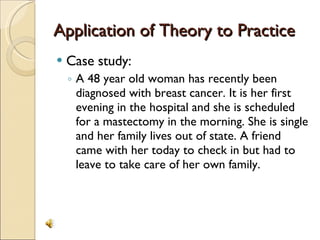
Application of Theory to Practice Case study: A 48 year old woman has recently been diagnosed with breast cancer. It is her first evening in the hospital and she is scheduled for a mastectomy in the morning. She is single and her family lives out of state. A friend came with her today to check in but had to leave to take care of her own family.
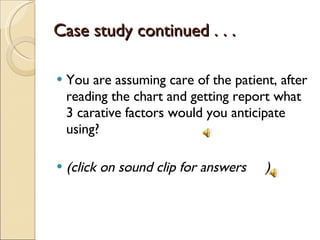
Case study continued . . . You are assuming care of the patient, after reading the chart and getting report what 3 carative factors would you anticipate using? (click on sound clip for answers  )
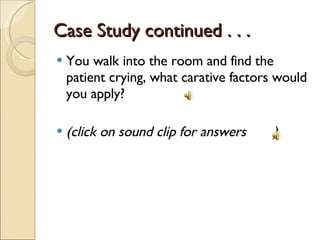
Case Study continued . . .  You walk into the room and find the patient crying, what carative factors would you apply? (click on sound clip for answers  )
Summary Key concept: Caring is a moral ideal: mind-body-soul, engagement with another There are 10 carative factors that evolved into the clinical caritas process Jean Watson believes that “the core of nursing is those nurse-patient relationships that result in a therapeutic outcome”
Web CT Question What is your overall opinion of this theory? Describe a situation in which you used or could use the caritas process in practice.
References Chinn, P.L. & Kramer, M.K. (2008).  Theory and nursing: Integrated knowledge development  (7 th  ed.). St. Louis, MO: Mosby. Tomey, A.M. & Alligood, M.R. (2006).  Nursing theorists and their work  (6 th  ed.). St. Louis, MO: Mosby. Current Nursing: http:// currentnursing.com/nursing_theory/Watson.htm
References University  of Colorado, Jean Watson http:// www.nursing.ucdenver.edu/faculty/caring.htm Nurses Info: http:// www.nurses.info/nursing_theory_person_watson_jean.htm

N212 Theory: Jean Watson Presentation

  • 1.
    Jean Watson’s Philosophy and Science of Caring Megan Andrews Julia Arnerich
  • 2.
    Tonight we willdiscuss the. . . History Breakdown Importance Examples Application Evaluation of the theory
  • 3.
    Background Born insouthern West Virginia in 1940 Attended the Lewis Gale School of Nursing in Roanoke, Virginia from which she graduated in 1961
  • 4.
    Background In 1961,moved to Colorado with her husband, Douglas Earned her BSN in 1964 MSN in psychiatric-mental health nursing in 1966 Doctorate in educational psychology and counseling in 1973
  • 5.
    Theory Overview Thephilosophy of caring and science examines the relatedness of ALL and includes, human science, human caring processes, experiences, and phenomena. Key Concept: Caring is a moral ideal: mind-body-soul, engagement with another
  • 6.
    Evolution of TheoryThe foundation for this theory was first published in 1979 The original theory included 10 Carative Factors
  • 7.
    Carative Factors 1)Formation of a Humanistic-altruistic system of values 2) Instillation of faith-hope 3) Cultivation of sensitivity to one's self and to others 4) Development of a helping-trusting, human caring relationship
  • 8.
    Carative Factors continued…5) Promotion and acceptance of the expression of positive and negative feelings 6) Systematic use of a scientific problem-solving caring process 7) Promotion of transpersonal teaching-learning
  • 9.
    Carative Factors continued…8) Provision for a supportive, protective, and/or corrective mental, physical, societal, and spiritual environment 9) Assistance with gratification of human needs 10) Allowance for existential-phenomenological-spiritual forces
  • 10.
    Clinical Caritas ProcessAs the theory evolved ,the carative factors evolved into the caritas process Caritas means ‘to cherish’
  • 11.
    Caritas Process continued. . . Formation of humanistic-altruistic system of values, becomes: "Practice of loving-kindness and equanimity within context of caring consciousness Instillation of faith-hope, becomes: "Being authentically present, and enabling and sustaining the deep belief system and subjective life world of self and one-being-cared- for“ Cultivation of sensitivity to one's self and to others, becomes: "Cultivation of one's own spiritual practices and transpersonal self, going beyond ego self"
  • 12.
    Caritas Process continued…Development of a helping-trusting, human caring relationship, becomes: "Developing and sustaining a helping-trusting, authentic caring relationship“ Promotion and acceptance of the expression of positive and negative feelings, becomes: "Being present to, and supportive of the expression of positive and negative feelings as a connection with deeper spirit of self and the one-being-cared-for" Systematic use of a creative problem-solving caring process, becomes: "creative use of self and all ways of knowing as part of the caring process; to engage in artistry of caring-healing practices"
  • 13.
    Caritas Process continued. . . Promotion of transpersonal teaching-learning, becomes: "Engaging in genuine teaching-learning experience that attends to unity of being and meaning attempting to stay within other's frame of reference“ Provision for a supportive, protective, and/or corrective mental, physical, societal, and spiritual environment, becomes: "Creating healing environment at all levels, (physical as well as non-physical, subtle environment of energy and consciousness, whereby wholeness, beauty, comfort, dignity, and peace are potentiated"
  • 14.
    Caritas Process continued. . . Assistance with gratification of human needs, becomes: "assisting with basic needs, with an intentional caring consciousness, administering ‘human care essentials', which potentiate alignment of mind-body-spirit, wholeness, and unity of being in all aspects of care“ Allowance for existential-phenomenological-spiritual forces, becomes: "opening and attending to spiritual-mysterious, and existential dimensions of one's own life-death; soul care for self and the one-being-cared-for
  • 15.
    Assumptions This theorymakes the following assumptions: 1) Caring can be effectively demonstrated and practice only interpersonally 2) Caring involves carative factors that result in the satisfaction of human needs 3) Effective caring promotes health and individual family growth
  • 16.
    Assumptions continued… 4)Caring responses accept the person as they are now and as what they may become 5) A caring environment is one that offers the development of potential while allowing the person to choose the best action for his or herself at a given point in time. 6) Caring is more “healthogenic” than it is curing. 7) The practice of caring is central to nursing.
  • 17.
    Internal Criticism Clarity:use of nontechnical yet sophisticated language Simplicity: theory draws on a variety of disciplines, more easily understood with a broad or liberal arts background
  • 18.
    Internal Criticism Generality: it encompasses all aspects of the health-illness continuum increasing its generality Accessibility: Difficulty to study empirically, though it does draw from other disciplines
  • 19.
    Internal Criticism Scope:Grand Theory Level: Situation Relating
  • 20.
    The Commonplaces Person: a valued person to be cared for, respected, nurtured and understood and assisted Health : overall physical, mental and social functioning, adaptability and the absence of illness
  • 21.
    Commonplaces Environment :caring exists in all societies and is passed by the profession as a unique way of coping with the environment Nursing: “ a human science of persons and human health-illness experiences that are mediated by professional, personal, scientific, esthetic, and ethical human transactions”
  • 22.
    Importance to NursingThis theory is important to nursing due to the central concept of caring This theory is grounded in the discipline of nursing and nursing science but has evolved to include a variety of other disciplines increasing its relevance in a variety of fields
  • 23.
    Circle of ContagiousnessCurrently this theory is being validated in many clinical settings Though many healthcare settings are trying to incorporate the concepts of this theory it is application is complicated by hospital acuity, length of stay and technology
  • 24.
    Do we likethis Theory The framework and key concepts are critical to compassionate nursing care, however the complexity, abstract qualities and lack of structure make this theory difficult to apply to a wide variety of healthcare settings
  • 25.
    Application of Theoryto Practice Case study: A 48 year old woman has recently been diagnosed with breast cancer. It is her first evening in the hospital and she is scheduled for a mastectomy in the morning. She is single and her family lives out of state. A friend came with her today to check in but had to leave to take care of her own family.
  • 26.
    Case study continued. . . You are assuming care of the patient, after reading the chart and getting report what 3 carative factors would you anticipate using? (click on sound clip for answers )
  • 27.
    Case Study continued. . . You walk into the room and find the patient crying, what carative factors would you apply? (click on sound clip for answers )
  • 28.
    Summary Key concept:Caring is a moral ideal: mind-body-soul, engagement with another There are 10 carative factors that evolved into the clinical caritas process Jean Watson believes that “the core of nursing is those nurse-patient relationships that result in a therapeutic outcome”
  • 29.
    Web CT QuestionWhat is your overall opinion of this theory? Describe a situation in which you used or could use the caritas process in practice.
  • 30.
    References Chinn, P.L.& Kramer, M.K. (2008). Theory and nursing: Integrated knowledge development (7 th ed.). St. Louis, MO: Mosby. Tomey, A.M. & Alligood, M.R. (2006). Nursing theorists and their work (6 th ed.). St. Louis, MO: Mosby. Current Nursing: http:// currentnursing.com/nursing_theory/Watson.htm
  • 31.
    References University of Colorado, Jean Watson http:// www.nursing.ucdenver.edu/faculty/caring.htm Nurses Info: http:// www.nurses.info/nursing_theory_person_watson_jean.htm